
Answers
So we want to find the surface area of this pyramid. Finding the surface area of a 3D shape is essentially finding the area of all its sides and adding them together.
What we're going to have to do here is find the area of the base of the pyramid, which is basically a square, and find the area of all four sides of the pyramid, which are triangles.
Formula for area of a square: length × width
Formula for area of a triangle: (base × height) ÷ 2
First we will find the area of the base:
l × w = A
(Write out formula)
8 × 8 =
(Input values)
A = 64 m^2 (square meters or meters squared)
(We have our answer, dont forgot to write your units.)
So we've figured out the area of the base. Now onto the triangles:
(b×h) ÷ 2 = A
(Write out formula)
(8 × 6) ÷ 2 =
(Input values)
48 ÷ 2 =
(Use PEMDAS to solve this correctly. We did whatever was in the parenthesis first, which was multiplication.)
A = 24m^2 (square meters or meters squared)
(We have our answer.)
Now we've found the area of the base of the pyramid and one of the sides of the pyramid, but we're almost done! There's four sides to the pyramid, they're all the same. So since we found the area for one, we can multiply that by 4 to find the area of all sides added together:
24 × 4
(area of a side × total sides)
= 96m^2
All that's left is adding the 96 to the area of the base to get our total surface area of the pyramid:
96 + 64 = 160
The surface area of the pyramid is 160m^2(square meters or meters squared)
(Hope this helps :) )
Answer:okkkkkkkk
Step-by-step explanation:360
Related Questions
Find the value of x and y. Need some help solving this one.

Answers
Answer: x is 45, y is 80
Step-by-step explanation:
subtract the angles surrounding x (70 - 25 = 45)
add 45 + 55 to get 100
the entire triangle has to equal 180 degrees, so subtract 100 from 180 to get the value of y
Best answer will be crowned the brainliest.
No cheating. May use calculator, pencil, paper, or pen, etc. but no looking up answers if you need hints I will give you hints.
Answers
Answer:
it won't lemme get to it
Step-by-step explanation:
Select the fraction that is equivalent to two thirds.
Question 9 options:
two twelfths
four twelfths
three sixths
eight twelfths
Answers
4) \( \frac{8}{12} = \frac{(8 \div 4)}{(12 \div 4)} = \frac{2}{3} \\ \)
is the right answer.
Answer:
Select the fraction that is equivalent to two thirds.
Question 9 options:
two twelfthsfour twelfthsthree sixthseight twelfths ✓Answer:
eight twelfths?
Step-by-step explanation: two twelfths is one sixths, four twelfths is one third, and three sixths is one half.
What is 200*80*90-200=?
Answers
Answer:
1 439 800
Step-by-step explanation:
200 x 80 x 90 - 200
= 16 000 x 90 - 200
= 1 440 000 - 200
= 1 439 800
Answer:
1439800
Step-by-step explanation:
200*80=16000
16000*90=1440000
144000-200=1439800
helpp mee with the answer pleasee! <3

Answers
Answer:
1. (-7,-3) and (-6,-4) is -1
2. (7,2) and (0,-5) is 1
3. (1,6) and (-3,0) is 1.5
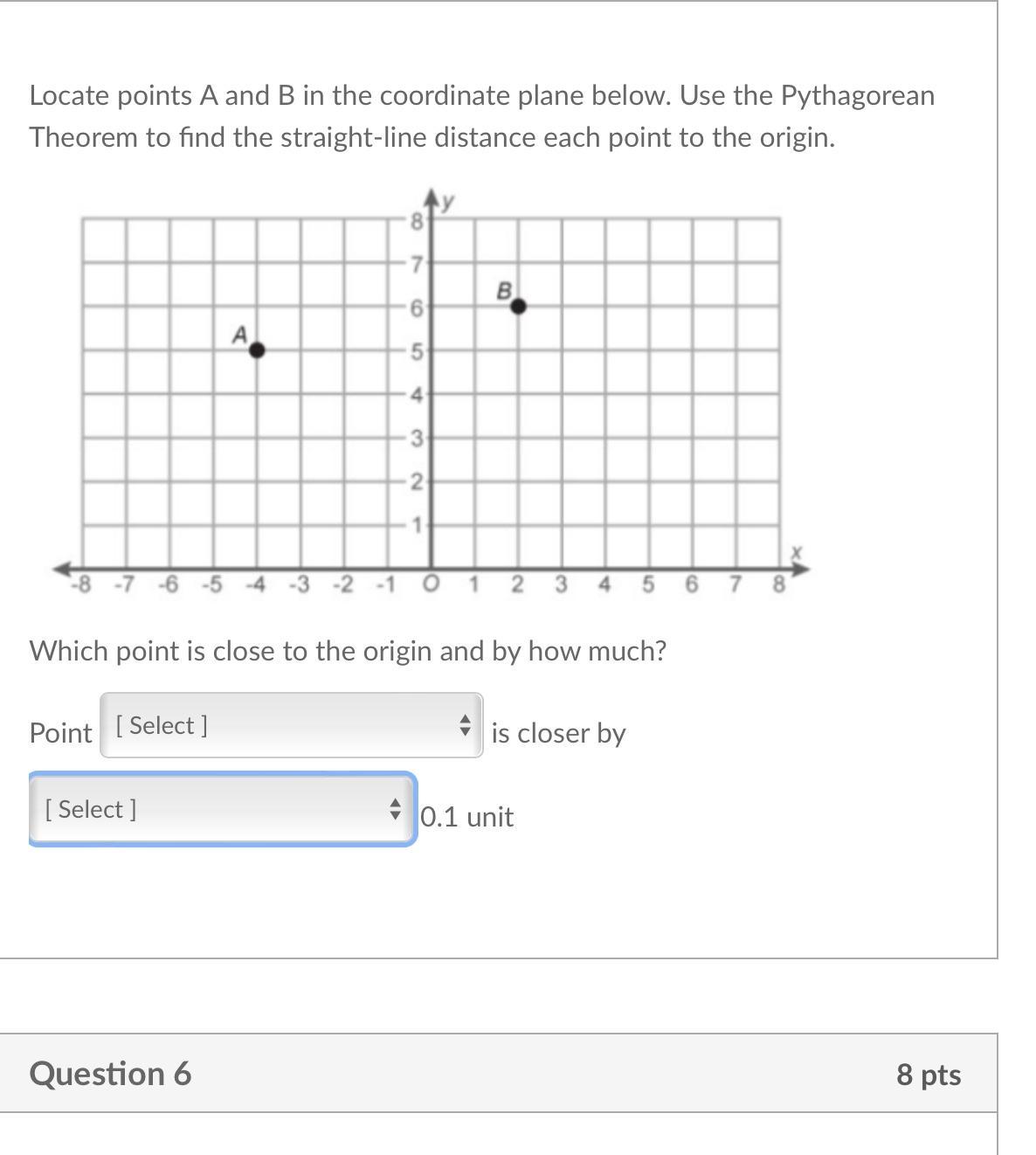
Which point is close to the origin and by how much?
Question:
Point ( a or b ) Is closer by ( less than or more than ) 0.1 units
The first select on the question Is A or b and the second was If its more than or less than
Answers
Answer:
B is closer.
Step-by-step explanation:
If you go down 6, and over 2, it's a total of 8 units to get to the origin. For A, if you go down 5 units, and go right 4 units, it's 9 units to get to the origin. When you do the Pythagorean Theorem for A, you get 41, and square rooting that gives you 6.4. When you do the Pythagorean Theorem for B, you get 40, and square rooting it gets you 6.3. Therefore, B is closer. I don't really get the more than / less than .1 unit but if I had to guess, it'd be less than 0.1 unit because 6.3 is lesser than 6.4 by .1.
Question is there ⬇️⬇️⬇️⬇️⬇️⬇️⬇️

Answers
Answer:
4.9
Step-by-step explanation:
for this I used the sine rule so I did 6/sin 70 × sin 50
Another question need help again

Answers
Answer:
33×26------- 198 66×------858-------858 is the right answer.
Find the coordinates of V" after a dilation of 1.5 and a reflection over the x -axis. Use parenthesis and leave a space after the comma.

Answers
Answer:
(2 ,2)
Step-by-step explanation:
Some students recorded how many minutes they spent on the phone in one day. They put the results in a Stem-and-Leaf Plot.
What is the mean number of minutes spent on the phone?

Answers
Explanation:
The data from the stem-and-leaf plot is:
10,
24,25,26,
30,30,32,33,
40,45,46
Add up those values
10+24+25+26+30+30+32+33+40+45+46 = 341
Then divide over n = 11 which is the sample size.
341/11 = 31 is the arithmetic mean.
Answer:
341/11 = 31 is the arithmetic mean.
Step-by-step explanation:
Which inequalities would have an open circle when graphed? Check all that apply.
t Less-than-or-equal-to 25
-2.5 Less-than-or-equal-to m
x > 5.4
One-half less-than x
x > 0
Answers
An open circle is used to graph strict inequalities, which means the inequality does not include the value at the boundary. The inequalities that would have an open circle when graphed are:
x > 5.4
One-half less-than x
x > 0
if an inequality states less than OR equal to that means the circle will be closed when graphed
The length of a rectangular garden is 20 feet and the width is 15 feet. What is ratio of length to width?
Answers
Answer: 4:3 because 20 divided by 5 is 4 and 15 divided by 5 is 3.
Which expression is equivalent to -1/3 ( 6x + 15 ) - 3?
a) -2x + 12
b) -2x + 2
c) -2x - 2
d) -2x - 8
Answers
The correct answer is (D) -2x - 8.
To simplify the expression -1/3 ( 6x + 15 ) - 3, we can first apply the distributive property to the term in parentheses:
-1/3 ( 6x + 15 ) - 3 = -1/3 * 6x - 1/3 * 15 - 3
Then we can simplify using the properties of multiplication and division:
-1/3 * 6x - 1/3 * 15 - 3 = -2x - 5 - 3
Finally, we can combine like terms:
-2x - 5 - 3 = -2x - 8
The correct answer is therefore (D) -2x - 8.✅
Which could NOT be side lengths of a parallelogram?
A.
2 yd, 2 yd, 2 yd, 2 yd
B.
3 cm, 2 cm, 2 cm, 3 cm
C.
4 m, 3 m, 4 m, 4 m
D.
5 in., 5 in., 3 in., 3 in.
Answers
Answer:
C
Step-by-step explanation:
Each measurement needs to be listed twice
Answer: A.
2 yd, 2 yd, 2 yd, 2 yd
Step-by-step explanation: because it do not have a odd amount of tech to be a parallelogram.
Find the percent of change from 6,570 pt to 16,425 pt.
Answers
Answer:
Percentage Change | Increase and Decrease
First: work out the difference (increase) between the two numbers you are comparing.
Increase = New Number - Original Number.
Then: divide the increase by the original number and multiply the answer by 100.
% increase = Increase ÷ Original Number × 100.
Step-by-step explanation:
hopefully this helped and you can find the percent change.
6,570 divided by 16,425
And that would get you
0.4%
Diana is painting statues. She has 7/8 of a liter of paint remaining each statue requires 1/20 of a liter of paint how many statues can she paint
Answers
Answer:
The number of statues = 7/8 × 16 = 14.
NEED HELP ASAP Match each set of information about a circle with the area of that circle.
Drag and drop the card to match the information.

Answers
Answer:
the first one is A The second on C the third one D and last one B
Step-by-step explanation:
2.C
3.D
4.D
Hope this helps
Find the standard form of the equation of the parabola with a vertex at the origin and a focus at (0.-4).
Oy=-x?
Oy2 = -4x
Oy2 = -16%
Oyə tox?
Answers
Answer:
\(x^2 = -16y\)
Step-by-step explanation:
Given
\(Vertex = (0,0)\\Focus = (0,-4)\)
Required
Equation of the parabola (in standard form)
The standard form of a parabola is \((x - h)^2 = 4p (y - k),\)
Such that
Vertex = (h,k)
Focus = (h, k + p)
For the vertex
This implies that (h,k) = (0,0)
h = 0 and k = 0
For the focus
This implies that (h, k + p) = (0, -4)
\(h = 0\\k + p = -4\)
Recall that \(k = 0;\)
Hence, \(0 + p = -4\)
\(p = -4\)
Substitute \(p = -4\), \(h = 0\ and\ k = 0\) in the given formula
\((x - h)^2 = 4p (y - k),\) becomes
\((x - 0)^2 = 4 * -4 (y - 0),\)
\((x)^2 = 4 * -4 (y),\)
\(x^2 = -16 (y),\)
\(x^2 = -16y\)
Hence,, the standard form is \(x^2 = -16y\)
In the problem above, Rob chose 1,526 inches^3 as the correct answer. How did he get that answer?
Answers
Answer:
He divided it to get the answer is 39
Step-by-step explanation:
Sample Answer: Make a table with inputs showing the number of bottles of water and outputs showing the total cost of the water. Use 1, 2, 3, and 4 bottles for the inputs. Find the corresponding outputs. Plot the ordered pairs in the table of the form (input,output).
Which instructions did you include in your explanation? Check all that apply.
Identify the input.
Identify the output.
Create a table for four input values.
Plot the points from the table.
Answers
The instructions that you would include in your explanation are:
Identify the output.
Create a table for four input values.
Plot the points from the table.
The instructions to be includedIn the given question, a series of instructions are provided. To properly explain your process, you have to explain how you got the output. There is no need of explaining the input as they are already provided.
Next, you will Show how you created the table and why you created it in that way. Finally, indicate how the points were plotted on the table. An explanation such as this will help anyone to follow through.
Learn more about ordered pairs here:
https://brainly.com/question/1528681
#SPJ1
Answer:1 to 2
2 to 4
Step-by-step explanation:
please help me it is 1 question

Answers
Answer:
5/6 more meters
Step-by-step explanation:
Find the perimeter of the wardrobe (Add all the sides together) and you get 4 5/6 m.
Subtract 4 meters because she already has 4 meters of ribbon.
4 5/6 - 4 = 5/6
Answer:
Step-by-step explanation:
P = (2/3)*2 + (7/4)*2 (1 3/4 = 7/4)
4/3 + 14/4
= 16/12 + 42/12
= 58/12
= 29/6
= 4 5/6
She already has 4 m of ribbon
4 5/6 - 4 = 5/6 m or ribbon needed
Help me please! Bookwork code:k90

Answers
Answer:
Step-by-step explanation:
Let’s mark the Triangle Points as Point A, Point B, Point C.
Point A = 1x°
Point B = 2x°
Point C = 3x°
We know that the Angle Sum of a Triangle is equal to 180°.
So, Point A + Point B +Point C = 180°
= 1x° + 2x° + 3x° = 180°
= (1 + 2 + 3)x° = 180°
= 6x° = 180°
= x° = (180/6)°
= x° = 30°
| — — |
| Point A = 1 * 30° = 30° | ⇒
| Point B = 2 * 30° = 60° | ⇒ Only Extra Information
| Point C = 3 * 30° = 90° | ⇒
| — — |
Learn more about Finding Angles here
Visit —
https://brainly.com/question/28293784
https://brainly.com/question/31507476
Hope my answer helps you ✌️
Mark BRAINLIEST
Point A- 1x
Point B- 2x
Point C- 3x
We know that Angle sum property of a triangle states that the sum of angles of a triangle is 180•
So 1x+ 2x+ 3x = 180
Take X out as common
(1+2+3)x = 180
6x= 180
x=180/6
x= 30•
Which is your answer
Pls mark as brainliest
HELP I NEED AWNCERS ASAPPPP!!!!!!!!!!!! I GIVE BRAINLIST
Question 1 (1 point)
Why does an eclipse happen?
a
A celestial object moves into the shadow made by another celestial object.
b
The Sun burns out quickly and reignites due to changes in magnetic energy.
c
Stars twinkle which creates a delay in light transfer.
d
The planets Mars and Venus interfere with Earth's orbit.
Question 2 (1 point)
The picture below shows a globe with the location of Barrow, Alaska circled. For almost three months, mid-May to mid-August, the Sun never sets in Barrow, Alaska.
Which is themost likelyreason for the Sun always shining in the summer in Barrow?
a
Earth only rotates on its axis during the winter, so the same part of Earth faces the Sun all summer.
b
Only the middle of Earth rotates around its axis, so the top of Earth always faces the Sun.
c
Earth's axis is tilted, so sometimes parts of Earth face the Sun for the entire daily rotation.
d
The Sun's axis is tilted, so sometimes parts of Earth face the Sun for the entire daily rotation.
Question 3 (0 points)
The diagram shows Earth in its yearly orbit around the Sun.
Earth is moving from Position B to Position C. Which statement correctly identifies the season in the Northern Hemisphere when Earth is in Position C?
a
It is fall because the Northern Hemisphere is tilting away from the Sun and receiving less direct sunlight than Position B.
b
It is fall because the Northern Hemisphere is tilting toward the Sun and receiving more direct sunlight than Position B.
c
It is spring because the Northern Hemisphere is tilting toward the Sun and receiving more direct sunlight than Position B.
d
It is spring because the Northern Hemisphere is tilting away from the Sun and receiving less direct sunlight than Position B.
Question 4 (1 point)
The map shows the United States.
Which city will most likely experience the mildest winters?
a
Tallahassee, FL, because it is closest to the equator and receives the most direct sunlight.
b
Harrisburg, PA, because it is located in the southern hemisphere.
c
Helena, MT, because it is closest to the equator and receives the most direct sunlight.
d
Des Moines, IA, because it is closest to the poles and receives the least direct sunlight.
Question 5 (1 point)
What can happen when Earth, the Sun, and the Moon line up in a straight line?
a
a lunar or solar eclipse
b
decreased planetary rotation
c
a change in the order of Moon phases
d
a reversal in the orbital direction
Question 6 (1 point)
Use the diagram below to answer the question.
Which point indicates the location of the Moon that is the best for viewing a lunar eclipse from Earth?
a
N
b
P
c
O
d
M
Question 7 (1 point)
Why can a solar eclipse only happen during a new moon?
a
During a new moon, Earth does not receive the light created by the Moon.
b
During a new moon, Earth is between the Moon and the Sun.
c
During a new moon, the Moon is fullest and blocks the sunlight best.
d
During a new moon, the Moon is between the Sun and Earth.
Answers
Answer:
An eclipse happens when a celestial object moves into the shadow made by another celestial object. In the case of a solar eclipse, the Moon moves into the shadow of the Earth, and in the case of a lunar eclipse, Earth moves into the shadow of the Moon.
The most likely reason for the Sun always shining in the summer in Barrow, Alaska is that Earth's axis is tilted, so sometimes parts of Earth face the Sun for the entire daily rotation.
When Earth is in Position C in the diagram, it is spring in the Northern Hemisphere because the Northern Hemisphere is tilting toward the Sun and receiving more direct sunlight than Position B.
The city that will most likely experience the mildest winters is Tallahassee, Florida because it is closest to the equator and receives the most direct sunlight.
When Earth, the Sun, and the Moon line up in a straight line, a lunar or solar eclipse can happen.
The point that indicates the location of the Moon that is the best for viewing a lunar eclipse from Earth is P.
A solar eclipse can only happen during a new moon because, during a new moon, the Moon is between the Sun and Earth. This allows the Moon to block the sunlight and create an eclipse.
Answer:
During a total lunar eclipse, Earth blocks sunlight from reaching the Moon. Earth casts a shadow onto the Moon. The Moon can look reddish orange.An eclipse occurs when one heavenly body such as a moon or planet moves into the shadow of another heavenly body. Let’s learn about the two types of eclipses on Earth.What Is a Lunar Eclipse?The Moon moves in an orbit around Earth. At the same time, Earth orbits the Sun. Sometimes Earth moves between the Sun and the Moon. When this happens, Earth blocks the sunlight that normally is reflected by the Moon. (This sunlight is what causes the Moon to shine.) Instead of light hitting the Moon's surface, Earth's shadow falls on the Moon. This is an eclipse of the Moon, or a lunar eclipse. A lunar eclipse can occur only when the Moon is full.A lunar eclipse can be seen from Earth at night. There are two types of lunar eclipses: Although the Moon is in Earth's shadow, some sunlight reaches the Moon. The sunlight passes through Earth's atmosphere, which filters out most of the blue light. This makes the Moon appear red to people on Earth.Earth's shadow passes in front of the Moon until it turns red or orange.A partial lunar eclipse happens when part of the Moon enters Earth's shadow. In a partial eclipse, Earth's shadow appears very dark on the side of the Moon facing Earth. What people see from Earth during a partial lunar eclipse depends on how the Sun, Earth and Moon align.A lunar eclipse usually lasts for a few hours. At least two partial lunar eclipses happen every year, but total lunar eclipses are rare. It is safe to look at a lunar eclipse.
math question someone pls explain how to answer it I am stuck

Answers
96
+
36
+
192
=
324
this is the answer
Answer:
A = 324m²
Step-by-step explanation:
Formula for finding the surface area of a rectangular prism:
2(wl + hl + hw)
First, let's find out which one of the measurements is the height, length, or width.
6m = length
16m = width
3m = height
Next, we calculate the surface area. We have to do the formula one by one too.
2(wl + hl + hw)
2(16x6 + 3x6 + 3x16)
16 x 6 = 96
3 x 6 = 18
3 x 16 = 48
Now, we add those together.
96 + 18 + 48 = 162
Lastly, multiply by 2.
162 x 2 = 324
Therefore, A = 324m²
I need help :,)
Mark is traveling by bus and needs to go from
Denver to San Diego and then on to San Francisco
The charge from Denver to San Diego is $17.50
and the charge from San Diego to San Francisco
is $8.75. How much will the ride cost?
Answers
Answer:
add 17.50 to 8.75 you get 26.25
$26.25
Explanation:
add both numbers given
please help me
(file below)

Answers
Answer:
at very bottom cuz im lasy to copy and paste :p
Step-by-step explanation:
13+18+6 is the total which is 37
Cinder cones probability is 13/37 or 0.35
Shield Volcano's probability is 18/37 or 0.486. rounding up we get 0.49
Stratovolcano's probability is 0.16.
Answers in order is 0.35, 0.49, 0.16
What is the slope-intercept form of the function described by this table?
x 1 2 3 4
y 8 13 18 23
Enter your answer by filling in the boxes.
y = x +
pls say why and explin it so i can understand it }btw its 8th grade
Answers
Answer:
y=5x+3
Step-by-step explanation:
You have the points (1,8) (2,13) (3,18) (4,23)
first you want to find the slope. The equation to find a slope is y2-y1 / x2-x1
your points (1,8) and (2,13) are really all you need
1 would be your x1 and your 2 would be your x2.
8 would be your y1 and 2 your y2
so you want to plug those into your equation y2-y1/x2-x1
13-8 /2-1 you get 5/1
Simplify your answer is 5 for your slope
Now finding the y intercept or "b" I normally just find the pattern of the sequence so in this case when you add one to the top your adding five to the bottom like
x 1 2 3 4
y 8 13 18 23
so to get to your y intercept which is (0,y)
subtract 1 from the top to get zero and subtract 5 from the bottom to get 3 so your y intercept is 3.
Hope this helps.
Determine if the relationship is a function explain why

Answers
The relationship is not a function because there are two different outputs (y-values) associated with an input value (x-value) of 6. In a function, each input must have only one output, but in this case, the input value of 6 has two outputs, namely 7 and 7.
HELP PLEASE I REALLY NEED HELP

Answers
First step is take it out of fractions and into decimals, they are easier to work with.
(0.5x1.125)x(2.66x3.33)x7.5
Then PEMDAS
Parentheses
0.625x-0.66x7.5
Then multiply
-0.41625x7.5
Answer
-3.121875
Could anyone help me with this problem, Quickly Please...

Answers
Answer:
3/4
Step-by-step explanation:
Since (p, r) lies on the line y = x + b,
we have,
r = p + b -----eq(1)
Since (2p, 5r) lies on the line y = 2x + b,
we have,
5r = 2(2p) + b -----eq(2)
Sub the value of r from eq(1) in eq(2),
5(p + b) = 4p + b
⇒ 5p + 5b = 4p + b
⇒ 5b - b = 4p - 5p
⇒ 4b = -p
⇒ b = -p/4
sub in eq(1)
r = p + (-p/4)
= p - p/4
= 3p/4
⇒ r = 3p/4
⇒ r/p = 3/4
Answer:
3/4
Step-by-step explanation:
We have two lines:
r = p + b eq(1)
5r = 4p + b eq(2)
eq(2) - eq(1)
4r = 3p
dividing by 4p
r/p = 3/4