Hi, how's everyone doing? I need help with these exponential equations, please. Thanks! :)

Answers
Answer:
Step-by-step explanation:
1). \(2^{x^{2} +2x}=\frac{1}{2}\)
\(2^{x^{2} +2x}=2^{-1}\)
Comparing exponents on both the sides.
x² + 2x = -1
x² + 2x + 1 = 0
(x + 1)² = 0
x = -1
2). \(2^{x-3}=8^{x+1}\)
\(2^{x-3}=(2^{3})^{x+1}\)
\(2^{x-3}=(2)^{3(x+1)}\)
By comparing exponents,
x - 3 = 3(x + 1)
x - 3 = 3x + 3
3x - x = 3 + 3
2x = 6
x = 3
3). \(\sqrt{a^{5-k}}=a^{3-k}\)
\(a^{\frac{5-k}{2}}=a^{3-k}\)
By comparing exponents,
\(\frac{5-k}{2}=3-k\)
5 - k = 2(3 - k)
5 - k = 6 - 2k
2k - k = 6 - 5
k = 1
4). \(3^{x+3}=27^{(2x+6)}\)
\(3^{x+3}=(3^3)^{2x+6}\)
\(3^{x+3}=(3)^{3(2x+6)}\)
By comparing exponents,
x + 3 = 3(2x + 6)
x + 3 = 6x + 18
6x - x = 3 - 18
5x = - 15
x = -3
5). \(5^{x-2}=1\)
\(5^{(x-2)}=5^{0}\)
x - 2 = 0
x = 2
Related Questions
What is the product?
(-202 + 5) (502 -65)
+
0-1004 +17025-652
O-1004+ 170452-652
0 -1004 - 7028-682
O -1004+ 1702S+682
Answers
Answer:
−1334o+1702s+84506
Step-by-step explanation:
wasn't sure if u were serious or not....
Answer:
N/A (Not Available Answer)
Step-by-step explanation:
Examine the function f(x,y) = x^3 - 6xy + y^3 + 7 for relative extrema and saddle points.
Answers
Answer:
The points are "(2,2)".
Step-by-step explanation:
Given value:
\(f(x,y)=x^3-6xy+y^3+7\)
Finding the first partial derivation which is equal to 0.
\(\to f_x(x,y)=3x^2-6y...............(a)\\\\ \to f_y(x,y)=-6x+3y^2...................(b)\)
solve both the above equation by equal to 0.
For equation (a)
\(\to 3x^2-6y=0\\\\\to 3x^2=6y\\\\\to x^2=2y\\\\\to y=\frac{x^2}{2}\\\\\)
For equation (b)
\(\to -6x+3y^2 =0 \\\\\to 3y^2 =6x\\\\\text{put the value of y in equation b}\\\\\to 3(\frac{x^2}{2})^2 -6x=0\\\\\to \frac{3}{4} x^4 -6x=0\\\\\)
by solving the above value in the form of x we get:
\(\to x=0\\ \to x=2\\ \to x= -1 +\sqrt{3} i\\ \to x= -1 -\sqrt{3} i\\\)
by solving the above value in the form of y we get:
\(\to y=0\\ \to y=2\\ \to y= -1 +\sqrt{3} i\\ \to y= -1 -\sqrt{3} i\\\)
Solve the value by applying the second derivation method:
\(\to f_{xx}(x,y)=6x...............(a1)\\\\ \to f_{yy}(x,y)=6y...................(b2)\\\\\to f_{xy}(x,y)=-6...................(c2)\)
calculating the value of discriminate:
\(d=f_{xx}(x,y) f_{yy}(x,y)-[f_{xy}(x,y)]^2\)
The critical point of the given equation will be (2,2)
\(d=f_{xx}(2,2) f_{yy}(2,2)-[f_{xy}(2,2)]^2\\\\\)
\(= (6 \times 2) (6 \times 2) -[(-6)^2]\\\\= (12) (12) -[36]\\\\= 144 -36\\\\= 108\\\\\)
Answer:
\((2,2)\) is a minimum point of the function \(f(x,y).\)
Step-by-step explanation:
\(f(x,y)=x^3-6xy+y^3+7\)
Find the partial differentiation w.r.t. \(x\) and \(y\).
\(\frac {\partial f}{\partial x}=3x^2-6y\)
\(\frac {\partial f}{\partial y}=-6x+3y^2\)
\(\frac {\partial^2 f}{\partial x^2}=6x\)
\(\frac {\partial^2 f}{\partial y^2}=6y\)
\(\frac{\partial f}{\partial xy}=-6\)
Find the critical points.
\(\frac {\partial f}{\partial x}=\frac {\partial f}{\partial y}=0\)
\(\Rightarrow 3x^2-6y=0 \;\text{and}\; -6x+3y^2=0\)
\(\Rightarrow 6y=3x^2\Rightarrow y=\frac{x^2}2\)
\(\Rightarrow -6x+\frac 34 x^4=0\Rightarrow \frac {x^3}4=2\)
\(\Rightarrow x^3=8\Rightarrow x=2,y=2\)
Therefore, \((2,2)\) is a critical point.
Now, \(\frac {\partial^2 f}{\partial x^2}\frac {\partial^2 f}{\partial y^2}-{\frac {\partial f}{\partial xy}}^2\)
\(=6x6y-36=36xy-36>0 \;\text{at critical point }\; (2,2)\)
Thus, \((2,2)\) is not a saddle point.
\(\because \frac{\partial^2 f}{\partial x^2}>0 \; \text{and}\; \frac {\partial^2 f}{\partial x^2}\frac {\partial^2 f}{\partial y^2}-{\frac {\partial f}{\partial xy}}^2>0 \;\text{at point}\; (2,2)\)
Hence, \((2,2)\) is a local minimum of a given function.
In one part of a rainforest 3/5 of the frogs are poisonous. what fraction of the frogs are not poisonous?
Answers
Then 1 - 3/5 = 2/5. This means that 2/5 of the frogs in that particular part of the rainforest are not poisonous. This fraction can also be expressed as 40/100 or 0.4 in decimal form.
In the given scenario, we know that 3/5 of the frogs in a particular part of the rainforest are poisonous. This means that the remaining fraction of the frogs are not poisonous.
To find this fraction, we need to subtract 3/5 from 1 (since the sum of the fractions of poisonous and non-poisonous frogs is equal to 1).
It's important to note that just because a frog is not poisonous, it doesn't mean it's safe to touch or handle them. It's always best to admire these beautiful creatures from a safe distance and leave them alone in their natural habitat.
To learn more about : fraction
https://brainly.com/question/17220365
#SPJ8
what is √ 169 please answer fast and the correct answer please
Answers
Answer:
Step-by-step explanation:
Answer:13
Step-by-step explanation:
find a and b if the points (3, 1) and
(0,2) lie on the grabh of ax-by=6
Answers
Answer:
\(a=1, b=-3\)
Step-by-step explanation:
\((3,1) \implies 3a-b=6 \\ \\ (0,2) \implies -2b=6 \implies b=-3 \\ \\ \therefore 3a-(-3)=6 \implies a=1\)
If a ring costs a jeweler $2100, at what price should it be sold to yield a profit of 50% on the selling price?
Answers
2100/2 = 1050
Meaning 50% is $1050
You have 2 jars of marbles. The first jar contains a blue marble, a yellow marble, and a purple marble. The second jar contains a green marble, a blue marble, and a pink marble. Write out the sets that represent all the colors of the marbles.
Answers
The set containing all the colors of the marbles is given as follows:
{blue, yellow, purple, green, pink}.
What is the set of elements?A set of elements is composed by elements that respect a given characteristic, or are present in an experiment.
In this problem, we need to find the colors present in each marble, which are given as follows:
First jar: Blue marble, yellow marble and purple marble.Second jar: Green marble, blue marble and pink marble.Then we have to list all these colors in a set, which are opened and closed by the brackets {}.
The color blue appears in both sets, however, it will appear only once in the set of the colors, as the elements are not repeated.
Thus, the set containing all the colors of the marbles is given by the set presented as follows:
{blue, yellow, purple, green, pink}.
More can be learned about sets of elements at https://brainly.com/question/24700823
#SPJ1
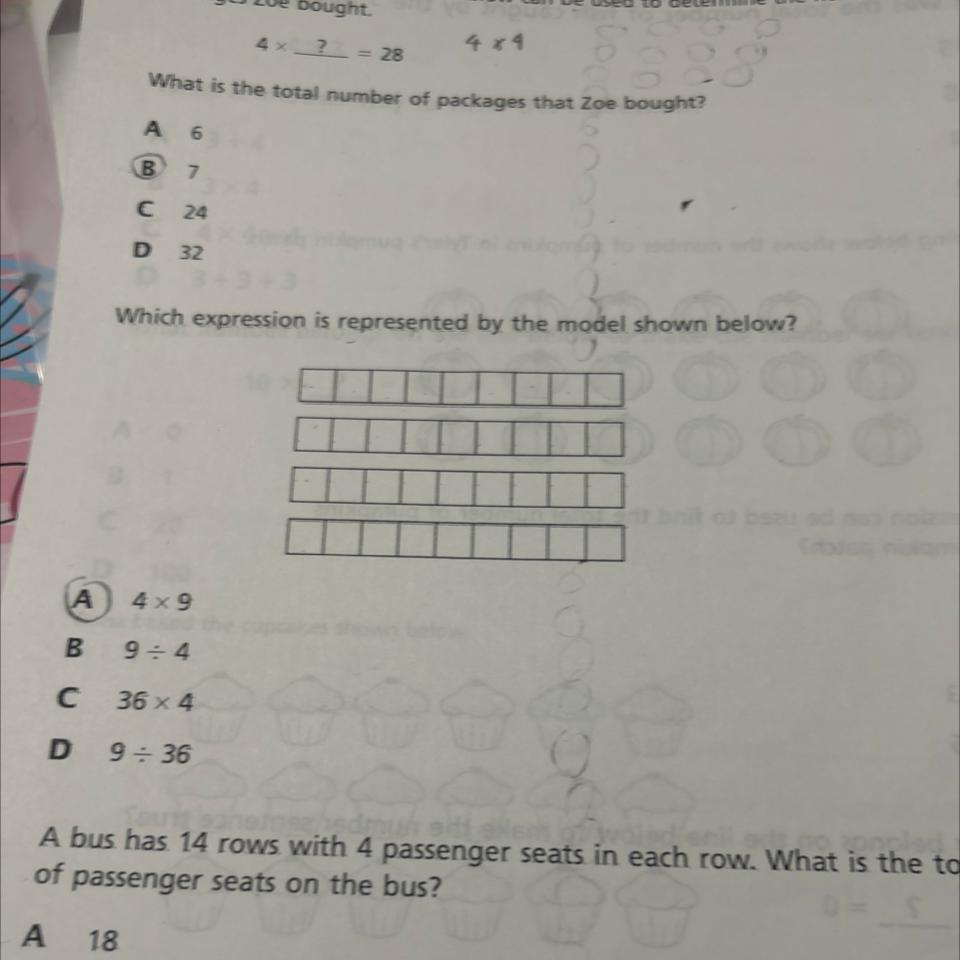
Which expression is represented by the model shown below?
brit of beau ad noo noiz
Srodeq nislame
Answers
Answer:
4*9
Step-by-step explanation:
It's obvious.
How much would you have to deposit today to accumulate the SAME AMOUNT OF MONEY that $75 monthly payments at a rate of 3.5% compounding monthly for 10 years in an annuity would earn?

Answers
Answer:
7606.62
Step-by-step explanation:
Start by finding how much you will have through the annuity. The question isn't that clear, so i will just assume it's an annuity due.
\(p(\frac{(1+i)^n-1}{i})*(1+i)\\i=.035/12= .0029166667\\n=10*12=120\\p=75 (given)\\75\frac{(1+.0029166667)^{120}-1}{.0029166667}*(1+.0029166667)= 10788.814149\\\)
Now just equate this to a time 0 payment at the same rate
\(10788.814149=(1+.0029166667)^{120}*x\\x= 7606.6228603=7606.62\)
As a quick note, if you were supposed to assume that your annuity was an annuity immediate the answer would be 7584.50.
Brainliest if you answer it correctly

Answers
Answer:
See explanation
Step-by-step explanation:
The following are equivalent to the given equation;
\(15x \\ 5 \times (x \times 3)\)
Drag the tiles to the correct boxes to complete the pairs. Match each function to its domain and range.

Answers
Matching of the functions domain and range are as follows:
f(x) = 4-4x ;
Domain:{0,1,3,5,6}
Range;{-20,-16,-8,0,4}
f(x) = 5x - 3
Domain:{-2,-1,0,3,4}
Range:{-13,-8,-3,12,4}
f(x) = -10x
Domain:{-4,-2,0,2,4}
Range:{-40,-20,0,20,40}
f(x) = (3/x) + 1.5
Domain:{-3,-2,-1,2,6}
Range:{0.5,0,-1.5,3,2}.
How to find the domain and range of the functions?1) The function f(x) = 4 - 4x
Take Domain:{0,1,3,5,6}
If, we take x=0 and put in the function then we get
f(x)=4-0
f(x)=4
put x=1
f(x) = 4 - 4 =0
put x=3 then we get
f(x)=4-12=--8
put x=5 them we get
f(x)=4-20=-16
put x=6 then we get
f(x)=4-24=-20
Therefore ,range:[-20,-16,-8,0,4}
2) The function f(x)=5x-3
Take domain{-2,-1,0,3,4}
Now, put x=-2 in the function then we get
f(x) = -13
now put x=-1 then we get
f(x)=-5-3=-8
Put x=0 then we get
f(x)=0-3=-3
Put x=3 then we get
f(x)=15-3=12
Put x=4 then we get
f(x)=20-3=17
Therefore , range:{-13,-8,-3,12,17}
3) The function f(x)=-10x
Take domain:{-4,-2,0,2,4}
Put x=-4 in the function then we get
f(x)=40
Put x= -2 then we get
f(x)=20
Put x=0 then we get
f(x)=0
Put x=2 then we get
f(x)=-20
Put x=4 then we get
f(x)=-40
Therefore , range :{-40,-20,0,20,40}
4) The function f(x)= (3/x) + 1.5
Take domain:{-3,-2,-1,2,6}
Put x= -3 in the taken function then we get
f(x)=-1+1.5=0.5
put x=-2 then we get
f(x)= -1.5+1.5=0
Put x=-1 then we get
f(x)=-3+1.5=-1.5
Put x= 2 then we get
f(x)=1.5+1.5=3
Put x= 6 then we get
f(x)=0.5+1.5=2
Therefore, range : {0.5,0,-1.5,3,2}.
Read more about Domain and Range at: https://brainly.com/question/10197594
#SPJ1
NEED HELP ASAP!!! Angles of Elevation and Despression! Need to find y!

Answers
Answer:
Hey there!
We have cosine 61=y/500
cosine 61(500)=242.4 ft.
Let me know if this helps :)
If an investment over eight years at a rate of $160.00 results in a final balance of $660.00, what was the original investment?
Answers
Find a irrational number that is between 5.2 and 5.5.
Answers
Answer:
5.35
Step-by-step explanation:
Answer:
5.29150262213
Step-by-step explanation:
There is no pattern that repeats and it cannot be written as a fraction of two whole numbers.
H
6:00 PM
What is a frostbite?
Answers
A box of jerseys for a pick-up game of basketball contains 9 extra-large jerseys, 6 large jerseys, and 5 medium jerseys. If you are first to the box and grab 3 jerseys, what is the probability that you randomly grab 3 medium jerseys? Express your answer as a fraction in lowest terms or a decimal rounded to the nearest millionth.
Answers
Answer:
1/114 or 0.008772
Step-by-step explanation:
I am not very sure, my answer seems unlikely, but here's what I think:
There are 20 jerseys in the box to begin with, and 5 medium jerseys that you can have.
Therefore, the probability of you randomly grabbing a medium sized jersey is 5/20 or 1/4.
After taking out one medium sized jersey, there are 19 jerseys in the box and 4 medium jerseys you can pick from.
The probability of you randomly grabbing a medium sized jersey is 4/19.
After taking out another medium sized jersey, there are 18 jerseys left in the box and 3 medium jerseys you can pick from.
The probability of you randomly grabbing a medium sized jersey is 3/18.
To get the answer, you do 1/4 * 4/19 * 3/18, and get 1/114, or 0.00877192982.
If you round that to the nearest millionth, it's 0.008772
Don't judge me, it might not be correct.
ompute the range (chose either definition) and the standard deviation for the following sample of n=4 scores. Note that there are two scores clustered around the mean in the center of the distribution and two extreme values.
Scores: 0. 6, 6, 12
Then, break up the cluster in the center of the distribution by moving two of the central scores out to the extremes. Compute the range and the standard deviation, again.
New scores: 0, 0, 12, 12
a. According to the range, how do the two distributions compare in variability?
b. How do they compare according to the standard deviation?
Answers
a. According to the range, the two distributions have the same variability.
b. According to the standard deviation, the second distribution has greater variability than the first distribution.
a. To compute the range, we will subtract the lowest score from the highest score.
For the first set of scores: Range = 12 - 0 = 12
Similarly, for the second set of scores: Range = 12 - 0 = 12
Therefore, both sets of scores have the same range.
b. Now, to compute the standard deviation, we will first calculate the mean of the scores.
For the first set of scores: Mean = (0 + 6 + 6 + 12) / 4 = 6
Next, we calculate the deviation of each score from the mean:
0 - 6 = -6
6 - 6 = 0
6 - 6 = 0
12 - 6 = 6
Then, we square each deviation:
\((-6)^2\) = 36
\(0^2\) = 0
\(0^2\) = 0
\(6^2\) = 36
Taking the average of these squared deviations:
(36 + 0 + 0 + 36) / 4 = 18
Finally, we take the square root of this average to get the standard deviation:
SD = \(\sqrt{18}\) = 4.24 (rounded to two decimal places)
Similarly, we can find the mean calculate the standard deviation for the second set of scores which will come out to be -
Mean = (0 + 0 + 12 + 12) / 4 = 6
Standard deviation = \(\sqrt{36}\) = 6
Therefore, for the second set of scores, the standard deviation is larger, indicating greater variability.
Hence we can conclude that -
According to the range, the two distributions have the same variability and according to the standard deviation, the second distribution has greater variability than the first distribution.
Read more about standard deviation:
brainly.com/question/24298037
#SPJ4
what is negative 2/7 + 1/4 =
Answers
Answer:
-0.03571428571
Step-by-step explanation:
The Venn diagram below shows the events A and B, and the probabilities p, q and r.
It is known that P(A)=0.43 , P(B)=0.62 and P(A∩B)=0.27 .
Calculate the value of p
Calculate the value of q
Calculate the value of r
Find the value of P (A given NOT B)
Answers
The value of q is 0.35.
The value of p is 0.16.
The value of r is 0.27.
The value of P(A given NOT B) is approximately 0.4211.
To calculate the values of p, q, and r, we can use the information provided in the Venn diagram and the probabilities of events A and B.
Given:
P(A) = 0.43
P(B) = 0.62
P(A∩B) = 0.27
Calculating the value of p:
The value of p represents the probability of event A occurring without event B. In the Venn diagram, p corresponds to the region inside A but outside B.
We can calculate p by subtracting the probability of the intersection of A and B from the probability of A:
p = P(A) - P(A∩B)
= 0.43 - 0.27
= 0.16
Therefore, the value of p is 0.16.
Calculating the value of q:
The value of q represents the probability of event B occurring without event A. In the Venn diagram, q corresponds to the region inside B but outside A.
We can calculate q by subtracting the probability of the intersection of A and B from the probability of B:
q = P(B) - P(A∩B)
= 0.62 - 0.27
= 0.35
Therefore, the value of q is 0.35.
Calculating the value of r:
The value of r represents the probability of both event A and event B occurring. In the Venn diagram, r corresponds to the intersection of A and B.
We are given that P(A∩B) = 0.27, so the value of r is 0.27.
Therefore, the value of r is 0.27.
Finding the value of P(A given NOT B):
P(A given NOT B) represents the probability of event A occurring given that event B does not occur. In other words, it represents the probability of A happening when B is not happening.
To calculate this, we need to find the probability of A without B and divide it by the probability of NOT B.
P(A given NOT B) = P(A∩(NOT B)) / P(NOT B)
We can calculate the value of P(A given NOT B) using the provided probabilities:
P(A given NOT B) = P(A) - P(A∩B) / (1 - P(B))
= 0.43 - 0.27 / (1 - 0.62)
= 0.16 / 0.38
≈ 0.4211
Therefore, the value of P(A given NOT B) is approximately 0.4211.
for such more question on value
https://brainly.com/question/27746495
#SPJ8
find the diffrence. enter your answerin simplest terms usingthe slash (/) as a fraction bar
3/4 - 1/3

Answers
Answer:
5/12
Step-by-step explanation:
3/4 - 1/3
We need to use the common denominator of 12
3/4 * 3/3 = 9/12
1/3 * 4/4 = 4/12
9/12 - 4/12 = 5/12
write 0.0000002711 in scientific notation
Answers
Answer:
2.711e-7
Step-by-step explanation:
The length of a subway is 385 miles. If 3 cm represents 35 miles on the map, then what is the length of the subway on the map in cm?
Answers
Answer:
33cm
Step-by-step explanation:
385 / 35 = 11
11 times 3 = 33
Emily has a decorative box that is shaped like a cube with a height of
5 inches. What is the surface area of the box?
HELP MEH ASAP PLS PLZ PLZ
Answers
Answer:
5 x 5 x 5 x 5 x 5
Step-by-step explanation:
Consider the following two algorithms which both are meant to print all multiples of 11 from 1 up to a user input positive integer value - upper. Which statement correctly compares the efficiency of these two algorithms?
Algorithm 1:
for (int i = 1; i <= upper; i++)
{
if (i % 11 == 0)
{
System.out.println(i + " ");
}
}
Algorithm 2:
for (int i = 1; i <= upper / 11; i++)
{
System.out.println(i * 11 + " ");
}
Answers
Algorithm 2 is more efficient than Algorithm 1 because it only needs to loop through the numbers up to upper/11 instead of upper. This means that it will take fewer iterations to reach the result, making it more efficient than Algorithm 1.
Algorithm 1 will make upper/11 more checks than Algorithm 2, resulting in a slower runtime. Additionally, Algorithm 2 avoids the need to check the modulus of each number, further reducing the computation time. Algorithm 2 only needs to loop through the multiples of 11, which are always 11 apart from each other, so it can skip over the other numbers between them.
This makes Algorithm 2 much faster than Algorithm 1 because it is only looping through a fraction of the numbers.
Read more about Algorithm efficiency:
https://brainly.com/question/28992413
#SPJ4
i need help with this

Answers
Answer:
The first one is 10.5, I am unsure about the second one but I think 338.56.
Find the surface area of the rectangular prism with the dimensions listed below.

Answers
Given:
l = 6cm
w = 3cm
h = 4cm
The formula for the surface area of a rectangular prism is:
\(S\mathrm{}A\text{ = 2(lw + lh + wh)}\)Substituting the given values into the formula, we have:
\(\begin{gathered} SA\text{ = 2(6 }\times3\text{ + 6}\times\text{ 4 + 3}\times\text{ 4) } \\ =\text{ 2 }\times(18\text{ + 24 + 12)} \\ =\text{ 2 }\times\text{ 54} \\ =\text{ 108 square cm} \end{gathered}\)Answer:
Surface Area = 108 square cm
please answer the question if you can (this is 8th Grade math)

Answers
Answer:
D
Step-by-step explanation: The two angles are not equal. The alternate interior angles theorem states that if the alternate interior angles are equal when a pair of lines is cut by a transversal, the two lines are parallel. However, the two angles are not parallel, so the lines are not parallel.
Answer:
are parallel
Step-by-step explanation:
because the lines doesn't meet so it's parallel
Find a • b. a = <5, 2>, b = <4, 5> (2 points) a <20, 10> b <9, 7> c -10 d 30
Answers
The dot product of vectors a and b is option D. 30.
How did we get the value?To find the dot product of two vectors, you need to multiply their corresponding components and then sum the results.
Let's calculate the dot product of vectors a = <5, 2> and b = <4, 5>:
a • b = (5 x 4) + (2 x 5)
= 20 + 10
= 30
Therefore, the dot product of vectors a and b is 30.
learn more about product of vectors: https://brainly.com/question/30394406
#SPJ1
Find the area of the shaded figure below.

Answers
Answer:
x(y/2 + z)
Step-by-step explanation:
There are two triangles here.
The small triangle which is bound by dotted lines has base = y and height = x
The height of the larger triangle is 2x and its base is y + z
Area of larger triangle = 1/2 · 2x · (y + z)
= x(y + z) = xy + xz
Area of smaller triangle = 1/2 · x · y = xy/2
Shaded region area = Area of larger triangle - area of smaller triangle
= xy + xz - xy/2
= xy/2 + xz
= x(y/2 + z)
Mr. Scott want to tip his taxicab driver 18%. If his commute costs $25, what is the tip?
Answers
Answer:
4.5$
Step-by-step explanation:
25 times .18 = 4.5$