
Answers
Given the matrix:
\(\begin{bmatrix}{5} & {} & {} \\ {x} & {} & {} \\ -{1} & {} & {}\end{bmatrix}-\begin{bmatrix}{-3} & {} & {} \\ {2} & {} & {} \\ {y} & {} & {}\end{bmatrix}=\begin{bmatrix}{8} & {} & {} \\ {-5} & {} & {} \\ {-6} & {} & {}\end{bmatrix}\)Let's find the values of x and yin the following matrix substitution.
To find the values of x and y, subtract the rows from each other.
We have the equations:
• x - 2 = -5
• -1 - y = -6
For x, we have:
• x - 2 = -5
Add 2 to both sides:
x - 2 + 2 = -5 + 2
x = -3
• For y, we have:
-1 - y = -6
Add 1 to both sides:
-1 + 1 - y = -6 + 1
-y = -5
Divide both sides by -1:
\(\begin{gathered} \frac{-y}{-1}=\frac{-5}{-1} \\ \\ y=5 \end{gathered}\)ANSWER:
• x = -3
• y = 5
Related Questions
Helppppp!! Pleaseeeee

Answers
Suppose you toss a coin 100 times and get 65 heads and 35 tails. Based on these results, what is the probability that the next flip results in a tail?
Answers
Answer:
\( P(Head) = \frac{65}{100}=0.65\)
\( P(Tail) = \frac{35}{100}=0.35\)
And for this case the probability that in the next flip we will get a tail would be:
\( P(Tail) = \frac{35}{100}=0.35\)
Step-by-step explanation:
For this case we know that a coin is toss 100 times and we got 65 heads and 35 tails.
We can calculate the empirical probabilities for each outcome and we got:
\( P(Head) = \frac{65}{100}=0.65\)
\( P(Tail) = \frac{35}{100}=0.35\)
And for this case the probability that in the next flip we will get a tail would be:
\( P(Tail) = \frac{35}{100}=0.35\)
What equation should they enter into the distometer?

Answers
Answer:
92
Step-by-step explanation:
\(d = rt\)
\(2r = 184\)
\(r = \frac{184}{2} = 92\)
Just to check the answer:
\(r = \frac{276}{3} = 92\)
\(r = \frac{368}{4} = 92\)
Paj is filling a 9-cubic-inch flower pot with soil from small bags. Each bag of soil contains 2 2/3
cubic inches of soil. Exactly how many bags of soil are needed for Paj to fill the flower pot?

Answers
Answer:
3.375 bags of soil are needed for Paj to fill the flower pot
Step-by-step explanation:
This question can be solved using a rule of three.
One bag contains 2 + (2/3) = (8/3) cubic inches of soil. How many bags are needed to fill 9 cubic inches of soil?
1 bag - (8/3) cubic inches
x bags - 9 cubic inches
\(\frac{8x}{3} = 9\)
\(8x = 27\)
\(x = \frac{27}{8}\)
\(x = 3.375\)
3.375 bags of soil are needed for Paj to fill the flower pot
Paj needs 3.375 bags of soil to fill the bag.
Each bag contains 2²/₃ inch³ of soil and they need to fill up a 9 inch³ pot of soil.
First convert the mixed fraction to an improper one:
2²/₃ = 8/3
The number of bags needed is:
= Volume of pot / Quantity of soil in each bag
= 9 ÷ 8/3
= 9 x 3/8
= 3.375 bags of soil
Paj therefore needs 3.375 bags of soil to fill the pot
Find out more at https://brainly.com/question/17205287.
Consider the equation 9x+3=x−1. Squaring the left side and simplifying results in _______. Squaring the right side and simplifying results in _______.
Answers
Answer:
The first blank is 81\(x^{2}\)+9=x-1
The second blank is 9x+3=x^2-1
Step-by-step explanation:
For the first part, you must set up the equation (9x+3)^2 then you must multiply the exponent to the inside exponents \(9^{2} x^{2}\)+\(3^{2}\) next, simplify.
81\(x^{2}\)+9=x-1
For part two, set up equation. \(x^{2} -1^{2}\) Then simplify 9x+3= \(x^{2} -1\)
9x + 3 = x - 1
Squaring the left side and simplifying results in 81x² + 53x + 10 = 0.
Squaring the right side and simplifying results in x² - 11x - 2 = 0.
Given,
9x + 3 = x -1
We need to square on the left side and right side separately and find the results.
What is the formula for square?
(A + B)² = A² + 2AB + B²
(A - B)² = A² - 2AB + B²
We have,
9x + 3 = x - 1
Squaring the left side.
( 9x + 3)² = x - 1
(9x)² + 2 x (9x) x 3 + 3² = x - 1
81x² + 54x + 9 = x - 1
81x² + 54x - x + 9 + 1 = 0
81x² + 53x + 10 = 0
Now,
9x + 3 = x - 1
Squaring right side
9x + 3 = ( x - 1 ) ²
9x + 3 = x² - 2 x (x) x 1 + 1²
9x + 3 = x² -2x + 1
x² - 2x - 9x + 1 - 3 = 0
x² - 11x - 2 = 0
Thus the results after simplifying 9x + 3 = x - 1 are
Squaring on the left sides:
81x² + 53x + 10 = 0
Squaring on the right sides:
x² - 11x - 2 = 0
Learn more about algebraic formulas here:
https://brainly.com/question/14583646
#SPJ2
(-17)(-6)
A -23
B 102
C -102
D 2.8
Answers
Answer:
haha you are not going anywhere else to say it
Please answer this before friday
Answers
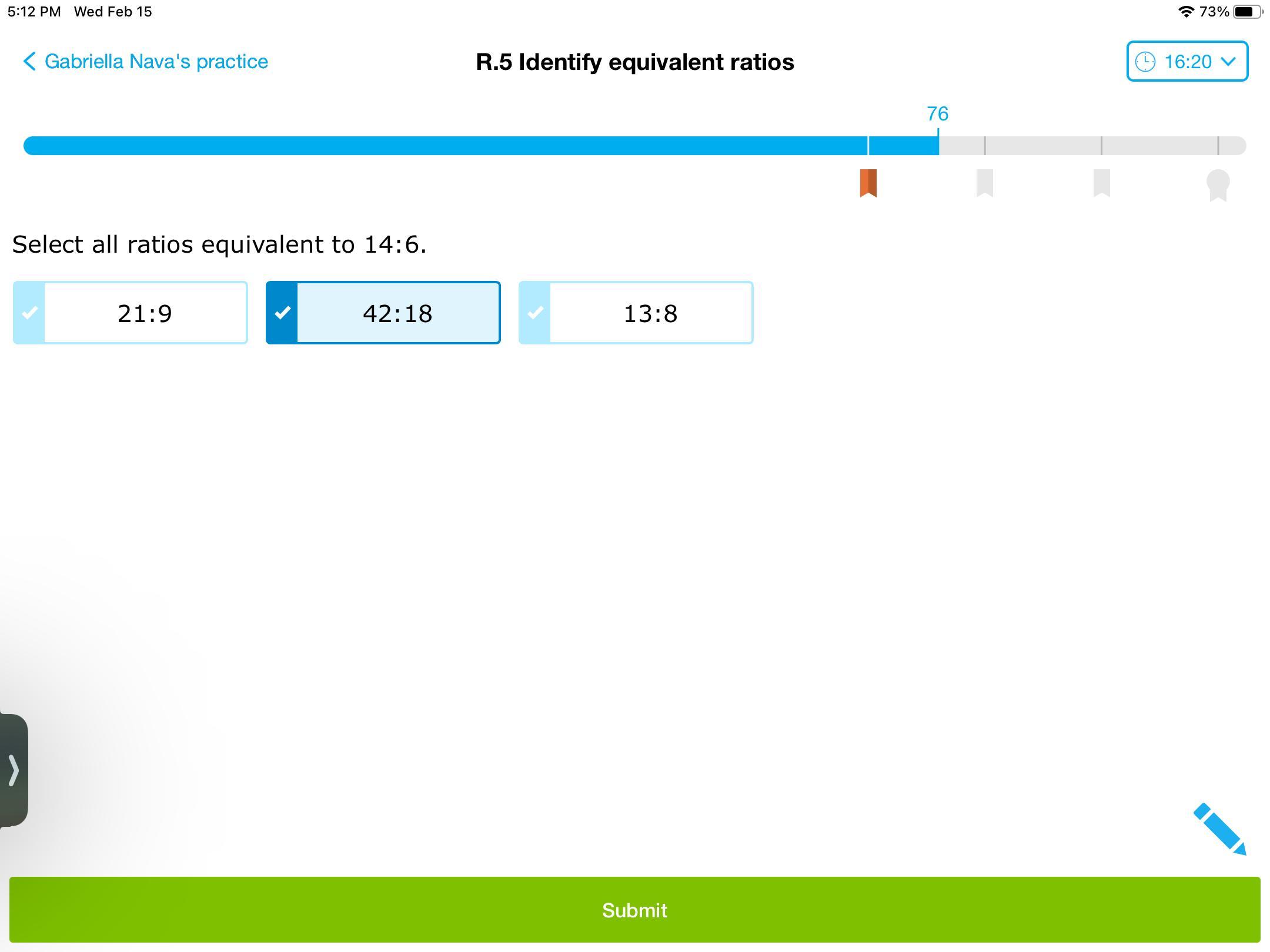
Answer: 21:9 and 42:18
Step-by-step explanation:
14:6 at its most basic form is 7:3, so find anything that could be equal to this if a number is multiplied on both sides.
21:9 is our simplified ratio multiplied by 3 on both sides.
42:18 is our simplified ratio multiplied by 6 on both sides.
But, the final ratio doesn't work, because 7 and 3 respectively cannot multiply to 13 and 8 with the same value.
PLS HELP WILL GIVE BRAINLIEST IF ANSWER IS RIGHT (NO LINKS)
Identify the surface area of the composite figure to the nearest tenth.

Answers
Answer:
D.
Step-by-step explanation:
6a² = surface area for cube
6(5)² = 150
2\(\pi\)(r)(h)+2\(\pi\)r² = surface area cylinder
2\(\pi\)(2)(3)+2\(\pi\)(4) = 20pi
150 + 20pi = 212.8318531
Solve the inequality p+4<-24
90 POINTS
Answers
Step-by-step explanation:
p+4<-24
collect like terms
p<-28
\(\\ \rm\Rrightarrow p+4<-24\)
\(\\ \rm\Rrightarrow p<-24-4\)
\(\\ \rm\Rrightarrow p<-28\)
So
\(\\ \rm\Rrightarrow p\in (-\infty,-28)\)
A researcher compares the effectiveness of two different instructional methods for teaching electronics. A sample of 138 students using Method 1 produces a testing average of 61. A sample of 156 students using Method 2 produces a testing average of 64.6. Assume the standard deviation is known to be 18.53 for Method 1 and 13.43 for Method 2. Determine the 98% confidence interval for the true difference between testing averages for students using Method 1 and students using Method 2. Step 1 of 2: Find the critical value that should be used in constructing the confidence interval.
Answers
Answer:
The 98% confidence interval for the true difference between testing averages for students using Method 1 and students using Method 2 is (-8.04, 0.84).
Step-by-step explanation:
The (1 - α)% confidence interval for the difference between population means is:
\(CI=(\bar x_{1}-\bar x_{2})\pm z_{\alpha/2}\times \sqrt{\frac{\sigma^{2}_{1}}{n_{1}}+\frac{\sigma^{2}_{2}}{n_{2}}}\)
The information provided is as follows:
\(n_{1}= 138\\n_{2}=156\\\bar x_{1}=61\\\bar x_{2}=64.6\\\sigma_{1}=18.53\\\sigma_{2}=13.43\)
The critical value of z for 98% confidence level is,
\(z_{\alpha/2}=z_{0.02/2}=2.326\)
Compute the 98% confidence interval for the true difference between testing averages for students using Method 1 and students using Method 2 as follows:
\(CI=(\bar x_{1}-\bar x_{2})\pm z_{\alpha/2}\times \sqrt{\frac{\sigma^{2}_{1}}{n_{1}}+\frac{\sigma^{2}_{2}}{n_{2}}}\)
\(=(61-64.6)\pm 2.326\times\sqrt{\frac{(18.53)^{2}}{138}+\frac{(13.43)^{2}}{156}}\\\\=-3.6\pm 4.4404\\\\=(-8.0404, 0.8404)\\\\\approx (-8.04, 0.84)\)
Thus, the 98% confidence interval for the true difference between testing averages for students using Method 1 and students using Method 2 is (-8.04, 0.84).
f(x)=x^(2) between x= 1 and x=3
Answers
Answer:
he values of F(x) between x=1 and x=3 are 1, 4, and 9.
Step-by-step explanation:
To find the value of F(x) between x=1 and x=3, we need to substitute the values of x into the given function F(x) = x^2 and evaluate the function at each value. This gives us:
F(1) = 1^2 = 1
F(2) = 2^2 = 4
F(3) = 3^2 = 9
Therefore, the values of F(x) between x=1 and x=3 are 1, 4, and 9.
Need your help guys

Answers
Based on the information, we lack credible evidence to assume an association between a student's academic success and if they are either a boarder or day student at a significance level of 0.05.
How to explain the hypothesisThe statistic for the chi-square test is given as follows:
X² = ∑ [(observed value - expected value)² / expected value]
Through employing a significance level of 0.05, accompanied by 1 degree of freedom (due to two categories and three degrees of performance), the critical value for the chi-square distribution is calculated at 3.84.
The computed chi-square test statistic is measured to be:
X² = [(130-147.43)²/147.43] + [(180-195.57)²/195.57] + [(240-222.57)²/222.57] + [(305-289.43)²/289.43] + [(100-111.43)²/111.43] + [(200-188.57)²/188.57]
X² = 5.61
Given that 5.61 is lower than 3.84, we dismiss the null hypothesis. Ultimately, we lack credible evidence to assume an association between a student's academic success and if they are either a boarder or day student at a significance level of 0.05.
Learn more about statistic on
https://brainly.com/question/15525560
#SPJ1
What do all Quadrilaterals have in common?

Answers
Answer:
The number of edges
Step-by-step explanation:
quad means 4 so all quadrilaterls have 4 sides.
what is the the answer of rounding .875 of hundreds
Answers
F(x)=3x^2-11 find f(-5)
Answers
Answer:
64
Step-by-step explanation:
help please, correct answers only

Answers
The solution to the quadratic equation 3x² + 5x + 4 = 0 is -5 ±√23/6
How to determine the solutionUsing the quadratic formula, we have the general equation;
ax + bx + c = 0
The general formula is given as;
= (-b±√(b²-4ac))/(2a)
Now, substitute the values, we get;
= -(5) ± √(-5)² - 4 × 3 × 4)/2(3)
find the square value and multiply
= -5± √25- 48/6
Then, we have;
= -5 ±√23/6
Hence, the solutions is -5 ±√23/6
Learn about quadratic equations at: https://brainly.com/question/1214333
#SPJ1
The grade distribution for a course is listed in the following table. If a student is randomly selected fro mly selected from this class, what is the probability that they received an A, B, or C? A B C D F 40 40 33 20 14
Answers
Answer:
the probability that a randomly selected student received an A, B, or C is approximately 0.769, or about 76.9%.
Step-by-step explanation:
To find the probability that a randomly selected student received an A, B, or C, we need to add up the number of students who received each of these grades and divide by the total number of students in the class.
The total number of students in the class is:
total = A + B + C + D + E = 40 + 40 + 33 + 20 + 14 = 147
The number of students who received an A, B, or C is:
A + B + C = 40 + 40 + 33 = 113
Therefore, the probability that a randomly selected student received an A, B, or C is:
P(A or B or C) = (A + B + C) / total = 113 / 147 ≈ 0.769
So the probability that a randomly selected student received an A, B, or C is approximately 0.769, or about 76.9%.
We have 2 squares. One square is shaded 2/12 and the other shaded square in the diagram is 2/15 shaded. How much of the total diagram is shaded?
A.0.148
B.0.148 repeated
C. 0.3
D.0.3 repeated
Answers
Answer: The answer to your question is C. Brainliest?
Step-by-step explanation:
For the first square, we can multiply both the numerator and denominator by 5 to get an equivalent fraction with a denominator of 60:
2/12 = (2 x 5) / (12 x 5) = 10/60
For the second square, we can multiply both the numerator and denominator by 4 to get an equivalent fraction with a denominator of 60:
2/15 = (2 x 4) / (15 x 4) = 8/60
Now, we can add the two fractions:
10/60 + 8/60 = 18/60
Simplifying this fraction by dividing both numerator and denominator by 6, we get:
18/60 = 3/10
Therefore, the total shaded area in the diagram is 3/10 or 0.3 in decimal form.
The answer is C. 0.3.
Activity 1: Trigonometry
Find the supplement of an angle whose compliment is 62º.
Answers
Answer:
If the complement of an angle is 62°, then its supplement is 152°.
hope it helps u
branliest?
The sum of 8 and t
help anyone??

Answers
Not sure if I’m wrong but I am also learning this.
Answer:
8 + tStep-by-step explanation:
The sum of 8 and t ⇒ 8 + t
Solve for x to make A||B

Answers
Answer: x = 50
Step-by-step explanation:
In the given image, the alternate interior angles are equal. Therefore, 80 + x = 180 - 50 (since straight angles measure 180 degrees). Simplifying this equation, we get 130 + x = 180, which gives us x = 50 degrees. Thus, A||B when x = 50 degrees.
PLS HELP ASAP !!!!!!!!!!!!!!!!!!!!!!!!!!!!!!!!!!!!!!!!!!!!!!!!!!!!!!!!!!!!!!
What is the solution to the equation given the replacement set?
25 - 3r = 10; {3, 4, 5, 6,}
Responses
3
4
5
6
Answers
Answer:
r = 5
Step-by-step explanation:
25 - 3r = 10 ( subtract 25 from both sides )
- 3r = - 15 ( divide both sides by - 3 )
r = 5
the solution from the replacement set is 5
For each polynomial function, (a) list all possible rational zeros, (b) use a graph to eliminate some of the possible zeros listed in part (a), (c) find all rational zer…
For each polynomial function, (a) list all possible rational zeros, (b) use a graph to eliminate some of the possible zeros listed in part (a), (c) find all rational zeros, and (d) factor P(x). P(X)=x^3-2x^2-13x-10
Answers
Answer:
(a) ±{1, 2, 5, 10}
(b) attached
(c) {-2, -1, 5}
(d) P(x) = (x +2)(x +1)(x -5)
Step-by-step explanation:
You want the possible and actual rational zeros for P(x) = x^3-2x^2-13x-10, and the factored form of the polynomial.
(a) Rational zerosThe rational root theorem tells you the possible rational zeros of a polynomial will be of the form ...
±(divisor of the constant)/(divisor of the leading coefficient)
The leading coefficient is 1, and the divisors of the constant are {1, 2, 5, 10}, so the possible rational zeros are ...
{±1, ±2, ±5, ±10}
(b, c) Actual zerosThe attached graph shows the actual zeros of P(x) to be {-2, -1, 5}.
(d) FactorsEach zero q corresponds to a factor (x -q). The factored form of the polynomial is ...
P(x) = (x +2)(x +1)(x -5)

Drag the tiles to the correct locations on the image. Not all the tiles will be used.
The figure is a square, with side lengths as shown.
4√5mm
What are the perimeter and area of the square
Answers
The perimeter of the square is 16√5 mm, and the area of the square is 80 mm².
To calculate the perimeter and area of the square, we can use the formulas:
Perimeter = 4 * side length
Area = side length * side length
Substituting the given side length of 4√5mm into the formulas, we have:
Perimeter = 4 * 4√5mm = 16√5mm
Area = (4√5mm) * (4√5mm) = 16 * 5mm = 80mm²
Therefore, the perimeter of the square is 16√5mm, and the area of the square is 80mm².
Please note that the values are based on the provided side length of 4√5mm. If there are any changes to the side length, the perimeter and area will differ accordingly.
For such more question on perimeter:
https://brainly.com/question/397857
#SPJ8
The perimeter of the square is 16√5 mm, and the area of the square is 80 mm².
I took the test on plato.
Evaluate the expression when x = 3/4 and y= - 1/2: 2x +y
Answers
Answer:
1
Step-by-step explanation:
2(3/4)-1/2=
The 2 cancels out the 4 making it 3/2.
3/2-1/2=2/2
=1
Select the correct answer. Find the solution(s) for x in the equation below.
x2-9x+20=0
Answers
Step-by-step explanation:
Given
x² - 9x + 20 = 0
x² - ( 4 + 5) x + 20 = 0
x² - 4x - 5x + 20 = 0
x ( x - 4 ) - 5 (x - 4 ) = 0
(x - 4 ) ( x - 5 ) = 0
Either
x - 4 =0
x = 4
or
x - 5 =0
x = 5
x = 4 and 5
Hope it will help :)
\(.)\)
Answer: hope this helps. Check out the image.. and can u give me brainliest pls and I also have explanation
Step-by-step explanation:

Jenny wants to save $900 to go on a trip with her friends. She saves $45 each week. Her brother gives her $180. Write an equation to find out how many weeks she must save for her trip (1) 45x = 900 (2) 180 + 900 = 45x (3) 45x - 180 = 900 (4) 45x + 180 = 900
Answers
Let x represent the number of weeks
Given that she wants to save $900.
She saves $45 each week and her brother gives her $180.
The equation to represent this is:
45x + 180 = 900
To find the number of weeks, let's solve for x:
Subtract 180 from both sides
45x + 180 - 180 = 900 - 180
45x = 720
Divide both sides by 45;
\(\begin{gathered} \frac{45x}{45}=\frac{720}{45} \\ \\ x\text{ = }16 \end{gathered}\)Therefore, the number of weeks she must save for her trip is 16 weeks
ANSWER:
45x + 180 = 900
In Hawaii”s Kona iron man competition, Gretchen swims the first 7/8 of a mile in 70 minutes. At this pace, how many minutes will it take for Gretchen to swim the entire 2 2/5 mile course
Answers
It would Gretchen 192 minutes to swim the entire 2 2/5 mile course.
What is speed?
Speed is distance divided by the time taken to cover the distance.
In this case, we can determine distance covered in a minute by dividing the speed by the distance, which is distance of 7/8 mile(i.e. 0.825 mile) over the time take to cover the distance.
speed per minute=0.825/70
speed per minute=0.0125 mile/minute
With this, we can determine the time in minutes it would take to cover 2.4 miles(2/5=0.4)
0.0125=2.4/time
0.0125*time=2.4
time=2.4/0.0125
time=192 minutes
Find in the link below more about speed:
https://brainly.com/question/3004254
#SPJ1
Solve for x
x ^2 +3x−4=0
Answers
Answer:
= 1
= − 4
Step-by-step explanation:
Answer:
The solution set is {-4, 1}.
Step-by-step explanation:
x^2 + 3x − 4 = 0
(x + 4)(x - 1) = 0
x = -4, 1.
Real numbers a and b satisfy
a + ab = 250
a - ab = -240
Enter all possible values of a, separated by commas.
Answers
The only possible value of "a" that satisfies the given equations is a = 5.
The possible values of "a" that satisfy the given equations, let's solve the system of equations:
a + ab = 250 ---(1)
a - ab = -240 ---(2)
We can solve this system by using the method of substitution. Rearranging equation (2), we get:
a = ab - 240 ---(3)
Substituting equation (3) into equation (1), we have:
(ab - 240) + ab = 250
2ab - 240 = 250
2ab = 250 + 240
2ab = 490
ab = 490/2
ab = 245
Now we have the value of "ab."
We can substitute this back into equation (3) to solve for "a":
a = (245) - 240
a = 5
For similar questions on possible value
https://brainly.com/question/21237643
#SPJ11