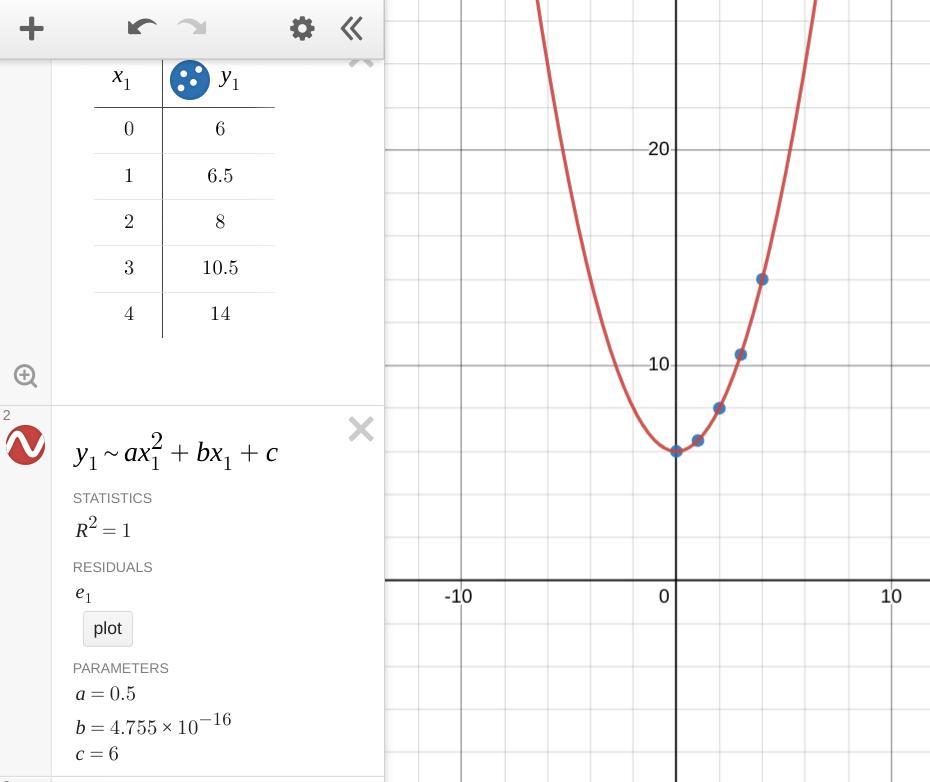
Find THe QUADRATIC equation 100 POINTS PLS HELP: (0,6),(1,6.5),(2,8),(3,10.5),(4,14)
Answers
Answer:
y = 1/2x^2 +6
Step-by-step explanation:
The quadratic regression function of a calculator or spreadsheet is useful for this purpose. It shows you the equation is ...
y = 1/2x^2 +6
_____
Alternate solution
Another way to approach this is to look at first and second differences of the y-values.
Sequence of y-values:
6, 6.5, 8, 10.5, 14
Sequence of first differences:
0.5, 1.5, 2.5, 3.5
Sequence of second differences:
1, 1, 1, 1
The leading coefficient of the quadratic is half the value of the second differences: a = 1/2. The constant in the quadratic is the y-intercept, the value when x=0. The first point gives that as 6.
__
Now, you can check some other point to see what the linear term coefficient might be:
y = 1/2x^2 +bx +6
For x=2, this is ...
8 = 1/2(2^2) +b(2) +6 = 8 +2b . . . . . substitute (x, y) = (2, 8), simplify
0 = 2b ⇒ b = 0
Then the quadratic is ...
y = 1/2x^2 +6
_____
Additional comment
You may not know the relation between second differences and the leading coefficient. The most general way to solve this is to write three equations in the unknown coefficients. Since y has integer values for x=0, 2, 4, you may want to use these. For (x, y) = (0, 6), (2, 8), and (4, 14), you have ...
y = ax² +bx +c
6 = 0a +0b +c8 = a(2²) +b(2) +c14 = a(4²) +b(4) +cAfter finding c=6 in the first equation, you have two equations in 2 unknowns:
2 = 4a +2b ⇒ 2a +b = 18 = 16a +4b ⇒ 4a +b = 2The solution to these is a=1/2, b=0, as above.
Related Questions
Pls, help! A standard number cube with the numbers 1 through 6 is rolled. Find the probability of rolling a number less than 3. Find the probability of not rolling a number less than 3.
1/3; 2/3
1/2; 1/2
5/6; 1/2
1/6; 5/6
Brainlist for positive attitude and correct answer :D
Answers
Answer: The correct answer is:
Probability of rolling a number less than 3: 2/6 or 1/3
Step-by-step explanation:
Explanation: Out of the six possible outcomes (numbers 1, 2, 3, 4, 5, 6), there are two outcomes that meet the condition of rolling a number less than 3, which are 1 and 2. Therefore, the probability of rolling a number less than 3 is 2 out of 6, which simplifies to 1/3.
Probability of not rolling a number less than 3: 4/6 or 2/3.
Explanation: To find the probability of not rolling a number less than 3, we consider the outcomes that are not favorable (i.e., rolling a 3, 4, 5, or 6). There are four such outcomes, so the probability of not rolling a number less than 3 is 4 out of 6, which simplifies to 2/3. :D
14m + 5i - 6s + 7s - 8i + 11s - 9s - 4i + 10p - 3p + 5i
There are (Fill in the blank) different terms in the expression above.
Answers
I'm not sure how to do these, slader is no assistance to me.

Answers
Answer:
Perimeter: 18 ft
Height: 7 ft
Base Area: 12
Surface Area: (7)*(8) + 2(47) = 150
Step-by-step explanation:
To find the perimeter add all the edges together.
5 + 5 + 8 = 18
To find the height look at the diagram. 7ft shows the height of the rectangle and thus is the height for the rest of the shape.
Base Area:
Multiply the length (8ft) of the base by the height of the base (3ft)
8 * 3 = 24
Then divide by 2 to get the total area of the triangle
24 / 2 = 12.
Surface Area:
To find the surface area you to need to find the specifics of each side.
The base area we already solved for which is 12. We'll get back to this in a minute. The other double sides are of 5 * 7. That equals 35. Add together 12 + 35 to get 47. That is what will go in the 2(___) box because both of those sides have 2. It is the same number when done this way versus just adding them up.
47 * 2 = 94
12 + 12 + 35 + 35 = 94
Then for the (___)(___) that would be 7ft * 8ft because it is the only side left and does not have a double so it must be separate.
7 * 8 = 56
56+94 = 150
Tommy must inspect a bridge that goes over a river. He begins 18 feet above water level to inspect the lighting, descends 32 feet to inspect the base of the bridge underwater, then descends another 4 feet to check on the concrete anchoring the base. Which best represents Tommy's position with respect to the water level?
Answers
Answer:
18 - 32 = -14
-14 - 4 = -18
Step-by-step explanation:
Hall swam 34 laps in 1 2/3 hours. Find his swimming rate in laps per hour
Answers
5/3 ÷ 5/3 = 1
34 ÷ 5/3 = 34 x 3/5
102/5 = 20.4
20.4 laps per hour
1 2/3 =1.66
They swam 34 laps so take 34 and divide it by 1.66
34/1.66= 20.48
So his swimming rate is 20.48 laps per hour
A theater company has raised $810.75 by selling 15 floor seat tickets. Each ticket costs the same.
Part A: Write an equation with a variable that can be solved to correctly find the price of each ticket. Explain how you created this equation. (5 points)
Part B: Solve your equation in Part A to find the price of each floor seat ticket. How do you know your solution is correct? (5 points)
Answers
Let's assume the price of each floor seat ticket is represented by the variable 'x'.
Since the theater company has raised $810.75 by selling 15 floor seat tickets, we can create an equation using the concept of total revenue. The total revenue is calculated by multiplying the price of each ticket by the number of tickets sold.
Therefore, the equation can be written as:
15x = 810.75
In this equation, '15x' represents the total revenue from selling 15 tickets at the price of 'x' per ticket, and '810.75' represents the total amount of money raised.
Part B:
To solve the equation 15x = 810.75, we need to isolate the variable 'x' on one side of the equation.
Dividing both sides of the equation by 15, we have:
x = 810.75 / 15
Evaluating the division, we find:
x ≈ 54.05
Therefore, the price of each floor seat ticket is approximately $54.05.
To confirm the solution, we can substitute the value of 'x' back into the original equation:
15 * 54.05 ≈ 810.75
This equation holds true, as the left side is approximately equal to the right side. Hence, we can conclude that the solution is correct.
I hope this helps! :)
Part A: 15x= $810.75. Part B: x= $54.05
The total money earned from 15 tickets is $810.75.
Assume, the money earned from selling 1 ticket is $x.
Therefore, the money earned from selling 15 tickets= 15*x= 15x= $810.75
Here, the variable, i.e. the changing value, is x which is the price of each ticket. The equation hence derived is 15x= $810.75.
Using the equation above,
15x= $810.75.
Dividing both sides by 15,
We get,
x= $54.05
Hence, $54.05 is the price of each ticket.
To learn more about linear equations with single variable:
https://brainly.com/question/28555579
if you rolled two dice what is the probability that you would roll a sum of 10
Answers
The probability of rolling a sum of 10 with two dice is 1/12.
What is probability?Probability is a measure of the likelihood of an event to occur. Many events cannot be predicted with total certainty. We can predict only the chance of an event to occur i.e., how likely they are going to happen, using it.
Given that two dice are rolled and find the probability of a sum of 10.
The sample space of the event of rolling two dice is
S = {(1, 1), (1, 2), (1, 3), (1, 4), (1, 5), (1, 6),
(2, 1), (2, 2), (2, 3), (2, 4), (2, 5), (2, 6),
(3, 1), (3, 2), (3, 3), (3, 4), (3, 5), (3, 6),
(4, 1), (4, 2), (4, 3), (4, 4), (4, 5), (4, 6),
(5, 1), (5, 2), (5, 3), (5, 4), (5, 5), (5, 6),
(6, 1), (6, 2), (6, 3), (6, 4), (6, 5), (6, 6)}
The total possible outcomes is 36.
The favorable outcomes that is the outcomes where the sum is 10 is
(1, 4), (2, 3), (3, 2).
The number of favorable outcomes are 3.
To find the probability of rolling a sum of 10 with two dice, write the sample space and then determine the number of favorable outcomes that is the outcomes where the sum is 10 and the total number of possible outcomes.
The formula to find out the probability of any event is:
\(\text{P(event)} = \dfrac{(\text{number of favorable outcomes})}{\text{total number of possible outcomes}}\)
By using the data and formula, the probability of rolling a sum of 10 is,
\(\text{P(event)} = \dfrac{(\text{number of favorable outcomes})}{\text{total number of possible outcomes}}\)
\(\text{P(rolling a sum of 10)} = \dfrac{3}{36}\)
On dividing both numerator and denominator by 3 gives,
\(\text{P(rolling a sum of 10)} = \dfrac{1}{12}\)
Hence, the required probability of rolling a sum of 10 with two dice is 1/12.
To know more about probability, visit:
https://brainly.com/question/31828911
The probability that you would roll a sum of 10 if you rolled two dice is 1/12.
We need to consider all the possible outcomes and count the favorable outcomes to determine the probability of rolling a sum of 10 when rolling two dice.
When rolling two dice, each die has six possible outcomes, ranging from 1 to 6. To find the total number of outcomes, we multiply the number of outcomes for each die: 6 * 6 = 36.
Next, we need to count the number of favorable outcomes, which are the combinations of two dice that result in a sum of 10. These combinations include:
1. Rolling a 4 on the first die and a 6 on the second die: (4, 6)
2. Rolling a 5 on the first die and a 5 on the second die: (5, 5)
3. Rolling a 6 on the first die and a 4 on the second die: (6, 4)
There are three favorable outcomes.
Therefore, the probability of rolling a sum of 10 when rolling two dice is:
Probability = (Number of favorable outcomes) / (Number of total outcomes) = 3/36 = 1/12.
Hence, the probability is 1/12.
To know more about probability, click:
brainly.com/question/30034780
Marcus tried to solve an equation step by step.
2.5b=5
Step 1- 2.5b 5
----- = ------
2.5 2.5
Step 2- b=3
In which step did marcus make a mistake:
A - Step 1
B- Step 2
C- Marcus did not make i mistake
Answers
Answer:
b
hope this helps :)
Which inequalities would have an open circle when graphed? Check all that apply.
t Less-than-or-equal-to 25
-2.5 Less-than-or-equal-to m
x > 5.4
One-half less-than x
x > 0
Answers
An open circle is used to graph strict inequalities, which means the inequality does not include the value at the boundary. The inequalities that would have an open circle when graphed are:
x > 5.4
One-half less-than x
x > 0
if an inequality states less than OR equal to that means the circle will be closed when graphed
The temperature of a city changed by a total of −24 degrees Celsius over a 6-week period. The temperature changed by the same amount each week.
Part A: Write an expression to show the average change in the temperature of the city each week. (5 points)
Part B: Simplify the expression and explain, using words, what your answer means. (5 points)
Answers
Answer:
Multple included
Step-by-step explanation:
Part A. the answer would be −4 since −24 divided by 6 would equal −4 (-24/6=?)
For Part B you can write:that passed week, the change of temperature would to −4 degrees, so than after period of 6 weeks, the change of temperature should be 4∗(−6)=−24 degrees.
Im 95% sure this is correct. :)
Answer:
Step-by-step explanation:
4
please write a function for the points (1/3,0) (-2 3/4,0) and (0,-5) and explain the steps.
thank you!
Answers
The function for the points are y = -15x - 5
How to determine the functionFrom the information given, we have that;
The points are;
(1/3,0) (-2 3/4,0) and (0,-5)
Using the point-slope form of a linear equation, we have;
y - y₁ = m(x - x₁)
Such that;
m is the slope of the liney - y₁ and (x - x₁) are the pointsUsing (1/3, 0) and (0, -5), we have that the slope is;
m = (0 - (-5))/0 -1/3)
expand the bracket
= 5 / (-1/3)
= -15
Now, take any of the given points and substitute the values
Using (1/3, 0), we get;
y - 0 = -15(x - 1/3).
y = -15x - 5.
Learn more about functions at: https://brainly.com/question/25638609
#SPJ1
The function for the points solved by (1/3,0) (-2 3/4,0) and (0,-5) solved by point slope form is \(a=-15b-5\)
We have given the points:
(1/3,0) (-2 3/4,0) and (0,-5)
Using the formula of linear equation
\(a-\)\(a_{1}\)\(=x[b-b_{1}]\)
Where we will consider (1/3,0) = \(a-a_{1}\) and (0,-5) = \(b-b_{1}\)
that is 1/3 = \(a\), 0 = \(a_{1}\) and
0 = \(b\), -5 = \(b_{1}\)
\(x\) refers to the slope of line (take any variable)
Now for finding the value of \(x\),
\(x=a-a_{1}/b-b_{1}\)
inserting the values,
\(x=[0-[-5]]/[0-1/3]\\x= -15\)
Substitute the value of \(x\) in the equation
\(a-0=-15[b-1/3]\)
By simplifying the equation, we get
\(a=-15b-5\)
To know more about functions and points:
https://brainly.com/question/30721594
Which product is negative? will mark brainliest

Answers

Neg*neg=pos
1. Has two neg and two negs make a pos
2. Has 4 neg which will also make pos
3. Has 3 neg. The first 2 will cancel out and make a pos but the last one will make the answer neg
4. Would just be 0 because its multiplying 0 but without it it would be neg.
So the answer is the third one
88. Referring to the figure, Mrs. Hawkins took four slips of paper
and wrote a different student's name on each. Two of the names were
boys and two girls. She put the four slips of paper in a bag and said
she is going to draw two slips out. She then drew the tree diagram
to show the different outcomes that are possible. "B" represents a
boy's name and "G" represents a girl's name. What is the theoretical
probability that the teacher draws two names that are the same sex?
a. 1/6 c. 1/3
b. 2/3 d. 1/12

Answers
Answer:
a. 1/6
Step-by-step explanation:
I just counted the 12 outcomes and the 2 same sex possibilities, which would turn to 2/12, and then simplified it into 1/6. I hope this is right, I am very sorry if it isn't.
Interpreting graphs of functions
8th grade math
15 points for correct answer


Answers
Answer:
The hourly charge for the first three hours is 4 dollars. The hourly charge for the next three hours is 2 dollars. The hourly charge for the next four hours is 1 dollar. The maximum price of the bike rental is 30 dollars.
Step-by-step explanation:
Looking at the graph, we see that the slope, which is the bike rental price per hour, is constant for the first three hours. Then, it changes and remains constant between the 3rd and 6th hour. After that, it changes and remains constant between the 6th and 10th hours. Finally, the cost becomes a constant after 10 hours, meaning the slope becomes 0. This is consistent with the information given in the answer section. Now, we can proceed with the problem.
We have to remember that the slope of the graph is the hourly charge because the y-axis is the cost and the x-axis is the time.
The first part of the question deals with the first three hours. Between hour 0 and hour 3, the price goes up from 8 to 20. We can calculate the slope (m) by calculating the rise over the run (divide the difference in the prices by the difference in the hours):
\(m=\frac{20-8}{3-0}=\frac{12}{3}=4\)
We can also see visually that the price goes up by 4 for every hour. Either way, the hourly charge for the first three hours is 4 dollars
Between hours 3 and 6, which is the second part of the question, the price goes from 20 to 26. Here is the calculation of the slope:
\(m=\frac{26-20}{6-3}=\frac{6}{3}=2\)
Therefore, the hourly charge for the next three hours is 2 dollars
Between hours 6 and 10, which is the third part of the question, the price goes from 26 to 30. Here is the calculation of the slope:
\(m=\frac{30-26}{4-0}=\frac{4}{4}=1\)
Therefore, the hourly charge for the next four hours is 1 dollar
Finally, after hour 10, the price consistently stays at 30. The slope is 0 because the line on the graph is horizontal. The horizontal line is also the maximum portion of the graph. Therefore, the maximum price of the bike rental is 30 dollars.
It is financial literacy. i need help with just 2 questions


Answers
Answer:
1) cash
2) automatic payment
help this will help me

Answers
Answer:
the arrow that says cool because warm air rises and cool air sinks
and tha arrow that says land breeze
Step-by-step explanation:
Answer:
The arrow that says, "cool."
The arrow that says, "land breeze."
Step-by-step explanation:
Warm air will rise and cool air will sink.
Which set describes the number below?

Answers
Answer:
A: Correct
It needs more characters so here ya go
The tape diagram below represents 100\%100%100, percent.
What percent is represented by the shaded area?
Answers
Answer:
Step-by-step explanation:
Well the answer is 40 cause you count by 20 so if you in 20 t o times then you would get 40 percent
Which scenario can be modeled by the linear function
y = -15x + 500?
A. The temperature on Jupiter is
15℉ and increases by 500℉ every day.
B. There is a population of 500 giraffes in Western Africa that decreases by 15 giraffes each year.
C. A carpet cleaning service charges $500 plus an additional $15 for every hour.
D. A membership fee for a movie streaming service is free, but each rental costs $15.
Answers
Write an equation in slope-intercept form for the line that satisfies the following condition.
passes through (8, 10), parallel to the graph of y = x +7.
Select one:

Answers
Answer:
y=8/3x-34/3
Step-by-step explanation: If the line is parallel to y=8/3x+7, then the slope must be 8/3. So, we can eliminate A and B. Now, let's take C, and plug in (8, 10) into the equation. We end up with 10=64/3-34/3. 64-34=30. 30/3=10. 10 = 10. So, C is the correct answer. No need to check for D.
The box plots below show the heights (in centimeters) of the players on the University of Maryland women's basketball and field hockey teams.
Which pieces of information can be gathered from these box plots?


Answers
Gotta add more words
Answer:
IT is A and B
Step-by-step explanation:
It is on khan academy
what is the volume of the right triangular prism below? 9yd 6yd 21yd

Answers
Answer:
36 yd
Step-by-step explanation:
Answer:36 yd
Step-by-step explanation:
please help with this simple question i will give brainly

Answers
2) Sarah is speeding on the highway at a constant rate. She moves out of the fast lane to the regular one and drives at a constant speed. She sees a cop and slows down for the rest of the drive.
Can anybody give me an easy way to use prime factorization plssss
Answers
Answer: Step 1: Divide the given number by the smallest prime number. ...
Step 2: Again, divide the quotient by the smallest prime number.
Step 3: Repeat the process, until the quotient becomes 1.
Step 4: Finally, multiply all the prime factors.
Step-by-step explanation:

Find the area of the figure

Answers
Step by step: make it into two shapes by drawing a line through the shape which would be a square and a triangle. Area of square is bxh so 8x10=80
Area of triangle is 1/2(bxh) so 1/2(4x5)=10
80+10=90
Answer:
its b
Step-by-step explanation:
8*5=40
4*5=20/2=10
8*5=40
40+40+10=90
b is 90
i need help pls and explainnnnn

Answers
Steps:
Volume of a cylinder- V = π * r^2 * h
146.952 = π * 3^2 * h
146.925 = π * 9 *h
146.925 = 28.2743338823 * h
146.925 / 28.2743338823 = h
5.19640889201 = h
5.2 = h
A rectangular prism has a surface area of 448 cm2. It’s length is 14 cm and it’s width is 6 cm. Find the height.
Answers
Given:
Length, l = 14 cmBreadth, b = 6 cmArea of rectangular prism ( cuboid ) = 448 cm²To find out:
Find the height, h ?
Formula used :
Area of rectangular prism ( cuboid ) = 2 ( lb + bh + hl )
Solution:
We know that that,
Area of rectangular prism ( cuboid ) = 2 ( lb + bh + hl )
=> 448 = 2 ( 14 × 6 + 6 × h + h × 14 )
=> 448 = 2 ( 84 + 6h + 14h )
=> 448 = 2 ( 84 + 20h )
=> 448 = 168 + 40h
=> 40h = 448 - 168
=> 40h = 280
=> h = 280/40
=> h = 7 cm
Which number sentence is true?
A) √12 > -5.2
B) 78/5 > 15.6 x 10²
C) √35 > 7 8/9
D) -3 1/8 -81/6
Answers
Answer:
a) is true
and you did not state question D well
Step-by-step explanation:
PLEASE HELP I HAVE NO CLUEEE

Answers
Answer:
125000
Step-by-step explanation:
Answer:
1,125,000
Step-by-step explanation:
So first you take 75% which is 3/4 of 100%.
Then multiply 375,000 by 3 to get 1,125,000.
Hope this explanation helps ! :)
The perimeter of ΔPQR below is 55 units. What is the length of side QR?
Answers
Answer:
Pic plz?
Step-by-step explanation: