Express the area of the entire rectangle. your answer should be a polynomial in standard form. x+6 x+2 area=
Answers
The formula for the area of a rectangle is length times width, or in this case (x+6)(x+2) or x^2 + 8x + 12 in standard form.
To simplify this expression, we can use the distributive property to multiply the two binomials:
(x+6)(x+2) = x(x+2) + 6(x+2)
= x² + 2x + 6x + 12
= x² + 8x + 12
To express the area of the entire rectangle, we need to multiply the length (x + 6) by the width (x + 2). This will give us a polynomial in standard form.
Step 1: Write down the expression for the area of the rectangle.
Area = (x + 6)(x + 2)
Step 2: Use the distributive property (also known as the FOIL method) to expand the expression.
Area = x(x + 2) + 6(x + 2)
Step 3: Continue to expand and simplify the expression.
Area = (x² + 2x) + (6x + 12)
Step 4: Combine like terms.
Area = x² + 8x + 12
So the area of the entire rectangle is expressed as the polynomial x² + 8x + 12 in standard form.
Know more about area here:
https://brainly.com/question/27683633
#SPJ11
Related Questions
find the center and radius of the circle: (x+9)^2+(y-6)^2=25
Answers
Answer:
The center is (-9,6) and the radius is 5
Step-by-step explanation:
We can write the equation of a circle as
(x-h)^2+(y-k)^2=r^2
where (h,k) is the center and r is the radius
(x - -9)^2+(y-6)^2=5^2
The center is (-9,6) and the radius is 5
Circle equation: (x - h)^2 + (y - k)^2 = r^2
(h, k) is the center.
r is the radius.
(h, k) in the given equation is (-9, 6). This is the center.
We need to take the square root of 25 since the formula has r^2.
√25 = 5
So, the radius is 5.
Best of Luck!
Here are the ingredients to make 12 cookies.
300g flour
120g butter
100g sugar
Billy only has 200g of flour to make cookies.
How much butter should he use?
Answers
120/1.5 = 80g
Which statement about the point (2, 0) is true?
A coordinate plane.
It is on the origin.
It is in Quadrant I.
It is on the x-axis.
It is on the y-axis.
Answers
\(\qquad \qquad\huge \underline{\boxed{\sf Answer}}\)
The Correct choice is : C
\(\qquad \sf \dashrightarrow \: it \: \: is \: \: on \: \: the \: x - axis\)
As we can observe, the y - coordinate ( ordinate ) of the given point (2 , 0) is 0. so it's obvious that it's distance from x - axis is Zero. In other words we can say that the point is lying on x - axis.
Answer:
answer is C
it's on the x-axis
Step-by-step explanation:
hope t his helps!
The 10 students in the Environmental Club represent 10% of the students in the seventh grade. How many students are in the seventh grade?
Answers
Answer:
100 students
Step-by-step explanation:
10% of students in 7th grade ----- 10 students
Divide by 10 on both sides:
1% of students in 7th grade ----- 10 ÷10= 1 student
×100 on both sides:
100% of students in 7th grade ----- 1 ×100= 100 students
Answer:100
Step-by-step explanation:
is the square root of 23 rational or irrational
Answers
Which expressions are equivalent to one-third 8 d startfraction 5 over 7 endfraction? check all that apply. 1 3 8 d 5 7 8 d one-third startfraction 5 over 7 endfraction startfraction 1 over 7 endfraction 8 d startfraction 5 over 3 endfraction one-third startfraction 5 over 7 endfraction 8 d 3 8 d 7 8 d one-third startfraction 7 over 5 endfraction startfraction 5 over 7 endfraction one-third 8 d
Answers
multiply Start Fraction 5 Over 7 End Fraction by 3.
What do math fractions mean?
An element of a whole is a fraction. In mathematics, the number is represented as a quotient, where the numerator and denominator are divided. Both are integers in a simple fraction.
Whether it is in the numerator or denominator, a complex fraction contains a fraction.
The numerator and denominator of a correct fraction are opposite each other.
What is basic fraction theory?
Every fraction has two components: the numerator, which is the actual number of parts, and the denominator, which is the total number of parts.
Learn more about fraction
brainly.com/question/10708469
#SPJ4
Answer:
c is the answer i took the test
Step-by-step explanation:
Clock a runs 1 minute fast per hour. Clock b runs 7 minutes slow per day. If the clocks show the same time at noon, how many minutes ahead of clock b will clock a be 48 hours later?.
Answers
The answer is, 720 minutes ahead of clock b will clock a be 48 hours later.
How to read time?
The three hands on the clock's face display the time in hours, minutes, and seconds. The hour hand, minute hand, and second hand all display the hours, minutes, and seconds respectively.
A clock has 12 large divisions that are marked. Each of the large divisions has five smaller divisions. For a minute, the little separation remains in place. Five minutes have elapsed once the minute hand transitions from one large division to the next.
we will get after 360 hrs, clocks A and B will both have the same time.
Clock A will show the correct time, whereas clock B will be running faster by 12 hrs and therefore show the same time. A clock that moves forward by 12 hours will appear to display the same time once more. 12hours*60minutes/hour= 720 minutes.
Hence the answer will be 720 minutes.
Learn more about time, by the following link.
https://brainly.com/question/17146782
#SPJ4
Solve this for brainliest
y = x + a
make x the subject
Answers
Answer:
x = y - a
Step-by-step explanation:
y = x + a ( subtract a from both sides )
y - a = x
Answer:
x = y - a
Explanation:
y = x + a
y - a = x + a - a
x = y - a
The level of significance in hypothesis testing is the probability of
a. accepting a true null hypothesis
b. accepting a false null hypothesis
c. rejecting a true null hypothesis
d. could be any of the above, depending on the situation
9. (1 point)
In hypothesis testing, the critical value is
a. a number that establishes the boundary of the rejection region
b. the probability of a Type I error
c. the probability of a Type II error
d. the same as the p-value
Answers
The level of significance in hypothesis testing is the probability of: c. rejecting a true null hypothesis. In hypothesis testing, the critical value is:
a. a number that establishes the boundary of the rejection region.
Probability is a branch of mathematics in which the chances of experiments occurring are calculated. It is by means of a probability, for example, that we can know from the chance of getting heads or tails in the launch of a coin to the chance of error in research. In statistics , a null hypothesis is a statement that one seeks to nullify with evidence to contrary most commonly it is a statement that the phenomenon being studied produces no effect on makes no difference.
Learn more about probability here, https://brainly.com/question/15980493
#SPJ11
Solve for the right triangle.A=56° 41’, c= 253m, C=90°Draw the right triangle.Round side lengths to two decimal places if necessary.I believe they are looking for angle a, B and b since they have B, C and c.
Answers
Given the right triangle:
First, we know that ∡A and ∡B are complementary angles
\(\begin{gathered} \measuredangle B=90\degree-\measuredangle A \\ \Rightarrow\measuredangle B=90\degree-56\degree41^{\prime} \\ \Rightarrow\measuredangle B=33\degree19^{\prime} \end{gathered}\)Now, using the trigonometric functions:
\(\begin{gathered} \sin A=\frac{a}{c} \\ \sin B=\frac{b}{c} \end{gathered}\)Finally, using the values of A, B, and c to find a and b:
\(\begin{gathered} \sin 56\degree41^{\prime}=\frac{a}{253}\Rightarrow a=211.42\text{ m} \\ \sin 33\degree19^{\prime}=\frac{b}{253}\Rightarrow b=138.96\text{ m} \end{gathered}\)Summarizing:
\(\begin{gathered} \measuredangle A=33\degree19^{\prime} \\ a=211.42\text{ m} \\ b=138.96\text{ m} \end{gathered}\):

How do you write a slope parallel to a line?

Answers
Answer:
slope is m. Parallel means it has the same slope as the line it's parallel to. Let's say the slope of line 1 is 3, and your y intercept is 12. The equation would then be y = 3x + b and b would be 12 bc x would be 0 at y intercept making the equation become y = (0)x+b and for y to be 12, b has to be 12 in this case. So y = 3x + 12
The difference of the range and the interquartile range of the data set represented by the box plot is ______.

Answers
Answer:
10
Step-by-step explanation:
==>The range of the data set is the difference between the largest value of the data set (34) and the smallest value of the data set (16).
Range = 34 - 16 = 18
==>The interquartile range is the difference between the Q3 and the Q1.
Q3 = 29 (the data set value at the end of the box to our right)
Q1 = 21 (the data set value at the beginning of the box on our left)
IQR = 29 - 21 = 8
==>The difference between the range and the IQR = 18 - 8 = 10
If you want to be 95 confident of estimating the population proportion within a sampling error of +- .02 and there is historical evidence that the population proportion is approximately 0.40, what sample size is needed?
Answers
If you want to be 95 confident in estimating the population proportion within a sampling error of +- .02 and there is historical evidence that the population proportion is approximately 0.40, 2304 is the sample size which is needed.
To determine the sample size needed for a 95% confidence level when estimating the population proportion within a sampling error of ±0.02, we can use the formula for sample size in proportion estimation:
n = (\(Z^2\) * p * (1-p)) / \(E^2\)
where:
- n is the sample size
- Z is the Z-score corresponding to the desired confidence level (1.96 for 95% confidence)
- p is the historical population proportion (0.40)
- E is the desired sampling error (0.02)
Step 1: Identify the values for the formula
Z = 1.96 (for 95% confidence)
p = 0.40
E = 0.02
Step 2: Plug the values into the formula
n = (\(1.96^2\) * 0.40 * (1 - 0.40)) / \(0.02^2\)
Step 3: Calculate the sample size
n = (3.8416 * 0.40 * 0.60) / 0.0004
n = 0.9216 / 0.0004
n ≈ 2304
Therefore, you would need a sample size of approximately 2304 to be 95% confident in estimating the population proportion within a sampling error of ±0.02.
To learn more about sampling error, refer:-
https://brainly.com/question/14382279
#SPJ11
Write 100 + 2 + 0.09 in standard form
Answers
Just add them up
Zelda has a utility function u(x,y)=min{0.2x,1.5y}, for baskets containing the goods x and y. What is Zelda's utility if she consumes a basket where (x,y)=(20.5, 26)? 0.3 1.5 3.9 4.1 A consumer prefers to consume exactly 1 unit of x with each unit of y. If the price of x is $15 and the price of y is $5, and she has income of $250, what is the optimal amount of good x ∗
to consume? 14.5 9.5 11.0 12.5
Answers
Zelda's utility, based on her utility function u(x,y) = min{0.2x, 1.5y}, when consuming a basket with (x,y) = (20.5, 26), is 3.9. In another scenario where the consumer prefers to consume exactly 1 unit of x with each unit of y, the price of x is $15, the price of y is $5, and the consumer has an income of $250, the optimal amount of good x* to consume is 11.0.
To determine Zelda's utility when consuming a basket with (x,y) = (20.5, 26), we evaluate her utility function u(x,y) = min{0.2x, 1.5y}. In this case, 0.2x = 0.2 * 20.5 = 4.1, and 1.5y = 1.5 * 26 = 39. Since the minimum of these two values is 4.1, Zelda's utility is 3.9.
In the second scenario, where Zelda prefers to consume exactly 1 unit of x with each unit of y, we need to determine the optimal amount of good x* to consume given the prices of x and y and her income. The consumer's goal is to maximize utility while staying within her budget constraint. The consumer's budget constraint is given by the equation: p_x * x + p_y * y = income, where p_x and p_y are the prices of x and y, respectively.
In this case, the price of x is $15, the price of y is $5, and Zelda's income is $250. Plugging in these values into the budget constraint, we have 15x + 5y = 250. Since Zelda prefers to consume exactly 1 unit of x with each unit of y, we can substitute y = x into the equation, resulting in 15x + 5x = 250. Simplifying, we get 20x = 250, and solving for x, we find x* = 250 / 20 = 12.5.
Therefore, the optimal amount of good x* for Zelda to consume is 12.5 units.
Learn more about budget constraint here:
https://brainly.com/question/33554185
#SPJ11
Please please help!!

Answers
Answer:
y +4 = 1/5(x +5)
Step-by-step explanation:
The equation of a line with slope m through point (h, k) in point-slope form is ...
y -k = m(x -h)
You have m=1/5, (h, k) = (-5, -4). Putting these values into the formula gives ...
y -(-4) = (1/5)(x -(-5))
y +4 = 1/5(x +5)
a poll for a statewide election has a margin of error of percentage points. how many voters should be sampled for a confidence interval? round up to the nearest whole number.
Answers
The number of voters that should be sampled for a confidence interval depends on the desired level of confidence and the margin of error.
A larger sample size generally leads to a smaller margin of error and a higher level of confidence in the accuracy of the results. However, the relationship between sample size and margin of error is not linear, meaning that doubling the sample size will not necessarily halve the margin of error.
To calculate the required sample size, a formula can be used that takes into account the margin of error, level of confidence, and population size.
the number of voters that should be sampled for a confidence interval depends on several factors and cannot be determined without more information.
To determine the required sample size, you can use the following formula:
n = (Z^2 * p * (1-p)) / E^2
Where:
- n is the sample size
- Z is the Z-score (usually 1.96 for a 95% confidence interval)
- p is the estimated proportion of the population (usually 0.5 for the worst-case scenario)
- E is the margin of error (in decimal form)
Hence, without the specific margin of error, we cannot provide the exact sample size needed.
learn more about confidence interval click here:
https://brainly.com/question/20309162
#SPJ11
Sophie invested $26,000 in an account paying an interest rate of 6% compounded continuously. Sydney invested $26,000 in an account paying an interest rate of 5% compounded monthly. After 20 years, how much more money would Sophie have in her account than Sydney, to the nearest dollar?
Answers
Sophie would have $15,786 more than Sydney.
What is the compound interest?We know that the compound interest has to do with the kind of interest that we have to compound but on the principal and the the interest. In this case, we can see that we have;
A = P(1 + r/n)^nt
A = amount
P = principal
r = rate
t = time
n = Number of times compounded
Then we have For Sophie;
A = 26000(1 + 0.06/365)^20 * 365
A = $86315
For Sydney;
A =26000(1 + 0.05/12)^12 * 20
A = $70529
It then implies that; $86315 - $70529
= $15,786
Learn more about compound interest:https://brainly.com/question/14295570
#SPJ1
omg guyzzz where r u
Answers
Answer:
we are here, where have you been...???
Answer:
im at ur frien joe's house
Step-by-step explanation:
Having trouble figuring out this answer

Answers
Answer:
66.6667% decrease
Step-by-step explanation:
Start with the percent change formula:
\(p=\frac{(y_2-y_1}{|y_1|} \times100\)
Substitute values into the equation:
\(p=\frac{(135-81)}{|81|} \times100\)
Simplify:
\(p=\frac{54}{81} \times100\)
\(p=0.67\times100\)
\(p=66.6666666666667%\)
1. randy burgarner earns a gross monthly salary of $3,600.00. to date, he has earned a total of $14,400.00. what is this month's social security tax withholding? what is this month's medicare tax withholding?
Answers
To calculate Randy Burgarner's social security tax withholding, we first need to determine his gross monthly salary. Randy's total earnings to date are $14,400.00. Since we know that his gross monthly salary is $3,600.00, we can divide the total earnings by the number of months worked.
Social security tax withholding is $223.20 and medicare tax withholding for Randy Burgarner is $52.20. The solution to this problem is explained as under.
Total earnings to date: $14,400.00
Gross monthly salary: $3,600.00
Months worked = Total earnings to date ÷ Gross monthly salary
Months worked = $14,400.00 ÷ $3,600.00
Months worked = 4
Randy has worked for 4 months. Now we can calculate the social security tax withholding for this month.
The social security tax rate is 6.2% of the gross salary. To find the social security tax withholding, we multiply the gross monthly salary by the social security tax rate.
Social Security tax rate: 6.2%
Gross monthly salary: $3,600.00
Social Security tax withholding = Gross monthly salary × Social Security tax rate
Social security tax withholding = $3,600.00 × 6.2%
Social security tax withholding = $223.20
Therefore, this month's social security tax withholding for Randy Burgarner is $223.20.
Now let's calculate the Medicare tax withholding for this month.
The Medicare tax rate is 1.45% of the gross salary. To find the Medicare tax withholding, we multiply the gross monthly salary by the Medicare tax rate.
Medicare tax rate: 1.45%
Gross monthly salary: $3,600.00
Medicare tax withholding = Gross monthly salary × Medicare tax rate
Medicare tax withholding = $3,600.00 × 1.45%
Medicare tax withholding = $52.20
Therefore, this month's Medicare tax withholding for Randy Burgarner is $52.20.
Learn more about social security tax here:
https://brainly.com/question/13255138
#SPJ11
Each cat at the animal shelter gets
5/6 pound of food. Allie has 9 1/2
pounds of cat food. How many cats
can Allie feed?
A: 7
B:9
C: 11
D:13
Answers
Answer: C : 11
Step-by-step explanation:
So divide 9 1/2 by 5/6
So the answer is 11,4 and it round off to 11
So the answer is 11 option C
If Kiran solves the equation for p, which equation would result?

Answers
Answer: i have a answer but it is not up there srry
Step-by-step explanation:
15) In a basketball game, Reggie made 11 field goals (shots). Each of the field goals were worth either 2 or 3 points, and Reggie scored a total of 25 points from field goals.
Part A: Let x represent the number of 2-point field goals and y represent the number of 3-point field goals. Write a system of equations in terms of x and y to model the situation.
Part B: Using any method, find how many 2-point and 3-point field goals Reggie made in the game.
Answers
the answer would 2.35 bc or thw way its written
Step-by-step explanation:
its wrong dont put it
let x1, x2 ..., x100 all be independent bernoulli variables, which take a value of 1 with probability 0.5
Answers
Using the normal approximation to the binomial, there is a 0.9713 = 97.13% probability that the sum of these variables is less than 60.
What is the missing information?This problem is incomplete, but researching it on a search engine, it asks the probability that the sum of these Bernoulli variables is of less than 60.
Normal Probability DistributionThe z-score of a measure X of a normally distributed variable with mean \(\mu\) and standard deviation \(\sigma\) is given by:
\(Z = \frac{X - \mu}{\sigma}\)
The z-score measures how many standard deviations the measure is above or below the mean. Looking at the z-score table, the p-value associated with this z-score is found, which is the percentile of X.The binomial distribution is the probability of x successes on n trials, with p probability of a success on each trial. It can be approximated to the normal distribution with \(\mu = np, \sigma = \sqrt{np(1-p)}\).The binomial distribution is a series of n Bernoulli trials with p probability of a success on each trial, hence the parameters for the binomial distribution are given as follows:
n = 100, p = 0.5.
The mean and the standard deviation are given by:
\(\mu = np = 100(0.5) = 50\).\(\sigma = \sqrt{np(1-p)} = \sqrt{100(0.5)(0.5)} = 5\)Using continuity correction, the probability that the sum is less than 60 is P(X < 59.5), which is the p-value of Z when X = 59.5, hence:
\(Z = \frac{X - \mu}{\sigma}\)
Z = (59.5 - 50)/5
Z = 1.9
Z = 1.9 has a p-value of 0.9713.
Hence there is a 0.9713 = 97.13% probability that the sum of these variables is less than 60.
More can be learned about the normal distribution at https://brainly.com/question/24537145
#SPJ1
Please answer correctly !!!! Will mark brainliest !!!!!!!!!!!!!!
Answers
Answer:
5 years old
Step-by-step explanation:
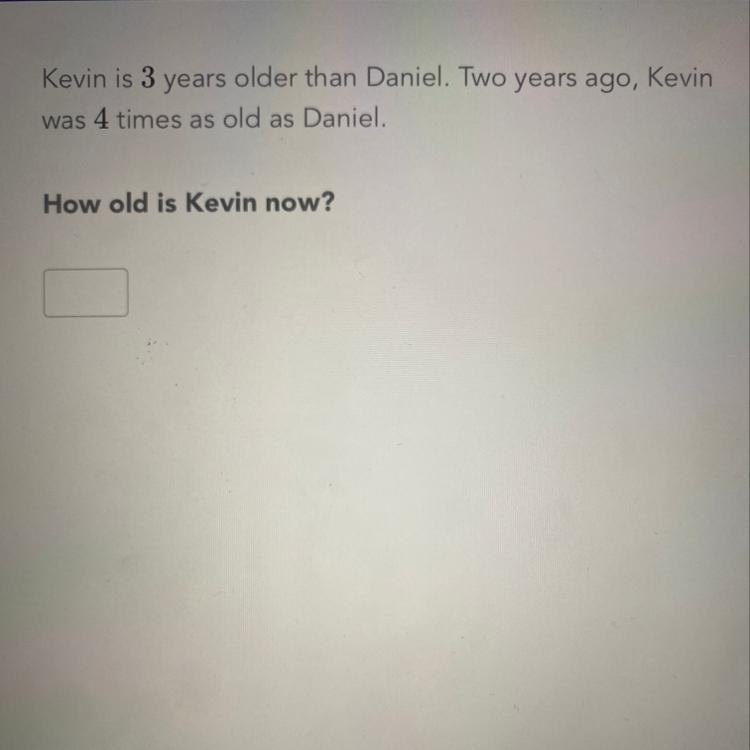
Kevin= k
Daniel= d
k=d+3k-2=(d-2)*4 ⇒ k-2= 4d-8 ⇒ d+3-2 = 4d-8 ⇒ 3d=9 ⇒ d=3 ⇒ k=d+3=5k=5Answer:
Kevin is 6 now
Step-by-step explanation:
K= D+3
2 years ago K-2 =4 (D-2) plug in D+3 for K
D+3-2=4D-8
D+1 =4D-8 rearrange equation by subtracting D and adding 8
9 = 3D
D =3 so K =6
4. From the top of a tower 14m high, the angle of depression of a student is 32° Make a scale drawing and find the distance of the student from the foot of the tower to the nearest 1/2
Answers
The distance of the student from the foot of the tower is 25.63m the nearest 1/2 is 25.5m.
Given that From the top of a tower 14m high
The angle of depression of a student is 32°
we can use trigonometry to find the distance from the foot of the tower to the student:
tan(32°) = opposite/adjacent = 14/distance
Rearranging this equation gives:
distance = 14/tan(32°)
= 25.63m
Therefore, the distance of the student from the foot of the tower is approximately 25.63m nearest 1/2, this is 25.5m.
To learn more on trigonometry click:
https://brainly.com/question/25122835
#SPJ1
we play a game with two fair dice. each has six sides. the first die is a usual one, with numbers on its sides from 1 to 6. the second die however is unusual, because it has a different set of numbers on its sides. if we rollthe two dice together, the sum of the two numbers will be 1, 2, ..., 12 with an equal probability of 1/12 each. what are the numbers on the second die?
Answers
The numbers on the second die are \(0, 1, 1, 2, 2, 3, 3, 4, 4, 5, 5, 6.\)
Given that,
The sum of the two numbers will be \(1, 2, ..., 12\) with an equal probability of \(\dfrac{1}{12}\) each.
For the numbers on the second die, determine a set of numbers that, when combined with the numbers on the first die, will result in an equal probability for each possible sum from 1 to 12.
Let's analyze the possible sums and their corresponding combinations of numbers from the two dice:
Sum 1: The only combination that results in a sum of 1 is (1, 1).
Therefore, the second die should have a side with 1.
Sum 2: The combinations that result in a sum of 2 are (1, 1) and (2, 0).
Since we already have 1 on the second die, the other number should be 1.
Hence, the second die should have a side with 1 and a side with 0.
Sum 3: The combinations that result in a sum of 3 are (1, 2) and (2, 1).
Since we already have 1 on the second die, the other number should be 2.
Hence, the second die should have a side with 1 and a side with 2.
Following this pattern, determine the numbers on the second die as:
Sum 1: 1
Sum 2: 0, 1
Sum 3: 1, 2
Sum 4: 1, 3
Sum 5: 2, 3
Sum 6: 2, 4
Sum 7: 3, 4
Sum 8: 3, 5
Sum 9: 4, 5
Sum 10: 4, 6
Sum 11: 5, 6
Sum 12: 6
Thus, The numbers on the second die are \(0, 1, 1, 2, 2, 3, 3, 4, 4, 5, 5, 6.\)
To learn more about the probability visit:
https://brainly.com/question/13604758
#SPJ12
Please help I need the answers ASAP!



Answers
Answer:
Refer to the step-by-step
Step-by-step explanation:
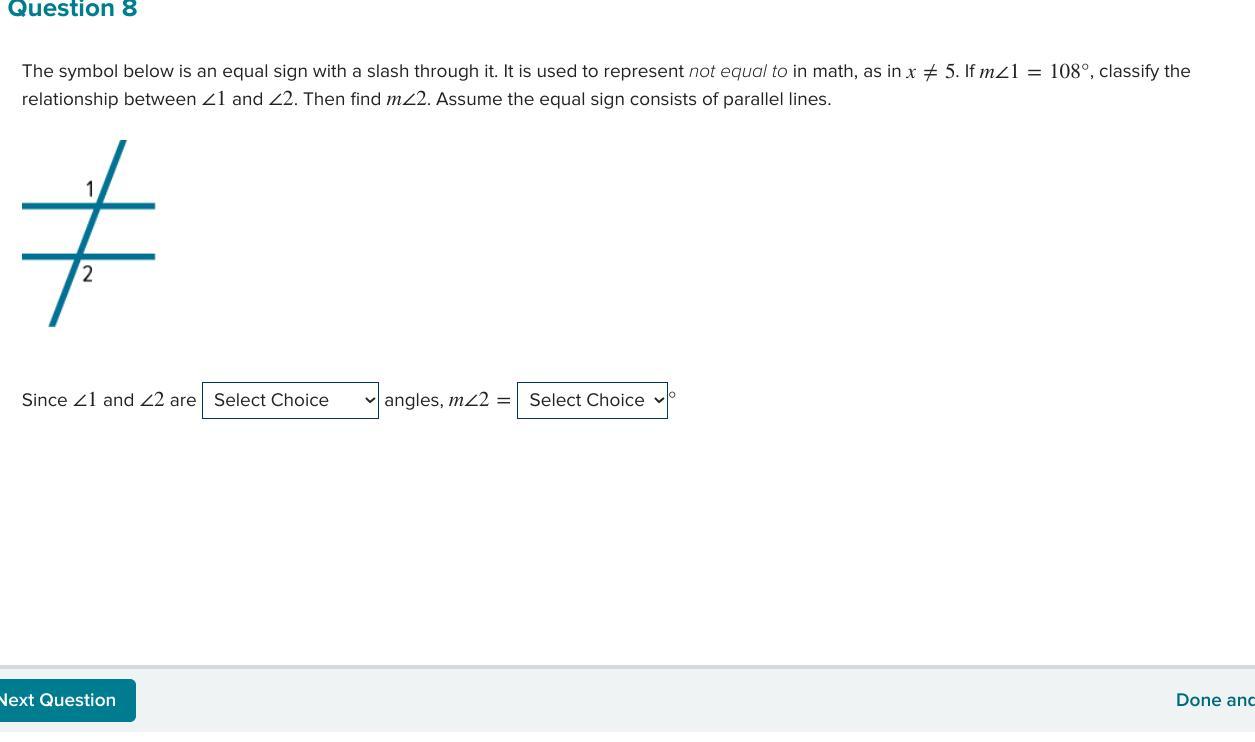
Since ∠1 and ∠2 are alternate exterior angles, m∠2=108°
algebra homework please help :(

Answers
The equivalent of the given expression ⁴√7⁵ × √7³ in exponential form is 7^11/4.
What is the equivalent of the given expression?Given the data in the equation;
⁴√7⁵ × √7³
Since fourth and square roots can be written as power 1/4 and 1/2 respectively.
7^(5 × 1/4) × 7^(3 × 1/2 )
7^(5/4) × 7^(3/2 )
From exponent rule, n^a × n^b = b^(a + b )
7^(5/4 + 3/2 )
7^11/4
The equivalent of the given expression ⁴√7⁵ × √7³ in exponential form is 7^11/4.
Hence, option D) 7^11/4 is the correct answer.
Learn more about exponent rule here: brainly.com/question/219134
#SPJ1