You want to express this number in scientific notation. What is the result? 437,000
Answers
Answer:
So
437,000
In scientific notation he number has to be more then 1 and less then 10
So to make 437,000 more then 1 and less then 9, we can put the decimal between 4 and 3 so we have
4.37000
Of course in scientific notation we hav e to put the power of 10s so we moved back 5 spaces so out scientifc notation is to The power of 5
4.37 * 10^5
Related Questions
Wind and Moisture: To understand how weather and landscape affect the spread of wildfires, an experiment was conducted in a low velocity wind tunnel. A fire was started in pine litter, and the researchers measured the fire spread rate for varying wind speeds and pine litter moisture contents. Data for fires started in pine litter that had a moisture content of 4% are shown in the table below.
Answers
Based on the scatterplot, the form of the relationshipbetween fire spread rate and wind speed can be described as a positive correlation.
How is this so?As wind speed increases,the fire spread rate also tends to increase.
b. Direction -
Based on the given scatterplot,the direction of the relationship between fire spread rate and wind speed appears to be positive.
As the wind speed increases,the fire spread rate generally tends to increase as well.
c. Strength -
The scatterplot suggests a moderate to strong relationship between fire spread rate and wind speed.
The data points exhibit a somewhat linear pattern, indicating that there is a noticeable association between these variables.
The firespread rate tends to increase consistently as the wind speed increases, suggesting a relatively strong positive correlation between the two factors.
Learn more about correlation at:
https://brainly.com/question/13879362
#SPJ1
Full Question:
Wind and Moisture: To understand how weather and landscape affect the spread of wildfires, an experiment was conducted in a low velocity wind tunnel. A fire was started in pine litter, and the researchers measured the fire spread rate for varying wind speeds and pine litter moisture contents.
Data for fires started in pine litter that had a moisture content of 4% are shown in the table below.
Wind Speed (miles/hour) Fire Spread Rate (feet/minute)
0.76 0
1.78 2
3.34 4
5.38 6
8.10 8
11.75 10
16.70 12
A scatterplot of these data is shown here -
1. Based on the scatterplot, how would you describe the following with regard to the relationship between fire spread rate and wind speed?
a. Form:
b. Direction:
c. Strength:

There are 12 inches in 1 foot. Write 75 inches in feet and inches
Answers
7 feet and 9 inches
Answer:6.25
Step-by-step explanation:
Using a calculator or statistical software, find the linear regression line for the data in the table below.
Using the regression with the values rounded to the nearest hundredth, find the value of y at x=7. Round your answer to the nearest hundredth if necessary.
x y
0 2.83
1 3.33
2 6.99
3 8.01
4 7.62
5 7.66
Answers
Rounded to the nearest hundredth, the value of y at \(x = 7\) is approximately \(12.78\), according to the concept of linear regression line.
To find the linear regression line for the given data, we can use statistical software or a calculator. The equation of the linear regression line is of the form \(y = mx + b\), where m represents the slope and b represents the y-intercept.
Using the provided data, the linear regression line equation is:
\(\[ y = 1.3642x + 3.2324 \]\)
To find the value of \(y\) at \(x = 7\), we substitute \(x = 7\) into the equation:
\(\[ y = 1.3642(7) + 3.2324 \]\)
Simplifying the equation, we get:
\(\[ y = 9.5494 + 3.2324 \]\[ y = 12.7818 \]\)
In conclusion, the linear regression analysis allows us to determine the relationship between the variables x and y in the given data set. By finding the equation of the linear regression line, we can estimate the value of y for any given x. In this case, the linear regression line equation is \(y = 1.3642x + 3.2324\). By substituting \(x = 7\) into the equation, we find that the estimated value of y is approximately \(12.78\). This analysis provides a useful tool for predicting and understanding the relationship between variables, allowing us to make informed decisions and interpretations based on the data.
For more such questions on linear regression line:
https://brainly.com/question/30401933
#SPJ8
The question what function matches the graph?
A) linear
B) exponential
C)Geometric
D)Quadratic

Answers
The midpoint of segment AB is M(-2,2). If A is located at (-5,7) find the coordinates of the endpoint B
Answers
Answer:
B (1, -3)
Step-by-step explanation:
Step 1: Use the midpoint formula to find the coordinates of the endpoint:
Normally, we find the midpoint of a segment using the midpoint formula, which is given by:
M = (x1 + x2) / 2, (y1 + y2) / 2, where
M is the midpoint,(x1, y1) are one endpoint on the segment,and (x2, y2) are the other endpoint of the segment.Since we're solving for the coordinates of an endpoint, we can allow (-5, 7) to be our (x1, y1) point and plug in (-2, 2) for M to find (x2, y2), the coordinates of the endpoint B:
x-coordinate of B:
x-coordinate of midpoint = (x1 + x2) / 2
(-2 = (-5 + x2) / 2) * 2
(-4 = -5 + x2) + 5
1 = x2
Thus, the x-coordinate of the endpoint B is 1.
y-coordinate of B:
y-coordinate of midpoint = (y1 + y2) / 2
(2 = (7 + x2) / 2) * 2
(4 = 7 + x2) -7
-3 = y2
Thus, the y-coordinate of the endpoint B is -3.
Thus, the coordinates of the endpoint B are (1, -3).
The tables of ordered pairs represent some points on the graphs of two lines. What is the solution to the system of equations represented by the two lines? There are no zeroes on the chart. What do I do
Answers
To find the solution to the system of equations represented by the two lines based on the given tables of ordered pairs, you can follow these steps:
Examine the tables and identify a pattern or relationship between the x-values and y-values for each line.Determine the slope (rate of change) of each line by calculating the difference in y-values divided by the difference in x-values for any two points on the line.Once you have the slopes, compare them to see if they are equal or different.If the slopes are different, the lines intersect at a single point, which represents the solution to the system of equations.If the slopes are equal, the lines are parallel, and there is no solution to the system of equations.If the slopes are different, you can find the intersection point by solving the system of equations using either substitution, elimination, or another suitable method.For such more question on equations
https://brainly.com/question/22688504
#SPJ8
Given the figure to the right and the fact
that m ZABD = 133', find the measure-
ments of the angles below.

Answers
Answer:
∠ABC = 94°
∠BCD = 25°
∠ACB = 43°
Step-by-step explanation:
∠ABD = 133°
Since △ADC is an isosceles triangle where AD = CD, it means that ∠CBD = 133°
We know sum of angles at a point is 360°.
Thus; ∠ABC = 360 - (133 + 133)
∠ABC = 94°
Now, in △BCD, ∠B = 133° and ∠D = 22°
Sum of angles in a triangle = 180°
Thus; ∠BCD = 180 - (133 + 22)
∠BCD = 25°
Since the △ABC is also an isosceles triangle , it means that;
In △ABC, ∠A = ∠C
Thus; ∠ACB = (180 - 94)/2
∠ACB = 86/2
∠ACB = 43°
Contains (1, −3) and has the same stretch factor as
f(x) = 3x2.
Vertex has x-coordinate of −1.
Answers
The obtained quadratic function has the same stretch factor as the given function and contains the given point is y = 3x² + 6x - 12
What is defined as the quadratic function?A quadratic function is one of the following: f(x) = ax² + bx + c, where a, b, and c are positive integers and an is not equal to zero. A parabola is a curve that represents the graph of a quadratic function.
Because a quadratic function is indeed a parabolic curve, we use the standard parabola equation.
y = a(x - h)² + k
where a = stretch factor,
h = x-coordinate of vertex and
k = y-coordinate of vertex.
The quadratic function incorporates the point (1, -3) and has the vertex x-coordinate at x = -1. h = -1 is the answer.
It also has the stretch factor of f(x) = 3x². So, a = 3.
Thus, y = a(x - h)² + k
y = 3(x - (-1))² + k
y = 3(x + 1)² + k
Now, because the quadratic function proceeds through (1, -3), we have
y = 3(x + 1)² + k
-3 = 3(1 + 1)² + k
-3 = 3(2)² + k
-3 = 3(4) + k
-3 = 12 + k
k = -3 - 12
k = -15
Similarly, find the value for y.
y = 3(x + 1)² + k
y = 3(x + 1)² - 15
y = 3(x² + 2x + 1) - 15
y = 3x² + 6x + 3 - 15
y = 3x² + 6x - 12
Therefore, the equation of the quadratic function that contains the given point and has the same stretch factor as the given function is y = 3x² + 6x - 12.
To learn more about quadratic functions, here:
brainly.com/question/10606041
#SPJ9
The complete question is-
Write the equation of the quadratic function that contains the given point and has the same stretch factor as the given function.
Contains (1, −3) and has the same stretch factor as
f(x) = 3x².
Vertex has x-coordinate of −1.
In 8 hours, Jose can bake 288 cupcakes. How many
cupcakes per hour can he bake?
Answers
Answer:
36
Step-by-step explanation:
What is the present value of R13 000 p.a. invested at the beginning of each year for 8years at 10%p.a. compound interest? (NB Use the compound interest tables provided or work to three decimal places only.)
Answers
Given statement solution is :- The present value of R13,000 per year invested for 8 years at 10% compound interest is approximately R69,776.60.
To calculate the present value of an investment with compound interest, we can use the formula for the present value of an annuity:
PV = A *\((1 - (1 + r)^(-n)) / r\)
Where:
PV = Present value
A = Annual payment or cash flow
r = Interest rate per period
n = Number of periods
In this case, the annual payment (A) is R13,000, the interest rate (r) is 10% per year, and the investment is made for 8 years (n).
Using the formula and substituting the given values, we can calculate the present value:
PV = \(13000 * (1 - (1 + 0.10)^(-8)) / 0.10\)
Calculating this expression:
PV = \(13000 * (1 - 1.10^(-8)) / 0.10\)
= 13000 * (1 - 0.46318) / 0.10
= 13000 * 0.53682 / 0.10
= 6977.66 / 0.10
= 69776.6
Therefore, the present value of R13,000 per year invested for 8 years at 10% compound interest is approximately R69,776.60.
For such more questions on present value
https://brainly.com/question/30390056
#SPJ8
A popular online shaving club charges $12 per month fee plus $1.50 per safety razor you purchase. How many razors can you buy if you spend $27 in 1 month?
Answers
Answer:10 Safety razors
Step-by-step explanation:
27-12=15
15/1.50=10
Evaluate the discriminant for x2-5x+4=0
Answers

If we are on a ship and the two-way travel time for sound to reach the bottom and come back to
the ship is 0.171 seconds, how deep is it here?
256 m
O 256 km
128 m
64 m
1 pt
6.4 m
none of these answers are correct
Answers
===========================================================
Explanation:
According to a few online sources, the speed of sound in water is approximately 1500 meters per second. The actual speed will depend on the the following factors:
Temperature of the waterHow salty it isWater pressureDespite those extra factors, we'll keep things simple and go with the 1500 m/s figure.
The round-trip time for the sound wave is 0.171 seconds. Half of which is 0.171/2 = 0.0855 seconds. This is the amount of time it takes for the sound wave to go from the boat to the bottom of the ocean.
Then,
distance = rate*time
distance = (1500 m/s)*(0.0855 seconds)
distance = 128.25 meters
When rounding to the nearest meter, we get 128 meters
128 meters = 419.948 feet approximately
For comparison purposes,
The Spring Temple Buddha statue (located in China) is about 128 meters tall. It is the second tallest statue in the world.The One Wall Centre (Vancouver Canada) is a 48-story building that is 128 meters tall. If each floor was the same height, then each story is about 128/48 = 2.667 meters = 8.75 feet tall.I found those objects when I searched out "what objects are 128 meters tall".
Find the volume of the cone. Round to the nearest tenth.
10 mm
9 mm
Volume:
mm3

Answers
May i know the answer

Answers
I think it is A but I'm not positive

Answers
Answer:
I'm pretty positive that the answer is A
Use interval notation to answer the following questions.
The domain of this function is ?
The range of this function is ?

Answers
The required domain and the range of the given function are (-2, 3) and (2, -3) respectively.
Given that,
To determine the domain and the range of the function given in the graph.
The domain is defined as the values of the independent variable for which there is a certain value of the dependent variable exists in the range of the function.
Here,
From the graph, the domain of the function is defined for x = -2 to x = 3,
While the range of the graph for a given function is defined for y = 2 to y = -3 corresponding to the domain.
Thus, the required domain and the range of the given function are (-2, 3) and (2, -3) respectively.
Learn more about the domain here: https://brainly.com/question/28135761
#SPJ1
Sam has a deck that is shaped like a triangle with a base of 18 feet and a height of 7 feet. He plans to build a 2:5 scaled version of the deck next to his horse's water trough.
Part A: What are the dimensions of the new deck, in feet? Show every step of your work. (4 points)
Part B: What is the area of the original deck and the new deck, in square feet? Show every step of your work. (4 points)
Part C: Compare the ratio of the areas to the scale factor. Show every step of your work. (4 points)
Answers
The 2 : 5 scaled version of the deck Sam plans to build and the dimensions of the original deck indicates;
Part A; Base length of the new deck = 7.2 feet
Height of the new deck = 2.8 feet
Part B; The area of the original deck is 63 square feet
The area of the new deck is 10.08 square feet
Part C; The ratio of the areas is the square of the scale factor
What is a scale factor?A scale factor is a number or factor that is used to enlarge or reduce the dimensions a shape or size of a figure.
The base length of the triangular deck = 18 feet
The height of the triangular deck = 7 feet
The scale factor for the scaled version Sam intends to build = 2 : 5
Part A; The dimensions of the new deck are;
Base length of the new deck using the the 2 : 5 ratio is; (2/5) × 18 = 7.2 feet
The height of the new deck = (2/5) × 7 = 2.8 feet
Part B; The area of the original deck = (1/2) × 18 × 7 = 63 square feet
Area of the new dec = (1/2) × 7.2 × 2.8 = 10.08 square feet
Part C; The ratio of the areas is; 10.08/63
Ratio of the area = 10.08/63 = 4/25 = 4 : 25
The scale factor is; 2 : 5
Therefore, the ratio of the area is the square of the scale factorLearn more on scale factors here: https://brainly.com/question/28822248
#SPJ1
Evaluate the function when x=1 and 5
g(x)=5-7x step by step
Answers
Answer: (1,-2) , (5,-35)
Step-by-step explanation:
x = 1
1. g(x) = 5 - 7x
This can also be written as g(1) = 5 - 7x
This means that we plug in 1 for all the "x"s. So we get:
g(1) = 5 - 7(1)
7(1) = 7
5 - 7 = -2
x = 1 is true and that means y = -2 (because g(x) also means y
x = 5
1. g(x) = 5 - 7x
This can also be written as g(5) = 5 - 7x
This means that we plug in 5 for all the "x"s. So we get:
g(5) = 5 - 7(5)
7(5) = 35
5 - 35 = -30
x = 5 is true and that means y = -35
I think this is what the question meant, hope this helps!
In 1908, W.S. Gossett performed a sleep study on 10 subjects, comparing the number of hours of sleep obtained by each subject with and without (in that order) the application of the drug hyoscyamine. The paired differences d were as follows: 1.0, 0.8, 1.1, 0.1, - 0.1, 4.4, 1.5, 1.6, 4.6, 3.4 At the 1% significance level, is the drug effective in increasing sleep
Answers
Answer:
Since the calculated value of t= 2.8782 does not fall in the critical region so we accept H0 and may conclude that the drug is not effective in increasing sleep.
Step-by-step explanation:
d d²
1.0, 1
0.8, 0.64
1.1, 1.21
0.1, 0.01
- 0.1, 0.01
4.4, 19.36
1.5, 2.25
1.6, 2.56
4.6, 21.16
3.4 11.56
∑18.4 ∑59.76
1: We state our null hypothesis as
H0 : μd= 0 against the claim Ha: μd ≠ 0
2: The significance level is set at ∝ = 0.01
3: The test statistic under H0 is
t= d`/ sd /√n
4:The critical region is t ≥ t ( 0.005) 9 = 3.250
5:Computation:
d`= ∑d/n= 18.4/10= 1.84
Sd² = ∑(di- d`)²/n-1 = 1/n-1 [∑di²- (∑di)² /n]
= 1/9 [59.76 - (18.4)²/10]
=(59.76 - 33.856)/9
= 25.904/9
= 2.8782
6: Conclusion:
Since the calculated value of t= 2.8782 does not fall in the critical region so we accept H0 and may conclude that the drug is not effective in increasing sleep.
This is because we have taken H0 as the mean of the difference is zero.
This can only be zero when the drug is not effective.
Write an equation that states (x, y) is the same distance from (4, 1) as it is from the x-axis.
Answers
The equation that gives all the points (x, y) that are at the same distance from (4, 1) as from the x-axis is:
y = (1/2)*(x - 4)^2 + 1/2.
How we can find the point (x, y)?
First, remember that for a point (x, y), the distance to the x-axis is equal to y.
And we also know that the distance between two points (x₁, y₁) and (x₂, y₂) is:
\(d = \sqrt{(y_2 - y_1)^2 + (x_2 - x_1)^2}\)
The distance between (x, y) and (4, 1) is:
\(d = \sqrt{(x - 4)^2 + (y - 1)^2}\)
And this must be equal to y, so we can write:
\(y = \sqrt{(x - 4)^2 + (y - 1)^2}\)
This is the equation we need to solve.
We will get:
\(y^2 = (x - 4)^2 + (y - 1)^2\\\\y^2 = (x - 4)^2 + y^2 - 2y + 1\\\\0 = (x - 4)^2 - 2y + 1\\\\2y = (x - 4)^2 + 1\\\\y = (1/2)*(x - 4)^2 + 1/2\)
This equation gives all the points (x, y) that are at the same distance of (4, 1) as from the x-axis.
If you want to learn more about distances between points, you can read:
https://brainly.com/question/7243416
HELPPPPPPPP!!!!!!!!!!!!

Answers
Answer:
able to be believed; convincing. hope this helped
Answer and Step-by-step explanation:
I'm not sure what was in the video, but I do know what this word means.
I would say that usually something that is credible is typically something like an ad. Usually in ads people to to convince and persuade someone to buy or do something that will promote something to happen, usually by buying a company's product.
When evaluating a source, it is important to look for things that indicate whether or not a source is something persuasive, and who the audience of this source is for. For example, if most of a source is opinionated, then it is probably a credible source that is trying to make you buy something.
So, if you are researching an article or information topic, it is important to look for the clues of a source being credible, as I mentioned above.
Once more, I'm not too sure what was in the video, but I hope this helps.
For two n by n square matricies A and B,
suppose rankA = rankB = n-1.
Can rank(AB) become less than n-1 ?
(e.g. rank (AB) = n-2)
If so, I humbly ask you for an example.
Thank you very much.
Answers
No, the rank of the product of two n by n square matrices A and B, denoted as AB, cannot be less than n-1 if both A and B have ranks of n-1.
According to the Rank-Nullity theorem, for any matrix M, the sum of its rank and nullity is equal to the number of columns in M. In this case, the number of columns in AB is n, so the sum of the rank and nullity of AB must be n.
If rank(A) = rank(B) = n-1, it means that both A and B have nullity 1. The nullity of a matrix is the dimension of its null space, which consists of all vectors that get mapped to the zero vector when multiplied by the matrix. Since both A and B have rank n-1, their null spaces consist only of the zero vector.
Now, considering AB, if the rank of AB were less than n-1, it would mean that the nullity of AB is greater than 1.
However, this would violate the Rank-Nullity theorem since the sum of the rank and nullity of AB must be n, which is the number of columns.
Therefore, if rank(A) = rank(B) = n-1, the rank of AB cannot be less than n-1.
For more such questions on rank
https://brainly.com/question/28839672
#SPJ8
(v-7)(v+5)(v-3)=0 solve the quadraticequation
Answers
A quadratic equation, or second-order polynomial equation with a single variable, has the form ax^2 + bx + c = 0. The solution to the given equation is v = 7, -5 and 3
Solving quadratic equations?The form ax^2 + bx + c = 0 is a quadratic equation, which is a second-order polynomial equation in a single variable. a 0. It has at least one solution because it is a second-order polynomial equation, which is guaranteed by the algebraic fundamental theorem. The answer could be simple or complicated.
Given the quadratic expression below:
(v-7)(v+5)(v-3)=0
Required
The solution to the system of equation
Equate each expression to zero calculate the value of 'v' as shown:
v - 7 = 0
v = 0 + 7
v = 7
Also, v + 5 = 0
v = 0 - 5
v = -5
Similarly, v - 3 = 0
v = 0 + 3
v = 3
Hence the solution to the given equation is v = 7, -5 and 3
Learn more on quadratic equation here; https://brainly.com/question/1214333
#SPJ1
Suppose a railroad is 2 kilometers and it expands on a hot day by 11 centimeters in length. Approximately how many meters would the center of the rail rise above the ground?
Answers
the center of the rail would rise above the ground by approximately 0.24 meters, or 24 centimeters.
How to solve?
To solve this problem, we can use the formula for the change in length of an object due to thermal expansion:
ΔL = αLΔT
where ΔL is the change in length, α is the coefficient of thermal expansion, L is the original length, and ΔT is the change in temperature.
We know that the original length of the railroad is 2 kilometers, or 2000 meters, and that the change in length is 11 centimeters, or 0.11 meters. We can also assume that the change in temperature is due to a hot day, which might raise the temperature by 10°C.
The coefficient of thermal expansion for steel, which is commonly used in railroad tracks, is about 1.2 x 10²-5 /°C.
Substituting these values into the formula, we get:
0.11 meters = (1.2 x 10²-5 /°C) x 2000 meters x 10°C
Simplifying this expression, we get:
0.11 meters = 0.24 meters
So the center of the rail would rise above the ground by approximately 0.24 meters, or 24 centimeters.
To know more about Thermal Expansion visit:
https://brainly.com/question/30242448
#SPJ1
1. P(adult and vanilla)2. P(chocolate/adult)3. P(adult/chocolate)4. P(not vanilla/teen)5. P(teen/not vanilla)6. P(neither/teen or adult)7. P(teen or adult/neither)Answer the following problems about two way frequency tables and make sure to reduce your fraction.
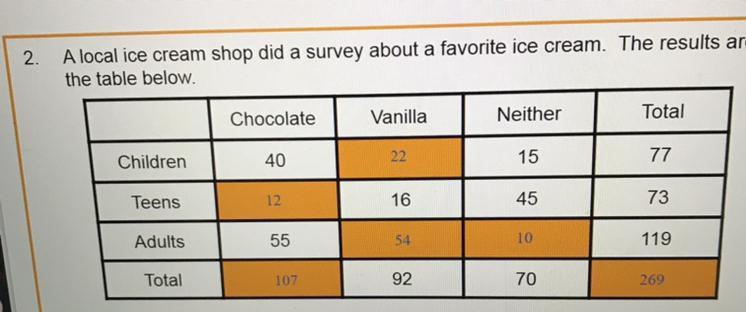
Answers
From the given table, the total number of people, T=269.
1)
The number of adults who like vanila, N=54.
So, P(adult and vanilla) can be found as,
\(P\mleft(adult\text{ and vanilla}\mright)=\frac{N}{T}=\frac{54}{269}\)2)
P(chocolate/adult) can be found as,
\(P\mleft(chocolate/adult\mright)=\frac{P(\text{choclate and adult)}}{P(\text{adult)}}=\frac{\frac{55}{269}}{\frac{119}{269}}=\frac{55}{269}\)3)
\(P\mleft(adult/chocolate\mright)=\frac{P(\text{choclate and adult)}}{P(\text{chocolate)}}=\frac{\frac{55}{269}}{\frac{107}{269}}=\frac{55}{107}\)4)
\(P\mleft(notvanilla/teen\mright)=\frac{P(not\text{ vanilla and t}een)}{P(\text{teen)}}=\frac{\frac{12+45}{2}}{\frac{73}{269}}=\frac{57}{73}\)5)
\(P\mleft(teen/notvanilla\mright)=\frac{P(\text{teen and not vanilla)}}{P(\text{not vanilla)}}=\frac{\frac{12+45}{269}}{\frac{269-92}{269}}=\frac{57}{177}\)6)
\(P\mleft(neither/teenoradult\mright)=\frac{P(\text{neither and teen or adult)}}{P(\text{teen or adult)}}=\frac{\frac{45+10}{269}}{\frac{73+119}{269}}=\frac{55}{192}\)7)
\(P\mleft(teenoradult/neither\mright)=\frac{P(\text{teen or adult and neither)}}{P(\text{neither)}}=\frac{\frac{45+10}{269}}{\frac{70}{269}}=\frac{55}{70}=\frac{11}{14}\)
1. The first quartile (1) of the ages of the 256 employees of CCNHS – Main Campus is 39 years old. What does it imply?
Answers
If the first quartile is 39 years old, it means that approximately one-fourth of the employees at CCNHS – Main Campus are 39 years old or younger.
The first quartile (Q1) of the ages of the 256 employees of CCNHS – Main Campus being 39 years old implies that 25% of the employees have an age equal to or less than 39 years old.
In statistical terms, the first quartile represents the point below which 25% of the data falls. It divides the data set into four equal parts, with each part containing 25% of the data. Therefore, if the first quartile is 39 years old, it means that approximately one-fourth of the employees at CCNHS – Main Campus are 39 years old or younger.
This information provides insight into the age distribution of the employees at the institution. It indicates that a significant portion of the employees are relatively young, with a quarter of them falling below the age of 39. Understanding the age demographics of the workforce can be useful for various purposes, such as planning professional development programs or implementing age-specific policies.
For more questions on quartile
https://brainly.com/question/28169373
#SPJ8
What is the sum of the interior angles of a regular polygon with 9 sides?
1,260°
1,620°
1,800°
1,980°
Answers
The sum of the interior angles of a regular polygon with 9 sides will be 1260°. The correct option is A.
What is the angle of the polygons?An angle is defined in mathematics as the figure formed by joining two rays at their common endpoint. An interior angle is an angle that exists within a shape. Polygons are closed shapes with sides and vertices. All of the interior angles of a regular polygon are equal.
Given that the number of the sides of the polygon is 9. The sum of the interior angles of the polygons will be calculated as,
Sum = ( n - 2 ) 180°
Sum = ( 9 - 2 ) 180
Sum = 7 x 180
Sum = 1260°
To know more about the angle of polygons follow
https://brainly.com/question/14332345
#SPJ1
5. You buy a boat for $35,000 that * 10 points
depreciates in value at about 17%
per year. How much will it be worth
in 3 years?
Your answer
Answers
Answer:
9000
Step-by-step explanation:
how are the probability of an event and the probability of its complement related mathematically
Answers
The relation between the probability of its complement is that their sum is 1.
Complement in probability theory is an essential concept that helps us understand the likelihood of an event not occurring. It is a mathematical term that refers to the opposite or negation of an event.
Complement refers to the probability of an event not occurring, given the probability of it occurring. It is often denoted as the complement of an event A and is represented by A’.
The complement of an event A is defined as the set of all outcomes in the sample space that are not in A.
The probability of the complement of A is equal to the probability of all the outcomes in the sample space that are not in A.
The most important properties of the complement of an event is that the probability of an event and its complement always add up to 1. This is known as the law of complementary probability, and is expressed as:
P(A) + P(A’) = 1
This means that if we know the probability of an event occurring, we can easily calculate the probability of its complement by subtracting the probability of the event from 1.
For example, if the probability of event A is 0.7, then the probability of its complement, A’, is 1 – 0.7 = 0.3.
Hence the relation between the probability of its complement is that their sum is 1.
Learn more about probability click;
https://brainly.com/question/17256887
#SPJ1