You put $800 in a savings account. The account earns 4% simple interest per year.
a. What is the interest earned after 5 years?
The interest earned is $__ after 5 years.
b. What is the balance after 5 years?
The balance is $__ after 5 years.
Answers
Answer:
A. 160
B. 960
Step-by-step explanation:
The interest earned after 5 years is the balance - the initial balance: 160
The balance is 800 * (1 + .04*5): 960
Related Questions
56 stamps on 8 sheets = ? stamps on 2 sheets
Answers
Answer:
14
Step-by-step explanation:
You divide 56/8 to get 7
Next you multiply that by 2 to get...
14
Hope this helps!
Answer: 14 stamps
Step-by-step explanation:
56/8=7 stamps per sheet
7 stamps= 1 sheet of paper
7 x 2= 14 stamps on 2 sheets
Explain the zero property. How do we use it to solve a quadratic equation?
Answers
Answer:
I'm sorry I don't know
Step-by-step explanation
Pickles are pretty tasty, though!
The denominator of a fraction is 8 more than its numerator. If 1 is subtracted from the numerator and 3 is added to the denominator, the fraction becomes 1/2. Find the fraction
pleases help as soon as possible..thank you so much
Answers
Answer:
The fraction is 13/21.
Step-by-step explanation:
The denominator of a fraction is 8 more than its numerator.
Let x be the numerator: x
So the denominator is: x + 8
\(\frac{x}{x + 8}\)
If 1 is subtracted from the numerator and 3 is added to the denominator, the fraction becomes 1/2.
It will become:
\(\frac{x - 1}{x + 8 + 3} = \frac{1}{2}\)
\(\frac{x - 1}{x + 11} = \frac{1}{2}\)
Now, by using cross multiplication, multiply (x - 1) by 2 and (x+11) by 1.
It will become:
2x - 2 = x + 11
Now transpose and combine the same values. Make sure to change the integer sign. If the integer is positive, change it to negative when you transpose it.
2x - x = 11 + 2
x = 13
So the value of x is 13. Now to check if it is correct. Go back to the equation(\(\frac{x - 1}{x + 11} = \frac{1}{2}\))
Put the value of x in it.
\(\frac{13-1}{13+11} = \frac{1}{2}\)
\(\frac{12}{24} = \frac{1}{2}\)
12/24 is equivalent to 1/2 so that is correct.
Now, to find the main fraction. Go back to the original equation which is;
(\(\frac{x}{x + 8}\))
Put the value of x.
\(\frac{13}{8 + 13}\)
= 13/21
Not a verified expert but I put much effort to answer your question. Hope it helps:)
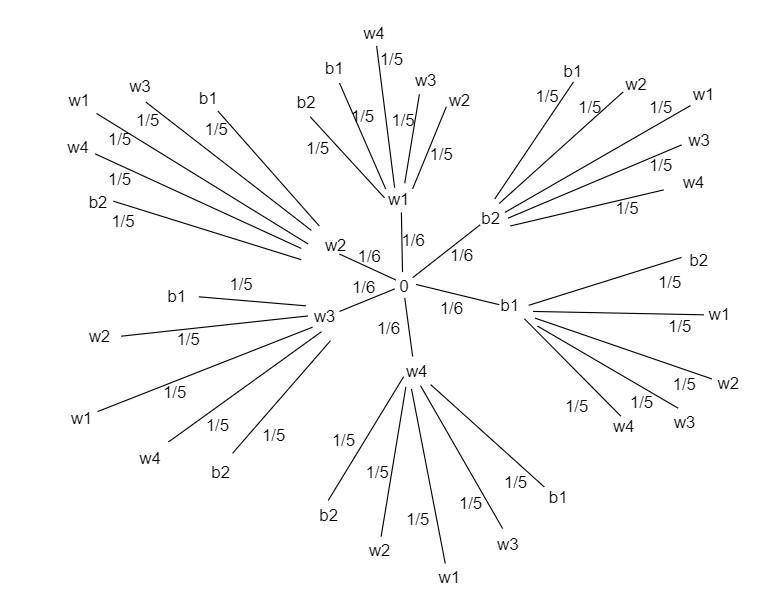
There are four white eggs and two brown eggs in an egg box. Lucy decides to use two of the eggs to make an omelette. She takes each egg from the box without looking at the colour. Draw a probability tree to show all the possible outcomes.
Answers
A probability tree to show all the possible outcomes. is as shown in the following diagram.
In this question, we have been four white eggs and two brown eggs in an egg box.
Lucy decides to use two of the eggs to make an omelet. She takes each egg from the box without looking at the color.
We need to draw a probability tree to show all the possible outcomes.
Let w1, w2, w3, w4 be four white eggs and b1, b2 be two brown eggs.
There are 6 total eggs.
So, the probability of selecting an egg would be 1/6
After selecting 1st egg, there would be 5 eggs in the bag.
The probability of selecting an egg from 5 eggs would be 1/5
The joint probability of selecting 2 eggs would be,
1/6 × 1//5 = 1/30
A probability tree to show all the possible outcomes. is as shown in the following diagram.
Learn more about the probability here:
https://brainly.com/question/3679442
#SPJ1
I need help its hard pls

Answers

Line CT and line SM intersect at point A. What is the relationship between angle CAM and angle TAS?
Angle CAM and angle TAS are supplementary angles that sum to 180°.
Angle CAM and angle TAS are vertical angles that are congruent.
Angle CAM and angle TAS are supplementary angles that are congruent.
Angle CAM and angle TAS are vertical angles that sum to 180°.
Answers
The relationship between angle CAM and angle TAS is that they are supplementary angles that sum to 180°.
Supplementary angles are two angles whose measures add up to 180°. In this case, angle CAM and angle TAS are formed by the intersection of line CT and line SM at point A.
Since they are formed by intersecting lines, angle CAM and angle TAS are adjacent angles that share a common vertex (point A) and a common side (line AM).
By definition, adjacent supplementary angles form a straight line, which measures 180°. Therefore, angle CAM and angle TAS are supplementary angles that sum to 180°.
It is important to note that vertical angles are pairs of opposite angles formed by the intersection of two lines. They are congruent, meaning they have equal measures.
However, the given information does not specify that angle CAM and angle TAS are formed by intersecting lines as vertical angles. Therefore, the correct relationship in this case is that they are supplementary angles, not vertical angles.
For more such answers on supplementary angles
https://brainly.com/question/12919120
#SPJ8
the administration team compiled test results for those who had been tested for strep throat in a random sample of 400 sick patients who had been tested. the following relative frequency table shows the data. positive negative total has the flu 54% 6% 60% does not have the flu 8% 32% 40% total 62% 38% 100% based on the data, what is the ratio of false positives to true positives? 6 over 32 8 over 6 8 over 54
Answers
The ratio of false positives to true positives is 8 over 54.
According to the Question
Results of a strep throat test performed on a sample of 400 ill people are displayed in the table's data. People who have the flu and those who don't are separated into two categories. The patients are then separated into groups based on whether they tested positive or negative for strep throat within each of these categories.
We must first define what a true positive and a false positive are in order to calculate the ratio of false positives to true positives. A patient who tests positive for strep throat but does not actually have the illness is said to have a false positive. The 8% of patients in this instance who tested positive for strep throat but did not have the flu would fall under that category. A patient who tests positive for strep throat and truly has the illness is said to have a true positive. That would be the 54% of patients who tested positive for both the flu and strep throat in this instance.
We divide the percentage of false positives (8%) by the percentage of true positives (54%), which gives us the ratio of false positives to true positives.
As a result, the ratio becomes 8% / 54%, or 8/54.
It's critical to remember that this ratio is dependent on the sample and test performed and may not be the same for different populations or testing methodologies.
To know more about proportion and ratio on brainly :
brainly.com/question/26974513
#SPJ4
Consider the equation below. n2 3h2 right arrow. 2nh3 what is the mole ratio of hydrogen to ammonia? 1:1 1:2 3:2 5:4
Answers
The mole ratio of hydrogen to ammonia in the equation N₂ + 3H₂ → 2NH₃ is 3:2
How to find mole ratio?we will balance the equation to find the mole ratio of the hydrogen to ammonia.
Therefore,
N₂ + 3H₂ → 2NH₃
From the equation, Nitrogen has a coefficient of 1 , Hydrogen have a coefficient of 3 and ammonia have a coefficient of 2.
Therefore, the coefficient of the substance is the number of moles.
Hence, the mole ratio of hydrogen to ammonia is 3:2
learn more on mole ratio here: https://brainly.com/question/8170320
#SPJ5
Letf(x, y) = 2ex − y.Find the equation for the tangent plane to the graph of f at the point
Answers
The final equation for the tangent plane to the graph of f at the point (a, b) is z = 2e^a(x - a) - y + 2e^a - 2b. This equation represents the plane that is tangent to the graph of f at the specified point (a, b).
To find the equation for the tangent plane to the graph of the function f(x, y) = 2e^x - y at a given point (x0, y0), we need to calculate the partial derivatives of f with respect to x and y at that point.
The partial derivative of f with respect to x, denoted as ∂f/∂x or fₓ, represents the rate of change of f with respect to x while keeping y constant. Similarly, the partial derivative of f with respect to y, denoted as ∂f/∂y or fᵧ, represents the rate of change of f with respect to y while keeping x constant.
Let's calculate these partial derivatives:
fₓ = d/dx(2e^x - y) = 2e^x
fᵧ = d/dy(2e^x - y) = -1
Now, we have the partial derivatives evaluated at the point (x0, y0). Let's assume our point of interest is (a, b), where a = x0 and b = y0.
At the point (a, b), the equation for the tangent plane is given by:
z - f(a, b) = fₓ(a, b)(x - a) + fᵧ(a, b)(y - b)
Substituting fₓ(a, b) = 2e^a and fᵧ(a, b) = -1, we have:
z - f(a, b) = 2e^a(x - a) - (y - b)
Now, let's substitute f(a, b) = 2e^a - b:
z - (2e^a - b) = 2e^a(x - a) - (y - b)
Rearranging and simplifying:
z = 2e^a(x - a) - (y - b) + 2e^a - b
The final equation for the tangent plane to the graph of f at the point (a, b) is z = 2e^a(x - a) - y + 2e^a - 2b.
This equation represents the plane that is tangent to the graph of f at the specified point (a, b).
Learn more about tangent here:
https://brainly.com/question/10053881
#SPJ11
At a restaurant, when a customer buys four pretzels the fifth pretzel is free. soft pretzels cost $3.90 each. you ordered 12 soft pretzels what is your mean(average) cost per pretzel
Answers
Answer:
($3.90)(12) - (2)($3.90) = 39.00
39.00/12 = 3.25 per pretzel
Step-by-step explanation:
Solve the differential equation
dR/dx=a(R²+16)
Assume a is a non-zero constant, and use C for any constant of integration that you may have in your answer.
R = ?
If anyone helps me, I will give away points.
Answers
the given differential equation dR/dx = a(R² + 16), where a is a non-zero constant, is R = -4/√\((16 - e^(2ax + C))\), where C is the constant of integration.
In the first part, the solution to the differential equation is R = -4/√\((16 - e^(2ax + C)).\)
In the second part, let's solve the differential equation step by step. We start by separating variables:
dR/(R² + 16) = a dx.
Next, we integrate both sides:
∫(1/(R² + 16)) dR = ∫a dx.
To integrate the left side, we can use a substitution. Let u = R² + 16, then du = 2R dR. This gives us:
(1/2) ∫(1/u) du = ∫a dx.
Simplifying the left side and integrating, we have:
(1/2) ln|u| = ax + C.
Substituting back for u and rearranging, we get:
ln|R² + 16| = 2ax + 2C.
Taking the exponential of both sides, we have:
|R² + 16| = \(e^(2ax + 2C).\)
Considering the absolute value, we can rewrite it as:
R² + 16 = \(e^(2ax + 2C).\)
Solving for R, we get:
R = ±√(e^(2ax + 2C) - 16).
Simplifying further:
R = ±√(e^(2ax + C) - 16).
Finally, we can rewrite it as:
R = -4/√(16 - e^(2ax + C)).
Learn more about differential equation here:
https://brainly.com/question/25731911
#SPJ11
next week your math teacher is giving a chapter test. the test will consist of 35 questions. some problems are worth 2 points and some problems are worth 4 points. there are 20 questions worth 2 points. how many problems of 4 points are on the test? answers
Answers
The chapter test from maths teacher will contain 15 questions of worth 4 points.
Let the number of questions having weightage of 4 marks be x. Now, we know that problems will only be worth 2 and 4 points. Also we know that some of these problems will be 35. Thus, let us form the equation.
20 + x = 35
Rewriting the equation according to x
x = 35 - 20
Performing subtraction on Right Hand Side of the equation
x = 15
Thus, there will be 15 questions of 4 points.of the maths test to be conducted next week.
Learn more about equations -
https://brainly.com/question/2972832
#SPJ4
help please idk what to do

Answers
Step-by-step explanation:
solve the ineq first then plot on the number line so,
-2(4x + 5) ≤ 30
-8x - 10 ≤ 30
-8x ≤ 40
x ≥ -5
therefore, option A is correct.
Topic: Inequalities
If you like to venture further, feel free to check out my insta (learntionary). I'll be constantly posting math tips and notes! Thanks!
a biotechnology company produces a therapeutic drug whose concentration has a standard deviation of 4 g/l. a new method of producing this drug has been proposed, although some additional cost is involved. management will authorize a change in production technique only if the standard deviation of the concentration in the new process is less than 4 g/l. the researchers chose n 10 and obtained the following data. perform the necessary analysis to determine whether a change in production technique should be implemented. 16.628 g/l 16.630 g/l 16.622 16.631 16.627 16.624 16.623 16.622 16.618 16.626
Answers
After answering the provided question, we can conclude that t = 1.833 is standard deviation the critical value for a one-tailed t-test with 9 degrees of freedom and a significance level of 0.05.
What is standard deviation?A statistic that communicates the fluctuation or variance of a number set is the standard deviation. A high standard deviation indicates that the values seem to be more dispersed, whereas a low standard deviation indicates that the values are closer to the established mean. The standard deviation is a measure of how far the data varies from the mean (or ). So when standard deviation is small, the data tends to cluster around the mean; when it is huge, the data is more dispersed. The standard deviation represents the average variability of something like the data set. It displays the average deviation from the mean of each score.
To decide whether the new manufacturing technique should be used, we must first determine whether the standard deviation of the drug concentration in the new process is less than 4 g/l. A hypothesis test can be used with the following null and alternative hypotheses:
H0 (null hypothesis): In the new process, the standard deviation of drug concentration is 4 g/l.
Alternative hypothesis (Ha): In the new process, the standard deviation of drug concentration is less than 4 g/l.
For the standard deviation, we can use a one-tailed t-test with a
\(t = (n - 1) * s^2 / \sigma^2\\s = \sqrt(1/(n-1) * \sum(xi - x\bar)^2) = 0.004 g/l\\t = (n - 1) * s^2 / \sigma^2 = (10 - 1) * 0.004^2 / 4^2 = 0.0007\)
t = 1.833 is the critical value for a one-tailed t-test with 9 degrees of freedom and a significance level of 0.05.
To know more about standard deviation visit:
https://brainly.com/question/23907081
#SPJ1
In February 2018, BMW of North America recalled certain vehicles with possibly defective head air bags. BMW claimed that 4%4% of the recalled vehicles actually had defective air bags. Suppose six of the recalled vehicles are selected at random. What is the probability that none of the six vehicles has a defective air bag
Answers
BMW of North America recalled certain vehicles with possibly defective head airbags in February 2018, and claimed that 4% of the recalled vehicles actually had defective airbags. Let X be the number of vehicles that have defective airbags out of six selected vehicles. The probability of a defective airbag is 4%, while the probability of a non-defective airbag is (1-0.04) = 0.96.
Using the binomial probability formula, the probability of x successes in n independent trials with the probability of success p is given by P(x) = nCx px(1 - p)n-x, where nCx represents the number of ways to choose x items from n distinct items. In this case, x = 0 (i.e., none of the six vehicles have a defective airbag), p = 0.04, and n = 6. Hence, we have:
P(0) = 6C0 (0.04)0 (0.96)6-0= 1(1)(0.96)6= 0.850 (approx)
Therefore, the probability that none of the six vehicles has a defective airbag is approximately 0.850.
Know more about binomial probability formula here:
https://brainly.com/question/30764478
#SPJ11
When computing the degrees of freedom for ANOVA, how is the between-group estimate calculated?
a. (n - 1)/k
b. n - 1
c. k - 1
d. N - k
Answers
The option that follows is c .
The between-group estimate for calculating the degrees of freedom in ANOVA is calculated using the formula k - 1, where k represents the number of groups or treatments being compared.
This estimate represents the variability between the group means and is used in the F-ratio calculation to determine if the differences between the groups are significant.
When conducting ANOVA, the between-group estimate is an important factor in determining the degrees of freedom. This estimate represents the variability between the group means and is used to calculate the F-ratio, which determines if the differences between the groups are significant. The between-group estimate is calculated using the formula k - 1, where k represents the number of groups being compared. This formula is used because the estimate is based on the number of independent sources of variation between the groups. By accurately calculating the degrees of freedom, researchers can determine if the differences between the groups are statistically significant.
The between-group estimate for calculating the degrees of freedom in ANOVA is crucial for determining the statistical significance of differences between groups. It is calculated using the formula k - 1, where k represents the number of groups being compared. This estimate represents the variability between the group means and is used in the F-ratio calculation. Accurately calculating the degrees of freedom is essential in conducting valid ANOVA analyses.
To know more about F-ratio visit:
brainly.com/question/31827066
#SPJ11
1.39/48= 0.028958333 rounded
Answers
Answer:
rounded to nearest tenths: 0.0
rounded to nearest hundredths: 0.03
rounded to nearest thousandths: 0.029
rounded to nearest ten thousandths: 0.0290
Step-by-step explanation:
A specification for a spacer plate used in a machine tool has specifications LSL=0.05 and USL= 0.10 cm in thickness. A sample of 100 parts found μ=0.067 and σ=0.021. Compute and interpret the process capability indexes C
p
,C
pl
,C
pu
, and C
pk
.
Answers
The process capability is moderate, with better capability to produce within the upper specification limit. Improvement may be needed to enhance the capability to produce within the lower specification limit.
To compute the process capability indexes Cp, Cpl, Cpu, and Cpk, we need to use the following formulas:
Cp = (USL - LSL) / (6 * σ)
Cpl = (μ - LSL) / (3 * σ)
Cpu = (USL - μ) / (3 * σ)
Cpk = min(Cpl, Cpu)
Given the specifications:
LSL = 0.05 cm
USL = 0.10 cm
And the sample data:
Sample size (n) = 100
Sample mean (μ) = 0.067 cm
Sample standard deviation (σ) = 0.021 cm
First, let's calculate the process capability index Cp:
Cp = (USL - LSL) / (6 * σ)
= (0.10 - 0.05) / (6 * 0.021)
≈ 0.416
Next, let's calculate the process capability index Cpl:
Cpl = (μ - LSL) / (3 * σ)
= (0.067 - 0.05) / (3 * 0.021)
≈ 0.333
Then, let's calculate the process capability index Cpu:
Cpu = (USL - μ) / (3 * σ)
= (0.10 - 0.067) / (3 * 0.021)
≈ 0.476
Finally, let's calculate the process capability index Cpk:
Cpk = min(Cpl, Cpu)
= min(0.333, 0.476)
≈ 0.333
Interpretation: Cp measures the overall capability of the process and indicates the potential for the process to produce within the specifications. In this case, Cp = 0.416, indicating a moderate process capability.
Cpl and Cpu measure the capability of the process to produce within the lower and upper specification limits, respectively. In this case, Cpl = 0.333 and Cpu = 0.476, indicating that the process has better capability to produce within the upper specification limit.
Cpk measures the capability of the process to produce within both the lower and upper specification limits. It is the minimum value between Cpl and Cpu. In this case, Cpk = 0.333, indicating that the process is limited by its capability to produce within the lower specification limit.
Overall, the process capability is moderate, with better capability to produce within the upper specification limit. Improvement may be needed to enhance the capability to produce within the lower specification limit.
learn more about lower specification limit on
https://brainly.com/question/28043775
#SPJ11
PLEASE HELP ASAP!
On a number line, point A is located at 4, point C is located at 11, and point B lies between points A and C. What is the location of B such that the ratio of AB:BC is 2:3?
8.2
6.8
5.9
5.6
Answers
The location of B under the Line Segment Partition is 6.8
What is Line Segment Partition?
A line segment is partitioned when it is divided into equal parts according to a specified ratio. The total number of partitions of the line segment must be equal to the sum of the two values in the ratio.
Given in the question that on a number line AC;
Location of Point A = 4
Location of point C = 11
point B lies between points A and C
So, B divides line AC in the ratio AB: BC = 2:3.
Thus;
BC = 3/5 of the total length of the AC
AB = 2/5 the total length of the AC
Then, total length of AC = 11-4 = 7
BC = 3/5 * 7 = 4.2
AB = 2/5 * 7 = 2.8
Thus, the location of point B is; 4 + 2.8 = 6.8
To learn more about Line Segment Partition
https://brainly.com/question/17374569
#SPJ1
What is the solution to the equation shown below?
2
32 +5=1
A) X= -6
B) X= 4
C) X= -4.5
D) X= 9

Answers
Answer:
Step-by-step explanation:
Here you go mate
Step 1
2/3x+5=1 Equation
Step 2
2/3x+5=1 Simplify
2/3x=-4
Step 3
2/3x=-4 Simplify
answer
x=-6
giving away big points
Which set of directions correctly describes how to plot the point (8, 4) on the coordinate plane?
O Start at the origin. Move 8 units to the right, then move 4 units up.
O Start at the origin. Move 8 units up, then move 4 units to the right.
O Start at the origin. Move 8 units to the left, then move 4 units up.
O Start at the origin. Move 8 units up, then move 4 units to the left.
Answers
Answer:
1st option. (x, y). The x - coordinate comes first and describes the horizontal (right and left) plane. The y - coordinate describes vertical (up, down) movement.
Step-by-step explanation:
i did test on edg.
Answer:
the first one
Step-by-step explanation:
The area of a rectangle is 12 square inches and the width is 3 inches what is the length
Answers
Answer:
4 inches
Step-by-step explanation:
W×L=A
3×L=12
L=4
Answer: 4
Step-by-step explanation
Area of square = width ×lenght
12 = 3 × lenght
Lenght = 12÷3
Lenght = 4
The estimated regression equation by least squares method minimizes the sum of the.
Answers
The estimated regression equation by the least squares method minimizes the sum of squared differences between observed values and predicted values.
The least squares method is used in regression analysis to find the line or curve that best fits a given set of data points. It achieves this by minimizing the sum of squared differences (also known as residuals) between the observed values and the corresponding predicted values from the regression equation. The "sum of squared differences" refers to the sum of the squared vertical distances between each data point and the regression line. By squaring the differences, larger deviations from the regression line have a greater impact on the overall sum. Minimizing this sum ensures that the estimated regression equation provides the best possible fit to the data points by reducing the overall error between the observed values and the predicted values. In summary, the least squares method finds the estimated regression equation that minimizes the sum of squared differences, allowing us to model and predict the relationship between variables based on the best fit to the given data.
The estimated regression equation by the least squares method minimizes the sum of squared differences between observed values and predicted values.
learn more about least square method here:
https://brainly.com/question/31984229
#SPJ11
The surface area S of a cube in square inches can be determined by S=6V 2/3 where V is the volume of the cube in cubic inches. Find the surface area of a cube that has a volume of 4096 cubic inches
Answers
The cube has a surface area of 1536 inches².
What is Three dimensional shape?A three dimensional shape can be defined as a solid figure or an object or shape that has three dimensions—length, width, and height.
Given \($ \mathrm{S = 6V^{\frac{2}{3} }}\)
S is surface Area ‘A’, in square units, of a cube
V is volume of cube in cubic units.
Now in the given question,
V = 4096 cubic inches
The formula below can be used to get the cube's surface area:
Surface area = \($ \mathrm{ 6V^{\frac{2}{3} }}\)
Surface area = 6 × \(4096^{\frac{2}{3} }\)
Surface area = 6 × 16² = 6 × 256
Surface area = 1536 inches²
Learn more about surface area:
https://brainly.com/question/27847638
#SPJ1
Mike is now 4 times older than al.if al was 2 years old 8 years ago how old is mike now?
Answers
Mike is 40 years old now.
Let Al's age be x years. According to the problem statement,
Al was 2 years old 8 years ago.
Therefore, Al's present age is:x + 8 years
Now, Mike is 4 times older than Al. That is, the age of Mike is 4(x + 8) years.
Mike is now 4 times older than Al, if Al was 2 years old 8 years ago, then Mike is 36 years old now.
In order to verify the solution, you can use a direct method of substitution.
If Al's present age is x + 8, then his age 8 years ago was x + 8 - 8 = x.
Since Al was 2 years old 8 years ago, we have:x = 2
Therefore, Al's present age is:x + 8 = 2 + 8 = 10 years
Now, Mike is 4 times older than Al.
Therefore, Mike's age is 4 × 10 = 40 years.
This is consistent with the original statement that "Mike is now 4 times older than Al if Al was 2 years old 8 years ago".Therefore, Mike is 40 years old now.
To learn about age here:
https://brainly.com/question/30994122
#SPJ11
Help me please I’m stuck


Answers
Answer:
the answer for first is 3
second is 4
SOMEONE PLEASE HELP!!!!! I’m not quite sure

Answers
Answer: I have no clue lol but if I had to guess I'd say A because it just seems like it stands out from the rest
Step-by-step explanation:
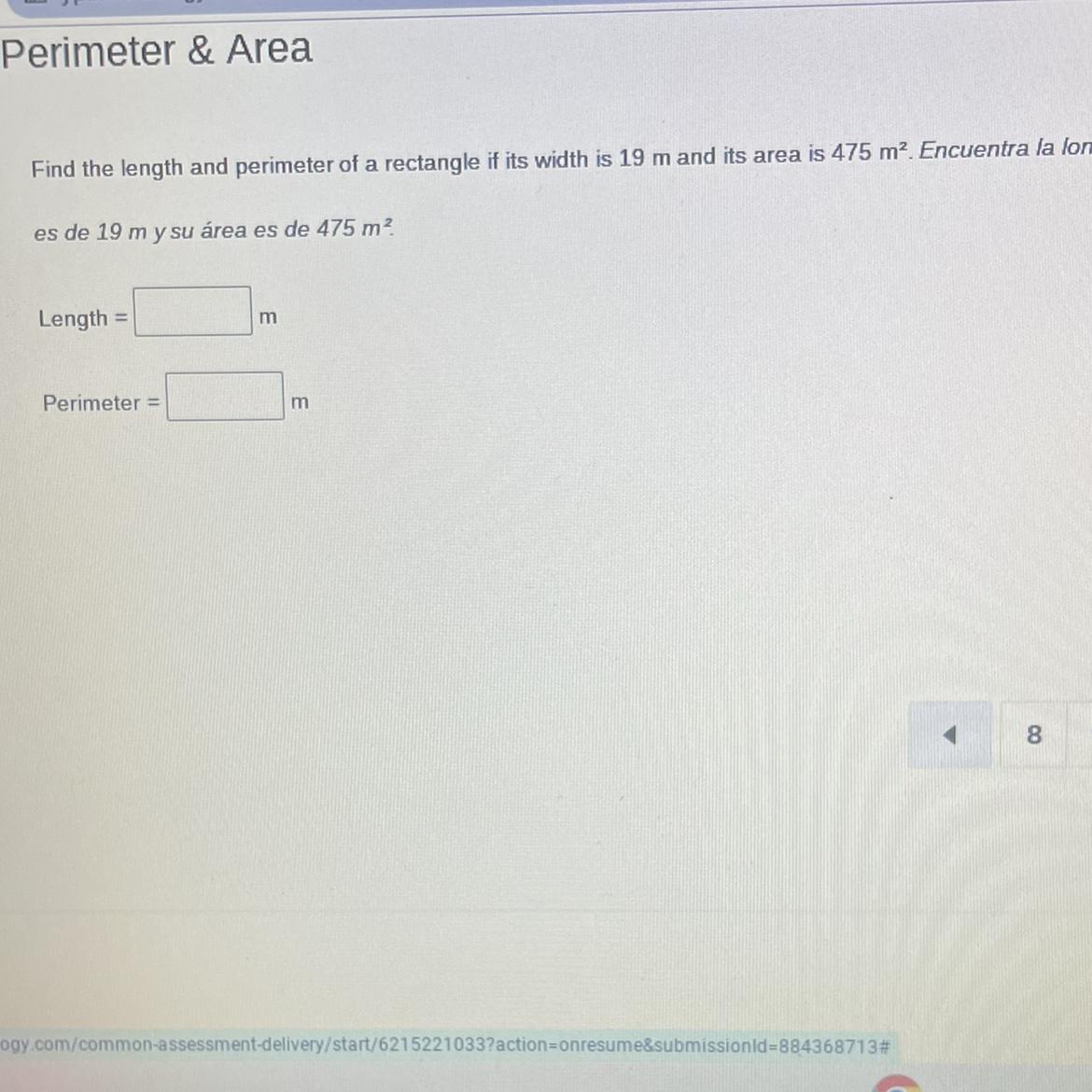
Find the length and perimeter of a rectangle if its width is 19 m and its area is 475 m?.
Answers
The length of the rectangle is: 25 m
The perimeter of the rectangle is: 88 m
What is the Area and Perimeter of a Rectangle?Area of a rectangle = (length)(width).
Perimeter of a rectangle = 2(length + width).
Give the following:
Width of rectangle = 19 m
Area of rectangle = 475 m²
Find the Length using the area formula:
475 = (length)(19)
475/19 = length
Length of the rectangle = 25 m
Find the perimeter of the rectangle
Perimeter of the rectangle = 2(25 + 19)
Perimeter of the rectangle = 2(44)
Perimeter of the rectangle = 88 m
Thus, the length of the rectangle is: 25 m
The perimeter of the rectangle is: 88 m
Learn more about the area and perimeter of rectangle on:
https://brainly.com/question/24571594
#SPJ1
In a school there are 60 teachers are and 1200 students. 30% of the students are billingual 15% of the teachers are billingual How many billingual students and teachers are there altogether?
Answers
Answer:
369
Explanation:
Calculate each of the groups mentioned. You will derive that 360 students and bilingual and 9 of the teachers are bilingual. Add them together and you got your answer!
- Hope this helped.
Answer:
360 students and 9 teachers
Step-by-step explanation:
30/100 x 1200=360 students
15/100 x 60=9 teachers
For which values is this undefined (what numbers makes the denominator 0)

Answers
Answer:
x = -6 and x = 1
Step-by-step explanation:
For the fraction to be undefined, find the zeros of the polynomial of the denominator.
x² + 5x - 6 = 0x² - x + 6x - 6 = 0x(x - 1) + 6(x - 1) = 0(x + 6)(x - 1) = 0x = -6 and x = 1