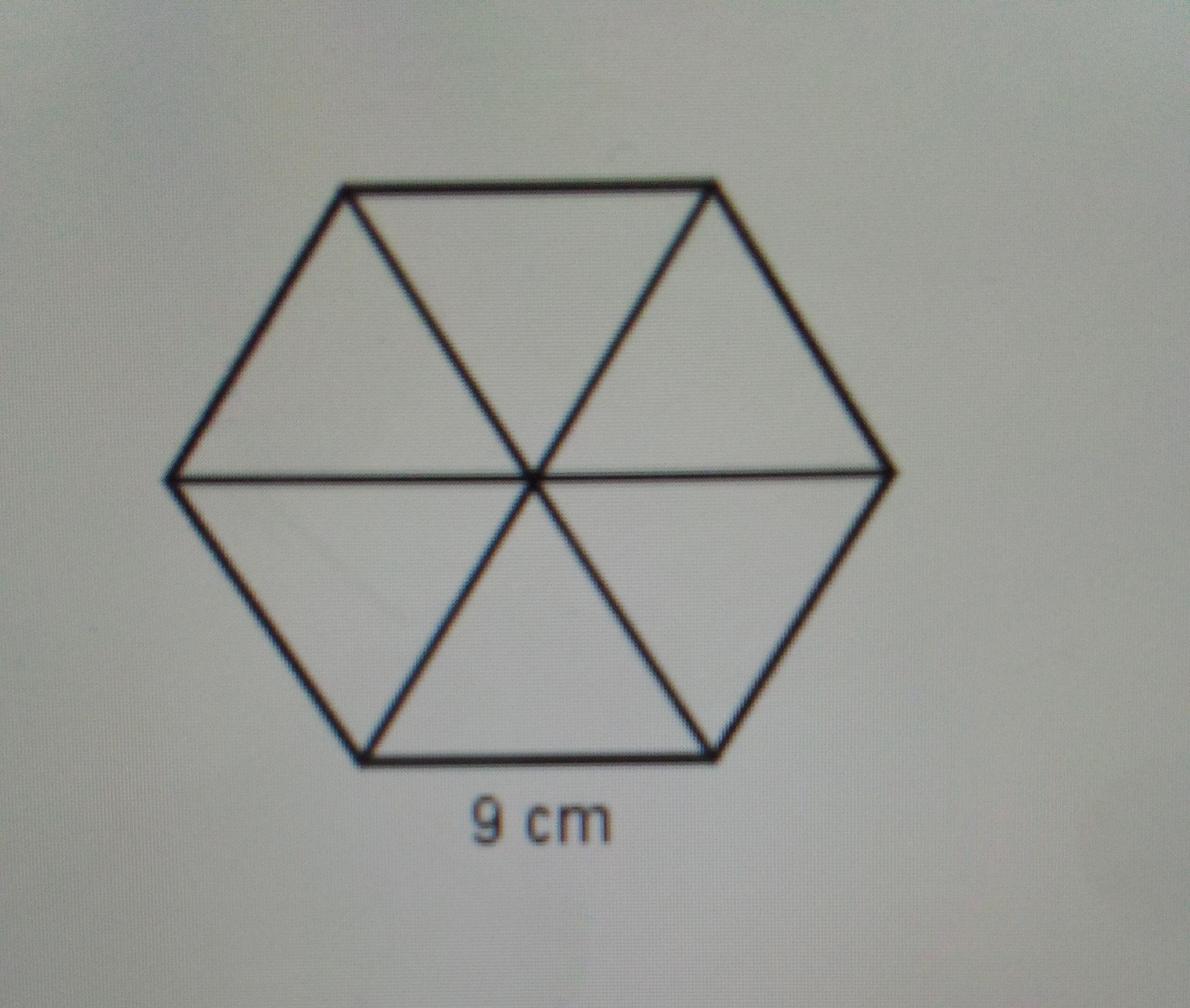
You are planning to use a ceramic tile design in your new bathroom. The tiles are blue-and-white equilateral triangles. You decide to arrange the blue tiles in a hexagonal shape as shown. If the side of each tile measures 9 centimeters, what will be the exact area of each hexagonal shape?
Answers
well, there are 6 equilateral triangles, each one with sides of measure of 9 cm.
\(\textit{area of an equilateral triangle}\\\\ A=\cfrac{s^2\sqrt{3}}{4} ~~ \begin{cases} s=\stackrel{length~of}{a~side}\\[-0.5em] \hrulefill\\ s=9 \end{cases}\implies A=\cfrac{9^2\sqrt{3}}{4} \\\\[-0.35em] ~\dotfill\\\\ \stackrel{ \textit{area for all six triangles} }{6\left( \cfrac{9^2\sqrt{3}}{4} \right)}\implies \cfrac{243\sqrt{3}}{2}\)
Related Questions
Polya’s urn model supposes that an urn initially contains r red and b blue balls.
At each stage a ball is randomly selected from the urn and is then returned along
with m other balls of the same color. Let Xk be the number of red balls drawn in
the first k selections.
(a) Find E[X1].
(b) Find E[X2].
(c) Find E[X3].
(d) Conjecture the value of E[Xk], and then verify your conjecture by a conditioning
argument
Answers
The expectation values E[X1], E[X2], and E[X3] have been found using the Law of Total Expectation. A conjecture for E[Xk] has also been obtained by conditioning on Xk-1 and verifying it using induction.
The Polya’s urn model supposes that an urn initially contains r red and b blue balls. After each stage, one ball is randomly selected from the urn and returned to the urn with m additional balls of the same color. The model then considers Xk, the number of red balls drawn in the first k selections. To find the expectation of Xk, conditioning on Xk-1 is considered.
In the model given above, it is required to find the expected value of Xk.
(a) For k=1, the first draw can be either a red or blue ball, so that:
E[X1] = P(red ball) x 1 + P(blue ball) x 0
= r/(r+b) x 1 + b/(r+b) x 0
=r/(r+b).
(b) To find E[X2], X2 = X1 + Y, where Y is the number of red balls drawn on the second draw, and it follows the hypergeometric distribution. Then, it can be shown that
E[Y] = m*r/(r+b) and by the Law of Total Expectation,
E[X2] = E[E[X2|X1]]
=E[X1] + E[Y]
= r/(r+b) + m*r/(r+b+1).
(c) E[X3] can be found using:
X3 = X2 + Z, where Z follows the hypergeometric distribution with parameters r+m*X2 and b+m*(1-X2). Thus,
E[Z] = m*(r+m*X2)/(r+b+m) and
E[X3] = E[E[X3|X2]]= E[X2] + E[Z].
Then E[X3] = r/(r+b) + m*r/(r+b+1) + m^2*r/(r+b+1)/(r+b+2).
(d) Conjecture: For any k>=1, it can be shown that
E[Xk] = r * sum(i=1 to k) (m^i / (r+b)^i) / sum(i=0 to k-1) (m^i / (r+b)^i). This is because, using the law of total expectation, E[Xk] = E[E[Xk|Xk-1]]. Then,
E[Xk|Xk-1] = Xk-1 + W
W follows a hypergeometric distribution with parameters r+m*Xk-1 and b+m*(1-Xk-1). Then E[W] = m*(r+m*Xk-1)/(r+b+m), and by induction, we can get the formula for E[Xk].
Therefore, the expectation values E[X1], E[X2], E[X3] have been found using the Law of Total Expectation. A conjecture for E[Xk] has also been obtained by conditioning on Xk-1 and verifying it using induction.
To know more about the Law of Total Expectation, visit:
brainly.com/question/27811090
#SPJ11
Find the volume of the rectangular prism. Express your answer as a simplified mixed number.
QUICK

Answers
Answer:V=whl
l Length
Enter value
w Width
Enter value
h Height
Enter value
Step-by-step explanation: m jj
A code ue for 1 for A, 2 for B, 3 for C and o on upto 26 for Z. Coded word are written without pace to confue the enemy o 18 could be AH or R. Decode the following meage
Answers
The code 1814151418 decodes to RADE using a simple substitution cipher, where each letter is replaced with a different letter or number. To decipher the message, one must know the key, which is the code that maps each letter to a number
The code provided indicates that each number corresponds to a letter in the alphabet. Since 1 is A, 2 is B, and so on, the code 1814151418 would decode as RADE. This is an example of a simple substitution cipher, a type of encryption where each letter is replaced with a different letter or number. To decipher the message, one must know the key, which in this case is the code that maps each letter to a number. Knowing this, it is a simple task to decode any message that has been encrypted with this code.
The code 1814151418 decodes to RADE using a simple substitution cipher, where each letter is replaced with a different letter or number. To decipher the message, one must know the key, which is the code that maps each letter to a number
Learn more about number here
https://brainly.com/question/10547079
#SPJ4
in a 2015 national survey, what percentage of young adults age 18-25 were not current alcohol users?
Answers
The question is an illustration of proportion and percentages
The percentage of young adults, age 18-25 were not current alcohol users is 34.92%
The attached graph represents the proportion of those that are surveyed.
From the graph, we have:
\(\mathbf{Total = 18.6 + 27.2 + 20.8 + 11.3}\)
\(\mathbf{Total = 77.9}\)
The number of young adults 18 - 25 that are not current alcohol users are:
\(\mathbf{Young\ adults = 27.2}\)
So, the percentage of this group is:
\(\mathbf{\% Young\ adults = \frac{Young\ adults}{Total} \times 100\%} }\)
This gives
\(\mathbf{\% Young\ adults = \frac{27.2}{77.9} \times 100\%} }\)
\(\mathbf{\% Young\ adults = 0.3492 \times 100\% }\)
Multiply
\(\mathbf{\% Young\ adults = 34.92 \% }\)
Hence, the percentage of young adults, age 18-25 were not current alcohol users is 34.92%
Read more about percentage and proportions at:
https://brainly.com/question/12662837

Solve for x in the triangle. Round your answer to the nearest tenth.
26°
X
10

Answers
Answer:
Step-by-step explanation:
Write an equation of the line shown in the graph in slope intercept form (y = mx + b). Show
your work for full credit.
(4,6)
(2, 2)

Answers
Answer:
y = 2x - 2
Step-by-step explanation:
Points on graph: (4,6) and (2, 2)
Slope:
m=(y2-y1)/(x2-x1)
m=(2-6)/(2-4)
m=(-4)/(-2)
m = 2
Slope-intercept:
y - y1 = m(x - x1)
y - 6 = 2(x - 4)
y - 6 = 2x - 8
y = 2x - 2
Find the sum of -4x^{2}-3x-3−4x
2
−3x−3 and -4x^{2}-9x−4x
2
−9x.
Answers
The sum of two given expressions will be -
h(x) = \(-3x^{-3} -8x^{2} -17x\).
We have two expressions.
We have to add them.
What is Expression in mathematics?An expression in math is a sentence with a minimum of two numbers or variables and at least one math operation in it.
According to the question -
f(x) = \(-4x^{2} -3x^{-3} -4x\)
g(x) = \(-4x^{2} -9x -4x\)
Now -
h(x) = f(x) + g(x) = \(-4x^{2} -3x^{-3} -4x\) + ( \(-4x^{2} -9x -4x\))
h(x) = \(-3x^{-3} -8x^{2} -17x\)
Hence, the sum of two given expressions will be -
h(x) = \(-3x^{-3} -8x^{2} -17x\)
To solve more questions on Adding expressions, visit the link below-
https://brainly.com/question/28277126
#SPJ1
200 = 1000 - n/4. What is the value of n? Show working out, please.
Answers
Answer:
n = 3200
Step-by-step explanation:
200 = 1000 - \(\frac{n}{4}\) ( subtract 1000 from both sides )
- 800 = - \(\frac{n}{4}\) ( multiply both sides by 4 to clear the fraction )
- 3200 = - n ( multiply both sides by - 1 )
n = 3200
plz helppp
Analyze the diagram below and complete the instructions that follow. Find the value of x and the value of y
A. x=15, y= 10 √3
B. x=20, y= 10 √3
C. x=20 √3, y= 5 √3
D. x=15, y= 5 √3

Answers
Answer:
Use the SOH CAH TOA
Step-by-step explanation:
Angle = 60°
x = opposite o
y = adjacent a
10√ 3 = hypotenuse h
To find x we use SOH {sineø = o/h}
Sin 60° = x/10√ 3
x=10√ 3 * sin 60
X=15
You can use Pythagoras theorem or CAH{cosø = a/h}
Cos 60°= y/10√ 3
y=Cos 60° * 10√ 3
y=5√ 3
What's the mean of 3 4 5 3 4 5 6 7 1 2 3 4 5 6 4 8 4 3 2
A. 4.1
B.4.2
C.8.0
D.8.3
Answers
Answer:
A. 4.1
Step-by-step explanation:
3+4+ 5+ 3+ 4+ 5+ 6+ 7+ 1+ 2+ 3+ 4+ 5+ 6+ 4+ 8+ 4+ 3+ 2= 79
79/ 19 = 4.1
pls help if you can asap!!!!

Answers
Answer: x= 6
Step-by-step explanation:
Since the shape is a parallelogram, the angles will either be equal to each other or add up to 180.
You can see they do not look the same so they add up to equal 180
12x + 3 +105 = 180
12x + 108 = 180
12x = 72
x = 6
HELP!!! i need it asap, thank you

Answers
Step by Step
prove that (sec theta + tan theta - 1)(sec theta - tan theta + 1) = 2tan theta
Answers
Answer:
(secΘ+tanΘ-1)(secΘ-tanΘ+1)
=sec²Θ-secΘtanΘ+secΘ+secΘtan-tan²Θ+tanΘ-secΘ+tanΘ-1
=2tanΘ+(sec²Θ-tan²Θ)-1
=2tanΘ+1-1
=2tanΘ
Find the mode of 7 , 3 , 2 , 5 , 0. Single choice.
2
0
No mode
Answers
Answer:
No mode
Step-by-step explanation:
The mode is the statistical method in which the most repetitive number should be considered
Like if we take an example
1,1, 2, 2, 2, 4, 4,4,4
So here the mode is 4 as 4 is repeated 4 times
But in the given situation there is no mode as every number is written single time
HELPP MEE PLEASEEE PLEASEEEE!!!!

Answers
Answer:
320 meters
Step-by-step explanation:
the length of a rectangle exceeds its width by 17 inches, and the area is 18 square inches. what are the length and width of the rectangle
Answers
The length and width of the rectangle are 18 in and 1 in, respectively.
QuadrilateralsThere are different types of quadrilaterals, for example, square, rectangle, rhombus, trapezoid, and parallelogram. Each type is defined accordingly to its length of sides and angles. For example, in a rectangle, the opposite sides are equal and parallel and their interior angles are equal to 90°.
The area of a rectangle can be found for the formula : b*h, where b = base and h =height.
For this question, the length exceeds its width by 17 inches - L=W+17. Here, the length is the base and the width is the height. Thus, from the value of area given, you can find the values of the length and width of the rectangle.
A=b*h
18=(W+17)*W
18=W²+17W
W²+17W-18=0
Solving this quadratic equation, you have:
\(w_{1,\:2}=\frac{-17\pm \sqrt{17^2-4\cdot \:1\cdot \left(-18\right)}}{2\cdot \:1}\)
\(w_{1,\:2}=\frac{-17\pm \:19}{2\cdot \:1}\)
w1=1 and w2= -18
For dimensions, only positive numbers must be used. Then, the width is equal to 1 inch.
As, the area (l*w) is 18 in², see.
18=l*w
18=l*1
l=18 in
Read more about the area of rectangle here:
https://brainly.com/question/25292087
#SPJ1
PLEASE HELP
which is the correct triangle congruence statement?

Answers
Answer:
it the 3rd one
Step-by-step explanation:
Answer:
3rd one
hope this helps :)
What is the initial value of the sequence?

Answers
HELPPPPP !!!!!!! Please answer correctly Will mark Brianliest !!!!!!!!!!

Answers
a batch of 500 machined parts contains 10 that do not conform to customer requirements. the random variable is defined as the number of parts in a sample of 12 parts that do not conform to customer requirements. determine the range (possible values) of this random variable.
Answers
The possible values of this random variable range from 0 to 12, with 0 meaning none of the 12 parts in the sample do not conform and 12 meaning that all 12 parts in the sample do not conform.
The random variable in this scenario is the number of parts in a sample of 12 parts that do not conform to customer requirements. This random variable can take on any value from 0 to 12, where 0 would mean that none of the 12 parts in the sample do not conform and 12 would mean that all 12 parts in the sample do not conform. This range of values for the random variable is based on the fact that out of the 500 machined parts, only 10 do not conform to customer requirements. Therefore, the probability of each individual part in the sample not conforming is only 10/500 or 2%. This means that it is very unlikely that all 12 parts in the sample will not conform, but still possible.
Learn more about variable here
brainly.com/question/29583350
#SPJ4
My teacher told me to do this question I will give brainliest
If you were to teach a friend how to solve the following two-step equation : 3x + 18 = 48, what would you say, step by step? You may work it out first before you start your writing.
Answers
Answer:
Step-by-step explanation:
3x + 18 = 48
Bringing like terms on one side
3x = 48 - 18
3x = 30
x = 30/10
x = 3
Answer:
x = 10
Step-by-step explanation:
Subtract 18 from both sides.
3x=48-18
Simplify 48-18 to 30.
3x=30
Divide both sides by 3.
x= 30/3
Simplify 30/3\ to 10
x=10
x=10
(3) The table shows some values of the linear
function f(n). Find the linear equation of f(n)
n f(n)
6-1
4 2
2 5
Answers
The linear equation of f(n) would be -3/2 n + 4.
What is linear function f(n) ?
A linear function is one with the equation f(x) = ax + b, where a and b are real values. The gradient of the line is represented by a, while the y-axis intercept is represented by b. (which is sometimes called the vertical intercept).
A linear equation can be represented as f(n) = mn + b, where m is the slope and b is the y-intercept.
To find m and b, we can use two points from the table.
Let's use the points (6, -1) and (4, 2).
The slope, m, can be found using the formula:
m = (f(n2) - f(n1)) / (n2 - n1)
Plugging in the values from the points, we get:
m = (2 - (-1)) / (4 - 6)
m = 3 / (-2)
m = -3/2
Now that we have m, we can use one of the points and the slope to find b. Let's use the point (6, -1).
f(n) = mn + b
-1 = (-3/2)(6) + b
Solving for b, we get:
b = -1 + (3)(3) = 4
So the linear equation of f(n) is:
f(n) = -3/2 n + 4
Thus, The linear equation of f(n) would be -3/2 n + 4.
To know more about linear function f(n) and linear equation visit,
https://brainly.com/question/28782185
#SPJ1
Help me help help help help help

Answers
Answer:
d) 500 scoops
Step-by-step explanation:
looking at the trend of scoops sold per year, 500 seems to be the correct answer. let me know if this is wrong.
Answer:
D
Step-by-step explanation:
Since each 2 years it goes up. A and B is incorerect. The answer has to be 402-597 so the only logically asnwer is D
pls tell if this helps
How do you find the gradient of y 2x 3?
Answers
The gradient of the equation y=2x+3 is 2.
The Gradient (also called Slope) of a line shows how steep it is.
The gradient of a function is defined to be a vector field. Generally, the gradient of a function can be found by applying the vector operator to the scalar function. (∇f (x, y)). This kind of vector field is known as the gradient vector field.
Given equation: y = 2x + 3
y = mx + c
2x - y = -3
x/ -3/2 + y/3 = 1
Comparing both the equation we get,
m=2 (slope) and c=3(intercept)
So the gradient is 2.
To know more about gradient visit: brainly.com/question/29188388
#SPJ4
Consider the following linear programming problem.
Min
s.t.
−2A
A,B≥0
2A+3B
1A+4B≤21
2A+1B≥7
3A+1.5B≤21
+6B≥0
(a) Find the optimal solution using the graphical solution procedure and the value of the objective function. at (A,B)=() (b) Determine the amount of slack or surplus for each constraint. slack for 1A+4B≤21 surplus for 2A+1B≥7 slack for 3A+1.5B≤21 surplus for −2A+6B≥0 (c) Suppose the objective function is changed to max7A+3B. Find the optimal solution and the value of the objective function at (A,B)=()
Answers
The optimal solution for the given linear programming problem using the graphical solution procedure is at (A, B) = (6, 2) with the objective function value of -4.
To find the optimal solution graphically, we plot the feasible region determined by the constraints. In this case, the feasible region is a polygon bounded by the lines 2A + 3B = 12, A + 4B ≤ 21, 2A + B ≥ 7, 3A + 1.5B ≤ 21, and -2A + 6B ≥ 0. We then evaluate the objective function -2A - B at the vertices of the feasible region to determine the optimal solution. The vertex that gives the minimum value of the objective function is the optimal solution. By calculating the objective function at each vertex, we find that the minimum value of -4 is obtained at (A, B) = (6, 2). This means that the optimal solution is to set A = 6 and B = 2, and the objective function value at this point is -4. For part (b), to determine the amount of slack or surplus for each constraint, we evaluate the constraints at the optimal solution (A, B) = (6, 2). For the constraint 1A + 4B ≤ 21, the left-hand side is 1(6) + 4(2) = 14, which indicates a slack of 7 (21 - 14). For the constraint 2A + 1B ≥ 7, the left-hand side is 2(6) + 1(2) = 14, which indicates a surplus of 7 (14 - 7). For the constraint 3A + 1.5B ≤ 21, the left-hand side is 3(6) + 1.5(2) = 20, which indicates a slack of 1 (21 - 20). Lastly, for the constraint -2A + 6B ≥ 0, the left-hand side is -2(6) + 6(2) = 4, which indicates a surplus of 4 (4 - 0). These slack and surplus values represent the amount by which the left-hand side of each constraint falls short or exceeds the right-hand side at the optimal solution. A positive slack indicates that the constraint is not fully utilized, while a positive surplus indicates that the constraint is exceeded.
Learn more about functions here: brainly.com/question/31062578
#SPJ11
For an end-of-year party, Ms. Wilson purchased 98 stickers and 56 lollipops. Each student will receive an equal number of stickers and an equal number of lollipops. There will be no stickers or lollipops leftover.
Based on this information, what is the greatest number of students that Ms. Wilson can have in her class?
Answers
Answer:
14 i think
Step-by-step explanation:
tbh, just guess and check
98/7=14 each student gets 7 stickers
56/14=4 each student gets 4 lollipops
there are 14 students.
suppose we are interested in studying the relationship between the shelf life of cheeses in a dairy factory and the thickness of the packaging material used for those cheeses. we would like to determine if there is a causal relationship between the thickness of the packaging material and the shelf life of the cheese; that is, does a change in the thickness of the packaging material cause a change in the shelf life of the cheese? select the study that would be best source of evidence for establishing the existence of a causal relationship.
Answers
To establish the existence of a causal relationship between the thickness of the packaging material and the shelf life of the cheese,
In a dairy factory, the best study that would be a reliable source of evidence is a randomized controlled trial (RCT).In an RCT, the participants are randomly assigned to two or more groups,
where one group receives the intervention (in this case, cheese packaged with thicker material) and the other group receives the standard treatment (cheese packaged with the usual material).
To ensure the reliability of the study, the RCT should be conducted in a double-blind manner, where neither the participants nor the researchers know which group is receiving the intervention. This will prevent any bias that may influence the results.
The participants should also be selected carefully to ensure that they represent the target population of the study. In this case, the participants should be cheese consumers or distributors who are interested in the shelf life of the cheese.
By comparing the shelf life of the cheese packaged with thicker material to that packaged with the usual material, the RCT can establish the existence of a causal relationship between the thickness of the packaging material and the shelf life of the cheese.
The results of the study can then be used to inform the dairy factory's packaging practices and improve the shelf life of their cheeses.
To know more about population click here
brainly.com/question/31544819
#SPJ11
The double number line shows that 42 people watched Deon's new video today.
People
Percentage
0
0
42
100
People
0%
Complete the table to show different percentages of the number of people who watched the
video.
42
100%
Percentage
100% of 42 people
50% of 42 people
150% of 42 people
Answers
The different percentages are, 42%, 21% and 63%.
What is the percentage?
It's the ratio of two integers stated as a fraction of a hundred parts. It is a metric for comparing two sets of data, and it is expressed as a percentage using the percent symbol.
A value or ratio that may be stated as a fraction of 100 is referred to as a percentage in mathematics. If we need to calculate a percentage of a number, we should divide it by its entirety and then multiply it by 100. The proportion therefore refers to a component per hundred. Per 100 is what the word percent means. The word "percent" is used to symbolize it.
There is no dimension to percentages. As a result, it is known as a dimensionless number. We must divide the value by the entire value to find the percentage, and then multiply the resulting number by 100.
Now, according to the given information, the double number line shows that 42 people watched Deon's new video today.
Now, we are to find,
100% of 42 people.
This is, (100/100)*42 = 42%.
Again, 50% of 42 people is,
(50/100)*42 = 21%.
Again, 150% of 42 people is,
(150/100)*42 = 63%.
Hence, the percentages are, 42%, 21% and 63%.
To Learn more about the percentage form the link:
brainly.com/question/28269290
#SPJ1
Answer:
Answers are in the explaination.
Step-by-step explanation:
100% of 42 people answer is 42
50% of 42 people answer is 21
150% of 42 people answer is 63
Find the partial derivative indicated. Assume the variables are restricted to a domain on which the function is defined.
z = (3x^2y^3 - y^3)/13xy-7
Answers
To find the partial derivative, we need to differentiate with respect to one of the variables while treating the other as a constant. Let's find the partial derivative with respect to x:
z_x = [(6xy^3)(13xy-7) - (3x^2y^3 - y^3)(13y)] / (13xy-7)^2
This is the partial derivative of z with respect to x, assuming that y is constant. Similarly, we can find the partial derivative with respect to y by differentiating with respect to y while treating x as a constant:
z_y = [(9x^2y^2 - 3y^2)(13xy-7) - (3x^2y^3 - y^3)(13x)] / (13xy-7)^2
This is the partial derivative of z with respect to y, assuming that x is constant.
It's important to note that these partial derivatives only apply within the domain on which the function is defined. Without more information about the domain, we cannot determine if the function is defined for all values of x and y.
partial derivativehttps://brainly.com/question/16940728
#SPJ11
The length of a rectangle is 6 ft longer than its width.
If the perimeter of the rectangle is 68 ft, find its length and width.
Answers
Answer:
the length is 23 ft and the width is 11 ft
Step-by-step explanation:
68/4 = 17
17 17 17 17
11 11 23 23