(y+3):(y+5)=k:1
show that y=\(\frac{5k-3}{1-k}\)
Answers
Answer:
see explanation
Step-by-step explanation:
Express the ratios in fractional form, that is
\(\frac{y+3}{y+5}\) = \(\frac{k}{1}\) ( cross- multiply )
y + 3 = k(y + 5) ← distribute
y + 3 = ky + 5k ( subtract ky from both sides )
y - ky + 3 = 5k ( subtract 3 from both sides )
y - ky = 5k - 3 ← factor out y from each term on the left side
y(1 - k) = 5k - 3 ← divide both sides by (1 - k)
y = \(\frac{5k-3}{1-k}\)
Related Questions
To solve the system of linear equations 3 x minus 2 y = 4 and 9 x minus 6 y = 12 by using the linear combination method, Henry decided that he should first multiply the first equation by –3 and then add the two equations together to eliminate the x-terms. When he did so, he also eliminated the y-terms and got the equation 0 = 0, so he thought that the system of equations must have an infinite number of solutions. To check his answer, he graphed the equations 3 x minus 2 y = 4 and 9 x minus 6 y = 12 with his graphing calculator, but he could only see one line. Why is this?
Answers
Henry could only see one line since both lines had the same slope, which means that the graphs of both equations will be identical and hence overlap.
Identify the linear equation?Linear equations in a system 3x + 2y = 4, and 9x + 6y = 12
We must demonstrate why Henry could only make out one line when he plotted the equations 3x-2y=4 and 9x-6y=12 on a graph.
Take the provided linear equation system into consideration.
3x - 2y = 4 ................(1)
9x - 6y = 12 ..................(2)
Due to the fact that equation (2) is a multiple of equation (1), 3 (3x - 2y = 4) = 9x - 6y = 12
The slopes of the provided equations are also same.
Difference with regard to x for equation (1) yields,
additional to equation (2),
With regard to x, we can differentiate to get,
The graphs of both equations will overlap since both lines have the same slope and hence have the same appearance on the graph.
To learn more about linear equations refer to:
https://brainly.com/question/2030026
#SPJ1
Determine whether the probabilities below are computed using the classical method, empirical method, or subjective method.
The probability of having six girls in an six-child family is 0.015625.
A.Empirical method
B.Classical method
C.Subjective method
D.It is impossible to determine which method is used.
Answers
The given probability of having six girls in a six-child family is 0.015625. To determine the method used to compute this probability, we need to analyze the information provided.
The Classical method is based on theoretical assumptions and probabilities calculated using mathematical principles. It assumes equally likely outcomes and relies on counting favorable outcomes over the total number of possible outcomes.
The Empirical method involves gathering data from observations or experiments to estimate probabilities. It relies on observed frequencies and relative frequencies to compute probabilities. However, the given probability does not suggest a sample or data collection, making it unlikely that the Empirical method was used.
The Subjective method involves assigning probabilities based on personal judgment or opinions. Individuals subjectively evaluate the likelihood of an event based on their own beliefs or knowledge.
To learn more about probability : brainly.com/question/31828911
#SPJ11
a soccer league has 60 returning players and 36 new players. each team will have the same ratio of returning players to new players as the league has. how many new players will a team with 10 returning players have?
sophia says that you can solve the problem in the example by multiplying both quantities in the ratio 60:36 by 1/6. is sophia correct?
Answers
A team with 10 returning players will have 6 new players.
Sophia's statement is correct.
60 x (1/6) = 10
36 x (1/6) = 6
Given,
A soccer league has,
Number of returning players = 60
Number of new players = 36
Given that,
Each team will have the same ratio of returning players to new players.
Then,
Ratio of returning players to new players = 60:36
60:36 = 10:6 = 5:3
A team contains 10 new players.
Now we have to find the number of returning players.
We have the common ratio 5:3
We know that,
Number of returning players = 5 × 2 = 10
Then, number of new players = 3 × 2 = 6
Sophia's statement is correct.
That is,
60 × (1/6) = 10
36 × (1/6) = 6
Learn more about ratio here: https://brainly.com/question/18153424
#SPJ4
If the student selected prefers snowboarding, what is the probability that the student is in junior college
Answers
a. The probability of selecting a student whose favorite sport is skiing is 0.3142.
b. The probability of selecting a junior-college student is 0.2844.
c. If the student selected is a four-year-college student, the probability that the student prefers ice skating is 0.3333.
d. If the student selected prefers snowboarding, the probability that the student is in junior college is 0.3223.
e. If a graduate student is selected, the probability that the student prefers skiing or ice skating is 0.6444.
a.
To calculate this probability, we need to divide the number of students who prefer skiing by the total number of students in the sample.
Number of students who prefer skiing = 171
Total number of students in the sample = 545
Probability = Number of students who prefer skiing / Total number of students
Probability = 171 / 545
= 0.3142
b.
To calculate this probability, we need to divide the number of junior-college students by the total number of students in the sample.
Number of junior-college students = 155
Total number of students in the sample = 545
Probability = Number of junior-college students / Total number of students
Probability = 155 / 545 ≈ 0.2844
c.
To calculate this probability, we need to divide the number of four-year-college students who prefer ice skating by the total number of four-year-college students.
Number of four-year-college students who prefer ice skating = 70
Total number of four-year-college students = 210
Probability = Number of four-year-college students who prefer ice skating / Total number of four-year-college students
Probability = 70 / 210 ≈ 0.3333
d.
To calculate this probability, we need to divide the number of junior-college students who prefer snowboarding by the total number of students who prefer snowboarding.
Number of junior-college students who prefer snowboarding = 68
Total number of students who prefer snowboarding = 211
Probability = Number of junior-college students who prefer snowboarding / Total number of students who prefer snowboarding
Probability = 68 / 211
= 0.3223
e.
To calculate this probability, we need to sum the number of graduate students who prefer skiing and the number of graduate students who prefer ice skating, and then divide it by the total number of graduate students.
Number of graduate students who prefer skiing = 59
Number of graduate students who prefer ice skating = 47
Total number of graduate students = 180
Probability = (59 + 47) / 180
= 0.6444
To learn more on probability click:
https://brainly.com/question/11234923
#SPJ4
A survey of 545 college students asked: What is your favorite winter sport? And, what type of college do you attend? The results are summarized below: College Type Favorite Winter Sport Snowboarding Skiing Ice Skating Total Junior College 68 41 46 155 Four-Year College 84 56 70 210
Graduate School 59 74 47 180
Total 211 171 163 545
Using these 545 students as the sample, a student from this study is randomly selected.
a. What is the probability of selecting a student whose favorite sport is skiing? (Round your answer to 4 decimal places.) Probability= b. What is the probability of selecting a junior-college student? (Round your answer to 4 decimal places.) Probability = c. If the student selected is a four-year-college student, what is the probability that the student prefers ice skating? (Round your answer to 4 decimal places.) Probability = d. If the student selected prefers snowboarding, what is the probability that the student is in junior college? Round your answer to 4 decimal places.) Probability = e. If a graduate student is selected, what is the probability that the student prefers skiing or ice skating? Round your answer to 4 decimal places.) Probability =
Item 7 Question 1 Select the equation that represents the question. What percent of 300 is 51? 300=51×p 51=p×300 300=p×51 p=300×51 Question 2 Solve the equation. P= %
Answers
Answer:
51 = p×300
p = 17%
Step-by-step explanation:
Let p be the value of the percentage.
To find the percentage;
51/300 = p
51 = p * 300
Therefore, p = 0.17
Percentage represents a 100;
P = 0.17 * 100
P = 17%
PLS HELP IM STRUGGLING!!!!!!

Answers
Answer:
i think ist D correct me if im wrong
Step-by-step explanation:
Answer:
22.7
Step-by-step explanation:
if ∡M is 90° then you can do:
sin 65 = h/25
h = 25(sin 65°)
h = 22.65
Sides of three square rooms measure 13 feet each, and sides of two square rooms measure 15 feet each. Which expression shows the total area of these five rooms?
Answers
An expression that shows the total area of five rooms is (3 × 13²) + (2 × 15²)
The correct answer is an option (A)
Let 'a' represents the side length of the square rooms measuring 13 ft each and 'b' represents the side length of the square rooms measuring 15 ft each.
We know that the formula for the area of a square is A = s²
where 's' is the side of a square.
Sides of three square rooms measure 13 feet each.
So, the area of the three rooms would be:
A₁ = 3 × a²
A₁ = 3 × 13²
And sides of two square rooms measure 15 feet each.,
So, the area of the two rooms would be:
A₂ = 2 × b²
A₂ = 2 × 15²
Total area of the five rooms A = A₁ + A₂
So, we get an expression:
A = 3 × 13² + 2 × 15²
A = 3 × 169 + 2 × 225
A = 957 ft²
Therefore the total area of the five rooms be 957 ft².
Learn more about an expression here:
brainly.com/question/30091997
#SPJ4
The complete question is:
Sides of three square rooms measure 13 feet each, and sides of two square rooms measure 15 feet each. Which expression shows the total area of these five rooms?
a.(3 × 13^2) + (2 × 15^2)
b.(2 × 13^3) + (2 × 15^2)
c.(3 × 15^2) + (2 × 13^2)
d.(3 × 13^2) × (2 × 15^2)
Find the area for this problem

Answers
Answer:
494 cm^2
Step-by-step explanation:
Find area od the rectangle:
14 x 26 = 364
Find area of the triangle:
10 x 26 = 260
260/2 = 130
Add the areas together:
364 + 130 = 494
How many paths are there from $A$ to $B,$ if you travel along the edges? You can travel along each edge at most once, but you can pass through the same point more than once. (You can pass through $B,$ as long as you end up at the point $B.$) [asy] unitsize(1.5 cm); draw((0,0)--dir(60)--(1,0)); draw((0,0)--(1,0)); draw((0,0)--dir(-60)--(1,0)); label("$A$", (0,0), W); label("$B$", (1,0), E); [/asy]
Answers
Answer:
There are $\boxed{3}$ paths from $A$ to $B.$
how can you describe the graph of equation ax + by = c
Answers
The standard form of a line is simply a special way of writing the equation of a line. You are probably already familiar with the slope-intercept form of a line, y = mx + b. The standard form is just another way to write this equation and is defined as Ax + By = C, where A, B, and C are real numbers, and A and B are both not zero (see note below about other requirements). As you will see in the lesson below, every line can be expressed in this form.
Note that the requirements on A, B, and C vary a bit from textbook to textbook. While they technically can be any real numbers, it is most common to write them as integers and to keep A positive. It is also common to require that A, B, and C share no common factors.
Ax+By=C
THE STANDARD FORM OF A LINE: Ax+By=C
The result is referred to as the standard form of the line: Ax+By=C. We should always be able to convert from one form of an equation to another. For example, if we are given a line in the slope-intercept form, we should be able to express it in the standard form, and vice versa
he standard form for linear equations in two variables is Ax+By=C. For example, 2x+3y=5 is a linear equation in standard form. When an equation is given in this form, it's pretty easy to find both intercepts (x and y). This form is also very useful when solving systems of two linear equations
Now ,
A=0
B=0
A and B are not both zero, the graph of Ax + By = C is always a line.
when ,
The graph of Ax + By = C, where A and B are not both zero
A\(\neq\)0
B\(\neq\)0, is a line.
Divide both sides by B. Because the form Ax + By = C can describe any line,
it is called the standard form of an equation for a line.
#SPJ9
More details : brainly.com/question/12452575
need help please: show that 2^2020+2^2022=5.2^2020
Answers
The expression 2^2020+2^2022=5.2^2020 is proved below
How to show the expressionFrom the question, we have the following parameters that can be used in our computation:
2^2020+2^2022=5.2^2020
Express 2022 as 2020 + 2
So, we have the following representation
2^2020+2^(2020 + 2) = 5.2^2020
When expanded, we have
2^2020+2^(2020) * 2^2 = 5.2^2020
Factor out 2^2020
2^2020 * (1 + 2^2) = 5.2^2020
Evaluate
2^2020 * 5 = 5. 2^2020
This implies that
5.2^2020 = 5.2^2020
HEnce, the expression has been proved
Read more about expression
https://brainly.com/question/15775046
#SPJ1
Find parametric equations and a parameter interval for the motion of a particle starting at the point (3,0) and tracing the top half of the circle x^2 y^2
Answers
The parametric equation are x = 3 cost and y = 3 sint and moves in counterclockwise direction.
According to the statement
we have given that the Find parametric equations and a parameter interval for the motion of a particle that starts at (3,0) and traces the circle \(x^{2} +y^{2} =3^{2}\)once counterclockwise.
And we have to find the parametric equation for this given statement.
So,
A parametric equation defines a group of quantities as functions of one or more independent variables called parameters.
Then
A particle that starts at (3,0) and traces the circle \(x^{2} +y^{2} =3^{2}\) once counterclockwise.
The parametric equations for a circle \(x^{2} +y^{2} =3^{2}\) and stats at (3,0) are
x = 3 cost
y = 3 sint
It requires going around a circle once.
Therefore required parametric equations are x = 3 cost and y = 3 sint and \(0\leq t\leq 2\pi\).
So, The parametric equation are x = 3 cost and y = 3 sint and moves in counterclockwise direction.
Learn more about parametric equation here
brainly.com/question/8674159
Disclaimer: This question was incomplete. Please find the full content below.
Question:
Find parametric equations and a parameter interval for the motion of a particle that starts at (a,0) and traces the circle \(x^{2} +y^{2} =3^{2}\) once counterclockwise.
#SPJ4
the dean's secretary receives an average of 3 calls per hour. assuming the poisson distribution applies, what is the probability that th secretary will receive 6 calls next hour?
Answers
The probability that the secretary will receive 6 calls next hour is approximately 0.090 or 9.0%.
The Poisson distribution is a probability distribution that describes the number of events occurring in a fixed time interval, given the average rate at which events occur and the independence of events. In this case, the average rate of calls is 3 calls per hour.
The probability of receiving exactly 6 calls next hour can be calculated using the Poisson probability formula:
\(P(X = 6) = (e^(-λ) * λ^6) / 6!\)
where λ is the average rate of calls, e is the base of the natural logarithm, and 6! is the factorial of 6.
Substituting the values, we get:
\(P(X = 6) = (e^(-3) * 3^6) / 6! ≈ 0.090\)
Therefore, the probability that the secretary will receive 6 calls next hour is approximately 0.090 or 9.0%.l
Learn more about the probability
https://brainly.com/question/30034780
#SPJ4
The probability that the secretary will receive 6 calls next hour is approximately 0.0504, or 5.04%
To calculate the probability that the secretary will receive 6 calls next hour, given that the average is 3 calls per hour
and the Poisson distribution applies, follow these steps:
Identify the given information: λ (average calls per hour) = 3, k (number of calls to calculate the probability for) = 6.
Use the Poisson probability formula:
P(k) =\((e^{(-\lambda)} \times\lambda^k) / k!,\)
where P(k) is the probability of k calls,
e is the base of the natural logarithm (approximately 2.71828),
λ is the average rate (3 calls per hour), and
k! is the factorial of k (6 in this case).
Calculate \(e^{(-\lambda)}: e^{(-3)} = 0.04979.\)
Calculate \(\lambda^k: 3^6 = 729.\)
Calculate k!: 6! = 6 × 5 × 4 × 3 × 2 × 1 = 720.
Substitute these values into the formula: P(6) = (0.04979 × 729) / 720 ≈ 0.0504.
for such more question on probability
https://brainly.com/question/13604758
#SPJ11
If 4 : 9 is equivalent to (5x+13) : 63, then what is the value of x?
Answers
\(\large{\underline{\underline{\pmb{\sf{\color{yellow}{Answer:}}}}}}\)
The value of x is 3
Step-by-step explanation:
\( \textsf{\underline{\large{To find :-}}} \)
The value of x
\( \textsf{\underline{\large{Given :-}}} \)
4 : 9 = (5x + 13) : 63
\(\textsf{\underline{\underline{\large{Solution :-}}}} \)
we can write this as
\( \sf \frac{4}{9} = \frac{(5x + 13)}{63} \)
Now we will cross multiply the values
\( \sf 4 \times 63 = 9(5x + 13) \\ \\ \sf 252 = 45x + 117 \\ \\ \sf 252 - 117 = 45x \\ \\ \sf 135 = 45x \\ \\ \sf \frac{135}{45} = x \\ \\ \sf \orange {3 = x}\)
Identify the most reasonable unit to measure the volume of a glass of orange juice.
Answers
Answer:
Liters
Step-by-step explanation:
Every recipient that has a volume of liquid in it,you mesure it in liters!
PLS HELP I'LL GIVE YOU BRAINLIEST In a recipe you need 200 g of flour to make 8 cookies. Rosie has 480 g of flour. What is the greatest number of cookies rosie can make?
Answers
Answer:
19 cookies
Step-by-step explanation:
200/8 = 25
25 grams of flour in each cookie.
480/25 = 19.2
Rosie can make up to 19 cookies with 480g of flour
Answer:
The greatest number of cookies Rosie can make is 19 cookies.
Step-by-step explanation:
200g = 8 cookies
400g = 16 cookies
475g = 19 cookies
you only have 480 g of flour and 1 cookie uses 25 g of flour.
Your Welcome!
if there are 5 finalists at a singing competition, in how many ways can they be ordered, if they each take turns singing?
Answers
If there are 5 finalists at a singing competition, in 120 ways they can be ordered, if they each take turns singing by applying basic counting principles.
There are 5 finalists at a singing competition and each of them takes turns singing.
We can calculate the number of ways the 5 finalists can take up turn by applying basic counting principles.
Therefore, they can be ordered in n factorial ways, that is n !, where n is the number of finalists who take turns to sing.
Thus, number of ways the finalists can be ordered is = 5!
= 5*4*3*2*1 ( ways )
= 120 ways
To know more about basic principle of counting here
https://brainly.com/question/30971316
#SPJ4
*I WILL MARK U BRAINLIEST IF IT CORRECT* Using the following set of data, calculate the lower quartile, the upper quartile, and the interquartile range.
20, 22, 25, 28, 29, 30, 32, 33, 34
Be sure to show your work for finding:
the lower quartile
the upper quartile
the interquartile range
Answers
Answer:
1. 20
2. 34
3. 14
Step-by-step explanation:
20 is smallest number
34 is biggest number
34-20=14
range is 34-20
together, katya and mimi have 480 pennies in their piggy banks. after katya loses 1/2 and mimi losses 2/3of her pennies, they have an equal number of pennies left. how many pennies did they lose altogether?
Answers
The number of pennies they lose altogether is 288 pennies.
How to find the number of pennies they lost together?
Together, Katya and Mimi have 480 pennies in their piggy banks.
Therefore, there total amount of pennies is 480.
After Katya loses 1/2 of her pennies and Mimi loses 2/3 of her pennies, they have an equal number of pennies left.
Therefore,
let
x = number of pennies Katya have
y = number of pennies Mimi have
Hence,
x + y = 480
x = 480
Katya pennies left = x - 1 / 2x = 1 / 2x
Mimi pennies left = y - 2 / 3 y = 1 / 3 y
1 / 2 x = 1 / 3 y
2y = 3x
y = 3 / 2 x
Substitute the value in equation(i)
x + 3 / 2 x = 480
2.5x = 480
x = 480 / 2.5
x = 192
Therefore,
192 + y = 480
y = 480 - 192
y = 288
The number of pennies they lose can be calculated as follows;
Katya losses = 1 / 2 × 192 = 96
Mimi losses = 2 / 3 × 288 = 192
Therefore, they lost 96 + 192 = 288 pennies altogether.
learn more about pennies here:
brainly.com/question/11485510
#SPJ4
A rectangle with an area of x2 – 4x – 12 square units is represented by the model. What side lengths should be used to model the rectangle? (x + 2) and (x – 6) (x + 6) and (x – 2) (x + 2) and (x – 10) (x + 10) and (x – 2)

Answers
Answer: (x+2) and (x-6) represents the side lengths.
Step-by-step explanation:
The area of the rectangle is \(x^{2} -4x -12\) so in this case to find the side lengths we need to factor out the area.
To factor \(x^{2} -4x-12\) We need to find two numbers that if we multiply together we will have -12 and if we add those two number we will get -4.
-6 and 2 works out
Because -6 * 2 = -12 and -6 +2 = -4
Now we will rewrite the area as
\(x^{2}\) +2x - 6x -12 Group them
(\(x^{2}\) +2x) (-6x -12) factor them
x (x +2) -6(x+2) factor out x+2
(x+2)(x-6) Done!
Answer: The correct answer is A (x+2)(x-6) on Edg 2020;)
Someone help with this if you can

Answers
Answer:
z=74
x=15
Step-by-step explanation:
74+8x-14=180
step 1 combine like terms
60+8x=180
step 2 subtract each side by 60
8x=120
step 3 divide each side by 8
x=15
Answer:
z=74
x=15
Step-by-step explanation:
z=74 because vertical angles are the same
you have to add the z and 8x-14 and set it equal to 180 because the angles at supplementary
i need this fast please help me

Answers
Step-by-step explanation:
C. y= -5x + 27
D. y=2x - 15
thats all
Answer:
I believe the answer is C) and D)
What is the y-intercept?

Answers
Answer:
y- intercept = 4
Step-by-step explanation:
The y- intercept is the point on the y- axis where the graph crosses the y- axis
In this case that is the point (0, 4 ) , then
y- intercept = 4
Work in groups of two to three (If possible). For each of the activities described have the required number of people in your group (usually 1) perform the activity as the others observe. Following the performance and observation, record what was seen. Make sure that you understand the activity prior to performance. The observers should choose their positions carefully with reference to the planes of motion.
Laboratory Report - Reflexes
1. Long Jump - perform 2 trials of each of these jumps in turn. Record the relative length of each jump
(which jumps are longer than others).
Assign a rank order by distance:
_____a. Use a bobbing motion with the knees and arms.
_____b. Start the jump from a position of deep knee flexion, with no knee motion prior to the start of the jump.
_____c. Start the jump with the knees fully extended, using no knee motion.
Answers
a. Jump with a bobbing motion: Shortest jump b. Jump from deep knee flexion: Intermediate jump
c. Jump with fully extended knees: Longest jump ,In the long jump activity, three different jumping techniques were observed:
a) The bobbing motion involved bending and extending the knees and arms during the jump.
b) Starting from deep knee flexion meant initiating the jump from a position with knees bent and no motion prior to the jump.
c) Starting with fully extended knees involved jumping with the knees straight and no motion before the jump. During the performance, the lengths of each jump were measured. Trial results consistently indicated that the jump with the bobbing motion had the shortest length, while the jump starting from deep knee flexion had an intermediate length. The jump with fully extended knees consistently achieved the longest distance.
The observations reveal that starting the jump with fully extended knees and no knee motion results in the longest jump. The bobbing motion with knee and arm movements leads to the shortest jump. Deep knee flexion position falls between the two in terms of jump length.
To know more about bobbing visit:
https://brainly.com/question/32261353
#SPJ11
The length of a rectangular garden is 1 yard less than twice the width. The area of the garden is 55 square yards. What is the width of the garden?
Answers
Answer:
5 yards
Step-by-step explanation:
Area= 55
width=y(unknown)
length= 1+2y (given)
Formula for finding A=l*b
(1+2y)(y)=y+2y²
2y²=55-y
y=5
Verification2*5²=55-5
2*25=55-5
Graph and shade each inequality
y > 2x - 3
Answers
the answer is in the picture

given sin0=-3/5 and csc0=-5/3 and the angle is in quadrant lll, find the value of other trigonometric functions. draw a picture. pay attention to the signs
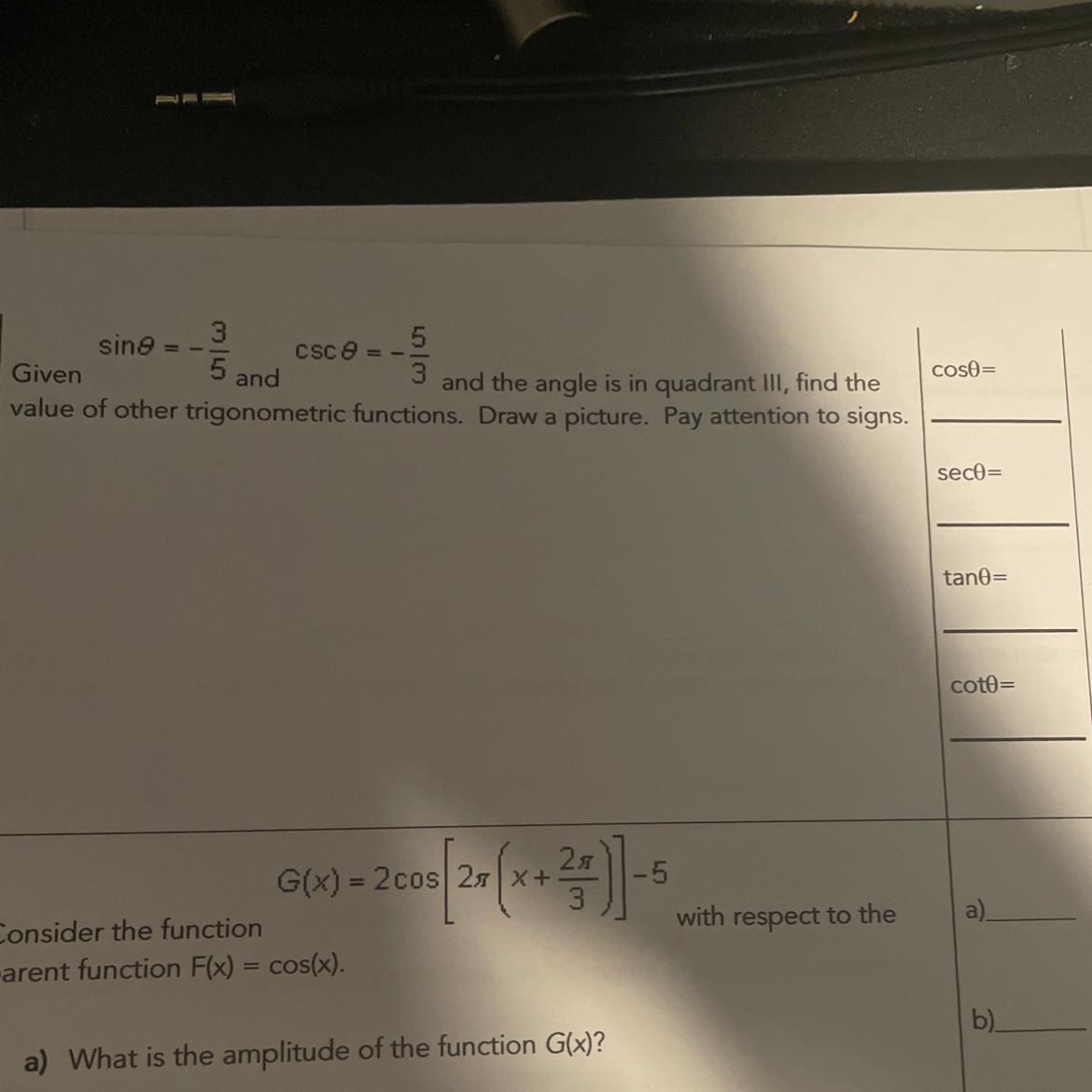
Answers
All the values of other trigonometric functions are,
cos θ = -4/5.
sec θ = -5/4.
tan θ = 3/4.
cot θ = 4/3.
Since, We have to given that;
sin θ = -3/5 and csc θ = -5/3
We know that;
⇒ sin² θ + cos² θ = 1
Substitute the given values, we get;
⇒ (-3/5)² + cos² θ = 1
⇒ cos² θ = 1 - 9/25
⇒ cos² θ = 16/25
⇒ cos θ = -4/5
(negative because it is in Quadrant 3).
And, sec θ = 1 / cos θ
sec θ = -5/4.
And, tan θ = sin θ / cos θ
tan θ = -3/5 / - 4/5
= -3/5 × -5/4
= 3/4.
And, cot θ = 1 / tan θ
cot θ = 4/3.
Hence, All the values of other trigonometric functions are,
cos θ = -4/5.
sec θ = -5/4.
tan θ = 3/4.
cot θ = 4/3.
Learn more about the function visit:
https://brainly.com/question/11624077
#SPJ1
The photographer takes the planned number of photos in sessions B
and C. At session D, the customer requests that she take the pictures
with a higher resolution. These photos will take up 3.4 megabytes of
space on the card.
Part C: Does the photographer have enough space left on her
memory card to take all the planned photos for session D at
a higher resolution? Explain how you know you are correct.
Answers
It will be impossible to know if the photographer has enough space left on her memory card without knowing the capacity of the card and the size of the planned photos for session D.
Main answer:
It is impossible to determine if the photographer has enough space left on her memory card without knowing the capacity of the card and the size of the planned photos for session D.
How can we determine if the photographer has enough space?We must know capacity of the card and the size of the planned photos for session D. If combined size of the planned photos for session B and C is less than remaining space on the card after accounting for the 3.4 megabytes needed for session D, then, the photographer would have enough space.
But if combined size of the planned photos for session B and C is greater than the remaining space on the card after accounting for the 3.4 megabytes needed for session D, then, the photographer would not have enough space.
Read more about memory card
brainly.com/question/31393928
#SPJ1
A math teacher keeps her wall-sized graph paper in a box shaped like a triangular prism. The triangular face of the prism has a base of 21 cm and a height of 16 cm. The length of the entire box is 130 cm.
Which of the following is the volume of the box?
.
43,680 cm3
B.
21,840 cm3
C.
4,368 cm3
D.
19,340 cm3
Answers
24 × 17 = 408 x 130 = 53,040 / 2 = 26,520
So the volume of this box is
C= 26,520 cm^3
please solve this que

Answers
Answer:
x=5
Step-by-step explanation:
you need to do dirty math stuff for these kind of Q. not hard you just need to do it, or use computer graphs to solve them.
