Write the equation of the line in slope-intercept form (y = mx + b) that has a slope of 4 and passes through the point (0,2).
Answers
Answer:
I need a graph.
Step-by-step explanation:
You can also use rise over run to help you. However if you are stating me that 4 is slope. Then it will be y=4x+ something because I am not sure if 2 is the y intercept even though its on the y-axis.
Related Questions
X - 4 <-4+ what’s the answer?
Answers
Answer:
Step-by-step explanation:
the answer is x<0
because
x-4+4<-4+4
Write the equation of the line that is parallel to y = 1/2x - 8 and passes through the point (4, 10).
Answers
Answer:
y=1/2x+8
Step-by-step explanation:
The slopes will be the same but the y-intercept will be different. I graphed out which equation will pass through (4,10) and also be parallel to y=1/2x-8.
Write an inequality to represent, "x is at least 30"
Answers
Answer:
x ≥ 30
Step-by-step explanation:
The "≥" sign means greater than or equal to. So the equation reads, "x is greater than or equal to 30."
.) how many ways are there to place testing dummies into the rollercoaster? b.) how many ways are there to place dummies into the roller coaster if the front car must have 3 or fewer testing dummies in it? c.) how many ways are there to place dummies into the roller coaster if the back car must be empty? d.) how many ways are there to place dummies into the roller coaster if the neither the front or back car can be
Answers
(a) There are 2²⁸ = 268,435,456 ways to place testing dummies into the rollercoaster
(b) There are 15 × 2²⁴ = 402,653,184 ways to place dummies into the rollercoaster if the front car must have 3 or fewer testing dummies.
(c) There is only 1 × 2²⁴ = 16,777,216 way to place dummies into the rollercoaster if the back car must be empty.
(d) There are 15 × 2²⁰ = 15,728,640 ways to place dummies into the rollercoaster if neither the front nor the back car can be full.
a) There are 7 cars and each car has 4 seats, there are a total of 7 × 4 = 28 seats. Each seat can either be occupied by a testing dummy or left empty.
For each seat, there are two possibilities (dummy or empty). Since each seat can be treated independently, the total number of ways to place the testing dummies is 2²⁸.
2²⁸ = 268,435,456
b) If the front car must have 3 or fewer testing dummies,
The front car can have 0, 1, 2, or 3 testing dummies.
There are C(4, 0) + C(4, 1) + C(4, 2) + C(4, 3) = 1 + 4 + 6 + 4 = 15 ways to select the number of dummies for the front car.
The remaining 6 cars can have any number of dummies between 0 and 4. Each car has 4 seats, and each seat can be occupied by a dummy or left empty. So, there are 2⁴ possibilities for each of the 6 remaining cars.
Total number of ways = 15 × (2⁴)⁶ = 15 × 2²⁴.
15 × 2²⁴ = 402,653,184
c) If the back car must be empty, we can calculate the number of arrangements by considering the possibilities for the back car and then multiplying it by the remaining possibilities for the other cars.
The back car can have 0 dummies. There is only 1 possibility for the back car.
The remaining 6 cars can have any number of dummies between 0 and 4. Each car has 4 seats, and each seat can be occupied by a dummy or left empty. So, there are 2^4 possibilities for each of the 6 remaining cars.
Total number of ways = 1 × (2⁴)⁶ = 1 × 224.
1 × 2²⁴ = 16,777,216
d) If neither the front nor back car can be full, we can calculate the number of arrangements by considering the possibilities for both the front and back cars and then multiplying it by the remaining possibilities for the other cars.
The front car can have 0, 1, 2, or 3 testing dummies. There are C(4, 0) + C(4, 1) + C(4, 2) + C(4, 3) = 1 + 4 + 6 + 4 = 15 ways to select the number of dummies for the front car.
The back car can have 0 dummies. There is only 1 possibility for the back car.
The remaining 5 cars (excluding the front and back cars) can have any number of dummies between 0 and 4. Each car has 4 seats, and each seat can be occupied by a dummy or left empty. So, there are 2^4 possibilities for each of the 5 remaining cars.
Total number of ways = 15 × 1 × (2⁴)⁵ = 15 × 2²⁰.
15 × 2²⁰ = 15,728,640
To know more ways about click here :
https://brainly.com/question/47446
#SPJ4
The question is incomplete the complete question is :
an amusement park is testing a roller coaster ride for safety. the roller coaster has 7 distinguishable cars, each of which contains 4 distinguishable seats. each seat can either be occupied by a testing dummy or left empty. the dummies are indistinguishable from one another, and there are enough to fill every car. for all sub-problems below, you are allowed to leave the entire ride empty, fill every seat in the ride, or anything in between. (update 2/17/23: the cars cannot be rearranged. they are fixed in one order.) a.) how many ways are there to place testing dummies into the rollercoaster? b.) how many ways are there to place dummies into the roller coaster if the front car must have 3 or fewer testing dummies in it? c.) how many ways are there to place dummies into the roller coaster if the back car must be empty? d.) how many ways are there to place dummies into the roller coaster if the neither the front or back car can be full?
what is the density of a pine log if the weight is 42.63 lbs, radius 5 in, length 30in
Answers
Answer:
Step-by-step explanation:
density is weight divided by volume. And the volume of a log is like a cylinder.
V=hpi(r^2) in this case
V=25(30)pi=750pi so
d=(42.63)/(750pi)
d=0.018 lb/in^3
Andy and dale solved 35 puzzles together
1/3 of the puzzle that Andy solved is twice the number number of puzzles that Dave solved. How many puzzles did each boy solve?
Please help me on this :)
Answers
By forming linear equations, Andy and Dale each had solved 30 and 5 puzzles respectively.
What precisely is a linear equation?
The equation is said to be linear when the greatest power of a variable is 1. A one-degree equation is another word for it. A linear equation with one variable has the conventional form Ax + B = 0. This has three variables: x, A, and B. A coefficient is represented by the letter A. A two-variable linear equation is often represented as Ax + By = C. The variables x and y, the coefficients A and B, and the variables have been added to the constant C.
Now,
Let x=puzzles solved by Andy and y=puzzles solved by Dale
then 1/3x=2y -->1
x+y=35 --->2
then from 1 x=6y and putting it into equation 2
7y=35
y=5
then x+5=35
x=30
hence,
Andy and Dale each had solved 30 and 5 puzzles respectively.
To know about linear equations visit the link
https://brainly.com/question/29739212
#SPJ1
what the metric system of measurement is based on the number?
Answers
The metric system of measurement is based on the number 10.
This system is also known as the International System of Units (SI) and is used in most countries around the world. In the metric system, various units of measurement are defined as multiples or fractions of a base unit, which is defined for each quantity being measured. For example, the base unit for length is the meter, and the base unit for mass is the kilogram. Prefixes such as kilo-, centi-, and milli- are used to indicate multiples or fractions of the base unit, based on factors of 10. For example, a kilometer is 1000 meters, a centimeter is 1/100 of a meter, and a milligram is 1/1000 of a gram. This makes the metric system easy to use and convert between units, as well as consistent and universally recognized.
To learn more about the metric system, refer:-
https://brainly.com/question/29953513
#SPJ4
a pole that is 2.8m tall casts a shadow that is 1.49m long. at the same time, a nearby building casts a shadow that is 37.5m long. how tall is the building? round your answer to the nearest meter.
Answers
The height of the building is 71 meters.
We can solve this problem using the similar triangles. The height of the building can be determined by setting up the following proportion:
(the height of pole) / (length of pole's shadow) = (height of building) / (length of building's shadow)
Substituting the given values:
2.8 / 1.49 = (height of building) / 37.5
To find the height of the building, we can cross-multiply and solve for it:
(2.8 * 37.5) / 1.49 = height of building
Calculating the expression on the right side:
(2.8 * 37.5) / 1.49 ≈ 70.7013
Rounding to the nearest meter, the height of the building is approximately 71 meters.
Learn more about heigth building at https://brainly.com/question/7289008
#SPJ11
Can someone please help me with math.

Answers
Consider a perfectly competitive firm that produces output from labor and capital under the following cond
2
ions: Y=100K
1/2
+40L
1/2
- P=$2 - W=$8 - R=$10 a. Suppose that the firm has decided to employ 25 units of labor and is currently employing 50 units of capital. What will its profit be at those employment levels? b. What equation describes the profit-moximizing quantity of capital for this firm? c. To raise profits, should the firm increase its capital employment (from 50 to something higher), or decrease it? Explain.
Answers
(a) The profit of the firm at the current employment levels of 25 units of labor and 50 units of capital can be calculated by subtracting the total cost from total revenue.
The total revenue is given by the output multiplied by the market price, which is $2. The total cost is the sum of the wage cost (W) and the rental cost of capital (R), multiplied by their respective quantities.
Profit = Total Revenue - Total Cost
Profit = (Output * Price) - (Wage * Labor + Rental * Capital)
Given that the output is determined by the production function Y = 100K^(1/2) + 40L^(1/2), the profit can be calculated as follows:
Profit = (100K^(1/2) + 40L^(1/2)) * $2 - ($8 * 25 + $10 * 50)
(b) The profit-maximizing quantity of capital for this firm can be determined by setting the marginal revenue product of capital (MRPK) equal to the rental cost of capital (R). MRPK represents the additional revenue generated by employing an additional unit of capital.
MRPK = R
The marginal revenue product of capital can be calculated as the partial derivative of the production function with respect to capital (K), multiplied by the market price (P):
MRPK = (∂Y/∂K) * P
Using the production function Y = 100K^(1/2) + 40L^(1/2), we can calculate the marginal revenue product of capital as follows:
MRPK = (∂Y/∂K) * P = (50K^(-1/2)) * $2
Setting this equal to the rental cost of capital (R) of $10, we have:
(50K^(-1/2)) * $2 = $10
Simplifying the equation, we find:
K^(-1/2) = 1/5
Squaring both sides of the equation, we get:
K = 25
Therefore, the profit-maximizing quantity of capital for this firm is 25 units.
(c) To raise profits, the firm should decrease its capital employment from 50 to 25 units. This is because the profit-maximizing quantity of capital is determined to be 25 units, as calculated in part (b). By employing fewer units of capital, the firm can reduce its rental cost while still maintaining the optimal level of capital for production. As a result, the firm can lower its total cost and increase its profit. Employing more capital beyond the profit-maximizing level would lead to diminishing returns, where the additional costs outweigh the additional revenue generated. Therefore, reducing capital employment to the optimal level of 25 units would be the most favorable decision for the firm to maximize its profits.
Learn more about profits here:
brainly.com/question/16168992
#SPJ11
True or false: In(x+y)- In(x+y)=0. Explain your thinking.
Answers
\(\huge \bf༆ Answer ༄\)
Let's solve ~
\( \sf ln(x + y) - ln(x + y) \)\( \sf ln( \frac{x + y}{x + y} ) \)\( \sf ln(1) \)\( \sf0\)[ Since, ln (1) = 0 ]
Therefore, the statement is true ~
Answer:
In(x+y) - In(x+y)
= In(\( \frac{x + y}{x + y} \))
= In(1)
=0
Hence, the statement is true!!
Solve its easy first one to answer get brainiest

Answers
Answer:
$1.53
Step-by-step explanation:
Answer:
1.53
Step-by-step explanation:
The revenue in dollars from the sale of x units of a product is represented by the following formula. (Round your answers to the nearest whole number.)
R = 10(5x + 1)−1 + 65x − 11
Find the marginal revenue when 20 units are sold.
$
Interpret your result.
If the sales go from 20 units sold to units sold, the revenue will increase by about $ .
Answers
To find the marginal revenue, we need to take the derivative of the revenue function with respect to x.
R(x) = 10(5x + 1)−1 + 65x − 11
R'(x) = 10(-1)(5x + 1)−2 (5) + 65
R'(x) = -50(5x + 1)−2 + 65
Now, we can plug in x = 20 to find the marginal revenue when 20 units are sold:
R'(20) = -50(5(20) + 1)−2 + 65
R'(20) = -50(101)−2 + 65
R'(20) ≈ 5
The marginal revenue represents the change in revenue from selling one additional unit of the product. By finding the derivative of the revenue function and evaluating it at x = 20, we found that the marginal revenue when 20 units are sold is approximately $5.
If the sales go from 20 units sold to 21 units sold, the revenue will increase by about $5. This means that for each additional unit sold after 20, the company can expect to earn an extra $5 in revenue.
Hi! I'd be happy to help you with this question.
To find the marginal revenue, we need to find the derivative of the revenue function R(x) with respect to x. Given the revenue function R(x) = 10(5x + 1)−1 + 65x − 11, let's differentiate it:
dR/dx = 10(-1)(5x + 1)^-2(5) + 65
Now, let's plug in x = 20 to find the marginal revenue:
Marginal Revenue = 10(-1)(5(20) + 1)^-2(5) + 65
= -10(101)^-2(5) + 65
≈ -10(0.00098)(5) + 65
≈ -0.049 + 65
≈ 64.951
Round the answer to the nearest whole number:
Marginal Revenue ≈ 65$
The marginal revenue is the additional revenue generated by selling one more unit. In this case, when 20 units are sold, the marginal revenue is approximately $65.
If the sales go from 20 units sold to 21 units sold, the revenue will increase by about $65.
To know more about derivative visit :-
https://brainly.com/question/29144258
#SPJ11
Find the balance in an account at the end of 12 years if $4000 is invested at an interest rate of 9% that is compounded continuously
Answers
Answer:
7250.66
Step-by-step explanation:
Choose the student who wrote and solved the equation correctly
The cost of 4 bananas is $2.36. What is the cost of each banana?
Answers
The student who wrote and solved the equation correctly would have found that the cost of each banana is $0.59.
Details, primary idea, strategy, and method make up this problem-solving plan's four steps. The use of "graphic representations" by students as they progress through each stage can help them to better organise their thoughts, demonstrate their mathematical thinking, and demonstrate how they plan to solve a problem.
To find the cost of each banana, we need to divide the total cost of 4 bananas ($2.36) by the number of bananas (4).
So, the equation would be:
Total cost / Number of bananas = Cost per banana
Substituting the values:
$2.36 / 4 = Cost per banana
Solving this, we get:
Cost per banana = $0.59
To know more about equation visit:-
https://brainly.com/question/29657983
#SPJ11
Find the domain and range of y=4-|x|
Answers
The domain of the function f(x) = 4 - |x| is -00 ≤ x ≤ 00
How to determine the domain of the function?From the question, the definition of the function is given as
f(x) = 4 - |x|
The above function is an absolute value function
The general rule of absolute value functions is that
They can take any real value as their input
Note that the domain of a function is the set of input values the function can take
Since the function is an absolute value function, then
The x values of the graph would start anywhere and increases towards all the axes
This means that the function has a domain of all set of real values
This is represented as
-00 ≤ x ≤ 00
So, the domain is -00 ≤ x ≤ 00
Read more about domain at
brainly.com/question/2264373
#SPJ1
Which function COULD be the one shown in the graph
Answers
Answer:
need the graph to know
Step-by-step explanation:
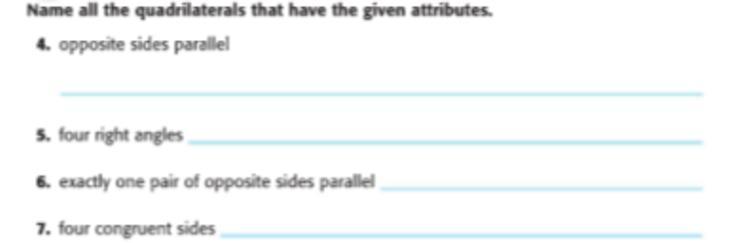
Name all of the quadrilaterals that have the given attributes.
Answers
Answer:
See below
Step-by-step explanation:
Opposite sides are parallel:
parallelogram, rectangle, rhombus and square
4 right angles:
rectangle square
Exactly 1 pair of parallel sides:
trapezoid
4 congruent sides:
square
Have a great day!
I need help with both of these questions.

Answers
X= 14 and x= -12
On the second one
X= 7 and x= -7
two airplanes leave chicago at the same time and fly in opposite directions. if one travels at 430 miles per hour and the other at 570 miles per hour, how long will it take for them to be 2000 miles apart?
Answers
The time taken by the planes when they are 2000 miles apart is 2 hours.
We all know that formula of distance, speed and time is given by distance = speed*time or time = distance/speed
Let x be the number of hours that the two planes will be 2000 miles apart.
Let 430x be the distance traveled by the first plane at 430 miles per hour
and 570x be the distance traveled by the second plane at 570 miles per hour.
here, 430x +570x =2000 is the total distance travelled by the first plane and the second plane
Solving yields the following steps:
1000x = 2000
Dividing 1000 to both sides of the above equation, we get
1000x/1000=2000/1000
So the value of x will be equivalent to 2
For more questions on distance, speed and time click on:
https://brainly.in/question/49075584
#SPJ4
9/3 x + 4 + 2x ?????
Answers
Answer:
5x + 4
Step-by-step explanation:
Base on the given:
\(\mathrm{\frac{9}{3}x+4+2x}\) → Divide 9 by 3. 9 ÷ 3 = 3
\(\mathrm{3x+4+2x}\) → Combine similar term {2x + 3x = 5x}
No farther can be simplify. Hence, 5x + 4 is the answer.
RevyBreeze
solve for the value K: (4k-7)° (3k+6)°
Answers
Problem
Solution
For this case we can do the following :
3 k + 6= 90 - (4k-7)
And then we can solve for k on this way:
3k +6 = 90 -4k +7
3k +6 = 97 -4k
7k = 97-6
7k= 91
k= 91/7= 13
then the solution for this case would be K=13

Find the solution of the following initial value problem. y ′′ + y = δ(t − 2π) cost; y(0) = 0, y′ (0) = 1
Answers
The solution of the given initial value problem is y(t) = sin(t) + H(t-2π)cos(t-2π), where H(t) is the Heaviside step function.
To solve the initial value problem, we start by finding the complementary solution, which satisfies the homogeneous differential equation y'' + y = 0. The complementary solution is given by y_c(t) = A sin(t) + B cos(t), where A and B are constants to be determined.
Next, we find the particular solution for the given non-homogeneous term δ(t-2π)cos(t). Since the forcing term is a Dirac delta function at t = 2π, we can write the particular solution as y_p(t) = K(t-2π)cos(t-2π), where K is a constant to be determined.
Applying the initial conditions y(0) = 0 and y'(0) = 1, we can solve for the constants A, B, and K. Plugging in these initial conditions into the general solution, we find A = 0, B = 1, and K = 1.
Therefore, the solution of the initial value problem is y(t) = sin(t) + H(t-2π)cos(t-2π), where H(t) is the Heaviside step function.
The initial value problem with the given conditions is solved by finding the complementary solution and the particular solution. The solution is y(t) = sin(t) + H(t-2π)cos(t-2π), where H(t) is the Heaviside step function. This solution satisfies the given initial conditions y(0) = 0 and y'(0) = 1.
To know more about Heaviside step function follow the link:
https://brainly.com/question/7137484
#SPJ11
please help i’ll give points or whatever
Answers
Answer:
I need this answer tooo. someone please answer
Answer:
Step-by-step explanation:
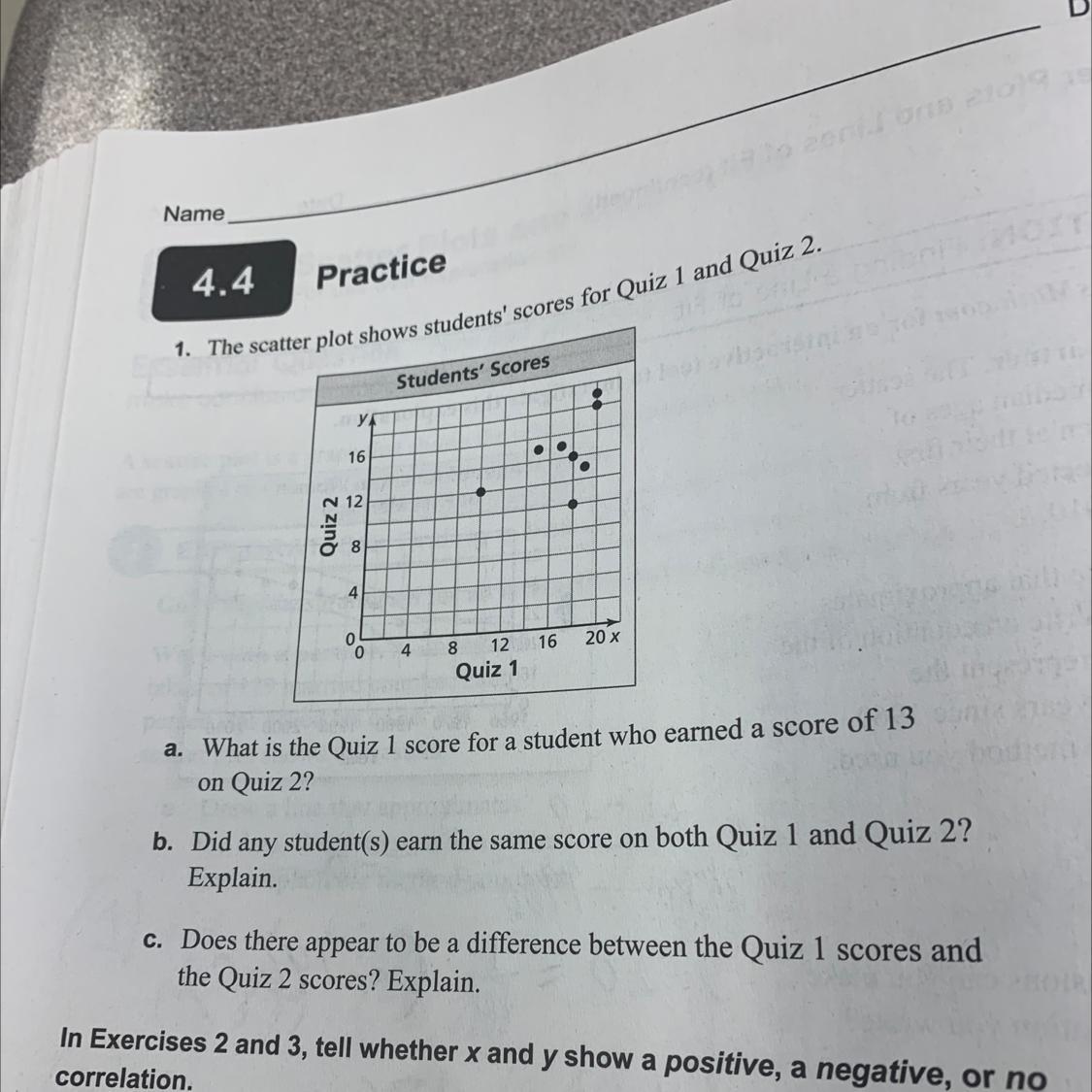
13)a ) Quiz 1 score of the student who scored 13 on Quiz 2 = 19
b) Yes. One student has scored 15 in both quizzes
c) Yes. There is a difference between Quiz 1 and quiz 2 scores
Meg has a coupon that will save her 20% off a jacket priced at $40. How much will Meg save with the coupon? Find 20% of $40.
Using friendly percents, think of 20% as
.
Meg will save 20% of $40, which is $
.
Answers
Answer:
$8
Step-by-step explanation:
20% is 1/5, so you can basically divide $40 by 5, which is $8.
Answer:
they are wrong the first one is the B one and the next one is D have a good day.
Step-by-step explanation:
1. Find the exact values of each of the six trigonometric functions of an angle θ, if (-3,3) is a point on its terminal side. 2. Given that tan θ = and sin θ <0, find the exact value of each of the remaining five trigonometric functions of θ.
Answers
Finding the six trigonometric functions of θ: Since (-3,3) is a point on the terminal side of θ, we can use the coordinates of this point to determine the values of the trigonometric functions.
Let's label the legs of the right triangle formed as opposite = 3 and adjacent = -3, and use the Pythagorean theorem to find the hypotenuse.
Using Pythagorean theorem: hypotenuse² = opposite² + adjacent²
hypotenuse² = 3² + (-3)²
hypotenuse² = 9 + 9
hypotenuse² = 18
hypotenuse = √18 = 3√2
Now we can calculate the trigonometric functions:
sin θ = opposite/hypotenuse = 3/3√2 = √2/2
cos θ = adjacent/hypotenuse = -3/3√2 = -√2/2
tan θ = opposite/adjacent = 3/-3 = -1
csc θ = 1/sin θ = 2/√2 = √2
sec θ = 1/cos θ = -2/√2 = -√2
cot θ = 1/tan θ = -1/1 = -1
Therefore, the exact values of the six trigonometric functions of θ are:
sin θ = √2/2, cos θ = -√2/2, tan θ = -1, csc θ = √2, sec θ = -√2, cot θ = -1.
Part 2: Finding the remaining trigonometric functions given tan θ and sin θ:
Given that tan θ = and sin θ < 0, we can deduce that θ lies in the third quadrant of the unit circle where both the tangent and sine are negative. In this quadrant, the cosine is positive, while the cosecant, secant, and cotangent can be determined by taking the reciprocals of the corresponding functions in the first quadrant.
Since tan θ = opposite/adjacent = sin θ/cos θ, we have:
sin θ = -1 and cos θ =
Using the Pythagorean identity sin² θ + cos² θ = 1, we can find cos θ:
(-1)² + cos² θ = 1
1 + cos² θ = 1
cos² θ = 0
cos θ = 0
Now we can calculate the remaining trigonometric functions:
csc θ = 1/sin θ = 1/-1 = -1
sec θ = 1/cos θ = 1/0 = undefined
cot θ = 1/tan θ = 1/-1 = -1
Therefore, the exact values of the remaining five trigonometric functions of θ are:
sin θ = -1, cos θ = 0, tan θ = -1, csc θ = -1, sec θ = undefined, cot θ = -1.
To learn more about Pythagorean theorem click here:
brainly.com/question/14930619
#SPJ11
Select the correct answer. Which expression is equivalent to the given expression? Assume the denominator does not equal zero. ((3C^(4)d^(4))/(2d^(9)))^(3) (3d^(4))/(2c^(2)) (27d^(2))/(8c^(2))
Answers
(27d^(2))/(8c^(2)) contains the C term with the same exponent and the d term with a different exponent as compared to the given expression. The correct is option (C).
The given expression is ((3C^(4)d^(4))/(2d^(9)))^(3).
We need to find the expression that is equivalent to the given expression. Here, we will use the properties of exponents to simplify the given expression, and then we will compare it with the expressions .
Let us simplify the given expression.
((3C^(4)d^(4))/(2d^(9)))^(3) = (3C^(4)d^(4)/2d^(9))^(3) = (3/2)(C^(4)d^(4-9))^(3) = (3/2)(C^(4)d^(-5))^(3) = (3/2)C^(4*3)d^(-5*3) = (3/2)C^(12)/d^(15)
Now, we need to compare this expression with the expressions given in the answer choices.
Option (A) (3d^(4))/(2c^(2)) cannot be the equivalent expression because it does not contain C and d terms with the same exponents.
Option (B) (81d^(6))/(8C^(6)) cannot be the equivalent expression because it contains the C term with a different exponent as compared to the given expression.
Option (C) (27d^(2))/(8c^(2)) contains the C term with the same exponent and the d term with a different exponent as compared to the given expression. Hence, this expression is equivalent to the given expression.
Hence, this expression is equivalent to the given expression .Therefore, the correct is option (C) (27d^(2))/(8c^(2)).
Know more about the exponent
https://brainly.com/question/13669161
#SPJ11
(50k³ + 10k² - 35k-7)÷(5k-4)
Divid please
Answers
Answer:
Step-by-step explanation:
10k^2 + 35k + 49
_____________________
5k - 4 | 50k^3 + 10k^2 - 35k - 7
50k^3 - 40k^2
_____________
50k^2 - 35k
50k^2 - 40k
__________
5k - 7
Therefore, the quotient is 10k^2 + 35k + 49 and the remainder is 5k - 7.
Thus, we can write:
50k³ + 10k² - 35k - 7 = (5k-4)(10k^2 + 35k + 49) + (5k-7)
Which addition does the model below represent? 5 positive tiles and 3 negative tiles. 8 + (negative 3) 2 + (negative 3) 5 + 3 5 + (negative 3)ufwufauydfauwfduAFWdfawu fuafdyfa Udafsdu faudfuafwud faWd awdacwdadaSd waSda
Answers
Answer:
D
Step-by-step explanation:
Hope this helps you on your conquest to success
0.000068 in standard form
Answers
Answer:
I guess 6.8*10 ^-5 is its standard form
The number of 0.000068 in standard form is \(6.8\times 10^{-5}\).
Given that,
The decimal number is 0.000068.We have to write in the standard form.Based on the above information, the calculation is as follows:
= 0.000068
= \(6.8\times 10^{-5}\)
Learn more: brainly.com/question/17429689