Write the equation of the line in slope-intercept form that passes through the points (-1, -2) and (4,23).
Answers
Answer:
y = 5x + 3
Step-by-step explanation:
The equation of a line in slope- intercept form is
y = mx + c ( m is the slope and c the y- intercept )
Calculate m using the slope formula
m = \(\frac{y_{2}-y_{1} }{x_{2}-x_{1} } \)
with (x₁, y₁ ) = (- 1, - 2 ) and (x₂, y₂ ) = (4, 23 )
m = \(\frac{23-(-2)}{4-(-1)} \) = \(\frac{23+2}{4+1} \) = \(\frac{25}{5} \) = 5 , then
y = 5x + c ← is the partial equation
To find c substitute either of the 2 points into the partial equation
Using (4, 23 ) , then
23 = 20 + c ⇒ c = 23 - 20 = 3
y = 5x + 3 ← equation of line
Related Questions
Mr. Peasley wrote an expression that is equivalent to
20 ÷ 1 + 4 on the board. Which expression could be the one Mr. Peasley wrote?
Responses
A 3 • 12 – 3 • 43 • 12 – 3 • 4
B 36 ÷ 3 • 2 + 1 36 ÷ 3 • 2 + 1
C 5 • 6 + 2 • 3 ÷ 2 • (1 + 5)5 • 6 + 2 • 3 ÷ 2 • (1 + 5)
D 6 + 6 • (10 + 2)
Answers
20 ÷ 1 + 4 on the board is 36 ÷ 3 • 2 + 1 36 ÷ 3 • 2 + 1.According to the order of operations, you should execute addition and subtraction last and multiply and division first, proceeding from left to right
How can addition, subtraction, multiplication, and division be calculated?According to the order of operations, you should execute addition and subtraction last and multiply and division first, proceeding from left to right. Divide and multiply from left to right as you continue. After that, add and subtract starting from the left.Remind them, if necessary, that addition and subtraction occur after multiplication and division in the order of operations.Mathematics has created standards (agreements) for how we interpret mathematical expressions in order to avoid these and other potential ambiguities. A writer who intended the contrary interpretation would have to write the sentence differently: 10 (5 2). One of these conventions stipulates that when all of the operations are the same, we go left to right. Therefore, 10 5 3 = 2.To learn more about mathematical expressions refer to:
https://brainly.com/question/1859113
#SPJ1
9. Construct proofs for the following more challenging problems, justifying each step that is not a premise. i. (~PV~Q) (~RV~S), (PDT), (~WD (~T·~Z)), (~SUZ): ~(X Y), (~Wv (XY)) .. (~R~W)
Answers
The given statements are not logically consistent.
(~PV~Q) (~RV~S), (PDT), (~WD (~T·~Z)), (~SUZ): ~(X Y), (~Wv (XY)) .. (~R~W)
Are the given premises logically consistent?The given statements, (~PV~Q) (~RV~S), (PDT), (~WD (~T·~Z)), (~SUZ): ~(X Y), (~Wv (XY)) .. (~R~W), are not logically consistent. The given premises do not lead to a valid conclusion. There is a contradiction between the premises and the conclusion, which indicates that the argument is unsound.
In formal logic, consistency refers to the property of a set of statements or premises that do not contradict each other. A set of statements is consistent if it is possible for all the statements to be true at the same time. In this case, the given statements are not logically consistent, meaning that there is a contradiction within the premises and the conclusion.
Learn more about premises
brainly.com/question/31488066
#SPJ11
A hamster wheel has a 7-in. diameter. How many feet will a hamster travel in 100 revolutions of the wheel
Answers
Find the slope of each line

Answers
Answer: 7/3
Step-by-step explanation: From the leftmost, lower point to the uppermost point, you move upwards 7, and rightward 3. Slope is vertical movement over horizontal, giving 7/3.
You must decide whether to buy new machinery to produce product X or to modify existing machinery. You believe the probability of a prosperous economy next year is 0.7. Prepare a decision tree and use it to calculate the expected value of the buy new option. The payoff table is provided below (+ for profits and - for losses).
When entering the answer, do not use the $ symbol. Do not enter the thousand separator. Enter up to 2 decimal places after the decimal point. For example, $6,525.35 must be entered as 6525.35
N1: Prosperity ($) N2: Recession ($)
A1 (Buy New) $1,035,332 $-150,000
A2(Modify) $823,625 $293,648
Answers
The expected value of the "Buy New" option is 724732.60.
Decision Tree:
To solve the given problem, the first step is to create a decision tree. The decision tree for the given problem is shown below:
Expected Value Calculation: The expected value of the "Buy New" option can be calculated using the following formula:
Expected Value = (Prob. of Prosperity * Payoff for Prosperity) + (Prob. of Recession * Payoff for Recession)
Substituting the given values in the above formula, we get:
Expected Value for "Buy New" = (0.7 * 1,035,332) + (0.3 * -150,000)Expected Value for "Buy New" = 724,732.60
Therefore, the expected value of the "Buy New" option is 724,732.60.
Conclusion:
To conclude, the decision tree is an effective tool used in decision making, especially when the consequences of different decisions are unclear. It helps individuals understand the costs and benefits of different choices and decide the best possible action based on their preferences and probabilities.
The expected value of the "Buy New" option is 724,732.60.
For more questions on expected value
https://brainly.com/question/14723169
#SPJ8
One morning, Mr. Chaplin, the Vice Principal took his own temperature in Centigrade as 35 and told Mrs. Jenkins that this is the same as 90 Fahrenheit. Was the Vice Principal giving Mrs. Jenkins correct data? (Yes or No)
Answers
Answer:
Yep
Step-by-step explanation:
Solve the system by graphing.
y = 3x -4
y= -1/2x +3
Answers
Answer:
(2,2)
Step By Step Solution:
(2,2)
Find the value of f(-8)

Answers
Answer:
f(-8) = 2
Step-by-step explanation:
y = f(x)
Here, x co-ordinate is an input value, and the y co-ordinate of each point is the corresponding output value.
x = -8. The corresponding y value of -8 is 2
f(-8) = 2

Calculate the total cost of a meal that cost $45.12 if the sales tax is 5.2% and yo want to leave a
17% tip.
Answers
Answer:
55.53
Step-by-step explanation:
45.12
5.2%= 1.052
new price= original(1+5.2%)
x=45.12(1.052)
×=47.46624+17%
=55.53
suppose we wish to test the null hypothesis that there is no association between student year in school and student opinion. under the null hypothesis, what is the expected number of strongly opposed juniors?
Answers
Under the null hypothesis, the expected number of strongly opposed juniors is 50.
The term null hypothesis refers the typical statistical theory which suggests that no statistical relationship and significance exists in a set of given single observed variable, between two sets of observed data and measured phenomena.
Here we have given that suppose we wish to test the null hypothesis that there is no association between student year in school and student opinion.
And we need to find under the null hypothesis, what is the expected number of strongly opposed juniors.
Here let us consider there are 100 students.
Then according to the given statement, there is no association between student year in school and student opinion.
Which refers that half of them are supported and half of them are opposed.
Therefore, the expected value is 50.
To know more about Hypothesis here.
https://brainly.com/question/29576929
#SPJ4
Plans for a new park call for gardens directly across the sidewalk from each other to be congruent. This computer printout shows a rose garden.
If the vertices of a tulip garden are located at (x1,−y1), (x2,−y2), (x3,−y3), and (x4,−y4), will the tulip garden be congruent to the rose garden?
Answers
The lengths of all four sides of the tulip garden are equal to the lengths of the corresponding sides of the rose garden, then the two gardens will be congruent.
In order to determine if the tulip garden will be congruent to the rose garden, we must first calculate the lengths of the corresponding sides of each garden. The rose garden's vertices are labeled (x1, y1), (x2, y2), (x3, y3), and (x4, y4). The tulip garden's vertices are labeled (x1, −y1), (x2, −y2), (x3, −y3), and (x4, −y4). The length of the first side of the rose garden can be found using the distance formula, \(d = √((x2−x1)^2 + (y2−y1)^2)\). The corresponding length of the tulip garden can be found using the same distance formula, d = √((x2−x1)^2 + (y2−y1)^2) We can continue this process for the other three side of both gardens. If the lengths of all four sides of the tulip garden are equal to the lengths of the corresponding sides of the rose garden, then the two gardens will be congruent.
Learn more about length here:
https://brainly.com/question/9736876
#SPJ4
HELP ME PLEASEE IM NOT UNDERSTANDING THIS

Answers
Answer:
(10, 1), (15, 1), (20, 13), (25, 7)
IS a function
Step-by-step explanation:
The ordered pairs are (input, output). Essentially, the numbers in each ordered pair are the numbers at each end of an arrow. There are as many ordered pairs as there are arrows.
Working top-down on input values, the ordered pairs of this relation are ...
(10, 1), (15, 1), (20, 13), (25, 7)
None of the input values is repeated, so the relation is a function.
F is directly proportional to A. if F=72 when A=9 find F when A=7
Answers
Equation for direct proportion is y = kx where k is the constant of proportionality. For your letters, it’s f = ka
We know 72 =k9, so k = 8
Then they want you to solve
f = 8•7
f = 56
Can someone pleaseee help me

Answers
Answer:6
Step-by-step explanation:
Vertical angle proof. 4x is equal to 24 so 24/4=6 and x is 6
When searching for the value 10 in the array [2, 3, 5, 6, 9, 13, 16, 19], a recursive binary search algorithm will return what?
Answers
When searching for the value 10 in the array [2, 3, 5, 6, 9, 13, 16, 19], a recursive binary search algorithm will return false since the element is not found in the array.
About Binary Search Algorithm
The binary search algorithm, applied on arrays are of recursive type. The broad strategy is to look at the middle item on the list. The procedure of the binary search algorithm is either terminated (key found), the left half of the list is searched recursively, or the right half of the list is searched recursively, depending on the value of the middle element.
The function carrying out the binary search algorithm in a code returns true if the desired element is found in the array, else returns false. Since the element 10 is not present in the given array: [2, 3, 5, 6, 9, 13, 16, 19], the binary search algorithm will return false.
Learn more about binary search algorithm here:
https://brainly.com/question/20734425
#SPJ4
Question 3 Let X1, X2,..., Xn be independent random variables, each having a uniform distri- bution over (0,1). Let M = maximum (X₁, X₂,..., Xn). Show that the distribution function of M, FM(-), is given by FM(x)=x, 0≤x≤1 What is the probability density function of M?
Answers
The distribution function of M, FM(-), is given by FM(x) = x, 0 ≤ x ≤ 1.
The probability density function of M is\(fM(x) = n * x^(^n^-^1^)\), 0 ≤ x ≤ 1.
In order to understand the distribution function of M, we need to consider the probability that M is less than or equal to a given value x. Since each Xi is uniformly distributed over (0,1), the probability that Xi is less than or equal to x is x.
For M to be less than or equal to x, all of the random variables Xi must be less than or equal to x. Since these variables are independent, their joint probability is the product of their individual probabilities. Therefore, the probability that M is less than or equal to x can be expressed as the product of n x's: P(M ≤ x) = x * x * ... * x = \(x^n\).
The distribution function FM(x) is defined as the probability that M is less than or equal to x. Therefore, FM(x) = P(M ≤ x) = \(x^n\).
To find the probability density function (PDF) of M, we differentiate the distribution function FM(x) with respect to x. Taking the derivative of \(x^n\)with respect to x gives us \(n * x^(^n^-^1^)\). Since the range of M is (0,1), the PDF is defined only within this range.
The distribution function of M is FM(x) = x, 0 ≤ x ≤ 1, and the probability density function of M is \(fM(x) = n * x^(^n^-^1^)\), 0 ≤ x ≤ 1.
Learn more about probability
brainly.com/question/32575884
#SPJ11
x ÷ 2/3= 7 1/9 what is the x?
Answers
The requried simplified value of x in the given expression is given as x = 128/27.
What is simplification?The process in mathematics to operate and interpret the function to make the function or expression simple or more understandable is called simplifying and the process is called simplification.
Here,
Given expression,
x ÷ 2/3= 7 1/9
Simplifying the above expression,
x = (7×9 +1 / 9) × 2/3
x = 64/9 × 2/3
x = 128/27
Thus, the requried simplified value of x in the given expression is given as x = 128/27.
Learn more about simplification here:
https://brainly.com/question/12501526
#SPJ1
2-b/3= -5/2 if you guys can help me thank you very much.
Answers
Answer:
b = 13.5
Step-by-step explanation:
2-b/3 = -5.2Multiply both sides of the equation by 6, the least common multiple of 3,212 - 2b = -15Subtract 12 from both sides-2b = -15 - 12Subtract 12 from -15 to get -27-2b = -27Divide both sides by -2b = -27/-2You can simplify -27/-2 by dropping off the negative sings making it b = 27/2Divide 27/2 to get 13.5 Or you can just simplify 27/2 to 13 1/2There are different ways you can solve this equation. Let me know if you'd like to know a different way.
Have a Good Rest of Your Day.
(a)A line through (2,1) meets the curve x²-2x-y=3at A (-2,5)and at B. Find the coordinates of B
(b) A(3,1) lies on the curve (x-1)(y+1)=4. A line through A perpendicular to x+2y=7 meets the curve again at B. Find the coordinates of B.
Answers
The slope of the line passing through these two points is:
m = (y2 - y1) / (x2 - x1) = (1 - 5) / (2 - (-2)) = -4/4 = -1
Using the point-slope form of the equation of a line, the equation of the line passing through A and (2,1) is:
y - 5 = -1(x + 2)
y - 5 = -x - 2
y = -x + 3
To find the coordinates of point B, we need to solve the system of equations formed by the equation of the line and the equation of the curve:
x² - 2x - y = 3
y = -x + 3
Substituting the second equation into the first, we get:
x² - 2x - (-x + 3) = 3
x² - x - 6 = 0
Solving for x using the quadratic formula, we get:
x = (1 ± √(1 + 24)) / 2 = 3 or -2
When x = 3, y = -x + 3 = 0, which means that point B is (3,0).
When x = -2, y = -x + 3 = 5, which means that point B is (-2,5).
Therefore, the coordinates of point B are (3,0) and (-2,5).
(b) We know that point A (3,1) lies on the curve (x-1)(y+1)=4.
Substituting x=3 and y=1 into this equation, we get:
(3-1)(1+1) = 4
4 = 4
Therefore, point A satisfies the equation of the curve.
We need to find the equation of the line passing through point A that is perpendicular to the line x+2y=7.
The slope of the line x+2y=7 is:
m = -1/2
The slope of a line perpendicular to this line is the negative reciprocal, which is:
m' = 2
Using the point-slope form of the equation of a line, the equation of the line passing through A(3,1) with slope 2 is:
y - 1 = 2(x - 3)
y - 1 = 2x - 6
y = 2x - 5
To find the coordinates of point B, we need to solve the system of equations formed by the equation of the line and the equation of the curve:
(x-1)(y+1) = 4
y = 2x - 5
Substituting the second equation into the first, we get:
(x-1)(2x-4) = 4
2x³ - 6x² + 4x - 5 = 0
We can use numerical methods to solve this cubic equation to get the value of x, and then substitute it back into the equation y = 2x - 5 to get the value of y. One possible solution is:
x ≈ 2.632
y ≈ -0.736
Therefore, the coordinates of point B are approximately (2.632, -0.736).
Find the y-intercept of the function 3x + 5y = 15.

Answers
Solution:
Given;
\(\begin{gathered} 3x+5y=15 \\ \end{gathered}\)Make y the subject of the equation;
\(\begin{gathered} 5y=-3x+15 \\ \\ y=-\frac{3}{5}x+\frac{15}{5} \\ \\ y=-\frac{3}{5}x+3 \end{gathered}\)
The y-intercept of the function is;
\(y=3\)1. What does the mean of a dataset represent? What does knowing
the standard deviation of a
dataset add?
2. What is a p value? What is the meaning of a p value?
3. Define alpha. How is it related to p
Answers
1. The mean of a dataset represents the average value of the entire set of numbers. It is calculated by adding up all the values and dividing by the number of values in the dataset. Knowing the standard deviation of a dataset adds information about how much the values deviate from the mean.
A high standard deviation indicates that the values are more spread out from the mean, while a low standard deviation indicates that the values are closer to the mean. It can help to identify outliers and the overall variability of the dataset.
2. A p-value is a statistical measure that helps to determine whether the null hypothesis (there is no significant difference between two groups) is true or false.
It is the probability of obtaining a result as extreme or more extreme than the observed result, assuming that the null hypothesis is true. A p-value of less than 0.05 (typically) is considered statistically significant, which means that there is strong evidence to reject the null hypothesis and accept the alternative hypothesis (there is a significant difference between the two groups).
3. Alpha is the level of significance that is set to determine whether a p-value is statistically significant or not. It is typically set at 0.05, which means that if the p-value is less than 0.05, then the result is considered statistically significant and the null hypothesis is rejected.
If the p-value is greater than 0.05, then the result is not statistically significant and the null hypothesis cannot be rejected. In summary, alpha and p-value are related because alpha sets the threshold for determining whether a p-value is statistically significant or not.
Learn more about hypothesis from:
https://brainly.com/question/26185548
#SPJ11
15 POINTS!
What is the correct answer for Landon's problem? Explain where he went wrong.

Answers
I need help on this the full answer
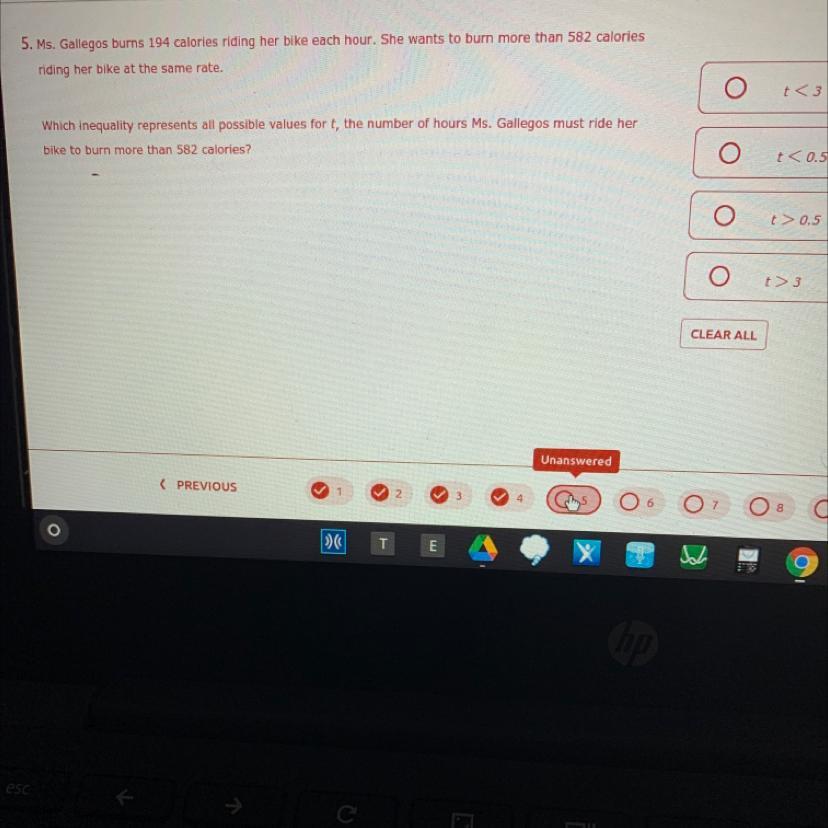
Answers
Answer:
t > 3
Step-by-step explanation:
1 hour = 194
582 / 194 = 3
She needs to ride for 3 hours to burn 582 calories
She needs to ride for more than 3 hours to burn more than 582 calories
Givenh (x) = x2 – 4whatish (6)?
Answers
Answer:
h(6) = 32
Step-by-step explanation:
h (x) = x^2 – 4
h(6) =
Let x = 6
h (6) = 6^2 – 4
= 36 -4
= 32
of ch have a coupon. Answer each question our reasoning One buys an item with a normal price of $24), but saves $6 by using a coupon For what percentage off is this coupon? 00 */% 100% 0% 25% 50% 75% 100%
Answers
The percentage off of the coupon is 25%
How to determine the percentage of the couponFrom the question, we have the following parameters that can be used in our computation:
Normal price = $24
Amount saved = $6
The above parameters mean that
Percentage of the coupon = Amount saved/Normal price
Substitute the known values in the above equation, so, we have the following representation
Percentage of the coupon = 6/24
Evaluate
Percentage of the coupon = 25%
Hence, the percentage is 25%
Read more about coupon at
https://brainly.com/question/5168855
#SPJ1
Oak street and elm street run parallel to each other when Main Street intersects them it forms interior <6 measuring70 what is the measure of <4
Answers
IfIf it forms interior <6 measuring70. The measure of <4 is: B. 110°.
Measure of <4Using this interior angle theorem
Measure of <4=180° - <6
Where:
<6 measure 70
Hence:
Measure of <4=180°-70°
Measure of <4=110°
Therefore the measure of <4 is: B. 110°.
Learn more about measure of <4 here:https://brainly.com/question/25716982
#SPJ1

9+x+3=8x-2
11+x=8x-2
-x -x
11=7x-2
+2 +2
13=7x
I need help
Answers
Answer:
x=2
Step-by-step explanation:
x=2
Check: 9+2+3=8(2)-2
14=16-2
14=14
A preton is located at the origin, and a secand proton is located on the x-axls at x1=5,74fm(1fm=10−15 m). (a) Calculate the electric potential enargy associated with this configuration. (b) An a pha partele (eharow 2e, mass =6.64×10 −2
kg) is now placed at (x 2,y 2)=(2.67,2.67) fm. Calculste the electric potential energy associated with the carriguration. (c) Starting with the three particie system, find the change in e.ectric potentiat energy if the alphs particle is allawed to escape to infinity while the two pratons remain fired it place. [Throughout, neglect any radiation effects.) (d) use canservatian of energy to calculate the speed of the alpha particie at infinith. mis: (e) If the two protons are released frem rest and the alpha partide renains fard, calculate the speed of the protons at infinity: mis gold nucleus before turning around? Assume the gold nocleus remains stabonary.
Answers
In this configuration, there are two protons located at the origin and on the x-axis at x1 = 5.74 fm. (a) To calculate the electric potential energy associated with this configuration, we can use the formula U = kq1q2/r, where k is the electrostatic constant (approximately 8.99 x 10^9 Nm²/C²), q1 and q2 are the charges of the two protons (both equal to the elementary charge, approximately 1.6 x 10^-19 C), and r is the distance between them (in this case, 5.74 fm). Plugging in these values, we can calculate the electric potential energy.
(b) When an alpha particle (charge = 2e, mass = 6.64 x 10^-27 kg) is placed at (x2, y2) = (2.67, 2.67) fm, we can calculate the electric potential energy associated with this configuration using the same formula.
(c) If the alpha particle is allowed to escape to infinity while the two protons remain fixed in place, the change in electric potential energy can be calculated by subtracting the initial potential energy (calculated in part (b)) from the potential energy when the alpha particle is at infinity.
(d) Conservation of energy can be used to determine the speed of the alpha particle at infinity. The initial potential energy of the system (when the alpha particle is at (x2, y2)) will be equal to the sum of the kinetic energy of the alpha particle at infinity and the final potential energy of the system (when the alpha particle is at infinity).
(e) If the two protons are released from rest and the alpha particle remains fixed, the speed of the protons at infinity can be calculated using conservation of energy. The initial potential energy of the system (when the protons are at their initial positions) will be equal to the sum of the kinetic energy of the protons at infinity and the final potential energy of the system (when the protons are at infinity).
In summary, the electric potential energy associated with the given configurations is calculated using the formula U = kq1q2/r. By applying conservation of energy, we can determine the change in potential energy and the speeds of the particles at infinity in different scenarios.
Learn more about infinity here:
https://brainly.com/question/22443880
#SPJ11
(x^2 + x - 17) + (x − 4) divide using polynomial long division
Answers
Answer: x+5 with a remainder of 3 (can also be said as 3/x-4)
Step-by-step explanation: See attachment

PLS I NEED HELP!!!!! Simplify.
√98
Answers
Answer:
7√2
Step-by-step explanation:
Answer:
I think that is simplyfied
Step-by-step explanation: