
Answers
Reason:
First you have to add 3 radical 2 and radical 2, getting 4 radical 2.
Then you multiple 4 radical 2 by 2 radical 5 and you get 8 radical 10.
Then you divide that by 2 to get the area of a triangle so then it comes back to 4 radical 10
Related Questions
Select the reason that best supports Statement 6 in the given proof.

Answers
Answer:
B. Distributive Property
Step-by-step explanation:
The equation for the distributive property is
ab+ac = a(b+c)
We, see it similar to statement 6, so it is the correct answer
Susan divides the fraction LaTeX: \frac{5}{8}5 8by LaTeX: \frac{1}{16}1 16. Her friend Robyn divides LaTeX: \frac{5}{8}5 8by LaTeX: \frac{1}{32}1 32. Who will get the greater quotient, Susan or Robyn? Write "Susan" or "Robyn." What is Susan's quotient? Write your answer as a whole number. What is Robin's quotient? Write your answer as a whole number.
Answers
Given:
Susan divides the fraction \(\dfrac{5}{8}\) by \(\dfrac{1}{16}\).
Her friend Robyn divides \(\dfrac{5}{8}\) by \(\dfrac{1}{32}\).
To find:
The quotient of Susan and Robyn.
Solution:
Susan divides the fraction \(\dfrac{5}{8}\) by \(\dfrac{1}{16}\).
\(\dfrac{\dfrac{5}{8}}{\dfrac{1}{16}}=\dfrac{5}{8}\times \dfrac{16}{1}\)
\(\dfrac{\dfrac{5}{8}}{\dfrac{1}{16}}=\dfrac{80}{8}\)
\(\dfrac{\dfrac{5}{8}}{\dfrac{1}{16}}=10\)
So, Susan's quotient is 10.
Her friend Robyn divides \(\dfrac{5}{8}\) by \(\dfrac{1}{32}\).
\(\dfrac{\dfrac{5}{8}}{\dfrac{1}{32}}=\dfrac{5}{8}\times \dfrac{32}{1}\)
\(\dfrac{\dfrac{5}{8}}{\dfrac{1}{32}}=5\times 4\)
\(\dfrac{\dfrac{5}{8}}{\dfrac{1}{32}}=20\)
So, Robyn's quotient is 20.
Since 20>10, therefore, Robyn will get greater quotient.
for the training adaptation of maximum strength, what is the recommended number of repetitions per set?
Answers
For maximum strength training, it is recommended to perform 1 to 5 repetitions per set, with heavier weights and longer rest periods between sets. This type of training focuses on increasing muscle strength and power.
Maximum strength training is a type of resistance training that is designed to increase muscle strength and power. The number of repetitions per set is an important factor in developing maximum strength, and the recommended range is between 1 and 5 repetitions. For this type of training, heavier weights and longer rest periods between sets are used. This allows the muscles to recover and build strength. During each set, the goal is to lift the weight as fast and explosively as possible, to help increase muscle power. It is important to also keep proper form and technique when performing exercises, as any incorrect movements can result in injury. Maximum strength training should be done with a gradual increase in weight, so that the body can properly adjust to the new load. It is also important to vary the exercises and the intensity level to help the body adapt to the training and to avoid plateaus in progress. To ensure optimal results, it is recommended to consult with a professional trainer or physical therapist.
Learn more about weights here
https://brainly.com/question/23312072
#SPJ4
What is the distance between the points (4, 6) and (5, 3)? Write the answer in simplest radical form.
Answers
Answer:
\( \sqrt{10} \: \: units\)
Step-by-step explanation:
\( \sqrt{(6 - 3)^{2 } + (4 - 5)^{2} } \)
\( \sqrt{9 + 1} \)
\( \sqrt{10} \)
= 3.16 units
The distance between two points of a line is given as:
Distance = \(\sqrt{(x_2-x_1)^2 +(y_2-y_1)^2}\)
Where,
\((x_1, y_1)~~and ~~(x_2, y_2)\) are the two points.
The simplest radical form of the distance between (4, 6) and (5, 3) is√10.
What is the distance between two points of a line?The distance between two points of a line is given as:
Distance = \(\sqrt{(x_2-x_1)^2 +(y_2-y_1)^2}\)
Where,
\((x_1, y_1)~~and ~~(x_2, y_2)\) are the two points.
We have,
The two points.
(4, 6) and (5, 3)
Now,
Distance = \(\sqrt{(5-4)^2 +(3-6)^2}\)
Distance = \(\sqrt{1^2 +(-3)^2}\)
Distance = \(\sqrt{1 + 9}\)
Distance = √10
We can also write this as,
Distance = \(10^{1/2}\)
Thus,
The simplest radical form of the distance between (4, 6) and (5, 3) is√10.
Learn more about distance of a line here:
https://brainly.com/question/14645718
#SPJ2
Which of the following statements about the assumptions underlying a two-way ANOVA are true? a.The two-way ANOVA is robust to violations of the assumptions of sampling from normal distributions and HOV provided the samples are of equal size (e.g. n1=n2=n3..).
b. The population variances for each of the cells should be equal (i.e., there is homogeneity of variance).
c. The populations from which the samples are taken for a two-way ANOVA must be distributed normally.
d. If the assumptions underlying a two-way ANOVA are violated, the research should conduct two one-way ANOVAs instead.
Answers
The correct statements are:
b. The population variances for each of the cells should be equal (i.e., there is homogeneity of variance).
c. The populations from which the samples are taken for a two-way ANOVA must be distributed normally.
In a two-way ANOVA, there are several assumptions that need to be met for valid statistical inference. Two of these assumptions are the equality of population variances and the normal distribution of populations.
b. The assumption of homogeneity of variance states that the population variances for each combination of levels of the two factors in a two-way ANOVA should be equal. Violation of this assumption can lead to biased results and affect the validity of the statistical test.
c. The assumption of normality states that the populations from which the samples are taken should follow a normal distribution. This assumption is important because the validity of the F-test used in ANOVA is based on the assumption of normality. Departures from normality can impact the accuracy and reliability of the results.
a. The statement in option (a) is not true. The two-way ANOVA is not robust to violations of the assumptions of sampling from normal distributions and homogeneity of variance, even if the samples are of equal size. Violations of these assumptions can lead to inaccurate and unreliable results.
d. The statement in option (d) is also not true. If the assumptions of a two-way ANOVA are violated, it does not necessarily mean that the researcher should conduct two separate one-way ANOVAs. There are alternative non-parametric tests or robust ANOVA methods that can be used in such cases. The choice of appropriate statistical analysis depends on the nature of the data and the specific research question.
Learn more about ANOVA here:
https://brainly.com/question/30763604
#SPJ11
the germination rate is the rate at which plants begin to grow after the seed is planted. a seed company claims that the germination rate for their seeds is 90 percent. concerned that the germination rate is actually less than 90 percent, a botanist obtained a random sample of seeds, of which only 80 percent germinated. what are the
Answers
The correct hypothesis for a one-sample z-test for a population proportion p for germination is p <0.9
A hypothesis is an informed estimate about the solution to a scientific issue that is supported by sound reasoning. It is the expected result of the trial, though it is not evidence in an experiment. Depending on the information collected, it might be supported or might not be allowed at all.
The material provided indicates that the following is the appropriate theories for a one-sample z-test for a population proportion where H0 is p = 0.9 and H1 <0.9. Thus, at the null hypothesis, it is tested if the germination rate is actually of 90%, that is H = 0.9 and at the alternative hypothesis, it is tested if the germination rate is of less than 90%, that is H1 <0.9.
Complete Question:
The germination rate is the rate at which plants begin to grow after the seed is planted. A seed company claims that the germination rate for their seeds is 90 percent. Concerned that the germination rate is actually less than 90 percent, a botanist obtained a random sample of seeds, of which only 80 percent germinated. What are the correct hypotheses for a one-sample z-test for a population proportion p ?.
Read more about hypothesis on:
https://brainly.com/question/25263462
#SPJ4
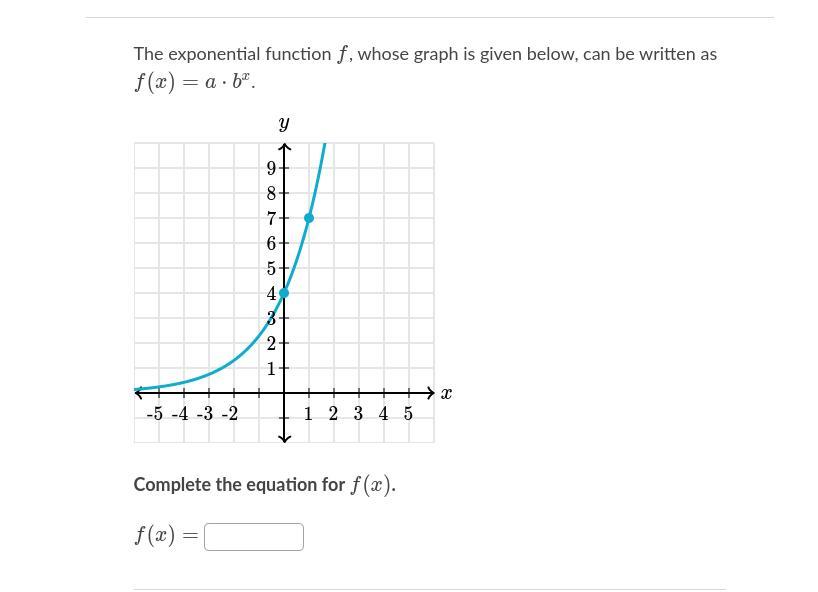
The exponential function f, whose graph is given below, can be written as f(x)=a⋅b^x
Answers
The exponential function f, whose graph is given below, can be written as f(x)=4.7ˣ.
What is function?In mathematics, a function is a rule that maps each element (or input) of a set, called the domain, to a unique element (or output) of another set, called the range. Functions are often represented using function notation, such as f(x), where "f" is the name of the function and "x" is the input variable. The value of f(x) is the output or image of x under the function f.
Here,
If the exponential function f can be written as f(x) = a ⋅ b^x, where a and b are constants, then the graph of f will have the following characteristics:
The y-intercept of the graph will be a, which is the value of f(0).
The base of the exponential function, b, determines the rate of growth or decay of the function. If b > 1, the function grows as x increases. If 0 < b < 1, the function decays as x increases. If b = 1, the function is constant.
The graph of f will be increasing if b > 1 and decreasing if 0 < b < 1. The rate of increase or decrease will be determined by the magnitude of b.
The graph of f will never cross the x-axis, but it will approach the x-axis as x becomes very negative (if b > 1) or very positive (if 0 < b < 1).
Note that the graph of an exponential function can also be characterized by its asymptote, which is a horizontal line that the function approaches but never crosses. The asymptote is the line y = 0 if 0 < b < 1, and the line y = a if b > 1.
To know more about function,
https://brainly.com/question/28193994
#SPJ1ˣ
Jose was playing a basketball shooting game in the arcade. He made 15 shots and missed 25 shots. What is the percentage of shots Jose made in the basketball game?
help pls :(
Answers
Answer:
37.5/38(rounded)
Step-by-step explanation:
Answer:
37.5%
Step-by-step explanation:
15 + 25 = 40
15/40 = 37.5%
15
40 x 100% = 37.5%
Sorry if wrong! Plz mark brainiest if correct :D Have a great day Luv!
-Bee
In an effort to protect the environment, Ryan is trying to get the citizens of his hometown, Centerville, to waste less water. A study indicated that they wasted 9,500 gallons of water last year and 5,130 gallons of water this year. What is the percent of decrease in the amount of water wasted yearly?
Answers
Answer:
13
Step-by-step explanation:
Determine the period.

Answers
Answer:
2
Step-by-step explanation:
Basically, the period of a sinusoidal graph is the distance between one cycle to another. As can be visually seen, this is 2.
Answer:
2
Step-by-step explanation:
its right on Acellus
please show the steps! tys m
evaluate: S√3+ 36+(In (8x))² X using this formula: √√₁²+ 4² du = =1/1/20 dx 7 + ₁/² 2 a²+u² +₁ in (u + √₁²+u² + c),
Answers
The steps to evaluate S√3 + 36 + (In (8x))², we should calculate the natural logarithm of 8×, square the result, take the square root of 3 and then add it into the formula.
To evaluate S√3 + 36 + (In (8x))², we need to follow a series of steps.
Step 1: Calculate the natural logarithm of 8x
The expression ln(8x) represents the natural logarithm of 8x. The natural logarithm, denoted by ln, is the logarithm with base e. To calculate ln(8x), we substitute the value of 8x into the natural logarithm function.
Step 2: Square the result
After obtaining ln(8x), we square the value. This involves multiplying the result obtained in Step 1 by itself. The squared value will be used later in the evaluation process.
Step 3: Take the square root of 3 and add it to 36
The expression √3 represents the square root of 3. We calculate this value separately and then add it to 36.
Step 4: Substitute the squared logarithm value into the formula
The next step involves using the squared value obtained in Step 2 and substituting it into the given formula:
√√₁² + 4² du = 1/(1/20 dx) 7 + ₁/² 2 a² + u² + ₁ in (u + √₁² + u² + c).
This formula contains various symbols and variables, and it requires careful substitution and calculations. By plugging in the squared logarithm value, we can simplify the expression further.
Following these steps will lead to the evaluation of the given expression, S√3 + 36 + (In (8x))².
To Learn more about square root click here: brainly.com/question/15208820
#SPJ11
Find the x- and y-intercepts of the graph of 2x + 7y = 8. State your answers as
whole numbers or as improper fractions in simplest form.
Answers
Answer:
y-intercept=8/7
x-intercept=4
Step-by-step explanation:
y=(8-2x)/7
=8/7-2/7x
Therefore y-intercept =8/7,
Subt.y=0,
8/7-2/7x=0
2/7x=8/7
x intercept=4
\(\\ \sf\longmapsto 2x+7y=8\)
.X-intercepty=0\(\\ \sf\longmapsto 2x+7(0)=8\)
\(\\ \sf\longmapsto 2x=8\)
\(\\ \sf\longmapsto x=4\)
(4,0)Y-interceptx=0\(\\ \sf\longmapsto 2(0)+7y=8\)
\(\\ \sf\longmapsto 7y=8\)
\(\\ \sf\longmapsto y=\dfrac{8}{7}\)
(0,8/7)Keith wants to place a picture frame in the center of a wall that is 14 5/6 feet wide. The picture is 1 1/2 feet wide.
How many feet from each side of the wall must the frame be so that it is centered?
A. 7
B. 6 2/3
C. 6 1/2
D. 6 1/2
E. 6
Answers
Answer:
HM
Step-by-step explanation:
dddd
Let point P be the weighted average of points A(7,3) and B(-3,-10), where point A weights three times as much as point B. What are the coordinates of point P?
A (-2,-27/4)
B (2,-7/2)
C (9/2, -1/4)
D (6,-1/3)
Answers
According to the question,
If B weighs x, then A would be 3x. So, P would be 2x, i.e., P divides A & B in 1:3 internally.
Coordinates of A (7, 3)
Coordinates of B (-3, -10)
Let coordinates of P be (x, y)
P(x) = 7 × (1) + (-3 × 3) / 3+1 = -2/4 = -2
P(y) = (3 × 1) + (-10 × 3) / 3+1 = -27/4
P(x, y) = (-2, -27/4)
Therefore, the correct answer is option A.
To learn more, https://brainly.com/question/18269861
#SPJ4
55 is 40% of what number?
a. 137.5
b. 110
c. 72.7
d. 13.8
Answers
Answer:
Answer Is A
Step-by-step explanation:
Just trust me
april, bill , candace, and bobby are to be seated at random in a row of 7 chairs. what is the probability that april and bobby will occupy the seats at the end of the row?
Answers
The required probability of occupying seats at the end of the row by April and Bobby is equals to 0.0333.
We have,
Number of chairs in a row = 5
April and Bobby need to occupy the two end chairs.
The other two people, Bill and Candace, can sit in any of the 3 remaining chairs.
The total number of ways to seat the 4 people in the 5 chairs is
= 5!/(5-4)!
= 5x4x3x2
= 120.
April can sit in either of the two end chairs, and then Bobby can sit in the other end chair.
Bill and Candace can then sit in either of the two remaining chairs, in either order.
The number of ways to seat April and Bobby at the ends of the row is,
= 2x1x2x1
= 4.
Probability that April and Bobby will occupy the seats at the end of the row is,
4/120
= 1/30
= 0.0333
Therefore, the probability of April and Bobby occupy seats at the end of the row is 1/30 or approximately 0.0333.
Learn more about probability here
brainly.com/question/31074652
#SPJ12
What is the diameter of the circle

Answers
Answer:
8.4 is the answer and the circumference is 26.4
help needed please!!!

Answers
denise measured a community college and made a scale drawing. in real life, a building at the college is 122 meters long. it is 183 centimeters long in the drawing. what scale did denise use?
Answers
The scale Denise used is as follows:
3 centimetres: 2 metres
How to find the scale of a drawing?Denise measured a community college and made a scale drawing. In real life, at the college is 122 meters long. it is 183 centimetres long in the drawing.
The scale of Denise use can be calculated as follows:
Using the proportional relationship,
3 / x = 183 / 122
cross multiply
122(3) = 183x
366 = 183x
divide both sides by 183
x = 366 / 183
x = 2 metres.
learn more on scale here: https://brainly.com/question/32042187
#SPJ4

when the film is placed into the xcp holder with the smooth side of the film towards the throat, after processing it will appear dark. t/f
Answers
The given statement " When the film is placed into the XCP (extension cone paralleling) holder with the smooth side of the film towards the throat, after processing, it will appear darker" is false because it will lighter, not darker.
The smooth side of the film is the side that interacts with the X-ray radiation and receives the image, while the emulsion side contains the light-sensitive crystals that react to the radiation.
Placing the smooth side towards the throat ensures that the image is sharp and clear, as the X-ray beam travels through the teeth and soft tissues before reaching the film.
After processing, the exposed areas of the film turn dark, representing the captured X-ray image, while the unexposed areas remain light or clear.
Know more about X-ray image here:
https://brainly.com/question/29127698
#SPJ11
ms. monroe ordered 24 costumes from tip-tap dance supply for each of her dance students to wear at an upcoming recital. since she ordered during the store's end-of-season sale, tip-tap took $3.50 off the price of each costume. ms. monroe paid $516 in all. which equation can you use to find the cost, x, of a costume at full price?
Answers
The equation that can be used to find the cost, x, of a costume at full price is 24x - 24(3.50) = 516.
Let's denote the cost of a costume at full price as x. Since Ms. Monroe ordered 24 costumes, the total cost before the discount would be 24x.
During the end-of-season sale, Tip-Tap Dance Supply took $3.50 off the price of each costume. Therefore, the discounted price of each costume is x - 3.50.
Ms. Monroe paid a total of $516 for the costumes, which is the discounted price for 24 costumes.
We can set up the equation to represent this situation:
24(x - 3.50) = 516
By distributing and simplifying, we have:
24x - 84 = 516
Adding 84 to both sides of the equation, we get:
24x = 600
Dividing both sides by 24, we find:
x = 25
Therefore, the cost of a costume at full price, x, is $25.
In conclusion, the equation that can be used to find the cost, x, of a costume at full price is 24x - 24(3.50) = 516.
Learn more about total cost here:
https://brainly.com/question/6506894
#SPJ11
Need help asap!!! will mark brainliest
analia wants to know which school has the lower sat range relative to the resources invested per student (lower, as sat range is a measure of inequality, which we want to minimize as much as possible).
Answers
The correct option is A. School A has the lower sat range relative to the resources invested per student.Choosing one answer for your answer is based on calculations from School A or School B.
How can this situation be analysed ?These are my results, assuming I interpreted the numbers correctly:Option A: School A = 1.20 School B = 1.35 Option B: School A = 0.40 School B = 0.26 Option C: School A = 0.11 School B = 0.11 Option D: School A = 18,947.4 School B = 11,052.6
I base my analysis on the big assumption that higher numbers mean more resources per student.So if I understand the question and interpret the numbers correctly, the two choices A, B, C, or D must make sense in determining the answer 1, 2, or 3.
I would approach this question by looking at options A, B, C, and D and deciding whether school A's number is greater than school B's number.1.20 < 1.35 school B wins 0.40 > 0.26 school A wins 0.11 = 0.11 draw, to two decimal places 18,947 > 11,052 school A wins
If we choose answer 2, where school B has more resources, then we should show which of the two options where school B is bigger than school A.
Looking at the numbers above, I don't see two options where school B is bigger than school A. A, only 1 option and a draw.If we choose answer 3, where none of the answers are greater or do not make sense, this answer can be chosen.
If we choose answer 1, where school A has more resources, we should choose options B and D. Again, this assumes that I interpret the numbers presented as simply duplicates
Therefore , school A is the right choice which means option A is right answer .
Learn more about inequality here :
https://brainly.com/question/30231190
#SPJ1
The above given question is wrong. Here is the right question .
Analia is a school district manager. Here are some details about two schools in her district for the last school year.
Analia wants to know which school has the lower SAT range relative to the resources invested per student (lower, as SAT range is a measure of inequality, which we want to minimize as much as possible). Analia thought to find way to define this quantity. Identify the correct definition among the following options.
Select all that apply.
A. SAT range divided by teachers per student.
B. SAT range divided by number of students
C. SAT range divided by Graduation rate.
D.SAT range divided by SAT average
Please help me find the area of the kite!

Answers
32.13 meters
Step-by-step explanation:
add the sides, then theres your answer!
Hope i helped! <3
Gustavo tested 1000 calculators to see if any were defective. The company claimed that the probability of a defective calculator was 1% per 1000 calculators. Gustavo found 15 defective calculators out of 1000. What was the predicted frequency
Answers
We can say that Gustavo found a higher frequency of defective calculators than what the company claimed was expected.
The company claimed that the probability of a defective calculator was 1% per 1000 calculators. This means that they expected 1% of the calculators to be defective.
So, the predicted frequency of defective calculators in the sample of 1000 calculators would be:
Predicted frequency = 1% of 1000 = 0.01 x 1000 = 10
However, Gustavo found 15 defective calculators out of 1000. This is higher than the predicted frequency of 10 defective calculators.
So, the actual frequency of defective calculators in Gustavo's sample is 15/1000 = 0.015, or 1.5%. This is higher than the expected frequency of 1%.
It's worth noting that the sample size of 1000 calculators is quite large, so it's possible that the actual frequency is closer to the expected frequency than it appears in this particular sample. However, based on this sample, we can say that Gustavo found a higher frequency of defective calculators than what the company claimed was expected.
for such more question on frequency
https://brainly.com/question/26754018
#SPJ11
function h(t) =-167 + 80t + 3 where t is the number of seconds after the ball is thrown. What is the value of h(t), two seconds after the ball is thrown?
Answers

Solve (x - 3)2 = 5.
O A. x = 8 and x = -2
B.
X = -35
C. X-5+13
Ô D. x = 3 + 6
Answers
Answer:
11/2
Step-by-step explanation:
if BF bisects DBC. mDBF = 8x-10 and mFBC = 5x + 23, find each missing measure
Answers
Applying the definition of bisection, the missing measure are:
m<FBC = 78°
m<ABD = 24°
m<CBE = 24°
m<DBF = 78°
m<ABE = 156°
What is the Definition of Bisection?When an angle is bisected by a line, two equal angles are formed, thus, it is implied that the angle is bisected.
Given:
BF bisects DBC into angles DBF and FBG
m<DBF = 8x - 10
m<FBC = 5x + 23
Therefore:
m<FBC = m<DBF
Substitute
5x + 23 = 8x - 10
5x - 8x = -23 - 10
-3x = -33
x = 11
m<FBC = m<DBF = 8x - 10 = 8(11) - 10 = 78
m<FBC = 78°
m<DBF = 78°
m<CBE = 180 - 78 - 78 = 24°
m<ABD = m<CBE = 24° [vertical angles]
m<ABE = 180 - m<ABD = 180 - 24 = 156°
In summary, applying the definition of bisection, the missing measure are:
m<FBC = 78°
m<ABD = 24°
m<CBE = 24°
m<DBF = 78°
m<ABE = 156°
Learn more about definition of bisection on:
https://brainly.com/question/25770607
#SPJ1

solve the following system of equations. if there is no solution, write dne in each coordinate of the ordered triplet. if there are an infinite number of solution, write each coordinate in terms of z . z. x 7
Answers
DNE in each coordinate of the ordered triplet are y is -7 , DNE ,y is-2.
Whais the explanation?1.) 2+3 = y + 12
Make y the formula's subject after adding the LHS.
5 = y + 12
Y = 5 - 12
Y = - 7
The answer to the equation is -7
2.) 2 + 13 = 1 +8
The equation cannot have a solution since there is no unknown variable and the sum of the numbers on the left hand side (LHS) does not equal the sum of the numbers on the right hand side (RHS).
3.) y - 7 = 2 - 11
RHS is added, and y is become the formula's subject.
Y - 7 = -9
Y = -9 + 7
Y = -2
The equation's answer is -2.
The complete question is:Solve the following system of equations. If there is no solution, write DNE in each coordinate of theordered triplet. If there are an infinite number of solution, write each coordinate in terms of z.2+3 = y + 12
2 + 13 = 1 +8
y - 7 = 2 - 11
To learn more about DNE refer to:
https://brainly.com/question/16938197
#SPJ4
For each of the bookcases a woodworker is building, she
charges $65 for materials. She also charges $35 for each
hour she works to build the bookcases. How much does
the woodworker charge for working 100 hours to build 18
bookcases?
A$4,735
B$3,565
C$3,583
D $4,670
Answers
35x100 hours = $3500+$65= $3565 for 100 hours of work and materials.
answer is b
my sister just had this question
2. sin(x) sin(y)dx + cos(x) cos(y)dy = 0, y (0) = 2, h = 0.5, Find y (1) using fourth-order RK
Answers
Using the fourth-order Runge-Kutta method, y(1) ≈ 1.598882.
To solve the given differential equation using the fourth-order Runge-Kutta method, we can follow these steps:
Define the given equation: sin(x)sin(y)dx + cos(x)cos(y)dy = 0.
Step 1: Rewrite the equation in the form dy/dx = f(x, y):
f(x, y) = -sin(x)sin(y) / cos(x)cos(y)
Step 2: Determine the interval and step size:
x = [0, 1]
y(0) = 2
h = 0.5
Step 4: Implement the fourth-order Runge-Kutta method:
For each step from x = 0 to x = 1 with a step size of 0.5:
For the first step, x = 0:
\(k_1\)= 0.5 f(0, 2)
= 0.5 (-sin(0)sin(2) / cos(0)cos(2))
= 0
\(k_2\)= 0.5 f(0 + 0.5/2, 2 + 0/2)
= 0.5 f(0.25, 2)
= 0.5 (-sin(0.25)sin(2) / cos(0.25)cos(2))
≈ -0.4636476
\(k_3\) = 0.5 f(0 + 0.5/2, 2 + (-0.4636476)/2)
= 0.5 f(0.25, 1.7681762)
= 0.5 (-sin(0.25)sin(1.7681762) / cos(0.25)cos(1.7681762))
≈ -0.2688967
\(k_4\)= 0.5 f(0 + 0.5, 2 + (-0.2688967))
= 0.5 * f(0.5, 1.7311033)
= 0
y = 2 + (0 + 2(-0.4636476) + 2(-0.2688967) + (-0.1554055))/6
≈ 1.763829
For the second step, x = 0.5:
\(k_1\)= 0.5 f(0.5, 1.763829)
= 0.5 (-sin(0.5)sin(1.763829) / cos(0.5)cos(1.763829))
≈ -0.1566779
\(k_2\)= 0.5 f(0.5 + 0.5/2, 1.763829 + (-0.1566779)/2)
= 0.5 (-sin(0.75)sin(1.7352406) / cos(0.75)cos(1.7352406))
≈ -0.1657957
\(k_3\)= 0.5 f(0.5 + 0.5/2, 1.763829 + (-0.1657957)/2)
= 0.5 (-sin(0.75)sin(1.73013) / cos(0.75)cos(1.73013))
≈ -0.1666891
\(k_4\)= 0.5 f(0.5 + 0.5, 1.763829 + (-0.1666891))
= 0.5 (-sin(1)sin(1.5971399) / cos(1)cos(1.5971399))
≈ -0.170668
y = 1.763829 + (0.1566779 + 2(-0.1657957) + 2(-0.1666891) + (-0.170668))/6
≈ 1.598882
Therefore, using the fourth-order Runge-Kutta method, y(1) ≈ 1.598882.
Learn more about Runge-Kutta method here:
https://brainly.com/question/30267790
#SPJ4