William bought 6 apples for $1.98. How much will 20 apples cost?
Answers
Answer:
If 6 apples cost $1.98 then 20 apples cost
Step-by-step explanation:
First you want to find the unit rate so divide both numbers
so the answer is 3
Answer:
$6.60
Step-by-step explanation:
6 apples=$1.98
So, 6 times 3= 18 apples
That means you also have too multiply the price by 3 and 1.98 times 3=5.94
now you have 18 of the 20 apples
for the last two, simply divide 1.98 by three which= $.66
then add $.66 to $5.94 and get $6.60
Related Questions
I am currently 13 times as old as my granddaughter. Next year, I will be 11 times as old as my granddaughter. How old am I now?
Answers
Answer:
65 years old.
Step-by-step explanation:
Define the variables:
Let x be the age of the granddaughter.Let y be the age of the grandparent.Given:
I am currently 13 times as old as my granddaughter. Next year, I will be 11 times as old as my granddaughter.Create two equations with the given information and defined variables:
\(\begin{cases}y = 13x\\y + 1 = 11(x + 1)\end{cases}\)
Substitute the first equation into the second equation and solve for x:
\(\implies 13x+1=11(x+1)\)
\(\implies 13x+1=11x+11\)
\(\implies 2x=10\)
\(\implies x=5\)
Substitute the found value of x into the first equation and solve for y:
\(\implies y=13(5)\)
\(\implies y=65\)
Therefore, the age of the grandparent now is 65 years.
Given statements:
I am currently 13 times as old as my granddaughter. Next year, I will be 11 times as old as my granddaughter.Let us represent the character's age by variables. Assuming that the grandparent's age is G and the granddaughter's age is D. Now, using the obtained variables and the statements, create two equations that represents the provided statements. Then, we can compare the equations and simplify if needed to determine the value of the variables.
\(\implies \left[\begin{array}{ccc} \text{G = 13D} \\ \text{G + 1 = 11(D + 1)}\\\end{array}\right]\)
Since G = 13D is in the form of direct variation, we can substitute the value of G into the second equation to determine the value of D (the age of the granddaughter). Then, we can substitute the value of D into any of the two equations to determine the age of the grandparent.
⇒ G + 1 = 11(D + 1)⇒ G + 1 = 11(D + 1) [G = 13D]⇒ 13D + 1 = 11(D + 1)To solve for D, simplify both sides of the equation by using the distributive property. We need to simplify both sides of the equation so that we can isolate the variables on the other side of the equation.
⇒ 13D + 1 = 11(D + 1)⇒ 13D + 1 = 11D + 11Isolate the variables on one side. This step is necessary because it can cancel out the extra variable and simplify the other variable. To do this, you can either add or subtract on both sides of the equation.
Note: I am subtracting 11D on both sides of the equation since it is my preference. But you can also subtract 13D on both sides of the equation.
⇒ 13D + 1 - 11D = 11D + 11 - 11D⇒ 1 + 2D = 11To further isolate 2D, we need to subtract 1 on both sides of the equation to cancel out the 1 on the left-hand side of the equation. Then, we have:
⇒ 1 + 2D - 1 = 11 - 1⇒ 2D = 10But the variable is still not completely isolated since there is a coefficient being multiplied to D. To isolate the coefficient from the variable, we will need to divide the coefficient (2) on both sides of the equation.
⇒ 2D = 10⇒ 2D/2 = 10/2Then, simplify both sides of the equation. Eventually, we will have a variable on one side and a numerical value on the other side.
⇒ 2D/2 = 10/2⇒ D = 5Now we know the age of the granddaughter, we can substitute the age of the granddaughter into one of the equations and simplify it to determine the age of the grandparent. I am going to choose G = 13D since it is easier to simplify. Then, we will substitute the value of D into the equation.
⇒ G = 13D ⇒ G = 13(5)⇒ G = 65 yearsTherefore, the age of the grandparent is 65 years.
Identify the numeric order of these fractions and mixed numbers from largest to smallest in the final form with common denominators 1 1/2, 1/4, 1 3/4, 5/6.
Answers
Answer:
1 3/4, 1 1/2, 5/6, 1/4
with a common denominator, it looks like this
21/12 = 1 3/4, 18/12 = 1 1/2 10/12 = 5/6 3/12 = 1/4
The order of the fraction from largest number to smallest number is 1 3/4, 1 1/2, 5/6, and 1/4.
What are arithmetic Operations?The four fundamental operations of arithmetic are addition, subtraction, multiplication, and division of two or even more items.
Included in them is the study of integers, especially the order of operations, which is important for all other areas of mathematics, notably algebra, data management, and geometry.
As per the data given in the question,
1 1/2 = 3/2 = 1.5
1/4 = 0.25
1 3/4 = 7/4 = 1.75
5/6 = 0.83
So, the order from largest to smallest number is:
1 3/4, 1 1/2, 5/6, and 1/4.
Now, with a common denominator it will be:
21/12 = 1 3/4, 18/12 = 1 1/2 10/12 = 5/6 3/12 = 1/4
To know more about arithmetic operations:
https://brainly.com/question/25277954
#SPJ2
9.8x+17=7.6x-16
??????
Answers
Answer:
2.8867
Step-by-step explanation:
9.8x+17=7.6x-16
We move all terms to the left:
9.8x+17-(7.6x-16)=0
We get rid of parentheses
9.8x-7.6x+16+17=0
We add all the numbers together, and all the variables
2.2x+33=0
We move all terms containing x to the left, all other terms to the right
2.2x=-33
x=-33/2.2
x=-2.8867
A bicycle has a listed price of $520.99 before tax. If the sales tax rate is 6.75%, find the total cost of the bicycle with sales tax included. Round your answer to the nearest cent, as necessary
Answers
Answer:
557.00
Step-by-step explanation:
520.99+35.166825 = 556.156825
Your answer would be $556.17 if you round
Help me please!!!!!!
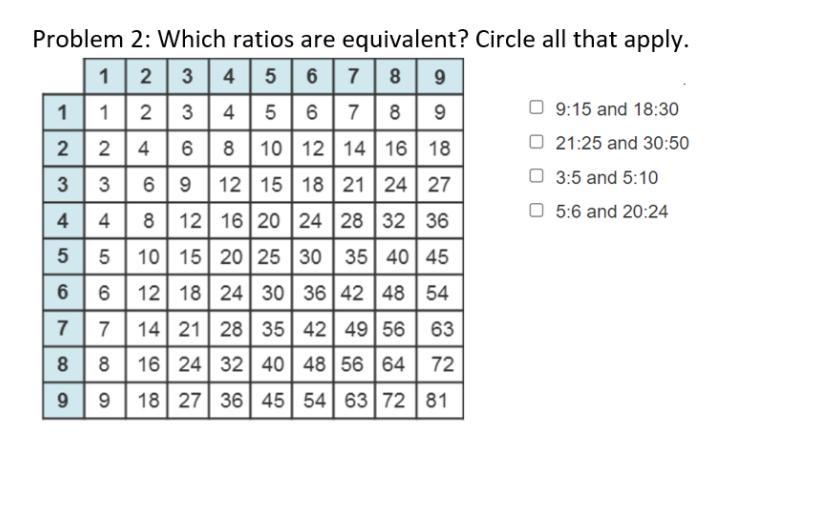
Answers
Answer:
9:14 AND 18:30 and 5:6 AND 20:24
Step-by-step explanation:
Explanation:
Because they add up to 1 whole

PLS HELP NEEDED TODAY

Answers
B:
Way One: 110 times 0.10 is 11. 110 - 11 = 99
Way Two: 110 times 0.90 is 99
C: yes, it would make sense to switch to company B because they have a lower price after discount.
A cage has canaries and parakeets in the ratio 4:7. another cage has cockatiels and parakeets in the ratio 5:8. are the ratios of birds in the two cages equivalent?
Answers
Answer: No
Step-by-step explanation:
think of 4:7 as a fraction. that would be 4/7 right? so compare that to 5:8 as a fraction- 5/8. Are these fractions the same? the answer is no.
Answer: No.
Step-by-step explanation: In this situation, you should be able to multiply the lesser ratio by a certain number and it should be equivalent with the bigger one.
Example:
1:1
2:2
For this example, you would want to multiply 1:1 by Q. Q will be our variable here. So, 1 times q equals 2. Q would be equivalent to 2, now multiply both the 1's in 1:1.
The two ratios also don't hold the same types of birds, so it cannot be equivalent whatsoever.
Zack fills bird feeders with birdseed. Each bird feeder holds 2 1/2 cups of birdseed. Zack’s scoop holds 1/4 cup.
How many scoops will Zack use to fill both bird feeders?
1. How many cups of seed does Zack need to fill both bird feeders? Show how you found your answer
2. Write an expression for the number of scoops Zack needs to fill both feeders
3. Evaluate the expression to find the number of scoops Zack needs. Show your work
Answers
Answer:
1.) 5
2.) 0.25x=5
3.) 20
Step-by-step explanation:
1.) 2.5 (same as 2 1/2) x2 ("both bird feeders")= 5 cups needed
2.) 0.25x=5 x= amount of cups needed (0.25 is the same as 1/4)
3.) 5÷0.25= 20
Answer:
1.) 5
2.) 0.25x=5
3.) 20
z = 15/4 How to solve this? (full explanation please)
Answers
When ever you have a question like that you just divide the numerator (top) by the denominator (bottom)
Which scenario can be modeled by the linear function
y = -15x + 500?
A. The temperature on Jupiter is
15℉ and increases by 500℉ every day.
B. There is a population of 500 giraffes in Western Africa that decreases by 15 giraffes each year.
C. A carpet cleaning service charges $500 plus an additional $15 for every hour.
D. A membership fee for a movie streaming service is free, but each rental costs $15.
Answers
The jamison family kept a log of the distance they traveled during a trip, as represent by the graph below. During which interval was their average speed the greatest
Answers
Answer:
20 meter jndbrje fjfjbrne
Plz help! read the instructions and write a proper answer and if you don't i will report you! And the first one to answer right will get a brainliest!

Answers
Answer:
1 = 0.61, 2 = 1.13
Step-by-step explanation:
The first is 25 + 25 + 10 + 1. This is 61 cents which is 0.61 of 1 dollar. The second is 100 + 10 + 1 + 1 + 1. This is equal to 113, 0r 1.13
BRAINLIEST PLEASE
PLEASE HELPPP IM STRUGGLING !!!!!!!!1

Answers
Answer:
956
Step-by-step explanation:
You should of studied dude
Witch one should i pick yes or no? please help me.

Answers
Answer:
yes they do have the same area
.
There are 3 peaches for every 4 strawberries in a grocery store. How many peaches and strawberries can be in a grocery store?
a. 42 peaches and 56 strawberries
b. 36 peaches and 52 strawberries
c. 33 peaches and 40 strawberries
d. 39 peaches and 48 strawberries
Answers
Answer:
A
Step-by-step explanation:
3x14=42
4x14=56
If xx and y vary directly and y is 21 when x is 7, find y when x is 5
Answers
Answer:
y = 15
Step-by-step explanation:
We need to solve for k
y = x
21 = 7k Divide both sides by 7 to solve for k
3 = k
y = xk
y = 5(3)
y = 15
Answer: y = 15
Step-by-step explanation:
easy math please help asap no rush

Answers
Answer:
20
Step-by-step explanation:
This is an easy problem. All that is needed to do is you add up all the numbers, then divide that number by how many numbers you have.
Example: 17+24+26+13=80
80/4 = 20
Answer:
So the mean means the average of all the numbers, right? So that means all you have to do is add up all the numbers together, and divide by the amount of numbers there are.
so for this question...
17 + 24 + 26 + 13 = 80.
since it equals 80, and there are four numbers, (17, 24, 26, 13) divide 80/4.
80/4 = 20
your answer is 20!
I hope this helps!
What is the Value of point P? Enter the answer in the box

Answers
Answer:
5.2
Step-by-step explanation:
add 2 to 4.8 then add 2 to 5.0.
Answer:
5.2
Step-by-step explanation:
The point P is near numbers 4.8 and 5.4.
You have to find in what matter the number line is being counted.
(counting by 0.2s)
Since you know it's being counted by 0.2s, you just subtract 5.4 - 0.2.
5.4 - 0.2 = 5.2
hope this helps :)
Write an equation for the following problem. 7th grade math.

Answers
Answer:
2.7 subtracted from 1.3 will give you your answer 1.4. Hope it helps
Answer:
w = 1.4
Step-by-step explanation:
w + 1.3 = 2.7
w = 2.7 – 1.3
w = 1.4
PLEASE HELP, ALMOST DUE 7TH GRADE MATH WORK! If Noah wanted to draw another floor plan on which Wall C was 20 cm, would 1 cm to 5 m be the right scale to use? Explain your reasoning.
Answers
Answer:
no, the scale has to go all the way to 20.
Step-by-step explanation:
I'm pretty sure this is right so ya.
THIS IS NOT MY WORK I ASKED THE SAME QUESTION ON BRAINLY AND SOMEONE ANSWERED FOR 20 POINTS :)
Answer:
no, because the scale should have cm as the largest unit
Step-by-step explanation:
is -93/6 equivalent to -93/6?
Answers
Answer: well yes because it looks exactly the same
Step-by-step explanation:
Answer:
Yes bacause they both are exactly the same.
Step-by-step explanation:
Hope it helps! =D
pls help.
Part A and B

Answers
ANSWER AND I GIVE YOU BRAINLIEST

Answers
Answer:
The whole is 375
Step-by-step explanation:
Rule S: Start with 21. Add 8.
Rule T: Start with 15. Add 8.
What is the relationship between the corresponding terms in Rules S and T?
Make a table to help you answer the question if necessary.
Answers
Answer:
They both involve adding 8
Step-by-step explanation:
When you start with 21, you add 8. When you start with 15, you add 8. In both situations you add 8.
ELIELIELIELIELIELIELIELIELIELIELIELIELIELIELIELIELIELIELIELIELIELIELIELIELIELIELIELIELIELIELIELIELIELIELIELIELIELIELIELIELIELIELIELIELIELIELIELIELIELIELIELIELIELIELIELIELIELIELIELIELIELIELIELIELIELIELIELIELIELIELIELIELIELIELIELIE
ITS ALL YOU FAULT SO OWN TO IT DUDEPLS I NEED HELP!! I'LL GIVE U THANKS AND RATES AND MARK U AS BRILLIANT BUT PLS HELP !! IT'S FOR TOMORROW!! :(
Answers
Step-by-step explanation:
10)We have to calculate the average speed if we know the distance and time that Johnatan can jog. The distance
distance=3 2/5 miles = 3.4 miles.
Time=7/8 hour = 0.875 h
Then we will use the formula for the average speed ( velocity )
velocity=distance/time. v = 3.4 m / 0.875 h = 3.866 mph
so therefore The average speed is 3.866 mph.
11) divide 120 / 7/4 (remember 120 = 120/1)
Which means you have to cross multiply (an important part on fraction division, that is, your division would be 120x4 / 1x7).
Then 120x4= 480
And 1x7 = 7
Then you get 480/7, which is the same as 68 4/7 mph
12)8 1/3=25/3
25/3 pages of a book in 10 minutes
Multiply both numbers by the reciprocal of 10, which is 1/10
25/3 x 1/10=25/30=5/6
10 x 1/10=1
So, Charlotte reads 5/6 pages of a book in 1 minute.
13)45 1/2% = 45.5% = 45.5/100 = 91/200
30 1/4% = 30.25% = 30.25/100 = 121/400
75 1/3% = 75.3333...% = 75.333.../100 = 11/15
Answer:
what he said
Step-by-step explanation:
There is no trend on the scatter plot shown below.
True or False

Answers
Answer:
It is true, since you would not be able draw a trend line to it, and there is no relative frequency in the graph.
Please help me with this as soon as possible!

Answers
Answer:
B
Step-by-step explanation:
it is the B because that's 2/5
Which graph represents y= 2/3x+3? Please explain

Answers
Answer:
The graph in the image is the correct one
Step-by-step explanation:
The slope intercept equation is y=mx+b, "m" is the slope and the "b" is the y-intercept
the y-intercept is the point where the lines crosses the y-axis and on the graph that point is 3, so our "b" would be 3, y=mx+3
Now, an easy way to get our slope is rise over run (rise/run) Start from any point where the line touches a point and count striaght up until you find another point and go to the left/right depending on where the point is. if we do that, we will get 2/3 as our slope/"m", y=2/3x+3
We can also find the slope using the slope formula, \(m=\frac{y2-y1}{x2-x1}\)
just find 2 coordinates on the graph and plug them in. If you have a graph, then I would recommend rise over run (rise/run)
feel free to ask any questions or comments

The coordinates points to plot on graph are (0, 3), (3, 5), (6, 7) and (9, 9).
What is the graph?Graph is a mathematical representation of a network and it describes the relationship between lines and points. A graph consists of some points and lines between them. The length of the lines and position of the points do not matter.
The given equation is y= 2/3x+3.
Graph the line using the slope and y-intercept, or two points.
Slope: 2/3
y-intercept: (0, 3)
Put x=0, 1, 2, 3, 4,....
When x=0
y= 2/3x+3=3
When x=3
y=5
When x=6
y=7
When x=9
y=9
So, the coordinates are (0, 3), (3, 5), (6, 7) and (9, 9)
Therefore, option C is the correct answer.
To learn more about the graph visit:
brainly.com/question/14375099.
#SPJ2
help me, please ........

Answers
Answer:
Step-by-step explanation:
Answer: D
Step-by-step explanation:
REFERENCE:
- An Integer is simply a whole number.
- Here, you have square roots. "Perfect squares" are square roots in which the square root of the number is an integer , or whole number.
__________
The perfect squares up to 100 are:
√1= 1 ( 1x1=1)
√4= 2 (2x2=4) and so on
√9= 3
√16= 4
√25= 5
√36= 6
√49= 7
√64= 8
√81= 9
√100= 10
____________
Now let's look at the answer choices:
A. √3. This is not an integer because the square root of 3 is a long decimal, 1.73205081. That's not a whole number.√3 is not in the list of perfect squares
B. √6. Not an integer. the square root of 6 is 2.44948974278. √6 is not listed in the perfect squares
C. √15 is 3.87298334621, which is not an integer. Not listed in the perfect squares.
D. √36 IS an integer. The square root of 36 is 6, which is a whole number. √36 is also listed in the perfect squares list. I know the square root of 36 is 6 because 6x6=36.
Answer= D
Hope this helps!!
quick
Use the reciprocal property to solve for x: 2 / 5 = 38 / x
Answers
It would be 2x=38(5) and you get 95
Answer:
95
Step-by-step explanation:
Cross multiply
2x = 38 × 5
Simplify
2x = 190
Divide both sides by 2
X = 95