Wich of the following is the complete list of roots for the polynomial function f(x) = (x²+2x-15) (x²+8x+17)?
-5, 3
-5, 3, -4 + i, -4-i
-5, 3, -4+1, 4+i
-4+i,-4-i
Answers
Answer:
\(-5, \quad 3, \quad -4+i,\quad -4-i\)
Step-by-step explanation:
Roots occur when f(x) = 0
\(\implies (x^2+2x-15)(x^2+8x+17)=0\)
First trinomial
\(\implies (x^2+2x-15)=0\)
\(\implies x^2+5x-3x-15=0\)
\(\implies x(x+5)-3(x+5)=0\)
\(\implies (x-3)(x+5)=0\)
Therefore, roots are 3 and -5
Second trinomial
The second trinomial cannot be factored, so solve using the quadratic formula:
\(x=\dfrac{-b \pm \sqrt{b^2-4ac} }{2a}\quad\textsf{when }\:ax^2+bx+c=0\)
Given: \((x^2+8x+17)=0\)
Therefore: a = 1, b = 8 and c = 17
\(\implies x=\dfrac{-8 \pm \sqrt{8^2-4(1)(17)}}{2(1)}\)
\(\implies x=\dfrac{-8 \pm \sqrt{-4}}{2}\)
\(\implies x=\dfrac{-8 \pm \sqrt{4}\sqrt{-1}}{2}\)
\(\implies x=\dfrac{-8 \pm 2i}{2}\)
\(\implies x=-4 \pm i\)
So the roots of the second trinomial are -4 + i and -4 - i
Therefore, the complete list of roots for the given polynomial function are:
\(-5, \quad 3, \quad -4+i,\quad -4-i\)
Related Questions
You form a company with two other partners. You own 40%, partner two owns 35% and partner three owns 25%. The company makes $950,000 in the first year and distributes profits in proportion to each partners ownership share. How much does partner two get?
Answers
Answer:$332,500
Step-by-step explanation:
I used a percent calculator and got it correct
Find the solutions/zero for the function represented in the table below

Answers
ANSWER:
x = 4 or 12
STEP-BY-STEP EXPLANATION:
Finding the zero(s) of the function in a table is locating the point(s) when y = 0 .
Therefore, in this case the zeros occur when x = 4 and when x = 12.
1. Solve the following expression if b=8. 10 b2(2=squared)
Answers
Answer:
640
Step-by-step explanation:
In order of operations, do exponents before multiplying.
8 squared= 64
64 x 10=640
(1 point) The circulation of a newspaper is increasing at a constant rate. Three months ago the circulation was 3400. Today, it is 4400. Let represent the number of months after today. a) Express the circulation as a function of time. Try drawing the graph. C(x) = ____
b) What will be the circulation 2 months from now? ____ units c) When will circulation reach 6734 newspapers? ____
Answers
The circulation as a function of time is given by C(x) = 200x + 3400. The circulation 2 months from now will be 3800 units, and the circulation will reach 6734 newspapers after approximately 16.67 months.
a) The circulation can be expressed as a linear function of time. Let C(x) represent the circulation after x months. We are given that three months ago the circulation was 3400, and today it is 4400. So, we can use the two points (0, 3400) and (3, 4400) to find the equation of the line. Using the formula for the equation of a line, we have:
C(x) = mx + b
Substituting the values (0, 3400) and (3, 4400) into the equation, we can solve for m and b. This gives us:
C(x) = 200x + 3400
b) To find the circulation 2 months from now, we substitute x = 2 into the equation C(x):
C(2) = 200(2) + 3400
C(2) = 400 + 3400
C(2) = 3800 units
c) To find when the circulation will reach 6734 newspapers, we set C(x) equal to 6734 and solve for x:
6734 = 200x + 3400
200x = 6734 - 3400
200x = 3334
x = 3334/200
x = 16.67
Therefore, the circulation will reach 6734 newspapers after approximately 16.67 months.
To learn more about function click here:
brainly.com/question/30721594
#SPJ11
Suppose you invest $ 3,500.00 in an account with an annual interest rate of 6 % compounded monthly (6% \div 12 =0.5 % each month). At the end of each month, you deposit
Answers
Investing $3,500 at 6% annual interest rate, compounded monthly, and depositing $100 at the end of each month yields a total value of $4,978.74 after 12 months.
To calculate the final value of the investment, we need to consider the monthly deposits as well as the compounded interest.
First, let's calculate the monthly interest rate in decimal form:
0.5% = 0.005
Next, we can use the formula for the future value of an annuity to calculate the value of the monthly deposits:
PMT x [((1 + r)^n - 1) / r]
where PMT is the monthly deposit, r is the monthly interest rate, and n is the number of months.
Assuming you deposit $100 at the end of each month, we have:
PMT = $100
r = 0.005
n = 12 (since there are 12 months in a year)
PMT x [((1 + r)^n - 1) / r] = $100 x [((1 + 0.005)^12 - 1) / 0.005] = $1,268.24
Therefore, the total value of the monthly deposits after 12 months is $1,268.24.
Now, let's calculate the compounded interest on the initial investment of $3,500.00. We can use the formula for compound interest:
A = P(1 + r/n)^(nt)
where A is the final amount, P is the principal (initial investment), r is the annual interest rate, n is the number of times the interest is compounded per year, and t is the number of years.
Plugging in the values, we get:
A = $3,500(1 + 0.06/12)^(12*1) = $3,710.50
Therefore, the total value of the investment after 12 months is:
$3,710.50 + $1,268.24 = $4,978.74
So, after 12 months, the investment would be worth $4,978.74 if you deposit $100 at the end of each month.
To know more about compound interest, visit:
brainly.com/question/14295570
#SPJ11
11-4 skills practice areas of regular polygons and composite figures answers
Answers
The 11-4 skills practice areas of regular polygons and composite figures involve finding the areas of different geometric shapes using specific formulas and methods.
To find the area of regular polygons, you can use the formula (1/2) x apothem x perimeter.
For composite figures, you can break the shape into smaller, more manageable shapes like rectangles, triangles, or circles, and then calculate the area of each component before adding them together.
Hence, The 11-4 skills practice areas of regular polygons and composite figures teach you to find areas using the appropriate formulas and methods, improving your geometry understanding and problem-solving abilities.
learn more about polygons click here:
https://brainly.com/question/26583264
#SPJ11
Can someone please help me with math.

Answers
20. Is 14x^2 - 3x + 9
21. Is 23x ^2 + 12x +4
22. Is -33x ^2 - 15
Ia-5I=5-a i need the anwser asap so pls try to be quick the I's are like the absolute value sign.
Answers
Answer:
a = 5
Step-by-step explanation:
|a|-|5|=5-a
a = 5
S
Page 1
(d)
A farmer plants two crops, potatoes and corn, on a ten-hectare piece of land. The number of
hectares of corn planted, c, must be at least twice the number of hectares of potatoes, p.
Write TWO inequalities to represent the scenario above,
Answers
Answer:
c ≥ (p x 2)
Step-by-step explanation:
When rolling two dice, which of the following events are independent of the event that the first die is 4:
A. the second is 2, B. the sum is 6, C. the sum is 7
D. the sum is even.
Answers
To determine which events are independent of the event that the first die is 4, we need to consider whether the probability of each event is affected by the outcome of the first die.
A. The second die is 2:
The probability of the second die being 2 is not affected by the outcome of the first die. Therefore, event A is independent of the event that the first die is 4.
B. The sum is 6:
The sum of the two dice will be 6 only if the second die is 2. Since event B depends on the outcome of the second die, it is not independent of the event that the first die is 4.
C. The sum is 7:
The sum of the two dice will be 7 if the second die is 3. Since event C depends on the outcome of the second die, it is not independent of the event that the first die is 4.
D. The sum is even:
The sum of the two dice will be even if the second die is 2, 4, or 6. Since event D depends on the outcome of the second die, it is not independent of the event that the first die is 4.
In summary, event A (the second die is 2) is the only event that is independent of the event that the first die is 4.
To learn more about probability , refer below:
brainly.com/question/26703830
#SPJ11
which table represents a linear function?

Answers
Answer:
The third option (with the y values of -3, -5, -7, and -9)
Step-by-step explanation:
The y values in the third table are increasing by the same amount, indicating that the rate of change is constant, which is a key quality of a linear function.
Given the functions f(x)=\sqrt(9-x^(2)) and g(x)=3x+6, find ((f)/(g))(x)
Answers
(f)/(g))(x) = (√[(3 + x)(3 - x)]) / (3(x + 2)).
In mathematics, a function from a set X to a set Y assigns to each element of X exactly one element of Y. The set X is called the domain of the function and the set Y is called the codomain of the function. Functions were originally the idealization of how a varying quantity depends on another quantity.
To find ((f)/(g))(x), we need to evaluate the function f(x)/g(x) for a given value of x.
We have:
f(x) = √(9 - x^2)
g(x) = 3x + 6
So,
(f/g)(x) = f(x) / g(x) = (√(9 - x^2)) / (3x + 6)
To simplify this expression, we can factor out 3 in the denominator and simplify the square root in the numerator:
(f/g)(x) = (√(9 - x^2)) / (3(x + 2))
= (√[(3^2 - x^2)]) / (3(x + 2))
= (√[(3 + x)(3 - x)]) / (3(x + 2))
Know more about function here:
https://brainly.com/question/30721594
#SPJ11
Which of the following is an increasing exponential function whose y-intercept is 50?
y = (2)* + 50
y = 50x - 4
y = 50(1.4)*
y = 500.05)*
(The little star things are x in exponent form)
Answers
Equations 1,3,4 are exponential (the 2nd isn’t so it’s out)
Y intercept means x is set at 0 so start testing
For y=2*+50 when x=0 y=1+50=51
(Any number raised to a 0 exponent is 1)
For y=50(1.4)* y=50(1) so y=50 and that is what you are looking for
Ari has a map with a scale of 1 inch: 18 miles. To get between two cities on the map, she measures 4.5 inches. How far would that be in real life
Answers
Answer:
81
Step-by-step explanation:
multiple 18 by 4 and you get 72 since you know you half of 18 is 9 you at 9 miles and the 9 comes from the left over .5
Find the component form of the vector given the initial point and the terminal point. Then find the length of the vector. MN; M(5,-9), N(-6,-2) The component form of the vector is (-11.7). (Simplify your answers.) The length of the vector is. (Simplify your answer, including any radicals. Use integers or fractions for any numbers in the expression.)
Answers
The component form of the vector MN is (-11, 7), and its length is approximately 13.04. To find the component form of the vector MN, we subtract the coordinates of the initial point M from the coordinates of the terminal point N.
M(5, -9)
N(-6, -2)
The component form of the vector MN can be calculated as follows:
MN = N - M = (-6, -2) - (5, -9)
To subtract the coordinates, we subtract the x-coordinates and the y-coordinates separately:
x-component of MN = -6 - 5 = -11
y-component of MN = -2 - (-9) = 7
So, the component form of the vector MN is (-11, 7).
To find the length of the vector MN, we can use the distance formula, which calculates the length of a vector in a Cartesian coordinate system:
Length of MN = sqrt((x-component)^2 + (y-component)^2)
= sqrt((-11)^2 + 7^2)
= sqrt(121 + 49)
= sqrt(170)
≈ 13.04
Therefore, the length of the vector MN is approximately 13.04 (rounded to two decimal places).
To read more about component form, visit:
https://brainly.com/question/13450744
#SPJ11
solve the following system of equations using the substitution method. –6x 2y = 8 y = 3x 4 question 9 options: a) no solution b) (0, 4) c) infinitely many solutions d) (8, 8)
Answers
The correct answer is option c) infinitely many solutions..
To solve the system of equations using the substitution method, we'll substitute the value of y from the second equation into the first equation and solve for x.
Given:
-6x + 2y = 8 ---(1)
y = 3x + 4 ---(2)
Substitute equation (2) into equation (1):
-6x + 2(3x + 4) = 8
Simplify:
-6x + 6x + 8 = 8
8 = 8
We obtained a true statement (8 = 8), which means the two equations are equivalent. This solution shows that the system has infinitely many solutions.
Therefore, the correct answer is option c) infinitely many solutions..
know more about substitution method
https://brainly.com/question/22340165
#SPJ11
The number t is doubled then decreased by 1
Answers
Answer:
2t - 1
Step-by-step explanation:
doubled is 2. So, it will be 2t. decreased by means subtract so:
2t -1
Raymond is building a new dog run with a raised border in his backyard. The boards on the two shorter sides are 6 feet thick, and the boards on the two longer sides are 4 feet thick. Raymond wants the outer length of the dog run to be 4 times its height and the outer width to be 2 times its height. He also wants the boards to rise 4 feet above the level of the grass in the dog run. Use x as the variable throughout the entire problem. Write a simplified expression in standard form that represents the volume of the grass in the dog run.
Answers
Answer:
The answer is 30.
Step-by-step explanation:
The equation of line fis y - 7=(x-4). Line g, which is parallel to line f, includes the point
10
(10, 4). What is the equation of line g?
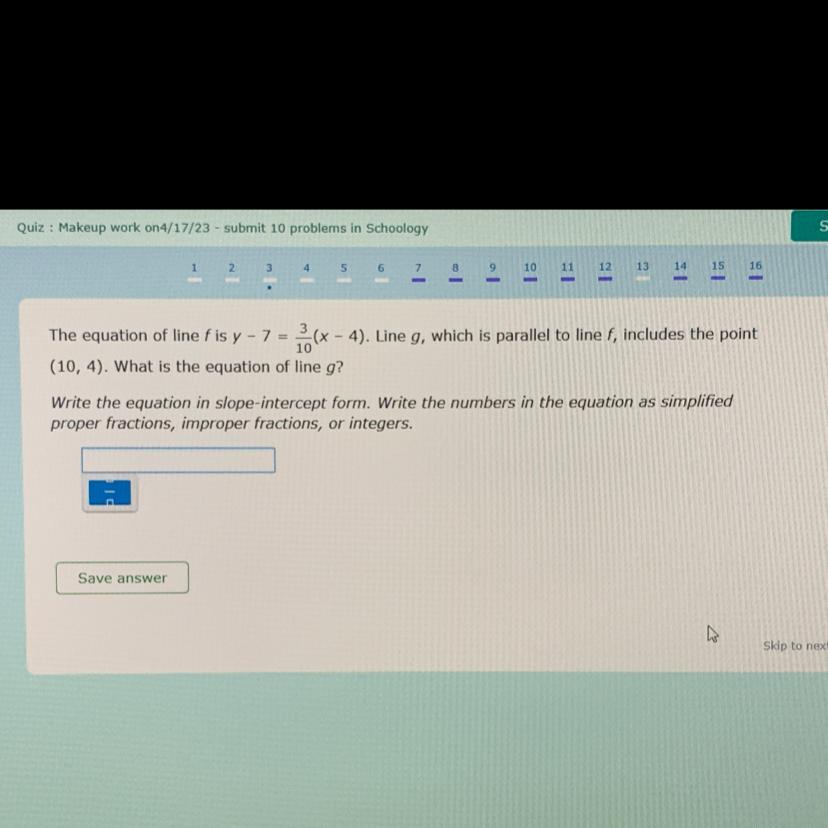
Answers
The equation of line g is y = (3/10)x + 1.
What is the equation of line g?The formula for equation of line is expressed as;
y = mx + b
Where m is slope and b is y-intercept.
Given the equation of line f is y - 7 = (3/10)(x - 4).
Since line g is parallel to line f, it will have the same slope as line f, which is 3/10.
Hence, the equation of line g can be written in the form:
y - y1 = m(x - x1)
Where (x1, y1) is the given point (10, 4) and m is the slope of line f, which is 3/10.
Substituting the values, we get:
y - y1 = m(x - x1)
y - 4 = (3/10)(x - 10)
y - 4 = (3/10)x - 3
y = (3/10)x + 1
Therefore, y = (3/10)x + 1 is the equation of line g.
Learn more about equation of line here: brainly.com/question/2564656
#SPJ1
Trade barriers discourage consumers from buying imported goods because barriers can __________. A. make imports much more common B. increase the volume of trade C. lower the taxes placed on imports D. increase the price of imports Please select the best answer from the choices provided A B C D
Answers
Answer:
B
Step-by-step explanation:
Answer:
I think its D.
Step-by-step explanation:
Im taking the quiz right now. But as far as i have seen most people are saying D too.
this is my third time asking brainly for this question. Find the perimeter and in standard form.

Answers
Consider the monthly payment formula M = (Pr(1+r)^n/(1+r)^n-1 What is the name of the formula you get if you solve for P?
What about if you solve for n? What special function do you need to use when solving for n?
I will give brainliest if correct.
Answers
In the given formula we have variables:
M - monthly payment,P - principal,r - interest rate,n - number of payments.If we have to solve it for P then it should be called 'Principal' or 'Loan amount'.
If we have to solve it for n then it should be called 'Number of payments' or 'Number of installments'.
Since n is the power of a number we need logarithm to solve it for n.
Answer:
"Principal (loan amount)"
"Term of the loan (in months)" or "Number of monthly payments"
Logarithms
Step-by-step explanation:
Monthly Payment Formula
\(M=\dfrac{Pr\left(1+r\right)^n}{\left(1+r\right)^n-1}\)
where:
M = monthly payment.P = principal loan amount.r = interest rate per month (in decimal form).n = term of the loan (in months).If we solve for P, the name of the formula is "Principal (loan amount)".
If we solve for n, the name of the formula is "Term of the loan (in months)" or "Number of monthly payments".
When solving for n, we need to use logarithms:
\(\boxed{\begin{aligned}M&=\frac{Pr\left(1+r\right)^n}{\left(1+r\right)^n-1}\\\\M(\left(1+r\right)^n-1)&=Pr\left(1+r\right)^n\\\\\frac{\left(1+r\right)^n-1}{\left(1+r\right)^n}&=\frac{Pr}{M}\\\\1-\frac{1}{\left(r+1\right)^n}&=\frac{Pr}{M}\\\\\frac{1}{\left(r+1\right)^n}&=1-\frac{Pr}{M}\\\\\left(r+1\right)^{-n}&=1-\frac{Pr}{M}\\\\\ln \left(r+1\right)^{-n}&=\ln \left(1-\frac{Pr}{M}\right)\\\\-n\ln(r+1)&=\ln\left(1-\frac{Pr}{M}\right)\\\\n&=\frac{-\ln\left(1-\frac{Pr}{M}\right)}{\ln(r+1)}\end{aligned}}\)
In triangle ABC shown find BC.
B
(5d - 3)cm
(3d + 7)cm
A
C

Answers
Answer:
BC = 22
Step-by-step explanation:
Hey There!
So if you see those two red lines on each side of the triangle than that indicates that the sides are congruent to each other so the first step is to right an equation to solve for d and because the sides are congruent the equation would be
5d-3=3d+7 and now we just solve for d
step 1 subtract 3d from each side
5d-3d=2d
3d-3d cancels out
now we have
2d-3=7
step 2 add 3 to each side
-3+3 cancels out
3+7=10
now we have
2d=10
step 3 divide each side by 2
2/2 cancels out
10/2=5
d=5
Now we just plug in 5 for d for side bc
3x5=15
15+7=22
so BC = 22
The1AndOnlyMarkus
Answer:
22
Step-by-step explanation:
make the two sides measurements equal. solve for d..
d=5... substitute d in bc formula and u should get 22
What is the value of x in the solution to this system of equations
Y+2x=-1 y=1/2x+4
Answers
Answer:
x=-25/2, y=-9/4. (-25/2, -9/4).
Step-by-step explanation:
The solution of the given system of linear equation will be x = -2 and y = 3.
What is linear equation?A linear equation is an algebraic equation in which each term has an exponent of 1 and, when graphed, the result is always a straight line.
Given are the equations,
y+2x=-1 ⇒ y = -1-2x
y=1/2x+4
Equating the equation,
-1-2x = 1/2x+4
x+8 = -2-4x
5x = -10
x = -2
And, y = -1+4
y = 3
Hence, the value of x and y are -2 and 3 respectively.
For more references on linear equation, click;
https://brainly.com/question/11897796
#SPJ5
Match the best answer on the right to the item on the left.
Group of answer choices
α [ Choose ]
Continuous variable [ Choose ]
Normal distribution [ Choose ]
q = 1 – p [ Choose ]
N [ Choose ]
x [ Choose ]
σ² [ Choose ]
σ [ Choose ]
Left skewed distribution [ Choose ]
Data is collected by watching the behavior of sample [ Choose ]
Data is collected by imposing a treatment on a sample and examining the results [ Choose ]
Data is collected as a result of computer modeling [ Choose ]
Data is collected by asking a series of questions [ Choose ]
Data is collected that does not fairly represent the population [ Choose ]
A measure of the spread or variability of the data set [ Choose ]
n [ Choose ]
r [ Choose ]
Most frequently occurring value in the date set [ Choose ]
Answers
data collected by imposing a treatment on a sample and examining the results is data collected as a result of computer modeling. Left skewed distribution is data collected that does not fairly represent the population.
Mode [ Choose ]
x Continuous variable
n N
σ σ²
r q = 1 – p
Mode Most frequently occurring value in the date set
Left skewed distribution Data is collected that does not fairly represent the population
Normal distribution Data is collected by asking a series of questions
A measure of the spread or variability of the data set Data is collected by watching
Data is collected by imposing a treatment on a sample and examining the results Data is collected as a result of computer modeling
x is a continuous variable, n is N, σ is σ², r is q = 1 – p, mode is the most frequently occurring value in the date set, a left skewed distribution is data collected that does not fairly represent the population, a normal distribution is data collected by asking a series of questions, a measure of the spread or variability of the data set is data collected by watching the behavior of sample, and data collected by imposing a treatment on a sample and examining the results is data collected as a result of computer modeling.
x is a continuous variable, n is N, σ is σ², r is q = 1 – p, mode is the most frequently occurring value in the date set. Data collected by asking a series of questions is a normal distribution, data collected by watching the behavior of sample is a measure of the spread or variability of the data set, and data collected by imposing a treatment on a sample and examining the results is data collected as a result of computer modeling. Left skewed distribution is data collected that does not fairly represent the population.
Learn more about population here
https://brainly.com/question/19538277
#SPJ4
We used these functions to represent the two sides of the equation:
f(x) = 3x
g(x) = 4x + 1
Graph the functions y = f(x) and y = g(x) on the same coordinate plane.
Answers
The solution to the system of equation graphed is (-1, -3)
Solution to system of equationGiven the system of equations graphed on the plane expressed as:
f(x) = 3x
g(x) = 4x + 1
Equate
f(x) = g(x)
3x = 4x + 1
3x - 4x = 1
-x = 1
x = -1
Determine the value of y
y = 3x
y = 3(-1)
y = -3
Hence the solution to the system of equation graphed is (-1, -3)
Learn more on system of equation here: https://brainly.com/question/847634
#SPJ1
If Mike runs 3/5 of a mile in 1/15 of an hour, how many miles would he walk in a full hour?
Answers
Answer:
9 miles
Step-by-step explanation:
The answer is 9 miles because if you divide 0.6 mile by 4 minutes, you will have an answer of 9 miles an hour, as 0.6x15=9. In a full hour, Mike would walk 9 miles.
Poisons are used to prevent rat damage in sugarcane fields. The U.S. Department of Agriculture is investigating whether rat poison should be located in the middle of the field or on the outer perimeter. One way to answer this question is to determine where the greater amount of damage occurs. If damage is measured by the proportion of cane stalks that have been damaged by the rats, how many stalks from each section of the field should be sampled in order to estimate the true difference between proportions of stalks damaged in the two sections, to within 0.02 with 90% confidence? (Assume equal number of stalks will be sampled from each section)
Answers
To estimate the difference between proportions, sample around 3355 stalks from each section of the field.
In order to estimate the true difference between proportions of stalks damaged in the two sections of the sugarcane field, we need to determine the sample size required to achieve a desired level of precision and confidence.
To estimate the required sample size, we can use the formula for sample size determination for estimating the difference between two proportions. This formula is based on the assumption of a normal distribution and requires the proportions from each section.
Let's denote the proportion of stalks damaged in the middle section as p1 and the proportion of stalks damaged in the outer perimeter as p2. We want to estimate the difference between these proportions to within 0.02 (±0.02) with 90% confidence.
To calculate the required sample size, we need to make an assumption about the value of p1 and p2. If we don't have any prior knowledge or estimate, we can use a conservative estimate of p1 = p2 = 0.5, which maximizes the required sample size.
Using this conservative estimate, we can apply the formula for sample size determination:
n = (Z * sqrt(p1 * (1 - p1) +\(p2 * (1 - p2)))^2 / d^2\)
where:
n is the required sample size per sectionZ is the z-score corresponding to the desired confidence level (90% confidence corresponds to a z-score of approximately 1.645)p1 and p2 are the estimated proportions of stalks damaged in the two sections (assumed to be 0.5)d is the desired precision or margin of error (0.02)Plugging in the values, we get:
n = (1.645 * sqrt(0.5 * (1 - 0.5) + 0.5 *\((1 - 0.5)))^2 / 0.02^2\)
n = (1.645 * sqrt\((0.25 + 0.25))^2\)/ 0.0004
n = (1.645 * sqrt\((0.5))^2\) / 0.0004
n =\((1.645 * 0.707)^2\) / 0.0004
n =\(1.158^2\) / 0.0004
n = 1.342 / 0.0004
n ≈ 3355
Therefore, the required sample size from each section of the field would be approximately 3355 stalks, in order to estimate the true difference between proportions of stalks damaged in the two sections to within 0.02 with 90% confidence.
Learn more about Sample Size
brainly.com/question/30100088
#SPJ11
To estimate the true difference between proportions of stalks damaged in the two sections of the sugarcane field, approximately 665 stalks from each section should be sampled.
In order to estimate the true difference between proportions of stalks damaged in the middle and outer perimeter sections of the sugarcane field, a representative sample needs to be taken from each section. The goal is to estimate this difference within a certain level of precision and confidence.
To determine the sample size needed, we consider the desired precision and confidence level. The requirement is to estimate the true difference between proportions of stalks damaged within 0.02 (i.e., within 2%) with 90% confidence.
To calculate the sample size, we use the formula for estimating the sample size needed for comparing proportions in two independent groups. Since an equal number of stalks will be sampled from each section, the total sample size required will be twice the sample size needed for a single section.
The formula to estimate the sample size is given by:
n = [(Z * sqrt(p * (1 - p)) / d)^2] * 2
Where:
n is the required sample size per section
Z is the Z-value corresponding to the desired confidence level (for 90% confidence, Z = 1.645)
p is the estimated proportion of stalks damaged in the section (unknown, but assumed to be around 0.5 for a conservative estimate)
d is the desired precision (0.02)
Plugging in the values, we can calculate the sample size needed for each section.
n = [(1.645 * sqrt(0.5 * (1 - 0.5)) / 0.02)^2] * 2
n ≈ 664.86
Rounding up, we arrive at approximately 665 stalks that should be sampled from each section.
Learn more about Sugarcan field
brainly.com/question/12925625
#SPJ11
Is there an irrational number that exists between 4.99 and 5?
Answers
Answer:
Yes.
Step-by-step explanation: 4.99191919
4.992
4.993
4.994
4.995
4.996
4.997
4.998
4.999
4.9999999999999999
An airline food service finds that a recent flight of 120 passengers ordered dinner as depicted in the table to the right. Based on this data, how many lasagna dinners are likely to be needed for a flight with 360 passengers? Answer correctly for 100 points!

Answers
Answer:
3 times 25 = 75
Step-by-step explanation:
Plz vote Brainliest
There are 75 lasagna dinners are likely to be needed for a flight with 360 passengers.
What is Proportional?Any relationship that is always in the same ratio and quantity which vary directly with each other is called the proportional.
Given that;
An airline food service finds that a recent flight of 120 passengers ordered dinner as depicted in the table to the right.
Here, Number of Lasagna for 120 passengers = 25
Hence, For 360 passengers number of lasagna is,
⇒ 120 / 35 = 360 / x
Where, x is umber of lasagna for 360 passengers
⇒ x = 360 × 25 / 120
⇒ x = 75
Thus, There are 75 lasagna dinners are likely to be needed for a flight with 360 passengers.
Learn more about the proportion visit:
https://brainly.com/question/1496357
#SPJ2