Answers
It is because of subduction, oceanic crust tends to get colder and denser with age as it spreads from the mid-ocean ridges.
Answer: It is because of subduction, oceanic crust tends to get colder and denser with age as it spreads from the mid-ocean ridges!
Explanation:
Related Questions
Help please, info in the pic
Answers
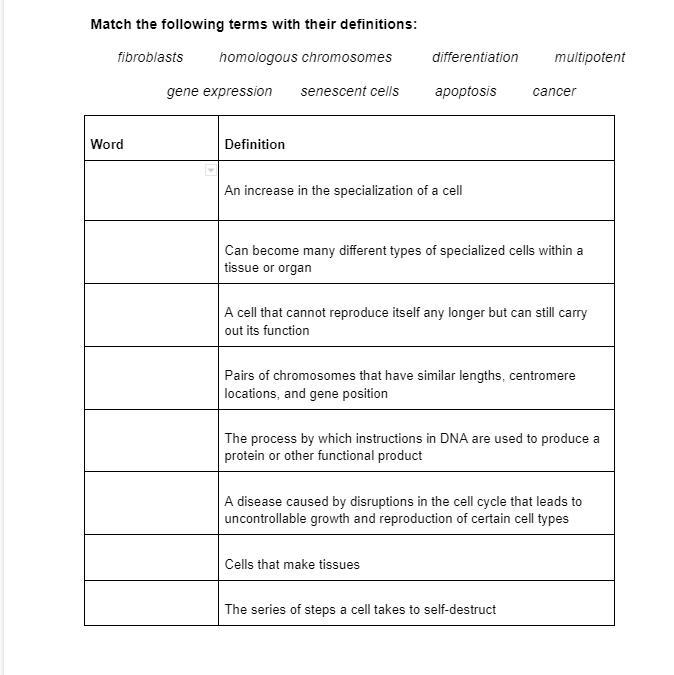
Homologous chromosomes- Pairs of chromosomes that have similar lengths, centromere locations, and gene position.
Cancer- A disease caused by disruptions in the cell cycle that leads to uncontrollable growth and reproduction of certain cell types.
Senescent cells- A cell that cannot reproduce itself any longer but can still carry out its function.
Apoptosis- The series of steps a cell takes to self-destruct.
Gene expression- The process by which instructions in DNA are used to produce a protein or other functional product.
Fibroblasts- Cells that make tissues.
Multipotent- Can become many different types of specialized cells within a tissue or organ.
Using at least 5 sentences, explain how introducing a new organism into an ecosystem can affect the stability of that system. Give specific examples.
Answers
Answer:
Introducing a new organism into an ecosystem can have significant impacts on the stability of that system. This is because every species in an ecosystem is interconnected and plays a vital role in maintaining the balance of the ecosystem. Introducing a new species can disrupt this balance and lead to both direct and indirect effects.
One direct effect of introducing a new organism can be competition for resources. For example, the introduction of the cane toad to Australia led to a decrease in the population of native insect-eating animals, as the toads outcompeted them for food.
Another direct effect of introducing a new organism can be predation. The introduction of the brown tree snake to Guam led to the extinction of several bird species, as the snake had no natural predators and was able to prey on the birds.
Indirect effects of introducing a new organism can include changes in the availability of resources. For example, the introduction of the zebra mussel to the Great Lakes in North America led to a decrease in the abundance of plankton, as the mussels filtered them out of the water.
The introduction of a new organism can also lead to the spread of diseases. For example, the introduction of the Asian tiger mosquito to the United States led to the spread of dengue fever and chikungunya virus.
Finally, the introduction of a new organism can also affect the relationships between existing species. For example, the introduction of the invasive plant Kudzu to the southeastern United States led to changes in the abundance and distribution of native plant species, which in turn affected the populations of native animals that relied on these plants for food and shelter.
In conclusion, introducing a new organism into an ecosystem can have far-reaching effects on the stability of that system. It is important to carefully consider the potential impacts before introducing a new species to an ecosystem.
Explanation:
I know you said 5 sentences, but nerded out LOL
A division is always associated with _____.
A. plants
B. animals
C. plants or animals
D. plants and animals
Answers
Division is a biological categorization level that is used to categorize or research plants. Consequently, a division must be related to plants.
What does biological classification imply?Living creatures are categorized by scientists based on their biological characteristics. Organisms are grouped based on how similar they are. In the past, similarity was determined by examining the physical characteristics of an organism, but modern classification uses a variety of techniques, including genetic analysis.
Which are the three categories used in biology?As according similarities and differences, recognized species are divided into several groupings or taxa, which is the definition of classification. Phylogenetic classifications, Natural classifications, & Artificial classifications are the three categories of categorization.
To know more about biological classification visit :
https://brainly.com/question/11136571
#SPJ1
What muscular tubes, not supported by cartilage, help regulate airflow into and out of the lungs?
A. trachea
B. diaphragm
C. alevoli
D. bronchioles
Answers
Bronchioles are small, muscular tubes in the respiratory system that help regulate airflow. The correct option is B.
Bronchioles help regulate the airflow by contracting and relaxing their smooth muscles, allowing for adjustments in the amount of air entering and exiting the lungs
Their muscular walls can constrict or dilate, allowing the body to adjust the volume of air reaching different parts of the lungs based on factors like physical activity or oxygen demands. This regulation ensures efficient gas exchange and helps maintain optimal respiratory function.
Unlike the trachea and larger airways, bronchioles lack cartilage support, which gives them the flexibility to respond to the body's respiratory needs.
Thus, the correct option is B.
To know more about Bronchioles, click here:
https://brainly.com/question/32418931
#SPJ3
An isotonic environment outside a cell has _______% salt, the same as the inside of the cell.
Answers
An isotonic environment outside a cell has same amount of salt, the same as the inside of the cell.
What is isotonic solution?Isotonic solutions are the ones that have the similar concentration of water as well as solutes as cell cytoplasm. Because there is no net gain or loss of water, cells in an isotonic solution will neither shrink nor swell.
When a cell is immersed in an isotonic solution, there is no net flow of water into or out of the cell, and the volume of the cell remains constant.
If the concentration of solutes outside the cell is the same as the concentration inside the cell and the solutes cannot cross the membrane, the solution is isotonic to the cell.
Thus, it has same percentage of salt inside and outside.
For more details regarding isotonic solution, visit:
https://brainly.com/question/12126040
#SPJ1
The external appearance of traits is called: -----
a.
Ecotype
b.
Genotype
c.
Cytotype
d.
Phenotype
Answers
Answer:
d) Phenotype
Explanation:
External appearance of an individual trait is called phenotype. The term "phenotype" refers to the observable physical properties of an organism; these include the organism's appearance, development, and behavior.
characteristics of contaminated water
Answers
Contaminated water is a type of water that is harmful to human beings due to the presence of harmful substances, pollutants, or impurities that make the water unsafe for drinking or other household uses. The characteristics of contaminated water can be identified through various indicators, which can either be physical, biological or chemical.
Physical indicators are visible and may include color, taste, and odor, while biological indicators are not visible and may include bacteria, viruses, and protozoa. Chemical indicators may include heavy metals, pesticides, and organic compounds, among others.
Physical Characteristics: Physical characteristics of contaminated water include cloudy or turbid appearance, unusual taste or odor, or discoloration of the water. The color may range from yellow to brown, blue to green, or even black.
Biological Characteristics: Biological characteristics of contaminated water include the presence of bacteria, viruses, or protozoa. These microorganisms can cause diseases such as diarrhea, typhoid, cholera, and dysentery.
Chemical Characteristics: Chemical characteristics of contaminated water include the presence of heavy metals such as lead, arsenic, or cadmium. Pesticides and fertilizers can also contaminate water and affect human health. Organic compounds like benzene and toluene can also be present in contaminated water, which can lead to health problems such as cancer and nerve damage.
Therefore, it is important to test water sources regularly to identify and monitor any contaminants that may be present. This can help prevent health problems associated with the use of contaminated water.
Know more about Contaminated water here :
brainly.com/question/16943782
#SPJ8
In addition to deep sea organisms, there are many species found throughout the ocean. The numbers and relative proportions of Bacteria and Archaea change with depth in response to changing conditions. Viruses that infect the prokaryotic organisms play a variety of important roles in this habitat, including control of their overall numbers and facilitation of horizontal gene transfer. Choose whether each statement best describes bacteria, archaea, or viruses.
a. Most are inactivated by hydrolytic enzymes or sunlight,
b. Turnover in seawater is relatively rapid; the populations are replaced within a few days or weeks.
c. They are the predominant prokaryotes above 1000 m.
d. Most of these living below 1000 m are thought to be ammonia oxidizers.
e. Below 1000 m the most common phylum is Thaumarchaeota.
f. They increase to near 50% of total prokaryotes below 1000 m.
g. They are the most numerous biological entities in seawater.
h. A common genus is Pelagibacter.
i. Some types found in the photic zone carry out aerobic photosynthesis.
Answers
Answer:
The different sentences that belong to different groups are given as follows:
Bacteria
A common genus is Pelagibacter.
Some types found in the photic zone carry out aerobic photosynthesis.
They are the predominant prokaryotes above 1000m
Archaea
Below 1000m the most common phylum is Thaumarchaeota.
Most of these living below 1000m are thought to be ammonia oxidizers.
They increase to near 50% of total prokaryotes below 1000m
Viruses
Most are inactivated by hydrolytic enzymes or sunlight
Turnover in sea water is relatively rapid, the populations are replaced within a few days or weeks
They are the most numerous biological entities in seawater
The following are the statement that best describes the bacteria, archaea, or viruses individually.
What do you mean by Habitat?Habitat may be defined as a given set of environmental conditions which are favorable for organisms to survive better and reproduce.
Bacteria:
They are predominant prokaryotes above 1000 m. A common genus is Pelagibacter. Some types found in the photic zone carry out aerobic photosynthesis.So, the statements (c), (h), and (i) are true about bacteria.
Archaea:
Most of these living below 1000 m are thought to be ammonia oxidizers. Below 1000 m the most common phylum is Thaumarchaeota. They increase to near 50% of total prokaryotes below 1000 m.So, statements (d), (e), and (f) is true about Archaea.
Viruses:
Most are inactivated by hydrolytic enzymes or sunlight. Turnover in seawater is relatively rapid; the populations are replaced within a few days or weeks.They are the most numerous biological entities in seawater.So, statements (a), (b), and (g) are true about Viruses.
Therefore, above are the statements that best describe the bacteria, archaea, or viruses individually.
To learn more about the Seawater habitat, refer to the link:
https://brainly.com/question/26826811
plz help for brainlyist

Answers
Answer:
1,3
2, organs
3, i do not know
4, i do not know
what occurs when an inducer is added to a medium containing an organism with a metabolic pathway controlled by a repressor?
Answers
Answer: Here is the option.
A. The inducer combines with the repressor and causes the repressor to bind to DNA
B. The inducer combines with the repressor and causes the repressor to dissociate DNA
C. The inducer combines with the substrate and blocks induction
D. The inducer combines with the substrate and activates induction
E. The inducer does not combine with repressor but functions as a chaperone molecule for the enzyme-substrate complex
The correct option is C.
The inducer combines with the substrate and blocks induction
Explanation:
Enzymes inducers are drugs or enzymes that Induces or bring out the activity of enzymes been expressed.
This drug increases the metabolic activity of an enzyme either it binded to the enzymes or in a away cause an increase gene code of an enzyme to be expressed.
When an inducer is added to a medium containing an organism with metabolic pathway controller by a repressor it will combine with the repressor and block induction because an enzyme repressor regulate enzyme activity in a negative way by reducing it's synthesis rate.
List 4 characteristics of plants
Answers
Photosynthesis,Cuticle, Cell Walls,Reproduction
there are 456 bases, 80 of them are adenine. How many cytosine and guanine bases will there be TOTAL?
Answers
Answer:
376
Explanation:
You take 456 and subtract 80 to get the total for cytosine and guanine.
Someone makes a loud noise and it scares you use complete sentences to put the following vocabulary terms in order to describe how the body processes the sound and reacts central nervous system, sensory organs, and sensory receptors
Answers
Answer:
When someone makes a loud noise and it scares you, your body goes through a series of processes to respond to the sound. I'll break it down using the terms you mentioned.
Explanation:
Sensory organs: These are specialized parts of your body that detect stimuli from the environment. In the case of hearing a loud noise, your ears are the sensory organs responsible for detecting sound waves.
Sensory receptors: These are specialized cells within your sensory organs that convert the stimuli, in this case, sound waves, into electrical signals that can be understood by your body. In your ears, tiny hair cells act as sensory receptors, converting the sound waves into electrical signals.
Central nervous system: This refers to your brain and spinal cord, which are the main components of your central nervous system. Once the sensory receptors in your ears convert the sound waves into electrical signals, these signals travel through nerves to reach your central nervous system.
So, in the situation where someone makes a loud noise, the sound waves are detected by the sensory organs (your ears), which then send the information to the sensory receptors (hair cells). The sensory receptors convert the sound waves into electrical signals, which are then transmitted through nerves to your central nervous system (brain and spinal cord).
Once the electrical signals reach your central nervous system, your brain processes the information and determines that the loud noise is something to be concerned about. It may trigger a response, such as a startled reaction or the feeling of fear. These responses are coordinated by your central nervous system, which sends signals to various parts of your body to react accordingly.
So, the order of the processes involved in how the body processes the sound and reacts to a loud noise is: sensory organs (ears) -> sensory receptors (hair cells) -> central nervous system (brain and spinal cord).
What will be the equation of a hyperbola that satisfies the given conditions having Foci at (±27,0) and the length of the transverse axis is 4.
Answers
The equation of a hyperbola that satisfies the given conditions is (x - a)² / a² - (y - 0)² / b² = 1.
How to determine equation of a hyperbola?The equation of a hyperbola with foci at (±a,0) and a transverse axis of length 2c is given by:
(x - a)² / a² - (y - 0)² / b² = 1
where a = distance between a focus and the center of the hyperbola, and b = distance between a vertex and the center of the hyperbola.
In this case, a = 27 and c = 4.
Substituting these values into the equation above, the equation of the hyperbola becomes:
(x - 27)² / (27)² - (y - 0)² / (4)² = 1
Simplifying, gives the equation:
(x - 27)² / 729 - y² / 16 = 1
This is the equation of the hyperbola that satisfies the given conditions.
Find out more on hyperbola here: https://brainly.com/question/30281625
#SPJ1
Help needed!
The virus cannot pass through the cell wall, so in order to infect The cells, the viruses have to be smaller than a
A. Pore
B. Vacuole
C. Nucleus
D. Ribosome
Answers
Answer:
i would say its C
Explanation:
hope it helps sorry if im wrong
What would most likely happen to a cell undergoing mitosis if you introduced an inhibitor to Aurora B at prometaphase
Answers
Answer:
Nuclear division will not occur in that cell
Please find the explanation below
Explanation:
Mitosis is a type of cell division in which two genetically identical daughter cells form from a single cell. The mitotic process occurs in stages, which includes the PROMETAPHASE described in this question. Prometaphase is the second stage of mitosis i.e after prophase and before metaphase.
Prometaphase stage is characterized by the degradation of the nuclear envelope in order to allow the sister chromatids to be separated into opposite poles. Also, a protein called KINETOCHORE forms at the centromere in order for the microtubules to attach to them in subsequent stages.
If an inhibitor is introduced into the cell at PROMETAPHASE stage, the activities described above, which are important for the separation of the chromatids, will not occur. Hence, the likely effect on the cells is INABILITY of NUCLEAR DIVISION TO OCCUR.
The most likely outcome of the addition of an inhibitor to Aurora B in prometaphase of a cell undergoing mitosis is the fact that sister chromatid arms would not separate (Option B).
Aurora B is a crucial regulator of accurate mitosis that localizes to the chromosomes during prophase, the centromeres during metaphase, and the mitotic spindle during anaphase.During prometaphase, this protein (Aurora B) regulates the association of motor proteins with the kinetochore, which s a structure associated with duplicated chromatids in eukaryotic cells.The interactions of the kinetochores with microtubules of the mitotic spindle modulate the movement of chromosomes during prometaphase and metaphase, and subsequent segregation during anaphase.In conclusion, the most likely outcome of the addition of an inhibitor to Aurora B in prometaphase of a cell undergoing mitosis is the fact that sister chromatid arms would not separate (Option B).
Learn more in:
https://brainly.com/question/15707609
The toxin produced by the intestinal bacterium Vibrio cholerae induces excessive diarrhea by stimulating the excretion of NaCl and large amounts of water into the intestine. The mechanism by which cholera toxin acts is ADP ribosylation of: a. the GTP-bound form of Gai, locking it in the active conformation. b. the GDP-bound form of Gas, locking it in the inactive conformation. c. the GTP-bound form of Gas, locking it in the active conformation. d. Gaq, inhibiting its GTPase activity. e. Gai, decreasing its affinity for GDP.
Answers
Answer:
c. the GTP-bound form of Gas, locking it in the active conformation.
Explanation:
The reason is that the toxin created by the enteric intestinal bacterium Vibro cholerae triggers an exorbitant amount of diarrhea by inducing the excretion of NaCl and enormous amounts of water into the bowel. The mechanism by that epidemic cholera toxin acts is ADP ribosylation of the Gs alpha monetary unit. This implies that G\(\alpha\)s macromolecule protein exploits NAD, therefore protecting it within the active conformation.
Activity 3: Direction: Study the picture. Write the phases of the moon 1 new moon O first quarter O MOON PHASES last quarter waning crescent woving crescent Waning gibbous working globos

Answers
Answer:
1.full moon
2.waxing gibbous
3.first quarter
4.waning gibbous
5.new moon
6.wabing cresent
7.last quarter
8.waxing cresent
In a serie Human Body. As a species, we have endured massive changes in our surroundings. What has always been our greatest challenge?
Answers
Answer:
Evolving terrestriality
Explanation:
The evolution of modern humans from our hominid ancestor is commonly considered as having involved four major steps: evolving terrestriality, bipedalism, a large brain (encephalization) and civilization.
when the tendon of origin of the erector spinae muscle is reflected in the anatomy lab, which of the following muscles we would be able to observe immediately deep to it?
Answers
The transversospinalis muscles, which include the multifidus, semispinalis, and rotatores, would be visible deep to the reflected erector spinae tendon.
What is the deepest transversospinalis muscle?The transverspinalis muscle group is a deep layer of muscles that run from the transverse processes of the vertebral column to the spinous processes of the vertebrae. It consists of three layers: the semispinalis, multifidus, and rotatores muscles.
The deepest layer is the multifidus. This muscle originates from the transverse processes of the vertebrae, and its fibers run obliquely and superiorly to insert into the spinous processes of the vertebrae. It is composed of several thin, short segments and is responsible for a variety of actions, including spinal rotation and extension.
It is also involved in stabilizing the spine and controlling postural changes. The multifidus is a key muscle in maintaining the stability of the spine and helping to prevent injury. It is important for daily activities such as walking, sitting, and lifting, as well as for athletically-demanding activities.
To learn more about muscles refer :
https://brainly.com/question/9883108
#SPJ4
When the tendon of origin of the erector spinae muscle is reflected in the anatomy lab, which of the following muscles we would be able to observe immediately deep to it?
O a Multifidus
b. Levator costarum
Oc. Semispinalis
Od. Rotatores
What gene is affected in type one diabetes
Answers
What is the strong muscule of the body?
Answers
Answer:
Masseter is the strongest muscule of our body.
HELP ME OUT PLEASE
1. What are the 2 types of cells (not plant and animal)? Describe each type.
Answers
Answer:
Nerve cells
Stem cells
look the rest up
Lara and Tim took different routes to travel from Point A to Point C. Lara took the route along A, B, and C. Tim took the route along A, E, D, and C. Their routes with distances and times are shown.
A 5 sided figure ABCDE is shown. Point A is labeled Start and Point E is labeled End. AB is 6 miles and 1.5 hours, BC is 2 miles and 1 hour, CD is 6 miles and 1.5 hours, DE is 4 miles and 1.5 hours, and AE is 2 miles and 0.5 hour
Which person's average speed is greater?
Lara's, because her average speed is twice Tim's average speed
Lara's, because her average speed is three times Tim's average speed
Tim's, because his average speed is 0.6 miles/hour greater than Lara's average speed
Tim's, because his average speed is 0.2 miles/hour greater than Lara's average speed
Answers
Answer:
Tim's, because his average speed is 0.2 miles/hour greater than Lara's average speed
Explanation:
Tims was greater than Lara's with an average speed of 0.2 miles/hour.
Hope this helps!
Answer: Tim's, because his average speed is 0.2 miles/hour greater than Lara's average speed
Explanation:
how i know is i got a brain and i got this question right :)
A human hair is:
100 nanometers wide
800-1,000 nanometers wide
80,000-100,000 nanometers wide
2.5 nanometers wide
Answers
Answer:
80-100 thousand
Explanation:
There are 25,400,000 nanometers in one inch. A human hair is approximately 80,000- 100,000 nanometers wide.
How do ATP and NAPDH connect light-dependent and light-independent reactions in photosynthesis
Answers
ATP and NADPH serve as key molecules that connect the light-dependent and light-independent reactions in photosynthesis. They play crucial roles in transferring energy and reducing power between the two processes, ensuring the overall efficiency of photosynthesis.
1. Light-Dependent Reactions: These reactions occur in the thylakoid membranes of the chloroplasts and convert light energy into chemical energy. During this process, light energy is absorbed by chlorophyll and other pigments, leading to the generation of ATP and NADPH.
2. ATP Generation: The absorbed light energy is used to power the electron transport chain, which pumps protons across the thylakoid membrane, creating a proton gradient. The flow of protons back across the membrane through ATP synthase generates ATP from ADP and inorganic phosphate.
3. NADPH Generation: Simultaneously, the energized electrons from the electron transport chain are transferred to NADP+, reducing it to NADPH. This process requires the input of high-energy electrons and protons.
4. Light-Independent Reactions (Calvin Cycle): ATP and NADPH generated during the light-dependent reactions are utilized in the stroma of the chloroplasts to fuel the Calvin cycle. Here, carbon dioxide is fixed and converted into glucose through a series of enzymatic reactions.
5. ATP Utilization: ATP provides the necessary energy to power the various enzyme-catalyzed reactions in the Calvin cycle. It is used to drive the carboxylation of ribulose bisphosphate (RuBP), the regeneration of RuBP, and other key steps in the cycle.
6. NADPH Utilization: NADPH functions as a reducing agent in the Calvin cycle, providing the necessary high-energy electrons to convert carbon dioxide into glucose. It acts as a source of electrons in the reduction of 3-phosphoglycerate to glyceraldehyde 3-phosphate (G3P).
7. Recycling of ADP, NADP+, and Pi: As ATP is hydrolyzed to ADP and inorganic phosphate (Pi) during the Calvin cycle, ADP and Pi are regenerated in the light-dependent reactions. Similarly, NADP+ is regenerated from NADPH.
8. Continuous Cycle: The production of ATP and NADPH in the light-dependent reactions and their utilization in the light-independent reactions create a continuous cycle, ensuring the flow of energy and reducing power required for photosynthesis.
In summary, ATP and NADPH act as energy and reducing power carriers, respectively, connecting the light-dependent reactions that capture light energy with the light-independent reactions that utilize this energy to produce glucose. Their continuous generation and utilization ensure the efficiency and functionality of photosynthesis.
For more such questions on molecules, click on:
https://brainly.com/question/20532679
#SPJ8
6.3 What is the difference between the universe and the galaxy?
Answers
Explanation:
The difference between the universe and the galaxy is that the universe refers to everything that exist, including galaxies and the space between them whereas the galaxy is a massive cluster of stars held together by gravity.
Answer:The universe refers to everything that exists,including galaxies and the space between them while the galaxy is a massive cluster of stars ⭐️ (Million or billion)held together by gravity. The Milky Way is the name of the galaxy I. Which we live.
Which of the following functions of light allows the greatest magnification by a microscope?
a. refraction
O b. diffraction
O c. absorption
O d. reflection
O e. transmission

Answers
Answer:
It's D
Explanation:
All the biological macromolecules contain carbon hydrogen and oxygen however most do not contain nitrogen. The category that contains nitrogen are
Answers
Answer:
you mean science.
Explanation:
Answer:
B) Proteins
Explanation:
Proteins are the only biological macromolecules that does contain nitrogen is proteins. Carbhohydrates, Unsaturated fats, lipids all do not contain nitrogen
How the energy is transferred to animals that cannot Barnes energy directly from the sun
Answers
Answer:
Because animals cannot produce energy directly from the sun, they must eat plants or other animals that eat plants, and acquire energy, either directly or indirectly, from glucose
Explanation: