Why did the Homestead Act
require settlers to remain on the
land for five years in order for
ownership to be official?
Answers
The idea behind letting the settlers have pieces of land that big almost free of cost was to populate the western part of the country and bring a broad equilibrium in the distribution of the population across the geography of the country. Thus, it was necessary to make the settlers stay there for a long period of time so that they settle down and do not opt to move back to where they came from. Hence, the condition of inhabiting and cultivating the land for at least five years was put on the settlers. The government wanted to assure that the settlers got accustomed to the atmospheric conditions in the west and did not leave the place after they got huge 160-acre plots of lands registered on their names, merely for not being able to adapt to the atmosphere in that part of the country. The government wanted the settlers seeking to own the land to take the responsibility of the cultivation of the land in the long term and not abandon it once they get its ownership. Moreover, the government also needed the settlers to check on themselves whether or not they were able to manage the entire 160-acre pieces of land. The 5-year span also allowed both, the settlers and the government to check the potential of the settlers to keep pieces of land that huge in size.
To populate the west of the country and achieve a general equilibrium in the population distribution across the country's geography, large areas of land that were nearly completely free to settlers were made available.
Who benefited most from the Homestead Act?However, it turned out that the act was not a cure-all for poverty. Few laborers and farmers could afford to construct a farm or purchase the required equipment, seed, and cattle. In the end, the majority of people who bought the property under the legislation were from regions that were quite near to their new homesteads. Unfortunately, the act's ambiguous wording made it seem as though fraud was encouraged, and early changes made by Congress only made matters worse.
Speculators, livestock ranchers, miners, loggers, and railways acquired the majority of the land. Only 80 million of the 500 million acres that the General Land Office distributed between 1862 and 1904 went to homesteaders. In fact, compared to the 19th century, small farmers obtained more land via the Homestead Act in the 20th.
Learn more about the Homestead Act here:
https://brainly.com/question/10390487
#SPJ2
Related Questions
Hello i'm in Middle School and i just wanna know Which of the 6 geography elements do you think is the most important
Answers
Answer:
Physical Systems, Human Systems, Environment and Society, and The Uses of Geography. Hope this helped!!
Explanation:
Which two statements explain why most American Indians initially supported the French in the French and Indian War?
The French expected the American Indians to leave their territories.
The French were mostly interested in trading furs, not settling the land.
The British did not want American Indians on their side.
Britain wanted to take land to set up farms for British settlers.
The French forces were more powerful than the British.
Answers
Answer:
1. The French were mostly interested in trading furs, not settling the land.
2. Britain wanted to take land to set up farms for British settlers.
Explanation:
1.France saw Indigenous nations as allies, and relied on them for survival and fur trade wealth.
2.The reason the Indians were involved in the French and Indian War was because the British were taking control over their land. They were upset that the Americans were listening to British orders and giving them less and less land to live on.
H*! For Coffeyville, Kansas!
Source: 1880s Pamphlet put by the Union Pacific Railroad
Is the source reliable, and biased? Why or why not for each answer? What does it tell us?
Answers
In the Judicial Branch, you will find all of the following except...
Department of Juvenile Justice
Attorney General
Supreme Court of GA
Court of Appeals
Answers
That the pretended power of suspending the laws by regal authority without consent of Parliament is illegal…
This quote from the English Bill of Rights may have influenced the colonists to believe that
A. no person may pretend to have power by suspending laws without proper consent
B. the king would be able to pass laws that may extend to America
C. the executive would need permission from the legislature in order to pass laws
D. each person is given certain rights that even regal authority cannot take away
Answers
Answer:
citizens should be able to bring requests and complaints to government
Explanation:
Why are the Herculaneum ruins a part of history like Pompeii?
Answers
Answer: Pompeii is the ideal place to visit to understand how a city of the Roman Empire looked like, whereas Herculaneum is able to show us how people truly lived
Explanation:
how did the Compromise of 1850 change the political map of Texas?
Texas became two states
A portion of land of Texas became part of New Mexico
Texas became a slave state
a portion of California was added to Texas
Answers
Hope this helps
Which of these features is a major difference between the government created by the U.S. Constitution and the government created by the Articles of Confederation?
Group of answer choices
separate executive branch
listing of the national government’s powers
shared power between states and the national government
presence of a legislature
Answers
briefly describe the compromise of 1996
Answers
Answer:
The original governing document of the United States was the Articles of Confederation, adopted by the Continental Congress in 1777 during the Revolutionary War before the United States was officially a country. This structure combined a weak national government with strong state governments. The national government could not tax, could not enforce the laws it passed, and could not regulate commerce. These and other weaknesses, along with an increase in national feeling, led to the Constitutional Convention, which met from May to September 1787.
The U.S. Constitution it produced has been called a "bundle of compromises" because delegates had to give ground on numerous key points to create a Constitution that was acceptable to each of the 13 states. It was ultimately ratified by all 13 in 1789. Here are five key compromises that helped make the U.S. Constitution become a reality.
Now that the Civil War is officially over, predict how the United States will be now that slavery is finally over and the Confederacy lost the war. Respond in 3 or more sentences explaining your predicition.
Answers
Hope this helps! :)
Which of the following is NOT one of the roles of the President of the United States?
A.
head of state
B.
chief executive
C.
speaker of the House
D.
commander in chief of armed forces
Please select the best answer from the choices provided
A
B
C
D
Answers
Answer:
C. speaker of the hiuse is Vice President role
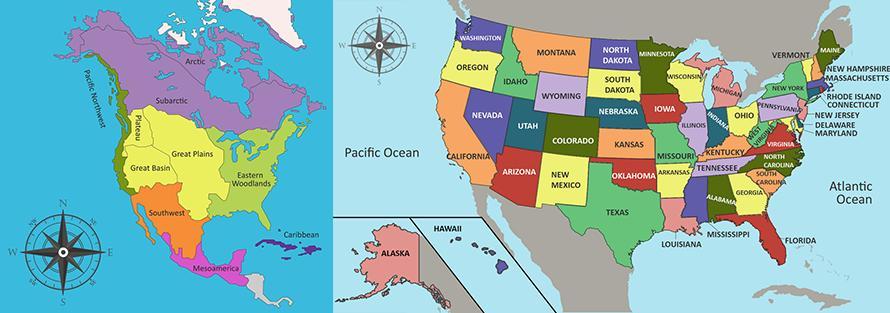
Use the maps below to answer the following question.
Based on the maps, which state listed below was located in the Southwest Native American cultural region?
New Mexico
Florida
Ohio
North Dakota
Answers
Answer:
The answer is New Mexico.
Explanation:
The first map shows the main Native American cultural regions in the United States, including the Southwest region. The second map specifically highlights the states that were part of the Southwest region, which includes Arizona, New Mexico, part of Utah, and part of Colorado.
The options are:
New Mexico - Correct. The map shows New Mexico as part of the Southwest region.
Florida - Incorrect. Florida is not shown as part of the Southwest region.
Ohio - Incorrect. Ohio is not shown as part of the Southwest region.
North Dakota - Incorrect. North Dakota is not shown as part of the Southwest region.
Therefore, based on the maps provided, New Mexico was located in the Southwest Native American cultural region.
35 POINTS PLEASE HELP
Write three sentences from the point of view of an early Chinese aristocrat defending the structure of Chinese society
(please don't forget it has to be 3 sentences or more but try to aim for 3 )
Answers
Answer:
The aristocrats made up a very small portion of Chinese society and were often well-connected to the emperor. These aristocrats were generally landowners who collected rent from their tenants and, in turn, paid tribute to the emperor as a show of allegiance. The revered Chinese thinker Confucius, who claimed that social structure and rigid orders was important if one wanted a peaceful Kingdom and Happy society.
Explanation:
As an early Chinese aristocrat, I believe that the social structure of our society is necessary for maintaining stability and order. Our system of hierarchy ensures that everyone knows their place and responsibilities, which leads to a harmonious and efficient society.
Without the strict rules and expectations that govern our society, chaos and disorder would ensue. The divisions between the different classes ensure that each group can focus on their specific tasks and contribute to the greater good of the community.
While some may criticize our system as being rigid and hierarchical, it is important to recognize that it has allowed our civilization to flourish and maintain its cultural identity for thousands of years. It is a system that has stood the test of time and should be respected and upheld.
I hope it helps you
Read document b then write, claim evidence, elaboration !!!
I will give brainliest!! Assappp it’s missing for like 3 days alreadyyy


Answers
Claim:
they planted corn, squash, beans, flowers, and willow trees.
Evidence:
Peter N. Stearns
World Civilizations: The Global Experience
2001
“Willow trees were planted at intervals to provide shade. Approximately twenty thousand acres of chinampas were constructed and yield from them was high: four corn crops per year were possible.
Elaboration:
they were not thriving with 4 corn crops per year
They needed the most food as they can that was possible with the style of living they were doing.
Answer:
Claim:
they planted corn, squash, beans, flowers, and willow trees.
Evidence:
Peter N. Stearns
World Civilizations: The Global Experience
2001
“Willow trees were planted at intervals to provide shade. Approximately twenty thousand acres of chinampas were constructed and yield from them was high: four corn crops per year were possible.
Elaboration:
they were not thriving with 4 corn crops per year
They needed the most food as they can that was possible with the style of living they were doing.
Help me. Due at 3pm 03/28/23
4 questions


Answers
2. All Cultures are alike in that they all seek: Food, Protection, and Prosperity
3. Culture differ from one another because: Environment differ
4. Culture is the authority and ability of man to: Subdue his environment
Hope this helps!
Answer:
1. Man
2. Make Alliances
3. Alliances, kin, and support
4. Marriage customs differ (if not, then environments differ)
How is an autocracy different from a democracy?
A. In an autocracy, one person has all of the power. In a democracy, power comes from the citizens.
B. In an autocracy, a small group of people has all of the power. In a democracy, power comes from the citizens.
C. In an autocracy, one person has all of the power. In a democracy, a small group of people has all of the power.
D. In an autocracy, a small group of people has all of the power. In a democracy, one person has all of the power.
Answers
I hope you do well!
Why did Shay’s Rebellion occur? What was it’s impact?
Answers
Answer:
Explanation:
August 29, 1786 and its significance were the series of violent attacks on government properties along with courthouses -- it ended with a full military confrontation in 1787.
Answer:
An uprising led by a former militia officer, Daniel Shays, which broke out in western Massachusetts in 1786. Shays's followers protested the foreclosures of farms for debt and briefly succeeded in shutting down the court system.
Explanation:
Shays' Rebellion was an armed uprising in Western Massachusetts and Worcester in response to a debt crisis among the citizenry and in opposition to the state government's increased efforts to collect taxes both on individuals and their trades
Who was John Nettleship
Answers
Answer: John Nettleship was a British artist known for his landscape and genre paintings.
Explanation: He was born in 1841 and studied at the Royal Academy Schools in London. Nettleship exhibited his work at the Royal Academy and other major galleries in England, and his paintings are now held in collections around the world.
*Answer ASAP please!* What is the movement of American settlement across the North American Continent from the Atlantic to the Pacific Oceans?
Answers
How are ancient Greece and Elizabethan theater times different?
Answers
Answer:
Over time, the actors supplanted the chorus as the dominant characters in tragedy, and theater design reflected this important shift. The skene evolved again, this time into a complex and permanent stone structure. This generation of skene allowed the actors to perform on stage level as well on the roof.
Explanation:
(fill in the blank) The framers wanted to keep the ___ government very limited in power for fear it could become another British ___.
(framers means founding fathers)
Answers
Answer: The framers wanted to keep the federal government very limited in power for fear it could become another British monarchy.
Explanation:
The framers of the United States Constitution, which was written in 1787, were deeply influenced by the experiences and political ideas of the American Revolution. One of their main goals was to create a new form of government that would avoid the abuses of power that they believed had occurred under British rule. In particular, they wanted to limit the power of the federal government to prevent it from becoming too strong and oppressive, like the British monarchy.
To achieve this goal, the framers included several provisions in the Constitution to limit the power of the federal government. For example, they created a system of checks and balances that would ensure that no one branch of government would become too powerful. They also included a Bill of Rights, which guarantees certain individual rights and freedoms, such as freedom of speech and religion. These rights were designed to protect citizens from an overreaching government.
Additionally, the Constitution divides power between the federal government and the states, with most powers reserved for the states. This division of power is known as federalism and it ensures that the central government cannot become too dominant over the states, preserving the autonomy of the states.
In summary, the framers of the United States Constitution wanted to create a government that would not repeat the mistakes of the British monarchy, which they saw as too powerful and oppressive. To achieve this goal, they included several provisions in the Constitution to limit the power of the federal government and protect individual rights and freedoms.
What groups have faced prejudice over time?
Answers
Answer:
Native American Indians. African Americans.Asian Americans.Hispanic Americans.Women. elderly.disabled
Explanation:
Answer:
Native Americans, African Americans, Asians, Hispanics, women, disabled, LGBTQIA+, and a lot more unfortunately :(
What are the long term effects of dehumanizing an entire race of people through slavery? Describe at least 2 tong term impacts.
Answers
Answer:
Slaves retained their humanity thanks to the support of families and religion, which helped them resist oppression. Nonetheless, slavery was a dehumanizing institution. Assaults on the bodies and minds of the enslaved exposed them to trauma that was both physical and psychological.
Explanation:
Whoever answers correct can have brainliest but answer ASAP!

Answers
Answer: any state governer
Explanation:
Answer: D) Senate
Explanation:
According to The Constitution "the Senate shall have the sole Power to try all Impeachments" and "The president, vice president, and all civil officers of the United States are subject to impeachment."
30 PTS HURRY PLS Match these items.
1. bank that makes small loans
Cabral
2. first airline in Americas
Bolivar
3. zoo animals
Air Avianca
4. walled city
Medellin
5. textiles
Cartagena
6. discovered Brazil
Leticia
7. Great Liberator
CAJA
im begging you answer correctly pls

Answers
Answer:
1 with caja
2 with Air Avianca
3 with Bolivar
4 with medellín
5 with Leticia
6 with Cabral
7 cartagena
why??
because i love in that places
2. First airline in America Boliver
3. Zoo animals air avian a
4. Medellin walled city
5. Textiles Cartagena
What happened to the Loyalists after the American Revolution in Canada? After their homes were burned down, etc.
Answers
Answer:
Many Loyalists fled to Canada after the American Revolution. They were given land by the British government and were allowed to rebuild their lives.
Snake Story
Becky moved off of the porch slowly, backing through the door and into the house. She slammed the sliding glass door shut and stood for a moment, relieved to have something solid between her and the snake on the porch.
The glass was cool under her hands despite her pounding heart. She tried to slow her breathing. She was safe, at last, inside. Or was she? How had that snake gotten into the screened-in and walled-up back porch. If it could get in there, it's possible it could get inside where she was as well.
Becky wasn't someone who was normally skittish about wild things. She'd handled snakes before, picked up lizards many times, caught frogs in the garage and let them go. But snakes seemed to always catch her off guard. They would turn up when least expected. She would see them out of the corner of her eye and just the surprise of it would make her jump; her adrenalin would pump, her heart would thump, and her panic would take over.
What was she going to do? She couldn't just stand there waiting for the snake to decide to leave. What if it were venomous? It didn't look like a viper, but it could be. She would need to get out there soon to water the plants.
"What this requires is some advanced planning," she said out loud to her cat, Louie. "And, I will probably have to go 'once more into the fray' kitty," she said, looking in the cat's direction for emphasis.
"First things first, though," she said. The cat meowed back. It often did that, having become used to being talked to. "Let's look that fellow up," Becky said walking to her bookshelf.
"Let's see, snakes," she said, thumbing through her reptile and amphibian identification book. "It's brown and gray, with some black. With a pattern that looks ... there it is," she said thumping the page so hard that Louie jumped. "Not venomous," she said, triumphantly.
"It's an oak snake, Louie," she returned the book and strode over to her closet. "Not venomous, but I am still not taking chances," she said.
She reached into the closet and pulled out her heaviest jacket. It was lined and stuffed thick with lots of padding. Then she found her mittens and a pair of rubber boots. She knew even non-venomous snakes would sometimes threaten to strike when scared. "And that threat would work on me," Becky said aloud again, though Louie had no idea what she was talking about.
"It's 90 degrees outside, Louie," she said, "so get the iced lemonade ready for when I return."
It wasn't much of a plan, but it was the best she could come up with. With her armor on, she was already sweating when she slowly pushed open the sliding glass door and stepped back on to the porch.
She was pretty sure the snake would slither away from her presence. She propped open the outside door, and hoped she could shoo the snake in that direction.
Sweat dampened her arms and collected on her face. She spread her arms out, and took a few steps toward the snake. There was so much for it to hide beneath. Becky regretted the rocking chairs and all the plant stands between where the snake was in the corner and the door to the outside.
At first it seemed like the snake was just going to remain where it was, flicking its tongue every now and then. Becky waved her arms, lunged in its direction, and stomped her feet. It sat there, coiled in the corner, as if perfectly happy to remain there. In a fit of desperation, she picked up one side of the rocking chair the snake was under and let it drop. The snake jumped, raised its head like it was going to strike, and then stayed right where it was.
"Snake," Becky said, "This is not how it works. You have got to go." The snake moved its head back and forth, swaying a bit, and that gave Becky an idea.
She had read somewhere that snakes can "hear" thanks to the ability to process vibrations through the bone in their jaw. This awareness of vibrations in the ground was one reason it was very hard to sneak up on snakes. She quickly realized that getting the snake out was going to be a lot easier than she had thought.
Becky turned on the radio she kept on the porch and lowered it to the ground, pointing in the snake's direction. She adjusted the controls so that the bass was as high as it could go. Then she cranked up the volume. She envisioned the snake swaying to the sounds of "Dancing Queen by Abba, and then leaving the porch and going far far away.
Coming back into the house she began peeling off the now damp armaments she had put on earlier. "Louie, there is more than one way to skin a snake," she said laughing. She watched as the snake uncoiled and moved cautiously in the direction of the door. Bending down to pick up Louie Becky sighed and stroked his head. "'Cause no one ever wants to skin a cat sweetie
The glass was cool under her hands despite her pounding heart. She tried to slow her breathing. She was safe at last inside.
What is the main purpose of this sentence in the story?
a
Create tension
b
Describe the setting
c
Resolve conflict
d
Lessen tension
Answers
Answer:
a
Explanation:
Following the financial panic in 1929, the government created the __________ in order to insure bank deposits.
A.
FCC
B.
FDA
C.
FDIC
D.
FICA
Answers
Answer:C
Explanation:
Federal Deposit Insurance Corporation
Explanation:
Because they definitely had a crash in the stock market in 1929
How did the entire American nation mobilize for war? [select all that apply]
Group of answer choices
A Industry made items for the war effort.
B Americans mobilized to produce armaments.
C The government created organizations to help mobilization.
D Women took over jobs that men left.
U can pick all the right answers
Answers
Answer:
I think the answer is A and D.
What historical event made the Jewish people want to have a homeland in Israel ?
A. World War 1
B. The Gulf War
C. The Holocaust
D. The bombing of Pearl Harbor
Answers
Answer:
C. The Holocaust
Explanation: