Which elements are important to include in the conclusion of an argumentative editorial? Check all that apply.
a restatement of the claim
a list of evidence used to support the claim
a personal opinion about the topic
a summary of the rebuttal
a solution, an alternative, or a call to action
Answers
Answer:
A restatement of the claim.
A summary of the rebuttal .
A solution, an alternative, or a call to action.
Explanation:
An argumentative editorial is writing on the editorial where a person presents an argument about a certain topic and presents both sides of the claim. This means that the editor of the argument in this certain scenario can't take sides nor present personal opinions.
And in presenting the conclusion of the argumentative editorial, a person must restate the claim, summarize the rebuttal points and provide a solution or any alternatives or a call to action.
Thus, the correct answers are the first, fourth, and fifth options.
Answer:
A restatement of the claim.
A summary of the rebuttal .
A solution, an alternative, or a call to action.
Related Questions
trina's little sister wants to wash their dog trina wants to write directions for her to follow what is the best form to use
Answers
When giving instructions or directions to someone, it is important to use clear and concise language to ensure that the person can understand and follow the directions without confusion or mistakes. There are several different forms that can be used when writing directions, but the best form to use will depend on the situation and the person who is receiving the instructions.
One common form for writing directions is to use a list of steps or instructions. This is often the best form to use when the directions are relatively simple and straightforward, and when the person receiving the directions is already familiar with the basic process or task. In this form, each step is listed separately, and may be numbered or bulleted for clarity.
Another form for writing directions is to use a flowchart or diagram. This can be useful when the process or task is more complex, or when there are multiple possible outcomes or decisions to be made. In this form, the process is visualized as a series of interconnected boxes or shapes, with arrows or other symbols used to show the flow of the process from start to finish.
When writing directions, it is important to keep in mind the person who will be following the directions, and to use language and a format that will be easy for them to understand and follow. Clarity, simplicity, and precision are key elements of effective directions, regardless of the form that is used..
For more questions on: directions
https://brainly.com/question/28108225
#SPJ8
When should the reader first stop to ask a question when reading "Armen Remembers Trying to 'Fit In'" in the "Ellis Island Oral History Project" excerpt, and which question should the reader ask to understand the mother’s love of music?
A reader should stop after the first sentence and ask, "Why did the speaker's mother play the music?"
A reader should stop after the second sentence and ask, "What kind of music did the speaker's mother play?"
A reader should stop after the second sentence and ask, "What does Armenian and Turkish music sound like?"
A reader should stop after the third sentence and ask, "Why were the windows open?"
Answers
Answer:
C
Explanation:
A reader should stop after the second sentence and ask, "What does Armenian and Turkish music sound like?" I also got this right on a test.
-Jake
Answer:
C
Explanation:
From "The Writing Process" chapter, complete the sentence:
"To plan any piece of writing effectively, think about your_________
and
you're writing for, and the _________
of your topic".
in writing, the
Answers
To plan any piece of writing effectively, think about your audience and the purpose of your writing, and the scope of your topic.
Considering your audience is crucial because it determines the tone, language, and level of detail you should use. Understanding who will be reading your writing helps you tailor your message to their needs, knowledge, and interests. By considering their expectations, background, and perspective, you can ensure your writing is engaging and relevant to them.
The purpose of your writing also influences your planning process. Are you trying to inform, persuade, entertain, or argue a point? Clarifying your purpose helps you structure your content and choose the most effective approach to convey your message. It guides your selection of evidence, organization, and the overall tone of your writing.
Lastly, considering the scope of your topic is essential. This involves determining the depth and breadth of your discussion. Is your focus broad or narrow? Are you covering the entire subject or a specific aspect? Understanding the scope helps you determine the amount of information to include, the level of detail, and the overall structure of your piece.
By thinking about your audience, purpose, and scope, you can plan your writing more effectively, ensuring that your message is targeted, meaningful, and well-structured to meet the needs of your readers.
Know more about writing here:
https://brainly.com/question/1643608
#SPJ8
It took he did not know he had to remain calm in the face of such unfounded allegations. A. spunk... flagrant B. conciliation ... respectable C. neutrality... righteous D. fortitude ... heinous E. mettle... conscientious
Answers
The word that best completes the text is this, "It took fortitude. He did not know he had to remain calm in the face of such heinous unfounded allegations."
D. fortitude ... heinous
What is the best way to complete the passage?The best way to complete the text is through the use of the words, fortitude and heinous. When describing an event, it is usually best to use words that are descriptive of the noun being described. So, the usage of the word, fortitude is important because it is a form of courage.
Also, an allegation can be described as heinous when it does not represent reality. So, option D is the best set of words for the sentence.
Learn more about fortitude here:
https://brainly.com/question/13963092
#SPJ1
Answer:
The answer is D. fortitude ... heinous.
Explanation:
"Fortitude" refers to courage and strength in facing difficult or challenging situations, which fits the context of remaining calm in the face of unfounded allegations.
"Heinous" means extremely wicked, evil, or shockingly awful, which indicates the severity of the allegations.
So, the correct sentence would be:
"It took fortitude he did not know he had to remain calm in the face of such heinous, unfounded allegations."
Hey. I’m playing in a tennis match next week for the college. I’ve got all my gear ready and a brand new racquet. It’s at the college’s sports hall. The light system there is great. The match begins at 10 am and it’s free to come and watch. It would be great if you could come along and support me.
Answers
I hope you have good luck and win!!!
There are two unnecessary sentences in this paragraph; they are:
I’ve got all my gear ready and a brand new racquet.The light system there is great.What is the text about
The text is an invitation to a tennis match. So the crucial information in it should be:
Date: I’m playing in a tennis match next week for the collegeLocation: It’s at the college’s sports hall.Time: The match begins at 10 am.Cost: it’s free to come and watch.That is why talking about:
the gear and new equipment lightingis not information that the reader needs.
The correct text
Hey. I’m playing in a tennis match next week at the college. It’s at the college’s sports hall. The match begins at 10 am, and it’s free to come and watch. It would be great if you could come along and support me.
Learn more about invitations here:
https://brainly.com/question/24945660
Can your help me out

Answers
Answer:
large
Explanation:
Which example uses syntax that demonstrates a thought that the author wants to put aside?
Answers
Answer:
The writer is harmonious and he should never disappoint anyone. The new change can be considered as a ease for life rather than a new great difficulty.
Explanation:
The correct answer to the given question is :
The writer is harmonious and he should never disappoint anyone. The new change can be considered as a ease for life rather than a new great difficulty.
These are a few examples used as syntax which is demonstrating the authors thoughts.
Which detail best supports the passage is central idea
Answers
Re-read Annie’s description of the start of her last day in her parents’ home (lines 95-131. What inferences can you draw about Annie’s parents, especially her mother? Support your inferences with textual evidence.
Answers
Answer and Explanation:
Annie's parents were excited about her going to London, especially her mom.
In lines 99-101, Annie says, “When I got up, my mother greeted me with a big, bright “Good morning”—so big and bright that I shrank before it.” This shows the audience how excited her mother was. Her mom also sent her jewelry to be blessed before she left.
Annie was happy with her family, and they were a perfect family when we read her diary. The last day she had spent in her parent’s home was full of joy and happiness, and she did not even know that what is going to happen next to her family. They were hoping for the best, even the situation around them was the worst. It was only because of her parents and the environment her family had provided her. So when we read these lines, which have been written in her diary, we get to know about her family's positive and healthy attitude, especially of her mother.
Some of the inferences that can be made Annie's parents, especially the mother are:
They were excited about her going to England.An evidence can seen when Annie said,
"When I got up, my mother greeted me with a big, bright "Good morning"- so big and bright that I shrank before it".
The mother was emotional at the same time.An evidence is seen when they got to jetty and Annie's parents embrace her and her mother starts to cry.
About "A Walk To The Jetty""A Walk To The Jetty" is a fictional work by Jamaica Kincaid.
The story is narrated by Annie John, the protagonist. She is 17 years old and actually leaving Antigua to go to England to become a nurse.
On the day of her departure, there was a mixed feeling of excitement and sorrow that was seen.
Learn more about "A Walk To The Jetty" on https://brainly.com/question/10876728
Are new messages and notifications the same?
Answers
Yes. Simply because a new message and a notification both serve the same purpose, they basically are letting you know new information right there at that very moment.
Change Indirect Speech.
"Can we stop at the next village?"
She asked me ...........
Answers
Answer:
She asked me if we could stop at the next village
Explanation:
question sentences in direct speech changes to either if or whether.
A narrator with an omniscient point of view knows
Answers
Answer:
all of the thoughts and feelings of all of the characters in the story, or limited, in which the narrator relates only their own thoughts, feelings, and knowledge about various situations and the other characters.
Explanation:
HELP PLEASE I WILL GIVE BRAINLIEST FOR THE RIGHT ANSWERS NOW!!!!!
Paine\'s line is an indirect reference to this line from the King James Bible: ...and the gates of hell shall not prevail against it. (Matthew 16:18) This technique is an example of the use of
A) alliteration.
B) allusion.
C) artistry.
D) assonance.
Answers
Answer:
The answer is C : Artistry.
Select the correct text in the passage.
Which example best demonstrates the neoclassical style used in poetry during the age of reason?
If ever two were one, then surely we.
If ever man were loved by wife, then thee;
If ever wife was happy in a man,
Compare with me ye women if you can.
Arise, my soul, on wings enraptur'd, rise
To praise the monarch of the earth and skies,
Whose goodness and beneficence appear
As round its centre moves the rolling year,
Or when the morning glows with rosy charms,
Or the sun slumbers in the ocean's arms:
Of light divine be a rich portion lent
To guide my soul, and favour my intent.
We smile, but, O great Christ, our cries
To thee from tortured souls arise.
We sing, but oh the clay is vile
Beneath our feet, and long the mile;
But let the world dream otherwise,
We wear the mask!
I caught a tremendous fish
and held him beside the boat
half out of water, with my hook
fast in a corner of his mouth.
He didn't fight.
He hadn't fought at all.
He hung a grunting weight,
battered and venerable
and homely. Here and there
his brown skin hung in strips
Reset Next
Previous13 Next Post Test: American Literature Through the Eighteenth Century Submit Test Reader Tools Info Save & Exit
©
Answers
The example that best demonstrates the neoclassical style used in poetry during the age of reason is option B.
B: Arise, my soul, on wings enraptur'd, rise
To praise the monarch of the earth and skies,
Whose goodness and beneficence appear
As round its centre moves the rolling year,
Or when the morning glows with rosy charms,
Or the sun slumbers in the ocean's arms:
Of light divine be a rich portion lent
To guide my soul, and favour my intent.
What distinguishes neoclassicism from other styles?Analytical, as well as geometrically symmetrical, clean, and historically rooted describe neoclassicism. Neoclassical concept is similar to the scientific way of thinking that the ancient Greeks and Romans had.
The Neoclassical movement, which had its start in France and Italy in the middle of the 18th century, gave rise to the architectural style known as Neoclassical architecture. It rose to prominence as one of the most popular architectural trends in the West.
Therefore, there is Grandeur of scale, simplicity of geometric forms, Greek, dramatic use of columns, as well as a propensity for blank walls are characteristics of neoclassical architecture.
Learn more about neoclassical style from
https://brainly.com/question/9199308
#SPJ1
The word "reparation" means?
Answers
Answer:
the action of making amends for a wrong one has done, by providing payment or other assistance to those who have been wronged.
Answer:
the making of amends for a wrong one has done, by paying money to or otherwise helping those who have been wronged
Select the words that have been spelt incorrectly
Belligerent
Disagreable
Iridescent
Answers
Answer:
disagreable, colmination, conciencious
Explanation:
correct spelling: disagreeable, culmination, conscientious
Justice is never the same for all
Answers
Answer:
yep sure is
Explanation:
...
..
..
..
..
..
I'm in exam please answer this question

Answers
Answer:
a considerable rise
Explanation:
hope that helps
Answer:
a considerable rise
Explanation:
hope this helps
Can someone just help me with this
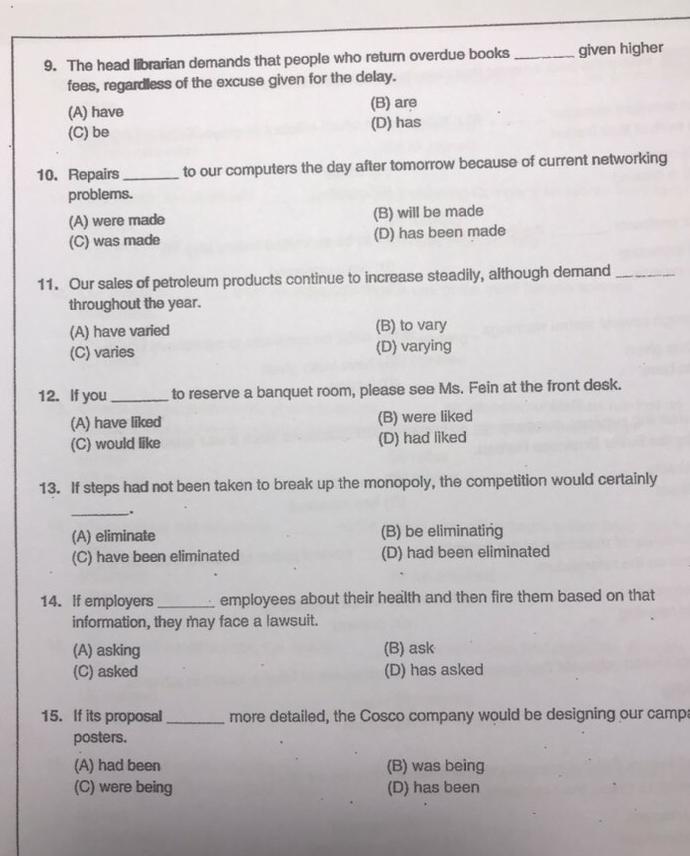
Answers
Answer:
If you have liked to reserve a banquet room,please see Ms. Fein at the front desk
Which idea would be better expressed in formal writing?
a. The package was from where?
b. Where was the package from?
Answers
Answer:
The correct answer is B.) Where was the package from?
I hope this helps! ^-^
3.4. How would you assess the learners prepared speeches?
Answers
Assessing learners' prepared speeches requires a comprehensive evaluation that considers various aspects of their performance. Here are some key factors to consider when assessing learners' prepared speeches:
Content: Evaluate the content of the speech to assess if it is well-organized, coherent, and relevant to the topic.
Structure and Organization: Assess the overall structure and organization of the speech.
Delivery: Evaluate the delivery of the speech, including vocal delivery, body language, and non-verbal communication.
Language and Style: Assess the language used in the speech, including vocabulary, grammar, and sentence structure.
Time Management: Evaluate the speaker's ability to manage time effectively.
Overall Impact: Consider the overall impact of the speech on the audience.
Assessing learners' prepared speeches requires a comprehensive evaluation that considers various aspects of their performance. Here are some key factors to consider when assessing learners' prepared speeches:
Content: Evaluate the content of the speech to assess if it is well-organized, coherent, and relevant to the topic. Look for a clear introduction, body, and conclusion that present ideas logically and effectively. Consider whether the speech demonstrates a deep understanding of the subject matter and if the arguments or main points are supported with evidence or examples.
Structure and Organization: Assess the overall structure and organization of the speech. Look for a clear and logical flow of ideas, transitions between main points, and a well-defined structure that enhances the coherence of the speech. Consider if the speech is easy to follow and if the speaker effectively engages the audience throughout.
Delivery: Evaluate the delivery of the speech, including vocal delivery, body language, and non-verbal communication. Assess the speaker's voice projection, clarity, pace, and intonation. Consider if the speaker maintains eye contact with the audience and uses gestures or facial expressions to enhance their message. Look for confidence, enthusiasm, and appropriate use of pauses and emphasis.
Language and Style: Assess the language used in the speech, including vocabulary, grammar, and sentence structure. Look for appropriate and varied language choices, use of rhetorical devices, and an engaging and persuasive writing style. Consider if the speaker effectively uses language to convey their message and engage the audience.
Time Management: Evaluate the speaker's ability to manage time effectively. Assess if the speech adheres to the allocated time limit and if the speaker balances the time spent on each section appropriately. Consider if the speaker is able to deliver their message within the given time constraints without rushing or going over time.
Overall Impact: Consider the overall impact of the speech on the audience. Assess if the speech is engaging, persuasive, and memorable. Evaluate if the speaker effectively connects with the audience, maintains their interest, and leaves a lasting impression.
When assessing learners' prepared speeches, it is important to provide constructive feedback that highlights both strengths and areas for improvement. Effective assessment encourages learners to reflect on their performance, make necessary adjustments, and develop their public speaking skills further.
For more such information on: speeches
https://brainly.com/question/26157848
#SPJ11
What is the denotation of the word snake?
Answers
A limbless,slithering reptile without eyelids is sometimes poisonous.
he tried___to open the door
Answers
Answer:
he tried hard to open the door
Answer:
he tried many times to open the door
Excessive money lead to danger
Answers
Numerous well-known and pervasive social evils, including decreased social trust, a shorter life expectancy, higher infant mortality, lower happiness, and more criminality, are associated with economic disparity.
What occurs if your love of money becomes excessive?The need for money can push us to make a variety of wicked decisions, such as padding costs, filing false tax returns, and shortchanging clients. Money obsession skews judgment. We could become "trapped in a snare" if we are blinded by our greed and lust (1 Timothy 6:9).
Why is it said that money is the source of all evil?Money is the source of all evil, as the saying goes. It implies that sometimes, people are driven to do bad things by a desire for money. The Bible is said to be the source of this quotation.
To know more about shorter life expectancy visit :-
https://brainly.com/question/2115661
#SPJ1
Write the commas if there are appositives or fix the plural form.
We will have a parade on Founder's Day the first Saturday in June.
Please help! The first person who answers gets brainlist!
Answers
We will have a parade on Founder's Day the first Saturday in June. Please assist! the first person who answers receives a mind list!: when an appositive is important to the meaning of the noun it belongs to, don't use commas.
An appositive is a noun or noun phrase that clarifies, identifies, describes, or otherwise renames every other noun or noun phrase. for example, the sentence My cousin Rebecca is a physician incorporates the appositive noun Rebecca. The appositive Rebecca identifies the noun cousin and each word talks to the same person.
There are sorts of appositive phrases: restrictive and nonrestrictive. Nonrestrictive appositive phrases, also called nonessential appositive terms, apply to records that aren't necessary to the meaning of the sentence. these are normally activated by commas. so one can use appositives, it's far crucial to remember the fact that appositives are noun terms rather than adjectives, adverbs, prepositional terms, or otherwise. To be an appositive, they must contain a noun. discover a noun inside the sentence which may be elaborated on. Insert an appositive beside the noun.
Learn more about appositive here:
https://brainly.com/question/13197842
#SPJ1
And I wish in my sorrow I could strip to the soul,
And dive off in my grave like the old swimmin'–hole.
These lines from the poem illustrate that the speaker
Answers
This question is missing the options. I've found the complete question online. It is the following:
Read these lines from the poem again:
And I wish in my sorrow I could strip to the soul,
And dive off in my grave like the old swimmin'-hole.
These lines from the poem illustrate that the speaker
A. wants to prevent his approaching death
B. has become sad, but finds comfort in old age
C. needs to visit the swimming hole again
D. has grown so sad that death would be a relief
Answer:
The lines from the poem illustrate that the speaker:
D. has grown so sad that death would be a relief
Explanation:
The excerpt we are analyzing here was taken from the poem "The Old Swimmin' Hole" by James Whitcomb Riley. The speaker talks of [his] sorrow," and of wanting to strip his soul. We can infer he is deeply sad, to the point of wishing for something drastic. After stripping his soul, he wants to "dive off in [his] grave," meaning he would like to die. Connecting both parts, we can tell that his sadness has become so extreme that he would rather die than feel it. For that reason, the best option is letter D. has grown so sad that death would be a relief.
D
Explanation:
Has grown so sad that death would be a relief
Racism is???
Let's see how smart are y'all
Answers
Answer:
Racism is prejudice and more like antagonism or discrimination
Explanation:
I think that's what it means, I learned it in S.S
Answer:
it is when white people would treat black people unfairly
Explanation:
The white people were buying the black people as slaves
What is the antonym for reticent?
A. loquacious
B. acrimonious
C. precursor
D. expound
Answers
Answer:
A
Explanation:
6. How does the discussion of riots help explain the motivations of school shooters? (Paragraphs 41-46)
A. Riots help explain why school shooters dress the same and use the same guns.
B. Riots demonstrate how ideas and actions are contagious, inspiring others to join in.
C. Riots are more likely to be started by white males, just like school shootings.
D. Riots always involve multiple people, whereas school shooters always act alone.
Answers
B. Riots demonstrate how ideas and actions are contagious, inspiring others to join in is the answer to the question "How does the discussion of riots help explain the motivations of school shooters?".
Explanation:
Paragraphs 41-46 discuss the connection between riots and school shootings, and how discussing one phenomenon can help us understand the other. The passage argues that riots and school shootings share similarities in terms of the way people become motivated to participate, as well as the way they dress and behave.There are many reasons why people become involved in riots, and one of the most important is that they are inspired by the actions and ideas of others. This is particularly true of young people, who are often more impressionable and more likely to be influenced by their peers. Similarly, school shooters are often motivated by the actions of other shooters, and may be inspired by their ideas or their methods. Therefore, riots demonstrate how ideas and actions are contagious, inspiring others to join in.
Read more about contaigous here:https://brainly.com/question/637002
#SPJ11
Read this passage taken from "How the Spaniards Came to Shung-opovi, How They Built a Mission, and How the Hopi Destroyed the Mission": Well, about this time the Strap Clan were ruling at Shung-opovi, and they were the ones that gave permission to establish the mission. The Spaniards, whom they called Castillia, told the people that they had much more power than all their chiefs and a whole lot more power than the witches. The people were very much afraid of them, particularly if they had much more power than the witches. They were so scared that they could do nothing but allow themselves to be made slaves. Whatever the Spaniards wanted done must be done. Any man in power who was in this position the Hopi called To-ta-achi, which means a grouchy person who will not do anything himself, like a child. They couldn't refuse, or they would be slashed to death or punished in some way. There were two To-ta-achi. The missionary did not like the ceremonies. He did not like the Kachinas, and he destroyed the altars and the customs. He called it idol worship and burned up all the ceremonial things in the plaza. Which two of these elements are found in the Hopi story?
Answers
Answer:
1. cultural differences between the Hopi people and the Spaniards
2. Tradition of the Hopi people
Explanation:
The two elements that are found in the Hopi story are cultural differences between the Hopi people and the Spaniards and tradition of the Hopi people.
From the excerpt, the Hopi people are two culturally different people; the Spaniards believed that they were superior to the chiefs and the witches while the Hopi people had always believed in the witches and feared them.
The tradition of the Hopi people was not liked by the Spaniards, like the To-ta-achi of which the Spaniards did not like the ceremonies and destroyed the altars and customs.
cultural differences between the Hopi people and the Spaniards and tradition of the Hopi people