What is the volume, in cubic feet, of this cone? Use ~ 3. 14. Round youranswer to the nearest whole, if needed.answer choices are 1809151452603

Answers
Given:
a.) Height = 9 ft.
b.) Radius = 8 ft.
To be able to determine the volume of the cone, we will be using the following formula:
\(\text{ Volume = }\frac{1}{3}\pi r^2h\)We get,
\(\text{ Volume = }\frac{1}{3}\pi r^2h\)\(\text{ = }\frac{1}{3}\pi(8)^2(9)\)\(\text{ = }\frac{9}{3}\pi(64)\)\(=(3\text{ x 64)(3.14)}\)\(\text{ Volume = 602.88 }\approx603ft^3\)Therefore, the volume of the cone is 603 cubic feet.
Related Questions
15 POINTS
Using Pythagoras' theorem, calculate the length
of XY.
Give your answer in centimetres (cm) to 1 d.p.

Answers
Answer:
13.27 cm
Step-by-step explanation:
I am using (xy) to mean the length of the side xy
7^2 + (xy)^2 = 15^2
49 + (xy)^2 = 225
(xy)^2 = 225-49
(xy)^2 = 176
Side (xy) = sqrt(176) = 13.2664991614 = 13.27 cm
13.3cm
Step-by-step explanation:
The Pythagorean theorem is a^2+ b^2 = c^2
Plug the values into the equation.
7^2+ b^2 = 15^2
Simplify.
49 ÷ b^2 = 225
Subtract 49 from both sides.
b^2 = 176
Take the square root of both sides.
vb^2 = v176
b=13.266
b=13.3cm
what is the answer to this problem

Answers
Answer: 12.56
Step-by-step explanation: 3.14 x 1/2 of 4 x 2
Please awnser asap I am
Stuck

Answers
Answer:
it is too blury to read
Step-by-step explanation:
20 points please help!!!

Answers
Answer:
a = 16
b = \(\frac{3}{4}\)
Step-by-step explanation:
Length of the design 16 inches is represented by the point (0, 16) and length of 12 inches by (1, 12).
That means these points lie on the graph of the function 'f' represented by,
f(x) = a(b)ˣ
For the point (0, 16),
f(0) = a(b)⁰
16 = a(1)
a = 16
For another point (1, 12),
f(1) = a(b)¹
12 = ab
12 = 16(b) [Since a = 16]
b = \(\frac{12}{16}\)
b = \(\frac{3}{4}\)
Therefore, values of a and b are 16 and \(\frac{3}{4}\) respectively.
Can someone pls help ?

Answers
What number is best to use to simplify a fraction Least common multiple be least common denominator see greatest common factor de greatest
Answers
The greatest common factor and least common multiple are the best used to simplify a fraction.
Suppose we wanted to add the fractions:
10/12 and 20/15.
Now, consider the fraction:
10/12
We can eliminate that component from both the numerator and the denominator and simplify the fraction if we can identify the greatest common factor between 10 and 12.
So,
The factors of 10 are 1, 2, 5, 10.
The factors of 12 are 1, 2, 3, 4, 6, 12.
Therefore, GCF of 10 and 12 is 2.
Hence,
10/12 = ( 10 ÷ 2 ) / ( 12 ÷ 2 ) = 5/6
Similarly,
For 20/15,
The factors of 20 are 1, 2, 4, 5, 10, 20.
The factors of 15 are 1, 3, 5, 15.
The greatest common factor is 5.
So,
20/15 = ( 20 ÷ 5 ) / ( 15 ÷ 5 ) = 4/3
Now, when we add the fractions:
10/12 + 20/15 = 5/6 + 4/3
Now, as the fractions are already simplified.
By using the least common multiple.
10/12 + 20/15 = 5/6 + ( 4/3 ) × ( 2/2 )
10/12 + 20/15 = 5/6 + 8/6
10/12 + 20/15 = 13/6
Hence, using the greatest common factor we can simplify the fractions, and the least common multiple we can perform operations on the fractions.
Learn more about least common multiple here:
https://brainly.com/question/1494483
#SPJ1
A chi-square test for homogeneity is conducted on three populations and one categorical variable that has three values. Computation of the chi-square statistic yields χ2 = 2.05. What is the p-value? (please provide a written explanation)
p > 0.25
0.05 < p < 0.1
0.02 < p < 0.025
0.01 < p < 0.02
0.005 < p < 0.01
Answers
the p-value is between 0.05 and 0.1, which means we can conclude that there is weak evidence against the null hypothesis at the 5% level of significance.the answer is 0.05 < p < 0.1.
To find the p-value for a chi-square test for homogeneity, we need to use the chi-square distribution table with the appropriate degrees of freedom and compare the computed chi-square statistic to the critical value at the desired level of significance.
The degrees of freedom for a chi-square test for homogeneity is given by the formula df = (r - 1) * (c - 1), where r is the number of rows and c is the number of columns in the contingency table. In this case, we have three populations and one categorical variable with three values, so the contingency table has 3 rows and 3 columns. Therefore, the degrees of freedom is df = (3 - 1) * (3 - 1) = 4.
Using the chi-square distribution table with 4 degrees of freedom and looking up the value of chi-square at 2.05, we can see that the corresponding p-value is between 0.1 and 0.05. Specifically, the p-value is between 0.05 and 0.1, which means we can conclude that there is weak evidence against the null hypothesis at the 5% level of significance.
Therefore, the answer is 0.05 < p < 0.1.
Learn more about null hypothesis here
https://brainly.com/question/28920252
#SPJ1
A farmer planted corn in two different fields. He planted 500 seeds of regular corn in Field A and 500 seeds of experimental corn in Field B. At
harvest time, more ears of corn had grown in Field A than in Field B. The farmer concluded that more corn grew in Field A because of the type
of corn planted.
Choose two other possible variables that could have caused more corn to grow in Field A.
Answers
Answer:
1. More pollination process in the regular corn planted in field A than that of field B.
2. Low pest and insect attack on corn planted in field A compared to that of B.
Step-by-step explanation:
1. Pollination is the process in which a plant becomes fertilized, so as to produced seeds. The process requires some agent which could be; air, human, wind etc.
Therefore more pollination of the corn planted in field A than those in B would lead to more yield (ears of corn harvested) than that of B.
2. Pests and insects are agents which could reduce the yield of the corn after harvest. Comparing the two fields A and B, if the corn planted in field A were not affected by pests or insects, while those planted in B were affected, then more ears of corn would be harvested in field A.
Answer:
a,c, And gg gamer
Step-by-step explanation:
-12 divided by 3 5/9
Answers
your answer is 3.375
Could someone help me with this trigonometry question where you have to calculate the length of bc, to the nearest degree.

Answers
Answer: The length of BC ≈ 12.4 cm
Step-by-step explanation:
The first thing we need to do is to find the length of BD which we can solve for with the tangent of 20° which is the opposite side over the adjacent side.
We get tan20° = BD/8.
Solve for BD and you get BD = 8tan20°.
Now we will need to solve for the length of CD which we can get from the tangent of 40°.
We get tan40° = 8/CD
Solve for CD and you get CD = 8/tan40°.
Now that we have the lengths of BD and DC, we can simply add them together to get the length of BC.
(8tan20°) + (8/tan40°) ≈ 12.4 cm
Given the figure below, find the values of x and z.
108
(12x+24)

Answers
We know that two vertical angles are equal.
\(108° \: = \: (12x \: + \: 24)°\)
\( - 12x \: = \: 24 \: - \: 108\)
\( - 12x \: = \: -84\)
\( \boxed{ \bold{x \: = \: 7°}}\)
We calculate "x":We know that a complete angle measures 360°.
\(108° \: + \: 108° \: + \: z \: + \: z \: = \: 360°\)
\(216 \: + \: 2z \: = \: 360\)
\(2z \: = \: 360 \: - \: 216\)
\(2z \: = \: 144\)
\( \boxed{ \bold{z \: = \: 72°}}\)
Answer: x = 7 z = 72 °Find all zeros? One zero has been given.

Answers
The zeros of the function f(x) = 2x⁴ + 11x³ + 16x² + x - 6 are x = -3, x = -2,
x = -1 and x = 1/2 respectively
What is the zeros of a function?The zero of a real-, complex-, or generally vector-valued function f, is a member x of the domain of f such that f(x) vanishes at x; that is, the function f attains the value of 0 at x, or equivalently, x is the solution to the equation f(x) = 0. Graphically, the real zero of a function is where the graph of the function crosses the x‐axis; that is, the real zero of a function is the x‐intercept(s) of the graph of the function.
In the given problem, the zero of the function;
f(x) = 2x⁴ + 11x³ + 16x² + x - 6; -3 are
f(-3) = 2(-3)⁴ + 11(-3)³ + 16(-3)² -3 - 6 = 0
f(-2) = 2(-2)⁴ + 11(-2)³ + 16(-2)² - 2 - 6 = 0
f(-1) = 2(-1)⁴ + 11(-1)³ + 16(-1)² - 1 - 6 = 0
f(1/2) = 2(1/2)⁴ + 11(1/2)³ + 16(1/2)² - 1/2 - 6 = 0
Learn more on zeros of a function here;
https://brainly.com/question/16550963
#SPJ1
Someone please help me answer this

Answers
Answer:
2^10
Step-by-step explanation:
When multipying indices, if the base is the same then just add the indices.
At the beginning of June Max and Shawn start saving money for the fair which occurs 10 weeks later Sean starts out with $20 just and saves just $2 per week Max starts out with no money but says $5 per week after how many weeks are Max have more money than Sean
Answers
At 7 weeks Max will have more saving than Sean.
How to find the number of week Max has more money?Max and Sean start saving money for a fair.
Sean starts out with just $20 and saves just $2 per week Max starts out with no money but says $5 per week .
Therefore,
Sean equation for amount gotten:
y = 20 + 2x
Max equation for amount gotten:
y = 5x
Where
x = number of weeks.
Therefore, the numbers of week max will save more than Sean is as follow:
y = 5x
y = 5(7) = $35
y = $35
y = 20 + 2x
y = 20 + 2(7)
y = 20 + 14
y = $34
Therefore, at 7 weeks Max will have more saving than Sean.
learn more on savings here: https://brainly.com/question/22375193
#SPJ1
Solve the inequality and express your answer in interval notation. Use decimal form for numerical values.

Answers
The funtion given is
\(\frac{6}{8}<\frac{x+4}{4}<\frac{28}{4}\)but if a < u < b, then a < u and u < b
\(\begin{gathered} \frac{6}{8}<\frac{x+4}{4} \\ \frac{3}{4}<\frac{x+4}{4} \\ 3-1 \end{gathered}\)and
\(\begin{gathered} \frac{x+4}{4}<\frac{28}{4} \\ x+4<28 \\ x<28-4 \\ x<24 \end{gathered}\)let's combine the intervals at this stage andmerge the overlapping intervals
\(-1the interval notation can be represented as\((-1,24)\)From the calculations above the interval notation of the function is given as (-1, 24)
yesssssssssssssssssssssss
Answers
Answer:
Yes?
Step-by-step explanation:
Did you figure out a problem and you are celebrating?
PLEASE HELP ME!! ILL GIVE BRAINLIEST!!
Kate is making hamburgers for her friends and has 7 1/2. pounds of hamburger. How many 1/4 pound of hamburgers can she make?
A. 15
B. 4
C. 30
D. 120
Answers
Answer:
C
Step-by-step explanation:
1/4 is .25
4 fourths is 1. 4 times 7 equals 28 hamburgers. one half is two fourths. 28+2=30 hamburgers.
No of hamburgers she can make
\(\\ \sf\longmapsto 7\dfrac{1}{2}\div \dfrac{1}{4}\)
\(\\ \sf\longmapsto \dfrac{15}{2}\times \dfrac{4}{1}\)
\(\\ \sf\longmapsto \dfrac{60}{2}\)
\(\\ \sf\longmapsto 30\)
In one year, 30,000 sheep on his property in the next year because of the drought the farmer reduced his flock by 37% The number of sheep he has after the fall in numbers is
Answers
Answer:
11,100
Step-by-step explanation:
1% of 30,000 is 300 so if we times 300 by 37 we get 11,100
there is 11,100 sheep in 37%.
hope this helps :)
what is the answer to this problem?
n is m% of what
its the last question in my homework and my class is starting in like 20 mins HELP
Answers
Step-by-step explanation:
n is m% of what ?
there are always 100% to represent the whole.
m% means it is m/100 of the whole.
so,
n = m% = m/100,
and the whole (1) is n×100/m
n is m% of 100n/m
52. Find a vector v whose magnitude is 3 and whose component in the i direction is equal to the component in the j direction.
Answers
The vector whose magnitude is 3 and whose components I. the I and j direction are equal is; <3√2/2i, 3√2/2j>.
Which vector is as described in the task content above?It follows that the magnitude of a vector in terms of its components in the i and j direction is;
M = √(x² + y²).
On this note, since the i and j components are equal; x = y and hence, we have;
3 = √(x² + x²).
3² = 2x²
x² = 9/2
x = 3/√2
x = 3√2/2
On this note, the required vector which is as described is; <3√2/2i, 3√2/2j>.
Read more on vector components;
https://brainly.com/question/26187714
#SPJ1
given g(x) = 1/2 (x-4)^2 , what is the value of g(10) .
Answers
Answer:18
Step-by-step explanation:
\(\text{if} \quad x=10,\\ g(10)=\dfrac{1}{2}(10-4)^2\\ g(10)=\dfrac{1}{2}(6)^2\\ g(10)=\dfrac{1}{2}36\\ g(10)=18\)
How do you put this in a system of equation
2y-x=6
3y-x=4
Answers
Answer: The system of equations would be:
2y - x = 6
3y - x = 4
With the answer of X being -10 and Y= -2
Step-by-step explanation:
Add x to both sides:
2y = x + 6
Subtract 6 from both sides:
2y - 6 = x
Now we can substitute this expression for x into the second equation:
3y - x = 4
Substitute 2y - 6 for x:
3y - (2y - 6) = 4
Simplify by distributing the negative sign:
3y - 2y + 6 = 4
Combine like terms:
y + 6 = 4
Subtract 6 from both sides:
y = -2
Now that we have found the value of y, we can substitute it back into one of the equations to find the value of x. Let's use the first equation:
2y - x = 6
Substitute y = -2:
2(-2) - x = 6
Simplify:
-4 - x = 6
Add x to both sides:
-4 = x + 6
Subtract 6 from both sides:
-10 = x
Therefore, the solution to the system of equations 2y - x = 6 and 3y - x = 4 is x = -10 and y = -2.
1) Solve for x.
(3.x - 2)°
(14x -19°
(9x+7)

Answers
Answer:
x = 12
Step-by-step explanation:
We will label the unknown interior angle of the triangle d.
14x - 19 + d = 180
14x + d = 199
d = 199 - 14x
199 - 14x + 3x + 9x + 7 - 2 = 180
199 - 2x +5 = 180
204 - 2x = 180
204 = 180 + 2x
2x = 24
x = 12
Look at the pic ! :) 6th grade math

Answers
Answer: 2 pounds in each bag
Step-by-step explanation:
12 = pounds of almonds
6 = number of bags
12 / 6 = 2
Answer:
The 12 means it's how many pounds of almonds she has and the 6 means how many bags she has.
Step-by-step explanation:
12 divided by 6 is 2. (Hope this helps!)
the wheel of a bike has a diameter of 27 inches. find the circumference of the wheel.
Answers
The circumference of the wheel of the bike given the diameter is 84.78 inches
What is the circumference of the wheel?As evident from the task content; it is required that the circumference of the bike's wheel be determined.
Given that the Diameter of the wheel = 27 inches
Recall; Radius = diameter / 2
= 27/2
= 13.5 inches
π = 3.14
Since the formula for the Circumference of the wheel which is circular = 2πr
= 2 × 3.14 × 13.5
= 84.78 inches
In conclusion, the circumference of the wheel according to the given description is 84.78 inches.
Read more on circumference of circle:
https://brainly.com/question/12823137
#SPJ1
Bookwork code: A99
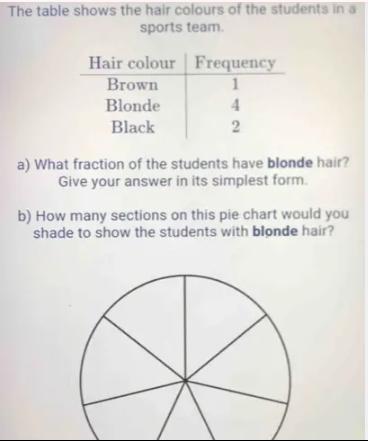
The table shows the hair colours of the
students in a sports team.
Hair colour
Black
Blonde
Brown
Frequency
1
< Back
a) What fraction of the students have brown
hair? Give your answer in its simplest form.
b) How many sections on this pie chart
would you shade to show the students with
brown hair?
4
2
Scroll down
Watch video
Answer >
Answers
A fraction of the students who have brown hair is equal to 1/7.
You should shade only one (1) section on the pie chart to show the number of students with brown hair.
What is a pie chart?In Mathematics, a pie chart can be defined as a type of graph that is used for the graphical representation of the proportion relationship between each part or unit to a whole, especially by dividing a circle into various sectors or sections.
Based on the information provided in the table (see attachment), we can logically deduce the following parameters about the various hair color;
Number of brown hair = 1 brown hair.
Number of blonde hair = 4 blonde hair.
Number of black hair = 2 black hair.
Therefore, the total number of hairs is equal to 7 hairs.
For the fraction of students with brown hair, we have;
Fraction = 1/7.
Read more on pie chart here: brainly.com/question/23608372
#SPJ1
A rectangular parking lot has a perimeter of 254 inches. The length of the parking lot is 77 inches more than the width. Find the length and the width.
Answers
Answer:
L = 102 inches, w = 25 inches
Step-by-step explanation:
We are looking for the length and width of a rectangle. Since the length is defined in terms of the width, we let W= width. The length is 77 inches more than the width, so we let W+77=L. The following formula for the perimeter relates all of the given information:
P=2L+2W
So we substitute in the given information and solve for W to find
254254254254−154100100425=2(W+77)+2W=2W+154+2W=4W+154=4W+154−154=4W=4W4=W
The width is 25 inches. The length is then
L=W+77=25+77=102
or 102 inches.
The length of the parking lot is 102 inches and the width of the parking lot is 25 inches.
What is a perimeter?The perimeter of the rectangle is defined as the sum of all the sides of the rectangle. The formula to calculate the perimeter is written as,
P = 2 ( L + W )
The length is 77 inches more than the width, so we let W+77=L. The following formula for the perimeter relates to all of the given information:
P=2L+2W
Substitute in the given information and solve for W to find
P = 2L + 2(W+77)
The width is 25 inches. The length is then,
L = W+77
L = 25+77
L = 102 Inches
W = L - 77
W = 102 - 77
W = 25 inches
To know more about perimeter follow
https://brainly.com/question/19819849
#SPJ2
(3^3*6^6)^-3
what is a simplified version of this
Answers
The simplified value of the above expression is 5.00248967e-19
we know,'^' this symbol means by times
\(3^{3}\) =27
\(6^{6}\) =46,656
27 multiplied by 46,656
\(27 \times 46,656 = 1,259,712\)
\(1,259,712 ^{-3} = 5.00248967e-19\)
if you want you can apply the BODMAS system here.
it is just a fraction try to simplify it.
Learn to know more about fractions at
brainly.com/question/17220365
Hannah put her dog on a diet and kept track of his weight. At the end of 6 weeks, she recorded the dog's weight change as – 8 1/3 pounds. She notice that he had lost the same amount of weight each week. What is the dog's weight change each week of the diet? Enter your answer as a simplified mixed number.
Answers
the change is the dog's weight is -8 1/3 pounds in 6 weeks
that is
\(-8\frac{1}{3}=\frac{-25}{3}\)6 weeks weight change is - 25/3
so for 1 week
\(\frac{\frac{-25}{3}}{6}=\frac{-25}{6\times3}=\frac{-25}{18}\)so weight change is each week is - 25 / 18
\(\frac{-25}{18}=-1\frac{7}{18}\)so the answer is -1 7/18 pounds.
What is 90.5 divided by 3.75? My textbook doesn't the correct setup for equations like this.
Answers
Answer:
24.1333333
Step-by-step explanation: