Use the coordinates of the plotted points to complete the calculation below. Pay
attention to negative signs.

Answers
Answer:
A to B for y: -6
A to B for x: 2
Step-by-step explanation:
to figure out y, you subtract the first “y” from the second “y”
0-6= -6
to figure out x, you subtract the first “x” from the second “x”
3-1=2
Related Questions
Sal's Sandwich Shop sells wraps and sandwiches as part of its lunch specials. The profit on every sandwich is $2, and
last month. The equation 2x + 3y = 1,470 represents Sal's profits last month, where x is the number of sandwich lunch
1. Change the equation to slope-intercept form. Identify the slope and y-intercept of the equation. Be sure to show
2. Describe how you would graph this line using the slope-intercept method. Be sure to write using complete sente
3. Write the equation in function notation. Explain what the graph of the function represents. Be sure to use comples
4. Graph the function. On the graph, make sure to label the intercepts. You may graph your equation by hand on a
5. Suppose Sal's total profit on lunch specials for the next month is $1,593. The profit amounts are the same: $2 for
sentences, explain how the graphs of the functions for the two months are similar and how they are different.
02.03 Key Features of Linear Functions-Option 1 Rubric
Requirements
Student changes equation to slope-intercept form. Student shows all work and identifies the slope and y-intercept of the
Student writes a description, which is clear, precise, and correct, of how to graph the line using the slope-intercept meth
Student changes equation to function notation. Student explains clearly what the graph of the equation represents.
Student graphs the equation and labels the intercepts correctly.
Student writes at least three sentences explaining how the graphs of the two equations are the same and how they are different.
Answers
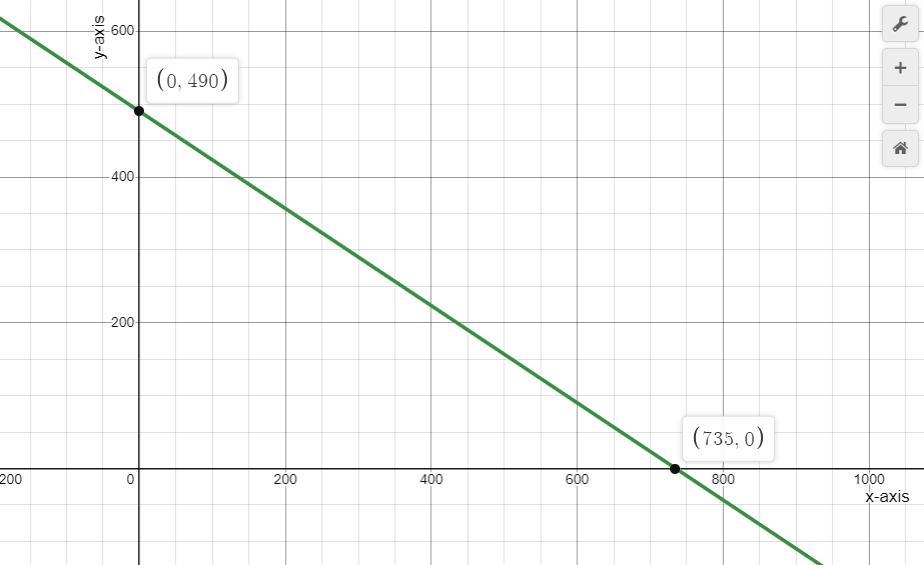
1. The equation to slope-intercept form is y = -2/3(x) + 490. The slope is -2/3 and the y-intercept is 490.
2. You should start at the y-intercept (0, 490) and move right by 3 units and downward by 2 units, and then connect the points.
3. The equation in function notation is f(x) = -2/3(x) + 490. The graph of the function is the rate of change with respect to the number of sandwich lunch sold.
4. A graph of the function with intercepts is shown below.
5. The graphs of the functions for the two months both have the same slope but different y-intercept and x-intercept.
How to change the equation to slope-intercept form?In Mathematics and Geometry, the slope-intercept form of the equation of a straight line is given by this mathematical equation;
y = mx + b
Where:
m represent the slope or rate of change.x and y are the points.b represent the y-intercept or initial value.Based on the information provided above, a linear equation that models Sal's Sandwich Shop's profit is given by;
2x + 3y = 1,470
By subtracting 2x from both sides of the equation and dividing by 3, we have:
2x + 3y - 2x = 1,470 - 2x
y = -2/3(x) + 490
Therefore, the slope is -2/3 and the y-intercept is 490.
Part 2.
In order to graph the equation by using the slope-intercept method, you would start at the y-intercept (0, 490) and move right by 3 units and down by 2 units, and then connect the points.
Part 3.
Next, we would write the equation in function notation as follows;
f(x) = -2/3(x) + 490
where:
f(x) represents the number of wrap lunch sold.x is the number of sandwich lunch sold.The graph represents the rate of change of the function with respect to the number of sandwich lunch sold.
Part 4.
In this context, we would use an online graphing calculator to plot the linear function as shown in the image attached below.
Part 5.
Assuming Sal's total profit on lunch specials for the next month is $1,593 and the profit amounts remain the same, a system of equations to model this situation is given by:
2x + 3y = 1593; y = -2/3(x) + 531.
2x + 3y = 1,470; y = -2/3(x) + 490.
In conclusion, we can logically deduce that the graphs of the functions for the two months both have the same slope but different y-intercept and x-intercept.
Read more on slope-intercept here: brainly.com/question/7889446
#SPJ1
Complete Question:
Sal's Sandwich Shop sells wraps and sandwiches as part of its lunch specials. The profit on every sandwich is $2, and the profit on every wrap is $3. Sal made a profit of $1,470 from lunch specials last month. The equation 2x + 3y = 1,470 represents Sal's profits last month, where x is the number of sandwich lunch specials sold and y is the number of wrap lunch specials sold.
Identify whether the statement represents an exponential function. The height of a projectile = at time t is represented by the function h(t) = -4.9t^2 + 18t + 40. a) Yes, the statement represents an exponential function. b) No, the statement does not represent an exponential function_ Show your work and explain, in your own words, how you arrived at your answer_
Answers
The correct answer is option (b) No, the statement does not represent an exponential function, h(t) = -4.9t² + 18t + 40 is a quadratic function and not an exponential function.
An exponential function is a mathematical function in which the variable is in the exponent. Exponential functions follow the form f(x) = a^x, where a is the base and x is the exponent.
The given statement is h(t) = -4.9t² + 18t + 40, which does not represent an exponential function. The value of t is not in the exponent in this case. Instead, it's a quadratic equation, which is in the form of h(t) = at² + bt + c.
Therefore, the correct answer is option (b) No, the statement does not represent an exponential function.
Explanation:
An exponential function can also be represented by the general form y = ab^x, where b > 0 and b ≠ 1. When plotted on a graph, the curve of an exponential function rises or falls at an increasing rate, depending on whether b is greater than or less than 1, respectively.
A quadratic equation is an equation of the form ax² + bx + c = 0, where a ≠ 0, and x represents a variable. Quadratic equations are second-degree equations, which means the highest exponent of the variable is two.
Therefore, h(t) = -4.9t² + 18t + 40 is a quadratic function and not an exponential function.
learn more about quadratic function here:
https://brainly.com/question/18958913
#SPJ11
Please answer ASAP I will mark brainliest!!
Ignore comment bit
Answers
Answer:
∠ RPQ = 28°
Step-by-step explanation:
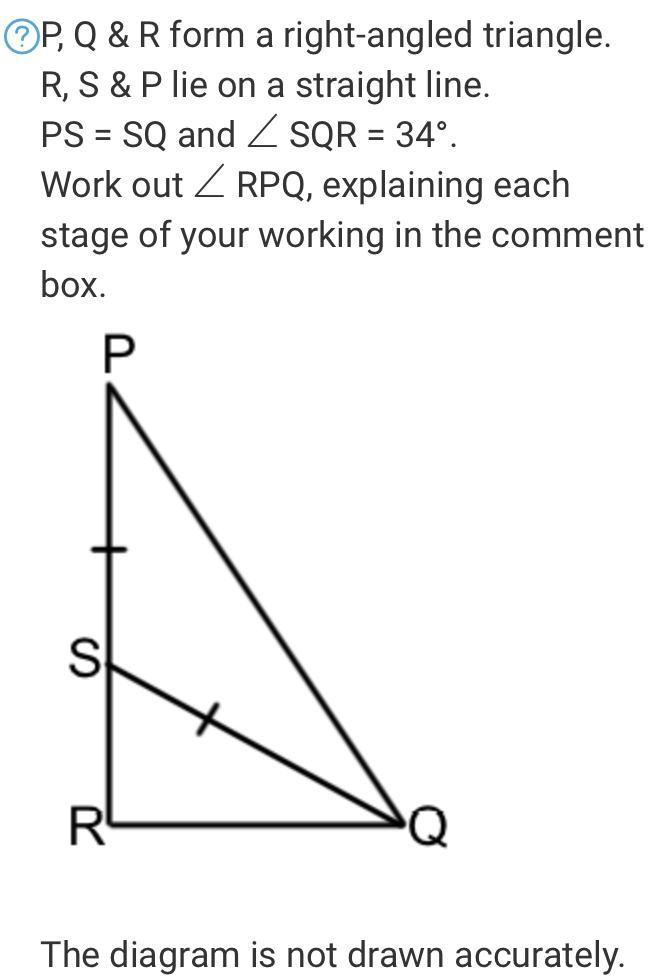
Since PS = PQ then Δ SPQ is isosceles and the base angles are congruent.
∠ SPQ = ∠ SQP = x
Thus ∠ RQP = ∠ SQR + ∠ SQP = 34 + x
The sum of the 3 angles in Δ RPQ = 180°, thus
x + x + 34 + 90 = 180
2x + 124 = 180 ( subtract 124 from both sides )
2x = 56 ( divide both sides by 2 )
x = 28
Thus
∠ RPQ = x = 28°
PLEASE HURRY WILL GIVE BRAINLIEST TO FIRST ANSWER
What is the volume of a cube that has edges of 334
inches?
Responses
27 27/64 in cubed
52 47/64 in cubed
63 1/4 in cubed
84 3/8 in cubed
Answers
Answer:
The volume of a cube that has edges of 334 inches is 27 27/64 cubic inches.
Step-by-step explanation:
The volume of a cube is given by the formula:
Volume = edge length^3
So if the edge length of a cube is 334 inches, the volume would be:
Volume = 334^3 cubic inches
You can also use the formula with 334334334 = 3,874,756 cubic inches
Answer: 334. V= a^3
3.733*10^7=334
334= 27 27/64
Step-by-step explanation: Hope this helps!! :)))
What is the sequence 6, 30, 150, 750, ____ ?
Answers
The value of the missing number and the 6th term is 3750
What is a geometric sequence?The formula for determining the nth term of a geometric sequence with a common ratio greater than one is expressed as;
Tn = ar^n-1
From the information given, the first term(a) is 6 and we are to find the 5th term, thus, n is 5
Let's substitute into the formula
T5 = 6 × 5^5-1
T5= 6× 5^4
Find the value
T5 = 6 × 625
T5 = 3750
Thus, the value of the missing number and the 6th term is 3750
Learn more about geometric sequence here:
https://brainly.com/question/1509242
#SPJ1
Help... my mom is screaming at me bc my math grade is a B for no reason

Answers
Answer:
Fa
Step-by-step explanation:
Answer: 1385.44
Step-by-step explanation:
πr^2*h
helppp pt.5 plzzzzz

Answers
Answer: 60 cm²
Step-by-step explanation:
This is pretty simple, we know AB is 12 cm and DE is 4 cm. We know ABC has a total of 180 square centimeters. So...
12 ÷ 3 = 4
180 ÷ 3 = 60
The answer is 60 cm²
I hope this helps!
A new computer can process the payroll for Brooklyn College in 12 hours An older computer needs 13 hours to process the same payroll: How long would the job take if both computers were used together to process the payroll? a) Let t the time to complete the payroll: Write the equation you would use to solve this problem b) Now solve your equation Give your answer first as reduced fraction, and then as decimal rounded to places_ Working together, the two computers will complete the payroll in: hours (write as fraction) , which as decimal is hours _
Answers
Both computers will do the job in 5 hours and 14 minutes.
Since a computer can process the payroll for Hometel in 10 hours, while an older back up computer needs 11 hours to process payroll, to determine how long would the job take if the two computers are both used to do the job, the following calculation should be performed:
X / 10 + X / 11 = 1
10X + 11X = 110
21X = 110
X = 110/21
X = 5.238
100 = 60
0.238 = X
0.238 x 60/100 = X
0.14 = X
Therefore, both computers will do the job in 5 hours and 14 minutes.
Learn more about Equations here:
brainly.com/question/14585276
#SPJ4
T/F: The proportion in the body of a normal distribution can never be less than 0.50.
Answers
This statement ''The proportion in the body of a normal distribution can never be less than 0.50.'' is false because the proportion in the body of a normal distribution can be less than 0.50, depending on the location of the mean and the spread of the distribution.
In fact, for a normal distribution with a mean of μ and standard deviation of σ, approximately 68% of the area under the curve falls within one standard deviation of the mean (i.e., between μ - σ and μ + σ), which means the proportion in the body of the distribution is about 0.68.
The remaining 32% is split evenly between the tails of the distribution, which means the proportion in each tail is about 0.16.
So, the proportion in the body of the distribution is greater than 0.50.
To know more about normal distribution refer here:
https://brainly.com/question/15103234#
#SPJ11
Calculate the new perimeter using a scale factor of 1/4

Answers
Answer:
i think its 90
Step-by-step explanation:
!!! TIME SENSITIVE !!! Determine the period.

Answers
Answer:
A wave period is the measure of the time it takes for the wave cycle to complete.
The period of the wave is 2 seconds.
Rich earns $35 per week mowing lawns in his neighborhood which expression can be used to show how much money he earns in 8 weeks
Answers
The expression that can be used to show how much money Rich earns in 8 weeks is: 8 * $35.
Rich earns $35 per week mowing lawns in his neighborhood.
We want to find out how much money he earns in 8 weeks.
To find the total amount of money Rich earns in 8 weeks, you can multiply the amount he earns per week ($35) by the number of weeks (8). This is because each week, Rich earns $35, so in 8 weeks, he will earn 8 times that amount.
So, the expression to calculate how much money Rich earns in 8 weeks is 35 dollars/week * 8 weeks.
By multiplying the amount earned per week by the number of weeks, we can determine the total earnings over the given period. In this case, Rich would earn a total of $280 in 8 weeks by mowing lawns in his neighborhood.
To know more about expression refer here:
https://brainly.com/question/28170201
#SPJ11
The Sloan family stayed in a hotel room for 6 nights while on vacation. The total cost before tax was $1,170. If the hotel room tax rate in the city is 12%, what was the total cost for the hotel room?
Answers
Answer:
Total cost for the hotel room is $1310.4
Step-by-step explanation:
The total cost before tax was $1170.
The tax rate is 12%.
So, tax paid = 12%(1170)
Convert 12% to decimal. We get 12% as 0.12
So, tax =0.12*1170 =140.4
So, total cost for the hotel room = $140.4 +$1170 =$1310.4
in setting up a left-tail hypothesis test you find that your rejection regions will be z < -1.96. you calculate your test statistic to be -1.95 so you conclude to:
a.Reject the null hypothesis. b.Fail to reject the null hypothesis. c.Reject the alternative hypothesis. d.Fail to reject the alternative hypothesis.
Answers
The rejection region for a left-tail hypothesis test with a significance level of 0.05 is z < -1.96
The rejection region for a left-tail hypothesis test with a significance level of 0.05 is z < -1.96. Since the calculated test statistic of -1.95 falls just outside of the rejection region, but still within the non-rejection region, the correct conclusion would be to ""Fail to reject the null hypothesis"" (option b). This means that there is not enough evidence to reject the null hypothesis at the chosen level of significance.
Click the below link, to learn more about left-tail hypothesis:
https://brainly.com/question/14007181
#SPJ11
Which best describes why these two figures are similar or not similar?

Answers
Answer:
first one top left
Step-by-step explanation:
a random sample of 10 subjects have weights with a standard deviation of 12.5915 kg. what is the variance of their weights? be sure to include the appropriate units with the result. question content area bottom part 1 the variance of the sample data is
Answers
The variance of the weights of the 10 subjects is 158.6527 kg^2.
The variance of a sample data measures how spread out the individual values are from the mean. To calculate the variance, you need to square the standard deviation.
Given that the standard deviation of the weights of the 10 subjects is 12.5915 kg, we can calculate the variance using the following steps:
1. Square the standard deviation:
Variance = Standard deviation^2
Therefore, Variance = 12.5915^2 = 158.6527 kg^2
So, the variance of the weights of the 10 subjects is 158.6527 kg^2.
Learn more about variance :
https://brainly.com/question/13708253
#SPJ11
Use the first derivative and the second derivative test to determine where each function is increasing, decreasing, concave up, and concave down.
y=-3x² -5x+2, XER
Select the correct choice below and, if necessary, fill in the answer box to complete your choice.A. The function is increasing on the interval(s)
(Type your answer in interval notation. Use a comma to separate answers as needed. Type an integer or a simplified fraction.)
B. The function is not increasing on any interval.
Answers
The function is not increasing on any interval.
First, we need to find the first derivative of the function:
y = -3x² - 5x + 2
y' = -6x - 5
Next, we need to find the critical points of the function by setting the first derivative equal to zero:
-6x - 5 = 0
-6x = 5
x = -5/6
Now, we need to use the second derivative test to determine where the function is increasing, decreasing, concave up, and concave down:
y'' = -6
Since the second derivative is a constant negative value, the function is concave down on the entire domain of x.
Now, we can use the first derivative and the critical point to determine where the function is increasing and decreasing:
When x < -5/6, the first derivative is positive, so the function is increasing.
When x > -5/6, the first derivative is negative, so the function is decreasing.
Therefore, the function is not increasing on any interval.
In interval notation, the function is increasing on the interval (-∞, -5/6) and decreasing on the interval (-5/6, ∞).
So, the correct choice is B. The function is not increasing on any interval.
See more about function at; https://brainly.com/question/23819325
#SPJ11
U7L2 Cool Down
The measure of the arc from B to A not passing through C is 26 degrees.
1. What is the measure of angle BOA ?
2. What is the measure of angle BDA?
3. What is the measure of angle BCA ?
degrees
degrees
degrees
Answers
Using the inscribed angle theorems, the measure of the indicated angles are:
1. m∠BOA = 26°
2. m∠BDA = 13°
3. m∠BCA = 13°
What is the Inscribed Angle Theorems?Based on the inscribed angle theorem, the following relationships are established:
Inscribed angle = 2(measure of intersected arc)Central angle = measure of intersected arcGiven:
Intercepted arc BA = 26°
1. ∠BOA is central angle
Thus:
m∠BOA = 26° (inscribed angle theorems)
2. ∠BDA is inscribed angle.
m∠BDA = 1/2(30) = 13° (inscribed angle theorems)
3. m∠BCA = m∠BDA = 13° (inscribed angle theorems)
Learn more about inscribed angle theorems on:
https://brainly.com/question/30494878
bernard paid an income tax of $1474 for the year 2018. Of his gross annual income, the amount he paid will not be subjected to income tax....
Answers
The annual gross income of Bernard is $53,200.
According to the statement
we have to find that the gross annual income which is subjected to the tax.
So, For this purpose, we have given information that is:
he has a wife, 4 children and 2 parents.
And the income required for all this is :
For himself = $3000
For wife = $2000
For 4 children = $4000*4 = $16000
For 2 parents = $5000 *2 = $10,000
And then
He paid an income tax of $1474 for the year 2018.
And
the gross tax payable for the first $40,000 is $550 and the tax rate for the rest is 7%.
Then
If tax for first 40,000 is 550 then it is clear that the annual amount is more than the 40,000.
So,
Left amount he pays as tax for more than 40,000 = 1474 - 550
Left amount he pays as tax for more than 40,000 = 924
An from given information:
The amount 924 behaves as the 7% of the income more than 40,000 then
924 = 7 /100 * x
here x is the income for which he pays 7% tax
then
924 = 7 /100 * x
92400 = 7x
x = 92400/7
x = 13,200.
The total gross income become = 40,000 + 13,200
The total gross income become = $53,200.
So, The annual gross income of Bernard is $53,200.
Learn more about gross annual income here
https://brainly.com/question/13793671
Disclaimer: This question was incomplete. Please find the full content below.
Question:
Bernard paid an income tax of $1474 for the year 2018. Of his gross annual income, the amount he paid will not be subjected to income tax
For more information please see the image below.
#SPJ1

Graph. (Shade. Dashed line. Solid line?)
x+3y≥3
Answers
Answer:
Since the graph looks like this, I would say solid line

Write the equations bellow in slope-intercept form. Determine if the lines are parallel, perpendicular, or neither
3x = y - 5
9y + 4x = x - 9
A. Parallel
B. Neither
C. Perpendicular
Answers
The population of a colony of mosquitoes obeys the law of uninhibited growth. If there are 1000 mosquitoes initially and there are 1600 after 1 day, what is the size of the colony after 4 days? How long is it until there are 70,000 mosquitoes?
Answers
The number of mosquitoes on the colony after 4 days is 2800.
The number of days that there are 70,000 mosquitoes will be 114 dad.
How to illustrate the population?The population of a colony of mosquitoes obeys the law of uninhibited growth and there are 1000 mosquitoes initially and there are 1600 after 1 day. The common difference will be:
= 1600 - 1000
= 600
The formula for the arithmetic sequence will be:
= a + (n - 1)d
a = 1000
d = 600
n = 4
The colony after 4 days will be:
= a + (n - 1)d
= 1000 + (4 - 1)600
= 1000 + 1800
= 2800
The number of days that there are 70,000 mosquitoes will be:
a + (n - 1)d = 70000
1000 + 600(n - 1) = 70000
1000 + 600n - 600 = 70000
Collect like terms
600n = 70000 - 1000 + 600
600n = 68400
n = 68400/600
n = 114 days
Learn more about population on:
brainly.com/question/25896797
#SPJ1
Which inequality is represented in the graph below?

Answers
Answer:
\(A) \: y\leq -3x+4\)
Answer:
A) y ≥ -3x + 4
Step-by-step explanation:
Given the graph of an inequality, where it shows that the y-intercept is (0, 4), and the line has a negative slope (as it declines from left to right). To figure out the value of the slope, choose two points from the graph, and substitute its values into the slope equation,
m = (y2 - y1)/(x2 - x1)
Let (x1, y1) = (0, 4)
(x2, y2) = (2, -2)
m = (-2 - 4)/(2 - 0)
m = -6/2
m = -3
Now that we have the value of the slope, m = -3, and the y-intercept, b = 4:
We need to determine which part of the region is shaded. Choose a test point that is not on the graph. Let's use the point of origin, (0, 0) to see whether it is included as a solution:
Option A: y ≥ -3x + 4
Substitute values of (0, 0) into the inequality statement:
0 ≥ -3(0) + 4
0 ≥ 0 + 4
0 ≥ 4 (False statement). The shaded region must not contain the given test point, (0, 0), which is actually the case in your given graph. The right-half plane is the shaded region. Hence, y ≥ -3x + 4 is the correct inequality statement that represents the graph.
The answer cannot be y ≤ -3x + 4 because if you plug in the test point into y ≤ -3x + 4, it will provide a true statement.
y ≤ -3x + 4
0 ≤ -3(0) + 4
0 ≤ 0 + 4
0 ≤ 4 (True statement, which means that the region where the test point is located should be shaded).
Therefore, the correct answer is Option A) y ≥ -3x + 4
Please mark my answers as the Brainliest, if you find this helpful :)
Question
A researcher collected the number of letters in each of 200 first names. The data are found to be normally distributed with a mean of 5.82 and a standard deviation of 1.43.
What percentage of first names have seven letters or less?
82.5%
99.8%
79.4%
84.1%
Answers
The data are found to be normally distributed with a mean of 5.82 and a standard deviation of 1.43. The answer will be the later. 90.62%
How to find the percentage?To find the percentage of first names with 7 letters or less, we need to use the Z-score formula to determine how many standard deviations the value 7 is from the mean.
Z = (7 - 5.82) / 1.43
The Z-score indicates how many standard deviations the value 7 is from the mean. A positive z-score indicates a value above the average, and a negative z-score indicates a value below the average.
A Z-score table or calculator can then be used with the standard normal distribution function to find the cumulative probability to which the Z-score compare. This cumulative probability is the percentage of data values that are 7 or less. In this case, Z = 1.36 and the cumulative probability is approximately 0.9062. This means that about 90.62% of given names are seven letters or less of him. So the answer will be the later. 90.62%
To know more about percentage visit:
https://brainly.com/question/29014288
#SPJ1
100 points please help!!

Answers
Answer: (5x-1)(x+4)
Step-by-step explanation:what she said
can someone help me please

Answers
Answer:
the third one ( -7+u+8t)
Step-by-step explanation:
first you add the ts together and you get 8. Then u keep the U and cancel out the +2 nad the -2. Then you are left with your answer. have a nice day
Which factors for p and q add to equal the coefficient of the x-term (–15) in the trinomial?

Answers
ANSWER
(-7, -8)
EXPLANATION
To locate the pair of numbers that add up to -15, look down your p+q column. This equals (p, q) (-7, -8).
hamid has gained weight.
he now weighs 88kg which is 10% higher than his normal weight
what is hamids normal weight?
Answers
Answer:
8.8 kilograms
Step-by-step explanation:
Answer: 83.6 Kg
Step-by-step explanation:
x * 0.1 = y ---> x = y/0.1
88 - y = x
y/0.1 = 88 - y
2y = 88 * 0.1
y = 4.4
88 - 4.4 = 83.6Kg
A building with a height of 6 m casts a shadow that is 8 m long while a taller building casts a 24 m long shadow. What is the height of the taller building?
Answers
Answer:
I am pretty sure it is 22m
Step-by-step explanation:
minus 2
a disk 2 inches in diameter is thrown at random on a tiled floor, where each tile is a square with sides 4 inches in length. let c be the event that the disk will land entirely on one tile. in order to assign a value to p(c), consider the center of the disk. in what region must the center lie to ensure that the disk lies entirely on one tile?
Answers
The probability that the disk will land entirely on one tile is 1/4.
For, this question I have attached an image which shows that the inner red square is the area of a tile in which the centre of the disk could land and the disk would be contained entirely within the tile while the grey area is the area in which the centre of the disk would land and the disk would not be entirely contained within the tile.
Now, The area of a square is the square of side length. The inner square has an area of 2² = 4 and the entire square (red and grey regions combined) has an area of 4² = 16.
Hence, the probability that the disk's centre lands in the red zone is the area of the red zone, divided by the total area, which is
4/16 = 1/4
To learn more about probability here:
brainly.com/question/11234923
#SPJ4