Type the correct answer in each box. Round your answers to the nearest whole number. Solve this system of equations using the elimination method. 3x − 2y = 0 2x + y = 7 The solution to the system is ( , ).
Answers
Answer:
( 2,3 )
x =2 , y = 3
Step-by-step explanation:
In elimination method of solving linear equation, steps are involved to eliminate one of the variables so that value of other can be deduced.
In this method we either subtract or add one of the variable which has the same coefficient in the both of the equation, so that it can be removed from equation.
___________________________________________________
Given system of linear equation
3x − 2y = 0 (1)
2x + y = 7 (2)
Let eliminate y to find x
as we can see equation has 1 as coefficient for y but in equation 2 y has coefficient as 1.
In order to make coefficient of y same as 2, we multiply LHS and RHS of equation 2 with 2.
( 2x + y )*2= 7 *2
=>2x *2+ y*2= 7 *2
=> 4x + 2y = 14 let it be equation 3
Adding equation 1 and 3
3x − 2y = 0
+4x + 2y = 14
_____________________________ -2 y + 2y = 0 (y gets eliminated)
7x = 14
=> x = 14/7 = 2
Thus, x = 2
using x = 2 in 2x + y = 2
2*2 + y= 7
=> 4 + y = 7
=> y = 7 - 4 = 3
\
Thus, The solution to the system is ( 2,3 ).
Answer:
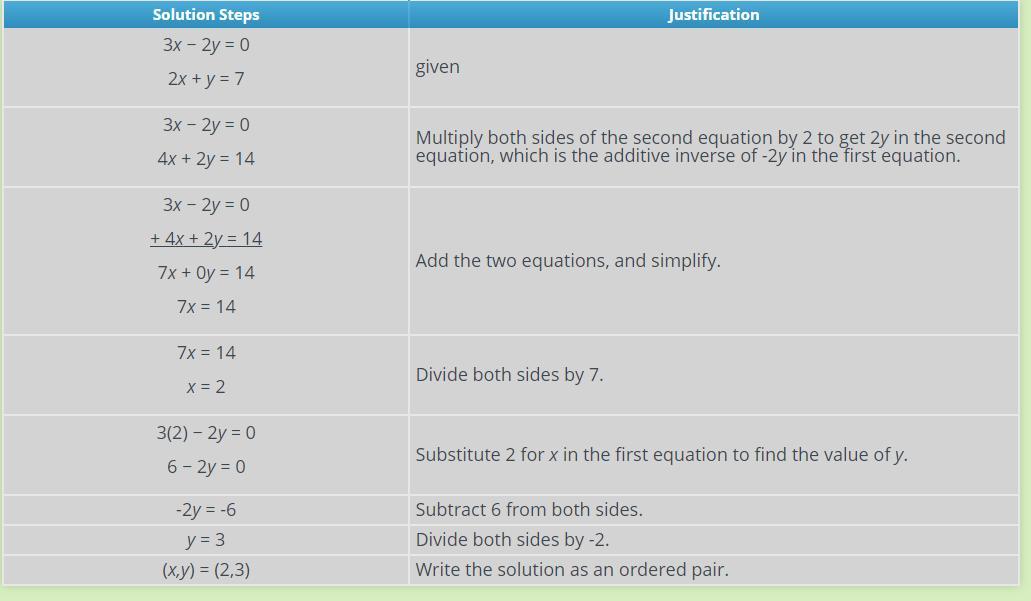
Here are the steps
Step-by-step explanation:
Related Questions
30
There are 640 acres in 1 square mile. The area of a
forest is increasing at a rate of 1 acre per decade.
Which of the following is closest to the rate at which
the area of the forest is increasing, in square
kilometers per decade? (Use 1 kilometer = 0.62
mile.)
A) 0.0006
B) 0.0010
C) 0.0025
D) 0.0041
Answers
0.0041 is closest to the rate at which the area of the forest is increasing, in square kilometers per decade.The correct answer is option D.
To determine the rate at which the area of the forest is increasing in square kilometers per decade, we need to convert acres to square kilometers and decades to years.
First, let's convert 1 square mile to square kilometers:
1 square mile = (1 mile)² = (1.60934 kilometers)² = 2.58999 square kilometers
Next, let's convert 1 acre to square kilometers:
1 acre = (1/640) square mile = (1/640) * 2.58999 square kilometers = 0.00404 square kilometers
Now, we know that the area of the forest is increasing at a rate of 1 acre per decade. So, the rate of increase in square kilometers per year is:
0.00404 square kilometers per decade ÷ 10 years = 0.000404 square kilometers per year
To find the rate in square kilometers per decade, we multiply the rate per year by 10:
0.000404 square kilometers per year × 10 = 0.00404 square kilometers per decade.
Among the given options, the closest rate is option D) 0.0041 square kilometers per decade.
For more such questions square,Click on
https://brainly.com/question/27307830
#SPJ8
Two sporting goods stores are having discount sales on basketballs. At one store, a basketball is on sale for 20% off the regular price of $24.95. the other store, the same kind of basketball is on sale for 25% off the regular price of 25.80 . What is the difference between the sale prices of the two stores?
Answers
Answer: $0.61
Step-by-step explanation:
1. Find the retail price of each store by multiplying the normal price by% discount to get a discount - and then opt out.
store A: 24.95 * 20% (or 0.20) = 4.99 (discount)
24.95 - 4.99 = 19.96 (sale price)
store B: 25.80 * 25% (or 0.25) = 6.45 (discount)
25.80 - 6.45 = 19.35
To find the sale price difference, subtract 19.96 - 19.35 = 0.61
Evaluate 4+(m-n)^4 when m =7 and n = 5
Answers
Answer:
20.
Step-by-step explanation:
Plugging m = 7 and n = 5 into the given expression:
Answer = 4 + (7 - 5)^4
= 4 + 2^4
= 4 + 16
= 20.
In a poll to pick the name of a new planet discovered in a distant solar system, a total of 963 scientists voted. There were four names to pick from. The winning name exceeded the other names by 53, 79, and 105 votes, respectively. How many scientists voted for the name which came fourth in the poll?
Answers
Answer:
195
Step-by-step explanation:
Let wining name have, x votes
1st = x
2nd = x - 53
3rd = x - 79
4th = x - 105
x + (x - 53) + (x - 79) + (x - 105) = 963
x + x - 53 + x - 79 + x - 105 = 963
4x - 237 = 963
4x = 963 + 237
4x = 1200
x = 1200 / 4
x = 300
4th = x - 105
x - 105 = 300 - 105 = 195
prove the following relations:cot²a-cos²a=cot²a cos
please help:((
Answers
Answer:
steps below
Step-by-step explanation:
It's easier to prove from right side to left side. If you insist to prove from left to right, you can just reverse the calculation from bottom to the top.
\(cot^{2} a * cos^{2}a \\= cot^{2} a * (1-sin^{2} a)\\= cot^{2} a - cot^{2} a*sin^{2} a\\= cot^{2} a - \frac{cos^{2} a}{sin^{2}a} *sin^{2} a\\= cot^{2} a - cos^{2} a\)
Subtract (4+2i) from (6-8i). Enter your answer as a complex number in the
form a+bi.
Answers
(4+2i) side note : -8i - 2i becomes 8i+2i 2+10i because the negatives cancel out
^^^answer
A design engineer is asked to develop an open pit cross section knowing the following info: 1. Max face slope 77
∘
for stability 2. Haul road width 25 m (crossing design section only once) 3. Bench width (15 m) and height (10 m) due work space limitations 4. Section Pit bottom depth 100 m at the end of the mine life. he geotechnical group at the mine estimated an erall slope angle not to exceed 45
∘
at designed ction - does previous design indices viable? If t - what to suggest to fix this problem? Use gineering to scale sketches
Answers
The design engineer has been tasked with developing an open pit cross-section based on the following information:
a maximum face slope of 77 degrees for stability, a haul road width of 25 meters (crossing the design section only once), a bench width of 15 meters, a bench height of 10 meters (due to workspace limitations), and a pit bottom depth of 100 meters at the end of the mine life. The geotechnical group at the mine has estimated that the overall slope angle should not exceed 45 degrees at the designed section.
The design engineer needs to evaluate whether the previous design indices are viable. The given information suggests a maximum face slope of 77 degrees, which exceeds the recommended overall slope angle of 45 degrees. This indicates a potential stability issue with the design.
To address this problem, the engineer could consider the following suggestions: 1. Adjust the face slope angle: The engineer should revise the design to ensure that the face slope angle is within a safe and stable range. This may involve reducing the slope angle to meet the recommended limit of 45 degrees.
2. Evaluate slope stability: The engineer should conduct a detailed geotechnical analysis to assess the stability of the proposed design. This analysis may involve geotechnical surveys, slope stability calculations, and computer modeling to determine the appropriate slope angles and design measures required to ensure stability.
3. Implement support measures: If the revised slope angles still exceed the recommended limit, the engineer should consider implementing additional support measures to enhance stability. These measures could include reinforcement techniques such as slope stabilization, retaining walls, or geotechnical anchoring systems.
It is crucial to consult with geotechnical experts and conduct thorough engineering analyses to ensure the safety and stability of the open pit design. The engineer should also create scaled sketches and drawings to visualize the proposed design modifications and present them to the relevant stakeholders for review and approval.
Learn more about stakeholders here: brainly.com/question/30241824
#SPJ11
The ratios in an equivalent ratio and 3:12 , 4:16 and 5:20 if frost number is 10 what is the second number ?
Answers
Use the ratios to determine the number that you should multiply by.
See details:

Which two sequences of transformations could be used to prove figure 1 and figure 2 are congruent?
Answers
In some circumstances, it might also be essential to demonstrate congruence using various transformations.
what is transformations ?In mathematics, transformations are modifications done to a geometric figure in a coordinate plane, such as a shape, point, or line. Applying various operations or functions on the coordinates of the points that make up the figure will result in these changes. Four fundamental types of transformations exist: Translation: A figure is moved horizontally, vertically, or both while maintaining its size, form, and orientation.
Translation, rotation, and reflection are the three fundamental transformations that can be employed to demonstrate the congruence of two figures.
To demonstrate that Figures 1 and 2 are congruent with one another, the following two transformational sequences could be used:
Figure 1 should be translated to overlap with Figure 2, then rotated.
b. Rotate Figure 1 about a point until it aligns with Figure 2's orientation.
c. Evaluate the two figures side by side to ensure that all related sides and angles match.
Rotation after reflection:
a. Create a mirror image of Figure 1 by reflecting it across a line.
b. Rotate the reflected Figure 1 about a certain point until it aligns with Figure 2's orientation.
c. Evaluate the two figures side by side to ensure that all related sides and angles match.
To ensure that the two figures are congruent, the transformations must be used in a precise order.
In some circumstances, it might also be essential to demonstrate congruence using various transformations.
To know more about transformation visit :-
brainly.com/question/11709244
#SPJ1

If we reflect the point (- 3, - 9) over the y-axis, where would the new point be located?
Answers
PLS ANSWER I WILL GIVE BRAINLIST AND A THANK YOU!!! :)

Answers
Answer:
(5,3) and (5,9)
Step-by-step explanation:
Please solve this, the answer is :4 and 25. I would like a step by step explanation please

Answers
Answer:
steps below
Step-by-step explanation:
x -7√x + 10 = 0
(√x)² - 7√x + 10 = 0
(√x - 2)(√x - 5) = 0
√x - 2 = 0 or √x - 5 = 0
√x = 2 or √x = 5
(√x)² = x = 4 or (√ x)² = x = 25 ...
Solve -7+2(-4x-3)=11. Justify each step
Answers
Answer:
x=-3
Step-by-step explanation:
Let's solve your equation step-by-step.
−7+2(−4x−3)=11
Step 1: Simplify both sides of the equation.
−7+2(−4x−3)=11
−7+(2)(−4x)+(2)(−3)=11(Distribute)
−7+−8x+−6=11
(−8x)+(−7+−6)=11(Combine Like Terms)
−8x+−13=11
−8x−13=11
Step 2: Add 13 to both sides.
−8x−13+13=11+13
−8x=24
Step 3: Divide both sides by -8.
−8x
−8
=
24
−8
x=−3
What is the scale factor from AABC to ADEF?

Answers
Answer:
C. 1/12
Step-by-step explanation:
The scale can be calculated by comparing side lenghts
AC is similar to FD and AB is similar to FE and BC is similar to ED
AB = 2 and FE = 24 so AB/FE is = 2/24 that's simplified is 1/12
5.
I DON'T
The rate is given as a percent (%). Before using it in the
SUFFER FROM simple interest formula, you must first convert it to a
INSANITY.
I ENJOY
EVERY
MINUTE OF IT
I a) fraction
b) decimal
c) ratio
. d) dollar amount
Answers
So you need to turn the percentage into a fraction so you have the rate as r/100
Super fast response easy math rate you 5 and brainlist

Answers
Answer:
1. f= 7 1/2
2. f= 9/10
3. f= -2 1/2
how many groups of participants would be needed to partially (e.g., using latin square arrangement) counterbalance a within-subjects experiment with three treatment conditions?
Answers
24 groups of participants would be needed to partially counterbalance a within-subjects experiment with three treatment conditions.
Given that;
How many groups of participants would be needed to partially counterbalance a within-subjects experiment with three treatment conditions.
Every participant in an experiment is exposed to every treatment or condition in a within-subject design, sometimes referred to as a repeated measures design.
The term "between-subjects design" is comparable to this within-subjects design. People are solely assigned to one treatment in a between-subjects design. As a result, one therapy would be given to one group of volunteers, while a different treatment would be given to another group. After that, the variations between the two groups would be contrasted.
24 groups would be required for a perfectly counterbalanced design for even four treatment conditions. This would obviously be impracticable because a large enough sample size would be required to conduct such an experiment.
To learn more about sample size click here:
brainly.com/question/25894237
#SPJ4
b) What is the value of 11 a?
Answers
What is the range of the function
graphed below?
(3,3)

Answers
pls anwser this question :) 9 and 10 there easy ! mayh

Answers
Answer:
1. 5/3
2. A
Step-by-step explanation:
a 10 foot ladder rests against a vertical wall if the bottom of the ladder slides away from the wall at a speed of 2 ft/s how fast is the angle betwween the top of the ladder and the wall changing when that angle is
Answers
Answer:
d∅/dt = √2/5 Rad/sec
Step-by-step explanation:
According to the Question,
Given That, a 10-foot ladder rests against a vertical wall if the bottom of the ladder slides away from the wall at a speed of 2 ft/s how fast is the angle between the top of the ladder and the wall changing when that angle is π/4.Solution,
Let x be the Distance between the base of the wall and the bottom of the ladder.
and let ∅ be the angle between the top of the ladder and the wall.
Then, Sin∅ =x/10 so, x=sin∅ *10
Differentiating with respect to time t we get,
dx/dt = 10 * cos∅ * d∅ /dt
We have given that dx/dt = 2 ft/s and ∅ =π/4Now, Put these value we get
2 = 10 *(cos(π/4))* d∅/dt
2 = 10/√2 * d∅/dt
d∅/dt = √2/5 Rad/sec
Raymond uses the Venmo
app to transfer money to
his friends. He had $6.50.
He gave $2.95 to Theresa
and received $1.26 from
Peyton. How much money
does he have now?
Answers
Answer:
2.29
Step-by-step explanation:
2.95 plus 1.26 is 4.21, and 6.50 minus 4.21 is 2.29.
1 1/2 divided by 2 2/3
CAN SOMEONE PLEASE HELP ME
Answers
Answer : 9/16
so sorry if I’m wrong
PLEASE HELP!!! At the state fair 6 employees were paid $6.93 an hour. They worked for 9 hours at regular price and then for 5 hours at overtime price (an extra 3.32 an hour). How much money did they make total?
Answers
Answer:
Your answer should be 443.82
Step-by-step explanation:
Ok, so if 6 workers were paid 6.93 an hour each and worked 9 hours each then you would do 6.93 x 9 for the number of hours and the pay for each hour, which is 62. 37. Then you would times 62.37 by 6 because you have 6 workers and the question asks for how much they made in TOTAL. 62.37 x 6 is 344.22, then you still have you overtime hours. So if each worker makes 3.32 for every overtime hour then you would do 3.32 x 5 for the number of hours. And that equals 16.60, then you would multiply that by 6 for the number of workers, 16.60 x 6 = 99.60. So in total for regual hours they made 344.22, and in total for overtime hours they made 99.60. Now you add those to to get you overall price which is 443.82. And that should be your answer
Hope I did some good :) Have a great day!
1. Which polygon or polygons are regular? (2 points)

Answers
Answer: 1st, 2nd, and 3rd
Step-by-step explanation: the last one isn't because not all of the sides are the same length
anthony can run at the rate (in meters per minute) shown in the graph below) which of the following best describes anthony’s rate of speed
Answers
Step-by-step explanation:
no this is a test I cant hlep i will tell ms.jules you are searching for the answers
How do you solve for x in a logarithmic property?
Answers
The logarithmic form is written as logₐ(X)=b. It is a rearrangement of the exponential form, aᵇ=X.
What is Logarithmic Form?
The logarithmic form is written as logₐ(X)=b. It is generally the rearrangement of the exponential form, aᵇ=X. Any exponential equation can be written as a logarithm. The logarithmic form is mostly used to calculate an exponent of an equation. The logₐ(X)=b. is read as “log base a of X equals b“.
The logarithmic form is simply a rearrangement of an equation written in exponential form. The same numbers are used but they are written in a different order. The word log is written which implies that the logarithm function is being used.
Therefore, If the logarithmic form is logₐ(X)=b. then it is a rearranged as the exponential form as aᵇ=X.
To learn more about logarithm refer here
brainly.com/question/237323
#SPJ4
please do this it's due tommrow

Answers
Answer: 10. equal 0.27
11. 5.12
12. 3.35
Step-by-step explanation:
10. 0.9 * 0.3 = 0.27
11. 1.6 * 3.2 = 5.12
12. 0.5 * 6.7 = 3.35
13. 0.81*7.3 = 5.873
14. 5.6*3.9 = 21.84
15. 1.2 * 0.05 = 0.06
Write and solve an equation to find the value of x. Then, write and solve an equation to find the value of y.

Answers
Answer:
x = 4
y = 10
Step-by-step explanation:
7x - 3 = 25
7x = 28
x = 4
12y + 35 = 155
12y = 120
y = 10
Hey there!
There are actually a few possible equations, but I will choose these:
FOR X:
7x - 3 = 25
7x = 28
x = 4
FOR Y:
12y + 35 = 155
12y = 120
y = 10
Hope it helps and have a great day!!
please helpp solve!!

Answers
If Angle M is y then,
Step-by-step explanation:
(6y) + (3y -6) + y = 180°
10y - 6 = 180
10y = 186
y= 18.6
Angle O = 3(18.6) - 6 = 49.8
Answer 49.8
I hope this helps!!!