
Answers
Answer:
SAS
Step-by-step explanation:
There is one common side (S)
both the triangles have 90° common (A)
Opposite sides are equal which is given (S)
They both are right angled triangles
Related Questions
A
True
False
P
Given the diagram as marked.
True or False: P is on the angle bisector of A

Answers
Answer:
False
Step-by-step explanation:
P is not necessarily on the angle bisector of angle A.
Attached is an example of a carefully constructed shape (so that it's easy to see the measurements):
Angle A measures 45° (again, for convenience)Point P is 4 units to the right of and 3 units above point A.Point P forms a right angle with two congruent line segments, each of which terminate on the rays extending from Point A, forming angle A.The lower point is 8 units to the right of point A; the upper point is 7 units to the right of and 7 units above point A.The length of the two line segments is 5 units, and thus they are congruent.Visually, point P is not on the angle bisector of angle A.
While having two adjacent congruent segments is necessary for P to be on the bisector of angle A, it is not sufficient. The segments on the rays from A to the end of those segments would also need to be a pair of congruent adjacent sides (forming a kite). For a kite, the diagonal from the point between one pair of adjacent congruent sides to the point between the other pair of adjacent congruent sides does form an angle bisector with both angles.

what is relative intrest
Answers
Relative interest refers to the comparison of interest rates between different financial instruments or investment opportunities. It allows individuals or investors to assess and evaluate the attractiveness of various options based on their potential returns.
1. Understand the basic concept: Interest is the cost of borrowing money or the return earned on invested funds. Relative interest involves comparing the interest rates of different financial instruments or investments to determine which one offers a more favorable return.
2. Identify the investment options: Start by identifying the different investment opportunities or financial instruments available. These can include savings accounts, certificates of deposit (CDs), bonds, stocks, or other investment vehicles.
3. Research interest rates: Research and gather information about the current interest rates offered by each investment option. This information can usually be found on financial websites, through financial institutions, or by consulting with a financial advisor.
4. Compare interest rates: Once you have the interest rates for each investment option, compare them side by side. Look for the differences in rates and identify which options offer higher or lower returns.
5. Assess risk and return: Consider the level of risk associated with each investment option. Higher returns often come with higher risk, so it's essential to evaluate the risk-reward tradeoff.
6. Make an informed decision: Based on the comparison of interest rates and the risk-reward assessment, make an informed decision on which investment option aligns with your financial goals and risk tolerance.
Always remember to consider your financial goals, risk tolerance, and consult with a financial advisor if needed.
For more such questions on interest rates, click on:
https://brainly.com/question/25720319
#SPJ8
Which of the following expressions are equivalent to -1/2 ?
Answers
Answer:
there are no other expressions....
Step-by-step explanation:
Ron started a construction company. The net value of the company (in thousands of dollars) ttt months after its creation is modeled by
v(t)=2t^2-12t-14v(t)=2t
2
−12t−14v, left parenthesis, t, right parenthesis, equals, 2, t, squared, minus, 12, t, minus, 14
If a company's net value is 000 dollars, the company is breaking even. Ron wants to know how many months it will take for his company to break even.
1) Rewrite the function in a different form (factored or vertex) where the answer appears as a number in the equation.
v(t)=v(t)=v, left parenthesis, t, right parenthesis, equals
2) How many months after its creation does the company break even?
Answers
Answer:
v(t)=2(t+1)(t-7)
7 months
Step-by-step explanation:
took the quiz
The number of months after its creation it will take the company to break even is; 7 months
How to Simplify Algebra?We are given the net value of the company after t months to be represented by the equation;
v(t) = 2t² - 12t - 14
1) Now, we need to factorize this to get;
v(t) = 2[t² - 6t - 7]
When we factorize using the factors, we get;
v(t) = 2(t + 1)(t − 7)
2) Now, we are told that the company will break even when the net value is zero.
Thus;
2(t + 1)(t − 7) = 0
thus;
(t + 1) = 0 or t - 7 = 0
We have;
t = -1 or 7
t cannot be negative and so;
t = 7 months
Read more about Algebra at; https://brainly.com/question/723406
#SPJ2
The depth of a local lake averages 42 ft, which is represented as |−42|. In February, it measured 8 ft deep, or |−8|, and in July, it was 33 ft deep, or |−33|. What is the difference between the depths in February and July?
9 feet
25 feet
34 feet
41 feet
Answers
The difference between depths in February and July is: 25 feet
Difference:
Difference means subtraction of the number with the smallest value from the number with the largest value.
Given,
The depth of a local lake averages 42 ft, which is represented as |−42|.
In February, it measured 8 ft deep, or |−8|,
And in July, it was 33 ft deep, or |−33|.
Here we have to use this formula
Difference in depth=July depths - February depths
Let plug in the formula
Difference in depth= 33 - 8
Difference in depth=25 feet
Therefore, the difference between the July and February depths is 25 feet.
To know more about Difference here
https://brainly.com/question/2432925
#SPJ1
Country A has an exponential growth rate of 4.3% per year. The population is currently 4,079,000, and the land area of Country A is 19,000,000,000 square yards. Assuming this growth rate continues and is exponential, after how long will there be one person for every square yard of land?
Answers
The number of years it would it take for there to be one person for every square yard is 108,325.68 years.
How many years would it take for there to be one person for every square yard?When there is one person for every square yard, it means that the population and land area are equal in value.
Number of years = (In FV / PV) / r
FV = future populationPV = present populationr = rate of growth(In 19 billion / 4,079,000) / 0.043 = 108,325.68 years
To learn more about exponential functions, please check: brainly.com/question/26331578
PLEASE HELP DUE IN 3 minutes

Answers
Answer:
B
Step-by-step explanation:
B option 2nd histograms matches with the data given in table...
Carns Company is considering eliminating its Small Tools Division, which reported a loss for the prior year of $205,000 as shown below. Segment Income (Loss) Sales $ 1,430,000 Variable costs 1,295,000 Contribution margin 135,000 Fixed costs 340,000 Income (loss) $ (205,000) If the Small Tools Division is dropped, all of its variable costs are avoidable, and $119,000 of its fixed costs are avoidable. The impact on Carns’s income from eliminating the Small Tools Division would be: Multiple Choice
Answers
The impact on Carns Company's income from eliminating the Small Tools Division would be a decrease of $1,209,000.
To determine the impact on Carns Company's income from eliminating the Small Tools Division, we need to consider the avoidable costs associated with the division.
The avoidable costs include all of the variable costs of the division and a portion of the fixed costs that are specifically related to the Small Tools Division. In this case, the variable costs of the division are $1,295,000, and $119,000 of the fixed costs are avoidable.
To calculate the impact on income, we subtract the avoidable costs from the loss reported by the division:
Impact on income = Loss - Avoidable costs
Impact on income = $205,000 - ($1,295,000 + $119,000)
Impact on income = $205,000 - $1,414,000
Impact on income = -$1,209,000
The negative sign indicates a decrease in income.
For more such questions on income
https://brainly.com/question/28414951
#SPJ8
Find the slope of the line below.
An image of a graph

Answers
Answer:
-3.
Step-by-step explanation:
1) to choose any two points on the given graph: for example, A[0;5] and B[1;2];
2) to calculate the required slope according to the formula:
\(slope=\frac{Y_B-Y_A}{X_B-X_A} ;\)
\(slope=\frac{2-5}{1-0} =-3.\)
Question 1 of 10
What is the slope of the line that contains the points (-2, 5) and (6,-3)?
OA. 8
OB. 1
O C. -1
OD. -8
Answers
Answer:
slope is -1
Step-by-step explanation:
Slope of the line is changes in y over changes in x. It can also be referred as rise over run.
We can express mathematically as:
\(\displaystyle{m=\dfrac{y_2-y_1}{x_2-x_1}}\)
where m is slope.
Let (-2,5) be \(\displaystyle{(x_2,y_2)}\) and (6,-3) be \(\displaystyle{(x_1,y_1)}\). Hence, apply the slope formula:
\(\displaystyle{m=\dfrac{5-(-3)}{-2-6}}\\\\\displaystyle{m=\dfrac{5+3}{-8}}\\\\\displaystyle{m=\dfrac{8}{-8}}\\\\\displaystyle{m=-1}\)
Therefore, the slope is -1
What is the following quotient?
2
√13+√11
O√13-2√11
√13+√11
6
O
113 + √11
12
O
● √13 - √11

Answers
\(\frac{2}{\sqrt{13}+\sqrt{11}} \times \frac{\sqrt{13}-\sqrt{11}}{\sqrt{13}-\sqrt{11}}\\\\=\frac{2\sqrt{13}-2\sqrt{11}}{13-11}\\\\=\boxed{\sqrt{13}-\sqrt{11}}\)
The solution is: our final quotient is: (√13 - √11).
What is multiplication?In mathematics, multiplication is a method of finding the product of two or more numbers. It is one of the basic arithmetic operations, that we use in everyday life.
here, we have,
Explanation
Since we have radicals in the denominator, we need to rationalize our expression.
To do it we just need to multiply both numerator and denominator by the conjugate of the denominator.
Remember that the conjugate of a binomial is the same binomial with the sing in between changed.
given that,
2/ (√13 + √11)
Now, we can simplify the denominator:
multiplying by (√13 - √11)
we get,
2 * (√13 - √11) / (√13 + √11)* (√13 - √11)
The only radical that we can simplify in the numerator is , which simplifies to:
2 (√13 - √11) / 13 - 11
= 2(√13 - √11) /2
= (√13 - √11)
So, our final quotient is: (√13 - √11)
To learn more on multiplication click:
brainly.com/question/5992872
#SPJ5
What is 1+1x29x78... Help
Answers
Answer:
2263
Step-by-step explanation:
1 + 1 x 29 x 78
1 + 29 x 78
1 + 2262
2263
Please see my question in the attachment, thanks!

Answers
The limit of the function As x → - ∞, f(x) → 2.
What is the limit of a function?The limit of a function is the value the function tends to as the independent variable tends to a given value.
Given the graph of the function above, to find the limit of the function As x → -∞, f(x) →? We proceed as follows
Looking at the graph, we see that f(x) has a horizontal asymptote at y = 2. Now, we see that As x → -∞, f(x) approaches 2.
So, As x → - ∞, f(x) → 2.
Learn more about limit of a function here:
https://brainly.com/question/27449919
#SPJ1
Save me please anyone please pleae

Answers
Answer: uh i think 48 for both
Step-by-step explanation:
Attempt 1 of 2
<< <
1
2
Find the vertices for the ellipse with the given equation.
x2 + 9y2 + 2x + 18y + 1 = 0
Answers
Answer:
is this quadratic equation
Sparkles the Clown makes balloon animals for children at birthday parties. At Bridget's party, she made 5 balloon poodles and 1 balloon giraffe, which used a total of 15 balloons. For Eduardo's party, she used 7 balloons to make 1 balloon poodle and 1 balloon giraffe. How many balloons does each animal require?

Answers
Let p be the number of balloons required to make one balloon poodle and g the number of balloons required to make one balloon giraffe.
Then we have:
I) 5p + g = 15
II) p + g = 7
Subtracting equation II from equation I, we have:
5p - p + g - g = 15 - 7
4p = 8
p = 8/4
p = 2
Replacing p with 2 in equation II we have:
2 + g = 7
g = 7 - 2
g = 5
Answer: Each poodle requires 2 balloons and each giraffe requires 5 balloons.
Chris works at a bookstore and earns $7.50 per h hour plus a $2 bonus for each book she sells. Chris sold 15 books. She
wants to earn a minimum of $300. Which inequality represents this situation, and what quantities are true for h?
A 2h + 30 > 300, where h > 135
B 7.50h + 30 > 300 where h > 36
7.50h + 30 < 300, where h <36
D2h + 30 < 300, where h < 135
Answers
Answer:
B
Step-by-step explanation:
Answer:
Step-by-step explanation:it is b because u multiply.
A bag contains 8 red marbles, 3 blue marbles, and 1 green marble. Find P(not blue).
A. 9
B. 4/3
C. 1/4
D. 3/4
Please select the best answer from the choices provided.
Answers
8+3+1=12
1-3/12=3/4
Maria practices her drums on all but 6 of the 31 days in January let d be the number of days Maria practices in January which equation could you use to find d?
Answers
Answer:
31-6=d
Step-by-step explanation:
it just is
Please help explanation need it

Answers
Answer:
\( \cos(z) = \frac{30}{34} \)
Arrange the following temperatures in ascending order and descending order.
a) 37°C, -15°C, 16°C, -12°C, 0°C, 96°C, -73°C
b) 20°C, -1°C -15°C 0°C, -7°C, 23°C, -36°C.
Answers
Answer:
a) -73°C, -15°C, -12°C, 0°C, 16°C, 37°C, 96°C
a) 96°C, 37°C, 16°C, 0°C, -12°C, -15°C, -73°C
b) -36°C, -15°C, -7°C, -1°C, 0°C, 20°C, 23°C
b) 23°C, 20°C, 0°C, -1°C, -7°C, -15°C, -36°C
The sun of a number and 5 is greater than 23
Answers
Answer: x + 5 > 23
x is at least 19
Step-by-step explanation:
Explain the approach you would take to verify that the following equation is an identity and why youwould choose that approach. Do not actually verify that the equation is an identity. (4 points)= csc(2x) + 1(sin(x) + cos(x))²sin(2x)
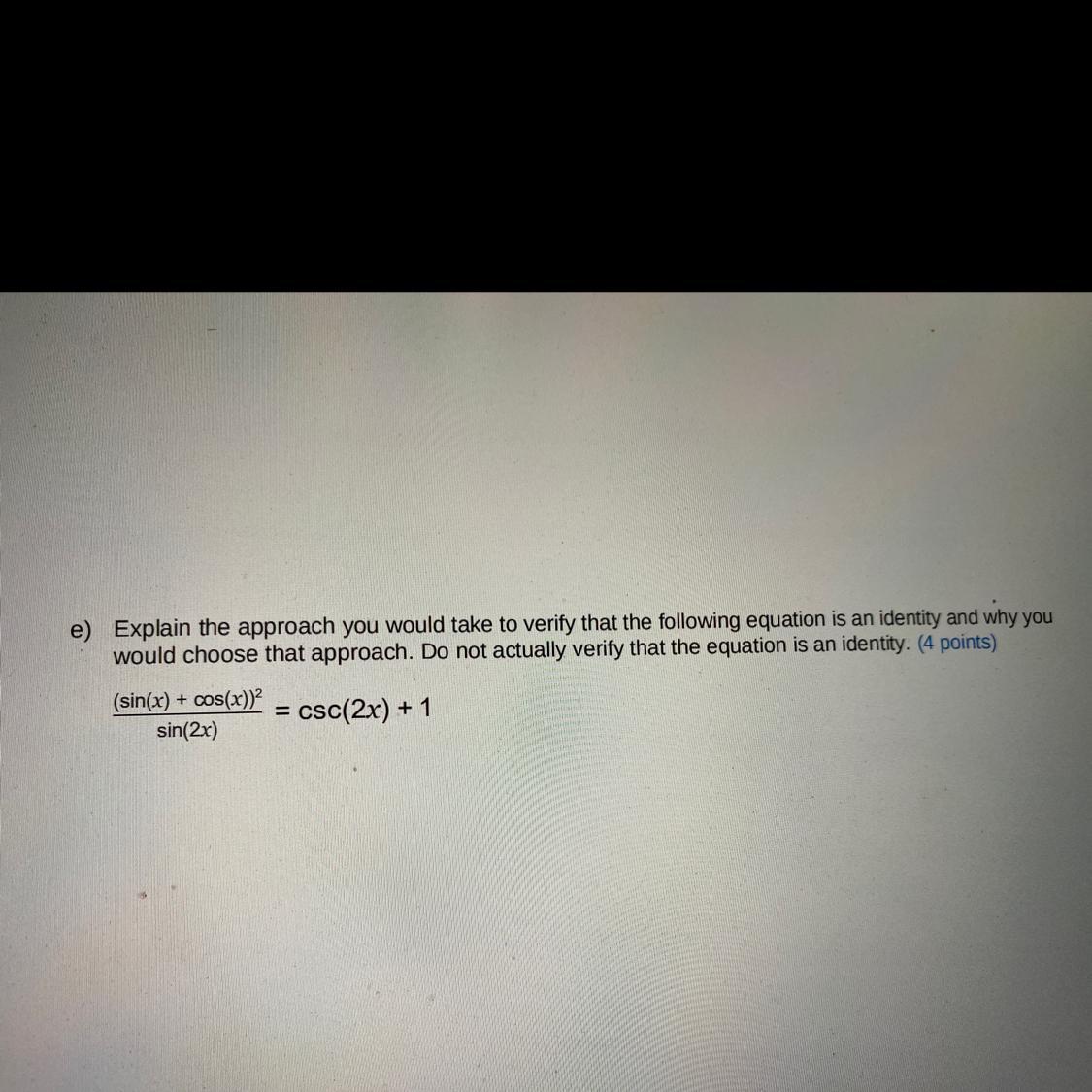
Answers
Given the expression
\(\frac{(sin(x)+cos(x))^2}{sin(2x)}=csc(2x)+1\)Solving the perfect square
\(\frac{sin^2(x)+2sin(x)cos(x)+cos^2(x)}{s\imaginaryI n(2x)}=csc(2x)+1\)\(\frac{1+2sin(x)cos(x)}{s\imaginaryI n(2x)}=csc(2x)+1\)Sin(2x) equals to
\(sin(2x)=2sin(x)cos(x)\)then
\(\frac{1+2s\imaginaryI n(x)cos(x)}{s\imaginaryI n(2x)}=csc(2x)+1\)\(\frac{1+sin(2x)}{sin(2x)}=csc(2x)+1\)\(\frac{1}{sin(2x)}+\frac{sin(2x)}{sin(2x)}=csc(2x)+1\)\(\frac{1}{sin(2x)}+1=csc(2x)+1\)\(csc(2x)+1=csc(2x)+1\)solve the following question

Answers
14. The trigonometric equation (sin47°/cos43°)² + (cos43°/sin47°)² - 4cos²45° = 4
15. In the trigonometric equation 2(cos²θ - sin²θ) = 1, θ = 15°
What is a trigonometric equation?A trigonometric equation is an equation that contains a trigonometric ration.
14. To find the value of (sin47°/cos43°)² + (cos43°/sin47°)² - 4cos²45°, we proceed as follows
Since we have the trigonometric equation (sin47°/cos43°)² + (cos43°/sin47°)² - 4cos²45°,
We know that sin47° = sin(90 - 43°) = cos43°. So, substituting this into the equation, we have that
(sin47°/cos43°)² + (cos43°/sin47°)² - 4cos²45° = (cos43°/cos43°)² + (cos43°/cos43°)² - 4cos²45°
= 1² + 1² - 4cos²45°
We know that cos45° = 1/√2. So, we have
1² + 1² - 4cos²45° = 1² + 1² - 4(1/√2)²
= 1 + 1 + 4/2
= 2 + 2
= 4
So, (sin47°/cos43°)² + (cos43°/sin47°)² - 4cos²45° = 4
15. If 2(cos²θ - sin²θ) = 1 and θ is a positive acute angle, we need to find the value of θ. We proceed as follows
Since we have the trigonometric equation 2(cos²θ - sin²θ) = 1
We know that cos2θ = cos²θ - sin²θ. so, substituting this into the equation, we have that
2(cos²θ - sin²θ) = 1
2(cos2θ) = 1
cos2θ = 1/2
Taking inverse cosine, we have that
2θ = cos⁻¹(1/2)
2θ = 30°
θ = 30°/2
θ = 15°
So, θ = 15°
Learn more about trigonometric equation here:
https://brainly.com/question/28025415
#SPJ1
What is the length of the longest diagonal

Answers
Answer:
pi 3.1415926535897932384626433832795
MULTIPLE CHOICE QUESTION
SOLVING SYSTEMS OF EQUATIONS BY ELIMINATION
(5x-y=74
x + 4y = 14
2x=y=5
7x+2y=-10
Which of the following will be the new
equation when the top equation
is multiplied by 4?
5x-4y=7
20x-4y=7
20x-4y=28
5x-y=28

Answers
Answer:
It will be: ( 5x - y =7 )4
20x - 4y = 28
Option (C)
Drag the tiles to the correct boxes to complete the pairs. Not all tiles will be used.
Match each graph with the correct cosine function based on its period.
Graph shows a sinusoidal function plotted on a coordinate plane. A curve enters quadrant 2 and it goes through (0, 1), (1.5, 0), (3, minus 1), (5, 0), (6.5, 1), (7.5, 0), It follows the same pattern.
Graph shows a sinusoidal function plotted on a coordinate plane. A curve enters quadrant 2 and it goes through (0, 1), (3, 0), (6, minus 1), (9.5, 0). It follows the same pattern.
Graph shows a sinusoidal function plotted on a coordinate plane. A curve enters quadrant 2 and it goes through (0, 1), (0.5, 0), (1, minus 1), (1.5, 1), (2, 0), (2.5, minus 1), (3, 0). It follows the same pattern.
Graph shows a sinusoidal function plotted on a coordinate plane. A curve enters quadrant 2 at (minus 1, 0) and goes through (0, 1), (1, 0), (3, 1), (4, 0), and (4.5, minus 1) and curve follows the same pattern on X-axis.
Graph shows a sinusoidal function plotted on a coordinate plane. A curve enters quadrant 2 and it goes through (0, 1), (6, 0), and (12, minus 1). It follows the same pattern.
y=cos x/2 arrowRight
y=cos x arrowRight
y=cos x/4 arrowRight
y=cos x/4arrowRight
Answers
The correct answer is Graph 1: y = cos(x/4)Graph 2: y = cos(x/2)
Based on the given descriptions of the graphs and the patterns they follow, the correct pairs are:
Graph 1: y = cos(x/4) ⟶ This graph has a period of 8 units and matches the pattern described.Graph 2: y = cos(x/2) ⟶ This graph has a period of 4 units and matches the pattern described.
Graph 3: y = cos(x) ⟶ This graph has a period of 2π (or approximately 6.28 units) and matches the pattern described.
Graph 4: (Not used)
Graph 5: (Not used)
Please note that without visual representation, it's difficult to provide a definitive answer. The pairs are based on the descriptions provided and may vary depending on the actual shapes of the graphs.
Learn more about Graph here:
https://brainly.com/question/29538026
#SPJ8
can anyone give me the answer to these questions? :)

Answers
Answer:
13.(8p-13)
14.(5y+1)
15.(11x+12)
Step-by-step explanation:
13. So combine like terms and then you get your answer
14. Same concept as question 13, just combine like terms
15. Also this is combining like terms and it’s pretty straight forward 3x+2x+x+5x=11x and 10+2=12
9(k-2)=-6 what is K the oz
Answers
Answer:k=0.67
Step-by-step explanation:
Answer:
Step-by-step explanation:
9(k-2)=-6
9k+9(-2)=-6
9k-18=-6
9k=12
x=12/9
x=4/3
Need help please tried this question on my own just couldn't get it

Answers
Answer:
15
Step-by-step explanation:
Answer:
15 (this is an answer from maxcolon89)
Step-by-step explanation:
To give an explanation, divide 675/45 to get 15