To obtain information on the corrosion-resistance properties of a certain type of steel conduit, 45 specimens are buried in soil for a 2-year period. The maximum penetration (in mils) for each specimen is then measured, yielding a sample average penetration of x = 52.9 and a sample standard deviation of s = 4.2. The conduits were manufactured with the specification that true average penetration be at most 50 mils. They will be used unless it can be demonstrated conclusively that the specification has not been met. What would you conclude? (Use alpha = 0.05.) State the appropriate null and alternative hypotheses. H_0: mu = 50 H_a: mu notequalto 50 H_0: mu = 50 H_a: mu > 50 H_0: mu notequalto 50 H_a: mu > 50 H_0: mu > 50 H_a: mu = 50 Calculate the test statistic and determine the P-value. (Round your test statistic to two decimal places and your P-value to four decimal places.) z = P-value = State the conclusion in the problem context. Reject the null hypothesis. There is sufficient evidence to conclude that the true average penetration is more than 50 mils. Do not reject the null hypothesis. There is not sufficient evidence to conclude that the true average penetration is more than 50 mils. Reject the null hypothesis. There is not sufficient evidence to conclude that the true average penetration is more than 50 mils. Do not reject the null hypothesis. There is sufficient evidence to conclude that the true average penetration is more than 50 mils.
Answers
Statistic value t=2.27
p-value: < 0.00001
To obtain information on the corrosion-resistance properties of a certain type of steel conduit a random sample of 45 specimens was taken and buried for two years.
The study variable is:
X: Max. penetration of a steel conduit.
The data of the sample
n= 45
sample mean X[bar]= 52.9
sample standard deviation S= 4.2
The conduits are manufactured to have a true average penetration of at most 50 mills, symbolically: μ ≤ 50
The hypothesis is:
H₀: μ ≤ 50
H₁: μ > 50
α: 0.05
To choose the corresponding statistic to use to study the population mean, the variable must have a normal distribution. There is no available information to check this, so I'll just assume that the variable has a normal distribution and, since the population variance is unknown and the sample is small, the statistic to use is a Student t.
Under the null hypothesis, the critical region and the p-value are one-tailed.
Critical value: \(t_{n- 1;1-\alpha} =t_{44;0.95} =1.68\)
Rejection rule:
Reject the null hypothesis when t ≥ 1.68
t= \(\frac{52.9-50}{\frac{4.2}{\sqrt{45} } }\)
t= 2.9-0.626 = 2.27
If the calculated value is greater than the critical value, the decision is to reject the null hypothesis.
p-value:
P(t ≥ 2.27) = 1 - P(t < 2.27) = < 0.00001.
The p-value is less than α so the decision is to reject the null hypothesis.
Since the null hypothesis was rejected, then the population average of the penetration of the conduits specimens is greater than 50 mils. It is not recommendable to use these conduits.
To know more about hypothesis testing visit: brainly.com/question/17099835
#SPJ4
Related Questions
PLEASE HELP!!! IT WOULD MEAN A LOT!

Answers
Answer:
The answer is 207 ft^2
Step-by-step explanation:
Answer:
207
Step-by-step explanation:
Hey There!
So the first step is to solve for the figure with a length of 9 and a width of 15
15x9=135
The other figure has a length of 12 and a width of 6
6x12=72
No we just add them
135+72=207
therefore 207 is your answer
Darlena has started taking photos at amateur dog racing events, later offering the photos for sale to the dog owners by email. The prices she has charged per photo at each of her first three events, and the corresponding number of photos sold and total revenue raised appear in the table below. Price per Photo $56 $52 $24 Number of Photos Sold 4 5 12 Revenue $224 $260 $288 Treating revenue as a function of the number of photos sold, a graph of the three data points is also shown. If she uses quadratic regression to fit a curve to the data, what number of photos are sold, and what price per photo will maximize her revenue?
Answers
Give the name of the parent function of y = 2[x-5]
Answers
The parent function of the transformed function is y = f ( x ) = x
Given data ,
Let the parent function be represented as f ( x )
Now , the value of f ( x ) is
The transformed function is represented as y
where y = 2 ( x - 5 )
On simplifying , we get
y = 2( x - 10 )
If the original function is y = f(x), assuming the horizontal axis is the input axis and the vertical is for outputs, then:
The function is shifted horizontally left by 10 units and multiplied by a scale factor of 2 units.
Hence , the parent function is f ( x ) = x
To learn more about transformation of functions click :
https://brainly.com/question/26896273
#SPJ1
the diameter of a circle is 18in find its area to the nearest tenth
Answers
Answer:
approximately 254.5
btw area of circle= pi multiplied by radius
Step-by-step explanation: I got you bro
Answer: Circle area = π * r² = π * 81 [inch²] ≈ 254.47 [in²]
but because it asks for nearest tenth
254.5 in²
this is your real answer
What number equals 2 4/5?
O 0.28
O 0.357
O 2.45
O 2.8
Answers
I think its 2.8.
Reason why:
4/5 = 0.8
Then the 2 would a whole number...
so 2.8.
TRUE/FALSE. the linear probability model always contains heteroskedasticity when the dependent variable is a binary variable unless all of the slope parameters are zero.
Answers
The Linear probability model always contains heteroskedasticity when the dependent variable is binary unless all of the slope parameters are zero. It's true.
Probability is the branch of mathematics concerning numerical descriptions of how probable an event is to do, or how likely it's that a proposition is true. The probability of an event is a number between 0 and 1, where, roughly speaking, 0 indicates the impossibility of the event and 1 indicates certainty.
In statistics, a direct probability model is a special case of a double retrogression model. Then the dependent variable for each observation takes values that are moreover 0 or 1.
The introductory sapience is that the direct probability model can be used whenever the relationship between probability and log odds is roughly direct over the range of modeled chances.
To know more about Linear probability,
brainly.com/question/28013612
#SPJ4
Please help ASAP
Compare -2.3 and -8/3 using symbols <, >, or =

Answers
Answer:
to compare -2.3 and -8/3, we need to put them in the same form. We can convert -8/3 to a decimal by dividing -8 by 3, which gives us -2.66667.
Now we can see that -2.3 is greater than -2.66667, so we can write -2.3 > -8/3.
Step-by-step explanation:
Don't worry I can help.
Mathmetics isn't easy. so study
Find the slope of the line that passes through all of the points
on the table.
X
2
7
12
17
y
2
-3
-8
-13
Only need the answer

Answers
Answer:
Step-by-step explanation:
so first you need to find the slope
you can draw the line on a graph and use a protractor
final answer=46 degrees
Answer:-5/-19
the answer is -5/-19 and can not be simplify
A 2015 Gallup poll of 1,627 adults found that only 22% felt fully engaged with their mortgage provider.
What is the sample size? Give only the number:
The margin of error for this data set is 2.5%. What is the 95% confidence interval for those who say they felt fully engaged with their mortgage provider (rounded to 1 decimal place)?
Answers
The sample size for the Gallup poll is 1,627 adults. The 95% confidence interval for those who say they felt fully engaged with their mortgage provider is approximately 22.0% (rounded to 1 decimal place).
To calculate the 95% confidence interval, we need to consider the margin of error. The margin of error is given as 2.5%, which means that we need to account for plus or minus 2.5% around the observed proportion of 22%.
First, let's calculate the margin of error:
Margin of Error = 2.5% of 22% = 0.025 * 22% = 0.0055
Next, we can calculate the lower and upper bounds of the confidence interval:
Lower Bound = 22% - Margin of Error = 22% - 0.0055 = 21.995% ≈ 22.0%
Upper Bound = 22% + Margin of Error = 22% + 0.0055 = 22.005% ≈ 22.0%
Therefore, the 95% confidence interval for those who say they felt fully engaged with their mortgage provider is approximately 22.0% (rounded to 1 decimal place).
To know more about Confidence interval visit: https://brainly.com/question/29680703
Round 548,239 to the nearest million
Answers
Answer:
548,239
17 ,14
31
i think thisthe answer
In Math town,60% of the population are males and 30% of them have brown eyes. Of the total math town population 28 % have brown eyes. What percentage of the females in math town have brown eyes?
Answers
25% percent of the females in Math town have brown eyes. To find the number of females with brown eyes, we need to subtract the number of males with brown eyes from the total number of people with brown eyes
what is percent ?
A percent is a way of expressing a number as a fraction of 100. The symbol for percent is %, which means "per hundred".
In the given question,
Let's assume that there are 100 people in Math town.
60% of them are males, so there are 60 males and 40 females.
Out of the 60 males, 30% have brown eyes, so there are 18 males with brown eyes.
28% of the entire population have brown eyes, so there are 28 people with brown eyes.
To find the number of females with brown eyes, we need to subtract the number of males with brown eyes from the total number of people with brown eyes:
28 - 18 = 10
So, there are 10 females with brown eyes.
Out of the 40 females in Math town, what percentage have brown eyes?
10 brown-eyed females out of 40 females is:
10/40 = 0.25 or 25%
Therefore, 25% of the females in Math town have brown eyes.
To know more about percent , visit:
https://brainly.com/question/28670903
#SPJ1
Rewrite the polynomial in the form ax+by+c and then identify the values of a,b,and c. Please help me!

Answers
using ax + by + c, simply means make the coefficients integers only, right now we have a rational, -1/4 namely on "x", well, we can always do away with denominators by simply getting the LCD of all fractions and multiplying both of an equation by the LCD, lemme write this polynomial like an equation and let's apply the LCD.
\(-\cfrac{x}{4}-y+2=0\implies \stackrel{\textit{multiplying both sides by }\stackrel{LCD}{4}}{4\left( -\cfrac{x}{4}-y+2 \right)=4(0)}\implies -x-4y+8=0 \\\\[-0.35em] ~\dotfill\\\\ ~\hfill \stackrel{\textit{multiplying both sides by -1}}{\underset{\stackrel{\uparrow }{a}}{x}+\underset{\stackrel{\uparrow }{b}}{4} y\underset{\stackrel{\uparrow }{c}}{-8}=0}~\hfill\)
without using the =0 equation we can also just write it as \(-4(\stackrel{}{\underset{\stackrel{\uparrow }{a}}{x}+\underset{\stackrel{\uparrow }{b}}{4} y\underset{\stackrel{\uparrow }{c}}{-8}})\)
Find a linear function h, given h(7
)equalsnegative 10
and h(negative 2
)equals8.
Then find h(3
)
Answers
The linear function of h is h(x) = -2x -13 and the values of h(3) = -19.
Two point form is a method for finding the equation of a function if two of its points are known. If (x1, y1) and (x2, y2) are the two points then equation of the function is given as-
(y - y1) = {(y1 - y2)/ (x1 - x2)} (x - x1)
Here, we are given that h(7) = -10 and h(-2) = 8
This, means that (7, -10) and (-2, 8) will satisfy the given function
Since, we have two points, we will use the two point form to find the equation of function h.
Substituting, x1 = 7, y1 = -10, x2 = -2 and y2 = 8 in the two point form equation we get-
( y - 7) = {(-10 - 8) / (7 + 2)} (x + 10)
y - 7 = (-18/9) (x + 10)
y - 7 = -2(x + 10)
y - 7 = -2x -20
y = -2x -20 + 7
y = -2x -13
Thus, h(x) = -2x -13
Hence, h(3) = -2(3) -13
= -6 -13
= -19
Therefore, h(3) = -19
Learn more about two point form here-
https://brainly.com/question/13763238
#SPJ9
Write the equation of the line:
(0,3); slope = -2
Answers
Answer:
y = -2x + 3
Step-by-step explanation:
The point-slope form of the equation of a line is:
y - k = m ( x - h )
Being m the slope and (h,k) is a point through which the line passes.
We are given the point (0,3) and the slope m=-2
Substituting:
y - 3= -2 ( x - 0 )
Operating:
y - 3= -2x + 0
y - 3= -2x
Adding 3:
y = -2x + 3
CAN YOU HELP PLEASE...CAN EALLY USE IT

Answers
Answer:
c
Step-by-step explanation:
got it from my math book
If I get payed $1.00 an hour, how much would I make for 10 minutes of work
Answers
Answer:
$0.10
Step-by-step explanation:
$0.10
Explanation
1/10 = 0.1
What is the range of the function shown on the graph

Answers
Answer:
-2<=y<=-7
Step-by-step explanation:
Let's roll two dice and find the probability of rolling a certain sum. Is this a simple or compound event?
Two dice - Red and Blue
Recall that a simple event has one and only one outcome of interest. In this example, we are rolling two dice, but we are only interested in one outcome, the sum of the two dice. This is a simple event.
What is the probability of:
Rolling a sum of 1?
Rolling a sum of 3?
Rolling a sum of 12?
Rolling a sum of 7?
Since we are rolling a pair of dice and looking for the sum, the sample space is a little more complicated than rolling one die. The chart below will help us determine the possible outcomes. The top row indicates the numbers on the sides of the blue die and the first column represents the number on the sides of the red die. The white area indicates the sum of the numbers in the row and column.
# Rolled 1 2 3 4 5 6
1 1+1=2
1
+
1
=
2
1+2=3
1
+
2
=
3
1+3=4
1
+
3
=
4
1+4=5
1
+
4
=
5
1+5=6
1
+
5
=
6
1+6=7
1
+
6
=
7
2 2+1=3
2
+
1
=
3
2+2=4
2
+
2
=
4
2+3=5
2
+
3
=
5
2+4=6
2
+
4
=
6
2+5=7
2
+
5
=
7
2+6=8
2
+
6
=
8
3 3+1=4
3
+
1
=
4
3+2=5
3
+
2
=
5
3+3=6
3
+
3
=
6
3+4=7
3
+
4
=
7
3+5=8
3
+
5
=
8
3+6=9
3
+
6
=
9
4 4+1=5
4
+
1
=
5
4+2=6
4
+
2
=
6
4+3=7
4
+
3
=
7
4+4=8
4
+
4
=
8
4+5=9
4
+
5
=
9
4+6=10
4
+
6
=
10
5 5+1=6
5
+
1
=
6
5+2=7
5
+
2
=
7
5+3=8
5
+
3
=
8
5+4=9
5
+
4
=
9
5+5=10
5
+
5
=
10
5+6=11
5
+
6
=
11
6 6+1=7
6
+
1
=
7
6+2=8
6
+
2
=
8
6+3=9
6
+
3
=
9
6+4=10
6
+
4
=
10
6+5=11
6
+
5
=
11
6+6=12
6
+
6
=
12
How many outcomes are in the sample space? Answer
Answers
Answer:
the answer to your question how many outcomes is really gonn adepend on you you slove you problem but my amswer is gonna be 7.
] 8 Which expression is equivalent to 12x + 3y - 9x ?
А. 3x + Зу
В. бxy
С. 12х – бу
D. x+y
![] 8 Which expression is equivalent to 12x + 3y - 9x ?. 3x + . xy. 12 D. x+y](https://i5t5.c14.e2-1.dev/h-images-qa/contents/attachments/YFKhTbmHmG0bdA4xA5YRtbDygDCQxcWi.png)
Answers
You have two different savings accounts. For Account A, the interest earned after 18 months is $12.00. For Account B, the interest earned after 27 months is $27.00.
a. If the interest rate is 3.2% for Account A, how much is the principal?
b. If the interest rate is 2.4% for Account B, how much is the principal?
c. How much interest is earned after the first year in Account A? $
d. How much interest is earned after the first year in Account B? $
Answers
The principal deposited in Account A is $250.
The principal deposited in Account B is $500
The interest earned in Account A is $8
The interest earned in Account B is $12
What are the principals and interests?
Interest is the amount that a person earns on an amount deposited in a savings account.
The formula that can be used to determine interest is:
Interest = principal x time x interest rate
Principal deposited in Account A = Interest ÷ ( time x interest rate)
Time = number of months / number of months in a year
Time = 18 / 12 = 1.5 years
Principal deposited in Account A = $12 / ( 1.5 x 0.032) = $250
Principal deposited in Account B = Interest ÷ ( time x interest rate)
Time = number of months / number of months in a year
Time = 27 / 12 = 2.25 years
Principal deposited in Account B = $27 / (0.024 x 225) = $500
Interest earned in Account A = principal x time x interest rate
$250 x 0.032 x 1 = $8
Interest earned in Account A = principal x time x interest rate
$500 x 0.024 x 1 = $12
To learn more about interest, please check: https://brainly.com/question/18596731
#SPJ1
type the inequality from its graph

Answers
Answer:
x>_-1
Step-by-step explanation:
x is such that x is greater or equal to -1
I NEED HELPP PLZ Which equation best represents the relationship shown in this graph?
y=−12x
y=−2x
y=12x
y = 2x

Answers
Answer:
y = 2x
the formula for linear equations are y = mx+c,
where m is the gradient,
and c is the y-intercept
to find m (the gradient):
1. pick to points on the graph (eg. -2,-4 and 2,4)
2 substitute the values into the formula for gradient y2-y1/x2-x1.
m = y2-y1/x1-x2
= -4 -4/-2-2
= -8/-4
= 2
to find c (y-intercept):
- the y-intercept is where the graph cuts the y axis
- in this graph, the y-intercept is 0
hence,
c = 0
substitute m = 2 and c = 0 to y = mx+c,
y = 2x + 0
y = 2x
hence, the equation that best represents the relationship shown in the graph is y = 2x.
Help would be appreciated

Answers
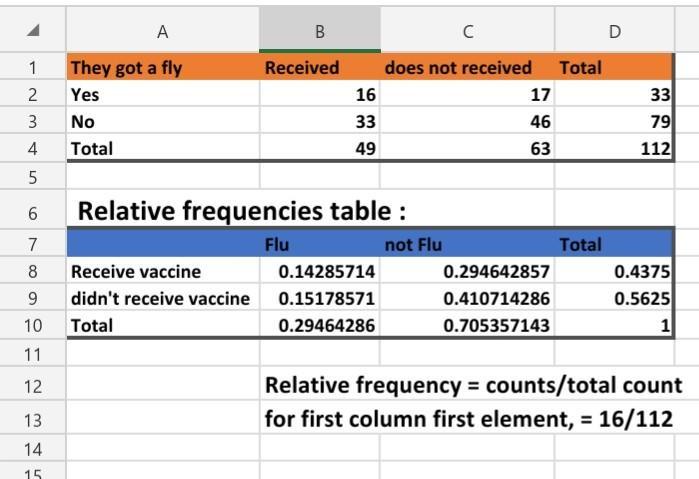
in a survey, 49 people received a flu vaccine before the flu season and 63 people did not receive the vaccine. of those who receive the flu vaccine, 16 people got the flu. of those who did not receive the vaccine, 17 got the flu. make 2 tables for the relative frequencies by row and by column.
Answers
Two way table for the relative frequencies by row and by column is shown in above for the survey, 49 people received a flu vaccine before the flu season and 63 people did not receive the vaccine. of those who receive the flu.
What is a Two Way Table?A two way table is defined as a way which display relative frequencies for two categorical variables. One category is represented by rows and a second category is represented by columns.
Number of people who vaccinated before flu = 49
Number of people who does not vaccinated before flu = 63
Number of people who vaccinated but got a flu = 16
Number of people who not got flu and vaccinated = 49 - 16 = 33
Number of people who not vaccinated but got a flu = 17
Number of people who not got flu and not vaccinated = 63 - 17 = 46
Now , we will find out the marginal frequencies. Hence, we know that total 16 people got flu and received the vaccine and 17 people got flu and received the not vaccine.
So, Total people got a flu = 16 + 17 = 33
Similarly, Total number of people who don't got a flu = 46 + 33 = 79
Also, from provide informations, total people's include in survey = 49 + 63 = 112
Thus , we get a table as listed above.
For joint relative frequency table we divide frequency by total people involved in survey. Relative frequencies interpret as probabilities. The relative frequencies table also present in above figure.
To learn more about Two-way relative frequency tables , refer:
https://brainly.com/question/20744563
#SPJ4
HELP 100 POINTS ANSWER IT PLEASE

Answers
Answer:
\(\boxed{\text{\large $ y=96.1\sqrt{x} $}}\)
Step-by-step explanation:
Using a graphing calculator, plot (x,y) points
x = no. of jobsy = no. of workers neededand plot the functions from the options to know which function fits the data

Answer:
Step-by-step explanation:
Using a graphing calculator, plot (x,y) points
x = no. of jobs
y = no. of workers needed
and plot the functions from the options to know which function fits the data
if a(x) = 3x+1 and b(x) = \(square root of x-4\), what is the domain of (boa)(x)
Answers
The domain of (boa)(x) is [1, ∞].
What is a domain?In Mathematics and Geometry, a domain is the set of all real numbers (x-values) for which a particular equation or function is defined.
Based on the information provided above, we have the following functions:
a(x) = 3x+1
\(b(x) = \sqrt{x-4}\)
Therefore, the composite function (boa)(x) is given by;
\(b(x) = \sqrt{3x+1 -4}\\\\b(x) = \sqrt{3x-3}\)
By critically observing the graph shown in the image attached below, we can logically deduce the following domain:
Domain = [1, ∞] or {x|x ≥ 1}.
Read more on domain here: brainly.com/question/9765637
#SPJ1
![if a(x) = 3x+1 and b(x) = [tex]square root of x-4[/tex], what is the domain of (boa)(x)](https://i5t5.c14.e2-1.dev/h-images-qa/answers/attachments/gGe6IRGOQUF4aKHR4HvpxeklJAqlYD78.png)
Problem 1: Consider the (nonlinear) differential equation
\(y' = \frac{ - y(y + 1)}{x} \)
Without solving the equation, check which of the following are solutions:
\(y(x) = {x}^{2} - 1\)
\(y(x) = \frac{2}{x - 2} \)
That is: do not use the method of integrating factors to solve. Just check by plugging in.
Answers
If y = x² - 1, then y + 1 = x² and y' = 2x. Then in the DE, we would have
2x = - (x² - 1) x² / x ⇒ 2 = - x² + 1
but this only true for some values of x. So the first choice is not correct.
If y = 2/(x - 2), then y + 1 = x/(x - 2) and y' = -2/(x - 2)². In the DE,
-2/(x - 2)² = - (2/(x - 2)) (x/(x - 2)) / x ⇒ -2/(x - 2)² = -2/(x - 2)²
so the second choice is the correct answer.
A study was conducted to determine if the salaries of the professors from two neighbouring universities were
equal. A sample of 20 professors from each university was randomly selected. The mean from the first university
was $109,100 with a population standard deviation of $2300. The mean from the second university was $110,500
with a population standard deviation of $2100. Assume that the distribution of professor salaries, at both
universities, are approximately normally distributed. Level of significance = 0.05.
Use the four-step P-value approach and test the claim that the salaries from both universities are equal.
Answers
Answer:
After calculating values from test statics we come to know that value of if null hypothesis is true then it will rejected
As critical values of z is ±1.96 after apply the test statics formula , we get the value of z that is - 4.50 As we consider the equation that
H₀ > z
Apply test statistic we fine the true value . So there is sufficient evidence to reject the claim.
Step-by-step explanation:
critical values z₀ = ±1.96; standardized test statistic z ≅ -4.50;
reject H₀
There is sufficient evidence to reject the claim.
Consider the system of equations and the partial solution below.
6x+3y=9
5x+4y=10
Multiply the first equation by -4.
Multiply the second equation by 3.
Add the resulting system of equations.
Which terms will cancel when you add the resulting system of equations?
-36 and 36
-24x and 24x
O-15x and 15x
-12y and 12y
Answers
-15x and 15x is the answer
Answer:
-12y and 12y
Step-by-step explanation:
lets do the multiplication to each equation
\(\left \{ {{(6x+3y)(-4)=9(-4)} \atop {(5x+4y)3=10(3)}} \right.\)
this is
\(\left \{ {{-24x-12y=-36} \atop {15x+12y=30}} \right.\)
if we add the systems notice the values that do cancel are -12y and 12y
and the results of the adition is
\(-9x=-6\)
from this
\(x=\frac{-6}{-9} =\frac{2}{3}\)
and you can find y from any of the first equation.
\(y=3-2x=3-\frac{4}{3} =\frac{5}3}\)
3. Study Hours (Based on Exercise 8.7) Babcock and Marks (2010) reviewed survey data from 2003–2005 and obtained an average of µ = 14 hours per week spent studying by full-time students at 4-year colleges in the United States. To determine whether this average changed over the 10 subsequent years, a researcher selected a sample of = 64 of college students. The data file hours.csv has data consistent with what the researcher found. In this question, you will use the data to if this sample indicates a significant change in the number of hours spent studying.
a. Which of the following are the hypotheses to test if this sample indicates a significant change in the average number of hours spent studying?
i. 0: µ = 14 and 1: µ < 14
ii. 0: µ = 14 and 1: µ ≠ 14
iii. 0: µ = 14 and 1: µ > 14
Answers
The hypotheses to test if this sample indicates a significant change in the average number of hours spent studying is:
0: µ = 14 (null hypothesis)
1: µ ≠ 14 (alternative hypothesis)
Option B is the correct answer.
We have,
The null hypothesis states that the population mean for the number of hours spent studying by full-time students at 4-year colleges in the United States is equal to 14 hours per week,
while the alternative hypothesis states that it is different from 14 hours per week.
By using a two-tailed test, we are checking for any significant change in either direction, whether the average number of hours spent studying has increased or decreased from 14 hours per week.
Thus,
The hypotheses to test if this sample indicates a significant change in the average number of hours spent studying is:
0: µ = 14 (null hypothesis)
1: µ ≠ 14 (alternative hypothesis)
Learn more about hypothesis testing here:
https://brainly.com/question/30588452
#SPJ1