Tickets for the school basketball game cost $4 each. Spencer plans to
make a table relating the number of people (x) to the money made from
ticket sales (y).
What is the most appropriate domain for Spencer's table?
A.
all integers
B.
all rational numbers
C.
all real numbers
D
all whole numbers
Answers
The most appropriate domain for Spencer's table would be D. all whole numbers.
To explain this, let's first understand the terms involved. In this context, the domain refers to the set of possible input values (x) for the function, which in this case, represents the number of people attending the school basketball game.
Option A, all integers, includes negative numbers, which are not suitable as you cannot have a negative number of people. Option B, all rational numbers, comprises fractions, which are also not applicable because you cannot have a fraction of a person attending the game. Option C, all real numbers, consists of all numbers including irrational numbers like π, which are not relevant in this context as well.
Option D, all whole numbers, represents the most suitable domain as it includes all non-negative integers (0, 1, 2, 3, ...). This set accurately represents the possible number of people attending the game, since you can have zero or a whole number of people attending but not negative or fractional values.
Therefore, Spencer should use whole numbers as the domain for his table to relate the number of people (x) to the money made from ticket sales (y).
To know more about domain, refer to the link below:
https://brainly.com/question/29281112#
#SPJ11
Related Questions
A fractal is a geometric figure that has similar characteristics at all levels of
magnification. One example of a fractal is Koch's (sounds like "Cokes")
snowflake. To build this fractal, start with an equilateral triangle whose sides
each have length 1. Then on the middle of each side, create a triangular
"bump" to make a new figure having 12 sides. On the middle of each of
these 12 sides, create a smaller bump, and so on. The upper part of the
illustration shows the first four stages in the construction of a Koch's
snowflake. The "real" snowflake is the result of carrying on this process
forever!
The lower part of the illustration shows how, when a bump is added to any
side, the ležgth you have is multiplied by If a bump is added to every side
of a snowflake figure, then the entire perimeter is multiplied by
Answers
The perimeter of Koch's snowflake fractal will be infinite.
Find out how Koch's snowflake fractal is created by adding triangular bumps to the side of an equilateral triangle?Koch's snowflake fractal is created by adding triangular bumps to the sides of an equilateral triangle at progressively smaller scales. At each stage, the number of sides of the resulting figure increases by a factor of 4, and the perimeter of the figure increases as well.
To see how the perimeter changes as bumps are added to all sides of the figure, we can use the fact that each bump adds a segment of length 1/3 to the original side. So if we start with a triangle of side length 1 and add a bump to each side, the new perimeter is:
P = 3(1 + 1/3) = 4
Now we have a figure with 12 sides. If we add a bump to each of these sides, the new perimeter is:
P = 12(1 + 1/3 + 1/9) = 16/3
In the next stage, we have 48 sides, and each side has a length of 1/3^2, so the new perimeter is:
P = 48(1 + 1/3 + 1/9 + 1/27) = 64/3
At each stage, we can see that the perimeter is multiplied by a factor of 4/3. So if we carry on this process forever, the perimeter of Koch's snowflake fractal will be infinite.
Learn more about Geometric Figure
brainly.com/question/24643676
#SPJ11
please hurry!!!!!find the measure of P

Answers
Look at the attachment
OQ=PQTriangle is isosceles
<Q=<P=50°
As shown in the attachment
since QO ≅ PQ
thus m∠Q = m∠P = 50°
∠P = 50°
{ properties of isosceles triangles }

Please help me solve these 3 questions
Answers
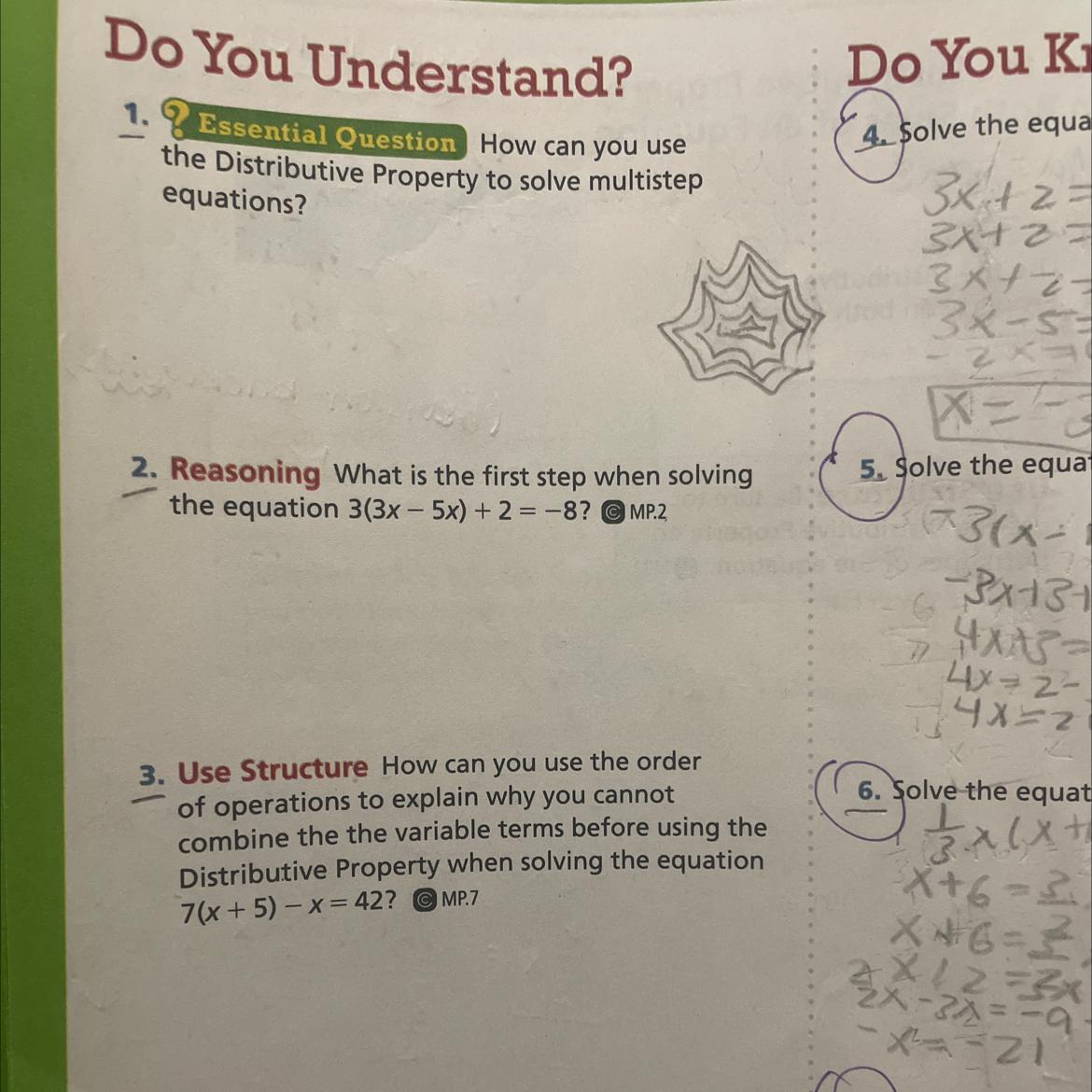
1. To solve algebra equations using the distributive property, we need to distribute (or multiply) the number with each term in the expression. In that way, the brackets are removed. We can then combine like terms and solve by equations when necessary.
2. The first step is simply to apply the distribution using the distributive property : 3(3x-5x)+2=-8 applying the distributive operation we get 9x -15x or we could have simply done 3(2x)+2=-8 which gives us 6x+2=-8 and finally 6x= -8/2= -4
6x=-4 means x= -4/6 thus x= -2/3
3. Multiplication has priority over addition or subtraction thus we have first to apply the distributivity before combining the variable terms
For a two-tailed hypothesis test about µ, we can use any of the following approaches excepta. compare the level of significance to the confidence coefficientb. compare the value of the test statistic to the critical valuec. compare the p-value to the value of a
Answers
For a two-tailed hypothesis test about μ, we can use any of the following approaches except comparing the level of significance; to the confidence coefficient
To determine if the sample mean is substantially more than or significantly less than the population mean, a two-tailed hypothesis test is used. The area under both tails or sides of a normal distribution is what gives the two-tailed test its name.
Any of the following methods, with the exception of comparing the level of significance to the confidence coefficient, can be used for a two-tailed hypothesis test regarding. To create a confidence interval estimate for the population mean, approach (d) compares the level of significance which is a to the confidence coefficient which is 1- a. This method is employed to estimate the population parameter rather than test a hypothesis.
Complete Question:
For a two-tailed hypothesis test about μ, we can use any of the following approaches EXCEPT compare the _____ to the _____.
a.confidence interval estimate of μ; hypothesized value of μ
b.p-value; value of α
c.value of the test statistic; critical value
d.level of significance; confidence coefficient
Read more about two-tailed hypothesis on:
https://brainly.com/question/29641971
#SPJ4
the diagram shows the cross-section of a wall of a cinema.

Answers
Answer:
280 m²£133Step-by-step explanation:
The area of the wall is the sum of the areas of the different sections of the wall. The cost to paint it will be the product of the cost of a tin of paint and the number of tins required.
__
Here, the shape of the wall can be divided into two trapezoids and a rectangle. Each shape has a corresponding area formula. Left-to-right, their areas are ...
Left Trapezoid
A = 1/2(b1 +b2)h
A = 1/2(10 m +11 m)(4 m) = 42 m²
Middle Rectangle
A = LW
A = (13 m)(11 m) = 143 m²
Right Trapezoid
A = 1/2(b1 +b2)h
A = 1/2(11 m +8 m)(10 m) = 95 m²
Wall Area
The total area to be painted is the sum of the above areas:
total area = 42 m² +143 m² +95 m² = 280 m²
The area that needs to be painted is 280 m².
__
A tin of paint covers 15 m², so the number of tins needed is ...
(15 m²)t = 280 m²
t = 280/15 = 18 2/3 . . . . . . divide by the coefficient of t
We can only buy whole tins, so we need to buy 19 tins. Their cost will be ...
(£7 /tin)(19 tins) = £133
It will cost £133 to paint the wall.
the square below into two small congruent rectangles and rearranges the pieces as shown to make a wider rectangle. the perimeter of the wider rectangle is 50. what is the perimeter of the original square
Answers
The area of the square is 22,500 square units.
Let's assume that the length of each rectangle is l and the width is w. Then the perimeter of each rectangle is given by:
P = 2l + 2w = 120
Simplifying the equation, we get:
l + w = 60
Since the square is divided into 5 congruent rectangles, its sides are 5 times the length of the rectangle, so the length of the square is 5l and its width is 5w. Therefore, the area of the square is:
A = (5l)^2 = 25l^2
We can express the width of the square in terms of l using the fact that the length and width of each rectangle add up to 60:
w = 60 - l
The area of the square can now be expressed as:
A = 25l^2 = 25(l)(60 - l)
To maximize the area of the square, we need to find the value of l that maximizes the expression 25(l)(60 - l). We can do this by finding the critical point of the function:
f(l) = 25(l)(60 - l)
Using the product rule, we can find the derivative of f(l):
f'(l) = 25(60 - 2l)
Setting f'(l) = 0, we get:
60 - 2l = 0
Solving for l, we get:
l = 30
Therefore, the length of each rectangle is 30, and the width is 60 - 30 = 30. The area of the square is:
A = 25l^2 = 25(30)^2 = 22,500
Correct Question :
A square is divided into 5 congruent rectangles. If the perimeter of each rectangle is 120, what is the area of the square?
To learn more about area here:
https://brainly.com/question/30556035
#SPJ4
The sales of Horizon, a cell phone sales and service provider, were $127,693,100 last year. What is the value of the 6th digit in this number?
Answers
Answer:
600000
Step-by-step explanation:
Cuz it is in the 100000 spot
Answer:
600000
Step-by-step explanation:
Based on the place value system, the digits are ordered from the right to left. So the 6th digit is 6 located in the hundreds of thousands column. The value of the 6th digit is obtained by multiplying the digit by the value of it's place value column
i.e 6 * 100,000 = 600, 000
Ans: 600,000
x ft
x ft
Bedroom
5 ft
Closet
5 ft
6 ft
Bathroom

Answers
Answer:
bedroom is 12ft which is equal to 6ft on left of bathroom if we add 6 +6=12 because it is rectangle and bathroom is square and square have 4 equal sides so both sides are 12ft
evaluate the expression when c=2. 6c/2
Answers
Answer:
6Step-by-step explanation:
Given the expression g(c) = 6c/2, we are to find the value when c = 2
Substitute c = 2 into the expression
g(2) = 6(2)/2
g(2) = 12/2
g(2) = 6
Hence the result when c = 2 is 6
PLS HELP ASAP! GIVING BRAINLY!!

Answers
Answer:
A
Step-by-step explanation:
1-0.045=0.955
the following data were collected for a two-factor anova with two treatments and three blocks. treatment block 1 2 a 46 31 b 37 26 c 44 35 using the 0.05 significance level conduct a test of hypothesis to determine whether the block or the treatment means differ. required: a. state the null and alternate hypotheses for treatments. b. state the decision rule for treatments. (round your answer to 1 decimal place.) c. state the null and alternate hypotheses for blocks. also, state the decision rule for blocks. (round your answer to 1 decimal place.)
Answers
The test hypothesis using 0.05 significance level has the following results:The treatment means differ, The block means do not differ.
What is hypothesis testing?A poll or study's findings can be tested using the statistical procedure known as hypothesis testing to see if the findings are significant. By calculating the likelihood that the findings happened by chance, you are basically evaluating if the findings are genuine. If it's possible that your results were a coincidence, the experiment won't be reproducible and won't be of much help.
Hypothesis testing may be one of the most perplexing components for students, mostly because you must first determine what your null is so that you can conduct a test. These challenging word problems that you encounter might sometimes be challenging to understand.
Make a plan for your null hypothesis.
Write down your null hypothesis
Determine the type of test you must do,
How to solve?
Describe the null and alternate treatment hypotheses:
Null hypothesis: No difference in treatment means
Alternative interpretation: The means differ
Indicate the treatment decision-making process:
F(1,2)=18.51 as seen in the table
Reject the null hypothesis if the estimated F exceeds 18.51.
Treatments Calculated F=43.75 > 18.51; hence, the null hypothesis is rejected.
As a result, we find that the treatment means differ.
Write out the null and alternative hypotheses for blocks.
Block means are not different under the null hypothesis.
A different theory There exists at least one pair of distinct meanings.
State the block decision rule as well:
Table F(2,2)=19.0 value
If the estimated F is greater than 19, reject the null hypothesis.
Blocks determined that F=8.14 19.0, thus we did not reject the null hypothesis.
Our conclusion is that the block means are equivalent.
To learn more about hypothesis testing, visit:
brainly.com/question/28155021
#SPJ4
the question is the png

Answers
The slope of the line parallel to y = 4 / 7 x + 7 is 4 /7.
The slope of the line perpendicular to y = 4 / 7 x + 7 is - 7 / 4.
How to find lines that are parallel and perpendicular?The equation of a line can be described as follows:
y = mx + b
where
m = slopeb = y-interceptThe equation of the line given is y = 4 / 7 x + 7.
Parallel lines have the same slope.
Therefore, the slope of the line parallel to the given equation of the line is 4 / 7.
A line perpendicular to each other follows the rule below:
m₁ m₂ = -1
where
m₁ = first slopem₂ = second slopeTherefore, let's find the slope of the line perpendicular to the given equation.
4 / 7 m₂ = -1
cross multiply
4m₂ = -7
m₂ = - 7 / 4
Therefore, the slope of the line perpendicular to the equation is - 7/4
learn more on parallel and perpendicular line here: https://brainly.com/question/12203383
#SPJ1
5 ounces of potatoes produce about 20 calories. What is the unit rate in
calories per ounce?
Answers
Answer:
4 calories per ounce.
Step-by-step explanation:
20/5 = 4
Write
21
2
as a mixed number.
Give your answer in its simplest form.
Answers
Answer:
10 1/2
Step-by-step explanation:
21 ÷ 2 = 10.5 = 10 1/2
Answer:
10 1/2
Step-by-step explanation:
can someone tell me how much is 0,5-⁶?
Answers
Answer:
add this and (5 × 5 × 5) × (5 × 5 × 5 × 5 × 5
Step-by-step explanation:
Solve the system of equations. y=-3/2+9
2x+2y=16
Answers
2x+2x7.5=16
2x+15=16
2x=16-15
2x=1
x=1/2
Need help plz help plz

Answers
Answer:
\(x = 11\)
Step-by-step explanation:
Given
The attached triangle
Required
Find x
The theorem that applies to this question is the theorem of external angles. And it translates to:
\(11x +2 = 58 + 5x + 10\)
Collect Like Terms
\(11x -5x = 58 + 10-2\)
\(11x -5x = 66\)
\(6x = 66\)
Divide through by 6
\(\frac{6x}{6} = \frac{66}{6}\)
\(x = \frac{66}{6}\)
\(x = 11\)
I'm having trouble with his question. Can some help me?

Answers
Answer:
34ft
Step-by-step explanation:
Line OQ is 46ft which is half of line SR which was 92ft. This means that half of line SP is the same as line QP or g: 68 ÷ 2 = 34. Therefore, g = 34ft
Hope this helps!
HELP PLS
nobody two dancers liquid smooth deftones korn mitski

Answers
perimeter: 59
area: 247
Answer:
agreed
Step-by-step explanation:
Multiply. Show your work.
42.7 x 0.8 show your work tell me how u got the answer
Answers
Answer:
34.16
Step-by-step explanation:
42.7
x 0.8
-------
34.16
Answer:
34.16
Step-by-step explanation:
2 5
42.7
x
0.8
=
43.16
may someone please help me with this ill give brainlyest if i figure out how to
Answers
Answer: 5
Step-by-step explanation:
5x3+6=21
5x5=25
25-21=4
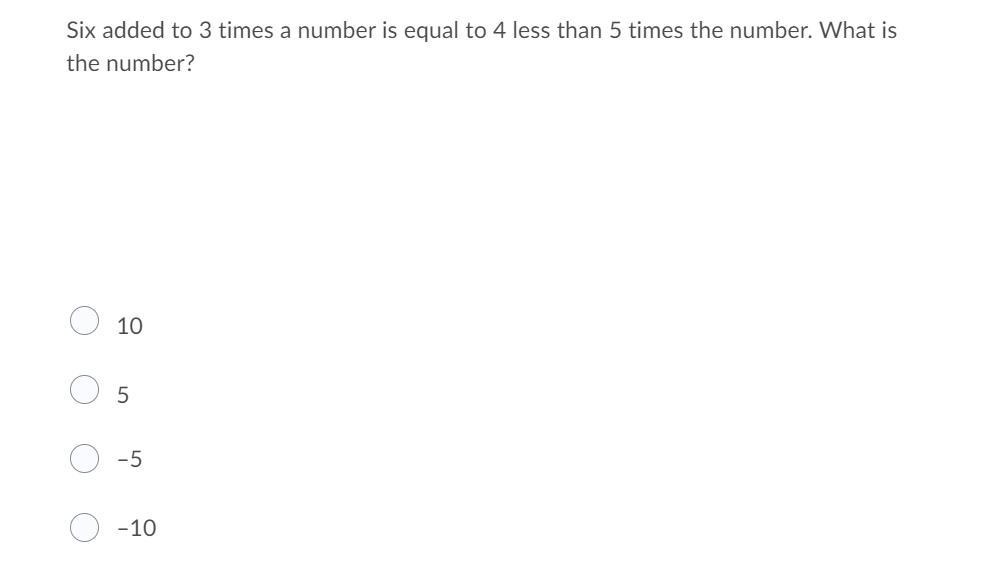
Let "the number" = \(n\)
\(6 + 3n = 5n - 4\)
\(6 + 3n - 5n = -4\)
\(6 - 2n = -4\)
\(-2n = -10\)
\(n = 5\)
Check my work:
Six added to 3 times (5) is equal to 4 less than 5 times (5)
Six added to 15 is equal to 4 less than 25
21 is equal to 21
the diameter or a circle is 2 yards. What is the circles circumference
use 3.14 for π
Answers
Answer:
diameter = 6.28 yards
Step-by-step explanation:
2 x 3.14 = 6.28
4. What is the chance that the culvert designed for an event of 50-year return period will have its capacity exceeded at least once in 20 years? (2 marks)
Answers
The chance that a culvert designed for a 50-year return period will have its capacity exceeded at least once in 20 years depends on the assumptions and parameters used in the design process.
Return period is a statistical concept used in engineering and hydrology to estimate the likelihood of an event of a certain magnitude occurring in a given time frame. For example, a 50-year return period means that, on average, a particular event is expected to occur once every 50 years.
To estimate the probability of the capacity being exceeded at least once in 20 years, we need to consider the concept of exceedance probability. Exceedance probability is the probability of a specific event exceeding a certain threshold in a given time period.
If we assume that the exceedance probability follows a Poisson distribution, which is commonly used in hydrology for estimating return periods, we can use the formula:
P(exceedance) = 1 - exp(-T/Tp)
Where:
P(exceedance) is the probability of exceedance within the given time period (20 years in this case).
T is the time period for which the return period is specified (50 years in this case).
Tp is the return period.
Using the given values, we can calculate the probability of exceedance within 20 years:
P(exceedance) = 1 - exp(-20/50)
P(exceedance) ≈ 0.3297
So, there is approximately a 32.97% chance that the culvert designed for a 50-year return period will have its capacity exceeded at least once within a 20-year period, assuming the exceedance probability follows a Poisson distribution.
To more about culvert, visit:
https://brainly.com/question/33104467
#SPJ11
which graph shows the solution to x - 2y ≥ 9

Answers
Answer: Your answer is (B).
To determine which graph shows the solution to the inequality x - 2y ≥ 9, you would need to look for a graph that shows a shaded region representing all the points (x,y) that satisfy the inequality. The boundary line for this inequality would be x - 2y = 9, which can be rewritten in slope-intercept form as y = (1/2)x - 9/2. This line would have a slope of 1/2 and a y-intercept of -9/2. Since the inequality is greater than or equal to, the shaded region would be above the line and include the line itself.
A researcher conducted a one-sided hypothesis test for a proportion (Ha:p>po) and obtained a test statistic of 4.318. Which of the following are true? Check all that apply. - The observed sample proportion is 4.318 standard deviations above the claimed value po. - The large value of the test statistic means that our observed data are not surprising when the null hypothesis is true. - The researcher should fail to reject the null hypothesis. - When the null hypothesis is true, the test statistic comes from a standard normal distribution. - There is a 4.318% chance that the alternative hypothesis is true.
Answers
This statement is true, as the test statistic represents the number of standard deviations between the observed sample proportion and the claimed value (po) under the null hypothesis.
- The large value of the test statistic means that our observed data are not surprising when the null hypothesis is true. This statement is false. A large test statistic implies that the observed data is surprising when the null hypothesis is true, which means there is evidence against the null hypothesis.
- The researcher should fail to reject the null hypothesis. This statement is false. A large test statistic suggests evidence against the null hypothesis, so the researcher should reject the null hypothesis in favor of the alternative hypothesis.
- When the null hypothesis is true, the test statistic comes from a standard normal distribution. This statement is true, as the test statistic follows a standard normal distribution when the null hypothesis is true.
- There is a 4.318% chance that the alternative hypothesis is true. This statement is false. The test statistic does not directly provide the probability of the alternative hypothesis being true. Instead, we can use the test statistic to calculate the p-value, which represents the probability of obtaining a test statistic as extreme as the observed one, assuming the null hypothesis is true.
To know more about "Hypothesis test" refer her:
https://brainly.com/question/4232174
#SPJ11
write the equation of the line that passes through the given points. (0,-1) and (-11,-4)

Answers
Answer:
Line equation
y=0.2727272727272727x−1 Slope 0.27 Intercept -1
Step-by-step explanation:
that sounds great describe and correct the error a student made when graphing the linear equation y equals -3 / 4 x - 6

Answers
The answer is (0,-6)
In step 1 the y intercept should be plotted at (0,-6)
Every day, George goes to church. The distance between church and his house is 15 feet. On a map, 1 inch is equal to 3 feet. How many inches apart would George’s church and home be on the map?
Answers
Answer: Five inches
Step-by-step explanation: If the distance between his home and church is 15 feet and on the map 1 inch = 3 feet then you would need to add three together until you reach 15 feet. 5•3=15
let y1, y2,..., yn denote a random sample from the probability density function f (y) = * θ y θ−1 , 0 < y < 1, 0, elsewhere, where θ > 0. show that y is a consistent estimator of θ/(θ 1
Answers
Given a random sample from the probability density function f(y) = * θ y θ-1, 0 < y < 1, 0, elsewhere, where θ > 0. We are to show that y is a consistent estimator of θ/(θ+1).
The probability density function f(y) can be written as: `f(y)=θ*y^(θ-1)`, `0 0.The sample mean is defined as: `Ȳ_n=(y1+y2+....+yn)/n`By the law of large numbers,Ȳ_n converges to E(Y) as n tends to infinity.Since E(Y) = θ/(θ+1),Ȳ_n converges to θ/(θ+1) as n tends to infinity.Hence, y is a consistent estimator of θ/(θ+1).Therefore, it has been shown that y is a consistent estimator of θ/(θ+1).Consequently, y is a reliable estimator of /(+1).As a result, it has been demonstrated that y is a reliable estimator of /(+1).
To know more about mean , visit;
https://brainly.com/question/1136789
#SPJ11
which problem(s) can be solved by performing this multiplication? 34 x 24
Answers
Answer:
The day before, Mike had 34 apples. Today, he had 24 times as much as the apples that he had the day before. How many apples did he have today?
Step-by-step explanation:
1st, gather information: The day before, Mike had 34 apples, Today, he had 24 times as much as the apples that he had the day before
2nd, plan to solve: I will do 34 x 24.
3rd, Solve: 34 x 24= 816.
4th, is it resonable? : Yes. 816/34=24.