This is an evaluation, make sure you are completing the work on your own. To earn full marks, you must justify your solution. Include the following as needed: Show diagram, define variables, state formula, theorem, equation or function used, Show substitutions and or steps in solving an equation, State restrictions, state concluding statement, Use correct notation. No marks are given if your solution includes: e or In, differentiation, integration. 1. The volume of a cylindrical can in cm 3
is V(x)=4πx 3
+28πx 2
+65πx+50π. The can is (x+2)cm high, where x>−2. Note that, V cylinder
=πr 2
h, where r is the radius and h is the height of a cylinder. a. What is the radius of the can? ( 3 marks) b. A beverage company is designing a gift cup that goes with the beverage can mentioned in part (a) above. The volume of the cup is w(x)=6πx 3
+39πx 2
+69πx+45π. The cup needs to fit the contents of one beverage can with extra space for ice cubes. What possible x values will satisfy these stated conditions knowing that x>−2 ? (5 marks)
Answers
a. The radius of the cylindrical can is \(\( \sqrt{\frac{V(x)}{\pi(x+2)}} \).\)
b. The possible values of \(\( x \)\) that satisfy the conditions for the cup volume are the solutions to the inequality \(\( w(x) \leq V(x) \)\).
a. The volume of a cylindrical can is given by \(\( V(x) = \pi r^2 h \)\), where r) is the radius and h is the height. In this case, the height is \(\( x+2 \)\) cm. We are given the equation for the volume of the can as \(\( V(x) = 4\pi x^3 + 28\pi x^2 + 65\pi x + 50\pi \)\). To find the radius, we can rearrange the equation as \(\( V(x) = \pi r^2 (x+2) \)\). Solving this equation for r , we get \(\( r = \sqrt{\frac{V(x)}{\pi(x+2)}} \)\).
b. The volume of the cup needs to fit the contents of one beverage can with extra space for ice cubes. The volume of the cup is given by \(\( w(x) = 6\pi x^3 + 39\pi x^2 + 69\pi x + 45\pi \)\). We need to find the possible values of x that satisfy the condition \(\( w(x) \leq V(x) \)\). Substituting the expressions for \(\( w(x) \) and \( V(x) \)\), we have \(\( 6\pi x^3 + 39\pi x^2 + 69\pi x + 45\pi \leq 4\pi x^3 + 28\pi x^2 + 65\pi x + 50\pi \)\). Simplifying this inequality by canceling out common terms and rearranging, we get \(\( 2\pi x^3 + 11\pi x^2 - 4\pi x - 5\pi \leq 0 \)\). To find the possible values of x that satisfy this inequality, we can factorize the expression or use numerical methods. The solutions to this inequality will give us the possible values of x that satisfy the conditions for the cup volume.
Learn more about radius here:
https://brainly.com/question/9854642
#SPJ11
Related Questions
Divide 320 into 8 equal groups
Answers
Answer:
320 divided by 8 is 40. 40 times 8 is 320, so it works backwards.
When dividing 320 into 8 equal groups, each group would contain 40.
We have to divide 320 into 8 equal groups.
Performing the division as
8 | 320 | 40
320
-_______
0
So, 320 ÷ 8 = 40
Therefore, when dividing 320 into 8 equal groups, each group would contain 40.
Learn more about Division here:
https://brainly.com/question/13374431
#SPJ6
A recipe requires 1/4 cup of oil for every 2/3 cup of water. How much oil (in cups) is needed per cup of water?
Answers
Answer:
To determine the amount of oil needed per cup of water, we need to find the ratio between the oil and water quantities given in the recipe.
According to the recipe:
1/4 cup of oil is required for every 2/3 cup of water.
To find the amount of oil needed per cup of water, we can set up a proportion:
1/4 cup of oil / 2/3 cup of water = x cups of oil / 1 cup of water
To solve for x, we can cross-multiply and then divide:
(1/4) * (1 cup of water) = (2/3) * (x cups of oil)
1/4 = (2/3) * (x cups of oil)
To isolate x, we can multiply both sides of the equation by the reciprocal of (2/3), which is (3/2):
(1/4) * (3/2) = (2/3) * (x cups of oil) * (3/2)
3/8 = (2/3) * (x cups of oil) * (3/2)
Now, let's simplify the equation:
3/8 = x/1
x = 3/8
Therefore, per cup of water, you would need approximately 3/8 cups of oil.
Step-by-step explanation:
this confusing please help meeeeeeeeeeeeeeeeee

Answers
Answer : the answer is D
f(x) = 4 |x-1|
help with these two pages


Answers
A square is a quadrilateral with four equal sides and four equal angles that is a regular quadrilateral. The square's angles are at a straight angle or 90 degrees.
Explain about the square?Area of a square is measured in square units. The area of a square equals d22 square units when the diagonal, d, is known. For instance, a square with sides that are each 8 feet long is 8 8 or 64 square feet in area (ft2)
A square is a common polygon with four equal sides and angles that are each 90 degrees in length.
A square is a four-sided polygon with sides that are all the same length and angles that are all exactly 90 degrees. The square's shape ensures that both parts are symmetrical if it is divided down the middle by a plane. Then, each half of the square seems to be a rectangle with diagonal sides.
To learn more about square refer to:
https://brainly.com/question/25092270
#SPJ1
Bill has 205 in his savings account and adds 5$ per week.John has $5 in his account and adds 25 dollers per week. After six weeks who has more money in their account
Answers
Answer:
bill
Step-by-step explanation:
Bill:
205+(6x5)
205+30= 235
Bill - $235
John:
5+(25x6)
5+150=155
John - $155
So bill has more
Hope this helps
Suppose vector u = LeftAngleBracket 1, StartRoot 3 EndRoot RightAngleBracket, |v| = 6, and the angle between the vectors is 120°. What is u · v?
a) – 8.19
b) – 6
c) 6
d) 8.19
Answers
Answer:
B) -6
Step-by-step explanation:
got it right on edge :)
The value of u · v is -6 if the u = <1, √3> and |v| = 6, and the angle between the vectors is 120° option (b) is correct.
What is a vector?It is defined as the quantity that has magnitude as well as direction also the vector always follows the sum triangle law.
We have:
u = <1, √3>
The magnitude of u:
|u| = √(1²+√3²)
|u| = 2
|v| = 6
We know,
u · v = |u||v|cos120
u · v = 2(6)(-0.5)
u · v = -6
Thus, the value of u · v is -6 if the u = <1, √3> and |v| = 6, and the angle between the vectors is 120° option (b) is correct.
Learn more about the vector here:
brainly.com/question/8607618
#SPJ2
A ball i drawn randomly from a jar that contain 5 red ball, 2 white ball, and 1 yellow ball. Find the probability of: Find P(red ball): Find P(NOT Yellow): Find P(white or yellow)
Answers
Following are all of the subparts' solutions using the probability formula:
Red ball (A) P: 5/8
(B) P: 7/8 (NOT Yellow)
(C) P(yellow or white): 3/8
What is probability?
Probability is a branch of mathematics that deals with numerical representations of the likelihood of an event occurring or of a proposition being true.
What is an event?The probability of an event is a number between 0 and 1, with 0 approximately denoting impossibility and 1 denoting certainty.
Probability formula: P(E) = favorable events/Total events
(A) P(red ball):
P(E) = favorable events/Total events
P(E) = 5/8
(B) P(NOT Yellow)
P(E) = favorable events/Total events
P(E) = 7/8
(C) P(white or yellow)
P(E) = favorable events/Total events
P(E) = 3/8
Therefore, the answers to all the subparts using the probability formula are shown:
(A) P(red ball): 5/8
(B) P(NOT Yellow): 7/8
(C) P(white or yellow): 3/8
To Know more about probability visit:
https://brainly.com/question/11234923
#SPJ4
Enter an algebraic expression to model the given context. give your answer in simplest form. the price s of a pair of shoes plus 2% sales tax.
Answers
An algebraic expression which models the given context would be written as s + 0.02s = 1.05s.
What is price?Price can be define as an amount of money which is primarily set by the seller of a good (product), and it must be paid by a buyer to the seller, so as to enable the acquisition of this good (product).
What is an algebraic expression?An algebraic expression can be defined as a mathematical equation which is used to show the relationship existing between two or more variables and numerical quantities.
Let s represent the price of a pair of shoes.
Therefore, an algebraic expression which models the given context would be written as follows:
s + 0.02s = 1.05s.
Read more on algebraic expression here: https://brainly.com/question/17615109
#SPJ4
Every day Ms.Twinkle walks around a park near her house. The park is the shape of a rectangle 2 mi long and 1 3/10 mi wide. How far does she walk.
Answers
Ms. Twinkle walks a total of 6.6 miles around the park.
What is perimeter ?
Perimeter is the total distance around the outside of a two-dimensional shape. It is the sum of the lengths of all the sides of the shape.
To find how far Ms. Twinkle walks, we need to find the perimeter of the rectangle-shaped park, which is the sum of the lengths of all its sides.
The length of the park is 2 miles and the width is 1 3/10 miles. We can write the width as a mixed number of 1 + 3/10 = 13/10 miles.
Therefore, the perimeter of the park is:
Perimeter = 2(length + width)
Perimeter = 2(2 + 13/10)
Perimeter = 2(20/10 + 13/10)
Perimeter = 2(33/10)
Perimeter = 66/10
Perimeter = 6.6 miles
Therefore, Ms. Twinkle walks a total of 6.6 miles around the park.
To know more about perimeter visit :
https://brainly.com/question/30728473
#SPJ1
QN is tangent to circle O at point I. IA is the circle's diameter. Find m/QIA.
N
€
E
E
C
3
R
3
C
Help I need help
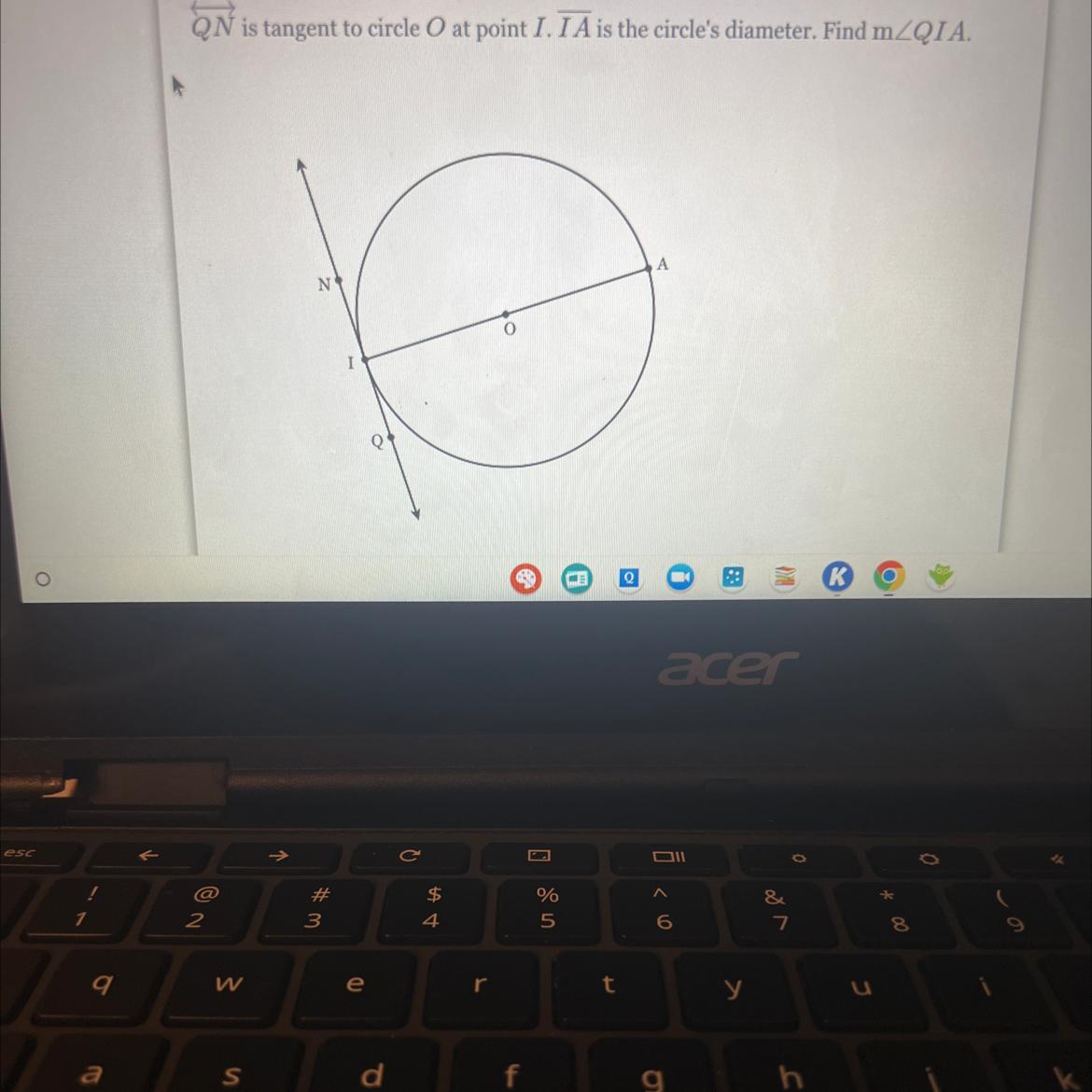
Answers
The measure of tangent angle QIA is 180 degrees.
m/QIA = 180 degrees.
If IA is the diameter of the circle, it means that angle QIA is a right angle (90 degrees). Since QN is tangent to the circle at point I, it is perpendicular to the radius IA at that point.
Therefore, in triangle QIA, we have a right angle at Q and a right angle at I. This implies that angle IQA is also 90 degrees.
In a right triangle, the sum of the angles is 180 degrees. Since angles QIA and IQA are both right angles, the remaining angle in the triangle, angle QAI, must be:
180 degrees - 90 degrees - 90 degrees = 0 degrees
Angle QAI is a degenerate angle, which means it has a measure of 0 degrees. Therefore, the measure of tangent angle QIA is 180 degrees.
To summarize, m/QIA = 180 degrees.
For such more questions on Tangent angle
https://brainly.com/question/30385886
#SPJ11
For the following set of scores find the value of each expression: a. εX b. εx^2
c. ε(x+3) ε Set of scores: X=6,−1,0,−3,−2.
Answers
The values of the expressions for the given set of scores are:
a. εX = 0
b. εx^2 = 50
c. ε(x+3) = 15
To find the value of each expression for the given set of scores, let's calculate them one by one:
Set of scores: X = 6, -1, 0, -3, -2
a. εX (sum of scores):
εX = 6 + (-1) + 0 + (-3) + (-2) = 0
b. εx^2 (sum of squared scores):
εx^2 = 6^2 + (-1)^2 + 0^2 + (-3)^2 + (-2)^2 = 36 + 1 + 0 + 9 + 4 = 50
c. ε(x+3) (sum of scores plus 3):
ε(x+3) = (6+3) + (-1+3) + (0+3) + (-3+3) + (-2+3) = 9 + 2 + 3 + 0 + 1 = 15
Therefore, the values of the expressions are:
a. εX = 0
b. εx^2 = 50
c. ε(x+3) = 15
To learn more about expressions visit : https://brainly.com/question/1859113
#SPJ11
A) Find the centroid of the region in the first quadrant bounded by the given curves.
y=x2, x=y2
B) Sketch the region bounded by the curves, and visually estimate the location of the centroid.
y=25−x2, y=0
C) Find the exact coordinates of the centroid for the region from part B).
Answers
A) the centroid of the region is (1/4, 1/10).
A) To find the centroid of the region bounded by y=x^2 and x=y^2, we first need to find the intersection points of the curves.
Setting x=y^2, we get y=x^(1/2). Substituting this in y=x^2, we get x=x^4. Solving for x, we get x=0 or x=1.
So the region is bounded by the curves x=y^2, x=1, and y=0. To find the centroid, we need to evaluate the following integrals:
x-bar = (1/A) * ∫[0,1] ∫[0,√x] x*y dy dx
y-bar = (1/A) * ∫[0,1] ∫[0,√x] (1/2)*y^2 dx dy
where A is the area of the region, which we can find by integrating y=x^2 from x=0 to x=1:
A = ∫[0,1] x^2 dx = 1/3
Evaluating the integrals, we get:
x-bar = (1/3) * ∫[0,1] ∫[0,√x] x*y dy dx = 1/4
y-bar = (1/3) * ∫[0,1] ∫[0,√x] (1/2)*y^2 dx dy = 1/10
B) To sketch the region bounded by y=25−x^2 and y=0, we can start by plotting the y-axis and x-axis. Then, we can plot the curve y=25−x^2, which is a downward-facing parabola that intersects the x-axis at x=5 and has a maximum value of 25 when x=0. Finally, we can shade the region below the curve and above the x-axis to represent the region bounded by the curves.
```
|
| ----
| / \
| / \
| / \
| / \
---------+------------------
|0 5
```
C) To find the exact coordinates of the centroid, we can use the formula:
x-bar = (1/A) * ∫[a,b] ∫[0,f(x)] x*y dy dx
y-bar = (1/A) * ∫[a,b] ∫[0,f(x)] (1/2)*y^2 dx dy
where A is the area of the region, f(x) is the upper curve, and a and b are the x-coordinates of the intersection points.
In this case, the intersection points are x=0 and x=5. So the region is bounded by the curves y=25−x^2, y=0, x=0, and x=5. The area of the region can be found by integrating y=0 from x=0 to x=5:
A = ∫[0,5] 0 dx = 0
This doesn't make sense. It means that we made an error in setting up the integral. Looking back at the sketch, we see that we forgot to include the region between the x-axis and the curve y=25−x^2. So the area of the region is:
A = ∫[0,5] (25-x^2) dx = 125/3
To know more about curves visit:
brainly.com/question/31154149
#SPJ11
5
Evaluate the expression when x = 3 and y = 6
The product of 8 and a number x
Answers
Answer:
46
Step-by-step explanation:
First, we must write the mathematical form for "the product of 8 and a number x":
8
×
x
Then "6 more than this" would be:
(
8
×
x
)
+
6
So, to evaluate for
x
=
5
we substitute
5
for
x
and calculate:
(
8
×
5
)
+
6
→
40
+
6
→
46
The question is in the picture I would appreciate if you could explain how to get the answer thank you.

Answers
The equation that is modeled to the situation is x - 2y + 2 = 0 and the slope of the line is 1/2.
The slope of an equation:
A line's steepness and direction are measured by the line's slope. Without actually using a compass, determining the slope of lines in a coordinate plane can assist in determining if the lines are parallel, perpendicular, or none at all.
The slope intercept form of a line is y = mx + c
Where, c - y-intercept and m - the slope of the line
Given that
The cost of using the internet at an internet cafe is equal to a fee plus a certain rate per minute.
4 minutes of internet costs $ 3
8 minutes of internet costs $ 4
[ We can represent the given situation as given below ]
And the coordinates formed are (4, 3) and (8, 4)
The slope of the line formed = (4 - 3)/(8 - 4) = 1/4
Let y = mx + c be the equation to the model situation
=> y = (1/2)x + c
=> 2y = x + c ---- (1)
As we know (1) will pass through (4, 3)
=> 2(3) = 4 + c
=> 6 = 4 + c
=> c = 6 - 4
=> c = 2
=> 2y = x + 2
=> x - 2y + 2 = 0
Therefore,
The equation that is modeled to the situation is x - 2y + 2 = 0 and the slope of the line is 1/2.
Learn more about Slope of an equation at
https://brainly.com/question/15874858
#SPJ1

machinery on a production line must be repaired if it produces more than 10% defectives in a large lot. a random sample of 100 items contains 15 defectives. does the data indicate that the machinery should be repaired? explicitly state hypotheses
Answers
Yes, the data indicate that the machinery should be repaired and the hypotheses are stated.
In this scenario, the null hypothesis is that the machinery is not producing more than 10% defective items, while the alternative hypothesis is that it is producing more than 10% defectives. We can represent these hypotheses as follows:
H0: The machinery is not producing more than 10% defectives.
Ha: The machinery is producing more than 10% defectives.
To test the hypothesis, we will use a statistical test called the one-sample proportion test. This test compares the sample proportion to a hypothesized population proportion. In this case, the hypothesized proportion is 0.10 (10% defectives).
Using the one-sample proportion test, we can calculate a p-value, which is the probability of obtaining a sample proportion as extreme as the one observed or more extreme, assuming the null hypothesis is true. If the p-value is less than the significance level, we reject the null hypothesis in favor of the alternative hypothesis.
In this scenario, the sample proportion is 0.15 (15 defectives out of 100 items), and the hypothesized population proportion is 0.10 (10% defectives). Using a one-tailed test with a significance level of 0.05, we can calculate the p-value as 0.0347.
Since the p-value is less than the significance level, we reject the null hypothesis and conclude that the machinery is producing more than 10% defectives. Therefore, the machinery should be repaired to reduce the defect rate.
To know more about hypotheses here
https://brainly.com/question/29576929
#SPJ4
A shelving company shipped 2,483 shelving units to each of 417 warehouses how many shelving units did the company ship in all
Answers
A shelving company shipped 2,483 shelving units to each of 417 warehouses 1035411 shelving units did the company ship in all.
Total shelving to one = 2483
Total shelving to 417 warehouse = 417 x 2483 = 1035411
A flexible display system that can be moved and altered to meet various product dimensions is a shelving unit. A gondola is an open-sided island shelving unit. Overstocks are kept on the riser, the top shelf atop a shelving unit.
Pallet racks are used for products placed onto pallets, whereas used shelving is often used for single things or boxes. The styles of used shelving include enclosed, nut and bolt, modular, wire, clip, and record storage, among others.
To learn more about shelving units visit:https://brainly.com/question/17204417
#SPJ1
Students are going to conduct an experiment to study the effect of a net force applied to an object on the object’s motion. In each trial of the experiment, the students will apply a net force on the object. They also need to take two other measurements. What are the other quantities they should measure in each trial of the experiment?.
Answers
For conducting experiment based on effect of a net force , to apply net force on the object two other quantities should be measured in each trial of the experiment is given by velocity and time.
As given in the question,
To conduct a experiment based on the effect of net force applied to an object the dependable quantities are as follow:
Force = mass × acceleration
As object remain same ⇒ mass is constant as object remain same.
And there is change in the acceleration.
Acceleration depends change in velocity over total time taken.
Acceleration depends on velocity and time.
Net force also depends on velocity and time.
Two measurements need to know while conducting trail experiments are velocity and time.
Therefore, to conduct experiment based on effect of a net force , to apply net force on the object two other quantities should be measured in each trial of the experiment is given by velocity and time.
Learn more about quantities here
brainly.com/question/12986460
#SPJ1
BD bisects ABC, m/ABD = 2(3x), and m/ABC = 42°.
What is the value of x?
Answers
In the given triangle ABC where BD bisects ABC and according to the values of the given angles, the value of x is found out to be 3.5.
It is given to us that -
BD bisects ABC.
m/ABD = 2(3x) ----- (1)
and, m/ABC = 42 ------- (2)
We need to find out the value of x.
Since BD bisects triangle ABC,
The angles created with respect to the bisector are equal.
=> m/ABD = m/CBD ----- (3)
Also, it is also known that -
m/ABD + m/CBD = m/ABC ----- (4)
Substituting equation (3) in equation (4),
m/ABD + m/CBD = m/ABC
=> m/ABD + m/ABD = m/ABC
=> 2 m/ABD = m/ABC ----- (5)
Substituting the values of m/ABD and m/ABC from equation (1) and (2) in equation (5), we get
2 m/ABD = m/ABC
=> 2*2(3x) = 42
=> 12x = 42
=> x = 3.5
Thus, according to the values of the angles of the triangle, the value of x is 3.5.
To learn more about triangles visit
https://brainly.com/question/2773823
#SPJ9
pls help is it A. B. C. D.

Answers
Answer:
C
Step-by-step explanation:
Hope I was able to help!! :)
On average, people switched jobs every three years. Suppose you have held your current job for two years. What is the probability that you switch jobs in the next three years
Answers
The probability that you will switch jobs in the next three years, given that people on average switch jobs every three years and you have already held your current job for two years, is 0.7037 or approximately 70.37%.
If people, on average, switch jobs every three years, then the probability of switching jobs in any given year is 1/3 or approximately 0.3333.
Since you have already held your current job for two years, we are interested in the probability that you will switch jobs within the next three years. This can be calculated as the probability of not staying at your current job for the next three years, which is:
P(switching jobs in the next three years) = 1 - P(staying at current job for the next three years)
The probability of staying at your current job for one year is 2/3 (the complement of the probability of switching jobs in any given year). Therefore, the probability of staying at your current job for the next three years is:
P(staying at current job for the next three years) = (2/3)^3 = 0.2963
So, the probability of switching jobs in the next three years is:
P(switching jobs in the next three years) = 1 - 0.2963 = 0.7037
Therefore, the probability that you will switch jobs in the next three years, given that people on average switch jobs every three years and you have already held your current job for two years, is 0.7037 or approximately 70.37%.
Learn more about probability here:
https://brainly.com/question/32117953
#SPJ11
What are the x-intercepts of the function y = x2 - X - 6?
Answers
Answer:(3,0) , (-2,0)
Step-by-step explanation:To find the x-intercept, substitute in 0 for y and solve for x
♥️♥️♥️♥️♥️♥️♥️♥️♥️♥️♥️♥️♥️♥️
\(f(x) = {x}^{2} - x - 6 \)
\(f(x) = (x - 3)(x + 2)\)
\(0 = (x - 3)(x + 2)\)
_________________________________
Hint :
\(a \times b = 0\)
\(a = 0 \: \: \: or \: \: \: b = 0\)
_________________________________
Thus ;
\( x - 3 = 0\)
Add sides 3
\(x - 3 + 3 = 0 + 3\)
\(x = 3\)
Or
\(x + 2 = 0\)
Subtract sides 2
\(x + 2 - 2 = 0 - 2\)
\(x = - 2\)
Thus the x-intercepts are (( - 2 )) and (( 3 )) .
♥️♥️♥️♥️♥️♥️♥️♥️♥️♥️♥️♥️♥️♥️
A CD usually sells for $18.00. If the CD is 10% off, and sales tax is 7%, what is the total price of the CD, including tax?
A. $18.30
B. $17.33
C. $17.46
D. $17.50
Answers
Answer:
b
Step-by-step explanation:
Which inequality is represented by this graph?

Answers
Answer:
y≤-1/3x+1
Step-by-step explanation:
Rise/run, aka the slope, would be 1/3 because you move down/up one, and to the side 3. It is -1/3 because the line is going up to down.
Since the y-intercept is 1, you would be adding 1 to the end of the equation.
Does anyone know how to do this?

Answers
Answer:
D
Step-by-step explanation:
The question:
10^4= 10000
4^10=1048576
1048576x10000= 10485760000
4^5= 1024
10485760000/1024= 10240000
A. 262144 (NO)
B. 2.62144e+14 (NO)
C. 10000x1073741824= 1.0737418e+13 (NO)
D. 10000x1024= 10240000 (YES)
Hope this helps ^^
0.015
The function f) = 500(1 + 4
models the balance in a savings account.
The savings account had an initial balance of _____ and compounds ____
an interest rate of _____
Answers
Answer:
$500 , quarterly , 1.50%
Step-by-step explanation:
plato / edmentum
The initial balance of the account is $1250. The interest rate per year is 1.2% and the account is compounded 4 times yearly (quarterly)
What is an equation?An equation is an expression that shows the relationship between two or more numbers and variables.
The function \(f(x)=1250(1+\frac{0.012}{4} )^{4t\) models the balance in a savings account. Hence:
The initial balance of the account is $1250. The interest rate per year is 1.2% and the account is compounded 4 times yearly (quarterly)
Find out more on equation at: https://brainly.com/question/2972832
#SPJ2
let y1 and y2 denote the proportions of two different types of components in a sample from a mixture of chemicals used as an insecticide. Suppose that y1 and y2 have the joint density function given by
f(y1,y2) = 2, 0<=y1<=1, 0<=y2<1, 0<= y1+y2 <=1 and 0 elsewhere.
Notice that Y1 +y2 <= 1 because the random variables denote proportions withint he same sample.
Find
a.) P(y1<=3/4, y2<=3/4)
b.) P(y1<=1/2, y2<=1/2)
Answers
The values of the samples are:
a.) P(y₁<=3/4, y₂<=3/4) = 7/8
b.) P(y₁<=1/2, y₂<=1/2) = 1/2
For this case we have two random variables Y1 and Y2, the joint density function is given by:
f(y₁,y₂(=2, ≤ y₁ ≤ 1, 0 ≤ y₂ ≤y₂, 0 ≤ y₁+y₂ ≤1
And 0 for other case.
We know that Y₁+Y₂≤1
Let Y1 =X and Y2 =Y we can plot the joint density function. First we need to solve the slope line equation from the condition y₁+y₂≤1
And we got that y₂≤1 - y₁ or equivalently in our notation y ≤ 1-x . And we know that the two random variables are between 0 and 1. So then the joint density plot would be given on the figure attached.
Part a
In order to find the probability that:
P(Y₁<=3/4, Y₂<=3/4) we can use the second figure attached.
We see that we have two triangles with the same Area, on this case
A = bh/2 = 1/4×1/4/2 and then the total area for both triangles is
At = 2 ×1/4×1/4/2
Since our density function have a height of 2 since the joint density is equal to 2 then we can find the volume for the two triangles like this :
Vt = 2 × 2 ×1/4×1/4/2
And then we can find the probability like this:
P(Y₁<=3/4, Y₂<=3/4) = 1 - 2 × 2 ×1/4×1/4/2
= 7/8
Part b
For this case w want this probability:
P(Y₁<=1/2, Y₂<=1/2) we can use the third figure attached.
We see that we have two triangles with the same Area, on this case
A = bh/2 = 1/2×1/2/2 and then the total area for both triangles is
At = 2 ×1/2×1/2/2
Since our density function have a height of 2 since the joint density is equal to 2 then we can find the volume for the two triangles like this :
Vt = 2 × 2 ×1/2×1/2/2
And then we can find the probability like this:
P(Y₁<=1/2, Y₂<=1/2) = 1 - 2 × 2 ×1/2×1/2/2
= 1/2
Hence we get the required answer.
Learn more about Probability here:
brainly.com/question/24756209
#SPJ4
find a value of c> 1 so that the average value of f(x)=(9pi/x^2)cos(pi/x) on the interval [2, 20]
Answers
c = pi/2, and the value of c > 1 such that the average value of f(x) on the interval [2, 20] is equal to c is c = pi/2.
The average value of a function f(x) on the interval [a, b] is given by:
Avg = 1/(b-a) * ∫[a, b] f(x) dx
We want to find a value of c > 1 such that the average value of the function \(f(x) = (9pi/x^2)cos(pi/x)\) on the interval [2, 20] is equal to c.
First, we find the integral of f(x) on the interval [2, 20]:
\(∫[2, 20] (9pi/x^2)cos(pi/x) dx\)
We can use u-substitution with u = pi/x, which gives us:
-9pi * ∫[pi/20, pi/2] cos(u) du
Evaluating this integral gives us:
\(-9pi * sin(u) |_pi/20^pi/2 = 9pi\)
Therefore, the average value of f(x) on the interval [2, 20] is:
\(Avg = 1/(20-2) * ∫[2, 20] (9pi/x^2)cos(pi/x) dx\)
= 1/18 * 9pi
= pi/2
Now we set c = pi/2 and solve for x:
Avg = c
\(pi/2 = 1/(20-2) * ∫[2, 20] (9pi/x^2)cos(pi/x) dx\)
pi/2 = 1/18 * 9pi
pi/2 = pi/2
Therefore, c = pi/2, and the value of c > 1 such that the average value of f(x) on the interval [2, 20] is equal to c is c = pi/2.
To know more about function refer to-
https://brainly.com/question/12431044
#SPJ11
Approximately how long will it take a 100-gram sample of francium-223 to decay to 20 grams?
Answers
Answer: 50 minutes
Answer choices:
20 minutes
70 minutes
50 minutes
30 minutes
It will take 68.8 minutes for a 100-gram sample of francium-223 to decay to 20 grams.
What is an equation?An equation contains one or more terms with variables connected by an equal sign.
Example:
2x + 4y = 9 is an equation.
2x = 8 is an equation.
We have,
The decay of a radioactive substance can be modeled by the exponential decay formula:
\(N(t) = N_0 ~ e^{-ct}\)
where:
N(t) is the amount of the substance at time t
N0 is the initial amount of the substance
c is the decay constant
t is the time elapsed since the initial measurement
The half-life of francium-223 is about 22 minutes.
t = 22
Now,
0.5 = \(e^{-c \times22}\)
ln (0.5) = -c x 22
c = ln(2) / 22
c ≈ 0.03159
Now,
We can use the formula to solve for the time it takes for the sample to decay from 100 grams to 20 grams.
20 = 100 x \(e^{-0.03159t}\)
\(e^{-0.03159t}\) = 0.2
-0.03159 t = ln(0.2)
t = ln(0.2) / (-0.03159)
t = 68.8 minutes
Therefore,
It will take 68.8 minutes for a 100-gram sample of francium-223 to decay to 20 grams.
Learn more about equations here:
https://brainly.com/question/17194269
#SPJ2
The weights of the chocolate in Hershey Kisses are normally distributed with a mean of 4.5338 g and a standard deviation of 0.1039 g. Is the distribution a standard normal distribution? Why or why not?Is the distribution a standard normal distribution? Why or why not? Choose the correct answer.
Answers
The distribution is not a standard normal distribution.
We know that the variable (X) usually obeys and follows a standard normal distribution provided that the summation of (X) is zero and the variance of the random variable V(X) = 1.
Mathematically:
E(X) = 0 and V(X) = 1
Given that;
the mean which follows a normal distribution (X) = 4.5338 g, and the standard deviation SD(X) = 0.1039 gAs such, the distribution is not a standard normal distribution.
Therefore, we can conclude that the distribution is not a standard normal distribution.
Learn more about standard normal distribution here:
https://brainly.com/question/11876263?referrer=searchResults
Can you solve this problem

Answers
Answer: YES!!!!
Step-by-step explanation:
PLEASE HELP ME ALSO- GO TO MY PROFILE AND ANSWER THE LAST Question.

Answer:
Step-by-step explanation:
