Answers
Answer:
1.05 × 10^-20 microlitres
Explanation:
The computation of the volume of a molybdenum atom in micro liters is shown below:
As we know that
1 litre = 1000cm^3
1 microlitre= 10^-6 litre
Therefore
1 cm^3 = 10^3 microlitres.
hence,
1.05 × 10^-23 cm^3 = 1.05 × 10^-20 microlitres
Hence, the volume of a molybdenum atom in micro liters is 1.05 × 10^-20 microlitres
The same is to be considered
Related Questions
The theory of relativity is stated as the equation E=mc² where:
E-energy
m = mass
c=speed of light
A scientist has data for the speed of light and energy variables. What form of the equation should the scientist use to determine the mass of an
object?
Answers
Answer:
don't know mass? or energy just search
the number of particles of 0.2
mole
Answers
Answer:
There are 1.205x10²³ particles in 0.2 moles.
Explanation:
In order to convert from moles to number of particles we need to use Avogadro's number, which states the number of particles contained in 1 mol:
0.2 mol * 6.023x10²³ particles /mol = 1.205x10²³ particlesThus, there are 1.205x10²³ particles in 0.2 moles.
Question 1Propane gas is commonly used in household grills, barbecues, and camping stoves. Heat for these stoves is produced through thecombustion of propane gas (C3Hg) in the presence of Oz which produces carbon dioxide (CO2) and water (H2O). The density of thispressurized propane gas is usually around 0.52 kilograms of propane per liter. If you use 0.2 L of propane gas during a cookout,how much carbon dioxide in grams does this reaction produce? (Assume 02 is in excess)Select an answer and submit. For keyboard navigation, use the up/down arrow keys to select an answer.a416 gb 3128C2088d 104 gUnanswereda Savemartian
Answers
Answer:
\(312\text{ g}\)Explanation:
Here, we want to get the mass of carbon (iv) oxide produced
We start by writing the equation of reaction as follows:
\(C_3H_{8(g)}\text{+5 O}_{2(g)}\text{ }\rightarrow\text{ 3CO}_{2(g)}\text{ + 4H}_2O_{(g)}\)Now, we need to get the mass of propane that reacted
We can get that by multiplying the density of propane by its given volume
Mathematically, we have that as:
\(\begin{gathered} 0.52\text{ }\times0.2\text{ = 0.104 kg} \\ 1000\text{ g = 1kg} \\ 0.104\text{ kg = 0.104 }\times\text{ 1000g = 104 g} \end{gathered}\)From here, we get the actual number of moles of propane that reacted
We can get that by dividing the mass by the molar mass of propane
The molar mass of propane is 44 g/mol
The number of moles is thus:
\(\frac{104}{44}\text{ mol}\)From the balanced equation:
1 mole of propane gave 3 moles of carbon (iv) oxide
104/44 mol will give x moles
We have the value of x as:
\(x\text{ = }\frac{104}{44}\times\text{ 3 = }\frac{312}{44}\text{ mol}\)To get the mass of carbon (iv) oxide produced, we multiply the number of moles above by the molar mass of carbon (iv) oxide
The molar mass of carbon (iv) oxide is 44 g/mol
Thus, we have the mass as:
\(\frac{312}{44}\times44\text{ = 312 g}\)The temperature of a sample of gas in a steel container at 25.0 kPa starts at -50 C and decreases by a factor of three. What is the final pressure inside the tank?
Answers
Answer: The final pressure inside the tank is 8.41 kPa.
Explanation: We can use the combined gas law to solve this problem, which relates the pressure, volume, and temperature of a gas:
(P1V1)/T1 = (P2V2)/T2
where P1, V1, and T1 are the initial pressure, volume, and temperature, respectively, and P2, V2, and T2 are the final pressure, volume, and temperature, respectively.
We are given P1 = 25.0 kPa, T1 = -50 C = 223 K, and V1 is unknown. We also know that the temperature decreases by a factor of three, so T2 = T1/3 = 223/3 K.
To find V2, we need to assume that the steel container is rigid and its volume remains constant. Therefore, V1 = V2, and we can cancel out the volume from the equation:
P1/T1 = P2/T2
Substituting the values, we get:
P2 = P1 * T2 / T1 = 25.0 * (223/3) / 223 = 8.41 kPa
Therefore, the final pressure inside the tank is 8.41 kPa.
Answer:
So if pressure of a gas is increased by 25%, the volume of a gas is decreased by 25%.
Explanation:
a cube of iron pyrite is 0.31 cm on each side and has a mass of 0.040g. what is the density of the sample?
Answers
The density of the iron pyrite cube is 1.343 g/cm³.
Given,
Side of iron pyrite cube = 0.31 cm
Mass of iron pyrite = 0.040 g
The volume of iron pyrite cube = s³ cm³
Or, volume = 0.029791 cm³
We have to find the density of the sample.
Density is defined as the mass per unit volume. Or, it is the ratio of mass to the volume of the substance.
Using the formula for density, we get,
Density = mass/volume
Or, density = 0.40/0.029791
Or, density = 1.343 g/cm³
Hence, the density of the iron pyrite cube is 1.343 g/cm³.
To learn more about density, visit: https://brainly.com/question/15164682
#SPJ9
How many moles is 3.01 x 10 24 molecules of oxygen ( g)?
Answers
Answer:
5.00 moles O₂
General Formulas and Concepts:
Chemistry - Atomic Structure
Using Dimensional AnalysisAvogadro's Number - 6.022 × 10²³ atoms, molecules, formula units, etc.Explanation:
Step 1: Define
3.01 × 10²⁴ molecules O₂
Step 2: Convert
\(3.01 \cdot 10^{24} \ mc \ O_2(\frac{1 \ mol \ O_2}{6.022 \cdot 10^{23} \ mc \ O_2} )\) = 4.99834 moles O₂
Step 3: Check
We are given 3 sig figs. Follow sig fig rules and round.
4.99834 moles O₂ ≈ 5.00 moles O₂
Describe protons. Location: Charge: Mass
Answers
Answer:
Protons are one of the basic atoms.
Explanation:
Proton's charge: Positive (+)
Proton's location: Usually in the nucleus with neutrons
Proton's mass: 1.67262 × 10⁻²⁷ kg
Answer:
Location: nucleus
Charge: positive
Mass: one amu
Explanation:
For the reaction 2 A - Products, the concentration of A is monitored over time. A graph of [A] versus time was found to be linear, with a negative slope. Select the true statement regarding this reaction.
A) The reaction is first order with respect to A.
B) The reaction is second order with respect to A.
C) The rate constant has a negative value.
D) In 2 The reaction has a half-life equal to k.
E) None of these statements is true.
Answers
Answer:
none of these statements is true
according to the question E) None of these statements is true.
What is a concentration in chemistry?The concentration of a chemical substance expresses the amount of a substance present in a mixture. There are many different ways to express concentration. Chemists use the term solute to describe the substance of interest and the term solvent to describe the material in which the solute is dissolved
What is concentration in chemistry units?
Quantitative units of concentration include molarity, molality, mass percentage, parts per thousand, parts per million, and parts per billion.
Learn more about concentration here
https://brainly.com/question/24595796
#SPJ2
List the 2 pKa's for H2SO4
Answers
A chemist determines by measurements that 0.0850 moles of oxygen gas participate in a chemical reaction. Calculate the mass of oxygen gas that participates. Be sure your answer has the correct number of significant digits.
Answers
Answer:
The mass of oxygen that participates is 2.72g
Explanation:
Oxygen gas is O2.
O2 has the molar mass of approximately 32.
Mass can be calculated by multiplying the molar mass and the moles.
Moles = Mass/Molar mass
therefore, Mass= Moles*Molar mass
Which is equal to 32*0.085= 2.72g
If a 50.0 g piece of glass is heated from 20.0°C to 40.0°C, how many joules of heat are added? The specific heat of glass is 0.50 J/g°C.
Answers
Answer:
500J (joules)
Explanation:
since heat is is the product of mass, change in temperature, and specific heat, the solution can be found from the equation q = mcΔt, heat is 50 * .5 * 20 = 500J
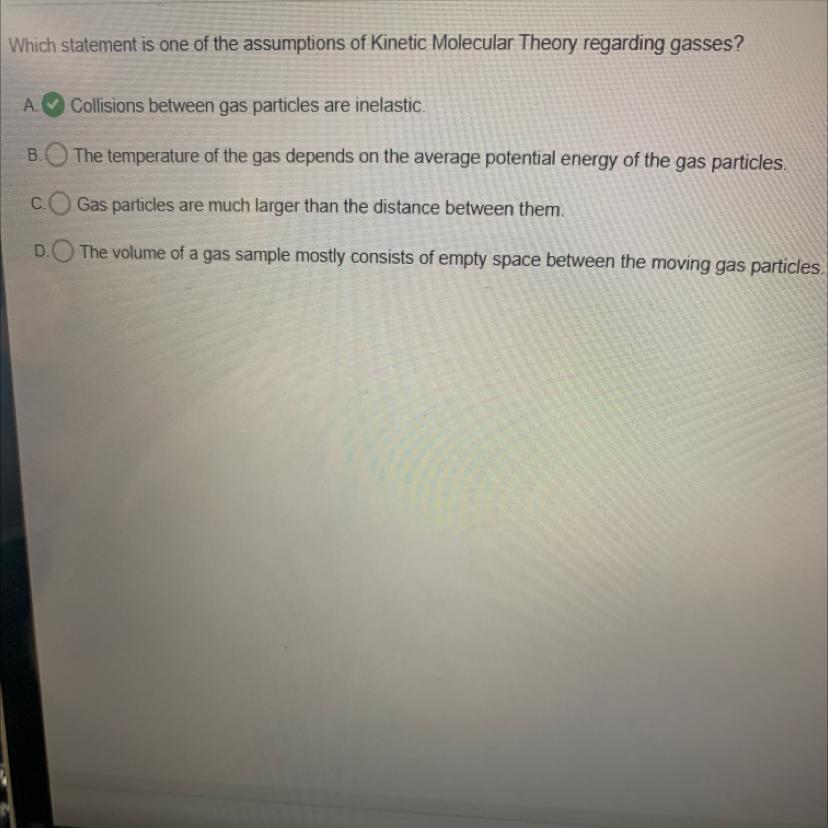
Which statement is one of the assumptions of Kinetic Molecular Theory regarding gasses?
A Collisions between gas particles are inelastic.
The temperature of the gas depends on the average potential energy of the gas particles.
Gas particles are much larger than the distance between them.
The volume of a gas sample mostly consists of empty space between the moving gas particles.
Answers
The statement that "The volume of a gas sample mostly consists of empty space between the moving gas particles" is one of the assumptions of the Kinetic Molecular Theory regarding gases.
What is Collision?
There are different types of collisions, depending on the nature of the objects involved, the speed and direction of their motion, and the type of contact that occurs. For example, elastic collisions are those in which the total kinetic energy of the colliding objects is conserved, meaning that no energy is lost or gained during the collision. In contrast, inelastic collisions are those in which some of the kinetic energy is transformed into other forms of energy, such as heat or sound.
The Kinetic Molecular Theory is a model that describes the behavior of gases. One of the main assumptions of this theory is that gas particles are in constant random motion and move in a straight line until they collide with other particles or the walls of their container.
Another important assumption of this theory is that the volume of a gas sample mostly consists of empty space between the moving gas particles. This means that gas particles are assumed to be very small compared to the overall volume of the gas sample. Therefore, the particles do not occupy all of the available space in the container, but instead only occupy a small portion of it.
Learn more about Collision from given link
https://brainly.com/question/24915434
#SPJ1
What mass of sodium hydroxide, NaOH, would be required to produce 16 g of the antacid milk of magnesia [magnesium hydroxide, Mg(OH)2] by the following reaction? MgCl2(aq) + 2NaOH(aq) ⟶ Mg(OH)2(s) + 2NaCl(aq)
Answers
It would take 22g of sodium hydroxide (NaOH) to make 16g of the antacid milk of magnesia (magnesium hydroxide).
Simply put, what is stoichiometry?In the field of chemistry known as stoichiometry, desired quantitative data is ascertained by using relationships between the reactants and/or products of a chemical reaction. Stoichiometry literally translates as the measure of elements because the Greek words stoikhein and metron both mean element and measure, respectively.
What is the stoichiometric law?In a chemical reaction, the total mass of reactant and product are equal, according to the statement, and neither is generated nor destroyed. This is the stoichiometric law, and also the law of conservation of mass.
\(16 \mathrm{~g} \text { of } \mathrm{Mg}(\mathrm{OH})_2 \times \frac{1 \mathrm{molMg}(\mathrm{OH})_2}{58.3 g \mathrm{gg}(\mathrm{OH})_2} \times \frac{2 \mathrm{~mol} \mathrm{NaOH}}{1 \mathrm{molMg}(\mathrm{OH})_2} \times \frac{40 \mathrm{gNaOH}}{\mathrm{molNaOH}}=22 \mathrm{~g}\)
To learn more about Stoichiometry visit:
brainly.com/question/29775083
#SPJ1
The diagrams to the right show the distribution and arrangement of gas particles in two different containers. According to kinetic-molecular theory, which of the following statements is true? Check all that apply. If the temperatures of both containers are equal, container A has greater pressure than container B. If the volume of container A decreased, its pressure would decrease. If the pressure in both containers is equal, container A has a lower temperature than container B. Two containers are shown. Container A is square, and Container B is the same height, but is about twice as wide. Each container holds 6 gas particles distributed randomly.
Answers
The kinetic-molecular theory's true assertions are as follows:
If both containers' temperatures are the same, container A will have a higher pressure than container B.
Container A has a lower temperature than container B if the pressure in both containers is equal.
What is the kinetic theory of molecules?The molecules that make up a gas are always moving randomly, colliding with one another and the container walls, according to the kinetic molecular hypothesis. Remember that high temperature and low pressure are the only conditions in which perfect gases can exist.
The kinetic-molecular theory's true assertions are as follows:
If both containers' temperatures are the same, container A will have a higher pressure than container B.
If both are under pressure
Learn more about kinetic molecular theory:brainly.com/question/12025712
#SPJ1
what is nuclear weapons
Answers
if scientists found a fossil in the middle layer that was 2 million years old, would they think Earth was more or less than 2 million years
Answers
The discovery of a 2-million-year-old fossil would align with the existing understanding of Earth's geological history, as it falls within the timeframe of the Quaternary period.
If scientists found a fossil in the middle layer that was determined to be 2 million years old, they would not automatically conclude that Earth was younger or older than 2 million years. The age of the fossil would provide valuable information about the minimum age of the layer in which it was found, but it would not necessarily provide conclusive evidence about the age of the entire Earth.
To determine the age of Earth, scientists rely on a variety of dating methods, including radiometric dating of rocks and minerals, as well as the study of isotopes and geological processes. These methods provide estimates of Earth's age in the billions of years.However, it would not significantly alter the prevailing scientific consensus that Earth is approximately 4.5 billion years old. The age of Earth is based on a comprehensive body of evidence from multiple disciplines and dating techniques, and a single fossil would not overturn that understanding.
for such more questions on period
https://brainly.com/question/29752383
#SPJ8
Sort the five steps of the scientific method.
State problem
Conduct experiment
Interpret data
Draw conclusion
Form hypothesis
Answers
The correct order of the five steps of the scientific method is as follows:
State problem
Form hypothesis
Conduct experiment
Interpret data
Draw conclusion.
The scientific method is a systematic approach used by scientists to investigate and understand the natural world. The five steps of the scientific method, in their logical order, are as follows:
State problem: In this step, the scientist identifies and defines a specific question or problem to be investigated. The problem should be clear and well-defined to guide the rest of the scientific process.
Form hypothesis: A hypothesis is a proposed explanation or prediction for the problem stated in step one. It is an educated guess that can be tested through experiments and observations. The hypothesis should be based on prior knowledge and observations.
Conduct experiment: In this step, the scientist designs and performs experiments to test the hypothesis. The experiment is carefully planned and executed, and data is collected through observations and measurements.
Interpret data: Once the experiment is completed, the scientist analyzes the collected data. This involves organizing, graphing, and statistically analyzing the data to identify patterns and trends.
Draw conclusion: Based on the interpretation of the data, the scientist draws conclusions about whether the hypothesis is supported or not. The conclusions should be objective and supported by evidence obtained from the experiment.
It's important to note that while these steps are presented in a linear order, the scientific process is often iterative, with scientists revisiting and refining hypotheses, conducting further experiments, and building upon existing knowledge.
For more questions on Conduct experiment
https://brainly.com/question/30994979
#SPJ8
What characterizes a crystalline solid when it breaks?
A. The solid stretches rather than breaks.
B. The break follows the crystal structure.
C. The solid shatters into jagged pieces.
D. The break occurs in random places.
Answers
Answer:
The breaks follows the crystal structure
Explanation:
In crystalline solids, the atoms, ions or molecules are arranged in an ordered and symmetrical pattern that is repeated over the entire crystal. … This means that a crystalline solid will have a distinct melting point, because applying heat will break all the bonds at the same time
According to the forces of attraction, the break follows the crystal structure characterizes a crystalline solid when it breaks.
What are forces of attraction?Forces of attraction is a force by which atoms in a molecule combine. it is basically an attractive force in nature. It can act between an ion and an atom as well.It varies for different states of matter that is solids, liquids and gases.
The forces of attraction are maximum in solids as the molecules present in solid are tightly held while it is minimum in gases as the molecules are far apart . The forces of attraction in liquids is intermediate of solids and gases.
The physical properties such as melting point, boiling point, density are all dependent on forces of attraction which exists in the substances.
Learn more about forces of attraction,here:
https://brainly.com/question/23841038
#SPJ7
how many moles and numbers of ions of each type are present in the following aqueous solution? 396 ml of 0.284 g aluminum sulfate/l:
Answers
The molar mass of aluminum sulfate is 342.15 g/mol.
To find the number of moles in the solution, we first need to calculate the mass of aluminum sulfate present in 1 liter of the solution:
0.284 g/L x 1 L = 0.284 g
Then we can find the number of moles:
0.284 g / 342.15 g/mol = 0.000829 moles
Since we only have 396 mL of the solution, we need to adjust the number of moles accordingly:
0.000829 moles/L x 0.396 L = 0.000328 moles
Aluminum sulfate dissociates in water to form 3 ions: one aluminum ion (Al3+) and two sulfate ions (SO42-).
So for every 1 mole of aluminum sulfate dissolved, we get 1 mole of Al3+ ions and 2 moles of SO42- ions.
Therefore, in 0.000328 moles of aluminum sulfate, we have:
0.000328 moles of Al3+ ions
0.000656 moles of SO42- ions
To find the number of ions of each type, we can use Avogadro's number, which tells us the number of particles (ions, atoms, molecules) in 1 mole of a substance:
Number of Al3+ ions: 0.000328 moles x 6.022 x 10^23 ions/mol = 1.97 x 10^20 ions
Number of SO42- ions: 0.000656 moles x 6.022 x 10^23 ions/mol = 3.95 x 10^20 ions
Therefore, there are approximately 1.97 x 10^20 aluminum ions and 3.95 x 10^20 sulfate ions in 396 mL of 0.284 g/L aluminum sulfate solution.
the lattice constant of gaas is 5.65 a, determine the number of ga atoms and as atoms per c m 3 . (b) determine the volume density of germanium atoms in a germanium semiconductor. the lattice constant of germanium is 5.65 a..
Answers
The Number of atoms per unit cell for Ga = 4 atoms per unit cell. Number of atoms per unit cell for As = 4 atoms per unit cell. Volume density of Germanium in its unit cell = 4.35 × 10²² /cm³
According to published data, GaAs has a number density of 4.42 x 10²²atoms/cm³.
Because it is well known that Ga and As are essentially equally distributed throughout GaAs.
Ga's number density is equal to As's number density (2.21 x 10²² atoms/cm³).
Volume of the unit cell = (lattice parameter)³ = (5.65 × 10⁻⁸)³ = 1.804 × 10⁻²² cm³
a) Number of atoms per unit cell for Ga and As = number density × volume of unit cell = 2.21 × 10²² × 1.804 × 10⁻²² = 4 atoms/unit cell
b) Volume density = Number of atoms per unit cell/volume of unit cell
A germanium unit cell contains 8 atoms (from literature)
Volume of unit cell = (lattice parameter)³ = (5.65 × 10⁻⁸)³ = 1.804 × 10⁻²² cm³
Volume density = 8/(1.804 × 10⁻²²) = 4.35 × 10²² /cm³
Learn more about number of atom at https://brainly.com/question/12515630
#SPJ4
Identify another chemical reaction that is important to your daily life hint this is a good resource
Answers
Photosynthesis is a chemical reaction it leads to the generation of oxygen and provides food for both plants and animals.
This is the process by which plants convert carbon dioxide and water into glucose and oxygen using energy from the sun. It is the basis for all life on Earth, as it provides the energy and oxygen necessary for life.
Photosynthesis is the process by which plants, algae, and some bacteria convert light energy from the sun into chemical energy in the form of glucose and other organic compounds.
This process is carried out by special structures called chloroplasts, which contain a pigment called chlorophyll that gives plants their green color.
To learn more about the photosynthesis, follow the link:
https://brainly.com/question/29764662
#SPJ1
PLEASE HELP QUICKK
Calculate the energy of combustion for one mole of butane if burning a 0.367 g sample of butane (C4H10) has increased the temperature of a bomb calorimeter by 7.73 °C. The heat capacity of the bomb calorimeter is 2.36 kJ/ °C.
Answers
The energy of combustion for one mole of butane to be approximately 2888.81 kJ/mol.
To calculate the energy of combustion for one mole of butane (C4H10), we need to use the information provided and apply the principle of calorimetry.
First, we need to convert the mass of the butane sample from grams to moles. The molar mass of butane (C4H10) can be calculated as follows:
C: 12.01 g/mol
H: 1.01 g/mol
Molar mass of C4H10 = (12.01 * 4) + (1.01 * 10) = 58.12 g/mol
Next, we calculate the moles of butane in the sample:
moles of butane = mass of butane sample / molar mass of butane
moles of butane = 0.367 g / 58.12 g/mol ≈ 0.00631 mol
Now, we can calculate the heat released by the combustion of the butane sample using the equation:
q = C * ΔT
where q is the heat released, C is the heat capacity of the calorimeter, and ΔT is the change in temperature.
Given that the heat capacity of the bomb calorimeter is 2.36 kJ/°C and the change in temperature is 7.73 °C, we can substitute these values into the equation:
q = (2.36 kJ/°C) * 7.73 °C = 18.2078 kJ
Since the heat released by the combustion of the butane sample is equal to the heat absorbed by the calorimeter, we can equate this value to the energy of combustion for one mole of butane.
Energy of combustion for one mole of butane = q / moles of butane
Energy of combustion for one mole of butane = 18.2078 kJ / 0.00631 mol ≈ 2888.81 kJ/mol
Therefore, the energy of combustion for one mole of butane is approximately 2888.81 kJ/mol.
In conclusion, by applying the principles of calorimetry and using the given data, we have calculated the energy of combustion for one mole of butane to be approximately 2888.81 kJ/mol.
For more questions on molar mass, click on:
https://brainly.com/question/837939
#SPJ8
give one use of zinc
Answers
If you need any more let me know
How many atoms are there in 4.13 moles of P4O10?
Answers
4.13 mol x (6.022x10^23) = 2.49x10^24 atoms (which typically isn’t written with a unit) so just 2.49x10^24
What is the molarity of a 750.0 milliliter solution containing 2.5 moles of solute?
ОА.
1.9 M
OB
0.0033 M
O c.
1,875 M
OD.
0.30 M
OE.
3.3 M
Answers
Molarity : It is defined as the number of moles of solute present in one liter of solution.
Therefore, the molarity of solution is 3.33
A. 1.9 M
B. 0.0033 M
C. 1,875 M
D. 0.30 M
E. 3.3 M
Which is NOT a compound?
A. silicon dioxide
B. water
C. carbon dioxide gas
D. oxygen gas
Answers
Answer: Oxygen
Explanation: Its found on the periodic table as an element.
A measure of how much substance is packed into a space
A) Density
B) Mass divided by volume
C) Water
D) Element
Answers
Answer:
a
Explanation:
Answer:
A
Explanation:
Density is the amount of space that atoms are compacted in a substance.Apr 25, 2017
2. a. Draw and label an energy diagram similar to the one shown in the sample problem for a reaction in which E= 125 kJ/mol and E' = 86 kJ/mol. Place the reactants at energy level zero. b. Calculate the values of AE, forward and AEreverse. c. Is this reaction endothermic or exothermic? Explain your answer.
3. a. Draw and label an energy diagram for a reaction in which E= 154 kJ/mol and AE136 kJ/mol. b. Calculate the activation energy, E, for the reverse reaction.

Answers
The reaction is endothermic since the energy level of the products have are higher than that of the reactants.
What are the values of AE and E?The activation energy (AE) is the energy difference between the reactants and the transition state.
The change in energy E and the energy difference between the reactants and the products
The data given is as follows:
Reactants: 0 kJ/mol
AE forward 125 kJ/mol
AE reverse: 86 kJ/mol
Products: 39 kJ/mol
The values of ΔE forward and ΔE reverse are as follows:
ΔE forward = (39 - 0) kJ/mol
ΔE forward = +39 kJ/mol
ΔE reverse = (0 - 39) kJ/mol
ΔE reverse = -39 kJ/mol
3. Given that Ea = 154 kJ/mol and ΔE = 136 kJ/mol
AE reverse = ΔE - AE forward
E = 136 kJ/mol - 154 kJ/mol
E = -18 kJ/mol
Learn more about activation energy at: https://brainly.com/question/1380484
#SPJ1

Describe echolocation. Give an example of an animal that uses echolocation.
Answers
dolphin and whales use echolocation
Combustion reactions are a notable source of carbon dioxide in the environment. Using the following balanced equation, how many grams of carbon dioxide are formed when 100.00 g of propane is burned? Express your answer to the correct number of significant figures. Be sure to show all steps completed to arrive at the answer. Equation: C3H8 + 5O2 ->>>>>>> 3CO2 + 4H2O
Answers
Answer:
Explanation:
Number of moles of propane:
=Mass in grams ÷ Relative molecular Mass
= 100/((12*3) + (1*8))
= 100 ÷ 44
= 2.2727
Mole ratio propane:carbon (IV) oxide = 1:3(from the equation)
Number of moles of CO2 = 3*2.2727 = 6.8181
Mass in grams = Relative molecular Mass * Number of moles
= 44 * 6.8181
= 299.9964 grams
A number of moles of propane:
Mass in grams ÷ Relative molecular Mass
= 100/((12*3) + (1*8))
= 100 ÷ 44
= 2.2727
Mole ratio propane:carbon (IV) oxide = 1:3(from the equation)
Number of moles of CO2 = 3*2.2727 = 6.8181
Mass in grams = Relative molecular Mass * Number of moles
=44 * 6.8181
= 299.9964 grams
What is carbon dioxide useful for?Carbon dioxide is used as a refrigerant, in fireplace extinguishers, for inflating lifestyles rafts and life jackets, blasting coal, foaming rubber and plastics, selling the increased vegetation in greenhouses, and immobilizing animals earlier than slaughter, and in carbonated liquids.
Learn more about Propane at https://brainly.com/question/19883306
#SPJ2