The Leaning Tower of Pisa in Italy was built between 1173 and 1350. A. Write an equation in slope-intercept form for the yellow line. Equation: y= b. The tower is 56 meters tall. How far off center is the top of the tower? The top of the tower is meters off center
Answers
Answer:
The answer is below
Step-by-step explanation:
From the image of the leaning tower of Pisa, we can see that it passes through the point (7.75, 0) and (10.75, 42).
a) The equation of a line in slope intercept form is given by y = mx + b, where m is the slope and b is the intercept. Also, the equation of line passing through
\((x_1,y_1)\ and\ (x_2,y_2)\ is:\\\\y-y_1=\frac{y_2-y_1}{x_2-x_1} (x-x_1)\)
Hence since it passes through (7.75, 0) and (10.75, 42), the equation is:
\(y-0=\frac{42-0}{10.75-7.75} (x-7.75)\\\\y=14(x-7.75)\\\\y=14x-108.5\)
b) When the tower is 56 meters tall, i.e. y = 56, we need to find the value of x:
y = 14x - 108.5
56 = 14x - 108.5
56 + 108.5 = 14x
164.5=14x
x = 164.5/14
x = 11.75
When the tower is 56 meters tall, the top of the tower is 11.75 m off center
Related Questions
Evaluate \dfrac32y-3+\dfrac53z 2 3 y−3+ 3 5 zstart fraction, 3, divided by, 2, end fraction, y, minus, 3, plus, start fraction, 5, divided by, 3, end fraction, z when y=6y=6y, equals, 6 and z=3z=3z, equals, 3.
Answers
Answer:
11
Step-by-step explanation:
Given:
3/2y - 3 + 5/3z
When
y=6
z=3
3/2y - 3 + 5/3z
Substitute the value of y and z
3/2(6) - 3 + 5/3(3)
=18/2 - 3 + 15/3
=9-3+5
=6+5
=11
A rectangular garden has a length that is 3 more than twice the width. The perimeter of the
rectangular garden is 36 ft.
+ xp
a) Write a system of equations that represents the situation.
b) What is the length and width of the garden?
Answers
Answer:
W = width
L = length = 2W + 3
P = 36 = 2W + 2L = 2W + 2(2W + 3) =
6W + 6 = 36
6W = 30
W = 5
L = 13
Evaluate the expression.
6*13 - 4 (to the second power)

Answers
Answer:
62
Step-by-step explanation:
6*13-4^2
6*13-16
78-16
62
Suppose a firm has the following total cost function: TC-50+ 2q². What is the minimum price necessary for the firm to earn profit? Select one: O a. p-$35 O b. p = $20 Oc. p-$30 Od. p = $40
Answers
The minimum price necessary for the firm to earn a profit is $30.
Hence,.option C is correct
The profit of a firm is calculated as the difference between total revenue and total cost. To find the minimum price necessary for a firm to earn a profit, we need to determine the revenue and cost functions first. Then we can find the break-even point and determine the minimum price for the firm to earn a profit.
Total cost function: TC = 50 + 2q²
where
q = quantity produced
We know that the profit equation is:
Total revenue (TR) = price (p) x quantity (q)
Profit (π) = TR - TC
Now we need to determine the revenue function:TR = p × q
We can substitute this into the profit equation to obtain:π = TR - TCπ = p × q - (50 + 2q²)
To find the break-even point, we can set the profit to zero:
0 = p × q - (50 + 2q²)
p × q = 50 + 2q²
We can rearrange this equation to solve for p:p = (50 + 2q²) / q
Let's substitute q = 5:p = (50 + 2(5)²) / 5 = $30
Therefore, the minimum price necessary for the firm to earn a profit is $30. So, the correct option is O c. p-$30.
Learn more about profits at:
https://brainly.com/question/32571367
#SPJ11
Suppose you work for a large coffee distributor that has a secret coffee blend it sells to local stores. You mix the Ethiopian blend with the House blend, but always in the same proportion. Yesterday, you mixed 70 pounds of the Ethiopian blend with 28 pounds of the House blend. Today, there is 20 pounds of the Ethiopian coffee left in stock. How many pounds of the House coffee should you mix with it to get your secret blend?
Answers
Answer:
\(8\text{ pounds}\)Explanation:
Here, we want to get the weight of the House Coffee to be mixed
The mixing ratio is 70 pounds Ethiopian blend with 28 pounds House blend
This gives a ratio of:
\(\frac{70}{28}\text{ = }\frac{5}{2}\)What the above means is that for every 5 pounds of Ethiopian blend, we have 2 pounds of the House blend
Now, today, there are 20 pounds of the Ethiopian blend. To satisfy the mixing criteria, we have it that:
\(\begin{gathered} \frac{5}{2}\text{ = }\frac{20}{h} \\ \\ 5\text{ }\times\text{ h = 2}\times20 \\ h\text{ = }\frac{2\times20}{5}\text{ = 8 pounds} \end{gathered}\)This means that 8 pounds of the House Coffee should be mixed with the 20 pounds of the Ethiopian blend to get the secret blend
points a b c d and e are collinear and in that order. find ac if ae = x + 50 and ce = x + 32
Answers
Points a b c d and e are collinear and in that the distance between points a and c is AC = 18.
What are collinear points?If you can draw a straight line that passes through two or more points, then those points are collinear.
According to question:If points a, b, c, d, and e are collinear and in that order, then we can represent the distances between them as follows:
AB + BC + CD + DE = AE
AC + CD + CE = AE
Since we want to find AC, we can use the second equation and substitute the given values:
AC + CD + CE = AE
AC + CD + (x + 32) = (x + 50)
Now, we can use the fact that points a, b, c, d, and e are collinear to realize that CD = 0, since it is the distance between point c and itself. Therefore, we can simplify the equation:
AC + CD + (x + 32) = (x + 50)
AC + 0 + (x + 32) = (x + 50)
AC + x + 32 = x + 50
AC = 18
Therefore, the distance between points a and c is AC = 18.
To know more about collinear points visit:
https://brainly.com/question/5191807
#SPJ1
The complete question is If points a, b, c, d and e are collinear and in that order which forms a line segment. Find AC if AE = x + 50 and CE = x + 32.
27 is 30% of what number?
A 8585
B 9292
C 1212
D 90
Answers
Answer:
27 is 30% of what number?
D. 90
Step-by-step explanation:
You're welcome.
Take the first 4 digits of your student number as the first number and the last 3 digits as the second number. Write the matlab code to find the greatest common divisor of these numbers using the Euclidean algorithm.
Answers
The required Matlab code to find the greatest common divisor of a number using the Euclidean algorithm is shown.
To find the greatest common divisor (GCD) of two numbers using the Euclidean algorithm in MATLAB, you can use the following code:
% Replace '12345678' with your actual student number
studentNumber = '12345678';
% Extract the first 4 digits as the first number
firstNumber = str2double(studentNumber(1:4));
% Extract the last 3 digits as the second number
secondNumber = str2double(studentNumber(end-2:end));
% Find the GCD using the Euclidean algorithm
gcdValue = gcd(firstNumber, secondNumber);
% Display the result
disp(['The GCD of ' num2str(firstNumber) ' and ' num2str(secondNumber) ' is ' num2str(gcdValue) '.']);
Make sure to replace '12345678' with your actual student number. The code extracts the first 4 digits as the first number and the last 3 digits as the second number using string indexing. Then, the gcd function in MATLAB is used to calculate the GCD of the two numbers. Finally, the result is displayed using the disp function.
Learn more about Matlab code here:
https://brainly.com/question/30763780
#SPJ4
Convert the following linear equations from slope form to standard form:
y=-3x+7
y = - 2/3x - 3/4
Answers
Answer:
3x+y=7
8x+12y=-9
Step-by-step explanation:
I need help with problems 19 through 21!!!

Answers
After t=1 or t=4 seconds, the ball will reach 20 meters high.
The ball will go up to 31.25 meters high.
After 4.5 seconds, the ball will be at a height of 11.25 meters.
What is a quadratic equation?
A quadratic equation is any equation in algebra that can be rearranged in standard form as ax²+bx+c=0, where x is an unknown value and a, b, and c are known numbers.
For 19)
The given equation is h = 25t - 5t²
Now the height of the ball is 20 meters, so put h = 20, so the equation will become,
20 = 25t - 5t²
⇒ 5t² -25t + 20 = 0
⇒ t² - 5t + 4 = 0
finding factors, we get
t² - 4t - t + 4 = 0
t (t - 4) - 1(t - 4) = 0
(t - 4)(t - 1) = 0
t = 4 seconds (or) t = 1 second.
For 20)
To find the maximum height, we have to differentiate the given function with respect to the 't'
so differentiating 'h' with respect to 't', we get
dh/dt = 25 - 10t
dh/dt = velocity.
v = 25 - 10t,
The maximum height will attain at v = 0,
25 - 10t = 0
⇒ t = 2.5 seconds
so at t = 2.5 seconds, the ball will achieve its maximum height.
put t = 2.5 in the given function, we get
h = 25(2.5) - 5(2.5)²
h = 62.5 - 31.25
h = 31.25 meters.
For 21)
Put t = 4.5 seconds,
h = 25(4.5) - 5(4.5)²
h = 112.5 - 101.25
h = 11.25 meters.
Hence,
After t=1 or t=4 seconds, the ball will reach 20 meters high.
The ball will go up to 31.25 meters high.
After 4.5 seconds, the ball will be at a height of 11.25 meters.
To learn more about quadratic equations, visit:
https://brainly.com/question/1214333
#SPJ1
25 points pluss brainliest!!! math.
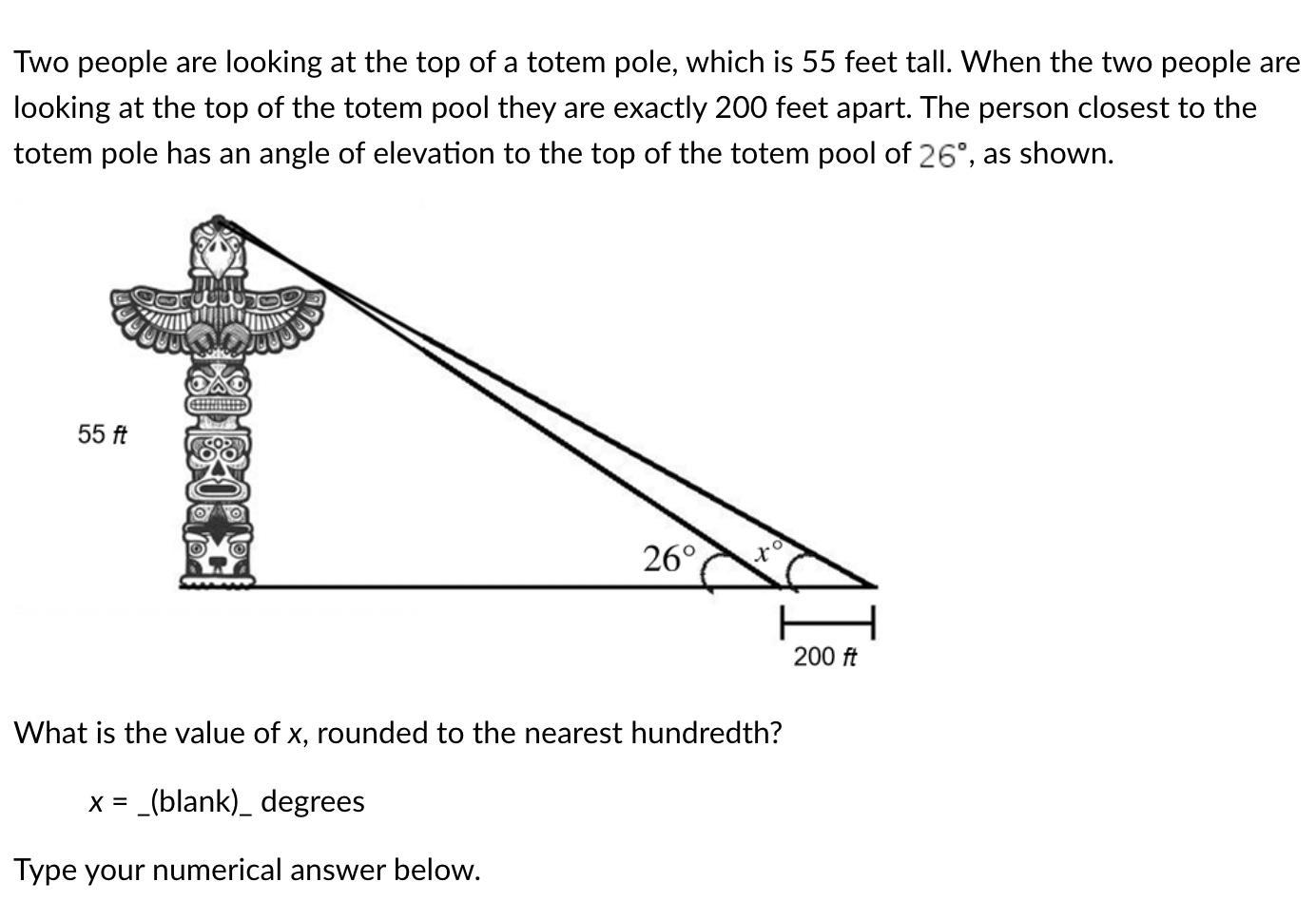
Answers
Answer: 9.97
==============================================
Explanation:
y = distance from the base of the pole to the closest person
y+200 = total horizontal distance
-------------
Focus on the smaller right triangle.
tan(angle) = opposite/adjacent
tan(26) = 55/y
y*tan(26) = 55
y = 55/tan(26)
y = 112.76671 approximately
Make sure your calculator is in degree mode.
--------------
Now move to the larger right triangle
tan(angle) = opposite/adjacent
tan(x) = 55/(y+200)
tan(x) = 55/(112.76671+200)
tan(x) = 55/312.76671
tan(x) = 0.17585
x = arctan(0.17585) same as \(\tan^{-1}\)
x = 9.97349
x = 9.97 degrees approximately
Help me please, I need to pass this class

Answers
Answer:
Step-by-step explanation:
20
Answer: KL IS 3 + 9 THEN 5 MINUS NINE
Step-by-step explanation: FIND KL
Please someone help im giving brainliest :)

Answers
Answer:
No, they are opposite as squared is multiplication. Please give brainliest!
What is -8.64 / -0.024?
Answers
Let's first write both numbers in their fraction form:
\(\begin{gathered} -8.64=-\frac{864}{100} \\ -0.024=-\frac{24}{1000} \end{gathered}\)then, we can write the division like this:
\(-8.64\frac{\cdot}{\cdot}-0.024=-\frac{864}{100}\frac{\cdot}{\cdot}(-\frac{24}{1000})\)Now, given the general rule for the division of fractions, we have:
\(\begin{gathered} \frac{a}{b}\frac{\cdot}{\cdot}\frac{c}{d}=\frac{a\cdot d}{b\cdot c} \\ b,d\ne0 \end{gathered}\)also notice that we are dividing two negative numbers, then our final result will be positive according to the law of signs. Then, we have in this case:
\(-\frac{864}{100}\frac{\cdot}{\cdot}(-\frac{24}{1000})=\frac{864\cdot1000}{24\cdot100}=\frac{864\cdot10}{24}=\frac{8640}{24}=360\)therefore the final result is 360
6. According to Statistics Canada, the number of cable television subscribers increased from about 1 151 000 in 2002 to about 1 393 000 in 2003. What was the mean number of new subscribers per month during that year?
Answers
The mean number of new subscribers per month during that year is 242000.
What is a mean?A mean simply means the average of the numbers given.
The number of cable television subscribers increased from about 1 151 000 in 2002 to about 1 393 000 in 2003.
The mean number of new subscribers will be:
= Change in numbers / Number of years
= (1393000 - 1151000) / 1
= 242000 / 1
= 242000
Therefore, the mean is 242000.
Learn more about mean on:
brainly.com/question/1136789
#SPJ1
Insurance companies are interested in knowing the population percent of drivers who always buckle up before riding in a car. They randomly survey 382 drivers and find that 317 claim to always buckle up. Construct a 95% confidence interval for the population proportion that claim to always buckle up. p Do not round between steps. Round answers to at least 4 decimal places. Question Help: Message instructor Submit Question Question 4 0/2 pts 100 Details 126 students at a college were asked whether they had completed their required English 101 course, and 88 students said "yes". Construct the 90% confidence interval for the proportion of students at the college who have completed their required English 101 course. Enter your answers as decimals (not percents) accurate to three decimal places.
Answers
The 95% confidence interval for the proportion of drivers who always buckle up is approximately 0.7848 to 0.8738.
To calculate the confidence interval, we can use the formula for the confidence interval of a proportion:
Confidence interval = p ± Z * √(p * (1 - p) / n)
Where:
p is the sample proportion (317/382)
Z is the Z-score corresponding to the desired level of confidence (95% confidence corresponds to a Z-score of 1.96)
n is the sample size (382)
Now let's calculate the confidence interval:
p = 317/382 ≈ 0.8293
Z = 1.96 (for 95% confidence)
n = 382
Substituting these values into the formula:
Confidence interval = 0.8293 ± 1.96 * √(0.8293 * (1 - 0.8293) / 382)
Calculating the expression inside the square root:
√(0.8293 * (1 - 0.8293) / 382) ≈ 0.0227
Plugging in this value:
Confidence interval ≈ 0.8293 ± 1.96 * 0.0227
Calculating the multiplication:
1.96 * 0.0227 ≈ 0.0445
Finally, the confidence interval is:
Confidence interval ≈ (0.8293 - 0.0445, 0.8293 + 0.0445)
Simplifying:
Confidence interval ≈ (0.7848, 0.8738)
Therefore, we can be 95% confident that the population proportion of drivers who always buckle up is between 0.7848 and 0.8738.
To know more about confidence intervals, refer here:
https://brainly.com/question/32546207#
#SPJ11
Write a story that can be represented using the equation y=x+1/5x
Answers
A story that can be represented using the equation y=x+1/5x is "John has an apple and he cut another apple into 5 equal parts and took on part. What's the rural fraction of apple that he has?
How to illustrate the equation?An equation is the statement that illustrates the variables given. In this case, two or more components are taken into consideration to describe the scenario. It is vital to note that an equation is a mathematical statement which is made up of two expressions that are connected by an equal sign.
In this case, if John has an apple and he cut another apple into 5 equal parts and took on part.
This can be illustrated as:
y = x + 1/5x
Learn more about equations on:
brainly.com/question/2972832
#SPJ1
Ariel earns $55 by walking dogs in his neighborhood. Let D be the number of dogs he walks by charging P dollars per dog. what is the correct equation that relates P and D
Answers
Answer: When P = 1, D = 55 So I Think The Ratio Is 1:55
Please help me ! I don’t understand :((

Answers
Answer:
(0,a)
Step-by-step explanation:
f(x) = a * b^x
Let x=0
f(0) = a * b^0
= a * 1
=a
(0,a)
8.2x + 9y + 2(2.5x) + 10xy
plz Help
Answers
Answer:
13.2x + 9x + 10xyStep-by-step explanation:
=> 8.2x + 9y + 2(2.5x) + 10xy
=> 8.2x + 9y + 5x+ 10xy
=> 13.2x + 9y + 10xy
Since we can't simplify it from here, 13.2x + 9y + 10xy is our answer.
The minute hand on a watch is 9 mm long and the hour hand is 3 mm long. How fast is the distance between the tips of the hands changing at one o'clock
Answers
The minute hand on a watch is 9 mm long and the hour hand is 3 mm long. How fast is the distance between the tips of the hands changing at one o'clock?We are given that the minute hand on a watch is 9 mm long and the hour hand is 3 mm long. We need to find out how fast the distance between the tips of the hands changing at one o'clock.The position of the hands at one o'clock is shown below:Position of hands at one o'clockAt one o'clock, the minute hand is on 12 and the hour hand is on 1. Let the tip of the minute hand be A and the tip of the hour hand be B. Let the origin be the centre of the watch. Let angle AOB = θ radians. We know that the length of the minute hand (OA) is 9 mm and the length of the hour hand (OB) is 3 mm.Let the distance between A and B be L mm. From the diagram above, we can see that:L² = OA² + OB² - 2 OA OB cosθSubstituting values, we get:L² = 9² + 3² - 2 × 9 × 3 cosθL² = 81 + 9 - 54 cosθL² = 90 - 54 cosθDifferentiating with respect to time t, we get:2L dL/dt = -54 d(cosθ)/dtDifferentiating cosθ, we get:d(cosθ)/dt = -sinθ dθ/dtWe need to find dL/dt when θ = π/6 (one o'clock).At one o'clock, θ = π/6 radians.L² = 90 - 54 cos(π/6)L² = 36Therefore, L = 6√2 mmWe know that sin(π/6) = 1/2Therefore, d(cosθ)/dt = -sinθ dθ/dt = -(1/2) dθ/dtSubstituting in the formula above, we get:2L dL/dt = 54 × (1/2) dθ/dtdL/dt = (27/2) dθ/dtWe need to find dθ/dt when θ = π/6.Let's consider the hour hand. At one o'clock, it has moved through an angle of (π/6) - π/2 = -π/3 radians from 12 to 1. The number of radians moved in 1 second = (π/3)/3600 = π/10800 radians per second.Therefore, dθ/dt = π/10800 radians per secondAt one o'clock, dL/dt = (27/2) dθ/dt = (27/2) × (π/10800) = π/800 mm per second.Hence, the distance between the tips of the hands is changing at a rate of π/800 mm per second at one o'clock.
Kalyan Singhal Corp. makes three products, and it has three machines available as resources as given in the following LP problem: Maximize contribution = 3X₁ +5X₂ +7X3 1X₁ +7X₂ + 4X3 ≤ 100 2X1 + 1X₂ + 7X3 ≤ 110 8X₁ + 4X₂ + 1X3 ≤ 100 X₁, X2, X3 20 (C₁: hours on machine 1) (C₂: hours on machine 2) (C3: hours on machine 3) a) Using a computer software for solving LP, the optimal solution achieved is: (round your response to two decimal places). X₁² = X₂ = (round your response to two decimal places). = X3² (round your response to two decimal places). Contribution (objective value) = (round your response to two decimal places). b) Machine 1 has Machine 2 has Machine 3 has hours of unused time available at the optimal solution (round your response to two decimal places). hours of unused time available at the optimal solution (round your response to two decimal places). hours of unused time available at the optimal solution (round your response to two decimal places). dollars to the firm (round your response to two decimal places). c) An additional hour of time available for third machine, is worth d) An additional 5 hours of time available for the second machine, at no cost to the firm, are going to increase the objective value by dollars (round your response to two decimal places).
Answers
a) Contribution (objective value) = $132.14
b) The firm earns $132.14 at the optimal solution.
c) An additional hour of time available for the third machine is worth $0.14 to the firm.
d) An additional 5 hours of time available for the second machine will increase the objective value by $3.69.
The best result obtained from using computer software to solve the LP problem is: X1 = 11.43, X2 = 12.86, X3 = 5.71
b) The number of unused hours at the ideal solution is:
Machine 1 still has 8.57 hours of time left.
There are no hours left on Machine 2 at the moment.
There are still 94.29 hours left on Machine 3.
c) The shadow price of the third limitation is worth an extra hour of time available for the third machine. With the exception of increasing the right-hand side of the third constraint by one unit, we can solve the LP problem using the same constraints to determine the shadow price. Using LP to solve this issue, we discover that the shadow price for the third constraint is
For such more questions on optimal solution
https://brainly.com/question/31025731
#SPJ8
In the Pythagorean Theorem, the sum of the squares of the legs is equal to the square of the
a. shorter leg
b. longer leg
c. sum of the angles
d. hypotenuse
Answers
Answer: D
Step-by-step explanation:
The sum of the squares of the legs is equal to the square of the hypotenuse .
What is the X and Y for this??????

Answers
Bonnie's younger brother is 36 inches tall. How many feet tall is Bonnie's younger brother?
Answers
Answer:
3 feet
Step-by-step explanation:
There are 12 inches in 1 foot, so 36 inches is equal to (36/12), or 3 feet.
Answer:
3
Step-by-step explanation:
take 36 and divide it by 12 because there are 12 inches in a foot.
12, 24, 36, 48.
12x3 is 36 or 36/12 is 3
out of 340 racers who started the marathon, 301 completed the race, 28 gave up, and 11 were disqualified. what percentage did not complete the marathon? round your answer to the nearest tenth of a percent.
Answers
Approximately 11.5% of the racers did not complete the marathon.
Step-by-step explanation:
To find the percentage of racers who did not complete the marathon, we need to add the number of racers who gave up and were disqualified:
28 + 11 = 39
So, out of the 340 racers who started the marathon, 39 did not complete it.
To find the percentage, we can use the formula:
percentage = (part/whole) x 100
In this case, the "part" is 39 and the "whole" is 340.
percentage = (39/340) x 100
percentage = 11.5
Rounding to the nearest tenth of a percent, we get:
percentage = 11.5%
Therefore, approximately 11.5% of the racers did not complete the marathon.
To learn more about approximately visit: https://brainly.com/question/30707441
#SPJ11
10. Last year students were offered pictures for purchase as a basic package plus sheets of portraits.
The table below shows the relationship between p, the number of sheets of portraits purchased, and c,
the total cost of all the pictures ordered.
Number of Portrait
Sheets, p
1
3
6
8
Total Cost ($), C
33
49
73
89
11.3=33
10
+23
This year the price of the basic package increased by $3. What is the new cost of 4 sheets of portraits?

Answers
On solving the provided question, we can say that by addition new total cost = 36 52 76 92
what is addition?The other three fundamental operations are subtraction, multiplication, and division. Addition is one of the four basic operations. The sum or total of these combined values is obtained by adding two integers. The process of merging two or more numbers is known as addition in mathematics. Numbers are added together to form addends, and the outcome of this operation, or the final response, is referred to as the sum. This is one of the crucial mathematical operations we employ on a regular basis. You would add numbers in a variety of circumstances. Combining two or more numbers is the foundation of addition. You can learn the fundamentals of addition if you can count.
here,
Number of portrait sheet = 1 3 6 8
Total cost = 33 49 73 89
A, This year the price of the basic package increased by $3.
so new total cost = 36 52 76 92
here,
we use addition
To know more about addition visit:
https://brainly.com/question/29560851
#SPJ1
eight people are sitting around a circular table, each holding a fair coin. all eight people flip their coins and those who flip heads stand while those who flip tails remain seated. what is the probability that no two adjacent people will stand?
Answers
The probability that no two adjacent people will stand is 47/256. This is a problem that represents a combination.
What is combination?A combination is a grouping of items where order does not matter. The formula of combination is
\(_{n}C_{r} = \frac{n!} {r! (n-r)!}\)
Where
C = number of combinationsn = number of total itemsr = number of choosing itemsGiven the case eight people sit around a circular table, flip coins, and those who flip heads will stand while those who flip tails will remain seated.
What is the probability that no two adjacent people will stand?
First, we count the total standing arrangements. They will be 2⁸ = 256 arrangements. n(S) = 256.
The number of arrangements according to the number of people standing.
Case 1: 0 people standing = 1 arrangement.
Case 2: 1 people standing = \(_{8}C_{1}\) = \(\frac{8!} {1! 7!}\) = 8 arrangements.
Case3: 2 people standing = \(_{8}C_{2}\) = \(\frac{8!} {2! 6!}\) = \(\frac{7 \times 8} {2}\) = 28 arrangements, but no two people are next to each other. There are 8 arrangements that two people in this case are standing next to each other. So, it will be 28 - 8 = 20 arrangements.
Case 4: 3 people standing = \(_{8}C_{3}\) = \(\frac{8!} {3! 5!}\) = \(\frac{6 \times 7 \times 8} {6}\) = 56 arrangements. In this case, three people standing are next to each other = \(_{8}C_{1}\) = 8 arrangements. Two people standing are next to each other and the third person is not = \(_{8}C_{1} \times _{4}C_{1}\) = 8 × 4 = 32. So, it will be 56 - 8 - 32 = 16 arrangements.
Case 5: 4 people standing but no two adjacent people = 2 arrangements.
The number of arrangements that no two adjacent people will stand.
n(A) = 1 + 8 + 20 + 16 + 2 = 47
The probability that no two adjacent people will stand is
P(A) = n(A)/n(S)
P(A) = 47/256
Hence, the probability that no two adjacent people will stand is 47/256.
Learn more about finding probability with combination here:
brainly.com/question/3901018
#SPJ4
Which percent is equivalent to 2 5/6?

Answers
Answer:
283.3%
Step-by-step explanation:
5/6 equals 0.83 repeating and it already has 200% for the whole number 2
Carlisle Transport had $4,520 cash at the beginning of the period. During the period, the firm collected $1,654 in receivables, paid $1,961 to supplier, had credit sales of $6,916, and incurred cash expenses of $500. What was the cash balance at the end of the period?
Answers
To calculate the cash balance at the end of the period, we need to consider the cash inflows and outflows.
Starting cash balance: $4,520
Cash inflows: $1,654 (receivables collected)
Cash outflows: $1,961 (payments to suppliers) + $500 (cash expenses)
Total cash inflows: $1,654
Total cash outflows: $1,961 + $500 = $2,461
To calculate the cash balance at the end of the period, we subtract the total cash outflows from the starting cash balance and add the total cash inflows:
Cash balance at the end of the period = Starting cash balance + Total cash inflows - Total cash outflows
Cash balance at the end of the period = $4,520 + $1,654 - $2,461
Cash balance at the end of the period = $4,520 - $807
Cash balance at the end of the period = $3,713
Therefore, the cash balance at the end of the period is $3,713.
To learn more about cash : brainly.com/question/31754110
#SPJ11