Answers
Answer:
\(p_2=5.17torr\)
Explanation:
Hello.
In this case, by using the Clausius-Clapeyron Equation which allows us to relate the vapor pressure, temperature and heat of vaporization as shown below:
\(ln(\frac{p_1}{p_2} )=\frac{\Delta _vH}{R}(\frac{1}{T_2}-\frac{1}{T_1} )\)
Whereas \(p_1\) is 760 torr due to the normal conditions. In such a way, for computing the vapor pressure of benzaldehyde at 53.5 °C (326.65 K), we proceed as shown below:
\(\frac{p_1}{p_2} =exp[\frac{48800J/mol}{8.314\frac{J}{mol*K}}(\frac{1}{326.65K}-\frac{1}{451.0K} )]\\\\\frac{p_1}{p_2}=147.0\)
Thus, the vapor pressure at the final T is:
\(p_2=\frac{p_1}{147.0}=\frac{760torr}{147.0}\\ \\p_2=5.17torr\)
Best regards!
Related Questions
Calculate the number of moles of magnesium, chlorine, and oxygen atoms in 7.40 moles of magnesium perchlorate, Mg(ClO4)2. Express the number of moles of Mg, Cl, and O atoms numerically, separated by commas.
Answers
Answer:
Number of moles Magnesium (Mg) = 7.40 moles
Number of moles Chlorine (Cl) = 14.8 moles
Number of moles of oxygen atoms = 29.6 moles
7.40;14.8;29.6
Explanation:
Step 1: Data given
Number of moles of magnesium perchlorate, Mg(ClO4)2 = 7.40 moles
Step 2: Calculate number of moles
In 1 mol of magnesium perchlorate, Mg(ClO4)2, we have:
1 Mol Magnesium (Mg)
2 moles of Chlorine (Cl)
8 moles of oxygen (O)
This means that for 1 mol of magnesium perchlorate, Mg(ClO4)2, we have the same amount of moles Magnesium (Mg), the double amount of moles of Chlorine (Cl) and 4x the amount of moles of oxygen (O)
Number of moles Magnesium (Mg)= 1 * 7.40 moles = 7.40 moles
Number of moles Chlorine (Cl) = 2 * 7.40 moles = 14.8 moles
Number of moles of oxygen atoms = 4 * 7.40 moles = 29.6 moles
7.40;14.8;29.6
6.At a pressure of 5.0 atmospheres, a sample of gas occupies 40 liters. What volume
will the same sample occupy at 1.0 atmosphere?
(a) 50 L
(b) 100 L
O (C) 80 L
(d) 200 L
Answers
Answer:
The answer is 200 LExplanation:
The new volume can be found by using the formula for Boyle's law which is
\(P_1V_1 = P_2V_2\)
where
P1 is the initial pressure
P2 is the final pressure
V1 is the initial volume
V2 is the final volume
Since we are finding the new volume
\(V_2 = \frac{P_1V_1}{P_2} \\\)
So we have
\(V_2 = \frac{5 \times 40}{1} \\ = 5 \times 40\)
We have the final answer as
200 LHope this helps you
Why is there no isotactic or syndiotactic form ofpolyethylene?
Answers
Answer: There is no isotactic or syndiotactic form of polyethylene.
Explanation: Polyethylene is a type of polymer that is made up of repeating units of ethylene monomers. The polymer chains in polyethylene are arranged randomly, without any specific stereochemistry, which means that there is no isotactic or syndiotactic arrangement of the polymer chains. The lack of stereochemistry in polyethylene results in a material that is amorphous and has low crystallinity, which gives it unique mechanical and physical properties that make it useful for a wide range of applications.
Humans have developed ways to increase the carrying capacity of their environment. True or false
Answers
Answer:
false.nowadays humans are destroying forest,extracted more minerals,making pollution. in my view.
4. A handful of sand has a mass of 208 g and displaces a volume of 80.0 mL. Calculate its
density (g/mL).
28
Answers
Answer:
2.6 g/mLExplanation:
The density of a substance can be found by using the formula
\(density = \frac{mass}{volume} \\\)
From the question we have
\(density = \frac{208}{80} = 2.6 \\ \)
We have the final answer as
2.6 g/mLHope this helps you
A chemical reaction between X and Y forms C according to the reaction below. The data for three trials to measure the
rate of this reaction are also given.
Trial
1
2
3
[X] (M)
0.01
0.01
0.02
X+Y→C
[Y] (M)
0.015
0.030
0.015
What is the rate law for this reaction?
OR=KX²M
OR=KX³M²
OR=KXM²
OR=KX²M²
Initial Rate (M/s)
7.83x10⁻⁵
BIBE
3.13x 10⁴
1.57x10
Answers
Explanation: The rate law for a chemical reaction is an equation that relates the rate of the reaction to the concentrations of the reactants. To determine the rate law for a reaction, experiments are typically conducted with different initial concentrations of the reactants and the initial rate of the reaction is measured.
From the data provided, it appears that the reaction is of the form X + Y → C. And the concentration of X and Y are varied in three trials and the corresponding Initial rate is measured.
In the first trial, [X] = 0.01 M and [Y] = 0.015 M, and the initial rate of the reaction is 7.83x10⁻⁵ M/s.
In the second trial, [X] = 0.01 M and [Y] = 0.03 M, and the initial rate of the reaction is 3.13x10⁴ M/s.
In the third trial, [X] = 0.02 M and [Y] = 0.015 M, and the initial rate of the reaction is 1.57x10 M/s.
Given the data, the rate law for this reaction is OR = KX²M. This is because when the concentration of X is doubled, the rate of the reaction is quadrupled, which is consistent with a rate law of the form OR = k[X]^2.
12. 5.6g of solid copper was heated with 476.2 J at room temperature (25°C). Given that
copper has a C of 0.38 J/g°C, what would its final temperature be?
Answers
Answer:
The final temperature of the copper would be 311.3°C.
I hope this helps you
Metamorphic rocks with a non-foliated texture show metamorphic change that involves what
Answers
Explanation:
well I'm not 100% sure but I studied a little bit with rocks and crystals I've noticed that the hotter the temperature are it does not matter if it is Obsidian the hotter it is the more shinier it will become so the texture of it has to be a right temperature to be able to create a different texture such as a diamond and a diamond has to be compressed so hard that it will turn into diamond this is just an explanation please do not take this as a real answer I hope this help you though
calculate the diffusion coefficients for the diffusion of hydrogen through bcc iron and fcc aluminum are room temperature (25oc). for the diffusion of h into al, do
Answers
The diffusion coefficient (D) of a species can be calculated using the Arrhenius equation: D = D0 * exp(-Q/RT)
Where D0 is the pre-exponential factor, Q is the activation energy, R is the gas constant, and T is the temperature in Kelvin. For the diffusion of hydrogen through BCC iron, the activation energy is typically in the range of 85-105 kJ/mol. Using Q = 100 kJ/mol and T = 298 K (25°C), we can estimate D = \(2.2 * 10^-14 cm^2/s\). For the diffusion of H into Al, we already know D0 =\(0.11 cm^2/s\)and Q = 9780 cal/mol. Converting Q to kJ/mol, we have Q = 40.8 kJ/mol. Using this value and T = 298 K, we can estimate D = \(7.3 * 10^-15 cm^2/s\). Based on these calculations, it is apparent that BCC iron would be better suited as the material for a high-pressure hydrogen storage tank due to its higher diffusion coefficient. The slower diffusion of hydrogen through aluminum would result in a lower rate of hydrogen uptake, making it a less suitable material for hydrogen storage applications.
The complete question is:
Calculate the diffusion coefficients for the diffusion of hydrogen through BCC iron and FCC aluminum at room temperature (25°C). For the diffusion of H into Al, D0 = 0.11 cm2/s and Q = 9780 cal/mol. Based on your calculations, which material would be better suited as the material for a high-pressure hydrogen storage tank?
Learn more about hydrogen here:
https://brainly.com/question/28060590
#SPJ4
Why is there not a constant molar volume for solids and
liquids?
a Solid and liquid particles are packed close together,
b The densities of solids and liquids are variable.
с
The volume of a solid or a liquid has very little
empty space.
d All of the above

Answers
Answer:
all of the above
Explanation:
i got the answer right on cK-12
I did it wrong but I just can’t figure it out.

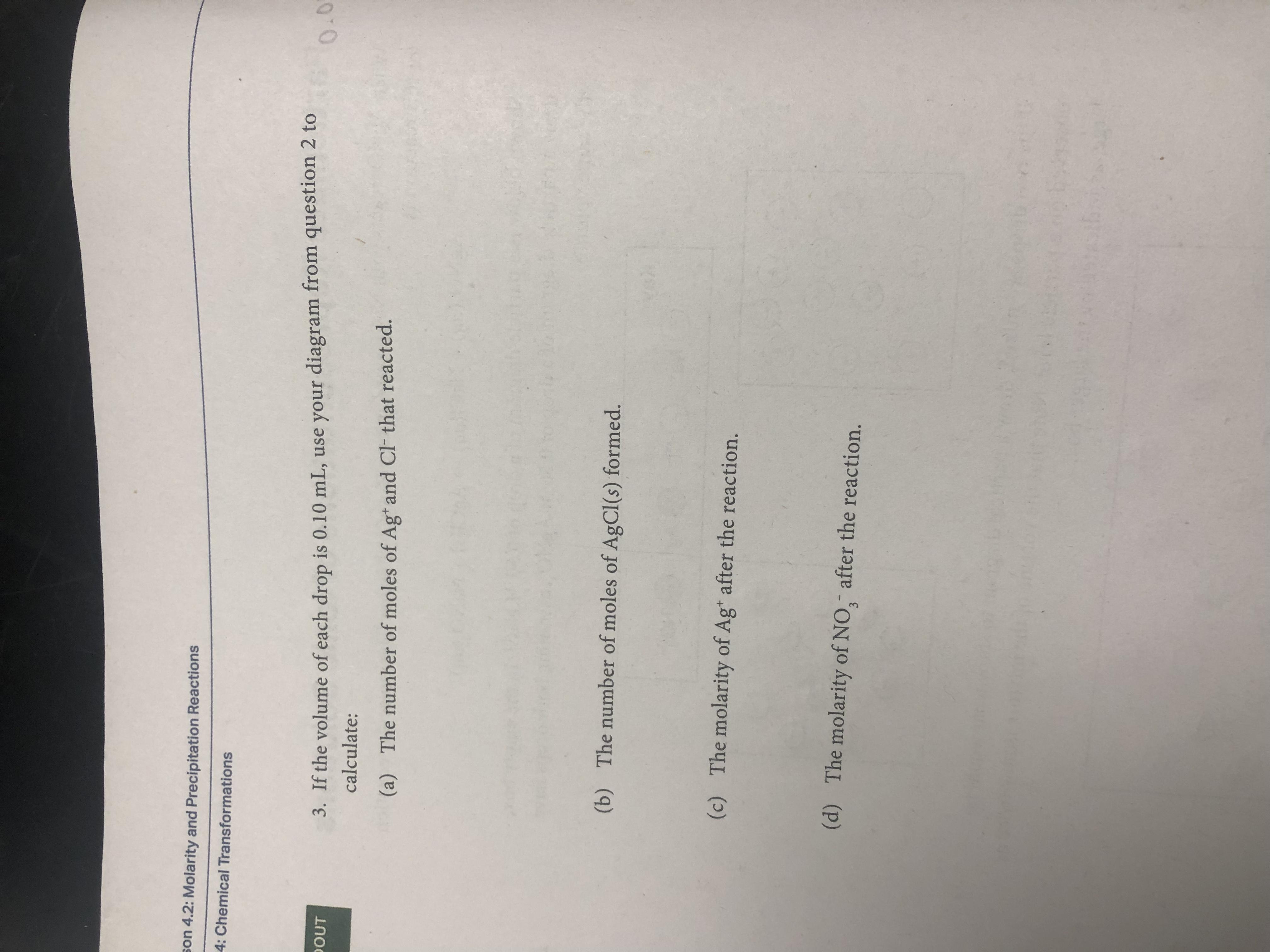
Answers
(a) The number of moles of Ag⁺ that reacted is 0.05 mmoles and moles of Cl- that reacted is 0.05 mmoles.
(b) The number of moles of AgCl(s) formed is 0.05 moles
(c) The molarity of Ag⁺ after the reaction = 0.0 M
(d) The molarity of NO₃⁻ after the reaction is 0.25 M
What is the number of moles of Ag and Cl- that reacted?The number of moles of Ag and Cl- that reacted is calculated as follows from the equation of the reaction:
AgNO₃ (aq) + NaCl (aq) ---> AgCl (s) + NaNO₃ (aq)
(a) The number of moles of Ag and Cl- that reacted:
Moles of Ag⁺ = 0.5 * 0.1
Moles of Ag⁺ = 0.05 mmoles
Moles of Ag⁺ that reacted = 0.05 mmoles
Moles of Cl⁻ = 0.5 * 0.1
Moles of Cl⁻ = 0.05 mmoles
Moles of Cl⁻ that reacted = 0.05 mmoles
(b) The number of moles of AgCl(s) formed.
Moles of AgCl that formed = 0.05 moles
(c) Since there are no more Ag⁺ ions in the mixture, the molarity of Ag⁺ after the reaction = 0 moles
(d) The molarity of NO₃⁻ after the reaction.
Moles of NO₃⁻ = 0.5 * 0.1
Moles of NO₃⁻ = 0.05 moles
Volume of mixture = 0.2 mL
The molarity of NO₃⁻ after the reaction = 0.05/0.2
The molarity of NO₃⁻ after the reaction = 0.25 M
Learn more about molarity at: https://brainly.com/question/30404105
#SPJ1
Which statement about the relationship between laws, hypotheses, and theories is true?
Answers
How many ways can you recall to synthesize
Answers
there are an infinite number of ways to synthesize an answer to a question, including the following:
Summarize the key points in a concise manner.
Provide a detailed explanation of the topic.
Use examples or analogies to illustrate the concept.
Break down the answer into smaller, more digestible pieces.
Address potential counterarguments or alternative perspectives.
Incorporate relevant statistics or data to support the answer.
Compare and contrast different aspects of the topic.
Provide historical context or a timeline of events.
Use a storytelling approach to engage the reader.
Use a Q&A format to organize the information.
To know more about answer synthesize, visit:
https://brainly.com/question/30029537
#SPJ1
The diagram shows the displayed formula of a substance. How many atoms of carbon are there in this substance?

Answers
Answer:
4
Explanation:
there are 4Cs on thr displayed formula showing the 4 carbon atom bonded in a straight chain. It is an aliphatic alcohol.
HQ5.40
Homework Answered Due Today, 11:59 PM
The reaction 3H₂(g) + N₂(g) → 2NH3(g) has an enthalpy of reaction of -92.6 kJ/mol. If 1 g of hydrogen and 2 g of nitrogen are
reacted, how much heat is produced (kJ)?
Answers
The amount of heat energy produced when 1 g of hydrogen and 2 g of nitrogen are reacted, is -6.61 KJ
How do i determine the heat energy produced?First, we shall obtain the limiting reactant. Details below:
3H₂ + N₂ -> 2NH₃
Molar mass of N₂ = 28 g/molMass of N₂ from the balanced equation = 1 × 28 = 28 g Molar mass of H₂ = 2 g/molMass of H₂ from the balanced equation = 3 × 2 = 6 gFrom the balanced equation above,
28 g of N₂ reacted with 6 g of H₂
Therefore,
2 g of N₂ will react with = (2 × 6) / 28 = 0.43 g of H₂
We can see that only 0.43 g of H₂ is needed in the reaction.
Thus, the limiting reactant is N₂
Finally, we the amount of heat energy produced. Details below:
3H₂ + N₂ -> 2NH₃ ΔH = -92.6 KJ
Molar mass of N₂ = 28 g/molMass of N₂ from the balanced equation = 1 × 28 = 28 gFrom the balanced equation above,
When 28 grams of N₂ reacted, -92.6 KJ of heat energy were produced.
Therefore,
When 2 grams of N₂ will react to produce = (2 × -92.6) / 28 = -6.61 KJ
Thus the heat energy produced from the reaction is -6.61 KJ
Learn more about heat energy:
https://brainly.com/question/31429264
#SPJ1
What does cellular respiration do?
Break down sugar and release energy for an
organism to use
Create sugar filled with energy
Deter predators
Form glucose from hydrogen, oxygen, and carbon
:D
help asap
Answers
Calculate the amount of energy (in kJ) required to increase the temperature of 255 g of water from 25.2 C to 90.5 C. Specific heat of water is 4.184J/g C.
Answers
Answer:
70.91 kJ
Explanation:
The amount of energy (in kJ) required to increase the temperature of 255 g of water from 25.2 C to 90.5 C can be calculated using the formula:
Q = m * c * ΔT
Where Q is the amount of energy, m is the mass of the substance, c is the specific heat, and ΔT is the change in temperature.
Substituting the given values:
m = 255 g
c = 4.184 J/g C
ΔT = (90.5 - 25.2) C = 65.3 C
Q = 255 g * 4.184 J/g C * 65.3 C
Q = 70905.564 J
Q = 70.91 kJ (rounded to two decimal places)
Therefore, the amount of energy required to increase the temperature of 255 g of water from 25.2 C to 90.5 C is 70.91 kJ.
2 Na2O2 + 2 H₂O = 4NaOH+O2
If sodium peroxide, Na2O2, is added to water, elemental oxygen gas, O2, and sodium
hydroxide, NaOH, are generated. Suppose 8.52 g of sodium peroxide, Na2O2, is added to a large
excess of water. What volume, in liters, of oxygen, O2, will be produced?
Answers
The volume of O₂ produced when 8.52 g of Na₂O₂ is added to excess water is approximately 1.17 liters at STP.
What is ideal gas law?When it comes to the ideal gas law, the underlying assumption is that the gas is in a state of thermodynamic equilibrium. This means that its molecules are not interacting with each other except through perfectly elastic collisions.
Equation:
We can use stoichiometry to determine the volume of oxygen gas produced from the reaction of 8.52 g of Na₂O₂.
First, we need to convert the mass of Na₂O₂ to moles using its molar mass:
8.52 g Na₂O₂ × (1 mol Na₂O₂ / 77.98 g Na₂O₂) = 0.1093 mol Na₂O₂
According to the balanced chemical equation, 1 mole of Na₂O₂ produces 1/2 mole of O₂:
2 Na₂O₂ + 2 H₂O → 4 NaOH + O₂
1 mol Na₂O₂ produces 1/2 mol O₂
So, the number of moles of O₂ produced is:
0.1093 mol Na₂O₂ × (1/2 mol O₂ / 1 mol Na₂O₂) = 0.05465 mol O₂
Finally, we can use the ideal gas law to determine the volume of O₂ produced at standard temperature and pressure (STP), which is defined as 0°C (273 K) and 1 atmosphere (1 atm) of pressure:
PV = nRT
At STP, the pressure and temperature are known, so we can rearrange the equation to solve for V:
V = nRT / P
Plugging the values, we get:
V = (0.05465 mol) × (0.08206 L atm mol⁻¹ K⁻¹) × (273 K) / (1 atm)
V ≈ 1.17 L
To know more about ideal gas law, click here
https://brainly.com/question/28257995
#SPJ1
What mass of water in grams will fill a tank 126cm long, 47 cm wide, and 13 cm high
Answers
Answer:
Mass = 76986 g
Explanation:
Given data:
Dimensions of tank = 126 cm× 47 cm× 13 cm
Mass of water required to filled = ?
Solution:
First of all we will calculate the volume of tank which is equal to the volume of water required to fill it.
Volume = length ×height ×width
Volume = 126 cm × 13 cm× 47 cm
Volume = 76986 cm³
Mass of water:
Mass = density × volume
density of water is 1 g/cm³
Mass = 1 g/cm³× 76986 cm³
Mass = 76986 g
Uric acid can collect in joints, giving rise to a medical condition known as gout. If the pKa of uric acid is 3.89, what is the pH of a 0.0140 M solution of uric acid?
Answers
Answer:
The pH of the solution is 2.873
Explanation:
Given:
Pka = 3.89pH of a 0.0140 MLet the solution of the uric acid be HA. We have to set up the ICE table as follows;
HA(aq) + H20(l) ⇄ H3O^+(aq) + A^-
I 0.0140 0 0
C -x +x +x
E 0.0140 - x x x
Ka = 10^-(pka)
= 10^-3.89
= 1.28 x 10^-4
Ka = [H+] * [A-]/[HA]
=> 1.28 x 10^-4 = [H+]^2 / 0.0140
=>[H+]^2 = 1.28 x 10^-4 x 0.014
=> [ H+] = 1.338656 x 10^-3
so pH = - log [ H+ ] = - log 1.338656 x 10^-3
= 3 - log 1.338656
= 2.87333101111
Learn more about acids here: brainly.com/question/12978582
3. How many grams of oxygen are required to completely react with 240g of C₂H6?
Answers
Approximately 766.08 grams of oxygen are required to completely react with 240g of C₂H₆.
To determine the amount of oxygen required to completely react with 240g of C₂H₆ (ethane), we need to set up a balanced chemical equation for the combustion of ethane.
The balanced equation for the combustion of ethane is as follows:
C₂H₆ + O₂ → CO₂ + H₂O
From the balanced equation, we can see that the stoichiometric ratio between C₂H₆ and O₂ is 1:3. This means that for every one mole of C₂H₆, three moles of O₂ are required for complete combustion.
To calculate the amount of oxygen required, we need to convert the given mass of C₂H₆ to moles using its molar mass, and then use the stoichiometric ratio to determine the moles of O₂ required. Finally, we can convert the moles of O₂ back to grams using the molar mass of oxygen.
The molar mass of C₂H₆ is calculated as follows:
(2 x atomic mass of carbon) + (6 x atomic mass of hydrogen)
(2 x 12.01 g/mol) + (6 x 1.01 g/mol) = 30.07 g/mol
Now, we can proceed with the calculation:
Calculate the moles of C₂H₆:
moles of C₂H₆ = mass of C₂H₆ / molar mass of C₂H₆
moles of C₂H₆ = 240 g / 30.07 g/mol ≈ 7.98 mol
Determine the moles of O₂ using the stoichiometric ratio:
moles of O₂ = moles of C₂H₆ x (3 moles of O₂ / 1 mole of C₂H₆)
moles of O₂ = 7.98 mol x 3 ≈ 23.94 mol
Convert moles of O₂ to grams:
mass of O₂ = moles of O₂ x molar mass of O₂
mass of O₂ = 23.94 mol x 32.00 g/mol = 766.08 g
For more such questions on oxygen visit:
https://brainly.com/question/28009615
#SPJ8
What is the frequency of gamma radiation with energy of 6.96 x 10⁻¹⁴ J?
Answers
The frequency of gamma radiation is calculated to be = 1.11 *10^20 Hz.
What is gamma radiation?A gamma radiation is also known as gamma ray. It is a penetrating form of electromagnetic radiation arising from radioactive decay of atomic nuclei. It consists of shortest wavelength electromagnetic waves, even shorter than X-rays.
Gamma rays can pass through the human body completely and as they pass through, they cause ionizations that damage tissue and DNA.
As we know that E= hf
Hence, f= E/h
Given E= 6.96 x 10⁻¹⁴ J
And, Planck's constant, h = 6.626 *10^-34 m² kg/s
f = 6.96 * 10^-14J +/6.626 *10^-34
f = 1.11 *10^20 Hz
Hence, frequency of gamma radiation = 1.11 *10^20 Hz.
To know more about gamma radiation, refer
https://brainly.com/question/22166705
#SPJ1
Find the ΔHr0 for the reaction : 2HCl(aq) + Ca(OH)2(s) → CaCl2(s) + 2H2O(l)
Answers
The standard enthalpy change of reaction for the given reaction is -46.9 kJ/mol. Since the enthalpy change is negative, it indicates that the reaction is exothermic and releases energy in the form of heat.
What is Enthalpy?
Enthalpy (H) is a thermodynamic property that describes the total heat content of a system at constant pressure. It is a measure of the internal energy of a system, which includes the energy required to create or destroy the system as well as the energy required to maintain its temperature and pressure.
The standard enthalpy change of reaction (ΔHr0) can be determined using the standard enthalpies of formation (ΔHf0) of the reactants and products.
2HCl(aq) + Ca(OH)2(s) → CaCl2(s) + 2H2O(l)
The standard enthalpy change of reaction can be calculated using the following equation:
ΔHr0 = Σ(nΔHf0(products)) - Σ(nΔHf0(reactants))
ΔHf0(HCl(aq)) = -167.2 kJ/mol
ΔHf0(Ca(OH)2(s)) = -986.1 kJ/mol
ΔHf0(CaCl2(s)) = -795.8 kJ/mol
ΔHf0(H2O(l)) = -285.8 kJ/mol
Substituting the values into the equation, we get:
ΔHr0 = [2(ΔHf0(H2O(l))) + ΔHf0(CaCl2(s))] - [2(ΔHf0(HCl(aq))) + ΔHf0(Ca(OH)2(s))]
ΔHr0 = [2(-285.8 kJ/mol) + (-795.8 kJ/mol)] - [2(-167.2 kJ/mol) + (-986.1 kJ/mol)]
ΔHr0 = (-571.6 kJ/mol - 795.8 kJ/mol) - (-334.4 kJ/mol - 986.1 kJ/mol)
ΔHr0 = -1367.4 kJ/mol + 1320.5 kJ/mol
ΔHr0 = -46.9 kJ/mol
Therefore, the standard enthalpy change of reaction for the given reaction is -46.9 kJ/mol. Since the enthalpy change is negative, it indicates that the reaction is exothermic and releases energy in the form of heat.
Learn more about Enthalpy from given link
https://brainly.com/question/14047927
#SPJ1
What two processes can harm soil fertility
Answers
Over-tilling and Over farming are the two processes that can harm the fertility of the soil.
Over-tilling refers to the exceeding levels of tilling and levelling the soil which adversely affects the quality of the soil. This is because tillage fractures the soil, it disrupts soil structure, accelerating surface runoff and soil erosion. Tilling of soil also reduces crop residue, which help cushion the force of pounding raindrops.
Without crop residue, soil particles become more easily dislodged, being moved or 'splashed' away. The splashed particles clog soil pores, effectively sealing off the soil's surface, resulting in poor water infiltration and hence subsequently affects the soil fertility.
Similarly, the main effect of over-farming is soil depletion. When crops are grown in the same place year after year, the soil becomes depleted of the nutrients that the plants need to grow. This can lead to lower yields and poorer quality crops. In extreme cases, it can lead to desertification.
So, these two are the processes that can harm soil fertility.
To know more about soil erosion, click below:
https://brainly.com/question/17905503
#SPJ9
6. How many aluminum atoms are there in 3.50 grams of Al₂O3?
Answers
Answer:
4.13×10^22 atoms
Explanation:
1. Find number of moles
mole=mass/rmm of compound
mole= 3.50/102
mole= 7/204 mol
2. Multiply it with avagadros constant( 6.02×10^23 particles)
7/204 × 6.02×10^23= 2.0657×10^22
3. Multiply it with the number of ALMINIUM ATOMS IN AL203( which is 2 atoms)
2.0657×10^22 × 2
you get 4.13×10^22 atoms
The oxidation of glucose to carbon dioxide and water is represented by the following reaction, whether the oxidation occurs by combustion in the laboratory or by biological oxidation in living cells: C6H12O6+6O2⇌6CO2+6H2O When combustion is carried out under controlled conditions in the laboratory, the reaction is highly exothermic, with an enthalpy change (ΔH) of −673kcal/mol. As you know, ΔG for this reaction at 25∘C is −686kcal/mol, so the reaction is also highly exergonic. Part A Explain what the ΔH and ΔG values mean. What do the negative signs mean in each case? Drag the terms on the left to the appropriate blanks on the right to complete the sentences. Terms can be used once, more than once, or not at all.
Answers
Answer:
See explanation
Explanation:
∆H is known as the change in enthalpy. When the change in enthalpy is negative, it simply means that heat is given out during the reaction. Therefore, we refer to the reaction as an exothermic reaction.
Similarly, ∆G is known as change in free energy. When the change in free energy is negative, it implies that the reaction is spontaneous as written. This is called an exergonic reaction.
How large are dwarf galaxies compared to the Milky Way galaxy?
Answers
Answer:
A dwarf galaxy is a small galaxy composed of about 1000 up to several billion stars, as compared to the Milky Way's 200–400 billion stars
Answer:
A dwarf galaxy is a small galaxy composed of about 1000 up to several billion stars, as compared to the Milky Way's 200–400 billion stars.
Explanation:
same answer for me
how many moles of Fe2O3 will react with 99.0 g of Al
Answers
Taking into account the reaction stoichiometry, 1.83 moles of Fe₂O₃ will react with 99.0 g of Al
Reaction stoichiometryIn first place, the balanced reaction is:
2 Al + Fe₂O₃ → Al₂O₃ + 2 Fe
By reaction stoichiometry, the following amounts of moles of each compound participate in the reaction:
Al: 2 molesFe₂O₃: 1 moleAl₂O₃: 1 moleFe: 2 molesThe molar mass of the compounds is:
Al: 27 g/moleFe₂O₃: 159.7 g/moleAl₂O₃: 102 g/moleFe: 55.85 g/moleBy reaction stoichiometry, the following mass quantities of each compound participate in the reaction:
Al: 2 moles ×27 g/mole= 54 gramsFe₂O₃: 1 mole ×159.7 g/mole= 159.7 gramsAl₂O₃: 1 mole ×102 g/mole= 102 gramsFe: 2 moles ×55.85 g/mole= 111.7 gramsMass of Fe₂O₃ requiredIt is possible to use a simple rule of three as follows: If by reaction stoichiometry 54 grams of Al react with 1 mole of Fe₂O₃, 99 grams of Al react with how many moles of Fe₂O₃?
moles of Fe₂O₃= (99 grams of Al ×1 mole of Fe₂O₃)÷54 grams of Al
moles of Fe₂O₃= 1.83 moles
Finally, 1.83 moles of Fe₂O₃ is needed.
Learn more about the reaction stoichiometry:
brainly.com/question/24741074
#SPJ1
2NO + 3MnO2 + 4H â 2NO3- + 3Mn2 + 2H2O For the above redox reaction, assign oxidation numbers and use them to identify the element oxidized, the element reduced, the oxidizing agent and the reducing agent.
Answers
Answer:
Manganese decreases from 4+ to 2+ (reduced and oxidizing agent) and nitrogen increases from 2+ to 5+ (oxidized and reducing agent).
Explanation:
Hello there!
In this case, according to the given redox reaction, we rewrite it as a convenient first step:
\(2NO + 3MnO_2 + 4H^+ \rightarrow 2NO_3^- + 3Mn^{2+} + 2H_2O\)
Next, we assign the oxidation numbers as follows:
\(2N^{2+}O^{2-} + 3Mn^{4+}O^{-2}_2 + 4H^+ \rightarrow 2(N^{5+}O^{2-}_3)^- + 3Mn^{2+} + 2H^+_2O^{2-}\)
Thus, we can see that both manganese and nitrogen undergo a change in their oxidation number, the former decreases from 4+ to 2+ (reduced and oxidizing agent) and the latter increases from 2+ to 5+ (oxidized and reducing agent).
Regards!
When 2 equal forces act on and object and the object generally doesn't move is
A. interia
B. unbalanced force
C. balanced force
D. speed
Answers
Answer:
a balanced force since the object isn't moving
hope this helped