Answers
This question is incomplete, the complete question is;
The flask contains 10.0mL of HCl and a few drops of phenolphthalein indicator.
The buret contains 0.320 M NaOH,
It requires 11.2 mL of the NaOH solution to reach the end point of the titration
What is the initial concentration of HCI?
Answer:
initial concentration of HCl is 0.3584 M
Explanation:
Given that;
the reaction between HCl and NaOH is 1:1 molar
HCl(aq) + NaOH(aq) -------> NaCl(aq) + H2O(l)
we know that molarity is the number of moles of solute per liter of solution
so moles of NaOH consumed
= ( 0.320 mol / 1000ml) × 11.2ml
= 0.003584 mol
now
0.003584 moles of NaOH reacts with 0.003584 moles of HCl
moles of HCl present in the 10.0ml solution = 0.003584 mol
therefore the initial concentration of HCl
= ( 0.003584 mol / 10.0ml )× 1000ml
= 0.3584 M
the initial concentration of HCl is 0.3584 M
Related Questions
What is the name of the functional group -CH2CH3?
A) propyl
B) methyl
C) ether
D) ethyl

Answers
1. Which statement is always true when nuclear fusion occurs?
A. The number of protons in the resulting nucleus is less than in each starting nucleus.
B. The number of protons in the resulting nucleus is double that of a starting nucleus.
C. The combined number of portions and neutrons remains constant.
D. The total number of protons and neutrons in each nucleus remains constant.
•
2. Use the equation to answer the question.
2H + 2H—> 4H + energy
1 1 2
Which statement best describes the mass numbers of the atoms in the reaction?
A. There are two atoms with mass numbers of 2.
B. There is one atom with
a mass number of 2.
C. There are two atoms with mass numbers of 1.
D. There is one atom with a mass number of 1.
•
3. How is the mass number calculated for an atom involved in nuclear fusion?
A. It is the number of electrons.
B. It is the number of protons plus electrons.
C. It is the number of neutrons.
D. It is the number of protons plus neutrons.
•
4. Which change will always take place in nuclear fusion?
A. The total charge will be less than before the fusion took place.
B. The nucleus with a smaller mass than any of the reactants will be produced.
C. A nucleus with a greater mass than any of the reactants will be produced.
D. The total charge will be greater than before the fusion took place.
•
5. Which statement best summarizes the way the sun produces energy?
A. Combustion reactions in the sun release large amounts of chemical energy.
B. Fusion reactions in the sun release large amounts of chemical energy.
C. Combustion reactions in the sun convert small amounts of matter into large amounts of energy.
D. Fusion reactions in the sun convert small amounts of matter into large amounts of energy.
Answers
Answer:
1. The combined number of protons and neutrons remains constant.
2. There are two atoms with mass numbers of 2.
3. It is the number of protons plus neutrons.
4. A nucleus with a greater mass than any of the reactants will be produced.
5. Fusion reactions in the sun convert small amounts of matter into large amounts of energy.
A beaker weighed 53.10g. To the isolated beaker was added 5.348g of iron pellets and 56.1g of hydrochloride acid. What was the total mass of the beaker and the products after reaction?
Answers
114.5 g is the total mass of the beaker .
Total mass of beaker=53.10g+5.348g+ 56.1g
Total mass=114.5 g
Mass is used in physics to specific inertia, a fundamental function of all remember. basically, it's far a mass of rely's resistance to changing its course or pace in response to the software of a force.
The exchange that an applied force produces is smaller the extra mass a body has. The kilogram, the unit of mass within the international machine of gadgets, corresponds to 6.62607015 1034 joule seconds using Planck's consistent (SI). One joule is produced by way of multiplying one kilogram by means of one rectangular meter per 2d.
The kilogram is decided by genuine measurements of Planck's regular on account that the second one and the meter have formerly been described in phrases of other bodily constants.
To know more about mass visit : brainly.com/question/5661976
#SPJ9
What is the final concentration when 5 ml of a 2.5M copper sulphate solution is diluted to 750 ml?
Answers
Answer: The final concentration when 5 ml of a 2.5M copper sulphate solution is diluted to 750 ml is 0.017 M
Explanation:
According to the dilution law,
\(M_1V_1=M_2V_2\)
where,
\(M_1\) = molarity of stock \(CuSO_4\) solution = 2.5 M
\(V_1\) = volume of stock \(CuSO_4\)solution = 5 ml
\(M_1\) = molarity of diluted \(CuSO_4\) solution = ?
\(V_1\) = volume of diluted \(CuSO_4\) solution = 750 ml
Putting in the values we get:
\(2.5\times 5=M_2\times 750\)
\(M_2=0.017\)
Therefore the final concentration when 5 ml of a 2.5M copper sulphate solution is diluted to 750 ml is 0.017 M
In ironmaking, iron metal can be separated from iron ore (Fe2O3) by heating the ore in a blast furnace in the presence of coke, which is a form of carbon: 2 Fe2O3(s) + 3 C(s) → 4 Fe(s) + 3 CO2(g) If 1000 kg of iron ore and 120 kg of coke are heated in a blast furnace, determine the limiting reactant, the theoretical yield of iron metal, and the theoretical yield of carbon dioxide.
Answers
The limiting reactant is iron ore, the theoretical yield of iron metal is 701.344 kg, and the theoretical yield of carbon dioxide is 413.292 kg.
Stoichiometric problemFrom the equation of the reaction:
\(2 Fe_2O_3(s) + 3 C(s) --- > 4 Fe(s) + 3 CO_2(g)\)
The mole ratio of iron ore to carbon is 2:3.
Mole of 1000 kg of iron ore = 1000000/159.69
= 6,262 moles
Mole of 120 kg carbon = 120000/12
= 10,000 moles
Thus, it appears that the carbon is in excess while the iron ore is limited in availability.
The mole ratio of the iron ore and the iron produced is 1:2. Thus, the equivalent number of moles of iron produced will be:
6,262 x 2 = 12,524 moles
Mass of 12,524 moles of iron = 12,524 x 56
= 701,344 g or 701.344 kg
Thus, the theoretical yield of iron is 701.344 kg.
The mole ratio of the iron ore and the carbon dioxide produced is 2:3. The equivalent mole of carbon dioxide produced will be:
6,262 x 3/2 = 9,393 moles
Mass of 9,393 moles carbon dioxide = 9,393 x 44
= 413,292 or 413.292 kg
The theoretical yield of carbon dioxide is, therefore, 413.292 kg.
More on stoichiometric problems can be found here: https://brainly.com/question/14465605
#SPJ1
? If a weaker solution of sodium bicarbonate was used in beaker b, would that solution require more or less hydrochloric to neutralize it and why?
Answers
Answer:
less HCL acid is required to neutralize a weaker solution of base (sodium bicarbonate).
Explanation:
An electrical circuit has a resistance of 20 ohms and a current of 0.05A. What voltage is applied in this circuit?
Answers
Answer:
1 volt
Explanation:
Use Ohm's Law:
V = IR
V = (0.05A)(20 ohms) = 1 volt
An electrical circuit has a resistance of 20 ohms and a current of 0.05A. The voltage is applied in this circuit is 1 volt.
What is Ohm's Law ?Ohm's Law states that the current in a circuit is equal to the potential difference divided by the resistance of the circuit. It is represented by V = IR, where V is the voltage difference, I is the current in amperes, and R is the resistance in ohms.
The law can be used to perform calculations such as determining the value of resistors or current in a circuit, or measuring voltage. Furthermore, Ohm's law assists us in describing how current flows through materials such as electrical wires, etc.
By using Ohm's Law we get,
V = IR
V = (0.05A)(20 ohms)
= 1 volt
Thus, The voltage is applied in this circuit is 1 volt.
To learn more about the Ohm's Law, follow the link;
https://brainly.com/question/1247379
#SPJ6
Create lattice for CaCl2
Answers

A balloon is inflated to a volume of 8.0 L on a day when the atmospheric pressure is 1.013 bar . The next day, a storm front arrives, and the atmospheric pressure drops to 0.968 bar . Assuming the temperature remains constant, what is the new volume of the balloon, in liters
Answers
Answer:
\(V_2=8.4L\)
Explanation:
Hello there!
In this case, according to the definition of the Boyle's law, which describes de pressure-volume behavior as an inversely proportional relationship, it is possible for us to write:
\(P_1V_1=P_2V_2\)
Thus, since we are given the initial pressure and temperature, and the final pressure, we are able to calculate the final volume as shown below:
\(baV_2=\frac{P_1V_1}{P_2}\\\\V_2=\frac{8.0L*1.013bar}{ 0.968bar}\\\\V_2=8.4L\)
Regards!
What forms of energy are produced when
fossil fuels burn?
Answers
When fossil fuels burn, several forms of energy are produced, including:
Heat energy: The primary form of energy released during fossil fuel combustion is heat. Fossil fuels contain chemical energy stored for millions of years, and when they burn, this energy is released in the form of heat. The heat energy can be harnessed for various purposes, such as heating buildings or generating steam to drive turbines.
Light energy: Burning fossil fuels can also produce light energy in the form of flames or glowing embers. This light energy is a byproduct of combustion.
Mechanical energy: Heat generated by burning fossil fuels can be converted into mechanical energy. This is typically achieved by using heat to produce steam, which drives a turbine connected to a generator. The rotating turbine converts the heat energy into mechanical energy, which is further transformed into electrical energy.
Electrical energy: Through the process described above, burning fossil fuels can ultimately generate electrical energy. The mechanical energy produced by the turbine is converted into electrical energy by the generator. Electrical energy can power various devices, appliances, industries, and infrastructure.
It's critical to note that while burning fossil fuels can produce useful forms of energy, it also results in the release of carbon dioxide and other greenhouse gases. This contributes to climate change and environmental concerns. As a result, there is a global shift towards cleaner and renewable energy sources to mitigate these negative impacts.
Question: How will soap or alcohol affect the hydrogen bonds between different water molecules? Hypothesis: Materials: Penny, water, soap, pipette, paper towel, 70% rubbing alcohol
Answers
Answer:
A soap or alcohol will interfere with the hydrogen bonding between water molecules making it weaker
Explanation:
A water molecule is polar as the oxygen atom is strongly electronegative and draws the electrons it shares with the hydrogen atoms in the water molecule to itself. This creates a partial negative charge on the oxygen atom and partial positive charges on the hydrogen atoms. The attraction of neighboring oxygen to hydrogen atoms in a water molecule results in hydrogen bonding.
However, a detergent molecule which has a polar head and a hydrophobic tail, when added to water significantly interferes with the hydrogen bonding between water molecules. The polar head is attracted to water molecules whereas the hydrophobic tail of each molecule are not. The detergent molecules form clusters known as micelles with the polar heads attracted to water and the hydrophobic tails directed towards the center of the micelle, away from water molecules. This weakens the hydrogen bonding between water molecules
An alcohol contains a polar -OH group in its molecules. However, the hydrogen bonding between alcohol molecules are weaker than that in water because the other end of the alcohol molecule has a C-O bond which is less polar than the O-H bond. Therefore, when an alcohol is added to water, it weakens the hydrogen bonding in water.
This weakening of the hydrogen bonding in water also has the effect of lowering the surface tension of water.
When alcohol is added to water, it disrupts the hydrogen bonding network between water molecules. Alcohol molecules compete with water molecules for hydrogen bonding sites, leading to a decrease in the number and strength of hydrogen bonds between water molecules.
When soap is added to water, the hydrophobic tails of the soap molecules are attracted to each other, forming structures called micelles.
Alcohol, such as rubbing alcohol (isopropyl alcohol), is a different type of molecule compared to soap.
Experiment with a penny, water, soap, and rubbing alcohol, the soap is likely to disrupt the hydrogen bonds more significantly than rubbing alcohol. Soap will interfere with the hydrogen bonding between water molecules through micelle formation and reduction of surface tension.
To learn more about the hydrogen bonds, follow the link:
https://brainly.com/question/31139478
#SPJ6
22.4 L is the volume of any gas regardless of atmospheric conditions.
O True
O False
Answers
5. What is the wavelength of a radio station emitting its signal at 95.5 MHz? Estimate your
answer to the nearest power of ten.
Answers
Answer:
\(\lambda=314\times 10^{-2}\ m\)
Explanation:
Given that,
Frequency, f = 95.5 MHz
We need to find the wavelength of a radio station emitting its signal.
The relation between the frequency and the wavelength is given by :
\(c=f\lambda\\\\\lambda=\dfrac{c}{f}\\\\\lambda=\dfrac{3\times 10^8}{95.5\times 10^6}\\\\=3.14\ m\)
or
\(\lambda=314\times 10^{-2}\ m\)
So, the wavelength of a radio station is \(314\times 10^{-2}\ m\).
what cases might humans need to collaborate with computers to solve a problem
Answers
Answer:
Like when they work of need to look something important
Explanation:
like image you are chilling and then your like omg I need to turn in the work and you go to your computer and send it but you used your computer
CHEMISTRY!! 50 POINTS!
There are 5.5 L of a gas present at -38.0 C. What is the temperature if the volume of the gas has changed to 1.30 L?
Answers
Answer:
The answer to this question is 33.8
The name of the metal is the only name that may have a small change in spelling when it is part of the compound
Answers
Answer:
goat
Explanation:
boat how do i build 90s
How liters of HCLO3 will be produced from 10 litters of CLO2
Answers
The amount of \(HClO_3\) that will be produced from 10 liters of \(ClO_2\) would be 8.33 liters.
Stoichiometric problem\(HClO_3\) is produced from the reaction of \(ClO_2\) and \(H_2O\) according to the following equation:
\(6 ClO_2 + 3 H_2O --- > 5 HClO_3 + HCl\)
From the balanced equation of the reaction, 6 moles of \(ClO_2\) reacts to produce 5 moles of \(HClO_3\). Thus the mole ratio is 6:5.
Now, assuming the mole ratio also transcribes to the volume ratio and 10 liters of \(ClO_2\) is available for reaction. The amount of \(HClO_3\) that will be produced can be calculated from the volume ratio as follows:
6 moles \(ClO_2\) = 5 moles \(HClO_3\)
10 liters \(ClO_2\) = 5 x 10/6
= 8.33 liters
In other words, with 10 liters of \(ClO_2\), the volume of \(HClO_3\) that will be produced would be 8.33 liters.
More on stoichiometric problems can be found here: https://brainly.com/question/15047541
#SPJ1
why does beryllium not liberate hydrogen from acid readily
Answers
How many moles are in 1.5 x 10^23 atoms of fluorine?
Answers
Answer: 0.125 moles F2
Explanation: 1.5x10²³ atoms of F = 0.75x10^23 molecules F2
moles F2 = 0.75x10^23/avogadro number = 0.125 moles
There are 0.25 moles in 1.5 x \(10^{23}\) atoms of fluorine.
Given,
How many moles are in one atom?
In one mole we have,
6.02 x \(10^{23}\) atoms.
1 mole = 6.02 x \(10^{23}\) atoms
Find the number of moles in 1.5 x \(10^{23}\) atoms of fluorine.
We have,
1 mole = 6.02 x \(10^{23}\) atoms
Multiply 1.5 x \(10^{23}\) / 6.02 x \(10^{23}\) on both sides
1.5 x \(10^{23}\) / 6.02 x \(10^{23}\) x 1 mole = 1.5 x \(10^{23}\) / 6.02 x \(10^{23}\) x 6.02 x \(10^{23}\) atoms
1.5/6.02 mole = 1.5 x \(10^{23}\) atoms
0.25 moles = 1.5 x \(10^{23}\) atoms.
Thus there are 0.25 moles in 1.5 x \(10^{23}\) atoms of fluorine.
Learn more about finding the number of moles in 25.0g of ammonium here:
https://brainly.com/question/21732146
#SPJ2
Hi can anyone please answer this!

Answers
Ai. The car's initial kinetic energy is 22657.94 J
Aii. The car's initial potential energy is 939960.1 J
B. The car's final kinetic energy is 171420.38 J
C. The car's change in kinetic energy is 148762.44 J
Ai. How do I determine the car's initial kinetic energy?
We can obtain the initial kinetic energy of the car as illustrated below:
Mass (m) = 1250 lb = 1250 × 0.453592 = 566.99 Kginitial Velocity (u) = 20 mi/h = 20 × 0.44704 = 8.94 m/sInitial Kinetic energy (KE₁) =?KE₁ = ½mu²
KE₁ = ½ × 566.99 × 8.94²
KE₁ = 22657.94 J
Aii. How do I determine the car's initial potential energy?
The car's initial potential energy can be obtained as shown below:
Mass (m) = 566.99 KgHeight (h) = 555 ft = 555 × 0.3048 = 169.164 mAcceleration due to gravity (g) = 9.8 m/s² Initial Potential energy (PE₁) = ?PE₁ = mgh
PE₁ = 566.99 × 9.8 × 169.164
PE₁ = 939960.1 J
B. How do I determine the car's final kinetic energy?
The final kinetic energy of the car can be obtained as illustrated below:
Mass (m) = 1250 lb = 1250 × 0.453592 = 566.99 Kginitial Velocity (u) = 55 mi/h = 55 × 0.44704 = 24.59 m/sFinal Kinetic energy (KE₂) =?KE₂ = ½mv²
KE₂ = ½ × 566.99 × 24.59²
KE₂ = 171420.38 J
C. How do I determine the car's change in kinetic energy?
The change in the kinetic energy of the car can be obtained as follow:
Initial Kinetic energy (KE₁) = 22657.94 JFinal Kinetic energy (KE₂) = 171420.38Change in kinetic energy (ΔKE) =?ΔKE = KE₂ - KE₁
ΔKE = 171420.38 - 22657.94
ΔKE = 148762.44 J
Learn more about kinetic and potential energy:
https://brainly.com/question/7981774
https://brainly.com/question/22274239
#SPJ1
What is the blocks average speed nearest hundredth of a m/s
Answers
The question is incomplete, the complete question is;
A block is pulled 0.90 m to the right in 2.5 s. What is the blocks average speed to the nearest hundredth of a m/s
Answer:
0.36 m/s to the hundredth place
Explanation:
Now let us remember the definition of speed. Speed is defined in physics as distance/time.
Here we have the distance as 0.9 m
We have the time as 2.5 s
Hence the average speed is obtained from;
Speed = 0.9/2.5 = 0.36 m/s to the hundredth place
The K of a given reactions is 432. Is the reaction favorable or not favorable?
Answers
Answer:Favorable
Explanation:um I know That it is Favorable sorry!
A particular power source creates electricity through the use of giant magnets that are rotated to create a flow of electrons. This electricity is then directed:
A. from the electric generator to electric outlets in homes.
B. from the electronic device to an electric outlet.
C. from the electric generator to a ground wire
D. to be stored in batteries, or "tanks"
Answers
A compound of a transition metal and iodine is 56.7% metal by mass.How many grams of the metal can be obtained from 630 g of this compound?
Answers
Answer:
357 g of the transition metal are present in 630 grams of the compound of the transition metal and iodine
Explanation:
In any sample of the compound, the percentage by mass of the transition metal is 56.7%. This means that for a 100 g sample of the compound, 56.7 g is the metal while the remaining mass, 43.3 g is iodine.
Given mass of sample compound = 630 g
Calculating the mass of iodine present involves multiplying the percentage by mass composition of the metal by the mass of the given sample;
56.7 % = 56.7/100 = 0.567
Mass of transition metal = 0.567 * 630 = 357.21 g
Therefore, the mass of the transition metal present in 630 g of the compound is approximately 357 g
Particle A has very little mass in comparison to Particle B. Both particles are in the same atom. Which is the best conclusion about Particles A and B?
They have the same charge.
They are located in the nucleus together.
Particle A has a positive charge, and Particle B is neutral.
Particle A orbits the nucleus, and Particle B is located in the nucleus.
Answers
Answer:
Particle A orbits the nucleus, and Particle B is located in the nucleus.
Explanation:
Since both particles A and B can be found in the same atom, the particles can either be protons, neutrons and electrons.
There are three fundamental subatomic particles which are the protons, neutrons and the electrons.
Protons and neutrons are found within the nucleus of an atom.
Electrons orbits the nucleus.
The mass of protons and neutrons is very large and so, they determine the mass of the atom.
The mass of electrons is very small and negligible compared to the mass of the neutrons and protons.
The electrons orbits around the nucleus.
Answer:
D
Explanation:
Because both Particles A and B can be found in the exact same atom.
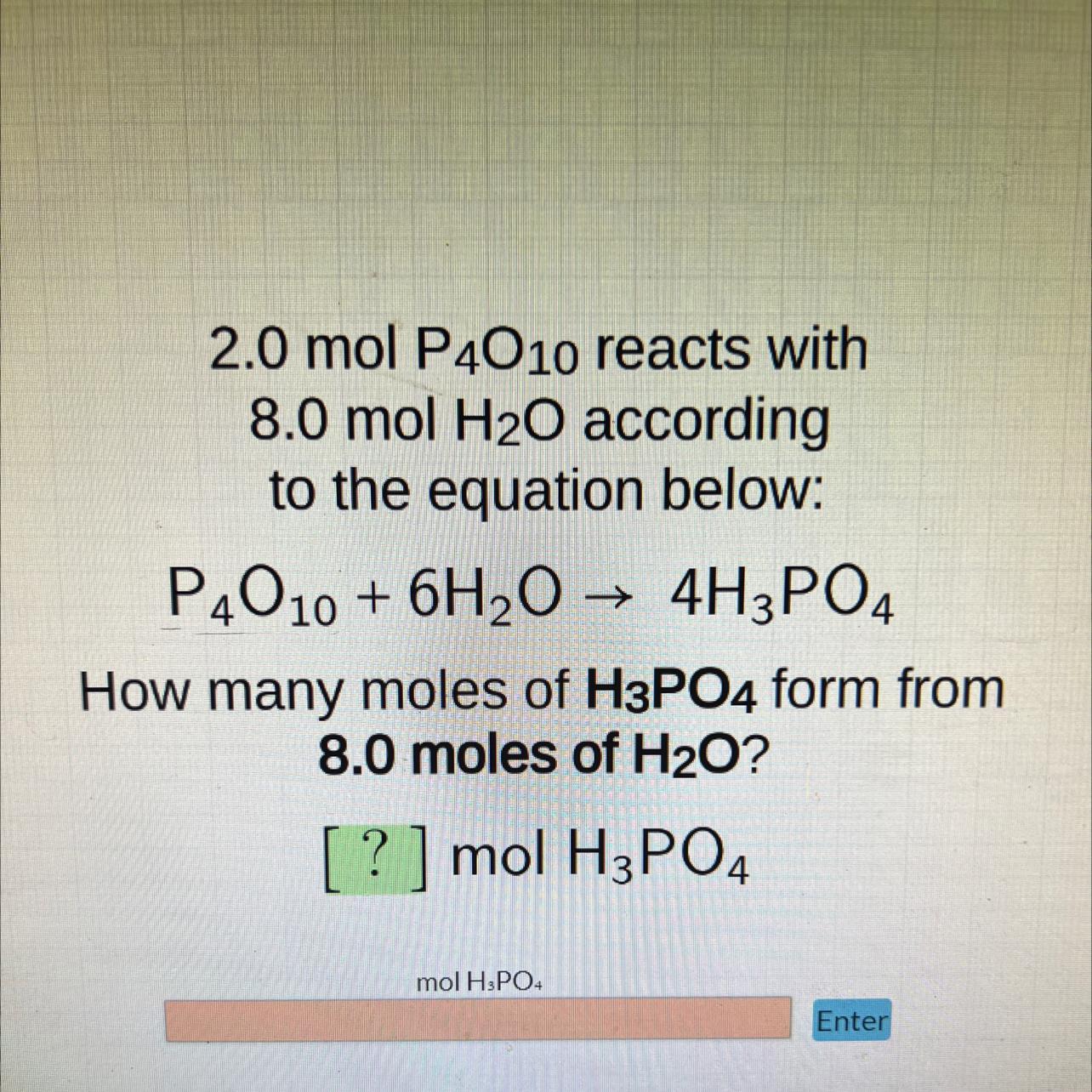
help pls!!! how many moles of H3PO4 form from 8.0 moles of H2O?
Answers
The number of mole of H₃PO₄ that can be formed from the reaction of 2 moles of P₄O₁₀ and 8 moles of H₂O is 5.33 moles
How do i determine the mole of H₃PO₄ formed?First, we shall determine the limiting reactant. Details below
P₄O₁₀ + 6H₂O -> 4H₃PO₄
From the balanced equation above,
1 mole of P₄O₁₀ reacted with 6 moles of H₂O
Therefore,
2 moles of P₄O₁₀ will react with = 2 × 6 = 12 moles of H₂O
From the above calculation, we can see that a higher amount of H₂O is needed to react completely with 2 moles of P₄O₁₀
Thus, H₂O is the limiting reactant.
Now, we shall determine the mole of H₃PO₄ formed from the reaction. Details below:
P₄O₁₀ + 6H₂O -> 4H₃PO₄
From the balanced equation above,
6 moles of H₂O reacted with 4 moles of H₃PO₄
Therefore,
8 moles of H₂O will react with = (8 × 4) / 6 = 5.33 moles of H₃PO₄
Thus, the mole of H₃PO₄ formed is 5.33 moles
Learn more about number of mole:
https://brainly.com/question/13375719
#SPJ1
What is the percent composition of Fluorine (F) in the compound XeF6?
Od
26.258%
12.520%
110.76%
46.472%
Answers
The percent by mass of the fluorine in the compound is 46.472%.
What is the percent by mass?We know that the percent by mass has to do with the ratio of the total mass of the atom that is part of the compound and the total molar mass of the compound multiplied by one hundred.
The question in this case has demanded that we ought to obtain the mass percent of fluorine from the compound that we can be able to identify from the formula of the compound that is shown here as xenon hexa fluoride.
Mass of the compound can be obtained from; 131 + 6(19)
= 245 g/mol
The total mass of the fluorine atom in the compound is 114 g
Thus we have the use of; 114 /245 * 100/1
= 46.472%
The percent by mass is now gotten for the fluorine atom as 46.472%.
Learn more about percent by mass:https://brainly.com/question/5394922
#SPJ1
4. Long answer type questions: a. b. C. d. e. f. g. h. j. i. What are the constituent gases of air? Why is the surrounding air not seen with the eyes? How do you prove that air supports burning? How do you show that air occupies space? How do you prove that air has weight? How is air useful to us? Mention any three points. Write any three properties of air. How can you say that air exerts force? Write any four effects of air pollution. Write any three causes of air pollution and any two control measures of it.
Answers
1. The constituent gases of air are:
Nitrogen Oxygen Argon Carbon Dioxide2. The surrounding air is not seen with the eyes because it is transparent. Air molecules are not visible to the na-ked eye, and they do not scatter or absorb visible light significantly. Therefore, air appears colorless and transparent.
What is air?3. To prove that air supports burning, you can perform an experiment with a burning candle. Place a glass jar or bell jar over a lit candle, ensuring that the jar is airtight. As the candle burns, it consumes oxygen from the air inside the jar. Eventually, the candle flame will go out due to the lack of oxygen, proving that air (specifically oxygen) is necessary for burning.
4. To show that air occupies space, you can perform a simple experiment using a plastic bottle or syringe. Fill the bottle or syringe with water, ensuring there are no air bubbles. Then, cover the opening tightly and try to compress the air inside. You will find that it is not possible to compress the air significantly, indicating that air occupies space.
5. To prove that air has weight, you can use a sensitive balance or scale. Weigh an airtight container or balloon, and then fill it with air. The weight of the container or balloon with the added air will be greater than its initial weight, demonstrating that air has weight.
6. Air is useful to us in various ways. Three points highlighting the importance of air are:
Breathing and RespirationCombustion and Energy ProductionClimate Regulation7. Three properties of air include:
Air is Compressible: Air can be compressed or expanded under different conditions, allowing it to fill various spaces and containers.Air has Mass: Air molecules have mass, which means air itself has weight. It exerts pressure on objects and surfaces.Air Exerts Pressure: Due to the collisions of air molecules with surfaces, air exerts pressure in all directions. This pressure is known as atmospheric pressure.Air exerts force in various ways. For example, air pressure allows objects like airplanes to fly by providing lift. Air resistance or drag opposes the motion of objects moving through the air, creating a force that can affect their speed and trajectory.
8. Four effects of air pollution include:
Respiratory ProblemsEnvironmental Damage:Climate ChangeHuman Health Impacts9. Causes of pollution:
Industrial EmissionsVehicle EmissionsResidential and Agricultural Activities10. Two control measures for air pollution include:
Emission ReductionAir Quality RegulationsLearn more about air on https://brainly.com/question/15215203
#SPJ1
What is the identity of a cation solution that burns in a flame test with a mix of red and yellow, but viewed through a cobalt filter the flame is red?
Answers
The identity of a cation solution that produces a mix of red and yellow colors in a flame test, but appears red when viewed through a cobalt filter, can be attributed to the presence of the strontium (Sr) cation.
During a flame test, different metal cations emit characteristic colors due to the excitation of electrons and their subsequent emission of light. Strontium, in particular, is known to produce a vibrant red color in flame tests.
The presence of both red and yellow colors indicates the possibility of multiple metal cations in the solution. While the specific metal responsible for the yellow color is uncertain, it could potentially be sodium or another metal that emits a yellow flame.
When the flame is viewed through a cobalt filter, which absorbs yellow wavelengths of light, the yellow color is filtered out, resulting in only the red color being observed. Since strontium is known for its distinctive red flame color and its emission is not affected by the cobalt filter, it is likely the metal cation responsible for the observed red color. Therefore, based on these characteristics, the identity of the cation solution is most likely strontium (Sr).
Know more about cation solution here:
https://brainly.com/question/30754382
#SPJ8
If you have a 200kg man and a 50 kg little girl standing at the top of a diving platform that is 8 ft. above a pool. Which person would have more potential energy? Explain why.
Answers
Answer:the 50 kg girl because she is 1/4th of the weight of the 200 kg man which would fall down faster causing him to have more kinetic energy and the little girl would have more more potential energy
Explanation: because in different …and ur stuck on question 10 of unit 4 guided notes