Suppose the flow rate of blood in a coronary artery has been reduced to half its normal value by plaque deposits. By what factor has the radius of the artery been reduced, assuming no turbulence occurs?
Strategy
Assuming laminar flow, Poiseuilleâs law states that
Q = (p2 - p1)pir^4/8nl.We need to compare the artery radius before and after the flow rate reduction.
Answers
Answer:
1.18
Explanation:
The flow rate of blood is proportional to the fourth power of its radius as given the Poiseuille's law.
The law is :
\($Q \propto r^4$\)
It is given here that the flood flow rate is been reduced to half its normal value. Therefore, \($Q_1 = \frac{1}{2}Q_2$\)
So, for the radius \($r_1$\) and \($r_2$\), the ratios of their flow rates are :
\($\frac{Q_1}{Q_2}=\frac{r_1^4}{r_2^4}$\)
It is given that the flow rate is reduced to half. So we have,
\($\frac{Q_1}{2Q_1}=\frac{r_1^4}{r_2^4}$\)
or \($r_2=2^{1/4}{r_1}$\)
\($r_2=1.18 \ r_1}$\)
So the radius changes by a factor of 1.18
Related Questions
Somebody tell me what the answer is please

Answers
Answer:
The acceleration of the ball is 200 m/s^2
Answer:
A
Explanation:
200 m/s squared
One end of a spring whose relaxed length is 0.14 m and whose stiffness is 160 N/m is attached to a wall. The other end of the spring is attached to one end of a straight stiff wire that is 2 m long, and you hold the other end of the wire so that the spring and the stiff wire are approximately horizontal. You pull on your end of the stiff wire so that the spring is 0.17 m long. What is the magnitude of the tension force exerted by the wire on the spring
Answers
Answer:
Explanation:
F = kΔx = 160(0.17 - 0.14) = 4.8 N
If all mass is ignored.
A 8.15 kg mass oscillates up and down on a spring that has a force constant of 90 N/m.
(a) What is the angular frequency of this spring/mass system (in rad/s)?
(b) What is the period of this spring/mass system (in seconds)?
Answers
Answer:
(a) The angular frequency ($\omega$) of a spring/mass system with a force constant ($k$) and a mass ($m$) can be found using the formula:
\omega = \sqrt{\frac{k}{m}}
Plugging in the values given, we get:
\omega = \sqrt{\frac{90 N/m}{8.15 kg}} \approx 3.18 \text{ rad/s}
Therefore, the angular frequency of the spring/mass system is approximately 3.18 rad/s.
(b) The period ($T$) of a spring/mass system can be found using the formula:
T = \frac{2\pi}{\omega}
Plugging in the value of $\omega$ we found in part (a), we get:
T = \frac{2\pi}{3.18\text{ rad/s}} \approx 1.98 \text{ s}
Therefore, the period of the spring/mass system is approximately 1.98 s.
What is the maximum possible age of the universe if H0=80km/s/Mpc
Answers
WHAT IS THE MASS OF A PURE PLATINUM DISK
Answers
The mass of a pure platinum disc can be gotten by multiplying the density with the volume.
Therefore the mass is 2418.2 grams or 2.4182 kilograms.
What is mass?A body's mass is an inherent quality. Prior to the discovery of the atom and particle physics, it was widely considered to be tied to the amount of matter in a physical body.
The kilogram is the primary mass unit in the SI.
The resistance of the body to acceleration in the presence of a net force can be measured as mass.
Due to the lower gravity on the Moon, an object would weigh less than it does on Earth while maintaining the same mass. This is due to the fact that mass, coupled with gravity, determines the strength of weight, which is a force.
Learn more about mass here https://brainly.com/question/28021242
#SPJ1
What is the mass of a pure platinum disk with a volume of 113 cm3? The density of platinum is 21.4 g/cm3.
Give your answer in grams and kilograms.
Consider a double-paned window consisting of two panes of glass, each with a thickness of 0.500 cm and an area of 0.760 m2 , separated by a layer of air with a thickness of 1.65 cm . The temperature on one side of the window is 0.00 ∘C; the temperature on the other side is 23.0 ∘C. In addition, note that the thermal conductivity of glass is roughly 36 times greater than that of air. Approximate the heat transfer through this window by ignoring the glass. That is, calculate the heat flow per second through 1.65 cm of air with a temperature difference of 23.0 ∘C . (The exact result for the complete window is 24.4 J/s .)
Answers
The approximate heat transfer through 1.65 cm of air with a temperature difference of 23.0 °C is approximately 24.4 J/s.
To approximate the heat transfer through the air layer in the double-paned window, we can assume that the glass layers have a negligible impact on the heat flow. The heat transfer can be calculated using Fourier's Law of Heat Conduction, which states that the heat flow (Q) is proportional to the temperature difference (ΔT) and inversely proportional to the thickness (L) and thermal conductivity (k) of the material.
First, we need to calculate the effective thermal conductivity of the air layer due to its thickness and the thermal conductivity ratio between air and glass. Let's denote the thermal conductivity of air as k_air and the thermal conductivity of glass as k_glass. Since glass has a thermal conductivity roughly 36 times greater than air, we have k_glass = 36 * k_air.
Next, we calculate the effective thermal conductivity of the air layer as:
k_eff = (k_air * L_air) / (L_air + k_glass)
Substituting the given values, we have:
k_eff = (k_air * 0.0165 m) / (0.0165 m + 0.005 m) = 0.01309 * k_air
Now, we can calculate the heat flow per second through the air layer using the formula:
Q = (k_eff * A * ΔT) / L_air
Substituting the given values, we get:
Q = (0.01309 * k_air * 0.760 m^2 * 23.0 K) / 0.0165 m = 24.4 J/s
Therefore, the approximate heat transfer through 1.65 cm of air with a temperature difference of 23.0 °C is approximately 24.4 J/s.
For more questions on temperature, click on:
https://brainly.com/question/27944554
#SPJ8
Answers for these 2 please

Answers
Which graph shows the change in velocity of an object in free fall?

Answers
Answer:
The graph of the velocity of an object in free fall would look like a straight line sloping downward. As the object falls, its velocity increases at a constant rate, so the graph of its velocity versus time will be a straight line with a negative slope. This is because acceleration due to gravity is a constant -9.8 meters per second squared, so the velocity of a free-falling object will increase by 9.8 meters per second every second.
Therefore, the graph that shows the change in velocity of an object in free fall is a straight line with a negative slope. Here is an example of such a graph:
Free Fall Velocity Graph
Can you please answer the questions and explain how you got it?
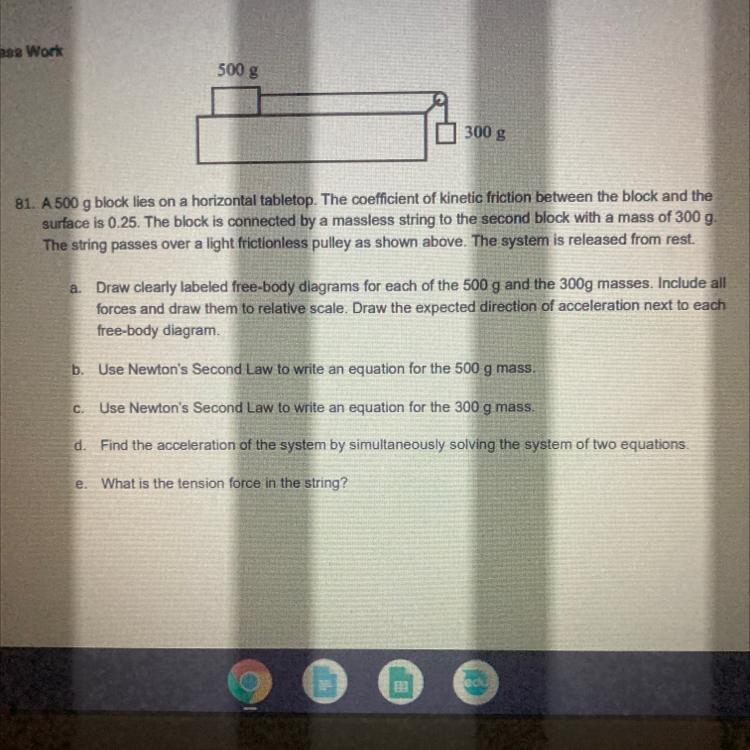
Answers
Given data:
The mass of the block on table is M=500 g.
The hanging mass is m=300 g.
The kinetic friction is μ=0.25.
Part (a)
The free body diagram of the block on table is shown below,
The free body diagram of hanging mass is shown below,
Part (b)
The equation according Newton's second law for 500 g mass will be,
\(\begin{gathered} F_{net}=Ma \\ T-f=Ma \\ T-\mu N=Ma \\ T-\mu Mg=Ma \\ T=M(a+\mu g)\ldots\ldots(1) \end{gathered}\)Here, f is the friction force, N is the normal force, and T is the tension in the string.
Part (c)
The equation according Newton's second law for 300 g mass will be,
\(\begin{gathered} F_{net}=ma \\ mg-T=ma \\ T=mg-ma \\ T=m(g-a)\ldots\ldots(2) \end{gathered}\)Part (d)
Equating equation (1) and (2) to solve for acceleration,
\(\begin{gathered} M(a+\mu g)=m(g-a) \\ 500(a+0.25(9.81))=300(9.81-a) \\ a+2.45=0.6(9.81-a) \\ a+2.45=5.886-0.6a \\ a+0.6a=5.886-2.45 \\ 1.6a=3.436 \\ a=2.14m/s^2 \end{gathered}\)Thus, the acceleration of the blocks are 2.14 m/s².
Part (e)
Substitute the value of acceleration in equation (1) to calculate the tension,
\(\begin{gathered} T=M(a+\mu g) \\ T=500(2.14+(0.25)(9.81)) \\ T=2296gm/s^2\times\frac{1\text{ N}}{1000gm/s^2} \\ T=2.296\text{ N} \end{gathered}\)Thus, the tension in the sting is 2.296 N.


Why might some abolitionists have been against supporting women's rights?
O They thought they had a better chance of abolishing slavery if it was not tied to women's suffrage.
O They thought women did not have the temperament to be able to govern themselves.
O They were jealous of the attention that the women's marches were getting.
O They were afraid that if women received the vote, they would not support abolition.
Answers
Answer: I think it’s b
Explanation:
HELP PLEASE USE KINEMATIC EQUATIONS!!!
A runner accelerates from rest to their top speed in 3 seconds. If they travel 18 m in that time, how
long does it take for the runner to run the entire 100 m race?
Answers
Answer:
ans is 16.66sec time is taken by runner
What happens to the amplitude of the resultant wave when two sound waves with equal amplitude constructively interfere?
Answers
Answer:
For two waves of equal amplitude interfering constructively, the resulting amplitude is twice as large as the amplitude of an individual wave. For 100 waves of the same amplitude interfering constructively, the resulting amplitude is 100 times larger than the amplitude of an individual wave.
An object has a mass of 450g. What is the gravitational force of the object by earth?
Answers
Answer:
4.41N or 4.5N (check explanation)
Explanation:
450g = 0.45kg
F = ma
Using 10m/s² = 10(0.45) = 4.5N
Using 9.8m/s² = 9.8(0.45) = 4.41N
A book is sitting on a desk. If the surface area of the book's cover is 0.05 m², and atmospheric pressure is 100.0 kPa, what is the downward force of the atmosphere on the book
Answers
Answer:
5000N
Explanation:
Given parameters:
Area of the book cover = 0.05m²
Atmospheric pressure = 100kPa = 100 x 10³Pa
Unknown:
Downward force of the atmosphere on the book = ?
Solution:
Pressure is defined as the force per unit area on a body.
So;
Downward force = Atmospheric pressure x Area
Downward force = 100 x 10³ x 0.05 = 5000N
Differences between LED and CFL bulb..
Answers
Explanation:
CFL bulbs were made to take the place of incandescent bulbs, which generate light as a result of heat. ... LED (light-emitting diode) is a type of bulb that produces light using a narrow band of wavelengths. LED lighting is more energy efficient than CFL bulb.
A uniformly charged insulating sphere with radius r and charge +Q
lies at the center of a thin-walled hollow cylinder with radius R>r
and length L>2r. The cylinder is non-conducting and carries no net charge.
1:Determine the outward electric flux through the rounded "side" of the cylinder, excluding the circular end caps. (Hint: Choose a cylindrical coordinate system with the axis of the cylinder as its z -axis and the center of the charged sphere as its origin. Note that an area element on the cylinder has magnitude dA=2πRdz
2:Determine the electric flux upward through the circular cap at the top of the cylinder.
3:Determine the electric flux downward through the circular cap at the bottom of the cylinder.
4:Add the results from parts A - C to determine the outward electric flux through the closed cylinder.
5:What result is expected according to Gauss's law?
Note:Express your answers in terms of electric constant ϵ0
and some or all of the variables r, R , L , Q .
Answers
According to Gauss' equation, the total flux of an electric field in a confined surface is directly proportional to the charge enclosed.
State Gauss’s law.1)To determine the outward electric flux through the rounded "side" of the cylinder, we can use Gauss's law. We choose a cylindrical Gaussian surface with radius r and length L, centered at the origin (where the charged sphere is located). The electric field due to the sphere is spherically symmetric, so the electric field lines are parallel to the cylinder's axis and perpendicular to its sides.
E = (1/4πϵ0) (Q/r^2)
where r is the distance from the origin (center of the sphere) to the point on the Gaussian surface.
The area element of the Gaussian surface is dA = 2πRdz, where dz is an element of length along the cylinder's axis. The electric flux through the top and bottom surfaces of the Gaussian surface is then given by:
Φ = ∫E⋅dA = E ∫dA = E(2πR)L
Substituting the expression for the electric field, we have:
Φ = (Q/2ϵ0r^2)(2πRL)
Therefore, the outward electric flux through the rounded "side" of the cylinder is:
Φ = (Q/ϵ0)(R/Lr^2)
2)To determine the electric flux upward through the circular cap at the top of the cylinder, we use a flat Gaussian surface with radius R and height r, centered at the top of the cylinder. The electric field due to the charged sphere is perpendicular to the Gaussian surface, so the electric flux through the top cap is simply the flux through the flat Gaussian surface. The electric field at any point on the Gaussian surface is given by Coulomb's law as:
E = (1/4πϵ0) (Q/R^2)
The area element of the Gaussian surface is dA = πR^2, so the electric flux through the top cap is given by:
Φ = ∫E⋅dA = E ∫dA = EπR^2
Substituting the expression for the electric field, we have:
Φ = (Q/ϵ0)(R/r^2)
3)To determine the electric flux downward through the circular cap at the bottom of the cylinder, we use a similar flat Gaussian surface with radius R and height r, centered at the bottom of the cylinder. The electric flux through the bottom cap is also given by:
Φ = (Q/ϵ0)(R/r^2)
4)Adding the results from parts 1-3, we have the total outward electric flux through the closed cylinder as:
Φ_total = Φ_side + Φ_top + Φ_bottom
= (Q/ϵ0)(R/Lr^2) + 2(Q/ϵ0)(R/r^2)
Simplifying this expression, we have:
Φ_total = (Q/ϵ0) [(2R/r^2) + (R/Lr^2)]
5)According to Gauss's law, the total outward electric flux through a closed surface is proportional to the total charge enclosed within that surface. In this case, the closed surface is the cylindrical Gaussian surface with radius r and length L, centered at the origin (where the charged sphere is located). The charge enclosed within this surface is simply the charge of the sphere, which is +Q. Therefore, we expect the total outward electric flux through the closed cylinder to be:
Φ_total = Q/
Learn more about Gauss's law
https://brainly.com/question/14767569=
#SPJ1
If the Test Section area has an air speed of 10 m/s, what would be the air speed at the Air Intake area
Answers
The speed of air at the intake area is \(\frac{10A_2}{A_1} \) (m/s).
Continuity equationThe continuity equation is used to determine the flow rate at different sections of a pipe or fluid conduit.
The continuity equation is given as;
\(A_1v_1 = A_2 v_2\)
Let the intake area = A₁Let the velocity of air in intake area = v₁Let the area of the test section = A₂Velocity of air in test section, v₂ = 10 m/sThe speed of air at the intake area is calculated as follows;
\(A_1 v_1 = A_2 v_2\\\\ v_1 = \frac{A_2 v_2}{A_1} \\\\ v_1 = \frac{10A_2}{A_1} \)
Learn more about continuity equation here: https://brainly.com/question/14619396
In the figure, a charged lithium nucleus (3 protons, 4 neutrons) is accelerated through a potential difference of 10 kV. It enters a region of uniform magnetic field in the direction shown, goes through half a circle of radius 10.0 cm, and then exits the region moving in the opposite direction. What is the radius of the orbit if the same nucleus is accelerated through a potential difference of 30 kV? OB 1) 3.3 cm (2) 17.3 cm (3) 10.0 cm (4) 30 cm (5) 8.66 cm
Answers
The radius of the orbit if the same nucleus is accelerated through a potential difference of 30 kV is 17.3cm
Given potential difference of nucleus (V1) = 10kV
radius of circle (r1) = 10cm
potential difference (V2) = 30kV
radius of orbit = r2
for lithium there are 3 protons and 4 neutrons
so charge (q) =+3e = 3x1.6x10-27 = 4.2x10⁻¹⁹C
magnetic field (B) =0.5T
So the charge carried by the nucleus is equal to three times the charge carried by a single particle. It is the potential which is used to accelerate this nucleus. The nucleus enters into the magnetic field after moving a distance of 20cm before entering. The charged particle enters into a magnet as:
r^2 = mV/Bq where B is the magnetic field
The energy gained by the charge particle (E) = qV
r = √mV/Bq
mass of lithium is equal to 7.02 x 10⁻²⁷kg
r = √7.02 x 10-27 x 30 x 10^3/0.5x4.2x10-19 = 17.3cm
Hence the radius of the orbit = 17.3cm
To learn more about potential difference click here https://brainly.com/question/12198573
#SPJ4
The weighted rod floats with 6 cm of its length under water (density = 1000kg/m³). What length is under the surface when the rod floats in brine (density = 1200 kg/m³)
Answers
The length is under the surface when the rod floats in brine is 4 cm .
This is done by Archimedes principle.
What is Archimedes principle ?The upward buoyant force exerted on a body immersed in a fluid, whether partially or fully submerged, is equal to the weight of the fluid that the body displaces and acts in the upward direction at the displaced fluid's center of mass.
The Archimedes law, discovered by Archimedes of Syracuse in Greece, determines the value of thrust force. When an object is immersed in a liquid, the apparent weight loss is equal to the weight of the liquid displaced by it.
using formula
Apparent weight= Weight of object (in the air) – Thrust force (buoyancy)
F = ρ x g x V
F is force
ρ = density
V = volume
g = gravity
Archimedes' principle states that the weight loss is equal to the weight of liquid displaced by the object.
to know more about Archimedes principle , visit ;
brainly.com/question/787619
#SPJ1
The work-energy theorem states that the change in the kinetic energy of an object is equal to what?
Answers
The work-energy theorem states that the change in the kinetic energy of an object will be equal to the net work done on the object.
Mathematically, it can be expressed as;
ΔKE = W
Where; ΔKE represents the change in kinetic energy of the object,
W represents the net work done on the object.
This theorem states that when work is done on an object, it results in a change in its kinetic energy. If work is done on an object, its kinetic energy increases, and if work is done by an object, its kinetic energy decreases.
This theorem is a fundamental principle in physics that relates the concepts of work and energy, and it is often used to analyze the motion and behavior of objects in various physical systems.
To know more about work-energy theorem here
https://brainly.com/question/30236175
#SPJ1
Does anybody know how to solve this? Thanks!!
The position x of a bowling ball rolling on a smooth floor as a function of time t is given by: x(t)=v0t+x0 , where v0=2.5m/s and x0=−5.0m . The polynomial relationship between position and time for the bowling ball is _______________.
exponential
inverse
linear
cubic
quadratic
Answers
The polynomial relationship between position and time for the bowling ball is linear.
What is a linear relationship between two variables?A linear relationship between two variables is a term used to describe a straight-line relationship between the two variables.
Linear relationships can be expressed either in a graphical format or as a mathematical equation of the form y = mx + b.
From the equation of linear relationship between two variable, the highest power of x is one.
The given equation for position and time;
x(t) = vot + xo
From this given equation, the highest power of t is one, hence it is called linear relationship.
Thus, the polynomial relationship between position and time for the bowling ball is linear.
Learn more about linear relationship here: https://brainly.com/question/6691346
#SPJ1
How can you measure the strength of any electric field?
Answers
Answer:
The strength of the source charge's electric field could be measured by any other charge placed somewhere in its surroundings. The charge that is used to measure the electric field strength is referred to as a test charge since it is used to test the field strength. The test charge has a quantity of charge denoted by the symbol q.
Explanation:
Electric field strength is a vector quantity; it has both magnitude and direction. The magnitude of the electric field strength is defined in terms of how it is measured. Let's suppose that an electric charge can be denoted by the symbol Q. This electric charge creates an electric field; since Q is the source of the electric field, we will refer to it as the source charge. The strength of the source charge's electric field could be measured by any other charge placed somewhere in its surroundings. The charge that is used to measure the electric field strength is referred to as a test charge since it is used to test the field strength. The test charge has a quantity of charge denoted by the symbol q. When placed within the electric field, the test charge will experience an electric force - either attractive or repulsive. As is usually the case, this force will be denoted by the symbol F. The magnitude of the electric field is simply defined as the force per charge on the test charge.
When a solid object is subjected to a tension
force, T on both ends it will stretch by a distance
denoted AL. A quantity called the strain,
denoted by & is the distance stretched, AL
divided by the original length of the object, Lo,
i.e. & = AL/Lo. For many materials, the
applied tension force is measured to be linearly
proportional to the strain times the cross-
sectional area, A of the object i.e.
ΤαεΑ
The figure shows an object with a circular cross-
section of diameter d and original length Lo. If
object 2 has twice the diameter and twice the
starting length of object 1 (and is made of the
same material), what must be the ratio T₂/T₁ so
that the two objects have the same strain.

Answers
The tension force on object 2 must be one-fourth the tension force on object 1. The correct option is D.
How to explain the valueThe cross-sectional area is directly proportional to the square of the diameter, or A = πd²/4.
The Young's modulus is a constant for a given material.
Therefore, the change in length is proportional to the tension force and the square of the diameter.
For the two objects to have the same change in length, they must also have the same tension force.
The tension force is inversely proportional to the cross-sectional area, or F = EA/L0.
Therefore, the tension force is inversely proportional to the square of the diameter.
If object 2 has twice the diameter of object 1, then it will have four times the cross-sectional area.
Therefore, the tension force on object 2 must be one-fourth the tension force on object 1.
In other words, T2/T1 = 1/4.
Learn more about tension on
https://brainly.com/question/24994188
#SPJ1
Which is a benefit of using synthetic polymers, such as nylon?
Synthetic polymers are lightweight.
O Synthetic polymers are produced in small
quantities.
Synthetic polymers are biodegradable.
Synthetic polymers are inexpensive to recycle.
Answers
Answer: Synthetic polymers are lightweight.
Explanation:
A benefit of using synthetic polymers is the fact that synthetic polymers are lightweight.
A polymer is a molecule composed of many repeating subunits.
Synthetic polymers are artificial polymers created by humans.
Most of the synthetic polymers are not biodegradable (unlike natural fibers such as cotton).
Synthetic polymers are classified according to their use into plastics, elastomers and synthetic fibers.
The advantages of synthetic polymers include: hard to break, being lightweight, and they last for a long time.
In conclusion, a benefit of using synthetic polymers is the fact that synthetic polymers are lightweight.
Learn more in:
https://brainly.com/question/4047007?referrer=searchResults
Two balls are rolled off a tabletop that is 0.85 m above the floor. Ball A has a
horizontal velocity of 3.5 m/s and that of ball B is 5.3 m/s.
A) How long does it take each ball to reach the floor after it rolls off the edge?
B) How far does each ball travel horizontally before hitting the floor?
Answers
Hi there!
A)
Since the ball's velocity is initially only in the HORIZONTAL direction, there is NO vertical component of its velocity. Therefore, we can treat this like a free-fall scenario. (Dropped from rest).
We can rearrange the following kinematic equation to make solving for the time taken for the balls to hit the ground easier.
\(d_y = v_yt + \frac{1}{2}at^2\)
dy = vertical displacement (height of table, 0.85 m)
vy = initial vertical velocity (0 m/s, only horizontal)
a = acceleration (due to gravity in this situation, 9.8 m/s²)
t = time (? sec)
Simplify and rearrange the variables for 't'.
\(d_y = 0(t) + \frac{1}{2}at^2\\\\d_y = \frac{1}{2}at^2\\\\t^2 = \frac{2d_y}{a}\\\\t = \sqrt{\frac{2d_y}{a}}}\)
Plug in the given values.
\(t = \sqrt{\frac{2(0.85)}{9.8}} = \boxed{0.4165 s}\)
B)
Now, remember that the ball's acceleration in the vertical direction due to gravity does NOT impact its horizontal velocity. Its vertical and horizontal velocities are COMPLETELY independent. Thus, we can simply use the time solved for above and each ball's respective velocities in the following kinematic equation:
\(d_x = v_xt\)
dₓ= horizontal displacement (? m)
vₓ = horizontal component of velocity (3.5 and 5.3 m/s for A and B respectively)
t = time (0.4165 s)
Solve for the distance traveled by each ball:
Ball A:
\(d_x = 3.5 * 0.4165 = \boxed{1.458 m}\)
Ball B:
\(d_x = 5.3* 0.4165 = \boxed{2.207 m}\)
Conclude what happens to the speed of light when it passes from a medium of low index of refraction into a medium of high index of refraction? Justify your statement using the data you have collected
Answers
The thing that happens to the speed of light when it passes from a medium of low index of refraction into a medium of high index of refraction is that it tend to speed up.
Why does it speed up?Light moves more quickly when it enters a medium with a lower refractive index, as air from water. The light deviates from the straight line. Light will move more slowly and obliquely as it penetrates a substance with a higher refractive index.
The speed of light increases with decreasing refractive index. The lesser refractive index belongs to medium A. When moving at a speed equal to the speed of light divided by the refractive index, light will move more quickly through medium A.
Hence, Light bends in the direction of the normal as it passes through an interface into a medium with a greater index of refraction. On the other hand, light bending away from an interface from higher n to lower n.
Learn more about light travels from
https://brainly.com/question/30978
#SPJ1
Which of the following quantitative research methods should a researcher use when trying to understand the political views held by the young population of a specific area? a.) Participant observation b.) Written surveys c.) Secondary data analysis d.) Laboratory experiments
Answers
Answer:
Options B
Explanation:
The appropriate quantitative research method for understanding political views held by the young population of a specific area is written surveys (option b). Surveys allow for the collection of data from a large number of participants, and specific questions can be asked to gather data on political views.
Participant observation (option a) involves direct observation of individuals in a natural setting, which may not be practical for studying political views.
Secondary data analysis (option c) involves analyzing data that has already been collected, and may not be specific to the young population or the area of interest.
Laboratory experiments (option d) are typically used to study cause-and-effect relationships between variables, which may not be applicable to studying political views.
Therefore, the best option for understanding the political views held by the young population of a specific area is written surveys.
To understand the political views of the young population of a specific area, a researcher can use written surveys, participant observation, and secondary data analysis as quantitative research methods.
Explanation:If a researcher is trying to understand the political views held by the young population of a specific area, they should use written surveys, participant observation, and secondary data analysis as quantitative research methods.
Written surveys: This method involves distributing survey questionnaires to gather data on political opinions from a sample of the young population in the area. Participant observation: This method involves the researcher immersing themselves in the community and directly observing and interacting with individuals to understand their political views.Secondary data analysis: This method involves analyzing existing data sources, such as census records or previous surveys, to gain insights into the political views of the young population in the area.Learn more about Quantitative Research Methods here:https://brainly.com/question/33505242
#SPJ2
The following table lists the speed of sound in various materials. Use this table to answer the question.
Substance Speed (m/s)
Glass 5,200
Aluminum 5,100
Iron 4,500
Copper 3,500
Salt water 1,530
Fresh water 1,500
Mercury 1,400
Hydrogen at 0°C 1,284
Ethyl Alcohol 1,125
Helium at 0°C 965
Air at 100°C 387
Air at 0°C 331
Oxygen at 0°C 316
Sound will travel fastest in air at _____.
-5°C
0°C
10°C
15°C
Answers
Sound will travel fastest in air at 15°C.
Speed of sound in air
The speed of sound in air, given in the range of 100 degrees Celsius and 0 degree Celsius include;
Air at 100°C 387 m/s
Air at 0°C 331 m/s
From the date above, the speed of sound in air increases with increases in temperature. Thus, Sound will travel fastest in air at 15°C.
Learn more about speed of sound here: https://brainly.com/question/2142871
#SPJ1
An RC circuit is connected across an ideal DC voltage source through an open switch. The switch is closed at time t = 0 s. Which of the following statements regarding the circuit are correct?
a) The capacitor charges to its maximum value in one time constant and the current is zero at that time.
b) The potential difference across the resistor and the potential difference across the capacitor are always equal.
c) The potential difference across the resistor is always greater than the potential difference across the capacitor.
d) The potential difference across the capacitor is always greater than the potential difference across the resistor
e) Once the capacitor is essentially fully charged, There is no appreciable current in the circuit.
Answers
Answer:
e)
Explanation:
In an RC series circuit, at any time, the sum of the voltages through the resistor and the capacitor must be constant and equal to the voltage of the DC voltage source, in order to be compliant with KVL.
At= 0, as the voltage through the capacitor can't change instantaneously, all the voltage appears through the resistor, which means that a current flows, that begins to charge the capacitor, up to a point that the voltage through the capacitor is exactly equal to the DC voltage, so no current flows in the circuit anymore, and the charge in the capacitor reaches to its maximum value.
15. a) The diagram below shows to answer the question that follow show State and explain the effect on the height, h, when the thistle funnel is of the liquids (2 marks) ved upwards towards the surface
Answers
When the thistle funnel is moved upwards towards the surface of the liquids, the height (h) decrease.
What happens when the thistle funnel is moved upward?
An important principle outlined by Pascal's law states that any fluid (in this instance, liquids) experiences equal transmission of force in every direction within it. Hence, there is an intimate relationship between the height of a liquid column and its pressure.
Raising a thistle funnel reduces this height causing loss of weight from above this point thus decreasing its pressure.
Learn about pressure here https://brainly.com/question/30638771
#SPJ1
See complete question in the attached image.
