suppose that the true proportion of registered voters who favor the republican presidential candidate is 0,4 find mean and standard deviation of sample proportion if the sample size is 30
Answers
The mean and standard deviation of the sample proportion is 0.4 and 0.09798 respectively.
To find the mean and standard deviation of the sample proportion, we can use the following formulas:
mean of sample proportion = p = proportion in the population = 0.4
The standard deviation of sample proportion = σp = √(p(1-p)/n), where n is the sample size.
Plugging in the values given in the question, we get:
mean of sample proportion = p = 0.4
standard deviation of sample proportion = σp = √(0.4(1-0.4)/30) = 0.09798 (rounded to 5 decimal places)
Therefore, the mean of the sample proportion is 0.4 and the standard deviation of the sample proportion is 0.09798 (rounded to 5 decimal places).
Learn more about mean:
https://brainly.com/question/26941429
#SPJ11
Related Questions
which sampling method is being described
A store manger randomly choose a shopper entering her store to interview she then interview every 20th person after that contomer
to do the survey
Answers
Systematic sampling offers several advantages. It is relatively easy to implement and eliminates bias that may arise from the subjective selection of participants.
The sampling method described in the scenario is called systematic sampling.
Systematic sampling involves selecting every nth element from a population after randomly selecting a starting point. In this case, the store manager randomly chooses a shopper entering the store as the starting point and then proceeds to interview every 20th person after that initial selection.
Systematic sampling offers several advantages. It is relatively easy to implement and eliminates bias that may arise from the subjective selection of participants. By ensuring a regular interval between selections, systematic sampling provides a representative sample from the population.
However, it's important to note that systematic sampling can introduce a form of bias if there is any periodicity or pattern in the population. For example, if the store experiences a peak in customer traffic during specific time periods, the systematic sampling method might overrepresent or underrepresent certain groups of shoppers.
To minimize this potential bias, the store manager could randomly select the starting point for the systematic sampling at different times of the day or on different days of the week. This would help ensure a more representative sample and reduce the impact of any inherent patterns or periodicities in customer behavior.
for more such question on relatively visit
https://brainly.com/question/29502088
#SPJ8
Solve this question

Answers
You have to do Cross multiplication,
2x+5 = 1(x+4) which is simply 2x+5=x+4.
1. x+5=4
2. x=-1
Answer:
X= -1
Step-by-step explanation:
2x+5=1(x+4)
2x+5=1x+4
2x-1x=-5+4
x=-1
What is the difference between 30% interest charged for a payday loan and a 30% APR on a credit card?
Answers
The main difference is interest charged for a payday loan is typically over a short period, whereas credit card represents the annualized interest rate over a year.
The payday loan interest is a one-time charge, while the credit card APR accumulates over time if the balance is not paid in full.
For a payday loan, the 30% interest is typically charged over a short period, often within a few weeks.
This means that if you borrow $100, you would need to repay $130, including the $30 interest, within that short timeframe.
On the other hand, a 30% APR on a credit card represents the annualized interest rate charged on the outstanding balance. This interest is spread out over a year.
If you have an outstanding balance of $100 on a credit card with a 30% APR, the interest charged over a year would be $30.
In summary, the main difference is that the 30% interest charged for a payday loan is typically applied over a short period, whereas the 30% APR on a credit card represents the annualized interest rate over a year.
Learn more about APR here:
https://brainly.com/question/14184570
#SPJ1
find the intervals of increase and decrease of 3/512(x-4)^2(x-8)(x-10)(x^2+16)
Answers
The given function is strictly decreasing in interval (−∞, 4) & trictly increasing in interval (4, −∞).
What is an increasing and decreasing functions?
For a given function, y = F(x), the function is known as an increasing function if the value of y increases as the value of x increases, and the function is known as a decreasing function if the value of y decreases as the value of x increases.
We have,
\(\frac{5}{512}\left(x-4\right)^2\left(x-8\right)\left(x-10\right)\left(x^2+16\right)\)
\(\frac{d}{dx}\left(\frac{5}{512}\left(x-4\right)^2\left(x-8\right)\left(x-10\right)\left(x^2+16\right)\right)\)
\(=\frac{5}{512}\frac{d}{dx}\left(\left(x-4\right)^2\left(x-8\right)\left(x-10\right)\left(x^2+16\right)\right)\)
\(f'(x)=\left(x-4\right)^2,\:g=\left(x-8\right)\left(x-10\right)\left(x^2+16\right)\)
\(=\frac{5}{512}\left(\frac{d}{dx}\left(\left(x-4\right)^2\right)\left(x-8\right)\left(x-10\right)\left(x^2+16\right)+\frac{d}{dx}\left(\left(x-8\right)\left(x-10\right)\left(x^2+16\right)\right)\left(x-4\right)^2\right)\)\(=\frac{5}{512}\left(2\left(x-4\right)\left(x-8\right)\left(x-10\right)\left(x^2+16\right)+\left(4x^3-54x^2+192x-288\right)\left(x-4\right)^2\right)\)
\(f'(x)=\frac{5\left(x-4\right)\left(3x^4-53x^3+300x^2-816x+1856\right)}{256}\)
The roots (zeros) are the x values where the graph intersects the x-axis. To find the roots (zeros), replace y with 0 and solve for x.
x = 4, 4i, −4i, 10, 8
∴ f′(x) = 0
x = 4,
Now, the point 4 divides the real line into two disjoint intervals i.e., (−∞, 4) and (4, −∞)
In interval (−∞, 4), f′(x) < 0
Hence, the given function (f) is strictly decreasing in interval (−∞, 4)
In interval (4, −∞), f′(x) > 0
Hence, the given function (f) is strictly increasing in interval (4, −∞)
To learn more about the increasing and decreasing functions visit,
https://brainly.com/question/13157110
#SPJ9
what is the mean standard deviation and classification?
3. Record your participant's blood pressure in the table provided and determine their risk classification. (4 marks) (3 marks)
Answers
The recorded blood pressure values would need to be compared to the established thresholds for each category.
To determine the mean, standard deviation, and risk classification for the participant's blood pressure, we would need the actual blood pressure measurements recorded in the table provided.
Without the specific data, I cannot calculate the mean and standard deviation or determine the risk classification.
However, I can explain the general process involved in calculating the mean and standard deviation and how blood pressure is typically classified.
Mean:
To calculate the mean, you would sum up all the blood pressure measurements and divide it by the total number of measurements. The mean provides an average value that represents the central tendency of the blood pressure data.
Standard Deviation:
The standard deviation measures the dispersion or variability of the blood pressure data. It quantifies how spread out the blood pressure measurements are from the mean. A higher standard deviation indicates greater variability in the blood pressure values.
Risk Classification:
Blood pressure is typically classified into different categories based on the values obtained. The classification may vary slightly depending on the specific guidelines followed, but generally, the categories include:
1. Normal: Blood pressure within a healthy range.
2. Prehypertension: Slightly elevated blood pressure, indicating a higher risk of developing hypertension.
3. Hypertension Stage 1: Elevated blood pressure requiring attention and potential lifestyle modifications.
4. Hypertension Stage 2: High blood pressure requiring medical intervention and treatment.
5. Hypertensive Crisis: Extremely high blood pressure requiring immediate medical attention.
To know more about thresholds refer here:
https://brainly.com/question/32863242#
#SPJ11
A circle with center c(2, 4) has radius 13. a) verify that a(14,9) and b(7, 16) are points on this circle. b) if m is the midpoint of ab, show that cm is perpendicular to ab.
Answers
a) To verify that the points A(14, 9) and B(7, 16) are on the circle with center C(2, 4) and radius 13, we can use the distance formula:
Distance between point A and C:
d_AC = sqrt[(x_A - x_C)^2 + (y_A - y_C)^2]
= sqrt[(14 - 2)^2 + (9 - 4)^2]
= sqrt[144 + 25]
= sqrt(169)
= 13
Since the distance between point A and C is equal to the radius of the circle, point A is on the circle.
Distance between point B and C:
d_BC = sqrt[(x_B - x_C)^2 + (y_B - y_C)^2]
= sqrt[(7 - 2)^2 + (16 - 4)^2]
= sqrt[25 + 144]
= sqrt(169)
= 13
Since the distance between point B and C is equal to the radius of the circle, point B is also on the circle.
Therefore, points A and B are on the circle with center C(2, 4) and radius 13.
b) The midpoint of line segment AB can be found using the midpoint formula:
M = [(x_A + x_B)/2, (y_A + y_B)/2]
= [(14 + 7)/2, (9 + 16)/2]
= [10.5, 12.5]
The slope of line segment AB can be found using the slope formula:
m_AB = (y_B - y_A)/(x_B - x_A)
= (16 - 9)/(7 - 14)
= -7/-7
= 1
The slope of a line perpendicular to AB will be the negative reciprocal of m_AB:
m_CM = -1/m_AB
= -1/1
= -1
The equation of the line passing through points C(2, 4) and M(10.5, 12.5) can be found using the point-slope form:
y - y_C = m_CM(x - x_C)
y - 4 = -1(x - 2)
y = -x + 6
The slope of line CM is -1, which is the negative reciprocal of the slope of line AB. Therefore, line CM is perpendicular to line AB.
Hence, we have shown that line segment CM is perpendicular to line segment AB.
To know more about radius refer here
https://brainly.com/question/22269716#
#SPJ11
Write the function that fits this graph:
-5
0
5
Answers
Answer:
f(x) = x
Step-by-step explanation:
what is 4325000 as a scientific notation?
Answers
Answer:
4.325X10^6
hope this helps :))
What is the probability that a randomly selected traveler who checks work email also uses a cell phone to stay connected?
Answers
The probability that a randomly selected traveler who checks work email also uses a cell phone to stay connected is approximately 0.71 or 71%.
The probability that a randomly selected traveler who checks work email also uses a cell phone to stay connected can be determined by analyzing the given information.
To find the probability, we need to consider two factors:
the number of travelers who check work email and the number of travelers who use a cell phone to stay connected. Let's assume there are 100 travelers in total.
1. Determine the number of travelers who check work email. Let's say that 70 out of the 100 travelers check work email regularly.
2. Determine the number of travelers who use a cell phone to stay connected. Let's assume that 80 out of the 100 travelers use a cell phone.
3. Find the number of travelers who both check work email and use a cell phone. Let's assume that 50 out of the 100 travelers do both.
4. Calculate the probability by dividing the number of travelers who both check work email and use a cell phone by the total number of travelers who check work email.
Probability = (number of travelers who both check work email and use a cell phone) / (number of travelers who check work email)
Probability = 50/70
Probability = 5/7 or approximately 0.71
Therefore, the probability that a randomly selected traveler who checks work email also uses a cell phone to stay connected is approximately 0.71 or 71%.
Learn more about probability from the given link;
https://brainly.com/question/31828911
#SPJ11
A nozzle is used to increase the velocity of steam before it enters a
turbine as a part of a power plant. The steam entering is at 1 MPa, 500 K and
leaves at the conditions of 350°C and 2 MPa. The nozzle has an inlet diameter
of 3 cm and an outlet diameter of 1 cm. Mass flowrate through the nozzle is
0.7 kg/s. What is the inlet enthalpy of steam in the nozzle? What is the enthalpy of steam at exit? What are the inlet and outlet velocities, respectively? How much heat is transferred?
Answers
In this scenario, the inlet enthalpy of steam in the nozzle is determined to be the enthalpy of saturated steam at 1 MPa and 500 K. The enthalpy of steam at the exit is calculated using the given conditions of 350°C and 2 MPa.
To determine the inlet enthalpy of steam in the nozzle, we need to find the enthalpy of saturated steam at 1 MPa and 500 K using steam tables or steam property calculations.
To calculate the enthalpy of steam at the exit, we use the given conditions of 350°C and 2 MPa to find the corresponding enthalpy value from the steam tables or steam property calculations.
The inlet and outlet velocities can be determined using the mass flow rate and the respective cross-sectional areas. The inlet velocity can be calculated by dividing the mass flow rate by the cross-sectional area at the inlet (A1), and the outlet velocity can be calculated by dividing the mass flow rate by the cross-sectional area at the outlet (A2).
The heat transferred can be calculated using the change in enthalpy and the mass flow rate. The heat transferred (Q) is equal to the mass flow rate (m) multiplied by the change in enthalpy (Δh), which can be calculated as the difference between the enthalpy at the exit and the enthalpy at the inlet.
By performing the necessary calculations and using the provided data, the values for the inlet enthalpy, exit enthalpy, inlet velocity, outlet velocity, and heat transferred can be determined for this specific scenario.
Learn more about calculated here:
https://brainly.com/question/31010676
#SPJ11
I need help answering 1-3 and explaining what it means because I don’t understand ( you can help with more questions on there if you want but I really need help with 1-3)!!!!!!!

Answers
Answer:
So the question is asking you what of the two equations would you chose to solve for the variable. (which means what eqation is easier to solve and why)
Step-by-step explanation:
1) the first one is easier because you could multiple 2 or 5 to get 10 which is a nice number compare to 21 (the other eqaution)
2) the first one bc the second opption you would have a -7y +2 =x and thats a mouth full
3) the first one as well bc I work better with smaller numbers.
Nevermind anyone know this answer???

Answers
Answer:
x = 6
Step-by-step explanation:
for SPECIAL RIGHT TRIANGLES specifically a 30°-60°-90° triangle.
The longest side is the hypotenuse. The longest side is twice the shortest side. Or the other way around, the shortest side is half the longest side.
Here the longest side (hypotenuse) is 12, so the shortest side is 6.
Also, since you seem to be trying to get this subject.
The long leg is the short leg× sqroot3.
OR the short leg is the long leg ÷ sqroot3. If you end up with a sqroot on the bottom of a fraction, you can't leave it like that. Times top and bottom by sqroot3/sqroot3 to fix it.
Mhanifa please help with this I find it super difficult! Thanks! I will mark brainliest! Random answers will be reported !

Answers
Answer:
a)
The point that is equidistant to all sides of a triangle is called the incenter.
The incenter is located at the intersection of bisectors of the interior angles of a triangle.
b)
The point that is equidistant to all vertices of a triangle is called the circumcenter.
The circumcenter is located at the intersection of perpendicular bisectors of the sides of a triangle.
c)
See the attachment
The blue lines and their intersection shows the incenter.
The red lines and their intersection shows the circumcenter.
As we see the red point- the circumcenter is closer to vertex B.

I subtract 3 from a certain number, multiply the result by 5 and then add 9 if the final result is 54. find the original number
Answers
\((x-3)\cdot 5+9=54\\5x-15=45\\5x=60\\x=12\)
Type the correct answer in the box. Use numerals instead of words. What value of x makes this equation true? -2x + 3 = -15 x =
Answers
Answer:
x=9
Step-by-step explanation:
plug in the number 9
-2(9)= -18
-18+3= -15
we would associate the term inferential statistics with which task?
Answers
Inferential statistics involves using sample data to make inferences, predictions, or generalizations about a larger population, providing valuable insights and conclusions based on statistical analysis.
The term "inferential statistics" is associated with the task of making inferences or drawing conclusions about a population based on sample data.
In other words, it involves using sample data to make generalizations or predictions about a larger population.
Inferential statistics is concerned with analyzing and interpreting data in a way that allows us to make inferences about the population from which the data is collected.
It goes beyond simply describing the sample and aims to make broader statements or predictions about the population as a whole.
This branch of statistics utilizes various techniques and methodologies to draw conclusions from the sample data, such as hypothesis testing, confidence intervals, and regression analysis.
These techniques involve making assumptions about the underlying population and using statistical tools to estimate parameters, test hypotheses, or predict outcomes.
The goal of inferential statistics is to provide insights into the larger population based on a representative sample.
It allows researchers and analysts to generalize their findings beyond the specific sample and make informed decisions or predictions about the population as a whole.
For similar question on population.
https://brainly.com/question/30396931
#SPJ8
Find the area of the figure.
For figures 10 and 11.

Answers
Answer:
10.27cm²
11.33cm²
Step-by-step explanation:
10. Area of the rectangle below = l×w =3×6=18
are of that triangle at top- 6 whole 1cm square +6 half shares which are =3 whole squares so 6cm +3cm = 9cm
Total figure Area = 18+9=27cm²
11.30 whole squares + 6 half squares = 3 whole squares
Total = 30cm+3cm = 33cm²
Pls help I’m really struggling with this
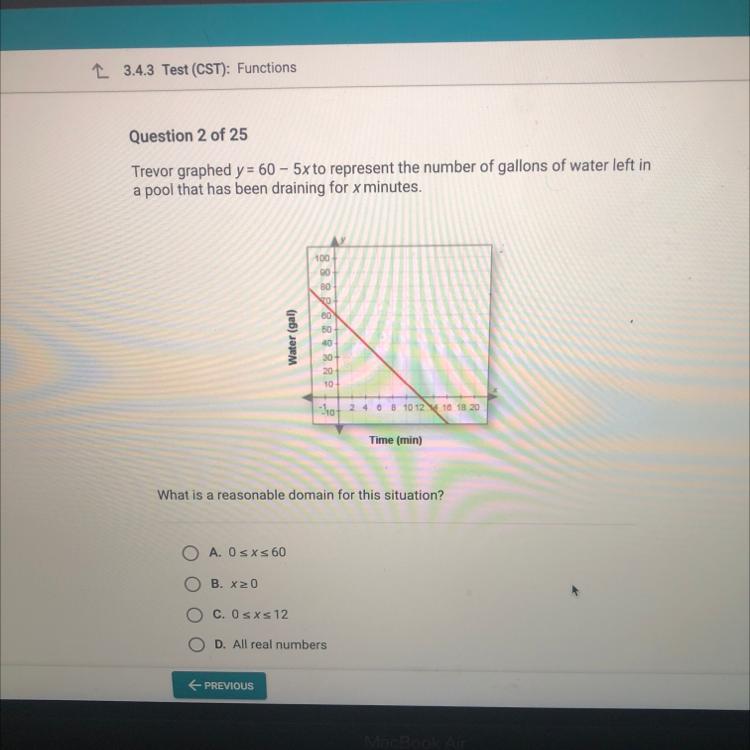
Answers
Answer:
B
Step-by-step explanation:
Time cannot be negative
write a function that takes a matrix m as input, inserts a row of zeros at the top and at the bottom of the matrix and returns the resulting matrix
Answers
The provided code defines a function called wrapzeros that takes a matrix M as input and returns the same matrix with an additional row and column of zeros added to the top, bottom, left, and right of the original matrix.
Here's a possible implementation of the wrapzeros function in MATLAB
function M = wrapzeros(M)
% Insert a row of zeros on the top and bottom, and a column of zeros on the left and right of a matrix
% Get the size of the input matrix
[m, n] = size(M);
% Create a new matrix with zeros on all sides
M_new = zeros(m+2, n+2);
% Copy the input matrix to the center of the new matrix
M_new(2:end-1, 2:end-1) = M;
% Set the first and last row and column to zeros
M_new(1,:) = 0;
M_new(end,:) = 0;
M_new(:,1) = 0;
M_new(:,end) = 0;
% Return the new matrix
M = M_new;
end
This function creates a new matrix M_new with dimensions m+2 by n+2, and copies the input matrix to the center of it.
It then sets the first and last row and column of M_new to zeros, effectively adding a row of zeros on the top and bottom, and a column of zeros on the left and right of the input matrix. Finally, it returns the new matrix.
Running the function with the provided input would produce the following output
a = [1 2; 3 4];
b = wrapzeros(a);
disp(b);
Output:
0 0 0 0
0 1 2 0
0 3 4 0
0 0 0 0
To know more about matrix:
https://brainly.com/question/28180105
#SPJ4
--The given question is incomplete, the complete question is given below " Write a function that takes a matrix M as input, inserts a row of zeros on the left, on the right, at the top, and at the bottom of the matrix and returns the resulting matrix in MATLAB.
>>
a = wrapzeros( [ 1 2; 3 4] )
a= 0 0 0 0
0 1 2 0
0 3 4 0
0 0 0 0"--
Help ASAP! Please answer below:

Answers
Answer:
the gcf is 4xyp
Step-by-step explanation:
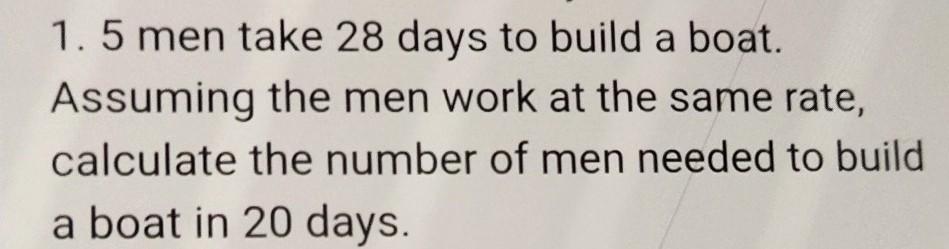
5 men take 28 days to build a boat. Assuming the men work at the same rate, calculate the number of men needed to build a boat in 20 days.
Answers
? men - 20 days
Cross multiplication:
(20x5)/28=3.57…≈4
What are the 4 tests for similar triangles?
Answers
The 4 tests for similar triangles are:-
AAA: Three pairs of equal angles.
SSS: Three pairs of sides in the same ratio.
SAS: Two pairs of sides in the same ratio and an equal included angle.
ASA: Two angles and the side included between the angles of one triangle are equal
What is AAA,SAS,ASA,SSS?
According to the SSS rule, two triangles are said to be congruent if all three sides of one triangle are equal to the corresponding three sides of the second triangle.
According to the SAS rule, two triangles are said to be congruent if any two sides and any angle between the sides of one triangle are equal to the corresponding two sides and angle between the sides of the second triangle.
According to the ASA rule, two triangles are said to be congruent if any two angles and the side included between the angles of one triangle are equal to the corresponding two angles and side included between the angles of the second triangle.
According to the AAA rule, "if in two triangles, corresponding angles are equal, then their corresponding sides are in the same ratio (or proportion), and hence the two triangles are identical."
Learn more about SAS ,ASA ,AAS, SSS from the link below
https://brainly.com/question/29617415
#SPJ4
y - 12 = 89
y - 12 +____
=89 + 12
y=?
Answers
Answer:101
Step-by-step explanation:
easy math problems!!!!!

Answers
Answer:
it 21
Step-by-step explanation:
its 21
Answer:21
Step-by-step explanation:
Zara bought 2.4 pounds of grapes and a watermelon what cost $5.28. The total cost of the fruit was 7.32. Which describes a way to determine x, the price per pound for the grapes?

Answers
Answer:
The answer is B.
Step-by-step explanation:
The image of a parabolic lens is projected onto a graph. The image crosses the x-axis at –2 and 3. The point (–1, 2) is also on the parabola. Which equation can be used to model the image of the lens?
y = (x – 2)(x + 3)
y = (x – 2)(x + 3)
y = (x + 2)(x – 3)
y = (x + 2)(x – 3)
Answers
Answer:
\(y =-\frac{1}{2}(x +2)(x - 3)\)
Step-by-step explanation:
Given
\(x_1 = -2\)
\(x_2 = 3\)
\((x,y) = (-1,2)\) --- a point on the parabola
Required
The equation
First, calculate the equation from the zeros
\(y =k(x - x_1)(x - x_2)\)
Substitute \(x_1 = -2\) and \(x_2 = 3\)
\(y =k(x - -2)(x - 3)\)
\(y =k(x +2)(x - 3)\)
To solve for k, we substitute \((x,y) = (-1,2)\)
\(2 = k(-1+2)(-1-3)\)
\(2 = k(1)(-4)\)
\(2 = -4k\)
Divide by -4
\(k=\frac{2}{-4}\)
\(k=-\frac{1}{2}\)
So, the equation is:
\(y =k(x +2)(x - 3)\)
\(y =-\frac{1}{2}(x +2)(x - 3)\)
Answer: c
Step-by-step explanation:
PLEASE HURRY
E
B
D
AC = 14 cm
EC = 84 cm
ED = 21 cm
C
Given the following segment lengths,
find the length of segment AB.

Answers
The length of the segment AB is 3.5 cm
What is a line segment ?
A line segment in geometry is bounded by two separate points on a line. Another way to describe a line segment is as a piece of the line that joins two points. A line segment has two fixed or distinct endpoints while a line has no endpoints and can stretch in both directions indefinitely.
We have segments ratio as shown:
BC/AB = CD/ED
=> (AC - AB)/AB = (EC - ED)/ED
=> (14-AB)/AB = (84-21)/21 = 3
Let AB=x
=> (14-x)/x = 3
=> 14-x = 3x
=> 14 = 3x+x = 4x
=> 14/4 = x
=> x=3.5 cm
AB=x = 3.5 cm
The length of the segment AB is 3.5 cm
To learn more about the line segment from the given link
https://brainly.com/question/2437195
#SPJ1
Please Simplify the phrase the first two and find the last one

Answers
Answer:
1) 23x + 6y
2) 8x - 4y
3) 4x - x² + 7
Step-by-step explanation:
Simplify:
Multiply each term of (3x + 6y) by 5 and multiply each term of (2x - 6y) by 4.
5(3x + 6y) + 4 (2x - 6y) = 5*3x + 5*6y + 4*2x - 4*6y
= 15x + 30y + 8x - 24y
Now, combine like terms. Like terms have same variable with same power.
= 15x + 8x + 30y - 24y
= 23x + 6y
2) 3(4x - 2y) - 2*(2x -y) = 3*4x + 3*(-2y) + (-2)* 2x + (-2)*(-y)
= 12x - 6y - 4x + 2y
= 12x - 4x - 6y + 2y
= 8x - 4y
3) f(x) = 3x + 2
To find f(x +1), replace x with (x +1)
f(x +1) = 3*(x + 1) + 2
= 3*x + 3*1 + 2
= 3x + 3 + 2
=3x + 5
f(2x) = 3*(2x) + 2
= 6x + 2
f(2x) + h(x) = 6x + 2 - x² - 2x + 5
= 6x - 2x - x² +2 + 5
= 4x - x² + 7
If ∆ABC≅∆DEF, and AB=15, BC=20, and FE=3x-7, then x=?
Answers
Answer:
x= 29
Step-by-step explanation:
Since, ∆ABC is congruent to ∆DEF,
AB= DE....(i)
BC= EF....(ii)
AC= DF....(iii)
From (ii), BC= EF,
So, 3x-7 = 20
3x= 20+7= 27
x= 27/3 = 9
Hope it helps you
From the congruent triangles value of x is 9 units.
Given that, ∆ABC≅∆DEF, and AB=15, BC=20, and FE=3x-7.
What is the congruence theorem?Triangle congruence theorem or triangle congruence criteria help in proving if a triangle is congruent or not. The word congruent means exactly equal in shape and size no matter if we turn it, flip it or rotate it.
Since, ∆ABC is congruent to ∆DEF,
AB= DE --------(I)
BC= EF --------(II)
AC= DF --------(III)
From (II), BC= EF,
So, 3x-7 = 20
3x= 20+7= 27
x= 27/3 = 9 units
Therefore, from the congruent triangles value of x is 9 units.
To learn more about the congruent theorem visit:
https://brainly.com/question/24033497.
#SPJ2
How much the statistic varies from one sample to another is known as the ____ _____ of a statistic.
Answers
How much a statistic varies from one sample to another is known as the sampling variability of a statistic.
Testing variability arises due to the reality that exceptional samples of the same size can produce special values of a statistic, although the samples are described from the same populace. the quantum of slice variability depends on the scale of the sample, the variety of the populace, and the unique statistic being calculated.
The end of statistical conclusion is to apply the data attained from a sample to make consequences about the population, while counting for the slice variability of the statistic. ways similar as thesis checking out and tone belief intervals do not forget the sampling variability of a statistic to make redundant accurate consequences about the populace.
Learn more about sampling variability:-
https://brainly.com/question/30530844
#SPJ4