Sulfur dioxide is emitted into the atmosphere through I. volcanic eruptions. II. transpiration. III. the combustion of coal.
Answers
Sulfur dioxide is emitted through volcanic eruptions and coal combustion, contributing to air pollution and acid rain, while transpiration does not release sulfur dioxide.
Sulfur dioxide (SO2) is emitted into the atmosphere primarily through volcanic eruptions and the combustion of coal. Volcanic eruptions release large amounts of sulfur dioxide, along with other gases and particulate matter, into the air. The intense heat and pressure during volcanic activity cause sulfur compounds to react and release sulfur dioxide as a gas.
On the other hand, transpiration, which is the process by which plants release water vapor, does not directly emit sulfur dioxide into the atmosphere. Transpiration is a natural process through which plants take up water from the soil and release it as vapor through their leaves. While plants do exchange gases with the environment during transpiration, sulfur dioxide is not a normal byproduct of this process.
The combustion of coal, a fossil fuel, is another significant source of sulfur dioxide emissions. When coal is burned for energy production or industrial processes, sulfur present in the coal reacts with oxygen to form sulfur dioxide. This is a major concern as coal combustion is a prevalent source of energy generation worldwide.
In summary, volcanic eruptions and the combustion of coal are the primary sources of sulfur dioxide emissions into the atmosphere. These emissions have significant environmental impacts, contributing to air pollution, acid rain formation, and potential health hazards. Transpiration, although an important natural process, does not directly emit sulfur dioxide.
To learn more about combustion click here:
brainly.com/question/31123826
#SPJ11
Related Questions
Water is able to act as an acid in some reactions.
T/F
Answers
Answer:
True.
Explanation:
Water can act as a base or an acid. This means it is amphiprotic.
What is 3 typical properties of Basalt?
Answers
content, dark in colour, and comparatively rich in iron and
magnesium. Some basalts are quite glassy (tachylytes), and
many are very fine-grained and compact.
1. State the general period and group trends among
main-group elements with respect to each of the
following properties:
a. atomic radii
b. first ionization energy
c. electron affinity
d. ionic radii
e. electronegativity
Answers
The general period and group trends among the main-group elements with respect to each of the following properties are as follows:
atomic radii - increase down the group; decrease across a periodfirst ionization energy - decrease down the group; increase across a periodelectron affinity - decrease down the group; increase across a periodionic radii - increase down the group; decrease across a periodelectronegativity - decrease down the group; increase across a periodWhat are periodic trends?Periodic trends are the trends followed by the properties of the elements going down a group or across a period in the periodic table.
The properties of elements that show periodic trends include:
a. atomic radii - the size of an atom of an element
b. first ionization energy - the energy required to remove a valence electron
c. electron affinity - the energy required to add an electron to a neutral atom
d. ionic radii - the size of the ion of an element
e. electronegativity - the ability to attract electrons
Learn more about periodic trends: https://brainly.com/question/28088037
#SPJ1
olympic cyclists fill their tires with helium to make them lighter. assume that the volume of the tire is 855 ml , that it is filled to a total pressure of 125 psi , and that the temperature is 23 ∘c. also, assume an average molar mass for air of 28.8 g/mol .
Answers
No, Olympic cyclists do not fill their tires with helium to make them lighter.
The claim that Olympic cyclists fill their tires with helium to make them lighter is not accurate. While helium is indeed a lighter gas compared to air, it is not a practical or effective choice for filling bicycle tires. The main reason for this is that helium is an inefficient gas when it comes to maintaining tire pressure.
When a tire is inflated, the pressure inside is determined by factors such as the volume of the tire, the amount of gas, and the temperature. In the given scenario, the tire has a volume of 855 ml and is filled to a pressure of 125 psi (pounds per square inch) at a temperature of 23 degrees Celsius. Assuming an average molar mass for air of 28.8 g/mol, the main answer can be explained as follows:
Helium, with a molar mass of 4 g/mol, is lighter than air. However, the pressure inside the tire is determined by the number of gas molecules present, rather than their individual masses. Since the molar mass of air is higher than helium, fewer air molecules are needed to achieve the same pressure as a larger number of helium molecules. In other words, if the tire is filled with helium, it would require more helium molecules compared to air to achieve the same pressure of 125 psi. This would result in a larger volume of gas inside the tire, potentially leading to an overinflated and less stable tire.
Additionally, helium is known to have higher rates of leakage compared to air, which means the tire would lose pressure more quickly over time. This would require frequent re-inflation, making it impractical for competitive cyclists who need to maintain optimal tire pressure throughout a race.
In conclusion, while helium is a lighter gas than air, Olympic cyclists do not fill their tires with helium because it is not an efficient or practical choice for maintaining tire pressure.
Learn more about helium
brainly.com/question/5596460
#SPJ11
An important secondary structures of proteins, the _______ forms hydrogen bonds with residues on a nearby strand when the protein folds.Question 10 options: β-pleated sheet random coil α-helix primary structure
Answers
In this case, the primary structure forms hydrogen bonds to fold itself.
The answer is primary structure.
help me pleaseee, i really need help with this

Answers
Answer:
look below
Explanation:
1) 1 g (1000 ÷ 1E3)
2) 1000 mL (1 × 1E3)
3) 1600 mm (160 × 1E1)
4) 14000 m (14 × 1E3)
5) 0.109 kg (109 ÷ 1E3)
6) 0.250 km (250 ÷ 1E3)
1E3 is the same as 1000
1E1 is the same as 10
Please let me know if I need to further eloborate
Measuring Liquid Volume Pre-Lab worksheet
Answers
1. The longer distance for each choice is:
1 mile1 meter1 inch2. The complete statements are as follows;
1 mi = 1.6 km1 yd = 0.9444 m1 in = 2.54 cm3. The basic unit of length in the metric system is the meter and is represented by a lowercase m.
4. The meter is defined as the distance traveled by light in absolute vacuum in 1⁄299,792,458 of a second.
5. The values that complete each statement is given below:
1 km = 1000 m1 m = 100 cm1 m = 1000 mm6. The larger value for each option is:
A. 105 centimetersB. 4400 metersC. 12 centimetersD. 1200 millimeters7. The number of millimeters in 1 centimeter is 10 mm
8. Using the ruler and line, the answers are:
2.8 cm29 mm3 cmWhat is the unit for measuring distance in the metric system?The unit for measuring distance in the metric system is the meter. Smaller and larger values of the meter are also used such as millimeters, centimeters, kilometers, etc.
Other units for measuring distance include yards, miles, and inches.
The various units for measuring distance can also be interconverted using their conversion factors.
Learn more about the metric system at: https://brainly.com/question/1837503
#SPJ1
I need help with this pleaseYou are cooking a dinner and the recipe calls for chicken broth. You realize that you don’t have a can of liquid broth, but you have the dried cube form of chicken broth that can be dissolved in water.

Answers
Answer
crush the cubes of broth, add warm water and stir the container.
Explanation
The FASTEST way to make the chicken broth with the cubes you have will be to increase the surface area of the cubes broth by crushing and raise the temperature of the cubes broth by adding warm water and by stirring the container.
Hence, the correct answer to your question is:
crush the cubes of broth, add warm water and stir the container.
what is chemical energy
Answers
Answer:
chemical energy is the energy of a chemical substance that is stored in the bonds of chemical compounds and is released when they undergo a chemical reaction and transform into another substance
56.75mL of 0.256 HI M reacts with 10.00mL sample of NaOH, what is the molarity of sodium hydroxide?
Answers
Answer: 1.45M
Explanation:
The definition of molarity is moles/liter. The neutralization of NaOH with HI is:
HI + NaOH = NaI + H2O
One mole of HI reacts with 1 mole of NaOH. We'll assume this is a titration reaction and that the 10.00ml sample of NaOH contains the same number of moles as the 56.75ml of 0.256M HI.
Moles HI: (0.256 moles/liter)*(0.05675 L) = 0.01453 moles HI
That means we muct have 0.01453 moles NaOH in 10.0ml of NaOH solution.
(0.01453 moles NaOH)/(0.010L) = 1.45 M
==
Another approach is to use the relationship M1V1 = M2V2, which is useful for titrations (M is concentration and V is volume):
We want M2, so rearrange: M2 = M1V1/V2
M2 = (0.256M)*(56.75ml)/(10.0ml)
M2 = 1.45M
Compare the boiling point and vapor pressure of chloroform and glycerol
Answers
Answer:
Chloroform has a boiling point of 61.15 degrees Celsius and a vapor pressure of 9.5 kPa at 20 degrees Celsius. Glycerol, on the other hand, has a boiling point of 290 degrees Celsius and a vapor pressure of 0.0002 kPa at 20 degrees Celsius. Therefore, chloroform has a much lower boiling point and a much higher vapor pressure than glycerol. This means that chloroform is more volatile and evaporates more easily than glycerol.
Explanation:
Chloroform has a boiling point of 61.15 degrees Celsius and a vapor pressure of 9.5 kPa at 20 degrees Celsius. Glycerol, on the other hand, has a boiling point of 290 degrees Celsius and a vapor pressure of 0.0002 kPa at 20 degrees Celsius. Therefore, chloroform has a much lower boiling point and a much higher vapor pressure than glycerol. This means that chloroform is more volatile and evaporates more easily than glycerol.
Beginning with interphase, use the letters to order the following events:
A prophase
B telophase
C metaphase
D interphase
E anaphase
Answers
Answer:
D, A, C, E, B
Interphase, Prophase, Metaphase, Anaphase, Telpohase
what number of chirality centers make the stereospecificity of halogenation reaction relevant?
Answers
The stereospecificity of the halogenation reaction is relevant when the alkane has at least one chirality center, and the number of chirality centers determines the number of possible stereoisomers that can be formed.
In the halogenation of an alkane, the stereochemistry of the product depends on the stereochemistry of the reactant. Specifically, the stereospecificity of the reaction is relevant when the reactant has at least one chirality center.
A chirality center is a carbon atom bonded to four different substituents. When a halogen, such as chlorine or bromine, adds to an alkane at a chirality center, two possible products can be formed: one in which the halogen is on the same side as one of the substituents (cis) and another in which the halogen is on the opposite side (trans).
If the alkane has more than one chirality center, the halogenation reaction can result in multiple stereoisomers, depending on the relative configurations of the chirality centers. Therefore, the number of chirality centers in the reactant molecule determines the stereospecificity of the halogenation reaction.
For more such questions on stereospecificity
https://brainly.com/question/22811170
#SPJ11
in setting up this experiment, a student noticed that a bubble of air leaked into the eudiometer when it was inverted in the water bath. what effect would this have on the measured volume of hydrogen gas and the calculated molar volume?
Answers
The volume of the gas is high and molar volume is also high.
A eudiometer is used to measure the change in the volume of the gas produced in the physical and chemical change. Air in the eudiometer is recorded during the experiment. leaked in to the water bath is also recorded during the experiment.so the measured volume is high. As the volume of the hydrogen gas is high. The volume is directly proportional to the number of moles of the gas ,the molar volume of the gas is also high. This is according to the Avogadro's law. Due to the presence of leaked air there are high volume of gas as well as high molar volume .
To learn more about Avogadro's law please visit:
https://brainly.com/question/26931664
#SPJ4
Which formula represents an ionic bond? 1 NaCl 2 N2O 3 HCl 4 H2O
Answers
Answer:
1 NaCl
Explanation:
NaCl is sodium chloride, and sodium chloride is an ionic compound because it's held together with ionic bonds.plesae answer this for me!!!
before 11 9 this is needed before
Answers
Answer:
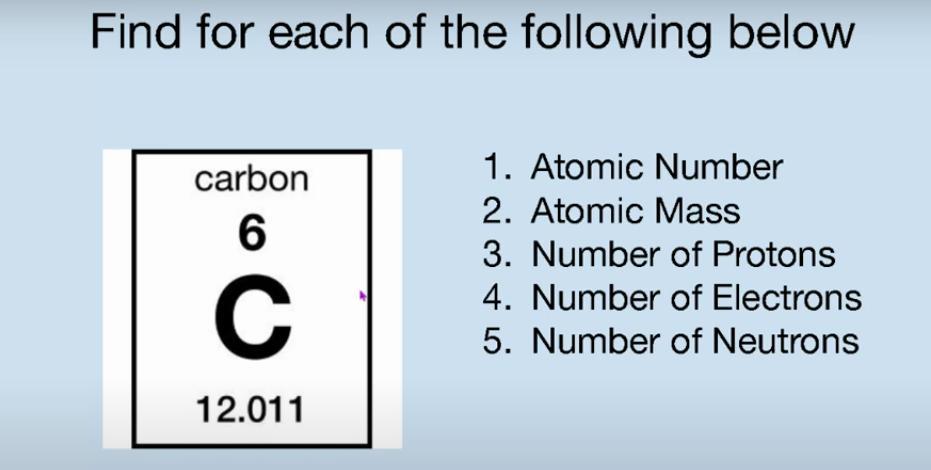
If i understand your question right, then your atomic number & number of protons is below the name so 6. Your atomic mass is at the bottom. Your number of electrons will be the sum of whatever your protons and neutrons are
the atmospheric pressure in the lab is measured as 765 torr, and the equilibrium vapor pressure of water at 298 k is 24 torr. calculate the number of moles of h2 produced in the reaction
Answers
the atmospheric pressure in the lab is measured as 765 torr, the number of moles of h2 produced in the reaction is 0.922066 moles.
given ,
pressure = 765 torr
temperature = 298 k
volume = 22.4 L/Mol
by ideal law ,
pv = nRT
n = pv/Rt
= 0.922066 moles
Learn more about Pressure here
https://brainly.com/question/29341536
#SPJ4
Help me Come up with my own question about a physical or chemical change
Answers
Answer:
What kind of properties result in the substance changing into a new substance?
A) Liquid Properties
B) Physical Properties
C) Chemical Properties
D) Real Properties
Edit: I don't like that question, so here another one instead...
Which of the following statement is incorrect for a chemical reaction?
A) Heat may be given out but never absorbed.
B) Sound may be produced.
C) A color change may take place.
D) A gas may be evolved
Explanation:
Answer:
Which of the following matches the correct definition to an example?
A. Chemical Change: My foot changes color
B. Physical Change: My microwave exploded
C. Chemical Change: My dog ate my homework
D. Physical Change: My homework burned in a fire
Also can u pls mark me brainliest im new pls
15 ft is the same as how many yards
Answers
a three-base sequence (loop) in trna that is complementary to a three-base sequence in mrna is
Answers
A three-base sequence (loop) in tRNA that is complementary to a three-base sequence in mRNA is anticodon.
What are base sequence?
The arrangement of the nucleotides that make up a DNA molecule is called base sequence.
Codons can be found in DNA or mRNA. These are three-nucleotide sequences that designate a particular amino acid. The tRNA (transfer RNA) molecules include anticodons, which aid in bringing or transferring amino acids to the mRNA during translation. A three-nucleotide sequence is also present in an anticodon. The nucleotides are complementary to the sequence of nucleotides on the mRNA that is being translated, allowing the anticodon in the tRNA to engage with the particular codon in the mRNA and bring the particular amino acid that the mRNA is coding for during translation.
To know more about anticodons use link below:
https://brainly.com/question/28811464
#SPJ1
how can you controlling hazardous substances, like coolant that drip off engine components when diagnosing and repairing cooling systems
Answers
Controlling hazardous substances like coolant that can drip off engine components when diagnosing and repairing cooling systems requires taking appropriate safety measures to minimize the risk of exposure. Here are some steps you can take to control the spread of hazardous substances:
Isolate the work area: Set up a barrier around the work area to keep coolant from spreading to other parts of the garage or workspace.
Use protective equipment: Wear gloves, eye protection, and other appropriate protective gear to minimize your exposure to coolant.
Collect and contain spills: Use absorbent materials like kitty litter, sand, or oil-only sorbents to collect and contain any coolant that drips off the engine components. Dispose of the absorbed material in a safe and appropriate manner.
Use drip pans: Place drip pans or catch trays under the engine components to catch any coolant that may drip off.
Clean up thoroughly: Clean up any remaining coolant or absorbent material thoroughly, taking care to avoid spreading the material to other parts of the workspace.
Learn more about components here:
https://brainly.com/question/29377319
#SPJ4
Oxidation States of Manganese Use the half-reaction method to determine the net-ionic redox reaction between the permanganate ion and the bisulfite ion in test tube #5. АР B I U S IX S2 I
Answers
the net-ionic redox reaction between permanganate ion and bisulfite ion in test tube #5 is MnO4− + 5HSO3− + 8H+ → MnSO4 + 5SO42− + 4H2O.
Manganese has multiple oxidation states. The most important ones are +2, +4, +6, and +7. In order to determine the net-ionic redox reaction between permanganate ion and bisulfite ion in test tube #5, we first write a balanced equation for the reaction that will occur between these two ions. To balance the equation, we will first write the oxidation states of manganese for both the permanganate and bisulfite ions. Oxidation States of Manganese: Manganese has an oxidation state of +7 in permanganate ion and +4 in MnSO4 (produced by the reaction).
Half Reactions: Next, we need to separate the reaction into two half-reactions: one for oxidation and one for reduction. The half-reaction for oxidation is:
MnO4− → MnSO4 + H2O + e−
The half-reaction for reduction is:
H+ + HSO3− + e− → SO42− + H2O
Combining the two half-reactions, we get:
MnO4− + 8H+ + 5HSO3− → MnSO4 + 5SO42− + 4H2O
Thus, the net-ionic redox reaction between permanganate ion and bisulfite ion in test tube #5 is
MnO4− + 5HSO3− + 8H+ → MnSO4 + 5SO42− + 4H2O.
To know more about redox reaction visit:
https://brainly.com/question/28300253
#SPJ11
Other than color, what evidence can you use to identify chemical changes?
Answers
Explanation:
There are several pieces of evidence that can be used to identify chemical changes, other than a change in color. Some of these include the production of a gas, the formation of a precipitate, a change in temperature, and a change in the state of matter (e.g. from a solid to a liquid or vice versa). For example, if a solid substance is added to a liquid and bubbles of gas are produced, this is evidence of a chemical change. Similarly, if two clear solutions are mixed together and a solid precipitate forms, this is also evidence of a chemical change. Additionally, if a substance is heated and it changes from a solid to a liquid or from a liquid to a gas, this is also evidence of a chemical change.
Which is a way to express concentration of a solution?
parts per billion
moles
molar mass
force per square meter
Answers
Answer:
A. Parts Per Billion
Explanation:
ED 2021
Answer:
a
Explanation:
A list of changes is shown. Temperature decreases Intermolecular bonds become weaker Melting Intermolecular bonds become stronger Temperature remains constant Temperature increases Vibration of molecules slows down Molecules vibrate faster Which of the above changes would be accompanied by an increase of the kinetic energy of particles in a solid? (4 points)
Answers
Answer:
Intermolecular bonds become weaker
Melting
Temperature increases
Molecules vibrate faster
Explanation:
In the solid phase, intermolecular forces are found to be strongest. However, as the temperature is increased, the molecules of the solid begin to vibrate faster and intermolecular forces between them begin to weaken.
As intermolecular forces of a substance become weaker, the substance melts. The molecules in the liquid state possesses greater kinetic energy than the molecules in the solid state.
Hence the the answer above.
Answer:
B, C, F, and H
Explanation:
These are all things that happen in the increase of the kinetic energy of particles in a solid.
B. Intermolecular bonds become weaker
C. Melting
F. Temperature increases
H. Molecules vibrate faster
Also, just took the test and got it right.
please I need help ASAP
Lead nitrate decomposes on heating as indicated in Equation. 2Pb(NO3)2(s) 2PbO(s) + 4NO₂(g) + O₂(g) (4.8) If a volume of 112 cm³ of oxygen gas was collected at STP when a sample of lead nitrate was completely decomposed by heating, calculate the; (a) mass of the lead nitrate sample. (b) mass of lead(II) oxide produced. (c) Volume of nitrogen dioxide gas produced at STP. (Pb=207, N = 14, O=16; molar volume of gas at STP = 22.4 dm³)
Answers
Answer:
To solve this problem, we'll need to use stoichiometry and the molar ratios from the balanced chemical equation. Here's how you can calculate the values:
(a) Mass of the lead nitrate sample:
From the balanced equation, we can see that 2 moles of lead nitrate (Pb(NO3)2) produce 1 mole of oxygen gas (O2). We know that the volume of oxygen gas collected is 112 cm³, which is equal to 112/1000 = 0.112 dm³ (converting cm³ to dm³).
According to the molar volume of gas at STP (22.4 dm³), 1 mole of any gas occupies 22.4 dm³ at STP. Therefore, the number of moles of oxygen gas can be calculated as:
moles of O2 = volume of O2 / molar volume at STP
moles of O2 = 0.112 dm³ / 22.4 dm³/mol = 0.005 mol
Since 2 moles of lead nitrate produce 1 mole of oxygen gas, we can determine the number of moles of lead nitrate as:
moles of Pb(NO3)2 = 2 * moles of O2
moles of Pb(NO3)2 = 2 * 0.005 mol = 0.01 mol
To calculate the mass of the lead nitrate sample, we'll use its molar mass:
mass of Pb(NO3)2 = moles of Pb(NO3)2 * molar mass of Pb(NO3)2
mass of Pb(NO3)2 = 0.01 mol * (207 g/mol + 2 * 14 g/mol + 6 * 16 g/mol)
mass of Pb(NO3)2 = 0.01 mol * 331 g/mol
mass of Pb(NO3)2 = 3.31 g
Therefore, the mass of the lead nitrate sample is 3.31 grams.
(b) Mass of lead(II) oxide produced:
From the balanced equation, we can see that 2 moles of lead nitrate (Pb(NO3)2) produce 2 moles of lead(II) oxide (PbO). So, the number of moles of PbO produced is equal to the number of moles of Pb(NO3)2.
mass of PbO = moles of PbO * molar mass of PbO
mass of PbO = 0.01 mol * (207 g/mol + 16 g/mol)
mass of PbO = 0.01 mol * 223 g/mol
mass of PbO = 2.23 g
Therefore, the mass of lead(II) oxide produced is 2.23 grams.
(c) Volume of nitrogen dioxide gas produced at STP:
From the balanced equation, we can see that 2 moles of lead nitrate (Pb(NO3)2) produce 4 moles of nitrogen dioxide gas (NO2). So, the number of moles of NO2 produced is twice the number of moles of Pb(NO3)2.
moles of NO2 = 2 * moles of Pb(NO3)2
moles of NO2 = 2 * 0.01 mol = 0.02 mol
Using the molar volume of gas at STP, we can calculate the volume of nitrogen dioxide gas:
volume of NO2 = moles of NO2 * molar volume at STP
volume of NO2 = 0.02 mol * 22.4 dm³/mol = 0.448 dm³
Therefore, the volume of nitrogen dioxide gas
This table shows the mass and volume of four different objects.
Which ranks the objects from most to least dense?
X, Y, W, Z
X, Z, Y, W
W, Y, Z, X
Z, Y, X, W

Answers
Answer:
second one/ B
Explanation:
just took the quiz
Answer:b
Explanation:
To prepare 800mL of 1M phosphate buffer of pH 7.2 (PKa=7.1), by using salt = K2HPO4 and acid = KH2PO4, the quantity of salt required is
Answers
Answer:
78.04g of 0.448 moles must be added
Explanation:
Using H-H equation we can find the pH of the buffer:
pH = pKa + log [A⁻] / [HA]
Where pH is the pH of the buffer = 7.2
pKa = 7.1
[A⁻] = [K₂HPO₄]
[HA] = [KH₂PO₄]
Replacing:
7.2 = 7.1 + log [K₂HPO₄] / [KH₂PO₄]
0.1 = log [K₂HPO₄] / [KH₂PO₄]
1.2589 = [K₂HPO₄] / [KH₂PO₄] (1)
And as the concentration of the buffer is:
1M = [K₂HPO₄] + [KH₂PO₄] (2)
Replacing (2) in (1):
1.2589 = 1M - [KH₂PO₄] / [KH₂PO₄]
1.2589 [KH₂PO₄] = 1M - [KH₂PO₄]
2.2589 [KH₂PO₄] = 1M
[KH₂PO₄] = 0.44M
And [K₂HPO₄] = 0.56M
In 800mL = 0.8L:
0.8L * (0.56mol / L) = 0.448 moles K₂HPO₄. The mass is -Molar mass K₂HPO₄: 174.2g/mol-:
0.448 moles * (174.2g / mol) =
78.04g of 0.448 moles must be addedData and Analysis:
Run
2
3
Mass (g)
Total
Total
mass
mass
before
vinegar
after
reaction reaction
36m 145.95 3.23 141.159 148.225
3.5ml 136.99 3.22140120 134.219
26145.45 3.300 148.22 147.72
Volume
(mL.)
Vinegar
Beaker
Tablet
Ebo's
Mass of
%
CO₂
NICO | NHCO.
Formed in tablet in tablet
Post Lab Exercises:
2. Calculate the mass of carbon dioxide gas generated in each of the runs (see data table).
Show a sample calculation.
Answers
44g is the mass of carbon dioxide gas generated in each of the runs. It is the most fundamental characteristic of matter as well as one of the fundamental quantities throughout physics.
Anything that has the same quantity, or the 6.022 x 10²³ atoms found in 12 grammes of carbon-12 (C-12), is referred to as a mole. The formula for calculating an element's number of moles is = Given mass/Atomic mass. Carbon dioxide's molar mass is 44g. It is the most fundamental characteristic of matter as well as one of the fundamental quantities throughout physics.
To know more about mass, here:
https://brainly.com/question/11954533
#SPJ1
A household in Abu Dhabi consumes a monthly average electric energy of 3750 kWh. The majority of electricity generation capacity in Abu Dhabi is produced oy natural gas-fuelled power generation plants. If gas turbines consume 0.21 m
3
of equivalent natural gas for every 1kWh of electricity produced. 1. Convert the monthly energy use of the household to m
3
of natural gas equivalent and kg of oil equivalent. [hint: assume the conversion efficiency of natural gas turbine to be 33% ] 2. Assuming the average CO
2
emissions coefficient for gas fired power plants is 400 g/kWh, what is the CO
2
footprint in kilograms of the household in that month?
Answers
The answers to the given problem are monthly energy use of household in m3 of natural gas equivalent = 787.5 m³, Monthly energy use of household in kg of oil equivalent = 0.29484627 ktoe, CO2 footprint of household in kg = 1500 kgCO2 (1.5 metric tonnes of CO2).
1) Calculation of monthly energy use in m3 of natural gas equivalent:For every 1 kWh of electricity produced, the gas turbines consume 0.21 m³ of natural gas equivalent.
The consumption of natural gas equivalent can be calculated by multiplying the monthly average electric energy consumption by the quantity of natural gas equivalent that is consumed by gas turbines for every 1 kWh of electricity produced.
So, the monthly consumption of natural gas equivalent will be,
3750 kWh * 0.21 m³/kWh = 787.5 m³ of natural gas equivalent
Calculation of monthly energy use in kg of oil equivalent:
Assuming that natural gas has a calorific value of 55.5 MJ/m³, and that the conversion efficiency of natural gas turbine is 33%, the equivalent energy that will be produced from 1 m³ of natural gas is 55.5 x 0.33 = 18.315 MJ/m³.
In order to calculate the equivalent energy that will be produced from 787.5 m³ of natural gas, we can use the formula:
Equivalent energy = calorific value of natural gas x volume of natural gas x conversion efficiency
So, the equivalent energy that will be produced from 787.5 m³ of natural gas is,
Equivalent energy = 55.5 x 787.5 x 0.33
= 12337.3125 MJ
= 12.337 GJ
So, the monthly consumption of oil equivalent will be:
12.337 GJ / 41.868 = 0.29484627 ktoe (kilo tonnes of oil equivalent)
2) Calculation of CO2 footprint in kg:
Assuming the average CO2 emissions coefficient for gas fired power plants is 400 g/kWh.
The CO2 footprint in kg can be calculated by multiplying the monthly average electric energy consumption by the CO2 emissions coefficient of gas-fired power plants.
So, the CO2 footprint in kg will be:
3750 kWh x 0.4 kg/kWh = 1500 kgCO2 (i.e., 1.5 metric tonnes of CO2).
Therefore, the answers to the given problem are:
Monthly energy use of household in m3 of natural gas equivalent = 787.5 m³
Monthly energy use of household in kg of oil equivalent = 0.29484627 ktoe
CO2 footprint of household in kg = 1500 kgCO2 (1.5 metric tonnes of CO2).
To know more about energy visit:
https://brainly.com/question/1932868
#SPJ11