Solve the simultaneous equations 3x- 4y =20 and 4x-2y = 25
Answers
Answer:
(6, - \(\frac{1}{2}\) )
Step-by-step explanation:
Given the 2 equations
3x - 4y = 20 → (1)
4x - 2y = 25 → (2)
Multiplying (2) by - 2 and adding to (1) eliminates the y- term
- 8x + 4y = - 50 → (3)
Add (1) and (3) term by term to eliminate y
- 5x = - 30 ( divide both sides by - 5 )
x = 6
Substitute x = 6 into either of the 2 equations and evaluate for y
Substituting into (1)
3(6) - 4y = 20
18 - 4y = 20 ( subtract 18 from both sides )
- 4y = 2 ( divide both sides by - 4 )
y = \(\frac{2}{-4}\) = - \(\frac{1}{2}\)
Solution is (6, - \(\frac{1}{2}\) )
The solution of the linear equations 3x - 4y = 20 and 4x - 2y = 25 will be (6, -0.50).
What is the solution to the equation?The allocation of weights to the important variables that produce the calculation's optimum is referred to as a direct consequence.
The linear equations are given below.
3x - 4y = 20 ...1
4x - 2y = 25
8x - 4y = 50 ...2
Subtract equation 1 from equation 1, then we have
8x - 4y - 3x + 4y = 50 - 20
5x = 30
x = 6
The value of the variable 'y' will be given as,
3(6) - 4y = 20
18 - 4y = 20
4y = - 2
y = - 0.50
The solution of the linear equations 3x - 4y = 20 and 4x - 2y = 25 will be (6, -0.50).
More about the solution of the equation link is given below.
https://brainly.com/question/545403
#SPJ2
Related Questions
(a) Find the first four terms, in ascending powers of x, of the binomial expansion of
(1+12x)^1/2
giving each term in simplest form.
(b) Explain how you could use x=1/36 in the expansion to find an approximation for √12
There is no need to carry out the calculation.
Answers
a) The binomial expansion of (1+12x)^1/2 is given by:
(1+12x)^1/2 = 1^1/2 + (1/2)(1^-1/2)(12x) + (1/2)(1^-1/2)(-1/2)*(12x)^2 + ...
Binomial expression: what is it?
A polynomial with only terms is a binomial. An illustration of a binomial is x + 2, where x and 2 are two distinct terms. Additionally, in this case, x has a coefficient of 1, an exponent of 1, and a constant of 2. As a result, a binomial is a two-term algebraic expression that contains a constant, exponents, a variable, and a coefficient.
The first four terms, in ascending powers of x, are:
1, (1/2)(12x), (1/8)(12x)^2, (1/16)*(12x)^3
b) To use x=1/36 in the expansion, you would substitute x=1/36 into the expansion, and keep only the terms up to x^3 (the fourth term in the expansion). This will give an approximation of the value of (1+12x)^1/2 when x=1/36.
This will be an approximation of √12 because x=1/36 corresponds to 12x = 1 and the initial value of the expansion is 1 + 12x .
We can use this approximation to approximate square root of 12 and also for other square roots by using appropriate x values.
Learn more about Binomial expression
https://brainly.com/question/13672615
#SPJ1
Find a sequence of translations, rotations, and
reflections that transform triangle EFG so that its image
rest on square ABCD to together form a simple drawing
of a house.

Answers
A series of rigid transformation that transform triangle EFG to produce an image that rests on the square ABCD to together form a simple drawing of a house are;
A translation and a counterclockwise rotation
What is a rigid transformation?A rigid transformation is one in which the lengths of corresponding points in the image are preserved.
A sequence of transformations (translations, rotations, and reflections that transform triangle EFG so that its image rest on square ABCD to together form a simple drawing of a house are;
A translation of triangle EFG to the leftA rotation of triangle EFG counterclockwise by an acute angleThe performance of the above transformations will produce the image of the simple drawing of the house consisting of the square base and the triangular top.
Learn more on translation transformation here: https://brainly.com/question/11134096
#SPJ1

You randomly choose one of the tiles. Without replacing the first tile, you randomly choose a second tile. Find the probability of the compound event. Write your answer as a fraction or percent rounded to the nearest tenth. The probability of choosing a green tile and then a blue tile is?

Answers
Answer:
4/21
Step-by-step explanation:
I got the first probability and the second probabilty then multiplied them together.
any thing would help it’s due today

Answers
Answer: P: (-3, -1), Q: (2, -1), R: (1, 2), S: (-3, 2)
Step-by-step explanation: the way I think about it is you have to run before you jump, so the third one let’s say, you have to “run” to 1, and then “jump” to 2. Now let’s take the first one, it’s the exact same thing just in the opposite direction, you “run” back to -3 and then “fall” to -1. Now let’s take the second one, first you would “run” to 2 and then “fall” (because it’s a negative) to -1, and if it was a negative first and then a positive, it would just be the opposite of the one O just explained
1. The probability that a person will be helped by a certain medicine is.75. A doctor will be seeing 15 patients today. Determine the following: a) P(The medicine will help all 15 patients) b) P(The medicine helps 9 or more patients) c) P(The medicine helps exactly 10 patients) d) P(Four of the first five patients will be helped by the medicine)
Answers
The probability that four of the first five patients will be helped by the medicine is 0.39. The probability that a particular medicine will help a person is an important aspect of medicine.
The probability that a certain medicine will help a person is 0.75. A doctor will be seeing 15 patients today.
To find out the probability of the following:
a) P(The medicine will help all 15 patients)When each patient is independent of the other, then the probability of the medicine helping all 15 patients can be calculated by multiplying 0.75 by itself 15 times.
Therefore:
= P(The medicine will help all 15 patients)
= 0.75 × 0.75 × 0.75 × 0.75 × 0.75 × 0.75 × 0.75 × 0.75 × 0.75 × 0.75 × 0.75 × 0.75 × 0.75 × 0.75 × 0.75
= 0.0047.
Therefore, the probability that the medicine will help all 15 patients is 0.0047.
b) P(The medicine helps 9 or more patients)
To determine this, we have to calculate the probability of the medicine helping 9 patients, 10 patients, 11 patients, 12 patients, 13 patients, 14 patients and 15 patients.
We can calculate these probabilities using the binomial probability formula. The probability of the medicine helping at least 9 patients is the sum of the probabilities of the medicine helping 9 patients, 10 patients, 11 patients, 12 patients, 13 patients, 14 patients and 15 patients.
Therefore:
P(The medicine helps 9 or more patients) = P(X = 9) + P(X = 10) + P(X = 11) + P(X = 12) + P(X = 13) + P(X = 14) + P(X = 15)
= 0.196 + 0.326 + 0.305 + 0.176 + 0.066 + 0.018 + 0.003
= 0.99
Therefore, the probability that the medicine helps 9 or more patients is 0.99.
c) P(The medicine helps exactly 10 patients)Using the binomial probability formula, we can find that the probability that the medicine will help exactly 10 patients is:
P(X = 10) = nCx * p^x * q^(n - x), where n = 15, x = 10, p = 0.75 and q = 0.25
Therefore:
P(X = 10) = 15C10 * (0.75)^10 * (0.25)^5
= 0.20
Therefore, the probability that the medicine helps exactly 10 patients is 0.20.
d) P(Four of the first five patients will be helped by the medicine)
Using the binomial probability formula, we can find that the probability that 4 of the first 5 patients will be helped by the medicine is:
P(X = 4) = nCx * p^x * q^(n - x)y, where n = 5, x = 4, p = 0.75 and q = 0.25
Therefore:
P(X = 4) = 5C4 * (0.75)^4 * (0.25)^1
= 0.39
Therefore, the probability that four of the first five patients will be helped by the medicine is 0.39.
The probability that a particular medicine will help a person is an important aspect of medicine. The likelihood of the medicine helping all 15 patients is very low, and the likelihood of the medicine helping 9 or more patients is very high. The likelihood of the medicine helping exactly 10 patients is relatively low, and the likelihood of four of the first five patients being helped by the medicine is relatively high.
To know more about the binomial probability formula, visit:
brainly.com/question/30764478
#SPJ11
Can someone help me with this. Will mark brainliest. Thank you.
Answers
Answers:
circlecenterradiuschorddiametersecant=======================================
Explanations:
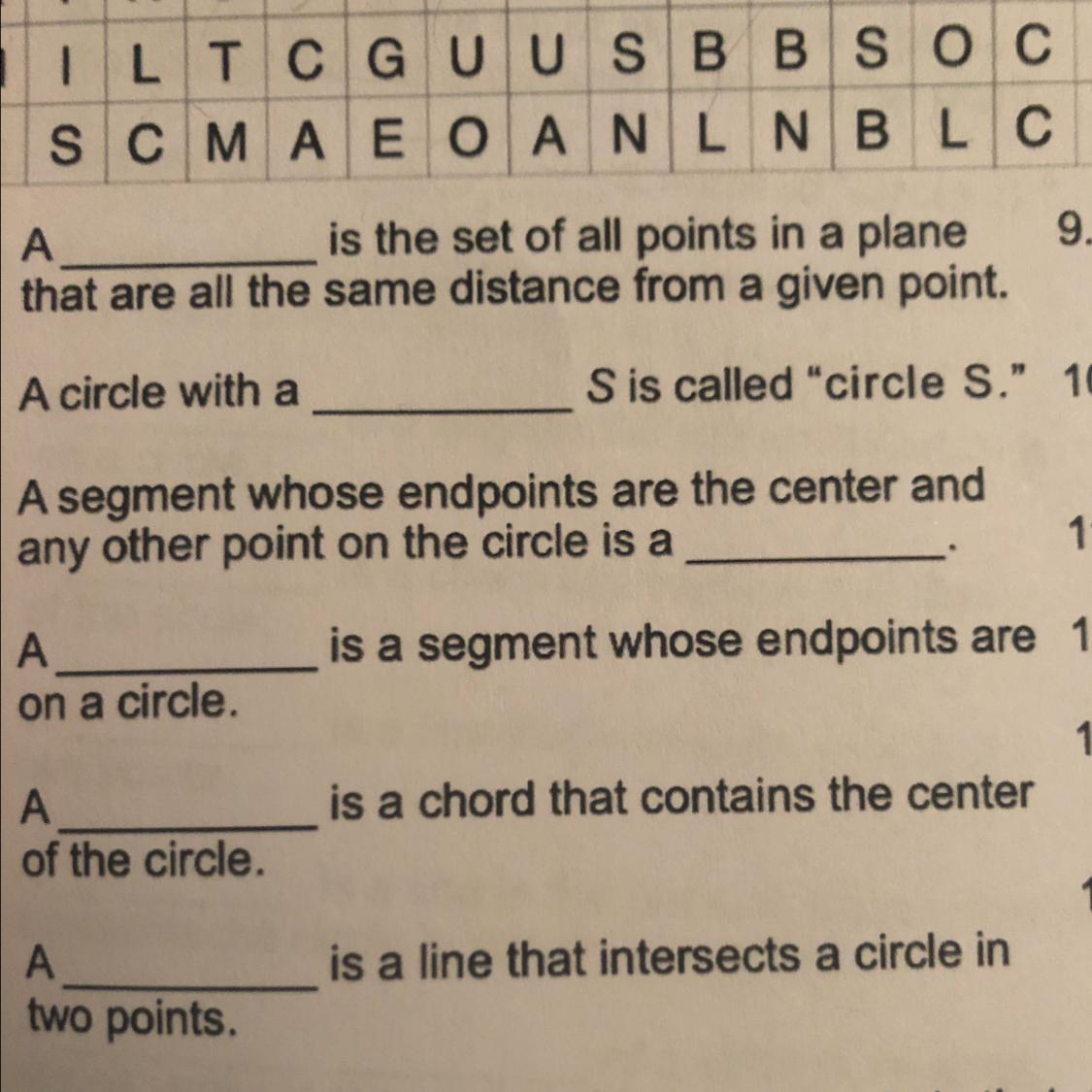
Consider a campfire and people surrounding it to warm up. The fire itself is the center of the circle, and the people around it are points on the circle's edge. Assume that each person is the same distance away from the fire. Refer to the diagram below.We always refer to the circle name by the center point. Think of it being like at the center of the universe, or you could think how the sun is at the center of the solar system. While technically the planets orbit in ellipses and not perfect circles, this idea still could be useful to help remember the naming convention. If we go back to the example in part 1, the radius is the distance from the campfire to any given person. The radius is half the diameter. This is not to be confused with the spelling "cord" which refers to wiring used in electronics, or in fabric fibers. If we connected any two campers with a segment, then we formed a chord. Refer back to part 1 above. Any diameter is a chord, but not the other way around.The diameter is a special type of chord that goes through the center. Note the endpoints of the diameter are on the circle's edge. A secant line is basically a chord but we've extended both endpoints off infinitely in both directions. A secant cuts the circle at 2 different points. In contrast, a tangent line touches the circle at exactly one point only.
Find the distance around each figure.Use 3.14 for pi.

Answers
Answer:
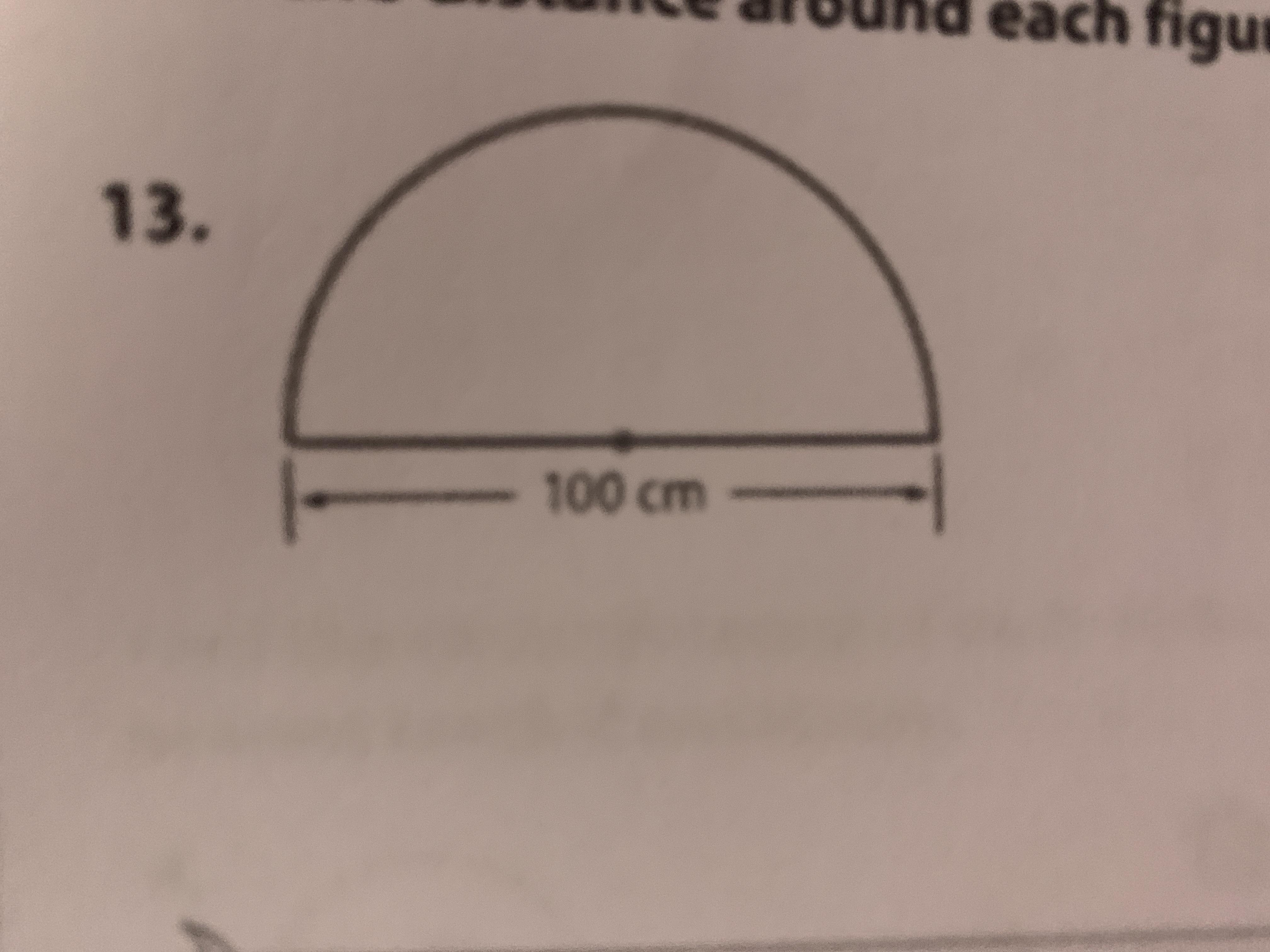
13.) 257.08
14.) 33.57
Step-by-step explanation:
Assume you mean the perimeter.
The circumference is 2\(\pi\)r, then just add the extra measurements
help me PLEASE! Ill mark brainliest

Answers
Answer:
I think it is 420 people
Step-by-step explanation:
The unit cube is divided into identical rectangular prisms. What is the volume of one of the identical prisms?

Answers
Answer:
Volume of one prism; (1/16) unit³
Step-by-step explanation:
The given volume of the cube, v₁ = 1 unit cube
The height of the unit cube, h₁ = 1 unit
The length of the unit cube, w₁ = 1 unit
The height of the unit cube, l₁ = 1 unit
The number of identical prism located along the height = 2 identical prism
The number of identical prism located along the width = 2 identical prism
The number of identical prisms located along the length = 4 identical prism
Therefore;
The height of each identical rectangular prism that make up the unit cube, h₂ = h₁/2 = 1/2 unit
Similarly, for each identical rectangular prism, we have;
The width, w₂ = w₁/2 = 1/2 unit
The length, l₂ = l₁/4 = 1/4 unit
The volume of each one of the identical rectangular prism, v₂ = h₂ × w₂ × l₂
∴ v₂ = 1/2 unit × 1/2 unit × 1/4 unit = 1/16 unit³
The volume of one of the identical rectangular prisms = (1/16) unit³.
Please help!
Stephen had his scooter repaired for a total of $90. The cost for the parts was $25. The cost for the labor was $15 an hour. If h represents the number of hours, which of the following shows an equality between two different ways of expressing the total cost of Stephen's scooter repairs?
A. 40h = 90
B. 15 + 25h = 90
C. 90 + 25h = 15
D. 15h + 25 = 90
Answers
Answer: D
Step-by-step explanation:
Answer:D
Step-by-step explanation:
...
2. Sandra's house is located at the point (2,2). The school is located at the point (7, 10). Each
unit on the graph represents 1 mi. How far is the school from Sandra's house? Remember to
show your work.
●
Plot and label your points on the coordinate plane (1 point)
Use the Pythagorean Theorem to calculate the diagonal distance between the two
points, express your answer as a radical and as a decimal rounded to nearest
hundredths.Show ALL of your work. (4 points)
Answers
Answer: Distance: 9.43398113206
Write an inequality, in slope-intercept form, for the graph below. If necessary,use "<=" for or">=" for >.(0,4)(2,0)-5

Answers
Find the equation of the dotted line:
\(y=mx+b\)1. Find the slope:
\(m=\frac{y_2-y_1}{x_2-x_1}\)\(m=\frac{0-4}{2-0}=-\frac{4}{2}=-2\)2. Find the y-intercept (b): the value of y when the line cross y-axis:
b=4
Then, the eqution of the line is: y=-2x+4
To write the inequality:
When the line is a dotted line you use > or <, whne it is a full line you use ≥ or ≤
When the sahdow area is under the line use < or ≤, when the shadow area is over the line you use > or ≥
Then, as you have a dotted line and the shadow area in under that line, you get the next inequality:
\(y<-2x+4\)3a - 2b - ab - (a-b+ab)+3ab+b-9
Answers
Answer:
2a +ab-9
Step-by-step explanation:
First, write out what you have:
3a-2b-ab-(a-b+ab)+3ab+b-9
Then, distribute the "-" to the "a-b+ab" inside the parenthesis:
3a-2b-ab-a+b-ab+3ab+b-9
Finally, combine like terms and simplify:
3a-a-2b+b+b-ab+3ab-ab-9
2a-2b+2b+3ab-2ab-9
2a+0+ab-9
2a+ab-9 is you equation fully simplified
Solve for x: 10 - 2x = -5x - 5
(1) X = -5
(3) X= 4
(2) x 15
(4)x= -15
Answers
Answer: x = -5
Step-by-step explanation:
Hey there, so you need to Solve for x.
x: 10 - 2x = -5x -5
Add All X's to the left side and All numbers to the right side
-2x+5x = -5 - 10
Add
3x = -15
Simplify
x = -5
~I hope I helped you! :)~
PLS HELP ASAP! GIVING BRAINLIST!

Answers
Answer:
B
Step-by-step explanation:
Answer:
A. \(10x^{2} + 33x^{2} +19x - 12\)
Explanation:
\((2x + 3) (5^{2} + 9x - 4)\\\)
Mutiply \(2x\) by each number on the second bracket
\((2x) (5^{2} ) = 10x^{3} \\(2x) (9x ) = 18x^{2} \\(2x) (- 4 } ) = -8x\)
Then mutiply 3 by each number on the second bracket
\((3) (5^{2} )= 15x^{2} \\(3) (9x) = 27x\\(3) (-4) = -12\)
New equation:
\(10x^{3} + 18x^{2} + -8x + 15^{2} + 27x - 12\)
Add all like terms
\(10x^{3} + 33x^{2} + 19x - 12\)
Find the missing side of each triangle

Answers
Answer:
B) x = √118 mi
Step-by-step explanation:
This is a right triangle, so we can the measure of x using the Pythagorean theorem, which is
a^2 + b^2 = c^2, where
a and b are the shorter legs,and c is the hypotenuse (longest side opposite the right angleIn the figure, the sides measuring x mi and √26 mi are the legs, so we plug these in for a and b in the theorem,and the side measuring 12 mi is the hypotenuse, so we plug it in for c in the theorem:Step 1: Plug in x and √26 for a and b and 12 for c and simplify:
x^2 + (√26)^2 = 12^2
x^2 + 26 = 144
Step 2: Subtract 26 from both sides to isolate x^2:
(x^2 + 26 = 144) - 26
x^2 = 118
Step 3: Take the square root of both sides to isolate x:
√(x^2) = √118
x = √118 mi
A system of linear equations with zero solutions has a graph containing

Answers
A system of linear equations with zero solutions has a graph containing parallel lines.
Recall that a linear equation is displayed as a line, which means that all points on the line are solutions to that linear equation. There are an infinite number of solutions. If you have a system of linear equations, the solution to the system is the value that makes all the equations true.
Systems of equations
A solution to a system of equations is the value or values that apply to all equations in the system. Graphing the equations in a system can tell you how many solutions there are for that system.
If the graphs of the equations intersect, then there is one solution that holds for both equationsIf the graphs of the equations do not intersect (for example, if they are parallel), then there are no solutions that hold for both equations.If both the equations possess same equation then infinite number of solutions are possible for both the equations.Learn more about Systems of equations here:
https://brainly.com/question/19549073
#SPJ9
What is the equation of the line with a Y-intercept of -3 and a slope of 2?

Answers
The equation of a line is generally written in the form \(y = mx + c\), where \(m\) is the slope and \(c\) is the y-intercept. So from the parameters we were given, \(m = 2\) and \(c = -3\), thus the equation becomes \(y = 2x + (-3), y = 2x - 3\)
\(y = 2x - 3\)
The equation of the line with a Y-intercept of -3 and a slope of 2 is y = 2x - 3
Equation of a lineThe slope of the line is represented by m
m = 2
The y-intercept of the line is represented by c
c = -3
The slope-intercept for of the equation of a line is:
y = mx + c
Substitute m = 2 and c = -3 into the equation above
y = 2x - 3
Therefore, the equation of the line with a Y-intercept of -3 and a slope of 2 is:
y = 2x - 3
Learn more on equation of line here: https://brainly.com/question/13763238
Annette and Nathan teach the kindergarten class at Wood Grove Elementary. Annette teaches on Monday, Wednesday, and Friday while Nathan teaches on Tuesday and Thursday. They both like this arrangement as it allows them time to help out with elderly parents when they are not teaching. What type of work arrangement does this represent
Answers
Job sharing is the name for this type of arrangement as Annette and Nathan share their work at Wood Grove Elementary.
A job share arrangement is a full-time of work of job and it is split between two individuals, each with responsibility for the success of the total job. Work sharing, sometimes known as work sharing, is a work arrangement in which two persons, or occasionally more, are kept on a part-time or reduced-time basis to carry out tasks that are typically completed by one person working full-time of job.
As a result, there is a net decrease in per-employee income. The individuals who share the job are jointly accountable for the workload of the shared job and work together to fulfill the task.
Learn more about Job sharing at:
https://brainly.com/question/31927752
#SPJ4
Which angle is congruent to 2?

Answers
which subshell (for example, 1s) is designated by each set of quantum numbers below?
Answers
The subshell designated by each set of quantum numbers is as follows:
a) n=3, l=1 -> 3p subshell
b) n=4, l=2 -> 4d subshell
c) n=2, l=0 -> 2s subshell
d) n=5, l=3 -> 5f subshell
In the electron configuration of an atom, each electron is described by a set of four quantum numbers, which includes the principal quantum number (n), the angular momentum quantum number (l), the magnetic quantum number (m), and the spin quantum number (s). The second quantum number (l) determines the shape of the subshell, which in turn influences the energy level and chemical behavior of the atom. The letter designation for each subshell is based on the value of the angular momentum quantum number (l): s (l=0), p (l=1), d (l=2), f (l=3), and so on. Therefore, for a given set of quantum numbers, we can determine the subshell designation by identifying the value of l.
Learn more about Quantum Numbers here: brainly.com/question/14288557
#SPJ11
and r(x) = 3x² If P(x)=x²-3x²-1/2 x + 10, Q(x) = ²x² - 1x ²-1/2 X- subtract R(x) from the sum of P(x) and Q(x). 6x + 1 then find p(x) + q(x) - r(x). 3 5 and R(x) - 34 X + the 4X
Answers
Answer:Z
cos x dx = sin x + C
Z
sec2 x dx = tan x + C
Z
sec x tan x dx = sec x + C
Z
1
1 + x2
dx = arctan x + C
Z
1
√
1 − x2
dx = arcsin x + C
8.1 Substitution
Needless to say, most problems we encounter will not be so simple. Here’s a slightly more
complicated example: find
Z
2x cos(x
2
) dx.
This is not a “simple” derivative, but a little thought reveals that it must have come from
an application of the chain rule. Multiplied on the “outside” is 2x, which is the derivative
of the “inside” function x
2
. Checking:
d
dx sin(x
2
) = cos(x
2
)
d
dxx
2 = 2x cos(x
2
),
so Z
2x cos(x
2
) dx = sin(x
2
) + C.
Even when the chain rule has “produced” a certain derivative, it is not always easy to
see. Consider this problem:
Z
x
3
p
1 − x
2 dx.
There are two factors in this expression, x
3
and p
1 − x
2, but it is not apparent that the
chain rule is involved. Some clever rearrangement reveals that it is:
Z
x
3
p
1 − x
2 dx =
Z
(−2x)
−
1
2
(1 − (1 − x
2
))p
1 − x
2 dx.
This looks messy, but we do now have something that looks like the result of the chain
rule: the function 1 − x
2 has been substituted into −(1/2)(1 − x)
√
x, and the derivative
Step-by-step explanation:Z
cos x dx = sin x + C
Z
sec2 x dx = tan x + C
Z
sec x tan x dx = sec x + C
Z
1
1 + x2
dx = arctan x + C
Z
1
√
1 − x2
dx = arcsin x + C
8.1 Substitution
Needless to say, most problems we encounter will not be so simple. Here’s a slightly more
complicated example: find
Z
2x cos(x
2
) dx.
This is not a “simple” derivative, but a little thought reveals that it must have come from
an application of the chain rule. Multiplied on the “outside” is 2x, which is the derivative
of the “inside” function x
2
. Checking:
d
dx sin(x
2
) = cos(x
2
)
d
dxx
2 = 2x cos(x
2
),
so Z
2x cos(x
2
) dx = sin(x
2
) + C.
Even when the chain rule has “produced” a certain derivative, it is not always easy to
see. Consider this problem:
Z
x
3
p
1 − x
2 dx.
There are two factors in this expression, x
3
and p
1 − x
2, but it is not apparent that the
chain rule is involved. Some clever rearrangement reveals that it is:
Z
x
3
p
1 − x
2 dx =
Z
(−2x)
−
1
2
(1 − (1 − x
2
))p
1 − x
2 dx.
This looks messy, but we do now have something that looks like the result of the chain
rule: the function 1 − x
2 has been substituted into −(1/2)(1 − x)
√
x, and the derivative
Help me please ASAP
10) In 1950, the population of the United States
was 152 million people. In 1990, it was 250
million. Use a linear model to estimate the
population of the United States in 2030.
A) 326 million
B) 337 million
C) 348 million
D) 359 million
E) 360 million

Answers
Answer:
ok so it is e because
Step-by-step explanation: n 1950, the population of the United States
was 152 million people. In 1990, it was 250
million. Use a linear model to estimate the
population of the United States in 2030.
HELP I NEED HELP ASAP HELP I NEED HELP ASAP HELP I NEED HELP ASAP HELP I NEED HELP ASAP HELP I NEED HELP ASAP

Answers
Answer:
B. (-3, -17)
Step-by-step explanation:
Plsss help correct answer gets marked

Answers
Answer:
B
Step-by-step explanation:
there are 7 blocks in the whole
the green portion is 3/7
1/2 times 6/7 is equal to 3/7
the answer is B
Cohen is a rational expected utility maximiser. You are given the following information about his preferences over the lotteries L 1
=((1/10,G),(3/10,W),(6/10,R))∼((3/10,G),(5/10,W),(2/10,R))=L 2
where G is a glass of Gin, W is a glass of Whisky and R is a glass of Rum. (Note (G,W,R) is not necessarily the order of preference). (a) Explain why there is not enough information to determine whether Cohen prefers a glass of Gin to a glass of Whisky. (b) If you are also told that Cohen prefers Rum to Gin, R≻G then what can you say about his preferences over L 1
and L 3
and therefore L 2
and L 3
where L 3
=((3/10,G),(3/10,W),(4/10,R)) Show that this implies W≻R and therefore W≻G. Also, show that if G≻R then R≻W and G≻W. (c) Construct a VNM utility function to represent his preferences in the case where W≻G. 2 You are now given the following additional information about his preferences, W≻G when he is happy and G≻W when he is depressed. (d) Explain why a VNM utility function over G,W and R cannot be used to represent his preferences. How would you model his preferences?
Answers
a) There is not enough information b) We can conclude that W≻R and W≻G. c) The probabilities p(G), p(W), and p(R) are the probabilities of getting each drink in the lottery L. d) The decision would be whether to drink Whisky or Gin.
(a) There is not enough information to determine whether Cohen prefers a glass of Gin to a glass of Whisky because the lotteries L1 and L2 are indifferent. This means that Cohen is equally likely to prefer one lottery to the other. In other words, his utility for Gin is equal to his utility for Whisky.
(b) If we are also told that Cohen prefers Rum to Gin, R≻G, then we can say that he prefers L3 to L1 and L2. This is because L3 has a higher probability of giving him his most preferred drink, Rum, than either L1 or L2. Therefore, we can conclude that W≻R and W≻G.
If G≻R, then we would have L1≻L3 and L2≻L3. This is because L1 and L2 have a higher probability of giving him his most preferred drink, Gin, than L3. However, we know that L3≻L1 and L3≻L2, so this is a contradiction. Therefore, G≻R cannot be true.
(c) A VNM utility function is a function that represents a person's preferences over lotteries. It takes as input a lottery and outputs a real number that represents the person's utility for that lottery. In the case where W≻G, a VNM utility function for Cohen would be of the form:
u(L) = w * p(G) + g * p(W) + r * p(R)
where w is Cohen's utility for Whisky, g is his utility for Gin, and r is his utility for Rum. The probabilities p(G), p(W), and p(R) are the probabilities of getting each drink in the lottery L.
(d) A VNM utility function cannot be used to represent Cohen's preferences because his preferences are not stable. In other words, his preferences change depending on his mood. When he is happy, he prefers Whisky to Gin. But when he is depressed, he prefers Gin to Whisky. This means that his utility for Gin and Whisky cannot be represented by a single number.
To model Cohen's preferences, we would need to use a more complex model that takes into account his mood. One possible model would be a Markov decision process. A Markov decision process is a model that describes how a person's preferences change over time. It takes as input the person's current mood and outputs a decision about what to do.
In the case of Cohen, the decision would be whether to drink Whisky or Gin. The person's mood would be represented by a state variable. The state variable would take on one of two values: happy or depressed. The transition probabilities would describe how likely it is for the person's mood to change from one state to the other. The reward function would describe how much utility the person gets from drinking each drink.
This model would allow us to capture the fact that Cohen's preferences change depending on his mood. It would also allow us to make predictions about how he would behave in different situations.
To learn more about probabilities here:
https://brainly.com/question/29381779
#SPJ4
Quel est, entre A et B, le nombre le plus proche de 1 ?
Answers
Answer: b
Step-by-step explanation:
its b i just did the work
Enter this matrix in matlab: >> f = [0 1; 1 1] use matlab to find an invertible matrix p and a diagonal matrix d such that pdp-1 = f. Use matlab to compare f10 and pd10p-1. Let f = (1, 1)t. Compute ff, f2f, f3f, f4f, and f5f. (you don't need to include the input and output for these. ) describe the pattern in your answers. Consider the fibonacci sequence {fn} = {1, 1, 2, 3, 5, 8, 13…}, where each term is formed by taking the sum of the previous two. If we start with a vector f = (f0, f1)t, then ff = (f1, f0 + f1)t = (f1, f2)t, and in general fnf = (fn, fn+1)t. Here, we're setting both f0 and f1 equal to 1. Given this, compute f30
Answers
This, compute f30 = (832040, 1346269)t.
To solve the given problem in MATLAB
Define the matrix f.
f = [0 1; 1 1];
Find the eigenvalues and eigenvectors of matrix f.
[V, D] = eig(f);
Obtain the invertible matrix p and the diagonal matrix d.
p = V;
d = D;
Verify that pdp^(-1) equals f.
result = p * d * inv(p);
Compute f^10 and pd^10p^(-1).
f_10 = f^10;
result_10 = p * (d^10) * inv(p);
Compute ff, f2f, f3f, f4f, and f5f.
f_1 = f * f;
f_2 = f_1 * f;
f_3 = f_2 * f;
f_4 = f_3 * f;
f_5 = f_4 * f;
The pattern in the answers can be observed as follows:
ff = (1, 1)t
f2f = (1, 2)t
f3f = (2, 3)t
f4f = (3, 5)t
f5f = (5, 8)t
To compute f30, we can use the same pattern and repeatedly multiply f with itself. However, computing f^30 directly might result in large numbers and numerical errors. Instead, we can utilize the Fibonacci sequence properties.
Given that f = (f0, f1)t = (1, 1)t, we know that fnf = (fn, fn+1)t. So, to find f30, we can calculate f30f = (f30, f31)t. Since f30 is the 31st term in the Fibonacci sequence, we can conclude that f30 = fn+1 = 832040.
For more such questions on compute visit:
https://brainly.com/question/30613029
#SPJ8
Evaluate 0.3y + y/z
When Y=10 and z=5.
Answers
The answer is 5.
Simple question
what is the product of (-0.5)(-1.2)(-5.22)?
0. -9.8
0. -3.132
0. 3.132
0. 9.8
Answers
Answer:
The answer is B or -3.132
Step-by-step explanation:
You are multiplying 2 negatives and a positive, so it guarantees it will be negative! Hope this helps!