Solve the compound Inequalities, graph the solutions and write the solutions in interval notation. Show all work.-5<2x+3 less then or equal to 11

Answers
Answer:
Interval Notation: (-4,4]
Explanation:
Given the compound inequality:
\(-5<2x+3\le11\)Subtract 3 from all sides of the inequality:
\(\begin{gathered} -5-3<2x+3-3\le11-3 \\ -8<2x\le8 \end{gathered}\)Next, divide all sides of the inequality by 2.
\(\begin{gathered} \frac{-8}{2}<\frac{2x}{2}\le\frac{8}{2} \\ -4The solution to the compound inequality in interval notation is:\((-4,4\rbrack\)Next, we graph the solution.
• Since we have, -4,• At, x≤4,, we use a ,closed circle,.
The graph is shown below:

Related Questions
A direct variation includes the points (9, 54) and (n. 48). Find n.
Answers
The Solution.
Step 1:
We shall state the variation as direct ( positive).
\(\frac{9}{54}=\frac{n}{48}\)Step 2:
We shall solve the equation in step1 above to get the value of n.
\(\begin{gathered} \text{Cross multiplying, we get} \\ 54n=9\times48 \\ 54n=432 \\ \text{Dividing both sides by 54, we get} \\ n=\frac{432}{54} \\ n=8 \end{gathered}\)Step 3:
Presentation of the Answer.
The correct answer is n = 8.
Classify each triangle in the figure below by its angles and sides.

Answers
The classification of triangle BDC is given by the following option:
d. Obtuse Isosceles.
How to classify triangles?The classification of the triangles relative to their side lengths are given as follows:
Scalene: all three side lengths have different measures.Isosceles: two of the side lengths have equal measures.Equilateral: all three side lengths have the same measure.The classifications of a triangle according to it's greatest angle measure is given as follows:
Acute: Greatest angle measure is less than 90º.Right: Greatest angle measure is of 90º.Obtuse: Greatest angle measure is greater than 90º.For triangle BCD, we have that:
It is an obtuse triangle, as the greatest angle, which is B, is given by the combination of a right triangle and an acute angle.It is an isosceles triangle, as the side lengths BD and CD are equal.Thus option D is correct.
More can be learned about classification of triangles at brainly.com/question/16589630
#SPJ1
Slope formula- Algebra 1
Please answer,
will give brainliest!!

Answers
Answer:
Step-by-step explanation:

Answer:
1) 1.33
2) 0
Step-by-step explanation:
1) 9-1/8-2 = 8/6= 4/3= 1.33
2)-3-(-3)/8-4 = 0/4=0
Find the 7th term in the
sequence
, 1, 3, 9,...
Hint: Write a formula to help you.
1st term . Common Ratio desired term - 1)
Enter
Answers
Answer:
The 7th term is 729
Step-by-step explanation:
Given
\(Sequence: 1, 3, 9...\)
Required: Determine the 7th term
The given sequence is a geometric function. So, we calculate the common ratio (r) first.
\(r = \frac{T_2}{T_1}\)
\(r = \frac{3}{1}\)
\(r = 3\)
The nth term of gp is:
\(T_n = ar^{n-1\)
Where
\(a = T_1\)
The 7th term is:
\(T_7 = ar^{7-1\)
\(T_7 = ar^6\)
\(T_7 = 1 * 3^6\)
\(T_7 = 729\)
Triangle ABC is similar to triangle EDF. Find the length of BC.

Answers
Answer:
17.5
Step-by-step explanation:
Angle EDF added up equals to 37.5
12+8=20
37.5-20=17.5, so the answer is 17.5, hope this helps :)
Answer:
BC = 5
Step-by-step explanation:
since the triangles are similar then the ratios of corresponding sides are in proportion , that is
\(\frac{BC}{DF}\) = \(\frac{AC}{EF}\) ( substitute values )
\(\frac{BC}{7.5}\) = \(\frac{8}{12}\) ( cross- multiply )
12 BC = 60 ( divide both sides by 12 )
BC = 5
Which system of inequalities is represented by the graph?

Answers
The inequalities that are represented by the given graph are expressed as;
y - x > 0 and y ≥ 1
How to interpret Inequality Graph?Inequalities that use < or > symbols are plotted with a dashed line to show that the line is not included in the region. Inequalities that use ≤ or ≥ symbols are plotted with a solid line to show that the line is included in the region.
The general form of the equation of a line in slope intercept form is;
y = mx + c
where;
m is slope
c is y-intercept
For the dashed line, shading is above the line, the y-intercept is 0.
Slope is 1. Thus, equation is;
y - x > 0
For the horizontal line, the inequality is expressed as;
y ≥ 1
Read more about Inequality Graph at; https://brainly.com/question/11234618
#SPJ1
what is the median of numbers 20,35,28,15,22,36,26
Answers
The median of the given data set is 26.
What is the median?In statistics and probability theory, the median is the value separating the higher half from the lower half of a data sample, a population, or a probability distribution. For a data set, it may be thought of as "the middle" value.
Given the data set, we need to find the median.
So, let's arrange the numbers from smallest to largest in order to find the median.
\(\sf 15,20,22,26,28,35,36.\)
\(\text{Median}=\sf 26\)
Therefore, the median of the data set is 26.
To know more about the median, visit:
https://brainly.com/question/28060453
#SPJ5
A sheriff patrols several neighborhoods in her patrol car it requires 3/15 of an hour to patrol an entire neighborhood how many neighborhoods can the sheriff patrol in 5/8 of an hour
Answers
Based on the time it takes to patrol one neighborhood, the number of neighborhoods that the sheriff can patrol in 5/8 of an hour is 3.125 neighborhoods
How to find the number of neighborhoods?The number of neighborhoods that the sheriff can patrol in 5/8 hours depends on the number of hours that it takes the sheriff to patrol one neighborhood.
The number of neighborhoods she can patrol can therefore be found by the formula:
= Number of hours sheriff has / Number of hours required to patrol one neighborhood
= 5/8 ÷ 3/15
= 5/8 x 15/ 3
= 75 / 24
= 3.125 neighborhoods
Find out more on sheriff patrols at https://brainly.com/question/12869716
#SPJ1
Find the domain and the range of the relation shown on the
graph to the right. Use the vertical line test to determine whether
the graph is the graph of a function.

Answers
Answer:
Domain = {0.-6}
Range = {-2, 4}
Notes We find coordinates and radius and state
Then we show formula (x -x1)^2 + (y +y1) = r ^2 and show
(x -3 )^2 + (y − 1)^2 = 9 = R^2 THE RADIUS^2
then ;
Domain formula = x - r and x + r
Range formula = y - r and y + r
Step-by-step explanation:
The graph is a circle so all the points are enclosed in it
The domain is the values for x so you subtract the radius from the centre coordinate and you add the radius to it The range is the values for y so you do the same to the y coordinate If you use
(x- x1) ^2 + (y - y1) ^2
(x -3 )^2 + (y − 1)^2 = 9
However this changes if centre coordinate shows negatives
we change negative x or y to + positive in the formula in bold.
Centre coordinate = (3.,1) radius is 3 SO = MUST BE THE RADIUS ^2
= (x - 3)^2 + (y - 1)^2 = 3^2 = 9
Domain formula = x - r and x + r
Domain = 3 - 3 = 0
and - 3 + 3 = -6
Domain = {0.-6}
Range formula = y - r and y + r
Range = 1 - 3 = -2
and 1 +3 = 4
Range = {-2, 4}
how to turn NSQ to SQ statistical problem
Answers
NSQ can be turned into SQ through hypothesis testing and statistical analysis to determine significant relationships and patterns in the data.
To turn a non-statistical question (NSQ) into a statistical question (SQ), we need to rephrase it in a way that allows for statistical analysis. A statistical question is one that can be answered by collecting and analyzing data. Here is an example of how to turn an NSQ into an SQ:
This is a non-statistical question because it cannot be answered by collecting and analyzing data. It is purely a matter of personal preference and cannot be measured quantitatively. However, we can turn it into a statistical question by rephrasing it as:
To answer this question, we would need to collect data from a sample of the population and analyze it statistically. For example, we could conduct a survey of 1000 people and ask them which beverage they prefer. We would then calculate the percentage of respondents who prefer tea over coffee and use statistical methods to estimate the margin of error and confidence interval.
By turning the non-statistical question into a statistical question, we have made it possible to collect and analyze data to answer it. This approach is useful in many fields, including market research, social sciences, and healthcare, where data-driven decisions are increasingly important.
for such more question on statistical analysis
https://brainly.com/question/14724376
#SPJ11
The formula for glue says to add 55ml of hardener to each container of resin. How much hardener should be added to 18 containers of resin?
Write your answer in liters.
Answers
The quantity of the hardener added to 18 containers of resin will be 990 ml.
What is an expression?Expression in maths is defined as the collection of numbers variables and functions by using signs like addition, subtraction, multiplication, and division.
Numbers (constants), variables, operations, functions, brackets, punctuation, and grouping can all be represented by mathematical symbols, which can also be used to indicate the logical syntax's order of operations and other features.
Given that the formula for glue says to add 55ml of hardener to each container of resin.
The quantity of hardener for 18 containers will be calculated as,
Q = 18 x 55
Q = 990 ml
To know more about an expression follow
https://brainly.com/question/29136008
#SPJ1
In circle M below, diameter AC, chords AB and BC, and radius MB
are drawn.

Answers
The statement which is not true about the circle M is ∆ABM is isosceles.
The correct answer choice is option 2.
Which statement is not true?Based on the circle M;
diameter AC,
chords AB and BC,
radius MB
Isosceles triangle: This is a type of triangle which has two equal sides and angles.
Equilateral triangle is a triangle which has three equal sides and angles.
Hence, ∆ABM is equilateral triangle.
Read more on triangles:
https://brainly.com/question/1058720
#SPJ1
what is the slope of the line containing (2,-9) and (-5,-3)
Answers
Answer:
\( \huge \boxed{ \boxed{ - \frac{6}{7} }} \\ \)
Step-by-step explanation:
The slope of a line given two points can be found by using the formula
\(m = \frac{ y_2 - y _ 1}{x_ 2 - x_ 1} \\\)
From the question we have
\(m = \frac{ - 3 - - 9}{ - 5 - 2} = \frac{ - 3 + 9}{ - 5 - 2} = - \frac{6}{7} \\ \)
We have the final answer as
\( - \frac{6}{7} \\ \)
Hope this helps you
Problem 2.8. Consider a language containing four letters: A, B, C, D. How many three-letter words can you form in this language? How many four-letter words can you form if each letter appears only once in each word?
Answers
If there is repetition of letters= 64 possibilities
Therefore total possibility of 3 letter words= 88
Possible 4 letter words(no repetition)=24
find the value
any help
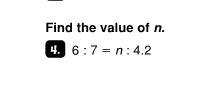
Answers
using the given function g(x) in comparison to its parent function f(x)=x^2 describe the transformation that occurred. g(x)=(x+5)^2
Answers
Answer:
the number has 2 resumable 6+5
URGENT, WILL GIVE BIG BRAIN OR WHATEVER ITS CALLED LOL
For every 1000 hits a YouTub channel gets it makes £2 from ad revenue. a How many hits are required to make £21?
Answers
Answer: 10,500 hits
Step-by-step explanation:
I WANT BIG BRAIN! I WANT BIG BRAIN AHAHHHHHHH!!!!!!!
ok there are a number of ways to go about this
it is unclear whether or not the YT content creator will get one pound for 500 hits
i honestly dont know but i am going to assume it will
1000 times 20 (we are plugging in a test variable, 20, here)
so lets say we have 20,000 hits
lets divide that by 1000 and we get 20. 20 times 2 is 40 pounds so obviously thats too much
lets try 1000 times 10
so we have 10 times 2 and thats 20 pounds. we are closer
10,500 hits
(i put in 500 because half of 1000 is 500 and that will give you one pound instead of two)
please complete the worksheet

Answers
Answer:
9. FEG is 65 and HEG is 115
Step-by-step explanation:
For FEG you can get this by doing supplementary angle and simply subtracting 180-115. For HEG, you realize that it is a vertical angle and from there you know that it is the same angle as DEF
what fraction of 2 1/2 is 48 minutes
Answers
Answer:
19.2
Step-by-step explanation:
Let x be the missing number
2 1/2x =48
5/2x =48
x=48(2/5)
x=19.2
Helen rolls a dice and flips a coin.
Calculate the probability that she gets a 4 and a tail.
Answers
Answer:
1/12
Step-by-step explanation:
Probability of 4 = 1/6
Probability tail = 1/2
Multiply them
Answer:
1/12
Step-by-step explanation:
Probability of 4 = 1/6
Probability tail = 1/2
1/6 x 1/2 = 1/12
The ratio of the number of baskets made by Tony to the number of baskets made by Colin is 2 to 3. Tony made 10 baskets. How many baskets did Colin make?
Answers
Step-by-step explanation:
The ratio of the number of baskets made by Tony to the number of baskets made by Colin is 2 to 3
let the ratio be 2x and 3x
Tony made 10 baskets
so , 2x=10
x=5
3x =3×5=15
so , Collin made 15 baskets
kira is walking. , given below, is her distance in kilometers from tomsville after hours of walking. complete the following statements. let be the inverse function of . take to be an output of the function . that is, and . (a) which statement best describes ? the amount of time she has walked (in hours) when she is kilometers from tomsville. her distance from tomsville (in kilometers) after she has walked hours. the ratio of the amount of time she has walked (in hours) to her distance from tomsville (in kilometers), . the reciprocal of her distance from tomsville (in kilometers) after walking hours.
Answers
The statement that describes inverse function best is the amount of time she has walked (in hours) when she is kilometers from tomsville i.e. option A
According to the question,
The given function denotes the distance travelled by Kira in kilometers from tomsville after hours of walking
D(t) = 10.4 - 4t
The inverse of the function is D⁻¹(x)
=> D(t) = 10.4 - 4t
Converting equation in terms of t,
=> D(t) + 4t = 10.4
=> 4t = 10.4 - D(t)
=> t = 10.4 - D(t) /4
Inverse function = D⁻¹(x) = 10.4 - D(x) /4
It denotes the amount of time she has walked (in hours) when she is kilometers from tomsville.
From the following statements in the question
Option (a) is correct about inverse function
To know more about Inverse function here
https://brainly.com/question/2541698
#SPJ4
Bernard designs motorized bicycles at Smart Gear Technologies. His total earnings are
$54,000 this year. Bernard pays $201 in payroll taxes for every $1,000 he earns.
What is Bernard's net income for this year?
Answers
Answer:
600
Step-by-step explanation:
5 times 100 times 105
Answers
Answer:
52500
Step-by-step explanation:
first do 5*105 to get 525 then mutiply by 100 to get 52500
In a study, 123 children of a certain race in a certain city were randomly assigned to one of two groups: one group enrolled in a preschool, and the other group did not. A research question was whether attendance at preschool had an effect on high school graduation. The accompanying table shows whether the students graduated from regular high school or not and includes both boys and girls. Find a 95% confidence interval for the difference in proportions, and interpret it.
Although we don't have a random sample of children, we do have random assignment to groups, and the two groups are independent.
We must verify that the sample sizes are large enough. Let sample 1 be children who went to preschool and let sample 2 be children who did not go to preschool.
n1p1=66(0.773) =51
n1(1-p1) =66(0.227) =15
n2p2=57(0.526) =
n2(1-p2) =
(Round to the nearest integer as needed.)
Answers
The 95% confidence interval is {0.01962, 0.37438}
How to solve thisGiven:
123 children of certain race are the sample size
The percentage who did not go to school: 23/23 + 31 = 42.6%
In this sample, the children who attend preschool are more likely to.
n2p2= 54(0.426) = 23.004 = 23
n2(1-p2) = 54(1-0.426) = 30.996 = 31
P(x1 + x2)/n1 + n2 = 43 + 23/69 + 54 = 0.54
SE = \(\sqrt{0.54(1-0.54)[\frac{1}{69} + \frac{1}{54} }\)
SE = 0.0905
z value for 95% confidence interval
z value = 1.96
(0.623 - 0.426) - 1.96 * 0.0905
= 0.01962
0.623 - 0.426 + 1.96 * 0.0905
= 0.37438
Hence, The 95% confidence interval is {0.01962, 0.37438}
Read more about confidence interval here:
https://brainly.com/question/15712887
#SPJ1
Keegan is determining whether the triangle with vertices L(-1, 3), M(5, 5) and N(7, -1) is a right triangle. Keegan finds the slopes as shown and concludes that the triangle is not a right triangle because the product is not -1. What is his error and what should he do to correct it?
(added an image)
will mark brainiliest

Answers
Keegan's error is assuming that the product of the slopes of any two sides of a triangle should be -1 for the triangle to be a right triangle.
To determine if the triangle LMN is a right triangle, Keegan should instead calculate the lengths of the three sides of the triangle and check if they satisfy the Pythagorean theorem.
The Pythagorean theorem states that in a right triangle, the square of the length of the hypotenuse (the longest side) is equal to the sum of the squares of the lengths of the other two sides.
To correct his approach, Keegan should calculate the lengths of sides LM, MN, and NL using the coordinates of the vertices and then check if the Pythagorean theorem holds true.
If the squared length of one side is equal to the sum of the squares of the other two sides, then the triangle LMN is a right triangle.
To learn more on Triangles click:
https://brainly.com/question/2773823
#SPJ1
Two people are driving to work at different constant speeds. The graph below shows the distance traveled over time by driver 1.
The table (no graph included just the table) below shows the distance traveled over time by driver 2.
What is the difference between the speeds of the two drivers in mph?


Answers
Answer:
5 mph
Step-by-sep explanation:
To find of out the difference between the speed of the two drivers in miles per hour (not in miles per minute), first, calculate the unit rate or speed of driver 1 using the graph, and driver 2 using the table given.
Unit rate/speed = distance travelled/time = y/x.
Speed of Driver 1/unit rate:
The graph shows 1.5 miles (y) is travelled in 2 minutes (x).
Convert the 2 minutes to hour, you will have:
\( \frac{2}{60} = \frac{1}{30} hr \)
Speed in mph = \( \frac{y}{x} = \frac{1.5}{\frac{1}{30}} = 1.5*\frac{30}{1} = 45 \)
Speed of Driver 1 in mph = 45 mph
Speed of Driver 2/unit rate:
The table shows 2.5 miles (y) is travelled in 3 minutes (x).
Convert the 3 minutes to hour, you will have:
\( \frac{3}{60} = \frac{1}{20} hr \)
Speed in mph = \( \frac{y}{x} = \frac{2.5}{\frac{1}{20}} = 2.5*\frac{20}{1} = 50 \)
Speed of Driver 2 in mph = 50 mph
Difference between the speed of the two drivers = 50 - 45 = 5 mph
-136=8(6x-5) can someone please help ?
Answers
Answer:
\(\Huge \boxed{x=-2}\)
Step-by-step explanation:
\(-136=8(6x-5)\)
Dividing both sides by 8.
\(-17=6x-5\)
Adding 5 to both sides.
\(-12=6x\)
Dividing both sides by 6.
\(-2=x\)
Answer:
\( \boxed{ \bold{ \huge{ \boxed{ \sf{x = - 2}}}}}\)
Step-by-step explanation:
\( \sf{ - 136 = 8(6x - 5)}\)
Distribute 8 through the parentheses
⇒\( \sf{ - 136 = 48x - 40}\)
Swap the sides of the equation
⇒\( \sf{48x - 40 = - 136}\)
Move 40 to right hand side and change it's sign
⇒\( \sf{48x = - 136 + 40}\)
Calculate
⇒\( \sf{48x = - 96}\)
Divide both sides of the equation by 48
⇒\( \sf{ \frac{48x}{48} = \frac{ - 96}{48} }\)
⇒Calculate
\( \sf{x = - 2}\)
Hope I helped!
Best regards!!
A researcher plans to conduct a test of hypotheses at the α=0.05 significance level. She designs her study to have a power of 0.80 at a particular alternative value of the parameter of interest. 18. The probability that the researcher will commit a Type I error is a. 0.05. b. 0.20. c. 0.80. d. equal to the P-value and cannot be determined until the data have been collected. 19. The probability that the researcher will commit a Type II error for the particular alternative value of the parameter at which she computed the power is a. 0.05. b. 0.20. c. 0.80. d. equal to the 1 – (P-value) and cannot be determined until the data have been collected. 20. The appraised values of three recently sold houses in the Columbus area are (in thousands of dollars) 160, 215, and 195. The standard error of the mean of these three appraised values is a. 190.00. b. 27.84. c. 22.73. d. 16.07.
Answers
The concept of type I and type II error was used to set hypothesis and to pick the correct option
What is Hypothesis?
In a scientific setting, a hypothesis (plural: hypotheses) is a tested claim regarding the relationship between two or more variables or a suggested explanation for a phenomenon that has been observed.
Given that,
Significance level: α = 0.05
Power of the test = 0.80
Making statistical claims about the characteristics of the population is made possible by hypothesis testing.
The type I error is also known as significance level.
Since, the given α = 0.05
Therefore, the type I error is 0.05
As a result, choice (a) is accurate.
Type I error is the probability of rejection \(H_{0}\) when \(H_{0}\) is true.
The type II error is denoted by β .
Now,
Power = 0.80
1 - β = 0.80
β = 1 - 0.80
β = 0.20
Therefore, the type II error is 0.20
Hence, option (b) is correct.
Type II error is fail to reject \(H_{0}\) when \(H_{0}\) is false.
The concept of type I and type II error was used to set hypothesis and to pick the correct option
To learn more about Hypothesis visit:
brainly.com/question/29519577
#SPJ4
Identify the exponential function whose graph is shown below.

Answers
Answer:
The exponential function is
\(y = {2}^{x} \)