solve. check for extraneous solutions
3 l4w-1l -5 = 1
Answers
Answer:
w = 3/4 or w = -1/4
Step-by-step explanation:
3l4w - 1l - 5 = 1
Add 5 to both sides.
3|4w - 1| = 6
Divide both sides by 3.
|4w - 1| = 2
Set the inside of the absolute value equal to 2 and -2.
4w - 1 = 2 or 4w - 1 = -2
Add 1 to both sides.
4w = 3 or 4w = -1
Divide both sides by 4.
w = 3/4 or w = -1/4
Check w = 3/4:
3l4w - 1l - 5 = 1
3|4(3/4) - 1| - 5 = 1
3|3 - 1| - 5 = 1
3|2| - 5 = 1
6 - 5 = 1
1 = 1
w = 3/4 works.
Check w = -1/4:
3l4w - 1l - 5 = 1
3|4(-1/4) - 1| - 5 = 1
3|-1 - 1| - 5 = 1
3|-2| - 5 = 1
3(2) - 5 = 1
6 - 5 = 1
1 = 1
w = -1/4 works.
There are no extraneous solutions.
Answer: w = 3/4 or w = -1/4
Related Questions
Find 133.5% of 413. Round to the nearest tenth.
Answers
Answer:
Step-by-step explanation:
Determine the two consecutive multiples of 10 that bracket 551
551 is between 550 and 560
555 is the midpoint between 550 and 560
As illustrated on the number line, 551 is less than the midpoint (555)
Therefore, 551 rounded to the nearest ten = 550
551 rounded to the nearest ten with a number line
Answer: 551.36
Step-by-step explanation:
“Of” means you have to multiply so multiply 133.5 and 413 and you will get 55,135.5 then you move the decimal point to the right 2 times and that will be 551.355, then since there is a five you change the other five to a 6 (5 or more raise the score 4 or less let it rest) and that will be 551.36.
Write a function g whose graph represents a vertical shrink by a factor of 1/2 of the graph of f(x)= 2x + 6
Answers
Answer:
f(x)= x + 3
Step-by-step explanation:
I need alot of help figuring out this problemm TRIG HW

Answers
Answer:
x = 15
y = 15√3
Step-by-step explanation:
This is a special right triangle with angle measures 30° 60° 90°
The side lengths should be x 2x x√3
If the measure of hypotenuse 30 then the side length that sees 30° should be half of it so x = 15 and y = 15√3
76 Ch 5 Practice Test
22
Mr. Specter designed the layout for a factory. The roof of the factory has an elevation of 56.2 feet, and the floor of the lowest level has
an elevation of -15.3 feet. A pulley is installed on an outer wall at an approximate elevation equal to 4 of the total height of the factory.
The factory office floor is located 5.5 feet above the pulley.
What is the approximate elevation of the factory office floor?
A.
19.6 feet
ОВ.
66 feet
C.
25 feet
OD. 23.4 feet
Reset
Next Question
H
Answers
Answer:
c
Step-by-step explanation:
Answer:
23.4 feet
Step-by-step explanation:
Which of these characteristics do a rhombus and a rectangle always have in common. Choose one.
1). opposite sides with equal length
2).all angles are right angles
3).all sides with equal length
Answers
Answer:
A) opposite sides with equal length.
Step-by-step explanation:
Found on another problem answered by Abdulazeez10
The characteristics a rhombus and a rectangle always have in common is opposite sides with equal length.
The right option is opposite sides with equal length
From the question,
We are to determine which of the given characteristics do a rhombus and a rectangle always have in common.
To determine which of the characteristics, we will list some of the characteristics of the two shapes
Characteristics of a Rhombus
All sides are of equal length
Opposite sides are parallel
Opposite angles are congruent
Diagonals intersect perpendicularly
Consecutive angles are supplementary
Characteristics of a Rectangle
Opposite sides are congruent and parallel
Diagonals bisect each other
Each of the interior angles is a right angle
Diagonals are congruent
Now, from above,
We have that all the sides of rhombus are equal in length, which makes the opposite sides to be equal as well.
Also, among the characteristics of a rectangle is that, opposite sides are equal in length
Hence, the characteristics a rhombus and a rectangle always have in common is opposite sides with equal length. The right option is opposite sides with equal length
https://brainly.com/question/12833352
please help and answer ASAP please will mark Brainlest
What is the value of x?
Enter your answer in the box.
x =
°

Answers
Answer:
80 degrees
Step-by-step explanation:
The sum of the angles in a triangle is 180 degrees so we can create the equation 70+30+x=180. This solves out to 80 so x=80 degrees.
plz help
Item 15
A crowd-funding project has received $16,770, which is $1230 less than 90% of the goal amount. What is the goal amount?
Answers
Answer:
The goal is $19,800.
Step-by-step explanation:
$16,770 is $1,230 less than %90 of the goal. If you add 16,770 and 1,230, you get 18,000. Then you have to multiply that by 1.10 to get it to the goal. That is how you get $19,800, which is the answer.
10. A flagpole is supported by two identical wires. What is the distance (X) between the two wires?

Answers
Using the Pythagoras theorem, we can find the value of x to be = 10ft.
Option B is correct.
Define Pythagoras theorem?The right-angled triangle's three sides are related in line with the Pythagoras theorem, also referred to as the Pythagorean theorem. The hypotenuse of a triangle's other two sides add up to a square, according to the Pythagorean theorem, which states that.
Here in the question,
We have 2 right-angled triangles.
So, base of the large triangle, x
= √ (13² - 12²) + √ (13² - 12²)
= √ 5² + √ 5²
= 5 + 5
= 10ft.
Therefore, the length of the side, x = 10ft.
To know more about Pythagoras theorem, visit:
https://brainly.com/question/343682
#SPJ1
Evaluate f (-3) for f(x) = x3 + 3x + 17
Answers
The output value of f( -3 ) in the function f(x) = x³ + 3x + 17 is -19.
What is the output value of f( -3 ) in the function?Given the function in the question:
f(x) = x³ + 3x + 17
To evaluate f(-3) for the function f(x) = x³ + 3x + 17, we simply substitute -3 for x in the expression and calculate the result.
f(x) = x³ + 3x + 17
Plug in x = -3
f(-3) = (-3)³ + 3(-3) + 17
First, let's calculate (-3)³, which means raising -3 to the power of 3:
(-3)³ = -3 × -3 × -3 = -27
Next, let's calculate 3(-3):
3(-3) = -9
Now, we can substitute these values into the expression:
f(-3) = -27 + (-9) + 17
Simplifying further:
f(-3) = -27 - 9 + 17
f(-3) = -36 + 17
f(-3) = -19
Therefore, the output value of f(-3) is -19.
Learn more about functions here: brainly.com/question/2541698
#SPJ1
Paper clips sell for 23 cents per box. What will 4 boxes cost?
Answers
Answer:
92 cents
Step-by-step explanation:
If each box has the cost of 23 cents, and you decided to buy 4, you would multiply the amount of boxes you want with the cost of each one, therefore, the 92 cents. 4 * 23 = 92
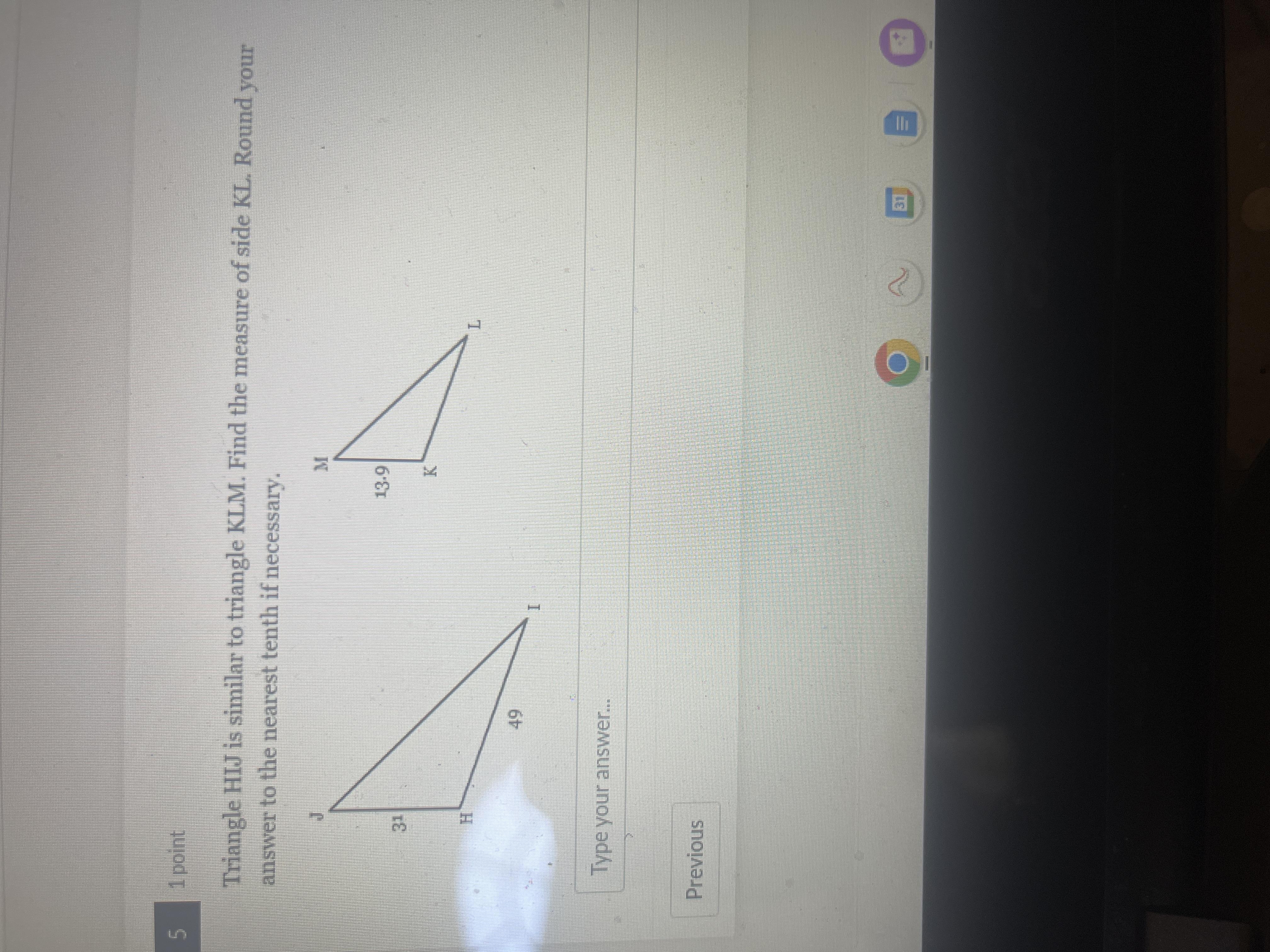
Triangle HIJ is similar to triangle KLM find the measure of side KL around your answer to the nearest tenth if necessary
Answers
The measure of side KL from triangle KLM is 22 units.
What are similar triangles?Two triangles are similar if the angles are the same size or the corresponding sides are in the same ratio. Either of these conditions will prove two triangles are similar.
Given that, triangle HIJ is similar to triangle KLM.
From the similar triangles,
JH/MK =HI/KL
31/13.9 =49/KL
31KL=49×13.9
31KL=681.1
KL=681.1/31
KL=21.97
KL≈22
Therefore, the measure of side KL is 22 units.
To learn more about the similar triangles visit:
https://brainly.com/question/25882965.
#SPJ1
Chloe is older than her brother, Michael, and she never lets him forget it! When Michael is y
years old, Chloe is y + 2.5 years old. Right now Michael is 9.5 years old.
How old is Chloe?
Write your answer as a whole number or decimal.
Answers
Answer: Chloe is 12 years old
y + 2.5
y = 9.5
9.5 + 2.5 = 12
Wally completed 7 out of 10 baskets. What percent is this?
Answers
Answer:70%
Step-by-step explanation:you have 7/10.SO u times the whole fraction by 10( 7 times 10 =70 and 10 times 10 =100) which means 70/100 so the percent is 70.
Hope it helps
what us 8171.28 in 1 d.p
Answers
Answer:
6
Step-by-step explanation:
8171.28
Sig Figs
6
8171.28
Decimals
2
8171.28
Scientific Notation
8.17128 × 10³
E-Notation
8.17128e+3
Words
eight thousand one hundred seventy-one point two eight
Sorr I'm dumb :P... ooooooooooooooooooooooooooooof for meeeeeeeeeeeeh
Answers
A candy bar that originally sold for $.60 undergoes a 3% price increase each year.
Answers
Both calculations from part (1) and part (2) yield the same result of $0.86 for the new cost of the candy bar after 11 years.
Part 1 of 2:
The new cost of the candy bar after 11 years can be calculated by applying a 3% price increase each year to the original cost of $0.60.
To calculate the new cost after 11 years, we can use the formula:
New Cost = Original Cost * (1 + Percentage Increase)^Number of Years
Plugging in the values:
New Cost = $0.60 * (1 + 3%)^11
≈ $0.60 * (1 + 0.03)^11
≈ $0.60 * (1.03)^11
≈ $0.60 * 1.432364654
Rounding to the nearest cent, the new cost of the candy bar after 11 years is $0.86.
Part 2 of 2:
If the cost of the candy bar increased by 3% of the original cost each year for 11 years, we can calculate the final cost by multiplying the original cost by (1 + 3%) for each year.
Using the formula:
Final Cost = Original Cost * (1 + Percentage Increase)^Number of Years
Plugging in the values:
Final Cost = $0.60 * (1 + 3%)^11
≈ $0.60 * (1 + 0.03)^11
≈ $0.60 * (1.03)^11
≈ $0.60 * 1.432364654
Rounding to the nearest cent, the final cost would also be $0.86.
For more such questions on cost
https://brainly.com/question/25109150
#SPJ8
Note: The complete question is - What will be the cost of the candy bar after a specific number of years if it originally sold for $.60 and undergoes a 3% price increase each year?
Thomas obtained a bank loan of k10 000 from BSP bank.He repays the money with 36% interest in one year.Calculate his installment payment he pays in one fortnight?
Answers
Thomas' installment payment that he pays in one fortnight is approximately k523.08.
To calculate Thomas' installment payment, we need to consider the principal amount (k10,000) and the interest rate (36%).
First, let's calculate the total amount to be repaid at the end of the year, including the interest. The interest is calculated as a percentage of the principal amount:
Interest = Principal × Interest Rate
= k10,000 × 0.36
= k3,600
The total amount to be repaid is the sum of the principal and the interest:
Total Amount = Principal + Interest
= k10,000 + k3,600
= k13,600
Now, we need to calculate the number of fortnights in a year. There are 52 weeks in a year, and since each fortnight consists of two weeks, we have:
Number of Fortnights = 52 weeks / 2
= 26 fortnights
To find the installment payment for each fortnight, we divide the total amount by the number of fortnights:
Installment Payment = Total Amount / Number of Fortnights
= k13,600 / 26
≈ k523.08
Therefore, Thomas' installment payment that he pays in one fortnight is approximately k523.08.
It's important to note that this calculation assumes equal installment payments over the course of the year. Different repayment terms or additional fees may affect the actual installment amount. It's always advisable to consult with the bank or financial institution for accurate information regarding loan repayment.
For more such questions on installment visit:
https://brainly.com/question/28330590
#SPJ8
A salesperson at a jewelry store earns 5% commission each week last week heidi sold $540 worth of jewelry how much did she make in the commission how much did the jewelry store make from her sales
Answers
Answer: $27
Step-by-step explanation:
$540x.05=$27
Answer:
Heidi made $27 from commision; And the store made $513 (i had this question my self on Saavas)
Step-by-step explanation:
1. 540x0.05=27
2. 540-27= $513
So the store made 513 dollars and heidi made 27 dollars
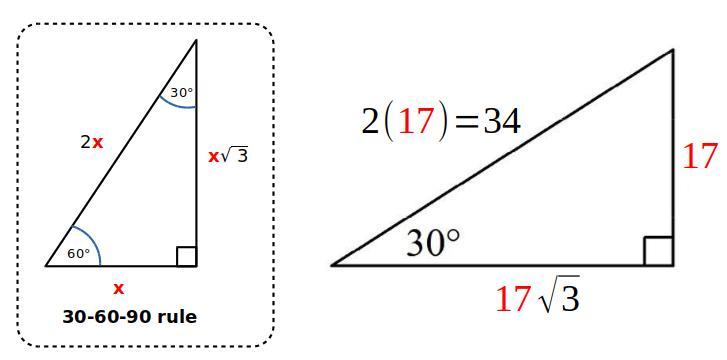
Label the triangle sides, assuming the angle of interest is the 30-degree angle:
solve for
The side with x is the
blank side.
The side with y is the
NO SPAM I WILL REPORT YOU
blank side.
The side with 17 is the blank side

Answers
Check the picture below.
7. Suppose that the discriminating monopolist has the demand functions
P_{1} = 200 - 2Q_{1}; P_{2} = 180 - 4Q_{2} and that the cost function is C = 20(Q_{1} + Q_{2}) .
a) How much should be sold in the 2 markets to maximise profits?
b) What are the corresponding prices?
c) How much profit is lost if it becomes illegal to discriminate?
12 marks]
12 marks]
16 marks]
d) Discuss the consequences of the imposition of a tax of 5 per unit sold in market 1 by
Answers
a) To maximize profits, 10 units should be sold in market 1 and 5 units in market 2.
b) The corresponding prices are $180 in market 1 and $160 in market 2.
c) If it becomes illegal to discriminate, the profit loss is $50.
d) The imposition of a tax of $5 per unit sold in market 1 would likely decrease the monopolist's profit and potentially lead to adjustments in prices and quantities sold in both markets.
a) To maximize profits, the monopolist should set marginal revenue equal to marginal cost in each market.
In this case, marginal revenue is equal to the derivative of the demand function with respect to quantity, and it can be calculated as MR = dP/dQ.
For market 1:
MR₁ = dP₁/dQ₁ = -2
For market 2:
MR₂ = dP₂/dQ₂ = -4
Setting MR equal to marginal cost, which is the derivative of the cost function with respect to quantity, gives:
MR₁ = -2 = dC/dQ₁ = 20
MR₂ = -4 = dC/dQ₂ = 20
Solving these equations, we find:
Q₁ = 10
Q₂ = 5
Therefore, the monopolist should sell 10 units in market 1 and 5 units in market 2 to maximize profits.
b) To determine the corresponding prices, we substitute the quantities obtained in part (a) into the demand functions:
For market 1:
P₁ = 200 - 2Q₁ = 200 - 2(10) = 180
For market 2:
P₂ = 180 - 4Q₂ = 180 - 4(5) = 160
Therefore, the corresponding prices are $180 in market 1 and $160 in market 2.
c) To calculate the profit lost if it becomes illegal to discriminate, we need to compare the profits under discrimination with the profits under non-discrimination.
Under discrimination, the monopolist charges different prices in each market, while under non-discrimination, the same price is charged in both markets.
Under discrimination:
Profit = Total revenue - Total cost
For market 1:
Total revenue₁ = P₁ \(\times\) Q₁ = 180 \(\times\) 10 = $1
For market 2:
Total revenue₂ = P₂ \(\times\) Q₂ = 160 \(\times\) 5 = $800
Total revenue = Total revenue₁ + Total revenue₂ = $1800 + $800 = $2600
Total cost = C = 20(Q₁ + Q₂) = 20(10 + 5) = $300
Profit = Total revenue - Total cost = $2600 - $300 = $2300
Under non-discrimination:
Since the same price is charged in both markets, we take the average price:
Average price = (P₁ + P₂) / 2 = (180 + 160) / 2 = $170
Total revenue = Average price \(\times\) (Q₁ + Q₂) = $170 \(\times\) (10 + 5) = $2550
Total cost remains the same at $300.
Profit = Total revenue - Total cost = $2550 - $300 = $2250
Therefore, the profit lost if discrimination becomes illegal is $2300 - $2250 = $50.
d) The imposition of a tax of $5 per unit sold in market 1 would increase the cost per unit for the monopolist.
This would affect the profit-maximizing quantity in market 1 and potentially lead to a change in prices.
The monopolist would compare the new marginal cost, which includes the tax, with the marginal revenue to determine the new profit-maximizing quantities and prices.
The tax would likely reduce the monopolist's profits and could potentially result in adjustments in production and pricing strategies.
For similar question on maximize profits.
https://brainly.com/question/21794386
#SPJ8
At a local college, only 30% of students live off campus. Of those who live off campus, 62% of those students get a part-time job. Of those who live on campus, 65% work part-time. The tree diagram shows how the college students are divided into subgroups.
The tree diagram shows college students branching off into two categories, off campus and on campus students. Off campus students branches off into two sub-categories, work part-time and do not work. On campus branches off into two subcategories, work part-time and do not work.
What is the percentage of students who live on campus who do not have a part-time job?
18.6%
24.5%
35%
38%
Answers
Answer:
24.5%
Step-by-step explanation:
Given
P(Off-Campus) = 0.30
P(Part-Time Job | Off-Campus) = 0.62
P(Part-Time Job | On-Campus) = 0.65
Inferred
P(On-Campus) = 0.70
P(No Part-Time Job | Off-Campus) = 0.38
P(No Part-Time Job | On-Campus) = 0.35
Calculation
P(No Part-Time Job | On-Campus) = P(No Part-Time Job ∩ On-Campus)/P(On-Campus)
0.35 = P(No Part-Time Job ∩ On-Campus)/0.70
0.245 = P(No Part-Time Job ∩ On-Campus)
Therefore, 24.5% of students that live on campus do not have a part-time job.
write the equation of lines shown on the graph.

Answers
Malingo read 3/8 of a book on Friday, 1/4 on Saturday and the rest on Sunday. what fraction did he read on Sunday?
Answers
Answer:
3/8
Step-by-step explanation:
We can write the entire book with the number 1. Now we can write this operation
3/8 + 1/4 + x = 1
3 + 2 + 8x = 8
5 + 8x = 8
8x = 3
x = 3/8
The question is in the picture.

Answers
Easy way to do this, divide 24 with 3, you will get 8. That means 8 is 1/3 of 24. To get 2/3 you just add 8+8 which equals to 16
The radius of a circle is 3 feet. What is the length of a 75° arc?
Answers
Therefore , the solution of the given problem of circle comes out to be arc length 3.93 feet.
How do circles work?Every area of the plane that is separated by a specific amount from this additional point makes a circle (center). As a result, it is a curve made up of spots that are separated from one another on the surface. Additionally, it rotates similarly about the centre at every angle. Every collection of endpoints in the confined, two-dimensional sphere of a circle is uniformly spaced apart from the "centre."
Here,
A circle with a radius of 3 feet is equal to its diameter as follows:
=> C = 2πr = 2π(3) = 6π feet
Since there are 360° of angles in a circle's centre, the angle for a 75° curve is:
5/24 of a complete circle is 75/360.
Therefore, the 75° arc's extent is
5/24 × 6π = 5π/4 ≈ 3.93 feet
To know more about circle visit:
https://brainly.com/question/29142813
#SPJ1
the dimensions of a rectangle are 2x-3 and 4x+1. what is the area in square feet?
Answers
The Area of the rectangle is (8\(x^{2}\) -10x -3)\(ft^{2}\)
What is a rectangle?A rectangle is a closed 2-D shape, having 4 sides, 4 corners, and 4 right angles (90°).The opposite sides of a rectangle are equal and parallel. Since, a rectangle is a 2-D shape, it is characterized by two dimensions, length, and width. Length is the longer side of the rectangle and width is the shorter side.
Area of rectangle = length x width
Area of Rectangle = ( 4x + 1) x (2x -3)
By expanding
Area of rectangle = 8\(x^{2}\) +2x -12x -3 which is (8\(x^{2}\) -10x -3)\(ft^{2}\)
In conclusion, (8\(x^{2}\) -10x -3)\(ft^{2}\) is the area of the rectangle.
Learn more about rectangles: https://brainly.com/quesion/2607596
#SPJ1
Error Analysis:
Describe and correct the error made in the reasoning:
If a/5 = b/3, then 5/a = b/3 * x
Answers
The correct expression is 5/a = 1. There is no need to introduce an additional variable "x".
What is a fraction?In such a fraction, the value that appears above the horizontal line is referred to as the numerator.
It represents the number of pieces removed from the whole. The denominator of a fraction is the numerical value that comes before the brings together various.
The error in the reasoning is that it assumes that multiplying the second fraction by "x" will result in an equivalent expression to 5/a. However, this is not necessarily true.
To correct the error, we can use the property of reciprocals, which states that if a/b = c/d, then b/a = d/c. Using this property, we can rewrite the given equation as:
a/5 = b/3
5/a = 3/b (multiplying both sides by 5/a)
5/a = (b/3) * (3/b) (multiplying both sides by the reciprocal of b/3)
5/a = 1
Therefore, the correct expression is 5/a = 1. There is no need to introduce an additional variable "x".
Learn more about fraction on:
https://brainly.com/question/28372533
#SPJ1
What is the scale factor?

Answers
The scaling factor for given transformation is 3.
What exactly is scaling factor?
The scaling factor, also known as the scale factor, is a value that indicates how much a geometric figure is enlarged or reduced. It is the ratio of the length of a side or dimension of the original figure to the length of the corresponding side or dimension of the new figure. The scaling factor can be greater than 1, which indicates an enlargement, or less than 1, which indicates a reduction. When the scaling factor is 1, the two figures are congruent, which means they have the same shape and size.
Now,
We can find the scale factor by comparing the corresponding side lengths of the two polygons. Let's start by finding the side lengths of the original polygon:
HI: √[(4-0)² + (-5+3)²] = √20
IJ: √[(6-4)² + (0-0)²] = 2
JK: √[(4-6)² + (5-0)²] = √41
KL: √[(0-4)² + (3-5)²] = √20
LH: √[(0-0)² + (-3+5)²] = 2
Now let's find the corresponding side lengths of the dilated polygon:
H'I': √[(12-0)² + (-15+9)²] = √600
I'J': √[(18-12)² + (0-0)²] = 6
J'K': √[(12-18)² + (15-0)²] = √600
K'L': √[(0-12)² + (9-0)²] = √600
L'H': √[(0-0)² + (-9+3)²] = 6
We can see that the side lengths of the dilated polygon are all 3 times as long as the corresponding side lengths of the original polygon. Therefore, the scale factor is 3.
To know more about scaling factor visit the link
brainly.com/question/30215119
#SPJ1
Desperate Need Of Help

Answers
The domain and range of the graph above in interval notation include the following:
Domain = [-6, 3]
Range = [-3, 3]
What is a domain?In Mathematics and Geometry, a domain refers to the set of all real numbers (x-values) for which a particular function (equation) is defined.
In Mathematics and Geometry, the horizontal portion of any graph is used to represent all domain values and they are both read and written from smaller to larger numerical values, which simply means from the left of any graph to the right.
By critically observing the graph shown in the image attached above, we can reasonably and logically deduce the following domain and range:
Domain = [-6, 3] or -6 ≤ x < 3.
Range = [-3, 3] or -3 < y < 3
Read more on domain here: brainly.com/question/9765637
#SPJ1
In a survey of 259 professional athletes, it was found that 110 of them owned a convertible, 91 of
them owned a giant screen TV, and 120 owned a sporting goods store. 15 owned a convertible and a
store, 43 owned a TV and a store, and 44 owned a covertible and a TV. 9 owned all three items.
1. How many athletes did not own any of the three items?
2. How many owned a covertible and a TV, but not a store?
3. How many athletes owned a convertible or a TV?
4. How many athletes owned exactly one type of item in the survey?
5. How many athletes owned at least one type of item in the survey?
6. How many owned a TV or a store, but not a convertible?
Answers
1. Number of athletes did not own any of the three items = 259 - 228
= 31.
2. Number of athletes own a convertible and a TV but not a store = 44 - 9
= 35.
3. Number of athletes own a convertible or a TV = 110 + 91 - 44
= 157.
4. Number of athletes owned exactly one type of item = 60 + 13 + 71 = 144.
5. Number of athletes owned at least one type of item = 259 - 31
= 228
6. Number of athletes own a TV or a store, but not a convertible = 13 + 34 +71
= 118.
The number of athletes did not own any of the three items need to subtract the number of athletes who own at least one item from the total number of athletes surveyed.
Total number of athletes surveyed = 259
Number of athletes own at least one item = 110 + 91 + 120 - 15 - 43 - 44 + 9 = 228
Number of athletes who did not own any of the three items = 259 - 228 = 31.
The number of athletes who owned a convertible and a TV but not a store need to subtract the number of athletes who own all three items from the number of athletes who own a convertible and a TV.
Number of athletes who own a convertible and a TV = 44
Number of athletes who own all three items = 9
Number of athletes who own a convertible and a TV but not a store = 44 - 9 = 35
The number of athletes who owned a convertible, or a TV need to add the number of athletes who own a convertible to the number of athletes who own a TV and then subtract the number of athletes own both a convertible and a TV.
Number of athletes who own a convertible or a TV = 110 + 91 - 44
= 157.
The number of athletes owned exactly one type of item need to add up the number of athletes who own a convertible only the number of athletes own a TV only and the number of athletes who own a store only.
Number of athletes own a convertible only = 110 - 15 - 9 = 86
Number of athletes own a TV only = 91 - 44 - 9 = 38
Number of athletes own a store only = 120 - 15 - 43 - 9 = 53
Number of athletes owned exactly one type of item = 60 + 13 + 71 = 144.
The number of athletes who owned at least one type of item can use the result from part (1).
Number of athletes who owned at least one type of item = 259 - 31
= 228
The number of athletes who owned a TV or a store but not a convertible need to subtract the number of athletes who own all three items, and the number of athletes own a convertible and a TV from the number of athletes own a TV or a store.
Number of athletes own a TV or a store = 91 + 120 - 43 - 9 = 159
Number of athletes own a TV or a store not a convertible = 13 + 34 +71
= 118.
For similar questions on athletes
https://brainly.com/question/25631156
#SPJ11