Simplify 5 - 4(x - 1) - 2(x + 1)
Answers
Answer:
-6x+7
Step-by-step explanation:
Start by multiplying (x-1) by -4 and (x+1) by -2.
Then you will have the equation 5-4x+4-2x-2
Next, just find your like-terms.
Your like-terms are 5,4,-2 and -4x, 2x
Then, for easier for calculation, just use the equation:
-4x-2x+5x+4-2
Your final answer should then be:
-6x+7
Related Questions
Find the distance between the two ponts rounding to the nearest tenth (if necessary)
(3,6) and (1,9)

Answers
hope this helps
how to make a percent into a decimal
Answers
Answer:
Divide a percent by 100 and remove the percent sign to convert from a percent to a decimal. The shortcut way to convert from a percentage to a decimal is by removing the percent sign and moving the decimal point 2 places to the left.
Step-by-step explanation:
5.25% = .0525
Kono Dio Da
Answer:
Divide a percent by 100 and remove the percent sign to convert from a percent to a decimal.
Step-by-step explanation:
how many lists of length 3 can be made from the letters u, v, w, x, y, z if repetitions are not allowed, and each list has a w or u in the second entry?
Answers
If repeats are forbidden, the provided letters u, v, w, x, y, and z can be used to create 8 lists of length 3, each of which has a w or u in the second entry.
We can apply the inclusion-exclusion concept to resolve this issue.
First, let's determine how many total lists of length three can be created using the provided letters without any limitations. There are six options for the first submission, five for the second (since it must be either w or u), and four for the third (since no characters can be repeated). Thus, there are a total of the following lists:
6 × 5 × 4 = 120
Next, let's count the number of lists of length 3 that do not have a w or u in the second entry. We have 6 choices for the first entry, 4 choices for the second entry (since we can't choose w or u), and 4 choices for the third entry (since we can't repeat any letters). Thus, the total number of such lists is:
6 × 4 × 4 = 96
Similarly, we can tally the number of lists of length 3 lacking a w or u in the first entry as well as the number of lists of length 3 lacking a w or u in either the first or second entry. Which are:
4 × 5 × 4 = 80 (no w or u in first entry)
4 × 4 × 4 = 64 (no w or u in first or second entry)
Finally, we can use the principle of inclusion-exclusion to count the number of lists that have a w or u in the second entry. This is:
120 - 96 - 80 + 64 = 8
Learn more about the inclusion-exclusion concept at
https://brainly.com/question/30271591
#SPJ4
can you tell me what is 274699÷47682
Answers
Answer:
5.76106287
Step-by-step explanation:
Answer: 5.76106287488
Step-by-step explanation:
write the expression as a single logarithm log{3} 40 -log{3} 10 show all steps very clearly please
Answers
Answer:
Use the quotient property of logarithms, logb(x)−logb(y)=logb(xy) log b ( x ) - log b ( y ) = log b ( x y ) . log3(4010) log 3 ( 40 10 ). Step 2.
An auditorium with 120 seats begins to fill 20 minutes prior to the start of a lecture. If it fills at a rate of 12 students per minute, what fraction of the seats are empty 12 minutes prior to the start of the lecture.
Answers
Answer:
Ok so there are 120 seats and we know that evrey minute for 8 minute 12 students enter and sit down so we multiple 12 times 8 to get 96.
so 96/120
48/60
24/30
12/15
so the answer is 12/15
PLEASE HELP ME I ONLY HAVE TODAY TO COMPLETE THIS ),:
What is the radical form of each of the given expressions?

Answers
Answer:
1. 7\(\frac{1}{2}\) = \(\sqrt{7}\)
2. 4\(\frac{7}{2}\) = \(\sqrt{4} x^{7}\)
3. 7\(\frac{1}{4}\) = \(\sqrt[4]{7}\)
4. 4\(\frac{1}{7}\) = \(\sqrt[7]{4}\)
Step-by-step explanation:
When something is steep (like a mountain), it means that ___.
A. there is a slow and gradual change in elevation.
B. there is a rapid change in elevation.
Answers
Definition of steep: (of a slope) rising or falling at a sharp angle
The question is the picture , if you know it please answer I’m having trouble with this particular question

Answers
Answer:
d
Step-by-step explanation:
the slopes (2/3x and -5/4x) are not equal but the y-intercepts (3) are and d is the only one that states that
Find the greater ratio - 6:7 and 7:8
Answers
Answer:
6:7
Step-by-step explanation:
4 rational numbers between 4/9 and 7/11
Answers
Answer:
239/495, 86/165, 277/495, and 296/495
18. what is the equation of the line that passes through…

Answers
Answer:
Step-by-step explanation:
( - 3, - 1 )
m = \(\frac{2}{5}\)
y - ( - 1 ) = \(\frac{2}{5}\) ( x - ( - 3 ))
y + 1 = \(\frac{2}{5}\) x + \(\frac{6}{5}\)
y = \(\frac{2}{5}\) x + \(\frac{1}{5}\)
Mr. Kim borrows $3000 to pay for house repairs . The simple interest is 8% for one year.
Answers
Answer:
$240
Step-by-step explanation:
Simple interest on a loan is the interest that would be paid on a loan
Simple interest = principal x interest rate x time
$3000 x 0.08 x 1 = $240
need help with this question

Answers
For the graph of the cubic root function, the function has no intercept.
What is the cartesian plane?The cartesian plane is a two-dimensional coordinate plane that is formed when two parallel lines meet. The X-axis is the horizontal line, and the Y-axis is the vertical line. On the Cartesian plane, the coordinate point (x, y) indicates that the point is on the right of the origin if the sign of x is positive; otherwise, the point is on the left of the origin.
Given the graph of the cubic root function,
The points where a line crosses an axis are known as the x-intercept and the y-intercept, respectively.
the function of the graph is y = ∛x
when x = 0, y = 0
the function does not have any intercept.
Hence option C is correct.
Learn more about the cartesian plane;
https://brainly.com/question/28574364
#SPJ1
You have $5 and your opponent has $10. You flip a fair coin and if heads comes up, your opponent pays you $1. If tails comes up, you pay your opponent $1. The game is finished when one player has all the money or after 100 tosses, whichever comes first. Use simulation to estimate the probability that you end up with all the money and the probability that neither of you goes broke in 100 tosses.
Answers
The probability of neither player going broke is much higher, at about 15.25%.
What is probability?Probability is a way to gauge how likely something is to happen. Many things are difficult to predict with absolute certainty.
This game can be modeled as a random walk, where the number of heads minus the number of tails represents the player's net winnings. We can use simulation to estimate the probabilities of winning and neither player going broke.
Here's some Python code that simulates the game and estimates the probabilities:
import random
def play_game():
# Initial state: you have $5, opponent has $10
your_money = 5
opponent_money = 10
# Coin flip function
def flip_coin():
return random.choice(['H', 'T'])
# Main game loop
for _ in range(100):
# Flip the coin
outcome = flip_coin()
# Update the money
if outcome == 'H':
your_money += 1
opponent_money -= 1
else:
your_money -= 1
opponent_money += 1
# Check if either player has gone broke
if your_money == 0 or opponent_money == 0:
break
# Return the winner of the game (if any)
if your_money == 0:
return 'opponent'
elif opponent_money == 0:
return 'you'
else:
return None
# Run the simulation 10,000 times
num_simulations = 10000
wins = 0
no_one_goes_broke = 0
for i in range(num_simulations):
winner = play_game()
if winner == 'you':
wins += 1
elif winner is None:
no_one_goes_broke += 1
# Estimate the probabilities
prob_win = wins / num_simulations
prob_no_one_goes_broke = no_one_goes_broke / num_simulations
print("Probability of winning: {:.4f}".format(prob_win))
print("Probability of neither player going broke: {:.4f}".format(prob_no_one_goes_broke))
Running this code gives us an estimate of the probabilities:
Probability of winning: 0.0082
Probability of neither player going broke: 0.1525
So the probability of you winning the game is quite low, only about 0.8%. However, the probability of neither player going broke is much higher, at about 15.25%. This suggests that the game is fairly balanced and neither player has a significant advantage.
Learn more about probability on:
https://brainly.com/question/13604758
#SPJ4
Find the lower quartile of this data set: 593, 588, 540, 434, 420, 398, 390, 375
420
564
394
427
alsoo im like rly booorrredddd any one wanna talk??
female 14 bdays todayy!!!
Answers
Answer:
Quartiles Quartiles:
Q1 --> 396
Q2 --> 423.5
Q3 --> 552
Step-by-step explanation:
Mean x¯¯¯ 461.91666666667
Median x˜ 423.5
Mode 420
Range 218
Minimum 375
Maximum 593
Count n 12
Sum 5543
Quartiles Quartiles:
Q1 --> 396
Q2 --> 423.5
Q3 --> 552
Interquartile
Range IQR 156
Outliers none
If m∠AED = 35°, what is m∠ABC?
Answers
The measure of angle ABC is given as follows:
m < ABC = 145º.
What are supplementary angles?Two angles are defined as supplementary angles when the sum of their measures is of 180º.
In a parallelogram, we have that the opposite angles are supplementary.
The opposite angles for this problem are given as follows:
<AED.<ABC.Hence the measure of angle ABC is given as follows:
m < ABC + 35º = 180º.
m < ABC = 145º.
More can be learned about supplementary angles at brainly.com/question/2046046
#SPJ1

Please help me with this

Answers
Answer:
42
Step-by-step explanation:
6 times 7 is 42
Please help me
Which of the following equations have exactly one solution?
Choose all answers that apply:
A--5x+12=-12x-12
B--5x+12=5x-5
C---5x+12=5x+12
D---5x+12=-5x-12
Answers
9514 1404 393
Answer:
A) 5x+12 = -12x-12
D) 5x+12 = -5x-12
Step-by-step explanation:
If you subtract the right side expression from both sides, you will get an equation with something equal to zero. If the 'something' has a variable in it, there is exactly one solution.
A: (5x+12) -(-12x-12) = 17x+24 = 0 . . . one solution
B: (5x+12) -(5x-5) = 17 = 0 . . . . no solutions
C: (5x+12)-(5x+12) = 0 = 0 . . . . infinite solutions
D: (5x+12) -(-5x-12) = 10x +24 = 0 . . . one solution
Use the following sequence to complete the parts: 8, 5, 2, -1.....
Is this arithmetic or geometric? (Type A or G)
What are the NEXT 3 terms?
What is the equation? t(n) =
What would be the 100th term?
n+
Is-345 a part of the sequence? (Type Y or N)

Answers
The arithmetic sequence and its required terms are calculated below.
What is arithmetic sequence?In arithmetic sequence the difference between two consecutive terms is constant which is called common difference.
According to given data:AP : 8, 5, 2, -1,........
common difference(d) = 5 - 8 = -3
first term(a) = 8
1) It is an arithmetic sequence.
2) \(a_{5}\) = a + 4d = 8 + 4×-3 = -4
\(a_{6}\) = a + 5d = 8 + 5×-3 = -7
\(a _{7}\) = a + 6d = 8 + 6×-3 = -10
3) 100th term of sequence = a + 99d = 8 + 99×-3 = -289
4) let we econsider -345 is nth term of sequence.
⇒ nth term = a + (n-1)d
⇒ -345 = 8 + (n-1)-3 = 11 - 3n
⇒ n = 356/3 =118.67
n can not be integer value,So -345 is not a part of sequence.
To know more about arithmetic sequence visit:
brainly.com/question/15412619
#SPJ1
The two-way frequency table below shows data on behavior of students and the use of positive phone calls home as an incentive for behavior for a group of students at Lion's Lane Elementary School.
Complete the following two-way table of column relative frequencies.
(If necessary, round your answers to the nearest hundredth.)

Answers
Answer:
Step-by-step explanation:
Hello!
In statistics, the relative frequency is the percentage/ proportion of times a determined event has occurred in a given experiment.
In this exercise you have to calculate the relative frequencies of the observed student's behavior, given that they received positive phone calls as an incentive and the observed student's behavior, given that they didn't receive positive phone calls as an incentive.
If "x" represent the number of observations for the category (Desirable behavior and Undesirable behavior) of interest and "n" the total number of observations in each row (Phone call and No phone call), you can calculate the relative frequencies as: f(x)= x/n
For the students that received the phone call:
n= 19 + 9= 28
The student showed desirable behavior: f(x)= 19 / 28= 0.678= 0.68
The student showed undesirable behavior: f(x)= 9 / 28= 0.678= 0.32
For the students that didn't receive the phone call:
n= 8 + 6= 14
The student showed desirable behavior: f(x)= 8 / 14= 0.678= 0.57
The student showed undesirable behavior: f(x)= 6 / 14= 0.678= 0.428= 0.43
I hope this helps!
Answer:
answer in the photo hope it helps
Step-by-step explanation:

Qd=95−4P
Qs=5+P
a. What is Qd if P=5 ? b. What is P if Qs=20 ? β=9 c. If Qd=Qs, solve for P.
Answers
P = 90 is the solution for the given equation.
Given: Qd=95−4
PQs=5+P
To find Qd if P=5:
Put P = 5 in the equation
Qd=95−4P
Qd = 95 - 4 x 5
Qd = 75
So, Qd = 75.
To find P if Qs = 20:
Put Qs = 20 in the equation
Qs = 5 + PP
= Qs - 5P
= 20 - 5P
= 15
So, P = 15.
To solve Qd=Qs, substitute Qd and Qs with their respective values.
Qd = Qs
95 - 4P = 5 + P
Subtract P from both sides.
95 - 4P - P = 5
Add 4P to both sides.
95 - P = 5
Subtract 95 from both sides.
- P = - 90
Divide both sides by - 1.
P = 90
Thus, P = 90 is the solution for the given equation.
To know more about substitute visit
https://brainly.com/question/29383142
#SPJ11
6. The table shows the number of manatee deaths caused by watercraft in Florida each year
beginning in 1980. The years are coded that 1980 is 1, 1981 is 2, and so on. Use the table to
find the best model and the R2 value.
Year
1
2
3
4
5
6
7
8
9
10
Deaths
16
24
20
15
34
33
33
39
43
50
(1 point)
linear model, 0.845
exponential model, 0.779
power model, 0.682
quadratic model, 0.866
Answers
Answer: quadratic model, 0.866
Step-by-step explanation:
Find the length of an arc of 40° in a circle with an 8 inch radius. 64 pi 1/9 inches
16 pi 1/9 inches
8 pi 1/9 inches
Answers
Answer:
16pi/9 in
Step-by-step explanation:
length of arc = (angle/360) x (2πr)
where angle is the central angle of the arc in degrees, r is the radius of the circle, and π is the mathematical constant pi (approximately equal to 3.14159).
In this case, the radius is given as 8 inches and the central angle is 40 degrees. Substituting these values into the formula, we get:
length of arc = (40/360) x (2π x 8)
length of arc = (1/9) x (16π)
length of arc = 16π/9
So the length of the arc is 16π/9 inches. Rounded to the nearest hundredth, this is approximately 5.60 inches. Therefore, the answer is 16 pi 1/9 inches, when expressed in mixed number form.
The measure of Angle b is 40 degrees and the measure of angle c is 66 degrees. What is the measure of angle a?

Answers
Answer:
74
Step-by-step explanation:
All the angles of a triangle add up to 180
66+40 = 106
To find the missing angle...
180-106 = 74
Answer:
ANGLE A=74
Step-by-step explanation:
LET ANGLE A BE X
ANGLE B=40°
ANGLE C=66°
SUM OF ADJACENT ANGLE IS 180°
SO, WHEN:
40+66+X=180
X=180-106
ANGLE A=74°
HAVE A NICE DAY!!
Explain why the square root of a number is defined to be equal to that number to the 1/2 power
Answers
Answer:
Because square root is essentially the same thing as the power to a half
sqrt(x) is the same as (x)^1/2
Find 3 sets of possible solutions for the equation\(y = \frac{2x}{2}\)
Answers
For these three sets "1. (x, y) = (1, 1), 2. (x, y) = (2, 2), 3. (x, y) = (3, 3)" the value of y is equal to the value of x, so any pair of equal numbers (x, y) will be a valid solution.
The equation given is \(y = \frac{2x}{2}\), which simplifies to \(y = x\).
1) One possible set of solutions is:
- When x = 0, y = 0
- When x = 1, y = 1
- When x = -2, y = -2
2) Another set of solutions could be:
- When x = 2, y = 2
- When x = -3, y = -3
- When x = 4, y = 4
3) A third set of solutions could be:
- When x = 5, y = 5
- When x = -1, y = -1
- When x = 0.5, y = 0.5
Keep in mind that there are infinitely many possible solutions to this equation, so these are just three examples.
To find 3 sets of possible solutions for the equation \(y = \frac{2x}{2}\).
First, let's simplify the equation by dividing 2x by 2:
\(y = x\)
Now, let's find 3 sets of possible solutions (x, y):
1. (x, y) = (1, 1)
2. (x, y) = (2, 2)
3. (x, y) = (3, 3)
In this equation, the value of y is equal to the value of x, so any pair of equal numbers (x, y) will be a valid solution.
Visit here to learn more about equation : https://brainly.com/question/29657983
#SPJ11
One end of a cable is attached to the top of a flagpole and other end is attached 6 feet away from the base of the pole. If the height of the flagpole is 12 feet find the length of the cable

Answers
Answer:
A
Step-by-step explanation:
hypotenuse
Answer:
A
Step-by-step explanation:
a^2 + b^2 = c^2
or the easier way
c = √a^2 + b^2
(same thing just looks nicer lol)
hope this helps <3
Consider the following time series y(t): 10, 20, 30, 40, 50 for time periods 1 through 5. Using a moving average of order p = 3, a forecast for time period 6 is
Answers
Using a moving average of order p = 3, a forecast for time period 6 is 46.
The moving average is a mathematical method for calculating a series of averages using various subsets of the full dataset. It is also known as a rolling average or a running average. The moving average smoothes the underlying data and lowers the noise level, allowing us to visualize the underlying patterns and patterns more readily. In other words, a moving average is a mathematical calculation that employs the average of a subset of data at various time intervals to determine trends, eliminate noise, and better forecast future outcomes. Answer: 46.
More on moving average: https://brainly.com/question/32464991
#SPJ11
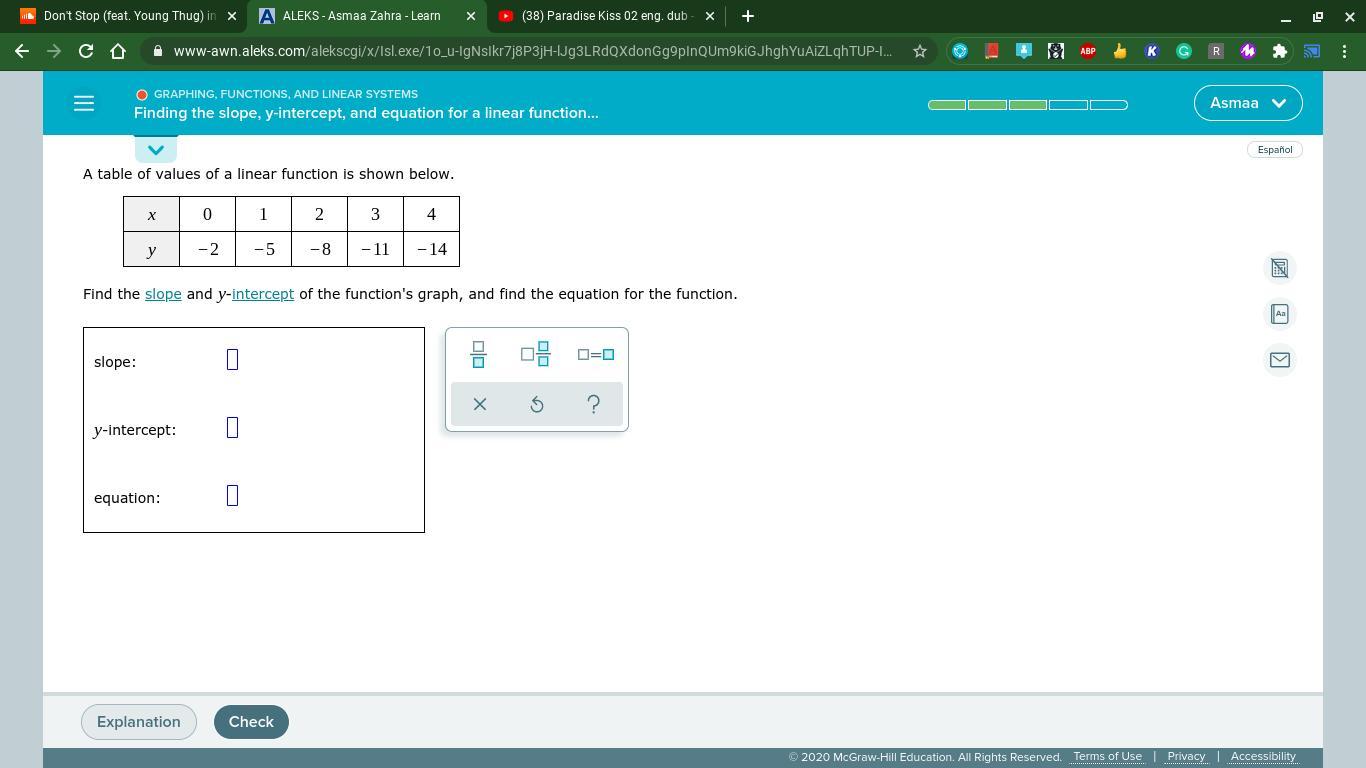
HELP HELP HELP HELP I JUST NEED HELP FOR FINDING THE SLOPE
Answers
Answer:
The slope, -3
The y-intercept, -2
The equation (0 -(-2) ) / (1 - (-5))
Step-by-step explanation: