Round the numbers to the highest place value.
2 398-
56 254-
71 563-
33 021-
9 645-
Answers
Answer:
\(2398 = 2000\)
\(56254 = 60000\)
\(71563 = 70000\)
\(33021 = 30000\)
\(9645 = 10000\)
Step-by-step explanation:
Given
\(2398\)
\(56254\)
\(71563\)
\(33021\)
\(9645\)
Required
Round up to highest place value
\(2398\)
Highest place value here is thousand.
So:
\(2398 = 2000\), when approximated
\(56254\)
Highest place value here is ten thousand.
So:
\(56254 = 60000\), when approximated
\(71563\)
Highest place value here is ten thousand.
So:
\(71563 = 70000\) when approximated
\(33021\)
Highest place value here is ten thousand.
So:
\(33021 = 30000\) when approximated
\(9645\)
Highest place value here is ten thousand.
So:
\(9645 = 10000\) when approximated
Related Questions
What is the surface area of the rectangular prism below?
Answers
Answer:
Step-by-step explanation:
The surface area of a rectangular prism calculator gives us the answer: A = 2 * l * w + 2 * l * h + 2 * w * h = 2 * 8 ft * 6 ft + 2 * 8 ft * 5 ft + 2 * 6 ft * 5 ft = 236 ft² .
Calculate the bearing of Y from X

Answers
Answer:
074°
Step-by-step explanation:
the bearing of Y from X is the measure of the angle from the north line (N) at X in a clockwise direction to Y , that is ∠ NXY
∠ NXY = 180° - 106° = 74°
the 3- figure bearing of Y from X is 074°
Clark typed 720 words in 18 minutes. How many words can he type in one minute?
Answers
Answer:
Clark can type 40 words in one minute
Step-by-step explanation:
Set up a proportion: \(\frac{720}{18} = \frac{x}{1}\) Cross multiply, then divide: 720 × 1 = 720, 720 ÷ 18 = 40So, x = 40I hope this helps!
He can type 40 words a minute
3) There were 35 children and 10 adults at a barbeque.
a. What is the ratio of adults to
children at the barbeque?
b. What is the ratio of children to
total people at the barbeque?
c. Five more children came to the
barbeque. Now what is the ratio
of children to total people?

Answers
Answer:
3. a. 10:35= 2:7
b.35:45=7:9
c.40:50=4:5
A solid metal cuboid has a volume of 600cm3.
(a) The base of the cuboid is 10cm by 12cm. Calculate the height of the cuboid.
(b) The solid metal cuboid is melted and made into 1120 spheres, each with radius
0.45cm. Find the volume of metal not used in making these spheres. [2]
Answers
a) The height of the cuboid is; 5 cm
(b) The volume of metal not used in making these spheres is; 172.5 cm³
How to find the volume of a cuboid?The volume of a cuboid is the space that is enclosed within a cuboid. For example, in order to fill water in an aquarium, we must know its volume.
The volume of a cuboid is found by multiplying the length by the breadth by the height.
The formula for the volume of a cuboid is;
V = l * w * h
Where;
l is length
w is width
h is height
a) We are given;
Volume = 600 cm³
Length = 12 cm
Width = 10 cm
Thus;
Height = 600/(12 * 10)
Width = 5 cm
b) Formula for volume of a sphere is;
V = ⁴/₃πr³
where r is radius
Thus;
V = ⁴/₃ * π * 0.45³
V = 0.3817 cm³
Volume of 1120 spheres = 1120 * 0.3817 cm³ = 427.5 cm³
Volume of metal not used = 600 - 427.5 = 172.5 cm³
Read more about Volume of a cuboid at; https://brainly.com/question/46030
#SPJ1
. Sipho's dad used 4/11 of the packet of oranges to make juice. The
next day he used another 4/11 of the packet of oranges.
a) How many elevenths has he used?
Answers
Answer:
8 of the 11
Step-by-step explanation:
4+4=8 of the 11
Part of oranges usef from the orange packet used on 1st day = 4/11
Part of oranges used from the orange packet used on 2nd day = 4/11
Total part of oranges used from the orange packet
= (4/11) + (4/11)
= 8/11
So, Sipho's dad used 8 elevenths of the oranges.
Dado cot B = 0.57736, determina la medida del ángulo B.
Answers
The measure of angle B is approximately equal to 56.31 degrees, rounded to two decimal places.
What is a angle measure?An angle measure is a numerical value that represents the amount of rotation between two intersecting lines, line segments or rays. It is typically measured in degrees, although other units of measurement such as radians and grads may also be used. The size of an angle can range from 0 degrees (corresponding to no rotation or a straight line) to 360 degrees (corresponding to a full rotation). In geometry, angles are used to describe the relationships between lines and shapes, and are an important concept in fields such as trigonometry and calculus.
To find the measure of angle B given cot B = 0.57736, we can use the inverse tangent function.
The tangent of an angle is the ratio of the opposite side to the adjacent side,
So cot B = adjacent side / opposite side.
By taking the inverse tangent of both sides and substituting cot B for adjacent side / opposite side, we arrive at the equation
B = arctan(cot B).
Evaluating arctan(cot B) using a calculator gives us the measure of angle B as,
B = arctan(cot B) = 56.31° (rounded to two decimal places)
To know more about angle visit:
brainly.com/question/28451077
#SPJ1
The complete question is: "Given cot B = 0.57736, determine the measure of angle B".
If F= 2x²+ +6x - 5 G=3x² + 4) and C=G-3F, find the value of C as a trinomial
Answers
3/4 ÷ a = 1/4. Solve for a
Answers
Answer:
a = 3
Step-by-step explanation:
ok so first you do the reciprocal of division which is multiplication. So its gonna be 3/4 x 1/a = 1/4
you multiply the fractions 3/4 x 1/a and get 3/4a = 1/4
then you cross multiply and you get 12=4a
swap sides so its going to be 4a = 12
divide both sides by 4 and you get a = 3
If electricity is billed at a rate of $0.75 per KWH and you used on average 120 KWHs per month, what would you expect to pay each month?
Answers
You would expect to pay $90 each month for electricity based on an average usage of 120 KWHs per month.
How to find the expected monthly payTo calculate the monthly cost of electricity, you can multiply the average number of kilowatt-hours (KWH) used per month by the cost per KWH.
Given:
Cost per KWH: $0.75
Average monthly usage: 120 KWHs
To find the monthly cost, you can multiply the cost per KWH by the average monthly usage:
Monthly Cost = Cost per KWH * Average monthly usage
Plugging in the values, we have:
Monthly Cost = $0.75/KWH * 120 KWHs
Calculating the result:
Monthly Cost = $90
Learn more about Monthly Cost at
https://brainly.com/question/24093839
#SPJ1
How many paths are there from $A$ to $B,$ if you travel along the edges? You can travel along each edge at most once, but you can pass through the same point more than once. (You can pass through $B,$ as long as you end up at the point $B.$)

Answers
Answer:
9
Step-by-step explanation:
You don't need to pass through each edge once.
If we name the top vertex 1 and the bottom vertex 2 then here are the possible combinations:
A-1-B
A-B
A-2-B
A-1-B-A-2-B
A-2-B-A-1-B
A-B-1-A-2-B
A-B-2-A-1-B
A-1-B-2-A-B
A-2-B-1-A-B
Some people say 6 because they think you need to pass through all the edges. But the only restriction with travelling on the edges is you can't pass one twice. The point is read the wording and it becomes easy.
Hope this helps!
Two consecutive integers have a sum of 55. Find the integers.
0.0
Х
?
Answers
Answer:
27 and 28
Step-by-step explanation:
x+x+1=55
2x+1=55
2x=55-1
2x=54
divide each side by 2
x=27
x+1=28
check your answer adding the two integers
27+28=55
A single die is rolled. Find the odds in favor of rolling a number greater than 2.
The odds in favor of rolling a number greater than 2 are
(Simplify your answers.)
Answers
Answer:
2/3
Step-by-step explanation:
1 and 2 are taken away, therefore you have 3, 4, 5, and 6 left as options to roll. So the answer is 4/6 since there's 4 numbers, but simplified it's 2/3.
Answer:
There are six possible outcomes when rolling a die, each of which is equally likely. Of these six outcomes, three are greater than 2 (3, 4, 5) and three are not (1, 2, 6). Therefore, the odds in favor of rolling a number greater than 2 are 3 to 3, or simply 1 to 1. Alternatively, we could express this as a probability: the probability of rolling a number greater than 2 is 3/6, or 1/2, since there are three favorable outcomes out of a total of six possible outcomes.
Step-by-step explanation:
Find the height of the rectangle in which the A = 10x2 ft2 and the base is 2x ft.
107 m2 and d = 15 m.
Answers
Answer:
Height of rectangle = 5x feet
Step-by-step explanation:
Given:
Area of rectangle = 10x² feet
Base of rectangle = 2x feet
Find:
Height of rectangle
Computation:
Area of rectangle = Length x width
Area of rectangle = Base of rectangle × Height of rectangle
10x² = 2x × Height of rectangle
Height of rectangle = 10x² / 2x
Height of rectangle = 10x / 2
Height of rectangle = 5x feet
The function g(x) = 10x2 – 100x + 213 written in vertex form is g(x) = 10(x – 5)2 – 37. Which statements are true about g(x)? Select three options. The axis of symmetry is the line x = –5. The vertex of the graph is (5, –37). The parabola has a minimum. The parabola opens up. The value of a, when the equation is written in vertex form, is negative.
Answers
Answer:
The vertex of the graph is (5, -37) [see attached image]The parabola has a minimum [the coefficient of x² is positive]The parabola opens up [the coefficient of x² is positive]
All the correct statements are,
The vertex of the graph is (5, -37).
The parabola has a minimum.
The parabola opens up.
What is an expression?Mathematical expression is defined as the collection of the numbers variables and functions by using operations like addition, subtraction, multiplication, and division.
We have to given that;
The function g(x) = 10x² - 100x + 213 written in vertex form is,
⇒ g(x) = 10(x – 5)² – 37.
Since, General equation is,
y = a (x - h)² + k
Where, (h, k) is vertex of parabola.
Hence, We get;
The vertex of the graph is (5, -37)
Since, the coefficient of x² is positive
Hence, The parabola has a minimum
And, The parabola opens up.
Thus, All the correct statements are,
The vertex of the graph is (5, -37).
The parabola has a minimum.
The parabola opens up.
Learn more about the mathematical expression visit:
brainly.com/question/1859113
#SPJ5
Given a right triangle with legs 5cm and 12cm, find the length of the hypotenus. Show work please
Answers
Answer:
13 cm
Step-by-step explanation:
We can use the Pythagorean Theorem to find the length of the hypotenuse. The Pythagorean Theorem is used to find a missing side to a right triangle.
The theorem states that \(a^2 + b^2 = c^2\), where a and b are the legs, and c is the hypotenuse.
The legs of this triangle are already states - 5 and 12, so we can plug it's values into the formula.
\(5^2 + 12^2 = c^2\\\\25 + 144 = c^2\\\\169 = c^2\\\\c = \sqrt{169}\\\\c=13\)
So the hypotenuse of this triangle is 13 cm.
Hope this helped!
The quotient of a number and negative eight is five-eighths. Find the number.
Answers
Answer:
-64/5
Step-by-step explanation:
Basically, the word "quotient" means the answer to a division problem. Therefore, its a division problem, so you have to work backwards with multiplication. -8 times a number is 5/8, so the other number is going to be negative.
The number is -64/5
Answer:
n = -5
Step-by-step explanation:
Form this quotient, representing the number by n: n / (-8) = 5/8.
Solve this equation for n by multiplying both sides by 8: -n = 5. Then n = -5
How do I interpret residuals and just this entire page? I slacked off for my statistics class and I need all of this and all the terms on this page explained so I can do my other assignments. Also are my previous answers correct?

Answers
a. The interval of time between eruptions if the previous eruption lasted 4 minutes is 86.51 minutes.
b. The residual for this cycle is 2.07 minutes.
c. The interval of time between eruptions lasted for 2.07 minutes than the regression line equation predicted.
d. The slope of the regression line means that the interval of time between eruptions increases by 13.29 minutes for every additional minute of the previous eruption.
e. No, the value of the y-intercept doesn't have meaning in the context of the problem.
How to determine the interval of time between eruptions?Based on the information provided above, the relationship between the duration of the previous eruption (x in minutes) and the interval of time between eruptions (y in minutes) is modeled by this regression line equation:
ÿ = 33.35 + 13.29x
Part a.
When x = 4 minutes, the value of is given by:
ÿ = 33.35 + 13.29(4)
ÿ = 86.51 minutes.
Part b.
The residual for the given cycle can be calculated as follows;
Residual = y - ÿ
Residual = 62 - (33.35 + 13.29(2))
Residual = 62 - 59.93
Residual = 2.07 minutes.
Part c.
Based on the calculation above, we can logically deduce that the interval of time between eruptions lasted for 2.07 minutes than the equation of regression line predicted.
Part d.
The slope of the regression line is equal to 13.29 and it implies that the interval of time between eruptions increases by 13.29 minutes for every additional minute of the previous eruption.
Part e.
In the context of the problem, we can logically deduce that the value of the y-intercept doesn't have any meaning because the duration of the previous eruption cannot be equal to 0 minutes.
Read more on regression here: brainly.com/question/16793283
#SPJ1
Can anyone please help me with this? i need answers for all the blank spaces. I dont need to know how to do it, just the answers.

Answers
Answer:
\(\\(x- -1)^{2} + (y- -1)^{2} = 13\)
so, -1, -1 and 13
50 Points! Multiple choice algebra question. Photo attached. Thank you!

Answers
Answer:
C
Step-by-step explanation:
cot²θ = 1/tan²θ
plug this in to get
1/(1/tan²θ + 1)
1/tan²θ + 1 = 1/tan²θ + tan²θ/tan²θ = (1+tan²θ)/tan²θ
we then have
1/((1+tan²θ)/tan²θ)
1/(x/y) = y/x, so this is equal to
tan²θ/(1+tan²θ)
tan²θ = sin²θ/cos²θ, so plug this in to get
(sin²θ/cos²θ)/(1+sin²θ/cos²θ)
1+sin²θ/cos²θ = cos²θ/cos²θ + sin²θ/cos²θ
sin²θ + cos²θ = 1, so we have
(cos²θ+sin²θ)/cos²θ = 1/cos²θ. plug this in to get
(sin²θ/cos²θ)/(1/cos²θ)
(a/b)/(c/d) = (d/c) * (a/b), so we have
(sin²θ/cos²θ)/(1/cos²θ) = cos²θ/1 * sin²θ/cos²θ = sin²θ
Helpp? Please! What’s the area of this triangle?

Answers
ES LA B
Step-by-step explanation:
Answer:
D
Step-by-step explanation:
25=d-10 true or false?
Answers
As the CAPS document outlines, the Content Specification and Content Clarification for Patterns, Functions, and Algebra shows sequenced mathematics content topics and a content area spread. In the Intermediate Phase, select one topic and report on the topic sequence and content area spread. Your report should demonstrate mathematics concepts and procedures’ hierarchical and logical progression.
Answers
Answer:
Step-by-step explanation:
In the Intermediate Phase of mathematics education, one topic that demonstrates a hierarchical and logical progression in patterns, functions, and algebra is the concept of "Linear Equations."
The topic of Linear Equations in the Intermediate Phase builds upon the foundation laid in earlier grades and serves as a stepping stone towards more advanced algebraic concepts. Here is an overview of the topic sequence and content area spread for Linear Equations:
Introduction to Variables and Expressions:
Students are introduced to the concept of variables and expressions, learning to represent unknown quantities using letters or symbols. They understand the difference between constants and variables and learn to evaluate expressions.
Solving One-Step Equations:
Students learn how to solve simple one-step equations involving addition, subtraction, multiplication, and division. They develop the skills to isolate the variable and find its value.
Solving Two-Step Equations:
Building upon the previous knowledge, students progress to solving two-step equations. They learn to perform multiple operations to isolate the variable and find its value.
Writing and Graphing Linear Equations:
Students explore the relationship between variables and learn to write linear equations in slope-intercept form (y = mx + b). They understand the meaning of slope and y-intercept and how they relate to the graph of a line.
Systems of Linear Equations:
Students are introduced to the concept of systems of linear equations, where multiple equations are solved simultaneously. They learn various methods such as substitution, elimination, and graphing to find the solution to the system.
Word Problems and Applications:
Students apply their understanding of linear equations to solve real-life word problems and situations. They learn to translate verbal descriptions into algebraic equations and solve them to find the unknown quantities.
The content area spread for Linear Equations includes concepts such as variables, expressions, equations, operations, graphing, slope, y-intercept, systems, and real-world applications. The progression from simple one-step equations to more complex systems of equations reflects a logical sequence that builds upon prior knowledge and skills.
By following this hierarchical progression, students develop a solid foundation in algebraic thinking and problem-solving skills. They learn to apply mathematical concepts and procedures in a systematic and logical manner, paving the way for further exploration of patterns, functions, and advanced algebraic topics in later phases of mathematics education.
2x³,6x², and 12x
GCF
Answers
It's the highest number that can be divided into all of them.
For variables, always choose the one with the lowest exponent.
Carter shared his post with 10 friends, who each share with only 2 people each day. Carter shared his post with 10 friends, who each share with only 2 people each day.
write an exponential function to represent the spread of carters social media post.
Answers
The exponential function will be equal to y = 20ˣ.
What is an expression?The mathematical expression combines numerical variables and operations denoted by addition, subtraction, multiplication, and division signs.
Mathematical symbols can be used to represent numbers (constants), variables, operations, functions, brackets, punctuation, and grouping. They can also denote the logical syntax's operation order and other properties.
Given that Carter shared his post with 10 friends, who each share with only 2 people each day.
The exponential function will be written as,
y = abˣ
y = 10(2)ˣ
y = 20ˣ
Therefore, the exponential function will be equal to y = 20ˣ.
To know more about an exponential expression follow
https://brainly.com/question/20168834
#SPJ1
Answer:
f(x) = 10(2)^x
Step-by-step explanation:
Rule for solving: The first number is the first part of the equation, and the second number is in parenthesis.
Hi can any one teach me this constant difference

Answers
The constant differences between the consecutive terms are 2 (a); 2 (b), -3 (c), 7 (d), 1(e), and 6(f).
How do you find the constant difference in a sequence of numbers?In math, the constant difference can be defined as the number that defines the pattern of a sequence of numbers. This means that number that should be added or subtracted to continue with the sequence.
Due to this, to determine the constant difference it is important to observe the pattern and find out the number that should be added. For example, if the sequence is 2, 4, 6, 8, there is a difference of 2 between each of the numbers and this is the constant difference.
Learn more about numbers in https://brainly.com/question/24908711
#SPJ1
In degrees, what is the measure of hmp
Please help, this is timed!
Please and thank you :)

Answers
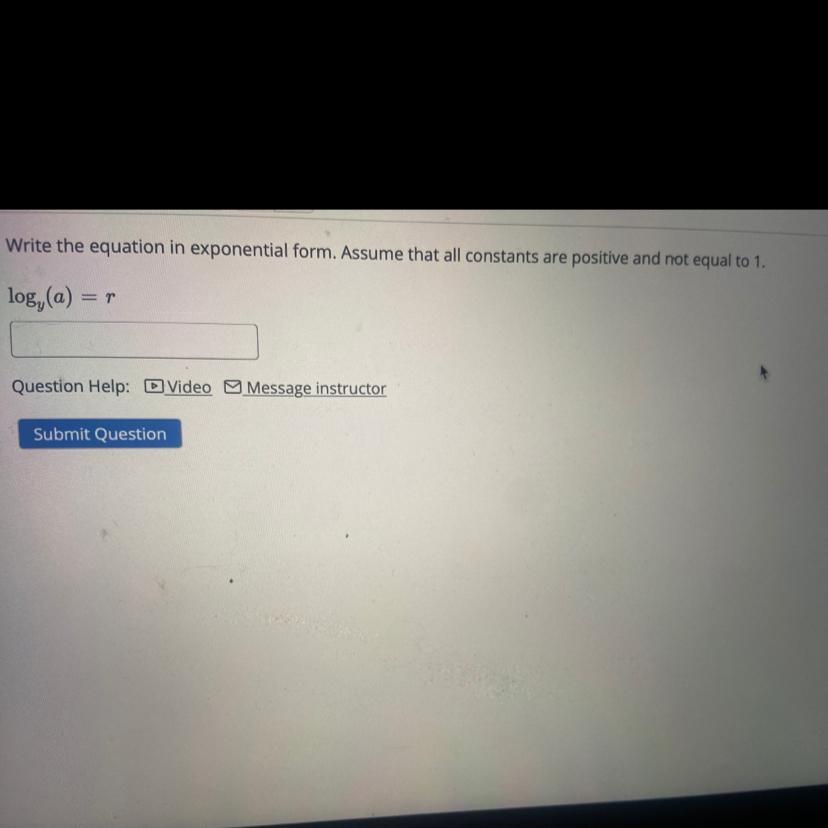
Write the equation in exponential form. Assume that all constants are positive and not equal to 1.logy(a) ==r
Answers
we have the expression
\(\log _ya=r\)In the exponential form we have
\(y^r=a\)in the given problem
y represents the base of the exponential equation
r represents the exponent of the base
a is the result of the base elevated to the exponent
general form
If you have
\(\begin{gathered} \log _xy=a \\ \text{then} \\ x^a=y \end{gathered}\)How do you solve linear equations using the distributive property?
Answers
Answer: Solving two-step linear equations using distributive property: a (x+b)=c;aleft ( {x + b} ight) = ca (x+b)=c Solving linear equations using multiplication and division Solving two-step linear equations: ax+b=cax + b = cax+b=c, xa+b=c {x over a} + b = cax+b=c
Step-by-step explanation:
Answer:
solving equations using distributive property. We'll guide you through two ways that the following question can be solved.
Question: 11.32 = 8(0.61 + x)
Solution 1:
11.32 = 8(0.61+x)
Divide both side by 8, you get 1.415 = 0.61 +x
Minus both side by 0.61, 0.805 = x
In this solution, we first try to move all the non-x terms over to one side. The first step of dividing both sides by 8 helps us move the 8 from the right side to the left side. This allows us to get rid of the parentheses too as the terms no longer have to be multiplied out (there's nothing to multiply them with). Then, in order to move 0.61 to the left side, we'll minus it from both sides. In the end, we'll get that x ultimately equals 0.805.
Solution 2:
11.32 = 8(0.61+x)
Open up the right side, you get 11.32 = 4.88+8x
Minus both side by 4.88, you get 6.44 = 8x
Divide both side by 8, you get 0.805 = x
In solution 2, we're truly using the distributive property. We're going to distribute 8 into the terms in the parentheses, which are "+0.61" and "+x". This gives us 4.88 + 8x on the right side of the equation. Then we can move over 4.88 to the left side with the rest of the non-x terms by minusing it from both sides. Lastly, divide both sides by 8 to move the 8 over to the left side and you'll find that x = 0.805. Both methods will bring you to the same correct answer.
Plz help mee I am bad at math

Answers
it would be option D
Answer:
c. 42 1/12
Step-by-step explanation:
sorry if it's wrong. this was an educated guess