Question Four Consider the following production function: y = f(z)=z¼/^z/2. Assuming that the price of the output is p and the prices of inputs are w, and w₂ respectively: (a) State the firm's profit maximization problem. (2 marks). (b) Derive the firm's factor demand functions for z; and zo. (10 marks). (c) Derive the firm's supply function. (5 marks). = 2. (d) Derive the firm's profit function. (3 marks). an (e) Verify Hotelling's lemma for q(w, p), z₁(w, p) and z₂(w, p). (6 marks). az (f) State the firm's cost minimization problem. (2 marks), (g) Derive the firm's conditional factor demand functions. (8 marks). (h) Derive the firm's cost function. (4 marks). Cond: 69 Porat funct
Answers
The text discusses a production function and addresses various aspects of a firm's decision-making. It covers profit maximization, factor demand functions, supply function, profit function, Hotelling's lemma, cost minimization, conditional factor demand functions, and the cost function. These concepts are derived using mathematical calculations and formulas. Hotelling's lemma is verified, and the cost function is determined.
(a) The firm's profit maximization problem can be stated as follows: Maximize profits (π) by choosing the optimal levels of inputs (z and zo) that maximize the output (y) given the prices of output (p) and inputs (w, w₂).
(b) To derive the firm's factor demand functions, we need to find the conditions that maximize profits.
The first-order condition for input z is given by:
∂π/∂z = p * (∂f/∂z) - w = 0
Substituting the production function f(z) = z^(1/4) / z^(1/2) into the above equation, we have:
p * (1/4 * z^(-3/4) / z^(1/2)) - w = 0
Simplifying, we get:
p * (1/4 * z^(-7/4)) - w = 0
Solving for z, we find:
z = (4w/p)^(4/7)
Similarly, for input zo, the first-order condition is:
∂π/∂zo = p * (∂f/∂zo) - w₂ = 0
Substituting the production function f(zo) = z^(1/4) / z^(1/2) into the above equation, we have:
p * (1/2 * z^(1/4) * zo^(-3/2)) - w₂ = 0
Simplifying, we get:
p * (1/2 * z^(1/4) * zo^(-3/2)) - w₂ = 0
Solving for zo, we find:
zo = (2w₂ / (pz^(1/4)))^(2/3)
(c) To derive the firm's supply function, we need to find the level of output (y) that maximizes profits.
Using the production function f(z), we can express y as a function of z:
y = z^(1/4) / z^(1/2)
Given the factor demand functions for z and zo, we can substitute them into the production function to obtain the supply function for y:
y = (4w/p)^(4/7)^(1/4) / (4w/p)^(4/7)^(1/2)
Simplifying, we get:
y = (4w/p)^(1/7)
(d) The firm's profit function is given by:
π = p * y - w * z - w₂ * zo
Substituting the expressions for y, z, and zo derived earlier, we have:
π = p * ((4w/p)^(1/7)) - w * ((4w/p)^(4/7)) - w₂ * ((2w₂ / (pz^(1/4)))^(2/3))
(e) To verify Hotelling's lemma, we need to calculate the partial derivatives of the profit function with respect to the prices of output (p), input z (z₁), and input zo (z₂).
Hotelling's lemma states that the partial derivatives of the profit function with respect to the prices are equal to the respective factor demands:
∂π/∂p = y - z * (∂y/∂z) - zo * (∂y/∂zo) = 0
∂π/∂z₁ = -w + p * (∂y/∂z₁) = 0
∂π/∂z₂ = -w₂ + p * (∂y/∂z₂) = 0
By calculating these partial derivatives and equating them to zero, we can verify Hotelling's lemma.
(f) The firm's cost minimization problem can be stated as follows: Minimize the cost of production (C) given the level of output (y), prices of inputs (w, w₂), and factor demand functions for inputs (z, zo).
(g) To derive the firm's conditional factor demand functions, we need to find the conditions that minimize costs. We can express the cost function as follows:
C = w * z + w₂ * zo
Taking the derivative of the cost function with respect to z and setting it to zero, we get:
∂C/∂z = w - p * (∂y/∂z) = 0
Simplifying, we have:
w = p * (1/4 * z^(-3/4) / z^(1/2))
Solving for z, we find the conditional factor demand for z.
Similarly, taking the derivative of the cost function with respect to zo and setting it to zero, we get:
∂C/∂zo = w₂ - p * (∂y/∂zo) = 0
Simplifying, we have:
w₂ = p * (1/2 * z^(1/4) * zo^(-3/2))
Solving for zo, we find the conditional factor demand for zo.
(h) The firm's cost function is given by:
C = w * z + w₂ * zo
Substituting the expressions for z and zo derived earlier, we have:
C = w * ((4w/p)^(4/7)) + w₂ * ((2w₂ / (pz^(1/4)))^(2/3))
This represents the firm's cost function.
To know more about profit maximization problem, refer here:
https://brainly.com/question/29787532#
#SPJ11
Related Questions
Convince Me! Use Patterns and Structure Sue knitted a scarf for her
friend June that was also 4 feet long. After a month, the length of June's
scarf could be represented by the expression 0.5 x 4. How did the length
of June's scarf change? Explain.
Answers
The length of June's scarf change using patterns and structure is 4.
What is Algebra?Algebra is the study of abstract symbols, while logic is the manipulation of all those ideas.
The acronym PEMDAS stands for Parenthesis, Exponent, Multiplication, Division, Addition, and Subtraction. This approach is used to answer the problem correctly and completely.
Given that;
The length of friend june scarf= 4 feet
The representation of length of june after a month= 0.5x4
Now,
Sue knitted a scarf for her friend June that was also 4 feet long and, after a month, the length of June's scarf is given by the expression 3/3 x 4, to know how did the length of June's scarf change you must perform the following calculation;
Month; 1 = 4
Month; 2 = 3/3 x 4 = 1 x 4 = 4
Therefore, by algebra the the answer will be 4.
More about the Algebra link is given below.
brainly.com/question/953809
#SPJ9
hurry pls i don’t understand

Answers
Answer:
c is the answer ....
mark me brainliest
Which of the following instrument could the predictive validity of a metric scale (a set of questions) best be determined?
A. Cronbach's alpha
B. A correlation-coefficient
C. Fishers r-to-z test.
D. With none of the above
Answers
B. A correlation-coefficient.
To determine the predictive validity of a metric scale, which measures a construct of interest, you would need to assess the relationship between the scores on the metric scale and a criterion measure that reflects the same construct. This can be done by calculating a correlation-coefficient between the scores on the metric scale and the scores on the criterion measure. The correlation-coefficient indicates the strength and direction of the relationship between the two measures, with values ranging from -1 to +1. A higher correlation-coefficient suggests a stronger relationship between the metric scale and the criterion measure, indicating higher predictive validity.
Cronbach's alpha is a measure of internal consistency reliability, which assesses the extent to which the items on a scale are consistent with each other. Fishers r-to-z test is a statistical test used to compare the magnitude of two correlation-coefficients, and is not directly related to determining the predictive validity of a metric scale. Therefore, the best answer is B. A correlation-coefficient.
To know more about metric scale visit:
https://brainly.com/question/30195072
#SPJ11
The best instrument to determine the predictive validity of a metric scale (a set of questions) would be a correlation-coefficient. This is because a correlation-coefficient measures the strength and direction of the relationship between two variables, in this case, the metric scale and the outcome it is predicting.
Predictive validity refers to the extent to which a measure accurately predicts an outcome. A correlation-coefficient would be the best instrument to determine the predictive validity of a metric scale as it measures the degree to which two variables are related, providing information on the strength and direction of the relationship between the metric scale and the predicted outcome. The higher the correlation-coefficient, the stronger the relationship, indicating higher predictive validity. Cronbach's alpha measures internal consistency, while Fisher's r-to-z test is used to compare correlation coefficients, making them less suitable for determining predictive validity.
Therefore, option B, a correlation-coefficient, is the best instrument to determine the predictive validity of a metric scale.
To know more about coefficient visit:
brainly.com/question/1594145
#SPJ11
Suppose A = {2, 4, 5, 6, 7} and B = {2,4,5,6,8}. Find each of the following sets. = = Your answers should include the curly braces a. AUB. b. AnB. C. A B. d. B\A.
Answers
a) A ∪ B (the union of A and B) is the set of all elements that are in A or B (or both). Since A and B have the same elements except for 7 and 8, which are unique to A and B respectively, we have:
A ∪ B = {2, 4, 5, 6, 7, 8}
b) A ∩ B (the intersection of A and B) is the set of all elements that are in both A and B. Since A and B have the same elements except for 7 and 8, which are unique to A and B respectively, we have:
A ∩ B = {2, 4, 5, 6}
c) A \ B (the set difference of A and B) is the set of all elements that are in A but not in B. Since A and B have the same elements except for 7 and 8, which are unique to A and B respectively, we have:
A \ B = {7}
d) B \ A (the set difference of B and A) is the set of all elements that are in B but not in A. Since A and B have the same elements except for 7 and 8, which are unique to A and B respectively, we have:
B \ A = {8}
Learn more about union and intersection of sets:
https://brainly.com/question/28278437
#SPJ11
4g+1 5 − G−7 4 = 2g−5 10
Answers
john has walked 15% of the way home from school. if he has walked 54 yards so far, how far does he walk home from school
Answers
Answer: John walks a total of 360 yards from school.
Step-by-step explanation:
Let's represent the total distance John walks from school as "x".
According to the problem, John has already walked 15% of the way, which can be written as:
0.15x
We also know that he has walked 54 yards so far, which means:
0.15x = 54
To find the total distance John walks from school, we can solve for "x" by dividing both sides of the equation by 0.15:
x = 54 ÷ 0.15
x = 360
Therefore, John walks a total of 360 yards from school.
To know more about total distance refer here
https://brainly.com/question/6516113#
#SPJ11
Which number is rational?
A: -2.1010010001...
B: -0.8974512...
C: -1.2547569...
D: -5.3333333...
Answers
Answer:
D: -5.3333333...
Step-by-step explanation:
Which number is rational?
A: -2.1010010001... B: -0.8974512... C: -1.2547569... D: -5.3333333...All given options are non-terminating, but the last one has repeating decimal
It can be represented as fraction:
-5.333333... = -5 1/3 = - 16/3, so is rationalAnswer:
Yeah its D i just checked
Step-by-step explanation:
Scenario 1A Calculate the following amounts for a participating provider who bills Medicare and has no deductible left. Submitted charge (based on provider’s regular fee) $650 Medicare participating physician fee schedule (PFS) $450 Coinsurance amount (20% paid by) $ Medicare payment (80 percent of the PFS) $ Provider write-off $ Scenario 1B Calculate the following amounts for a participating provider who bills Medicare and remaining annual deductible for the patient. Submitted charge (based on provider’s regular fee) $650 Medicare participating physician fee schedule (PFS) $450 Patient pays $100 remaining on their deductible $ Remaining amount for Insurance and patient to pay $ (PFS - $100) Coinsurance amount (20% of remaining amount) $ Total paid by patient (deductible & 20% of remaining) $ Medicare payment (80 percent of the remaining amount) $ Provider write-off $
Answers
Scenario 1A:
Coinsurance amount is $90
Medicare payment is $360
Provider write-off is $290
Scenario 1B:
Remaining amount for Insurance and patient to pay is $350
Coinsurance amount is $70
Total paid by patient is $170
Medicare payment is $280
Provider write-off is $370
Scenario 1A:
Submitted charge: $650
Medicare participating physician fee schedule (PFS): $450
Coinsurance amount (20% paid by patient): $
Medicare payment (80% of the PFS): $
Provider write-off: $
To calculate the missing amounts, we can use the provided information:
Coinsurance amount (20% paid by patient):
Coinsurance amount = 20% of the Medicare participating physician fee schedule (PFS)
Coinsurance amount = 0.2 * $450 = $90
Medicare payment (80% of the PFS):
Medicare payment = 80% of the Medicare participating physician fee schedule (PFS)
Medicare payment = 0.8 * $450 = $360
Provider write-off:
Provider write-off = Submitted charge - Medicare payment
Provider write-off = $650 - $360 = $290
Scenario 1B:
Submitted charge: $650
Medicare participating physician fee schedule (PFS): $450
Patient pays $100 remaining on their deductible
Remaining amount for Insurance and patient to pay: $
Coinsurance amount (20% of remaining amount): $
Total paid by patient (deductible & 20% of remaining): $
Medicare payment (80% of the remaining amount): $
Provider write-off: $
To calculate the missing amounts, we can use the provided information:
Remaining amount for Insurance and patient to pay:
Remaining amount for Insurance and patient to pay = PFS - remaining deductible
Remaining amount for Insurance and patient to pay = $450 - $100 = $350
Coinsurance amount (20% of remaining amount):
Coinsurance amount = 20% of the remaining amount
Coinsurance amount = 0.2 * $350 = $70
Total paid by patient (deductible & 20% of remaining):
Total paid by patient = remaining deductible + coinsurance amount
Total paid by patient = $100 + $70 = $170
Medicare payment (80% of the remaining amount):
Medicare payment = 80% of the remaining amount
Medicare payment = 0.8 * $350 = $280
Provider write-off:
Provider write-off = Submitted charge - Medicare payment
Provider write-off = $650 - $280 = $370
Learn more about Physician Fee Schedule (PFS) at
brainly.com/question/32491543
#SPJ4
The sum of four and a number sobtracted dron 7
Answers
4 + (7-n)
Solve for an angle in right triangles
Pretty please help!

Answers
Answer:
A = 26.57
Step-by-step explanation:
Since this is a right triangle, we can use trig functions
tan A = opposite/ adjacent
tan A = 3/6
Take the inverse tangent of each side
tan ^-1 tan A = tan ^-1 (3/6)
A = 26.56505118
To the nearest hundredth
A = 26.57
Answer:
A = 26.57
Step-by-step explanation:
Calculating brilliance in epidemiology Context. What follows is a data table showing the development of brilliance among a small class of PHE 450 students. NOTE: Student #8 came in as an existing case of brilliance and did not develop brilliance as a result of exposure to PHE 450. Student WK 1 WK 2 WK 3 WK 4 WK 5 WK6 WK 7 WK 8 WK 9 WK 10 CASE CASE CASE CASE DROP 1 2 3 4 5 6 7 8 9 10 11 12 CASE CASE CASE DROP CASE DROP ASSIGNMENT Referring to the data above, please answer the following questions What is the point prevalence of brilliance at the end of Week 1? What is the point prevalence of brilliance at the end of Week 2? • What is the point prevalence of brilliance at the end of Week 3? • Using person-weeks as your denominator, what is the incidence of brilliance over the course of the 10-week course?
Answers
The point prevalence of brilliance at the end of Week 1 is 0.08 or 8%.
The point prevalence of brilliance at the end of Week 2 is 0.17 or 17%.
The point prevalence of brilliance at the end of Week 3 is 0.33 or 33%.
Using person-weeks as denominator, the incidence of brilliance over the course of the 10-week course is 0.017 or 1.7%
In epidemiology context, brilliance can be calculated through calculating point prevalence, cumulative incidence, and incidence rate. The provided data table can be used to determine the point prevalence, incidence, and incidence rate of brilliance among PHE 450 students. So, the calculations of point prevalence, cumulative incidence, and incidence rate based on the provided data are as follows:
The point prevalence of brilliance at the end of Week 1 can be calculated by the following formula; Point prevalence = Total number of existing cases at a given time ÷ Total population at that time
Student #8 was the only existing case of brilliance at the beginning of Week 1, so the point prevalence of brilliance at the end of Week 1 is; Point prevalence = 1 ÷ 12 = 0.08 or 8%.
The point prevalence of brilliance at the end of Week 2 can be calculated by the following formula; Point prevalence = Total number of existing cases at a given time ÷ Total population at that time
Student #3 and Student #8 were existing cases of brilliance at the beginning of Week 2, so the point prevalence of brilliance at the end of Week 2 is; Point prevalence = 2 ÷ 12 = 0.17 or 17%.
The point prevalence of brilliance at the end of Week 3 can be calculated by the following formula; Point prevalence = Total number of existing cases at a given time ÷ Total population at that time
Student #3, #4, #6, and #8 were existing cases of brilliance at the beginning of Week 3, so the point prevalence of brilliance at the end of Week 3 is; Point prevalence = 4 ÷ 12 = 0.33 or 33%.
The incidence of brilliance can be calculated by the following formula; Incidence = Total number of new cases ÷ Total person-weeks of observation
Student #5 and Student #7 developed brilliance during the 10-week course, so the incidence of brilliance over the course of the 10-week course is; Incidence = 2 ÷ 120 = 0.017 or 1.7%.
To know more about denominator refer here:
https://brainly.com/question/931030#
#SPJ11
danny henry made a waffle on his six-inch-diameter circular griddle using batter containing a half a cup of flour. using the same batter, and knowing that all waffles have the same thickness, how many cups of flour would paul bunyan need for his -foot-diameter circular griddle?
Answers
Danny used half a cup of flour, so Paul Bunyan would need 2 cups of flour for his foot-diameter griddle.
To determine the number of cups of flour Paul Bunyan would need for his circular griddle, we need to compare the surface areas of the two griddles.
We know that Danny Henry's griddle has a diameter of six inches, which means its radius is three inches (since the radius is half the diameter). Thus, the surface area of Danny's griddle can be calculated using the formula for the area of a circle: A = πr², where A represents the area and r represents the radius. In this case, A = π(3²) = 9π square inches.
Now, let's calculate the radius of Paul Bunyan's griddle. We're given that it has a diameter in feet, so if we convert the diameter to inches (since we're using inches as the unit for the smaller griddle), we can determine the radius. Since there are 12 inches in a foot, a foot-diameter griddle would have a radius of six inches.
Using the same formula, the surface area of Paul Bunyan's griddle is A = π(6²) = 36π square inches.
To find the ratio between the surface areas of the two griddles, we divide the surface area of Paul Bunyan's griddle by the surface area of Danny Henry's griddle: (36π square inches) / (9π square inches) = 4.
Since the amount of flour required is directly proportional to the surface area of the griddle, Paul Bunyan would need four times the amount of flour Danny Henry used.
For more such questions on diameter
https://brainly.com/question/23220731
#SPJ8
Can someone help me PLZ! I keep posting the same question and no ones helping me :(((((((((((( its dues in 20 mins!!
Solve the system of equations below. Write your answer as an ordered pair. Start by multiplying the first equation by 2.
2x + 2y = 12
5x + 4y = 28
Answers
Answer:
x=4
y=2
Step-by-step explanation:
2*4+2*2=12
8+4=12
5*4+4*2=28
20+8=28
Have a good day ;-),
and can I please have brainliest? Thanks!
The Answer is 4,2
x=4 y=2
In regression analysis, an outlier is an observation whose
a. residual is much larger than the rest of the residual values b. mean is zero c. residual is zero d. mean is larger than the standard deviation
Answers
a. residual is much larger than the rest of the residual values.
In regression analysis, an outlier refers to an observation that significantly deviates from the expected pattern or trend of the data. Specifically, it is an observation whose residual (the difference between the observed value and the predicted value) is much larger than the residuals of the other observations.
Outliers can have a considerable impact on the regression model, affecting the estimated coefficients and overall model fit. It is important to identify and assess outliers to determine if they are influential or if they should be treated or removed to ensure the reliability and validity of the regression analysis.
To learn more about regression click here:
brainly.com/question/31809136
#SPJ11
I really need the answer to this

Answers
=============================================
Explanation:
Let point N be at the intersection of the horizontal line and segment JM.
We can prove the right triangles JNK and MNK are congruent using the hypotenuse leg (HL) rule. This in turn means JN = NM through the use of CPCTC.
In other words, JN = NM because the horizontal line is the perpendicular bisector of JM.
So,
JM = JN + NM
JM = NM + NM
JM = 2*NM
JM = 2*7.1
JM = 14.2
Answer:
JM = 14.2
Step-by-step explanation:
Given JK = MK then Δ JKM is isosceles.
The line through K is a perpendicular bisector of JM , so
JM = 2 × 7.1 = 14.2
i need help with this i am really bad at math

Answers
Answer:
You subtracted 25 from both sides.
Step-by-step explanation:
To move one part of the equation to the other side, you need to do the opposite. 25 is already negative(or being subtracted) so you need to add it to both sides to cancel it out on the left.
10x=-75+25
10x=-50
then divide both sides by 10
x=-5
PLEASEE HELP!!! find the area
(look at the picture)

Answers
Answer: Area= 60The Area is 60
Step-by-step explanation: Multiply 5 and 12 and you get 60!! I hope it helped!
works correctly at the 445 gram setting. based on a 27 bag sample where the mean is 448 grams and the standard deviation is 19, is there sufficient evidence at the 0.025 level that the bags are overfilled?
Answers
Based on the given information, there is not enough evidence at the 0.025 level to conclude that the bags are overfilled. This can be answered by the concept of Standard deviation.
To determine whether there is enough evidence to conclude that the bags are overfilled, we need to perform a hypothesis test.
Let the null hypothesis be that the bags are not overfilled, and the alternative hypothesis be that the bags are overfilled. We can set the significance level at 0.025.
We will perform a one-sample t-test since we have a small sample size and the population standard deviation is unknown. Using the formula for the t-test statistic, we obtain a t-value of 1.58. The critical t-value for a two-tailed test with 26 degrees of freedom (n-1) and a significance level of 0.025 is 2.479. Since 1.58 < 2.479, we fail to reject the null hypothesis.
Therefore, there is not enough evidence at the 0.025 level to conclude that the bags are overfilled.
To learn more about Standard deviation here:
brainly.com/question/23907081#
#SPJ11
what is the percent decrease from 5000 to 9000?
Answers
Answer:
80% lemme get brainlest plzzzzzzzzz
Step-by-step explanation:
it's answer is 80 percent
Given that the measurement is in inches find the circumference of the circle to the nearest tenth use 3.14 for. Please show ur work Bc I have too !!

Answers
Answer:
25.12 in.
Step-by-step explanation:
C = 2πd
C = 2 × 3.14 × 4 in.
C = 25.12 in.
A=1/2h(B+b); A=45, B=4, b=5
Answers
Solving Steps:
45 = 1/2h x (4+5)
45 = 1/2h x 9
45 = 9/2h
10 = h
h = 10
please help me with this

Answers
Answer:
The equation in the point-slope form for the line that passes through point (-1, -4) and has a slope of -3 is y+4=-3(x+1).
Step-by-step explanation:
Given that:
Line passes through the point = (-1, -4)
Slope of the line = -3
Point slope form of a line is given by;
\(y-y_1=m(x-x_1)\)
Here,
x1 = -1 , y1 = -4 and m = -3
Putting the values in the point-slope form of the equation,
y-(-4) = -3(x-(-1))
y+4= -3(x+1)
Hence,
The equation in the point-slope form for the line that passes through point (-1, -4) and has a slope of -3 is y+4=-3(x+1).
by observing a set of data values, thomas used a calculator for the weight (in pounds) and predicted the number of calories burned per minute to get an equation for the least-squares line: ŷ
Answers
A person weighing 173 pounds can burn 10.7 calories per minute.
The given equation is ŷ=2.2+0.05x.
To solve this question, we can use the equation given, ŷ=2.2+0.05x. We can insert the known weight value, 173 pounds, to calculate the anticipated calories burned per minute.
y = 2.2 + 0.05x
y = 2.2 + 0.05 × 173
y = 10.7
Therefore, a person weighing 173 pounds can burn 10.7 calories per minute.
Learn more about the least-squares here:
https://brainly.com/question/30176124.
#SPJ4
"Your question is incomplete, probably the complete question/missing part is:"
By observing a set of data values, Thomas used a calculator for the weight (in pounds) and predicted the number of calories burned per minute to get an equation for the least-squares line: ŷ=2.2+0.05x
Based on the information gathered by Thomas, select the statement that is true.
a) A person weighing 149 pounds can burn 9.8 calories per minute.
b) A person weighing 134 pounds can burn 8.9 calories per minute.
c) A person weighing 125 pounds can burn 8.3 calories per minute.
d) A person weighing 173 pounds can burn 10.7 calories per minute.
Answer:
A person weighing 134 pounds can burn 8.9 calories a minute.
Step-by-step explanation:
how many acute angles does an obtuse triangle have
Answers
Answer:
i think 2
Step-by-step explanation:
ya i think 2
A uniform continuous distribution has a maximum of 14 and a minimum of 2. Samples of size 36 are drawn from the distribution. What is the variance of the sample means?.
Answers
The variance of the sample means will be 0.3428.
What is Variance of sample means?
The variance of the sampling distribution of the mean is the population variance divided by the sample size.
Given that;
A uniform continuous distribution has a maximum of 14 and a minimum
of 2.
Samples of size 36 are drawn from the distribution.
Now,
The population variance = 14 - 2
= 12
And, Sample size = 36
Since, The variance of the sample means is defined as;
= Population variance / Sample size
Substitute all the values, we get;
= 12 / 35
= 0.3428
Thus, The variance of the sample means will be 0.3428.
Learn more about the Variance of sample means visit:
https://brainly.com/question/28213657
#SPJ1
A coach is buying snacks for 22 players at a soccer match. She pays a total of $77 to
buy each player a bottle of water and an energy bar. The price of one energy bar is $2.
Let w equal the price of a bottle of water. Write an equation that
represents the situation.
Answers
Answer: 22( w + 2 ) =77 and the amount of the water bottle would be 1.50
Step-by-step explanation: i dont know what to write??
Use the figure to write a two-column proof.
Given: PSUR is a rectangle.
PQ=TU
Prove: QS=RT
*THE QUESTION IN THE PHOTO IS JUST NUMBER 10
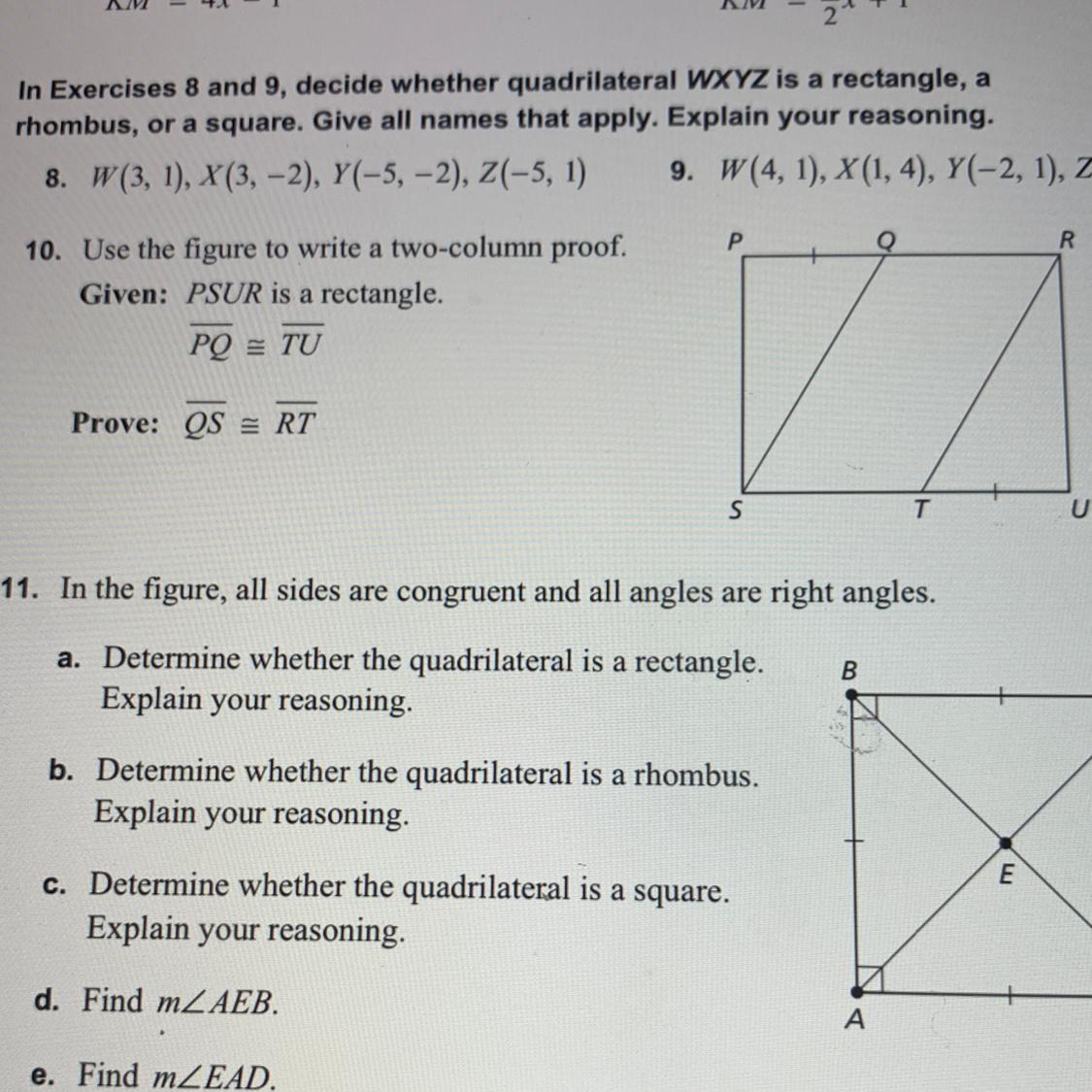
Answers
Answer:Given Prove
PSUR is a rectangle QS = RT
PQ = TU
Proof:
Since PSUR is a rectangle, we know that opposite sides are parallel.
Therefore, PQ and TU are parallel.
Also, PSUR is a rectangle, so the angles P and R are right angles.
Therefore, angles Q and S are also right angles.
Since PQ and TU are parallel, and angles Q and S are right angles, we know that QS and RT are corresponding angles.
Therefore, QS=RT
QED.
Step-by-step explanation:
A square picture has a 2-in. frame around it. If the area of the frame alone is 72 in .2, what is the area of the picture?
Answers
The area of the picture is 68 square inches
How to calculate the area of a squareGiven the following parameters
Area of the frame alone = 72 square inches
Area of the square picture = 2 * 2 = 4 square inches
Determine the area of the picture
Area of the picture = 72 square in - 4 square in
Area of the picture = 68 square inches
Hence the area of the picture is 68 square inches
Learn more on area of square here: https://brainly.com/question/25092270
Select the correct answer.
During training, a baseball player filmed himself and recorded the approximate angle, in degrees, at which each baseball was hit, along
with the corresponding horizontal distance, in feet. The results are in the following table,
O
O
284 feet
306 feet
230 feet
Angle Horizontal Distance.
(degrees)
20
275 feet
88888
The curve of best fit for the data is y-0.16x² +15r-45, where x is the angle and y is the horizontal distance. Which is the best
prediction of the horizontal distance of a baseball hit at an angle of 35 degrees?
O
30
40
50
60
(feet)
190
260
290
300
265
Answers
To make a prediction of the horizontal distance of a baseball hit at an angle of 35 degrees, we can use the equation of the curve of best fit given as y = -0.16x² + 15x - 45, where x is the angle in degrees and y is the horizontal distance in feet.
Substituting x = 35 in the above equation, we get:
y = -0.16(35)² + 15(35) - 45y = -196 + 525 - 45y = 284
Therefore, the best prediction of the horizontal distance of a baseball hit at an angle of 35 degrees is 284 feet, which corresponds to option O in the table.
It's important to note that this prediction is based on the data provided and the curve of best fit obtained from that data. The accuracy of the prediction depends on the quality and representativeness of the data used to obtain the curve of best fit.
There could be other factors that affect the horizontal distance of a baseball hit, such as wind speed, air resistance, and the force of the hit.
For such more questions on Horizontal distance:
https://brainly.com/question/24784992
#SPJ11
Explain all of the steps needed to simplify the equation 8(x+2) = 4(2x+9) using the order of operations.
Answers
Answer:
First, use the distributive property and distribute 8 to the \((x,2)\) in the first part of the equation to get \(8x + 16\).
Next, also use the distributive property to distribute the 4 to the \((2x+9)\) in the second part of the equation to get \(8x+36\).
The simplified equation looks like this: \(8x+16=8x+36\).