PRACTICE PROBLEM Two compounds, A and B, have the same molecular formula, C6H8. Both A and B react with two molar equivalents of hydrogen in the presence of platinum to yield cyclohexane. Compound A shows three signals in its broadband decoupled NMR spectrum. Compound B shows only two NMR signals. Compound A shows an absorption maximum at 256 nm, whereas B shows no absorption maximum at wavelengths longer than 200 nm. What are the structures of A and B
Answers
Answer:
See explanation
Explanation:
One basic thing that we must keep in mind is that A and B are both dienes.
The NMR spectrum and absorption maxima of A and B indicates that A may be a conjugated diene while B may be an isolated diene.
Remember that conjugated dienes shift the absorption maxima to longer wavelengths due to π - π* transition.
The two structures attached may suffice for compounds A and B

Related Questions
23.1 G Of HCI (a Strong Acid) Is Added To Water To Make 1250 ML Of Solution.
Answers
Answer:
[H₃O⁺] = 0.0507 M
pH = 1.29
Explanation:
23.1 g of HCI (a strong acid) is added to water to make 1250 mL of solution. Calculate [H₃O⁺] and pH of the solution.
Step 1: Given data
Mass of HCl (solute): 23.1 gVolume of solution: 1250 mLStep 2: Calculate the concentration of HCl
We will use the following expression.
[HCl] = mass HCl / molar mass HCl × liters of solution
[HCl] = 2.31 g / 36.46 g/mol × 1.250 L
[HCl] = 0.0507 M
Step 3: Calculate the concentration of H₃O⁺
HCl is a strong acid according to the following equation.
HCl(aq) + H₂O(l) ⇒ H₃O⁺(aq) + Cl⁻(aq)
The molar ratio of HCl to H₃O⁺ is 1:1. Then, [H₃O⁺] = 0.0507 M.
Step 4: Calculate the pH of the solution
We will use the following expression.
pH = -log [H₃O⁺]
pH = -log 0.0507
pH = 1.29
The temperature inside my refrigerator is about 40 Celsius. That temperature in Kelvin is K.
I place a balloon in my fridge that initially has a temperature of 220 C. This is K.
If the original volume of the balloon is 0.5 liters, what will be the volume of the balloon when it is fully cooled by my refrigerator? liters. (Round to two decimal places)

Answers
Substituting the given values, we have (0.5 L) / (220 + 273.15 K) = V₂ / (313.15 K).Solving for V₂, we get V₂ = (0.5 L) * (313.15 K) / (220 + 273.15 K).
Calculating this expression, the volume of the balloon when fully cooled by your refrigerator would be approximately 0.38 liters when rounded to two decimal places.To convert Celsius to Kelvin, we need to add 273.15 to the Celsius temperature. Therefore, the temperature inside your refrigerator of 40 degrees Celsius is equivalent to 313.15 Kelvin.Now, let's consider the ideal gas law, which states that PV = nRT, where P is the pressure, V is the volume, n is the number of moles, R is the gas constant, and T is the temperature in Kelvin.Since the number of moles and pressure remain constant, we can write the equation as V₁/T₁ = V₂/T₂, where V₁ is the initial volume of the balloon, T₁ is the initial temperature, V₂ is the final volume, and T₂ is the final temperature.
for such more questions on values
https://brainly.com/question/27964828
#SPJ8
Howmany molecules of iron (iii) oxide canbe produced from 13.5 molesFe
Answers
Calculations:
Balanced Reaction :
\(2Fe+3O_2\Rightarrow2Fe_2O_3\)1. by stoichiometry,• 2 moles of Fe : 2 moles of iron (iii) oxide
• then 13.5 moles Fe : x
X = 13.5 *2 /2 = 13.5 moles of Fe
• This means that 13.5 mole of Fe2O3 will be produce.
2. Calculate number of molecules by Avogardo principles.No. of molecules = Moles * Avogardo Number
\(\begin{gathered} Fe_2O_{3\text{ }}Molecules\text{ = 13.5 moles }\cdot6.022\cdot10^{23} \\ \text{=8.1297}\cdot10^{24} \end{gathered}\)• This means that there are 8.1297 x10^24molecules of Fe2O3 from 13.5 moles Fe.
In a heterogeneous chemical reaction requiring the use of a solid catalyst, the rate of the reaction could not be increased by increasing the concentration of reactants, but was doubled by doubling the amount of solid catalyst added. This probably indicated that
Answers
Answer:
The active sites on the initial amount of catalyst were fully saturated
Explanation:
A catalyst is a substance which alters the rate of a chemical reaction but largely remains unaltered at the end of the reaction. A catalyst has an active site which enables it to catalyze a reaction.
The active site provides the best possible orientation for reactant molecules to collide in order to form products.
When the active sites are not fully saturated with reactant molecules, more reactant molecules can bind and the reaction can proceed much faster. However, if the active sites of the catalysts are fully saturated, the reaction has maximum velocity and cannot go anymore faster.
Addition of more catalyst molecules can however make the reaction proceed faster as a it provides more active sites for reaction for the reactants.

If metal ions in a solution we're reduced, what would you expect to see ?
Answers
Answer: You would expect to see the ions turn into metal.
Hope this helps :)
Explanation:
Metal ions in their reduced form are the metal in their elemental phase. If you have a solution containing metal ions and they are reduced, you will notice the metal deposition.
Explain why anhydrous aluminium chloride is fairly soluble in organic solvent while anhydrous magnesium chloride is insoluble
Answers
Answer:
The correct answer is - anhydrous aluminum chloride is covalent whereas anhydrous magnesium chloride is ionic.
Explanation:
Anhydrous aluminum chloride is a covalent compound and we know that covalent compounds have less or no polarity. Organic compounds or solvents are mostly non-polar in nature. And it is a thumb rule that like-dissolves-like.
Thus they dissolve covalent molecules like anhydrous aluminum chloride.
Anhydrous magnesium chloride is an ionic compound that tends to interact with a polar solvent but not in a non-polar solvent such as organic solvents.
Anhydrous aluminum chloride is fairly soluble in the organic solvent while anhydrous magnesium chloride is insoluble because anhydrous aluminum chloride is covalent whereas anhydrous magnesium chloride is ionic.
Why is AlCl3 soluble in organic solvent?AlCl3 quite simply accepts electrons from other atoms, in an try and get a full valence shell of eight electrons. It's why it normally behaves as a Lewis acid. In the response under, the Al atom accepts a lone pair of electrons from a Cl atom.
Why is AlCl3 soluble in water?AlCl3 is hygroscopic and has a great affinity for water. Therefore, aluminum chloride dissolves in water partially.
Learn more about anhydrous aluminum chloride here: https://brainly.com/question/21626996
#SPJ2
Elements
Identify the particles that compose chemical elements and the elements’ characteristics. Create a concept map.
NOTE: Uses all terms and linking phrases at least once. Black phrases can't be used multiple time, but the white phrases can. Make sure they connect every proposition to another proposition.

Answers
Answer:
elements are composed of
electrons with a little mass and negative charge
protons with mass and positive charge
neutrons with mass and no charge
isotopes same number of protons, different in neutrons
share me the other part of the photo to complete!!!
please help thanks
Balance the following chemical equation (if necessary):
c6h6(l) + o2(g) → h2o(g) + co2(g)
Answers
The balanced equation is:
2C₆H₆ + 15O₂ —> 6H₂O + 12CO₂Chemical equation is simply a representation of chemical reaction with symbols and formula of the reactants and products involved in the reaction.
The balancing of chemical equation is guided by the law of conservation of matter which states that matter can neither be created nor destroyed during a chemical reaction but can be transferred from one for to the other.
Thus, an unbalanced equation simply means that matter has been created or destroyed.
Now, we shall balance the equation given in the question as follow:
C₆H₆ + O₂ —> H₂O + CO₂
There are 6 atoms of H on the left side and 2 atoms on the right side. It can be balance by writing 3 before H₂O as shown below:
C₆H₆ + O₂ —> 3H₂O + CO₂
There are 6 atoms of C on the left side and 1 atom on the right side. It can be balance by writing 6 before CO₂ as shown below:
C₆H₆ + O₂ —> 3H₂O + 6CO₂
There are 2 atoms of O on the left side and a total of 15 atoms on the right side. It can be balance by writing \(\frac{15}{2}\) before O₂ as shown below:
C₆H₆ + \(\frac{15}{2}\)O₂ —> 3H₂O + 6CO₂
Multiply through by 2 to clear the fraction.
2C₆H₆ + 15O₂ —> 6H₂O + 12CO₂Now, the equation is balanced.
Learn more: https://brainly.com/question/6685771
Taking into account the Law of Conservation of Mass, the balanced reaction is:
2 C₆H₆ + 15 O₂ → 6 H₂O + 12 CO₂
In first place, you have to know that the Law of Conservation of Mass postulates that "mass is neither created nor destroyed, it only transforms."
This means that the reagents interact with each other and form new products with different physical and chemical properties than the reagents.
But the amount of matter or mass before and after the chemical reaction is always the same, that is, the amounts of the masses involved in a given reaction must be constant at all times, not changing in their proportions when the reaction ends.
So, since the mass of the reactants must be equal to the mass of the products, the number of atoms present in the reactants must be kept in the products. Therefore, the equation must be balanced.
To balance the chemical equation, you must first look at the subscripts next to each atom to find the number of atoms in the equation. If the same atom appears in more than one molecule, you must add its amounts.
The coefficients located in front of each molecule indicate the amount of each molecule for the reaction. This coefficient can be modified to balance the equation, just as you should never alter the subscripts.
By multiplying the coefficient mentioned by the subscript, you get the amount of each element present in the reaction.
Then, taking into account all of the above, in this case you can determine the amount of elements on each side of the equation:
Left side: 6 C, 6 H and 2 O
Right side: 1 C, 2 H and 3 O
In first place, you can balanced the C:
C₆H₆ + O₂ → H₂O + 6 CO₂
Then, you have:
Left side: 6 C, 6 H and 2 O
Right side: 6 C, 2 H and 13 O
Now, balanced the H:
C₆H₆ + O₂ → 3 H₂O + 6 CO₂
Then, you have:
Left side: 6 C, 6 H and 2 O
Right side: 6 C, 6 H and 15 O
Finally, balanced the O:
C₆H₆ + \(\frac{15}{2}\) O₂ → 3 H₂O + 6 CO₂
Then, you have:
Left side: 6 C, 6 H and 15 O
Right side: 6 C, 6 H and 15 O
The reaction is balanced, but you can't balance a chemical equation with fractions, so multiplying all the stoichiometric coefficients by 2 finally obtains:
2 C₆H₆ + 15 O₂ → 6 H₂O + 12 CO₂
Finally, the balanced reaction is:
2 C₆H₆ + 15 O₂ → 6 H₂O + 12 CO₂
Learn more: https://brainly.com/question/14236219?referrer=searchResults
A 1.85-mole sample of H₂O2 weighs
(A) 33.3 amu
(B) 35.9 g
C) 62.9 g
(D) 1.85 g
E 33.3 g
Answers
Considering the definition of molar mass, the correct answer is option c): the mass of 1.85 moles H₂O₂ is 62.9 grams.
Definition of molar massThe molar mass of substance is a property defined as the amount of mass that a substance contains in one mole.
The molar mass of a compound is the sum of the molar mass of the elements that form it (whose value is found in the periodic table) multiplied by the number of times they appear in the compound.
Molar mass of H₂O₂In this case, you know the molar mass of the elements is:
O= 16 g/moleH= 1 g/moleSo, the molar mass of the compound H₂O₂ is calculated as:
H₂O₂= 2× 1 g/mole + 2× 16 g/mole
Solving:
H₂O₂= 34 g/mole
Mass of 1.85 moles H₂O₂You can apply the following rule of three: If by definition of molar mass 1 mole of the compound contains 34 grams, 1.85 moles of the compound contains how much mass?
mass= (1.85 moles× 34 grams)÷ 1 mole
mass= 62.9 grams
Finally, the mass of 1.85 moles H₂O₂ is 62.9 grams.
Learn more about molar mass:
brainly.com/question/5216907
#SPJ1
8. Base your answer to the following question on the equation below.
2H2(g) + O2(g) → 2H₂O()+571.6 kJ
Identify the information in this equation that indicates the reaction is exothermic.
Answers
The positive value of 571.6 kJwhich is the enthalpy change tells us that it is exothermic
What is an exothermic reaction?When energy is released into the surrounding area during a chemical reaction, it's considered an exothermic reaction with ΔH < 0. Conversely, endothermic reactions result from heat absorption with ΔH > 0.
The provided equation's positive value of 571.6 kJ reveals that heat is pouring out of the reaction, causing negative changes in enthalpy and firmly placing this chemical event as exothermic in nature.
Read more on exothermic reaction here:https://brainly.com/question/2924714
#SPJ1
How many moles of MgS are in 1.00g MgS?
Answers
Answer:
24.31 g/mol.
Explanation:
moles =mass/molar mass
n=w/m
What is the compound name for this compound structure?

Answers
The compound name for the compound structure given in the question is 2, 3-dimethlypentane
IUPAC nomenclatureThe international union of pure and applied chemistry (IUPAC) has organised a principle by which organic compounds are named. This principle includes:
Identify the functional group Locating the longest continuous carbon chain. This gives the parent name of the compound. Identified the substituent groups attached Give the substituent groups the lowest low count Combine the above to get the nameHow to name the compound The functional group is alkane since it contains only single bonds The longest continuous carbon chain is 5. Thus the parent name is pentane. Two methyl (CH₃) groups are attached The methyl (CH₃) groups are located at carbon 2 and 3The name of the compound is 2, 3-dimethlypentaneLearn more about IUPAC nomenclature:
https://brainly.com/question/16180944
#SJP1
calculate the number of atom of K element in 122.5g of KClO3
Answers
Answer:
6.022×10²³ atoms of K
Explanation:
Given data:
Mass of KClO₃ = 122.5 g
Number of atoms of K = ?
Solution:
First of all we will calculate the number of moles of KClO₃ .
Number of moles = mass/molar mass
Number of moles = 122.5 g/ 122.5 g/mol
Number of moles = 1 mol
One mole of KClO₃ have 1 mole of K atoms.
Number of atoms of K:
1 mole = 6.022×10²³ atoms of K
Thus in 122.5 g of KClO₃ 6.022×10²³ atoms of K are present.
Will the following reaction occur?

Answers
Answer:
LICl + K
Explanation:
Li + KCl ---> LiCl + K
reason: Potassium gives one chlorine to Li as in a single displacement reaction but K remains alone.
write the structural formula for 2-bromo-3-chloro-4,4-dimethylpentanal
Answers
Answer:
Br-CH2-CH(CH3)2-C(Cl)H-CH(CH3)2-CHO
Explanation:
The molecule has a total of 14 carbon atoms, 13 hydrogen atoms, and 1 bromine atom. The carbon atoms are arranged in a chain with a methyl group attached to the second carbon atom, a chlorine atom attached to the third carbon atom, and two methyl groups attached to the fourth carbon atom. The fifth carbon atom has a carbonyl group attached to it.
The molecule is an aldehyde, which means that it has a carbonyl group (C=O) at the end of the chain. The carbonyl group is polar, and the oxygen atom has a partial negative charge. The hydrogen atom has a partial positive charge. This polarity makes the aldehyde group susceptible to nucleophilic attack.
The bromine and chlorine atoms are both electrophilic, which means that they have a partial positive charge. This makes them susceptible to nucleophilic attack.
The methyl groups are non-polar and do not have any significant reactivity.
The molecule is a chiral molecule, which means that it has a mirror image that is not superimposable on itself. This is because the carbon atom with the carbonyl group is attached to four different groups.
The molecule is a liquid at room temperature and has a strong odor. It is used in a variety of products, including perfumes, flavorings, and plastics.
According to the VSEPR theory, a molecule or ion of CO2 will have a _______ shape. A. flat linear B. flat trigonal C. bent D. pyramidal E. None of the Above
Answers
According to the VSEPR theory, a molecule or ion of CO2 will have a flat linear shape. Option A
In CO2, the carbon atom forms double bonds with each oxygen atom. The carbon-oxygen double bonds consist of two pairs of electrons, which are arranged linearly, leading to a linear molecular shape.
The VSEPR theory suggests that electron pairs in the valence shell of the central atom repel each other and try to position themselves as far apart as possible, resulting in the linear shape.
The VSEPR theory allows us to predict the molecular geometry based on the arrangement of bonding and non-bonding electron pairs around the central atom. In the case of CO2, there are no lone pairs of electrons on the carbon atom, and the molecule has a symmetrical arrangement, leading to a linear shape. Option A
For more such questions on VSEPR theory visit:
https://brainly.com/question/14225705
#SPJ8
Calculate the root mean square velocity of gaseous xenon atoms at 25 ∘C .
Answers
The root mean square velocity of gaseous xenon atoms at 25°C is 56.6 m/s.
What is root mean square velocity?The Vrms velocity is directly proportional to the square root of temperature and inversely proportional to the square root of molar mass.
To calculate the root mean square velcoity of gaseous xenon, we use the formula below.
Formula:
Vrms = √(3RT/M)......... Equation 1Where:
Vrms = Root mean square velocityR = Molar gas constantT = TemperatureM = Molecular mass of xenon atomsFrom the question,
Given:
T = 25 °C = 298 KM = 131.29 g/molR = 8.314 J/molKSusbtitute these values into equation 1
Vrms = √(3×8.314×298/131.29)Vrms = 56.6 m/sHence, the root mean square velocity is 56.6 m/s.
Learn more about root mean square velocity here: https://brainly.com/question/28763632
#SPJ1
What are 3 elements similar to silver
Answers
Answer:
Copper, Sodium, and Francium
Explanation:
What are the charges of the ions in an ionic compound containing cobalt(III) and fluoride ions?
Write the formula for the compound.
Answers
The charge on the ions in an ionic compound containing cobalt(III) and fluoride ions is Co³⁺ and F⁻¹ and the formula of the compound is CoF₃.
Ionic compounds are a type of chemical compound where the oppositely-charged ions of a metal and a nonmetal are attracted to each other to form an ionic bond.
The compound formed from the bonded ions will have very different properties from the elements that make up the compound.
While atoms are neutral because they have an equal number of protons and electrons, ions have a net charge and result when an atom loses or gains electrons.
Learn more about Ionic compound, here:
https://brainly.com/question/3222171
#SPJ1
Answer each of the following questions using the equation provided. BE SURE TO BALANCE EACH EQUATION BEFORE SOLVING ANY PROBLEMS. SHOW ALL WORK. 1. ___Cu + ___O2 ___CuO a. If 101 grams of copper is used, how many moles of copper (II) oxide will be formed? b. If 5.25 moles of copper are used, how many moles of oxygen must also be used? c. If 78.2 grams of oxygen react with copper, how many moles of copper (II) oxide will be produced?
Answers
Answer
1. 2 Cu + 1 O₂ 2 CuO
a. 1.59 moles CuO
b. 2.625 moles O₂
c. 4.88 moles CuO
Explanation
(1) The balanced equation will be
2 Cu + 1 O₂ 2 CuO
(a) If 101 grams of copper is used, how many moles of copper (II) oxide will be formed?
From the reaction;
2 moles Cu produced 2 moles CuO
Molar mass of Cu = 63.546 g/mol
Molar mass of CuO = 79.545 g/mol
That implies;
(2 mol x 63.546 g/mol) = 127.092 g Cu produced (2 mol x 79.545 g/mol) = 159.09 g CuO
Therefore, 101 g Cu will produce
\(\frac{101g\text{ }Cu}{127.092g\text{ }Cu}\times159.09g\text{ }CuO=126.43g\text{ }CuO\)Therefore the mole of CuO produced = 126.43/79.545 = 1.59 moles
(b) If 5.25 moles of copper are used, how many moles of oxygen must also be used?
From the reaction;
2 moles Cu react with 1 mole O2
Therefore, 5.25 moles Cu will react with
\(\frac{5.25\text{ }mol\text{ }Cu}{2\text{ }mol\text{ }Cu}\times1\text{ }mol\text{ }O_2=2.625\text{ }mol\text{ }O_2\)Hence, 2.625 moles of oxygen must be used.
(c) If 78.2 grams of oxygen react with copper, how many moles of copper (II) oxide will be produced?
First, convert 78.2 grams of oxygen to moles using the mole formula.
\(Mole=\frac{Mass}{Molar\text{ }mass}\)Molar mass of O₂ = 31.998 g/mol
So,
\(Mole=\frac{78.2g}{31.998g\text{/}mol}=2.44\text{ }mol\text{ }O_2\)The final step is to use the mole ratio in the balanced equation to determine the mole of CuO that will be produced.
From the equation;
1 mole of O₂ produces 2 moles of CuO
2.44 moles O2 will now produce (2.44 moles x 2) = 4.88 moles of CuO
Therefore, 4.88 moles of CuO will be produced
In the following equation what is/are the reactants NH4Cl + Ba(OH)2 —> BaCl2 + NH3 + H2O
Answers
We must identify the reactants in the followng equation
NH4Cl + Ba(OH)2 —> BaCl2 + NH3 + H2O
To identify the reactants we must use that
The relationship between reactants and products in a chemical reaction can be represented by a chemical equation that has this general form:
Reactants → Products
So, in this case we can see that the reactants are:
- NH4Cl : Ammonium chloride
- Ba(OH)2 : BARIUM HYDROXIDE
Use the reaction and bond information to answer the question. H2 CO2 → CH2O2 Reactant bond energies: H–H is 432 kJ/mol, C=O is 799 kJ/mol Product bond energies: C–H is 413 kJ/mol, C=O is 745 kJ/mol, C–O is 358 kJ/mol, O–H is 467 kJ/mol How much energy must this system absorb before the reaction can begin?.

Answers
345678990098765435779999999999999999995699999
The attraction that nonpolar molecules have for each other is primarily caused by the presence of what?
Answers
(a) Van der Waal's forces. Van der Waal's forces are weak electrostatic interactions between non-polar molecules.
These weak forces arise from the fluctuating dipoles within the molecules, which cause temporary charges to develop and attract each other. This attraction leads to the formation of weak intermolecular bonds, which are mainly responsible for the attraction between non-polar molecules. These forces are weak in comparison to other intermolecular forces, such as hydrogen bonding and ionic bonds, but are still important for the stability of non-polar molecules and their ability to dissolve in other non-polar solvents.Van der Waals forces are attractive intermolecular forces between molecules caused by the fluctuating dipole moments of molecules.
learn more about ionic bonds Refer:brainly.com/question/11527546
#SPJ1
complete question:The attraction that non-polar molecules have for each other is primarily caused by —
(a) Van der Waal's forces (b) Difference in electronegativities
(c) Hydrogen bonding (d) High ionisation energy
Which characteristic of an outermost shell is required for an atom to not need any electrons?
1 electron
more than 2 electrons
more than 21 electrons
a full
Answers
Answer:
A full.
Explanation:
An electron needs to have a full octet do not need any more electrons. So the correct option is D.
What is a valence shell?
The s and p electrons in the outermost shell are valence electrons. Core electrons are those found in the inner shell. Valence electrons are little subatomic particles that we come across as we examine and investigate an element's atom. We can trace the valence electrons and forecast the sorts of bonds with the aid of Lewis structures.
The majority of valence electrons are negatively charged particles, and they are all grouped in various orbitals or shells. Additionally, these electrons are in charge of how atoms interact with one another and create chemical bonds.
However, not every electron belongs to an atom. A chemical bond or molecule can only be created by the electrons that are found in the outermost shell. Valence electrons are the name given to this sort of electron.
Therefore the correct option is D.
Read more about valency, here
https://brainly.com/question/12717954
#SPJ2
Where does the light that makes the moon visible come from?
A. another planet
B. the moon
C. Earth
D. the sun
Answers
Explanation: At night, the moon blocks the sun, while absorbing the light of the sun as-well.
Use the scenario to answer the following question. Four scientists observed an area of land that had been cleared of all trees and bushes to make space for a power line. Each scientist had a different argument about the impact clearing this area of land might have on the bird population living in the ecosystem. Which scientist’s argument demonstrates how the ecosystem will MOST LIKELY be impacted? A. Scientist 4: The rate of erosion will decrease causing less food and shelter to be available to the birds. B. Scientist 1: The natural enemies of birds will be eliminated causing less food and shelter to be available to the birds. C. Scientist 2: Weather conditions may change causing less food and shelter to be available to the birds. D. Scientist 3: The population of trees in the environment will decrease causing less food and shelter to be available to the birds.
Answers
Answer:
b
Explanation:t not sure
Answer:
c
Explanation:
The reaction of a Grignard reagent with an aldehyde followed by dilute acid gives a (n) 20) A) secondary alcohol. C) ester B) primary alcohol. D) tertiary alcohol
Answers
The reaction of a Grignard reagent with an aldehyde followed by dilute acid gives a secondary alcohol.
Given reaction is followed:
\(CH_{3}CHO \rightarrow CH_{3}COHHph\) in presence of phMgBr, ether and \(H_{3}O^{+}\)Aldehydes or ketones' carbonyl group, C=O, reacts with organolithium or Grignard reagents to produce alcohols. The type of alcohol produced depends on the carbonyl's substitutes.
A secondary alcohol is a substance that contains a saturated carbon atom with two additional carbon atoms linked to it and a hydroxy group, or OH.
A chemical molecule with the generic formula RMgX, where X is a halogen and R is an organic group, typically an alkyl or aryl, is known as a Grignard reagent or Grignard compound.
Learn more about Grignard reagent here:
https://brainly.com/question/16040954
#SPJ4
How many moles of CO are required to produce 45.0 L of carbon dioxide at STP?
2 CO(g) + O2(g) —> 2 CO2(g)
Answer should written as X.XX moles CO
Answers
Answer:
ang hirap na nag tanung
If strontium nitrate and sulfuric acid are reacted together, what would be the resultant white precipitate that forms?
Answers
strontium sulfate is WHITE CRYSTALLINE POWDER WITHOUT A SMELL. heating steadily above 1580°C causes decomposition. Sulfur oxides and other harmful and corrosive gases are produced as a result.
Sr(NO3)2 + H2SO4 -> 2HNO3 + SrSO4 is molecular equation
SrSO4 ( strontium sulfate will precipitate )
What is strontium sulfate used for? Glass and ceramics both employ it as a red colorant. Zinc is refined using it. It is also employed in flares.strontium sulfate is WHITE CRYSTALLINE POWDER WITHOUT A SMELL. heating steadily above 1580°C causes decomposition. Sulfur oxides and other harmful and corrosive gases are produced as a result.At the quantities normally seen in the environment, stable strontium has no negative effects on people. Stable strontium only exists in one chemical form, strontium chromate, which is extremely dangerous to breathe in due to poisonous chromium rather than strontium itself.To learn more about : Strontium
Ref : https://brainly.com/question/4249120
#SPJ9
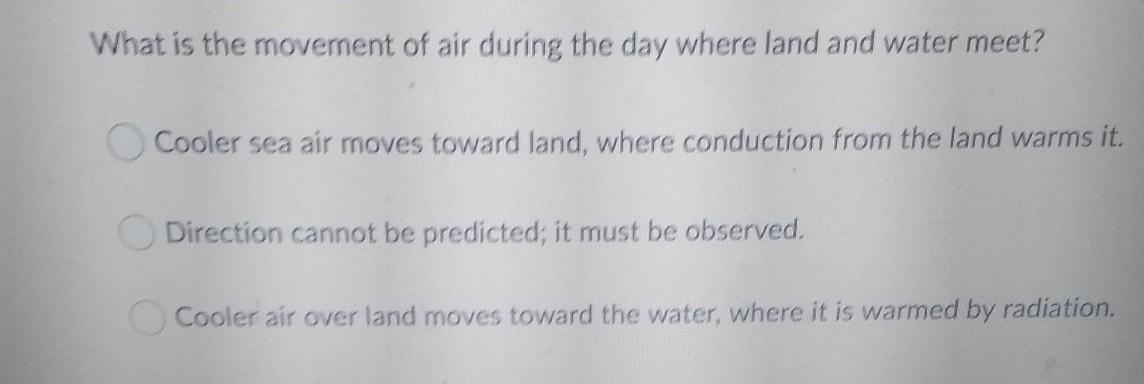
What is the movement of air during the day where land and water meet? Cooler sea air moves toward land, where conduction from the land warms it. , . Direction cannot be predicted; it must be observed. . Cooler air over land moves toward the water, where it is warmed by radiation.
Answers
I hope I'm not late, but it's "Cooler air over land moves toward the water, where it is warmed by radiation."