Please select the correct answer from the group of answer choices for each part of the question:
1a. Consider the computing load of a sum of 100 scalar variables and one matrix subtraction of a pair of two-dimensional array with dimensions 100x100. Assume the matrix subtraction is fully parallelizable, calculate the speedup using 100 processors assuming 10 processors carry 20% of the load and the rest load is shared among the rest 90 processors evenly?
A: 101/3
B: 101/2
C: 101
D: 100
1b: For the following vector MIPS code DAXPY which performs Y=a x X+Y, fill the two blank instructions.
L.d $f1, a($sp) ;load scalar a
Lv $v0, 0($s0) ;load vector x
__________________ ;vector-scalar multiply
Lv $v2, 0($s1) ;load vector y
___________________ ;add y to product
Sv $v3, 0($s1) ; store the result
A:
mul.d $v1, $v0, $f1
add.d $v3, $v1, $v2
B:
mulvs.d $v1, $v0, $f1
addv.d $v3, $v1, $v2
C:
mul.d $v2, $v0, $f1
add.d $v3, $v1, $v2
D:
mulvs.d $v2, $v0, $f1
addv.d $v3, $v1, $v2
1c. Which of the following statement is incorrect?
A: Both multithreading and multicore rely on parallelism to get more efficiency from a chip.
B: In coarse-grained multithreading, switching between threads only happens after significant events such as last-level cache miss.
C: In fine-grained multithreading, switching between threads happens after every instruction.
D: Simultaneous multithreading (SMT) uses threads to improve resource utilization of statically scheduled processor.
1d. In the roofline model, the attainable GFLOPs/sec is set by _____?
A: Peak Memory BW x Arithmetic Intensity
B: Peak Floating-Point Performance
C: Min (Peak Memory BW x Arithmetic Intensity, Peak Floating-Point Performance)
D: Max (Peak Memory BW x Arithmetic Intensity, Peak Floating-Point Performance)
Answers
The correct answer is D: Max (Peak Memory BW x Arithmetic Intensity, Peak Floating-Point Performance).
1a. C: 101 to calculate the speedup, we need to consider the computing load distribution among the processors. In this case, 10 processors carry 20% of the load, which means each of these processors handles 2% of the load. The remaining 90 processors share the rest of the load evenly, so each processor among these 90 handles (100% - 20%) / 90 = 0.8889% of the load.
The speedup can be calculated using Amdahl's Law, which states that the speedup is limited by the portion of the program that cannot be parallelized. In this case, the matrix subtraction is fully parallelizable, so the only portion that cannot be parallelized is the sum of the scalar variables.
The speedup formula is given by: Speedup = 1 / [(1 - p) + (p / n)], where p is the portion that can be parallelized and n is the number of processors.
In this case, p = 0.02 (for the 10 processors) and n = 100. Substituting these values into the formula, we get: Speedup = 1 / [(1 - 0.02) + (0.02 / 100)] = 1 / 0.99 = 1.0101.
Therefore, the correct answer is C: 101.
1b. A:
mul.d $v1, $v0, $f1
add.d $v3, $v1, $v2
The code snippet performs the DAXPY operation, which multiplies a scalar value (a) with a vector (x) and adds the result to another vector (y). The blank instructions should be filled with the above choices.
1c. C: In fine-grained multithreading, switching between threads happens after every instruction.
In fine-grained multithreading, switching between threads happens after every instruction, which is an incorrect statement. Fine-grained multithreading allows switching between threads at a much finer granularity, such as cycle-by-cycle or instruction-by-instruction, to improve resource utilization.
1d. B: Peak Floating-Point Performance
In the roofline model, the attainable GFLOPs/sec is set by the peak floating-point performance of the processor. The roofline model is a performance model that visualizes the performance limitations of a system based on the memory bandwidth and arithmetic intensity of the code. The attainable performance is determined by the lower value between the peak memory bandwidth and the peak floating-point performance. Therefore, the correct answer is B: Peak Floating-Point Performance.
Learn more about distribution here:
https://brainly.com/question/29664127
#SPJ11
Related Questions
d) half the number reduced by 4
Answers
Answer:0
Step-by-step explanation: You decreased by 4 means subtracting 4 from it.
Hope this helps!
Air enclosed in a sphere has density 1.2 kg/m3. What will the density be ifthe radius of the sphere is halved, compressing the air within?
Answers
Therefore, The density of air enclosed in a sphere with a radius halved will be 9.6 kg/m3. This is because the volume reduces by a factor of 8, resulting in an increase in density by a factor of 8.
When the radius of the sphere is halved, the volume of the sphere reduces by a factor of 8. Since the mass of the air enclosed remains constant, the density of the air within the sphere will increase by a factor of 8. Therefore, the density of the air within the sphere will be 9.6 kg/m3 after compression.
The density of the air enclosed within a sphere is given as 1.2 kg/m3. When the radius of the sphere is halved, the volume of the sphere reduces by a factor of 8 (since volume is proportional to the cube of radius). However, the mass of the air enclosed remains constant. Therefore, the density of the air within the sphere will increase by a factor of 8, resulting in a new density of 9.6 kg/m3.
Therefore, The density of air enclosed in a sphere with a radius halved will be 9.6 kg/m3. This is because the volume reduces by a factor of 8, resulting in an increase in density by a factor of 8.
To learn more about scale factors visit:
https://brainly.com/question/29967135
#SPJ11
Can someone help me out with this one???!!!
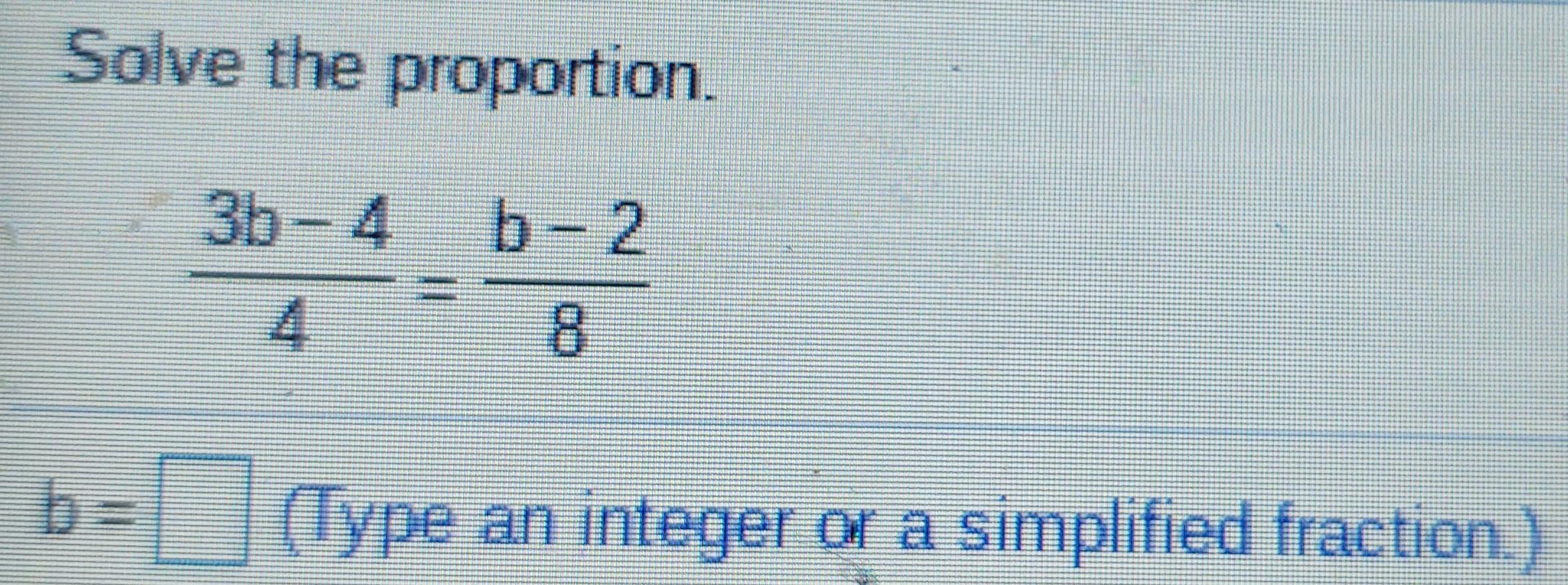
Answers
Answer:
b=6/5
Step-by-step explanation:
A sample of 50 11th graders were asked to select a favorite pattern out of 6
choices. The data list below shows what their favorite color patterns were,
and the accompanying frequency table and bar graph represent these data. In
the bar graph, the height of the blue-gray bar is 4, the height of the green bar
is 9, and so on
Color Pattern
Frequency
Buong
Green
9
in podot
14
Purple
11
Red and orange
9
Yellow
3
Suppose that, rather than being just a bar graph, the display you see above is
a relative frequency bar graph. The vertical axis of the graph will be marked
off in percentages, from 0 percent up to 30 percent. What will be the height of
the purple bar
A. 11
B. 27
C. 30
D. 22
Answers
Answer:
27
Step-by-step explanation:
Since pink dots is the highest(30) and Purple is second highest so purple must be close to 30.
The requried, height of the purple bar on the relative frequency bar graph is 22, and the answer is (D) 22.
What is Statistic?Statistics is the study of mathematics that deals with relations between comprehensive data.
Here,
Since the vertical axis of the bar graph is marked off in percentages, we can determine the height of each bar by multiplying its frequency by 2, since 50 students were surveyed (i.e., 100% of the sample size).
The frequency of the purple color pattern is 11, so its height on the bar graph is 11*2 = 22.
Therefore, the height of the purple bar on the relative frequency bar graph is 22, and the answer is (D) 22.
Learn more about Statistics here:
https://brainly.com/question/23091366
#SPJ7
How many liters of water should be added to 18 liters of a 14% bleach solution so that the resulting solution contains only 10% bleach? Original (L) Added (L) New (L) Amount of Bleach 2. 52 0 Amount of Solution 18 x 1. 8 liters 7. 2 liters 15. 5 liters 25. 2 liters.
Answers
The amount of water that should be mixed with 18 liters of 14% bleach solution to form 10% bleach solution is 7.2 liters.
What amount of water should be mixed with 1 liter of 14% bleach?The amount of water should be mixed with 1 liter of 14% bleach solution,
we know that the water will have 0% bleach. thus, the amount of water we need to mix with the 14% bleach solution is (2/5) liters.
Therefore, the ratio of water and bleach solution can be written as,
\(\rm \dfrac{14\%\ solution}{Water} = \dfrac{5}{2}\)
What amount of water should be mixed with 18 liters of 14% bleach?We know the ratio of water and bleach solution that should be mixed to form a 10% concentration bleach is (5/2), therefore, we will use the same ratio,
\(\rm \dfrac{14\%\ solution}{Water} = \dfrac{5}{2}\)
\(\rm \dfrac{18}{Water} = \dfrac{5}{2}\\\\\rm {Water} = \dfrac{18\times 2}{5}\\\\\rm Water = 7.2\ liters\)
Hence, the amount of water that should be mixed with 18 liters of 14% bleach solution to form 10% bleach solution is 7.2 liters.
Learn more about Ratio:
https://brainly.com/question/1504221
Use the Rational Root Theorem to list all possible rational roots for each equation. Then find any actual rational roots.
3x³+9 x-6=0
Answers
The equation 3x³ + 9x - 6 = 0 has one actual rational root, which is x = 1/3.
To apply the Rational Root Theorem to the equation 3x³ + 9x - 6 = 0, we need to consider the possible rational roots. The Rational Root Theorem states that any rational root of the equation must be of the form p/q, where p is a factor of the constant term (in this case, -6) and q is a factor of the leading coefficient (in this case, 3).
The factors of -6 are: ±1, ±2, ±3, and ±6.
The factors of 3 are: ±1 and ±3.
Combining these factors, the possible rational roots are:
±1/1, ±2/1, ±3/1, ±6/1, ±1/3, ±2/3, ±3/3, and ±6/3.
Simplifying these fractions, we have:
±1, ±2, ±3, ±6, ±1/3, ±2/3, ±1, and ±2.
Now, we can test these possible rational roots to find any actual rational roots by substituting them into the equation and checking if the result is equal to zero.
Testing each of the possible rational roots, we find that x = 1/3 is an actual rational root of the equation 3x³ + 9x - 6 = 0.
Therefore, the equation 3x³ + 9x - 6 = 0 has one actual rational root, which is x = 1/3.
Learn more about Rational Root Theorem here:
https://brainly.com/question/31805524
#SPJ11
what is 30 grams in ounces?
Answers
Answer:
1.05821886 ounces
Step-by-step explanation:
To convert 30 grams to ounces, use the conversion factor 1 ounce = 28.3495 grams.
What is the surface area of the rectangular prism below?

Answers
Answer:
108 in.
Step-by-step explanation:
SA = 2(lw + wh + lh)
SA = 2((6)(4) + (4)(3) + (6)(3)
SA = 2(24) + (12) + (18)
SA = 2(54)
SA = 108 in.
Answer:
108
Step-by-step explanation:
Scientists have discovered a new glow in the dark shark species that weighs up to 31 ounces when fully grown. About how much does an adult shark weigh in pounds?
Answers
A fully grown adult shark weighs 1.9375 pounds.
What is Metric System?Everything around us has a measurement value, from the amount of sugar you put in a cake to the size of a football field. Each thing is measured differently based on its length, weight, volume, or duration. With these measurements, the idea of "Metric System" is introduced.
Given that, Scientists have discovered a new glow in the dark shark species that weighs up to 31 ounces when fully grown.
We know that 1 pound =16 ounce
Now, 31 ounces = 31/16 pounds
= 1.9375 pounds
Therefore, a fully grown adult shark weighs 1.9375 pounds.
Learn more about the Metric System here:
https://brainly.com/question/25966695.
#SPJ4
ara scoops flour into a mixing bowl. Each scoop contains 34
cup of flour. Clara puts 5 scoops of flour into the mixing bowl, then transfers 13
of the flour into a small bowl. How many cups of flour are in the small bowl?
Answers
Answer:
1 1/4 cups
Step-by-step explanation:
The data set below has 6 values.
Find the mean absolute deviation for the data set.
8, 16, 15, 7, 18, 14
Answers
read the pic and tell me what statements are true

Answers
Answer:
Step-by-step explanation:

Find the slope of a line that includes the points (4, -2) and (5,0).
Answers
Answer:
The slope is 2
Step-by-step explanation:

What is the solution to (x 8) > (2x 10)? (â€"[infinity], â€"4) (â€"4, [infinity]) (â€"[infinity], 4) (4, [infinity])
Answers
The solution to the given equation is : (-∞,4)
According to the question we have been given the inequality equation as
\(\frac{3}{4}\) (x + 8) > \(\frac{1}{2}\)(2x + 10)
We will solve this for x step by step
multiplying both the sides by 4 and 2 we get
6(x+8) > 4(2x+10)
dividing both the sides by 2 we get
3(x+8) > 2 (2x + 10)
3x + 24 > 4x + 20
Taking the variables on one side we get
3x - 4x > 20 - 24
-x > -4
multiplying both the sides by -1 we get
x < 4
Hence the solution is (-∞,4)
Learn more about inequality here : https://brainly.com/question/24372553
#SPJ4
X(squared) + 16x +60=0
Solving quadric equations by factorising
Answers
Answer:
x = - 10, x = - 6
Step-by-step explanation:
x² + 16x + 60 = 0
Consider the factors of the constant term (+ 60) which sum to give the coefficient of the x- ter (+ 16)
The factors are + 10 and + 6 , since
10 × 6 = 60 and 10 + 6 = 16 , then
(x + 10)(x + 6) = 0 ← in factored form
Equate each factor to zero and solve for x
x + 10 = 0 ⇒ x = - 10
x + 6 = 0 ⇒ x = - 6
<=> x^2 + 6x + 10x + 60 = 0
<=> x(x+6) + 10(x+6) = 0
<=> (x+10)(x+6) = 0
<=> x+10=0 or x+6=0
<=> x= -10 or x= -6
Ok done. Thank to me:>
You run a t-test Two Sample Assuming Equal Variances in Excel. Which statistic displays the area cutoff by the combined negative and positive values of the T?
Answers
The p-value is the statistic that displays the area cutoff by the combined negative and positive values of the t-distribution when running a t-test with equal variances in Excel.
When running a t-test with the assumption of equal variances in Excel, the statistic that displays the area cutoff by the combined negative and positive values of the t-distribution is the p-value.
In Excel, the p-value is calculated using the T.TEST function, which returns the probability associated with a Student's t-test. The function requires the input of two sets of data for the two samples being compared. By comparing the calculated t-value to the t-distribution, the function determines the probability (p-value) of observing such extreme differences between the means of the two samples under the null hypothesis.
The p-value represents the probability of obtaining a t-value as extreme as the one observed, assuming the null hypothesis is true (i.e., there is no significant difference between the means of the two samples). If the p-value is smaller than a chosen significance level (e.g., 0.05), it indicates that the observed difference is statistically significant, and we reject the null hypothesis in favor of an alternative hypothesis.
In summary, the p-value is the statistic that displays the area cutoff by the combined negative and positive values of the t-distribution when running a t-test with equal variances in Excel.
Learn more about T.TEST function here:
https://brainly.com/question/14298233
#SPJ11
Twice the sum of a number and 9 is equal to three times the difference of the number and 9 Find the number.
Answers
Answer:
45
Step-by-step explanation:
You want the number described by, "twice the sum of a number and 9 is equal to three times the difference of the number and 9."
SetupLet x represent the number. Then "twice the sum of the number and 9" is ...
2(x +9)
and "three times the difference of the number and 9" is ...
3(x -9)
These are equal, so we have ...
2(x +9) = 3(x -9)
SolutionEliminating parentheses gives ...
2x +18 = 3x -27
45 = x . . . . . . . . . . . add 27-2x
The number is 45.
Determine which of the formulas hold for all invertible n×n matrices a and b
ABA^-1 = B
(I-A)(I+A) = I - A^2
Answers
For all invertible n×n matrices a and b, the formula ABA^-1 = B holds, while the formula (I-A)(I+A) = I - A^2 does not hold in general.
The formula ABA^-1 = B holds for all invertible n×n matrices a and b. When we multiply a matrix by its inverse and then multiply the result by the original matrix, the intermediate multiplication by the inverse effectively cancels out the original matrix's effect. Therefore, the resulting matrix is simply the second matrix, b. This property holds true for any invertible matrices a and b, regardless of their size.
On the other hand, the formula (I-A)(I+A) = I - A^2 does not hold in general. Here, I represents the identity matrix. While this formula might hold for specific matrices a, it is not universally valid for all invertible n×n matrices. In general, the product of (I-A)(I+A) will not simplify to I - A^2. The difference between the two sides of the equation is the term A^2, which does not always cancel out in this case. Therefore, we cannot conclude that this formula holds for all invertible n×n matrices a.
Learn more about identity matrix here:
https://brainly.com/question/2361951
#SPJ11
A bus traveled on a straight road for 3 h at an average speed that was 12 mph faster than its average speed on a winding road. The time spent on the winding road was 3 h. Find the average speed on the winding road if the total trip was 210 mi.
Answers
The average speed on the winding road was 45 mph.
The bus traveled for 3 hours on the winding road, so the distance covered can be calculated using the formula: Distance = Speed × Time. Let's assume the average speed on the winding road as 'x' mph. Therefore, the distance covered on the winding road is 3x miles.
On the straight road, the bus traveled for 3 hours at an average speed that was 12 mph faster than its average speed on the winding road. So the average speed on the straight road can be expressed as 'x + 12' mph. The distance covered on the straight road can be calculated as 3(x + 12) miles.
The total distance covered in the entire trip is given as 210 miles. Therefore, we can write the equation:
3x + 3(x + 12) = 210
Simplifying the equation:
3x + 3x + 36 = 210
6x + 36 = 210
6x = 174
x = 29
So the average speed on the winding road was 29 mph.
The problem states that the bus traveled for 3 hours on both the winding road and the straight road. Let's assume the average speed on the winding road as 'x' mph. Since the bus traveled for 3 hours on the winding road, the distance covered can be calculated as 3x miles.
On the straight road, the average speed was 12 mph faster than on the winding road. Therefore, the average speed on the straight road can be expressed as 'x + 12' mph. The distance covered on the straight road can be calculated as 3(x + 12) miles.
The total distance covered in the entire trip is given as 210 miles. This allows us to set up the equation 3x + 3(x + 12) = 210 to solve for 'x'. Simplifying the equation leads to 6x + 36 = 210. Solving for 'x', we find that the average speed on the winding road was 29 mph.
In summary, the average speed on the winding road was 29 mph.
Learn more about distance
brainly.com/question/13034462
#SPJ11
somebody please help me with this

Answers
Answer:
P(A) = 5/12
P(B) = 1/2
Step-by-step explanation:
A) Sum greater than 7
If the sum needs to be >7, then it can be 8, 9, 10, 11, and 12.
There are 26 out of 36 events where the sum is >7, thus P(A) = 15/36 = 5/12.
B) Sum is even
If we see in an overview of the sum distribution, there is a balanced division between odd and even numbers, thus the probability is very likely to be 1/2. Now let's make sure of it:
If the sum needs to be even, which means divisible by 2, then it can be 2, 4, 6, 8, 10, and 12.
There are 18 out of 36 events where the sum is even, thus P(B) = 18/36 = 1/2.
Image of table for reference: https://qph.fs.quoracdn.net/main-qimg-1283a98bd649f522986e2f91a592ffd3
I need help, please!!!!!!!!!!!!

Answers
Answer:
Its d!!!!!! Welcome!
Step-by-step explanation:
if you can assemble 20 gear boxes per day,how many days will it take you to assemble 6,400 gear boxes?
Answers
Answer:
320
Step By Step Explanation!-
6400÷20=320or320×30=6400Which of these is a prime number? 156, 149, 133, 152
Answers
please help!!
In a survey, 90% of dentists recommended sugarless gum for their patients who chew gum. If the total number of dentists surveyed was 80, how many dentists recommended chewing sugarless gum?
(Hint: What is 90% of 80?)
Answers
Answer:
72
Step-by-step explanation:
80x.90= 72
Answer:
72 is your answer
Step-by-step explanation:
Solve for x.
(13x-32)
S
T
V
(7x + 22)°
U

Answers
Answer:
x=9
Step-by-step explanation:
13x-32 and 7x+22 are equal to each other (angles) so
13x-32=7x+22
13x-7x=22+32
6x=54
x=54/6
x=9
John bought 4CDs that were each the same price. Including sales tax, he paid a total of 72.80 Each CD had a tax of 1.30 What was the price of each CD before tax?
Answers
$16.90
Step-by-step explanation:
The sales tax for each CD was $1.30 and there were 4 CD's so multiply $1.30 by 4 and you'll get $5.20, subtract $5.20 from $72.80 and you'll get $67.60. This means that $67.60 is the overall price (without tax) of the four CD's. Divide $67.60 by 4 and you'll get $16.90 this is the original price of one CD.
Marking you BRAINLIST! In Mr.Shipley’s class, 2 outs of 21 students did not turn in their homework. Based on this information, how many students would you expect to turn in their homework if Mr.Shipley has a total of 126 students?
Answers
Answer:
12
Step-by-step explanation:
2*126=252
252/21=12
Express complex numbers in standard form. ( a + bi )

Answers
Answer:
10.) -46 -38i
11.) 12 +8i
Step-by-step explanation:
You want the products (2+6i)(-8+5i) and 4i(2-3i) expressed in standard form.
Expressions with iAn expression containing i can be expanded or simplified by treating i the same as any other variable. All instances of i² can be replaced by -1.
10.(2 +6i)(-8 +5i) = (2)(-8) +2(5i) +(6i)(-8) +(6i)(5i)
= -16 +10i -48i +30i² . . . . . . i² = -1
= -46 -38i
11.4i(2 -3i) = (4i)(2) +(4i)(-3i) = 8i -12i²
= 12 +8i . . . . . . . i² = -1

Find the slope of the line that passes through (9, 6) and (4, 5).
Simplify your answer and write it as a proper fraction, improper fraction, or integer.
Answers
Answer:
slope = \(\frac{1}{5}\)
Step-by-step explanation:
calculate the slope m using the slope formula
m = \(\frac{y_{2}-y_{1} }{x_{2}-x_{1} }\)
with (x₁, y₁ ) = (9, 6 ) and (x₂, y₂ ) = (4, 5 )
m = \(\frac{5-6}{4-9}\) = \(\frac{-1}{-5}\) = \(\frac{1}{5}\)
You are a life saver if you help me figure out this problem step by step. I swear my math teacher is trying to make me fail:(
