
Answers
Answer:
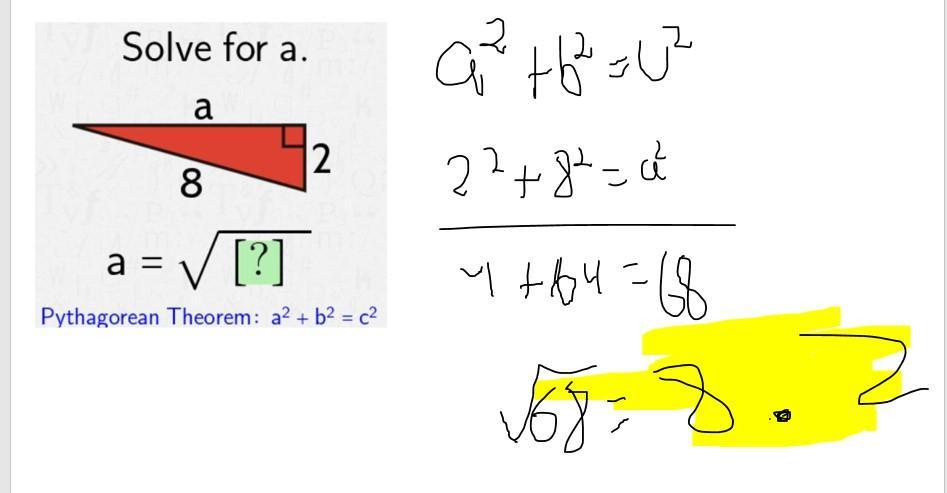
a = \(\sqrt{68}\) = 8.2
Step-by-step explanation:
Look at picture ↓
\(Hope\) \(this\) \(helps!\) \(:)\)
Answer:
60
Step-by-step explanation:
You have the proper formula. You just need to swap some things around so we aren't solving for C. C is always the hypotenuse, the diagonal line opposite the right triangle. A and B can be either side unless specified.
1. The side we're solving for can either be called a or b. Let's call it A.
2. Now, switch around the theorem to solve for a: \(C^2-B^2=A^2\\\)
3. Plug in what we know: \(8^2-2^2=a^2\)
4. It simplifies down to \(60=a^2\)
5. The "\(a^2\) " means to square the a. We need to undo that to get a by itself. The opposite of squared is the square root
6. This leaves us to take the square root of both sides, which isolates a.
7. \(\sqrt{60}\) is the answer. It's asking for it in the square root so we don't need to simplify it.
Related Questions
we wish to construct a rectangular auditorium with a stage shaped as a semicircle of radius $r$, as shown in the diagram below (white is the stage and green is the seating area). for safety reasons, light strips must be placed on the perimeter of the seating area. if we have $45\pi 60$ meters of light strips, what should $r$ be so that the seating area is maximized?
Answers
To maximize the seating area while using 45π + 60 meters of light strips, the radius of the semicircular stage should be approximately 29π/3 - 5 meters.
To maximize the seating area, we need to determine the dimensions of the rectangular auditorium that will give us the largest possible area while using the given length of light strips.
Let the length of the rectangular auditorium be L, and its width be W.
The seating area consists of the rectangular portion minus the semicircular stage. So, the seating area's length is L - 2r (subtracting the semicircle's diameter) and the seating area's width is W - 2r.
The perimeter of the seating area is the sum of the lengths of its four sides, excluding the semicircular stage. The perimeter is given as 45π + 60 meters.
Perimeter = 2(L - 2r) + 2(W - 2r) + πr = 45π + 60
Simplifying: 2L + 2W - 8r + πr = 45π + 60
Rearranging: 2L + 2W = 8r + 44π + 60
The area of the seating area is given by A = (L - 2r)(W - 2r).
We want to maximize A, so we need to express it in terms of a single variable. Since we have an equation with two variables (L and W), we can rewrite one of the variables in terms of the other.
Rearranging the perimeter equation: 2L + 2W = 8r + 44π + 60
Solving for L: L = (8r + 44π + 60 - 2W) / 2
Substituting L in terms of W into the area equation: A = [(8r + 44π + 60 - 2W) / 2 - 2r] (W - 2r)
Simplifying: A = (4r + 22π + 30 - W) (W - 2r)
Now we have the area equation in terms of a single variable, W. To maximize A, we can take the derivative of A with respect to W, set it equal to zero, and solve for W.
dA/dW = 2(4r + 22π + 30 - W) - (W - 2r) = 0
Solving for W: 8r + 44π + 60 - W = W - 2r
Simplifying: 10r + 44π + 60 = 2W
W = 5r + 22π + 30
Now that we have W in terms of r, we can substitute this expression back into the area equation to get the area in terms of r only.
A = (4r + 22π + 30 - (5r + 22π + 30)) ((5r + 22π + 30) - 2r)
Simplifying: A = (r - 22π) (3r + 22π + 30)
Expanding: A = 3r² + 8rπ + 30r - 66πr - 660π
Now, to find the maximum area, we can take the derivative of A with respect to r, set it equal to zero, and solve for r.
dA/dr = 6r + 8π + 30 - 66π = 0
Simplifying: 6r - 58π + 30 = 0
6r = 58π - 30
r = (58π - 30) / 6
r ≈ 29π/3 - 5
Therefore, to maximize the seating area while using 45π + 60 meters of light strips, the radius of the semicircular stage should be approximately 29π/3 - 5 meters.
Learn more about maximum area click;
https://brainly.com/question/29635164
#SPJ12
divide: (x3-1) by (x-1 )
plz divide ....
Answers
Answer:
\( \frac{ {x}^{3} - 1}{x - 1} \\ = \frac{ {x}^{3} - {1}^{3} }{x - 1} \\ = > but : {(x - 1)}^{3} = (x - 1)( {x}^{2} - 2x + 1) \\ \therefore \: = \frac{(x - 1)( {x}^{2} - 2x + 1) }{(x - 1)} \\ = {x}^{2} - 2x + 1 \\ = {(x - 1)}^{2} \)
\( \frac{ {x}^{3} - 1 }{ x- 1} \\ = \frac{ {x}^{3} - 1 }{x - 1} \\ = \frac{( {x} - 1)( {x}^{2} + x + 1) }{x - 1} \\
= {x}^{2} +x+1\)
What is the difference?
(-4x + 3) - (7x - 3x2 - 1)
Answers
Answer:
-5x + 4
Step-by-step explanation:
Select the correct answer.Adam constructed quadrilateral PQRS inscribed in circle O. How can he prove PQRS is a square?A.He needs to show only that the diagonals are perpendicular.B.He needs to show only that the diagonals are perpendicular and congruent.C.He needs to show only that the diagonals are perpendicular and bisect each other.D.He needs to show that the diagonals are perpendicular, congruent, and bisect each other.
Answers
Adam needs to show that the diagonals are perpendicular, congruent, and bisect each other.Therefore Option D is correct.
To prove that PQRS is a square, Adam needs to show that all four sides are congruent and that all four angles are right angles.
One way to do this is by showing that the diagonals of PQRS are perpendicular, congruent, and bisect each other.
If the diagonals are perpendicular, then opposite angles are congruent and the quadrilateral is a kite.
If the diagonals bisect each other, then opposite sides are congruent and the kite is a rhombus.
If the diagonals are also congruent, then all sides are congruent and the rhombus is a square.
Therefore, He needs to show that the diagonals of PQRS are perpendicular, congruent, and bisect each other to prove that PQRS is a square.
To learn more 'quadrilaterals':
https://brainly.com/question/23935806
#SPJ11
Farris Pharmacy has a uniform yearly demand for 200 bottles of Zithromax antibiotics. Suppose that their yearly ordering and storage costs C(x) ar given by the tunction C(x)=5x+ x
8,000
Where X is the number of bottles they place in each order. You may assume that one shipment arrives just as the previous shipment is sold. How much doesit cost the pharmacy to store one bottle?
Answers
The cost for Farris Pharmacy to store one bottle of Zithromax antibiotics is 8,005.
The given function is c(x)=5x+8000/x
We can calculate the cost for Farris Pharmacy to store one bottle of Zithromax antibiotics by using the provided equation C(x).
To find the cost of storing one bottle, we will simply set x equal to 1. Therefore, C(1) = 5(1) + 8,000/1 = 8,005.
This means that the cost for Farris Pharmacy to store one bottle of Zithromax antibiotics is 8,005.
Therefore, the cost for Farris Pharmacy to store one bottle of Zithromax antibiotics is 8,005.
To learn more about the function visit:
https://brainly.com/question/28303908.
#SPJ4
Represent each of the following sequences as functions. In each case, state a domain, codomain, and rule for determining the outputs of the function. Also, determine if any of the sequences are equal.
(a) 1,14,19,116,…
(b) 13,19,127,181,…
(c) 1,−1,1,−1,1,−1,…
(d)cos(0),cos(π),cos(2π),cos(3π),cos(4π),…
Answers
The sequence cos(0),cos(π),cos(2π),cos(3π),cos(4π),… can be represented as a function k: N -> R, where N is the set of natural numbers and R is the set of real numbers. The domain of the function is the set of natural numbers, and the codomain is the set of real numbers. The function l: N -> {-1,1}, where l(n) = (-1)^(n).
The sequence 1,14,19,116,… can be represented as a function f: N -> N, where N is the set of natural numbers. The rule for determining the outputs of the function is as follows: f(1) = 1, f(2) = 14, f(3) = 19, f(4) = 116, and so on.
The sequence 13,19,127,181,… can be represented as a function g: N -> N, where N is the set of natural numbers. The rule for determining the outputs of the function is as follows: g(1) = 13, g(2) = 19, g(3) = 127, g(4) = 181, and so on. The domain of the function is the set of natural numbers, and the codomain is also the set of natural numbers. We can see that this sequence is not equal to any of the other sequences given.
The sequence 1,−1,1,−1,1,−1,… can be represented as a function h: N -> {-1,1}, where N is the set of natural numbers. The rule for determining the outputs of the function is as follows: h(1) = 1, h(2) = -1, h(3) = 1, h(4) = -1, and so on. The domain of the function is the set of natural numbers, and the codomain is the set {-1,1}. We can see that this sequence is equal to the function f: N -> {-1,1}, where f(n) = (-1)^(n+1).
To know more about function visit:-
https://brainly.com/question/30721594
#SPJ11
what is it solved using quadratic formula?

Answers
-3/2
-7/2
PLEASE HELP PLEASE HELPPPPPP

Answers
Answer:
D
Step-by-step explanation:
just count how many spaces one of the points have moved
x moved 6 spaces to the left so it'll be x-6 and it moved up 2 so itll be y+2
A badge is the shape of a quarter circle as shown below. Calculate the perimeter of the badge. Give your answer correct to 2 decimal places. 9 cm base, 9 cm height.
Answers
As a professional tutor, I will explain how to calculate the perimeter of a badge in the shape of a quarter circle with a 9 cm base and 9 cm height.
Let's break the badge down into its three segments: the two straight sides (the base and height) and the curved outer edge.
1. Straight sides: The base and height are both 9 cm, so this part is straightforward. The combined length of the base and height is 9 cm + 9 cm = 18 cm.
2. Curved outer edge: To calculate the curved outer edge, we need to understand that it is one-fourth of the circumference of the entire circle from which it is cut. The formula for the circumference C of a circle with radius r is C = 2πr, where π (pi) is a mathematical constant approximately equal to 3.14. Since the base and height are both 9 cm, it's clear that the radius of the circle is 9 cm. Thus, the circumference of the full circle is C = 2π(9 cm) ≈ 56.55 cm. Since we only have a quarter of the circle, the curved outer edge is 1/4 of this, which is about 56.55 cm / 4 ≈ 14.14 cm.
3. Perimeter: Finally, add up the lengths of the three segments: 18 cm (straight sides) + 14.14 cm (curved outer edge) ≈ 32.14 cm.
So, the perimeter of the badge in the shape of a quarter circle with a 9 cm base and 9 cm height is approximately 32.14 cm (rounded to two decimal places).
Five times the sum of a number and 27 is greater than or equal to six times the sum of that number and 26.what is the solution set of this problem?
Answers
5(x + 27) >= 6(x + 26)
5x + 135 >= 6x + 156
-x >= 21
x <= -21
Answer: Choice B.
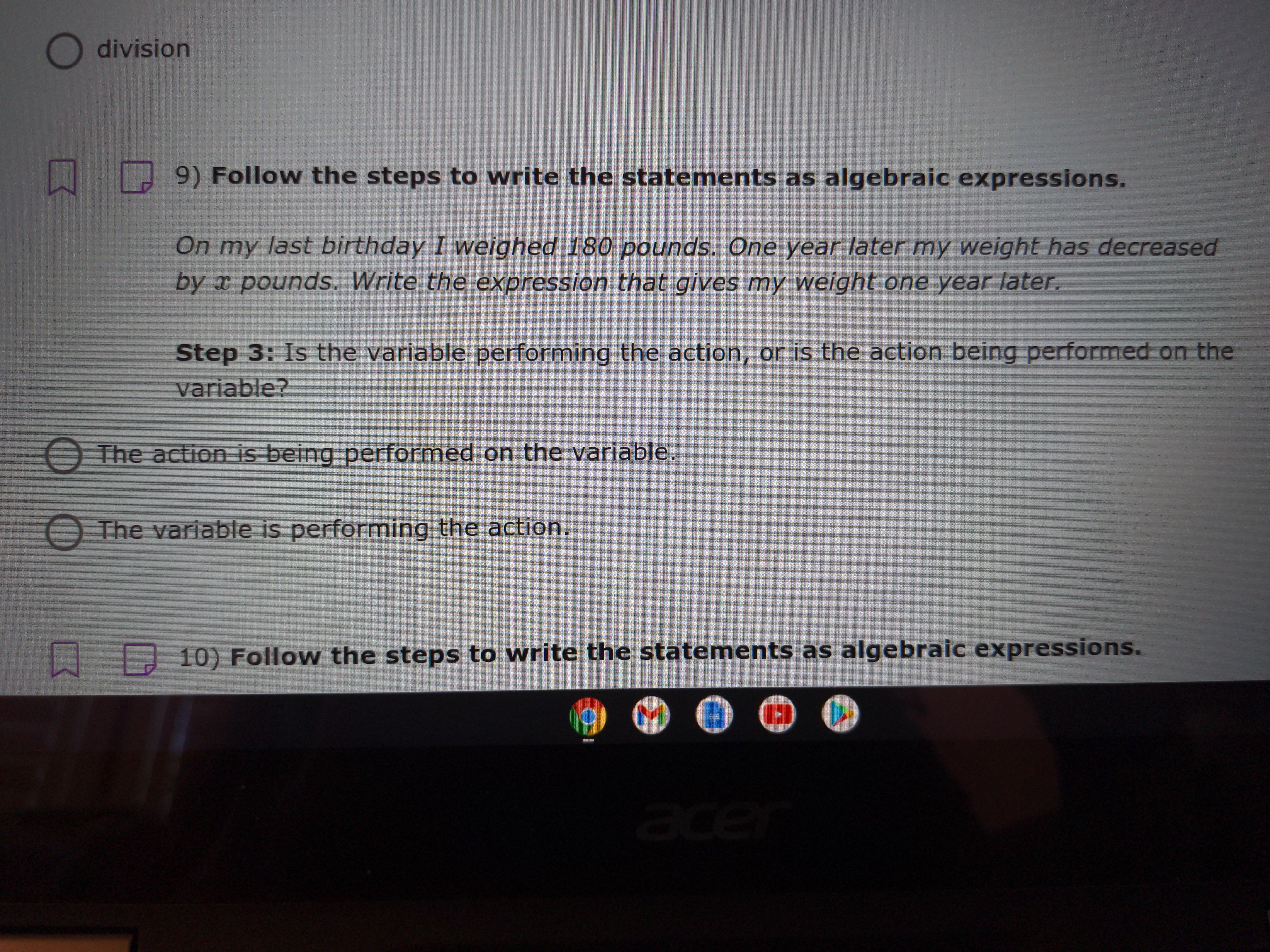
I'm stuck on this question. Help please.
Answers
Step-by-step explanation:
Option A is correct...
hope this answer helps you dear!
a square is inscribed in a circle. how fast is the area of the square changing when the circel is increasing at 1 in/min
Answers
The area of the square is changing at 12√2 + 2√2t square inches/minute when the circle is increasing at 1 in/min.
Let us find the relationship between r and s using the Pythagorean theorem. Since the square is inscribed in the circle, the diameter of the circle is equal to the diagonal of the square.
2r = s√2
Squaring both sides, we get:
4r² = 2s²or s² = 2r²
Dividing by 2 on both sides, we get:
s²/2 = r²
Differentiating both sides with respect to t, we get:
ds²/dt = 2r (dr/dt)
Dividing both sides by 2s, we get:
ds/dt = r (dr/dt) / s
Substituting r² = s²/2,
\(ds/dt = r (dr/dt) / √2s2s ds/dt = r (dr/dt)s ds/dt = (r/2) (dr/dt)2s ds/dt = r (dr/dt) or dA/dt = 2s ds/dt = 2r (dr/dt)\)
Now, substituting r² = s²/2,
dA/dt = 2s ds/dt = 2(√2 s) (dr/dt) = 2(√2) r (dr/dt)
Now, substituting dr/dt = 1 in/min and r = 6 in (since the circle is increasing at 1 in/min, the radius after t minutes is 6 + t),
dA/dt = 2(√2) (6 + t) (1) = 12√2 + 2√2t square inches/minute
Therefore, the area of the square is changing at a rate of 12√2 + 2√2t square inches/minute.
To know more about Pythagorean theorem refer here:
https://brainly.com/question/14930619
#SPJ11
PLEASE HELP ASAP!!! DUE IN SOON!!!


Answers
an= -16 + 7n - 7
an=7n -23
When the rate of change is 7
{a1 = 16, a2=-9, so the rate of rate of change is 7}
You work on a concrete crew starting a construction project. Once the pouring begins, it must continue non-stop until it is completed. Your crew will work an 8-hour shift along with two other crews. The total project requires 175,000 yards of concrete. Your supervisor estimates that each crew will pour around 1200 yards per hour. How many consecutive days should you plan to work on this project?
A3
B.6
C. 18
D. 27
Answers
Answer: B. 6
Step-by-step explanation:
There are 312 cards in 6 deck of playing cards write the ratio as a fraction them find the unit rate
Answers
Answer:
6x: 312
x: 52
Step-by-step explanation:
Let the deck be denoted by x then
6x: 312
There are 312 cards in 6x decks
In 1 deck x there are 312/6= 52 cards
6x: 312
6x/6: 312/6 Cancelling both sides by 6
x: 52
In ratio both the sides are divided by the same number to get equivalent fractions.
In 1 deck there are 52 cards
Find the area of a
square that has a side
length of 3 1/2 cm
Answers
Answer:
12.25cm2
Step-by-step explanation:
Area of a square= S ×S
3 1/2 × 3 1/2 = 3.5×3.5 = 12.25
Represent the system of equations as a matrix.
x+2y+z=-5
2x-y-3z=5
x+y+2z=0
Perform elementary row operations on the matrix to transform it into reduced row echelon form.
What is the reduced row echelon form of the matrix?
Enter your answer by filling in the boxes.

Answers
Answer:
Step-by-step explanation:
x+2y+z=-5
2x-y-3z=5
x+y+2z=0
The given system of equations is a 3×4 matrix:
\(\left[\begin{array}{ccccc}1&2&1&|&-5\\2&-1&-3&|&5\\1&1&2&|&0\end{array}\right]\)
We need to find the echelon form of the rows of this matrix
Multiply line 1 by (-2) and add it to line 2:
\(\left[\begin{array}{ccccc}1&2&1&|&-5\\0&-5&-5&|&15\\1&1&2&|&0\end{array}\right]\)
Multiply line 1 by (-1) and add it to line 3:
\(\left[\begin{array}{ccccc}1&2&1&|&-5\\0&-5&-5&|&15\\0&-1&1&|&5\end{array}\right]\)
Divide the line 2 by (-5) and add it to row 3:
\(\left[\begin{array}{ccccc}1&2&1&|&-5\\0&-5&-5&|&15\\0&0&2&|&2\end{array}\right]\)
Consequently, the matrix in the form of an echelon of rows has the form:
\(\left[\begin{array}{ccccc}1&2&1&-5\\0&-5&-5&15\\0&0&2&2\end{array}\right]\)
S=26.32 E=55 t=3 standard diviation=60% 3-year r=2.4% 10-year
r=3.1%
What minimum value would you assign? What isthe maximum value
you would assign?
Answers
For the given standard deviation the minimum value we would assign is 22.the maximum value we would assign is 88.
To calculate the minimum and maximum values based on the given information, we need to consider the standard deviation and the respective interest rates for the 3-year and 10-year periods.
Given:
S = 26.32 (Initial value)
E = 55 (Expected value)
t = 3 (Years)
Standard deviation = 60% (of the expected value)
3-year interest rate = 2.4%
10-year interest rate = 3.1%
To find the minimum value, we will calculate the value at the end of the 3-year period using the lowest possible growth rate.
Minimum value calculation:
Minimum value = E - (Standard deviation * E) = 55 - (0.6 * 55) = 55 - 33 = 22
Therefore, the minimum value we would assign is 22.
To find the maximum value, we will calculate the value at the end of the 10-year period using the highest possible growth rate.
Maximum value calculation:
Maximum value = E + (Standard deviation * E) = 55 + (0.6 * 55) = 55 + 33 = 88
Therefore, the maximum value we would assign is 88.
For more details about standard deviation
https://brainly.com/question/13498201
#SPJ4
What is the value of 3-(-2)?
Answers
Answer:
5
Step-by-step explanation:
keep change flip
3 - -2
3 + 2
Which of the following is not a step when drawing an angle?
A. Draw perpendicular lines
B. Draw a ray
C. Make a mark at the correct point on the protractor
D. Connect the mark and the vertex with a line
Answers
Answer:
A. Draw perpendicular lines
Step-by-step explanation:
Perpendicular lines are lines that intersect at a 90 degree angle. Unless you are constructing a right angle - or 45 degree angle - you would not need to draw perpendicular lines.
Therefore, answer A is correct.
Show your work, (I am stuck on this because I’m not smart lol)

Answers
Answer:
She needs to get at least 96 on the 4th test to earn an average of at least 90 in the class.
Step-by-step explanation:
(97+78+89+?) divided by 4 at\geq 90
It is divided by 4 because it is the average of 4 test scores.
To Solve: (97+78+89+?) divided by 4 at\geq 90
Multiply by 4 on both sides 97+78+89+? at\geq 360
Isolate variable: ? at\geq 96
3-109. because all airline passengers do not show up for their reserved seat, an airline sells 125 tickets for a flight that holds only 120 passengers. the probability that a passenger does not show up is 0.10, and the passengers behave independently. (a) what is the probability that every passenger who shows up can take the flight? (b) what is the probability that the flight departs with empty seats?
Answers
(a) The probability that every passenger who shows up can take the flight is approximately 0.163 or 16.3%. (b) The probability that the flight departs with empty seats is approximately 0.003 or 0.3%.
(a) In order for every passenger who shows up to take the flight, none of the 120 passengers who show up should be denied boarding due to the flight being overbooked. Since the airline sells 125 tickets for a flight that holds only 120 passengers, there is a possibility that more passengers show up than there are available seats. The probability that a passenger shows up is 1 minus the probability that they do not show up, which is 0.90 (1 - 0.10). Assuming the passengers behave independently, we can calculate the probability that all 120 passengers who show up can take the flight by multiplying the probability of each passenger showing up: 0.90^120 ≈ 0.163 or 16.3%.
(b) The probability that the flight departs with empty seats means that there are more available seats than the number of passengers who show up. In this case, the flight can accommodate all the passengers who show up, and there are empty seats remaining. Since the airline sells 125 tickets for a flight that holds 120 passengers, the flight will depart with empty seats only if less than 120 passengers show up. The probability that a passenger does not show up is 0.10, so the probability that a specific passenger shows up is 1 - 0.10 = 0.90. Using the binomial distribution, we can calculate the probability of fewer than 120 passengers showing up out of the 125 tickets sold. This probability is approximately 0.003 or 0.3%.
Learn more about binomial distribution here: brainly.com/question/29137961
#SPJ11
2x - 6y = - 24 and x + -5y = -22
by substitution
Answers
Answer:
2x-6y=-24
2x=-24+6y
x=-24+6y÷2
x=-12+3y equation 1
x+(-5y)=-22
-12+3y-5y=-22
-13-2y=-22
-2y=-22+13
-2y=-9
y=-9÷2
y=4.5equation 2
putting value of equation 2 in equation 1
x=-12+3y
x=-12+3×4.5
x=-12+13.5
x=1.5 answer!!!
1
32^1/25 × 2^x = 8^1/4
Work out the exact value of x
Answers
Answer:
Step-by-step explanation:
0.267
Function p represents the perimeter, in inches, of a square with side length x inches.
Answers
The function for the perimeter of the square is P = 4x.
The term function is defined as a relationship between inputs where each input is related to exactly one output.
Here we have given that Function p represents the perimeter, in inches, of a square with side length x inches.
As we all know that the term square is referred as a regular polygon having four equal sides and equal angles that measure 90° each.
And the term perimeter is defined as the distance around the edge of a shape.
as we all know the the square has 4 sides which is represented by the term x.
Then the perimeter is calculated as
p = x + x + x + x
Therefore, the resulting function is written as
p = 4x.
To know more about Function here.
https://brainly.com/question/28193995
#SPJ4
y - 6x = 12
y = 6x + 5
Answers
Answer:
there is no question. but these are two of the same lines with different Y-intercepts.
what is the difference between integrationg by ordinary substitution and integrating by trigonometric substiti
Answers
Integration by ordinary substitution is a general technique for simplifying integrals by changing variables, while integration by trigonometric substitution is a specific technique for evaluating integrals involving square roots and trigonometric functions.
Integration by ordinary substitution and integration by trigonometric substitution are two different techniques used to evaluate integrals in calculus.
Integration by ordinary substitution, also known as u-substitution, involves making a change of variables to simplify the integral. It is based on the chain rule for differentiation. The general steps for integration by ordinary substitution are as follows:
1. Identify a part of the integrand that can be replaced by a single variable, denoted by u.
2. Compute the derivative du/dx of the new variable u.
3. Substitute the expression for u and du into the integral, replacing the original integrand.
4. Integrate the resulting expression with respect to u.
5. Replace the variable u with the original variable or expression to obtain the final result.
Integration by trigonometric substitution, on the other hand, is a technique specifically used for integrals involving square roots of quadratic expressions or expressions with a combination of squares. It is based on trigonometric identities and is particularly useful when dealing with integrals that can be simplified using trigonometric functions. The general steps for integration by trigonometric substitution are as follows:
1. Identify a part of the integrand that can be expressed in terms of a trigonometric function.
2. Make a substitution using a trigonometric identity to replace the relevant part of the integrand.
3. Express all other terms in the integrand in terms of the same trigonometric function.
4. Simplify the integral using trigonometric identities and algebraic manipulations.
5. Integrate the resulting expression with respect to the new variable (usually denoted by θ).
6. Replace the trigonometric function with the original variable or expression to obtain the final result.
In summary, integration by ordinary substitution is a general technique for simplifying integrals by changing variables, while integration by trigonometric substitution is a specific technique for evaluating integrals involving square roots and trigonometric functions.
To know more about trigonometric functions
brainly.com/question/6904750
#SPJ4
Given AB=15cm,BC=20cm.Find AB correct 3 significant
(question refer to a triangle ABC which is right -angled at C)
Answers
The length of AB is 25 units
How to determine the length AB?The given parameters are
AC = 15 cm
BC = 20 cm
The triangle is right -angled at C.
So, we have:
AB^2 = AC^2 + BC^2
This gives
AB^2 = 15^2 + 20^2
Evaluate
AB^2 = 625
Take the square roots
AB = 25
Hence, the length of AB is 25 units
Read more about right triangles at:
https://brainly.com/question/6322314
#SPJ1
what is a simpler form for the radical expression 4√2401x^12y^16
Answers
Answer:
\(49x^{6}\)\(y^{8}\)
Step-by-step explanation:
1. Factor 2401 into its prime factors
2401 = 74
To simplify a square root, we extract factors which are squares, i.e., factors that are raised to an even exponent.
Factors which will be extracted are :
2401 = 74
No factors remain inside the root!!
To complete this part of the simplification we take the squre root of the factors which are to be extracted. We do this by dividing their exponents by 2 :
49 = 72
At the end of this step the partly simplified SQRT looks like this:
49√(x^12y^16)
2. Rules for simplifying variables which may be raised to a power:
(1) variables with no exponent stay inside the radical
(2) variables raised to power 1 or (-1) stay inside the radical
(3) variables raised to an even exponent: Half the exponent taken out, nothing remains inside the radical. examples:
(3.1) √(x8)=x4
(3.2) √(x-6)=x-3
(4) variables raised to an odd exponent which is >2 or <(-2) , examples:
(4.1) √(x5)=x2•√(x)
(4.2) √(x-7)=x-3•√(x-1)
Applying these rules to our case we find out that
SQRT(x12y16) = x6y8
Combine both simplifications:
sqrt (2401x12y16) =
49x6y8
May I have Brainliest please? My next rank will be the highest one: A GENIUS! Please help me on this journey to become top of the ranks! I only need 2 more brainliest to become a genius! I would really appreciate it, and it would make my day! Thank you so much, and have a wonderful rest of your day!
rosa travels 36 miles per hour how long does it take her to travel 3 miles? your answer should be in hours, accurate to at least the nearest tenth.
Answers
I think that’s right