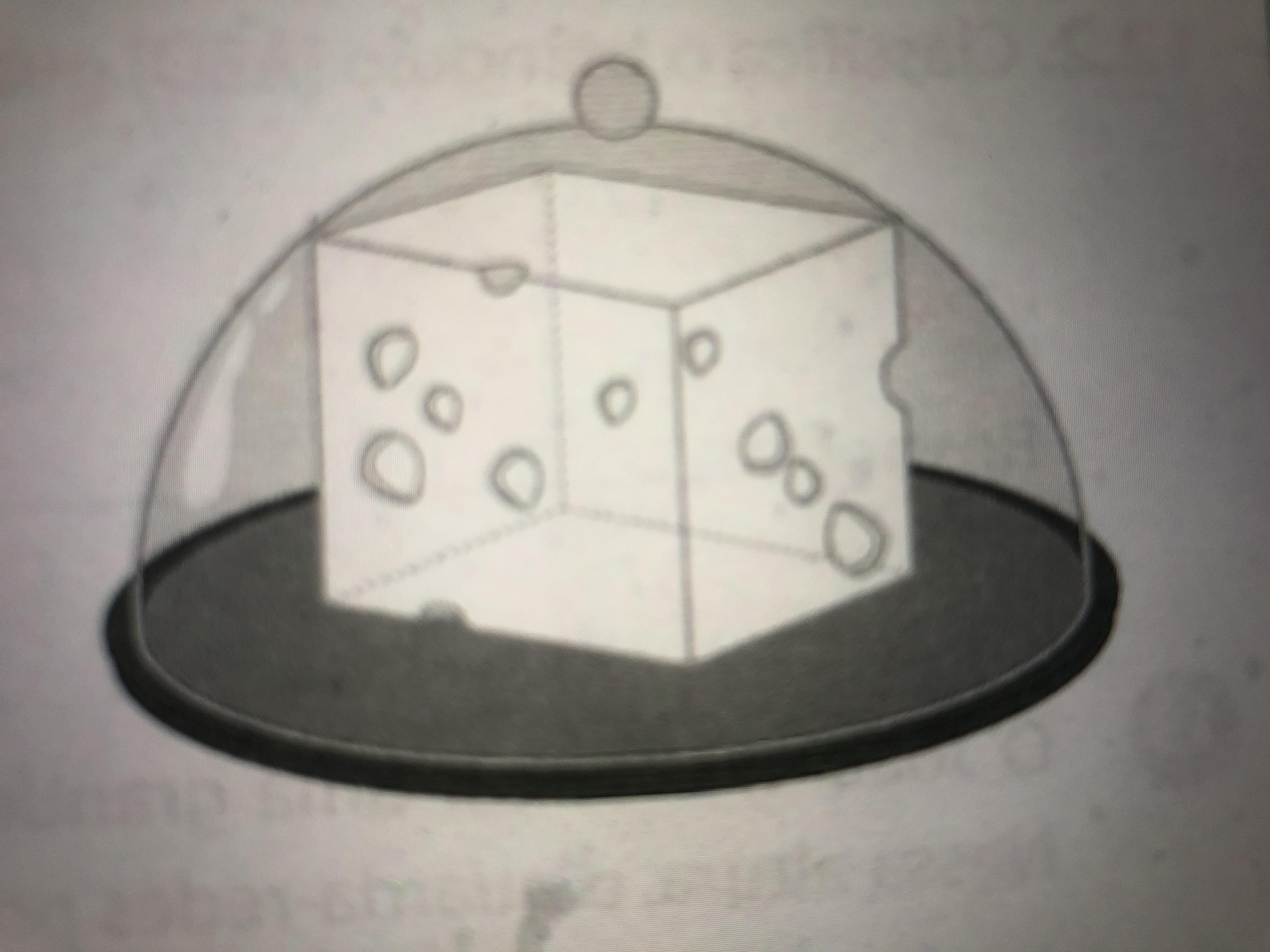
Please help me solve the following problem:Mary has a box with the shape of a semisphere where she keeps cheese. Inside the box there is a cubic cheese with 10 cm edge. The four top vertices of the cheese are in contact withthe cover of the box (see image).Which is the volume of the box?
Answers
Answer:
\(Volume\text{ of the box = 3847.60 cm}^3\)Explanation:Given:
The box is in the shape of a semisphere
The edge of the cubic cheese = 10cm
To find:
the volume of the box
The box is said to be a semisphere. This is also known as the hemisphere.
To get the volume of the box, we will apply the volume of a hemisphere.
The volume is given as:
\(Volume\text{ of a hemisphere = }\frac{2}{3}\pi r^3\)The 4 top vertices start from the cover of the box (hemisphere).
From the diagram, radius = AC
AB is an edge = 10
We need to get the distance BD using pythagoras theorem:
Hypotenuse² = opposite² + adjacent²
opposite = 10, adjacent = 10
BD² = 10² + 10²
BD² = 200
BD = √200 = √(100×2)
BD = 10√2
Next, we will find BC:
BD = BC + CD
BC = CD
BD = 2BC
BC = BD/2
BC = (10√2)/2
To get the radius, we will use Pythagoras theorem on triangle ABC
AB = opposite = 10
BC = adjacent = (10√2)/2
AC = hypotenuse = radius
Substitute the values into the Pythagoras formula:
\(\begin{gathered} radius²\text{ = 10^^b2 + \lparen}\frac{10\sqrt{2}}{2})^2 \\ \\ radius²\text{ = 100 + }\frac{10\sqrt{2}\text{ }\times10\sqrt{2}}{2^2} \\ \\ radius^2\text{ = 100 + }\frac{100(2)}{4}\text{ = 100 + 50} \\ \\ radius^2\text{ = 150} \\ \\ radius\text{ = }\sqrt{150}\text{ = 12.2474} \end{gathered}\)\(\begin{gathered} Volume\text{ of a hemisphere = }\frac{2}{3}\pi r^3 \\ \\ let\text{ }\pi\text{ = the value on a calculator} \\ r\text{ = 12.2474} \\ \\ Volume\text{ of the hemisphere = }\frac{2}{3}\times\pi\times(12.2474)^3 \\ \\ Volume\text{ of the hemisphere = 3847.60 cm}^3 \\ \\ Volume\text{ of the box= 3847.60 cm}^3 \end{gathered}\)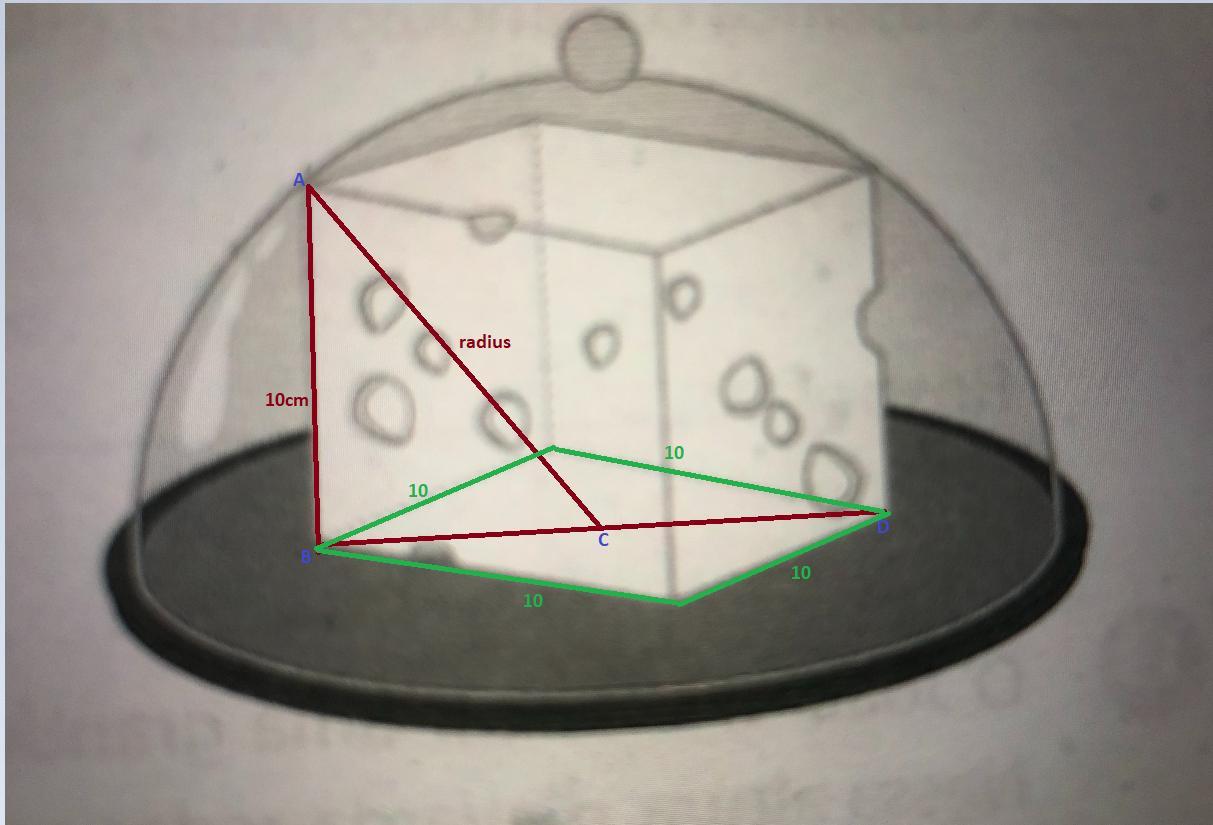
Related Questions
Round 6.487 and 2.049 to the hundredths place. What is the sum of the rounded numbers? *
Answers
Answer:
8.54
Step-by-step explanation:
If thousandth's place is ≥ 5 , then add 1 to the hundredth place.
6.487 = 6.49
2.049 = 2.05
6.487 + 2.049 = 6.49 + 2.05 = 8.54
I have 10 coins in my pocket, all nickels and
dimes.In total I have 65 cents. How many of each
coin do I have?
Answers
(-2.9) + 8.0 + 7.4
I need help with this
Answers
I think that’s the answer
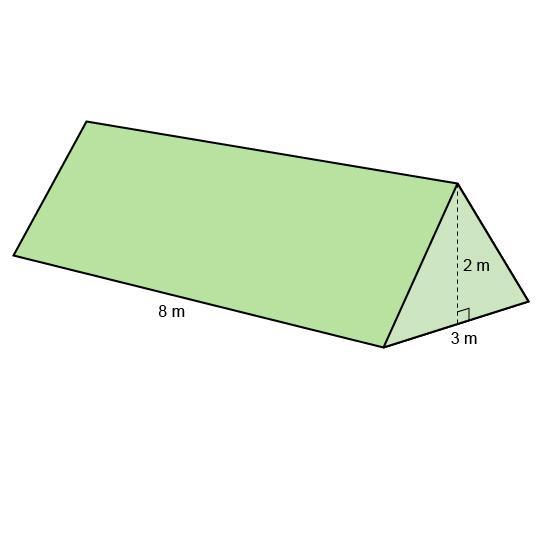
What is the volume of the triangular prism?
please help!! quickly its a test a look at the picture
7th grade math
Answers
The area of the triangle is:
A = (base•height) : 2 = (3•2) : 2 = 3 m2
So the volume is:
V = 3 • 8 = 24 m3
Suppose a system of 2 linear equations has one solution. What must be true about the graph of the 2 equations
Answers
Answer:
They are intersecting lines.
Step-by-step explanation:
Parallel lines do not intersect and have no common solution. The same line has infinite solutions with itself. Anything else must be intersecting lines.
Directions: Evaluate the following combinations and determine the value of the
unknown. Write the complete solutions in your answer sheet.
1. nCs = 126
2. 10Cr= 252
3. C(n, 5) + 8 = 9
4. C(n+1, 7) = 01
5. C(6r, 6-1) = 12 + C(4,2)
what is the answer with solution po

Answers
Answer:
1. C(9,4) : n=9, s=4
2. C(10,5) : r=5
3. C(5,5) : n=5
4. C(7,7) : n=6
5. C(18,17) : r=3
Step-by-step explanation:
Find the measure of the indicated angel.
A) 30 degrees
B) 35 degrees
C) 25 degrees
D) 40 degrees

Answers
Answer:
D
Step-by-step explanation:
44+32=76
180-76=104
104+36=140
180-140=40
D)40
What is the value of the expression 9 + (1/2) with a power of 4 • 48? A. 12 B. 15 C. 17 D. 18
Answers
Answer:
Option A
Step-by-step explanation:
Given the following question:
\(9+(\frac{1}{2})^4\times48\)
In order to find this, answer we use order of operations and solve.
\(9+(\frac{1}{2})^4\times48\)
\(\frac{1}{2} ^4=\frac{1}{2} \times\frac{1}{2} \times\frac{1}{2} \times\frac{1}{2} =\frac{1}{16}\)
\(9+\frac{1}{16} \times48\)
\(\frac{1}{16} \times48=\frac{1}{16}\times\frac{48}{1} =\frac{3}{1} =3\)
\(9+3\)
\(9+3=12\)
\(=12\)
Which means your answer is option A or "12."
Hope this helps.
plsss hurry Solve the application problem. Find the perimeter of a pantry shelf that measures 3 yards by 5/8 yard.
A. 1 7/8 yd
B. 7 1/4 yd^2
C. 1 7/8 yd^2
D. 7 1/4 yd
Answers
←
A plant engineer wishes to know which of two types of lightbulbs should be used to light a warehouse. The bulbs that
are currently used cost $46.90 per bulb and last 14,000 hours before burning out. The new bulb (at $57.5 per bulb)
provides the same amount of light and consumes the same amount of energy, but it lasts twice as long. The labor
cost to change a bulb is $15.00. The lights are on 20 hours a day, 365 days a year. (Assume that the firm's marginal
tax rate is 25%.) If the firm's MARR is 12%, what is the maximum price (per bulb) the engineer should be willing to
pay to switch to the new bulb? Round the service life of the old bulb to the nearest whole number.
Click the icon to view the interest factors for discrete compounding when i=12% per year.
The maximum price per new bulb the engineer should be willing to pay
More Info
1244-N
5
67898
10
Single Payment
Compound Present
Amount
Worth
Factor
(F/P, I, N)
1.1200
1.2544
1.4049
1.5735
1.7623
1.9738
2.2107
2.4760
2.7731
3.1058
Factor
(P/F, I, N)
0.8929
0.7972
0.7118
0.6355
0.5674
CI
0.5066
0.4523
0.4039
0.3606
0.3220
Compound
Amount
Factor
(FIA, I, N)
1.0000
2.1200
3.3744
4.7793
6.3528
8.1152
10.0890
12.2997
14.7757
17.5487
Equal Payment Series
Sinking
Fund
Factor
(A/F, I, N)
1.0000
0.4717
0.2963
0.2092
0.1574
0.1232
0.0991
0.0813
(Round to one decimal place.)
0.0677
0.0570
Present
Worth
Factor
(P/A, I, N)
0.8929
1.6901
2.4018
3.0373
3.6048
4.1114
4.5638
4.9676
5.3282
5.6502
Capital
Recovery
Factor
(A/P, I, N)
1.1200
0.5917
0.4163
0.3292
0.2774
0.2432
0.2191
0.2013
0.1877
0.1770
I
X
Answers
The most that an engineer should be ready to spend on new bulbs is The cost is P=$100.68.
What is a bulb?The term "electronic bulb" is also used to describe incandescent lamps, globes, and bulbs.A gadget that uses electricity to produce light is a light bulb. By passing current through a small wire known as a filament, light bulbs convert electrical energy into visible light. Tungsten, a substance that emits light when electricity is delivered through it, is typically used to make the filament.
How does a bulb function?The lightbulb is essentially a very thin filament of a difficult-to-melt metal, commonly tungsten, enclosed in a glass bulb filled with inert gases to prevent the filament from oxidising and disintegrating.
To know more about Bulb visit:
https://brainly.com/question/18554276
#SPJ1
When 1370 subjects were asked, "On how many days in the past 7 days have you felt lonely?" the mean was 1.5 and the standard deviation was 2.16. The margin of error for a 95% confidence interval for the population mean is 0.12. Construct that confidence interval, and interpret it. The confidence interval goes from nothing to nothing. (Round to two decimal places as needed.)
Answers
Answer:
Confidence Interval = (1.41, 1.59)
Step-by-step explanation:
To construct a confidence interval for the population mean, we can use the following formula:
Confidence Interval = sample mean ± (margin of error * standard error)
where the standard error is equal to the standard deviation divided by the square root of the sample size.
Given the information provided, we can calculate the standard error as:
standard error = 2.16 / sqrt(1370) = 0.058
Then, we can calculate the margin of error as 0.12.
Substituting these values into the formula, we get:
Confidence Interval = 1.5 ± (0.12 * 0.058)
Confidence Interval = (1.41, 1.59)
Therefore, we can interpret the 95% confidence interval as follows: we are 95% confident that the true population mean of the number of days that people feel lonely in the past 7 days is between 1.41 and 1.59. This means that if we were to take many samples of 1370 subjects and compute the confidence intervals for each sample using the same method, we would expect about 95% of the intervals to contain the true population mean.
Is this statement always true? Or sometimes true? Or
never true?
X-y is greater than x+y
Always
Sometimes or
Never
Answers
Answer:
Sometimes. Say x = 3 and y = 4. 3 + 4 = 7, 3 - 4 = -1. However, the subtraction problem can be greater than the addition if you add some negatives into the mix. Say x = 3 and y = -4. 3 + (-4) is the same as subtracting 4, which give you -1. However, when you subtract negative four, it's the same as adding four, which gives you seven.
X + X = X, what is the value of X?
Answers
Answer:
x = 0--------------------
Here is the solution:
x + x = x2x = x2x - x = 0x = 0Answer:
x = 0Step-by-step explanation:
\(x + x = x\)
Cancel x on both sides:-
\(x=0\)
-Hope this helps!
If 30% of (B-A)= 18% of (A+B), then the ratio A:B will be
Answers
Answer:
1:4
Step-by-step explanation:
30% of (B - A) = 18% of (A + B)
0.3(B - A) = 0.18(A + B) (converting percentages to decimals)
0.3B - 0.3A = 0.18A + 0.18B (distributing on both sides)
0.3B - 0.18B = 0.18A + 0.3A (grouping like terms)
0.12B = 0.48A
Simplifying further gives:
B/A = 0.48/0.12 = 4/1
Therefore, the ratio of A:B is 1:4.
Let's start by simplifying the given equation:
30% of (B-A) = 18% of (A+B)
0.3(B-A) = 0.18(A+B)
0.3B - 0.3A = 0.18A + 0.18B
0.12B = 0.48A
B = 4A
Now we know that B is 4 times A.
To find the ratio A:B, we can express B in terms of A:
B = 4A
A:B = A/4A = 1/4
Therefore, the ratio A:B is 1:4.
what is the raito 40 to 18
Answers
Answer:
20:9
Step-by-step explanation:
Here we will simplify the ratio to 40:18 for you and show you how we did it.
To simplify the ratio 40:18, we find the greatest common divisor of 40 and 18, and then we divide 40 and 18 by the greatest common divisor.
The greatest common divisor that you can use to simplify 40:18 is 2. This means the answer to ratio 40:18 simplified is:
20:9
0.006772 to 1 significant number
Answers
Answer:
0.006772
If the last dropping digit is less than 5 then it will be ignored
0.00677
if the last dropping digit is greater than 5 than the the last retained digit increases by 1
0.0068
if the last dropping digit is greater than 5 than the the last retained digit increases by 1
0.007
if the last dropping digit is greater than 5 than the the last retained digit increases by 1
0.01
if the last digit is less than 5 so it will be ignored
0.0 is significant figure because zero to the right of decimal point are significant
Step-by-step explanation:
i hope this will help you :)
Answer:
0.007
Step-by-step explanation:
Rounding off 0.006772 to 1 significant figures:
=> 0.007
There is only 1 significant figure in this , since the zeroes on the left are not counted as significant figures.
Write a fraction that has a value greater than 3/8 using 3 as the numerator
Answers
Answer: 3/4
Step-by-step explanation:
Any number as the denominator of the fraction that is less than 8 (the denominator) will give you a fraction greater than 3/8.
Another different answer could be 3/5 or 3/6.
A fraction that has a value greater than 3/8 using 3 as the numerator is 3/6, 3/4, 3/2 and so on.
What is the fraction?In Mathematics, fractions are represented as a numerical value, which defines a part of a whole. A fraction can be a portion or section of any quantity out of a whole, where the whole can be any number, a specific value, or a thing.
The given fraction is 3/8.
Here, 3/8 = 0.375
We need write the fraction which is greater than 3/8 using 3 as the numerator is 3/6 = 0.5
Therefore, a fraction that has a value greater than 3/8 using 3 as the numerator is 3/6, 3/4, 3/2 and so on.
To learn more about the fraction visit:
brainly.com/question/1301963.
#SPJ2
how does 9+10 equal 21?
Answers
9 + 10 does not equal 21.
If you add 9 and 10, you will get 19.
If you are referring to the meme, ok.
The required, left side of the expression 9 + 10 does not equal the right side expression 21.
The correct sum of 9 + 10 is 19. The statement "9 + 10 equals 21" is given by:
Consider the left side of the expression:
= 9 + 10
= 19
Where the right-hand side of the expression is 21, which implies
The left-hand side is not equal to the right-hand side.
However, mathematically, the sum is indeed 19.
Learn more about expression here:
https://brainly.com/question/31166009
#SPJ6
HELP! Evaluate the line integral where C is given by the vector function r(t).

Answers
Applying the steps, the result of the line integral is 99.
The curve is:
\(f(x,y,z) = xy i + 9y^2 j\)
The vector field is:
\(r(t) = (x(t), y(t)) = (16t^6, t^4)\)
Applying the vector field at the curve, we have that:
\(f(t) = (16t^{10}, 9t^8)\)
The derivative of the vector field is:
\(r^{\prime}(t) = (96t^5, 4t^3)\)
The dot product of the vector field along the curve with the derivative is:
\(f(t)r^{\prime}(t) = (16t^{10}, 9t^8)(96t^5, 4t^3) = 1536t^{15} + 36t^{11}\)
Hence, the line integral is:
\(I = \int_{0}^{1} (1536t^{15} + 36t^{11}) dt\)
\(I = 96t^{16} + 3t^{12}|_{t = 0}^{t = 1}\)
\(I = 96 + 3\)
\(I = 99\)
A similar problem is given at https://brainly.com/question/12666512
How do I subtract decimals from whole numbers?
Answers
Answer:
Just use long subtraction by expanding the decimal places of the whole number. This is done by adding a point, and enough zeros to it to match the number of decimal digits in the other number (digits after the decimal point).
12345678
i.e: 5 - 2.48374827, 2.48374827 has 8 decimal digits, so add 8 zeros after the point.
=
1 1 1 1 1 1 1
5.00000000
-
2.48374827
_______________
2.51625173
7 + 3 = 10, 7 + 2 + 1 = 10, 8 + 1 + 1= 10, 5 + 4 + 1 = 10, 2 + 7 + 1 = 10, 3 + 6 + 1 = 10, 1 + 8 + 1 = 10, 5 + 4 + 1 = 10, 2 + 2 + 1 = 5 : 5.00000000
This is basically borrowing a group of 10s which are the same as 1s in the next decimal place up.
For each digit except the first to the right, let 10 subtract that number from it and minus 1 since the 1 is carried over.
i need help asap
than you!

Answers
The highest height for the daily rainfall were for 5 and 6 inches
How to Interpret Dot Plots?Dot plots are used to present data in the form of points or small circles. It is similar to a simplified histogram or bar graph in that the height of the bar made up of points represents the numerical value of each variable. Dot plots are used to represent small amounts of data.
From the given dot plot, we see the number of times for each height of rainfall.
Thus, we see that the highest number of times of rainfall height was from that of 5 and 6 inches.
Thus, we conclude those were the highest heights for the daily rainfall.
Read more about Dot plots at: https://brainly.com/question/24309209
#SPJ1
PLS HELP! Question- The two figures shown below are similar. What is the value of x?

Answers
From the properties of similarity, the value of x is 24.
What is similarity of shapes?Euclidean geometry states that two objects are comparable if they have the same shape or the same shape as each other's mirror image. More specifically, by uniformly scaling (enlarging or decreasing), maybe with additional translation, rotation, and reflection, one can be created from the other. This indicates that one object may be properly aligned with the other object by rescaling, moving, and reflecting it. When two things are comparable to one another, one is consistent with the outcome of a specific uniform scaling of the other.
By comparing corresponding sides of the shapes, we get that
6/9 = 14/21 = 2/3
So that,
16/x =2/3
multiply both sides by 3/2 we get,
(16/x)*(3/2) = 1
multiply both sides by x we get,
16*3/2 = x
⇒ x = 48/2
⇒ x = 24
To learn more about similarity visit:
brainly.com/question/13831330
#SPJ1
If brownies are $1.80 each how much is that for 10 brownies
Answers
Answer:
18 just move the decimal because there is one zero
In a right triangle, sin (x + 10)° = cos (4x - 4)°. Solve for x. Round your answer
to the nearest hundredth if necessary.
Answers
The value of variable x is,
⇒ x = 42
We have to given that;
In a right triangle,
⇒ sin (x + 10)° = cos (4x - 4)°
Now, We can simplify as;
⇒ sin (x + 10)° = cos (4x - 4)°
⇒ cos (90 - (x + 10))° = cos (x - 4)°
⇒ 90 - (x + 10) = x - 4
⇒ 90 - x - 10 = x - 4
⇒ 80 + 4 = 2x
⇒ 2x = 84
⇒ x = 42
Thus, The value of variable x is,
⇒ x = 42
Learn more about the triangle visit;
brainly.com/question/1058720
#SPJ1
Does the ordered pair (1,1) satisfy the following system of inequalities? {x−8y≤9−7x+5y<4
Answers
Answer:
YESStep-by-step explanation:
Substitute x = 1 and y = 1 to the both inequalities:
\(x-8y\leq9\\\\1-8(1)\leq9\\1-8\leq9\\-7\leq9\qquad\bold{TRUE}\\==================\\-7x+5y<4\\\\-7(1)+5(1)<4\\-7+5<4\\-2<4\qquad\bold{TRUE}\)
Answer:
(1,1) does satisfy
x - 8y ≤ 9
- 7x + 5y < 4
Step-by-step explanation:
Well, first we need to plug in (1,1) into,
x - 8y ≤ 9
- 7x + 5y < 4
→ 1 - 8(1) ≤ 9
- 7(1) + 5(1) < 4
1 - 8 ≤ 9
-7 + 5 < 4
-7 ≤ 9
-2 < 4
Thus,
(1,1) does satisfy
x - 8y ≤ 9
- 7x + 5y < 4.
Hope this helps :)
7. Which of the following is NOT a subset of {1,3,5,6,7,8,9,12}? A) {1,3,8} B) <1.4,6,7,8} C) <12} D) {1,3,5,6,7,8, 12} 8. Which of the following is NOT a subset of all the even integers? A) {2,4,8} B) <4,10,12,16,18} C) (2,8,9,12, 18} D) (100,102,1008,2012) True or False 9. {3,4,8} C{1,2,3,4,5,6} 10. {1,3,5,7} is a subset of all positive integers 11. The counting numbers is a subset of the whole numbers. 12. The set of all whole numbers is a subset of the natural numbers. 13. {-2,0,1,3,8}C of all whole numbers For each of the following questions, graph the sets on the number line to the right and, if A £ B, state one value of A that is NOT found in B. Place either C or & in the blank. Graph Element of A not in B (if applicable) Sets 14. A = {x I x < 8} B = {x I x < 12} B A 15. A = {x 1 -2 3} A B 16.A = (x12 B = (xIx>1} A B 17. A = {x | 3
Answers
7. B <1.4,6,7,8} is NOT a subset of {1,3,5,6,7,8,9,12}.
8. C (2,8,9,12,18} is NOT a subset of all the even integers.
9. C
10. True
11. True
12. True
13. C
14. The sets A = {x I x < 8} and B = {x I x < 12} are subsets of each other.
15. C
16. C
17. C
What is subset?A subset is a group of objects, elements, or values taken from a larger set. Subsets are typically used to define specific characteristics or qualities of the larger set. For example, a subset of numbers might include only the even numbers from 1 to 10.
7. B <1.4,6,7,8} is NOT a subset of {1,3,5,6,7,8,9,12}.
A subset is a collection of elements that are part of a larger set. In this case, the larger set is {1,3,5,6,7,8,9,12}. B <1.4,6,7,8} is not a subset of this larger set because it includes an element, 1.4, that is not found in the larger set.
8. C (2,8,9,12,18} is NOT a subset of all the even integers.
A subset is a collection of elements that are part of a larger set. In this case, the larger set is all the even integers. C (2,8,9,12,18} is not a subset of all the even integers because it includes an element, 9, that is not even.
9. C
The sets {3,4,8} and {1,2,3,4,5,6} are not subsets of each other. The set {3,4,8} is not a subset of {1,2,3,4,5,6} because it includes an element, 8, that is not found in the larger set.
10. True
The set {1,3,5,7} is a subset of all positive integers. A subset is a collection of elements that are part of a larger set. In this case, the larger set is all positive integers. The set {1,3,5,7} is a subset of this larger set because all of its elements, 1, 3, 5, and 7, are found in the larger set.
11. True
The counting numbers is a subset of the whole numbers. A subset is a collection of elements that are part of a larger set. In this case, the larger set is the whole numbers. The counting numbers is a subset of this larger set because all of its elements, 1, 2, 3, 4, and so on, are found in the larger set.
12. True
The set of all whole numbers is a subset of the natural numbers. A subset is a collection of elements that are part of a larger set. In this case, the larger set is the natural numbers. The set of all whole numbers is a subset of this larger set because all of its elements, 0, 1, 2, 3, 4, and so on, are found in the larger set.
13. C
The sets {-2,0,1,3,8} and all whole numbers are not subsets of each other. The set {-2,0,1,3,8} is not a subset of all whole numbers because it includes an element, -2, that is not found in the larger set.
14. The sets A = {x I x < 8} and B = {x I x < 12} are subsets of each other. The set A is a subset of B because all of its elements, x < 8, are found in the larger set. One element of A that is not found in B is 7.
15. C
The sets A = {x I -2 3} and B are not subsets of each other. The set A is not a subset of B because it includes an element, -2, that is not found in the larger set.
16. C
The sets A = (xIx12 and B = (xIx>1} are not subsets of each other. The set A is not a subset of B because it includes an element, 12, that is not found in the larger set.
17. C
The sets A = {x | 3x + 6 < 0} and B = {x I x < 0} are not subsets of each other. The set A is not a subset of B because it includes an element, -2, that is not found in the larger set.
For more questions related to integers
brainly.com/question/26009132
#SPJ1
PLS HELP ASAP !!!!!!!!!!!!!!!!!!!!!!!!!!!!!!!!!!!!!!!!!!!!!!!!!!

Answers
I need help alot of help

Answers
Take 8.50 times 1.80
Which of the following is not a rational number? (Select all that apply.)
6.725
0.0625
2.713
0.65
Answers
Answer:
Step-by-step explanation:
All of them are rational.
Irrational numbers go on forever, like 10/3=3.33333333...
Pi is an irrational number because it goes on forever.
Is 7-¹ a negative number? Explain.
Answers
Answer:
No
Step-by-step explanation:
\(7^{-1}\) is a fraction
using the rule of exponents
• \(a^{-m}\) = \(\frac{1}{a^{m} }\)
then
\(7^{-1}\) = \(\frac{1}{7^{1} }\) = \(\frac{1}{7}\) ← that is a fraction