
Answers
f = 4t +48
f = t + 282
f = t+282
t+282= 4t+48
282-48=4t-t
234=3t
t=234/3
t=78
f=282+t
f=282+78
f=360
answer f=360 t=78
Related Questions
A quadrilateral that has its opposite sides equal and its angles, not a 90 is called:
a. deltoid
b. parallelogram
c. rectangle
d. square
e. trapezoid
Answers
EXPLANATION: It is saying that the angles are not 90 degrees, while all the options angles would be 90 except the parallelogram because it is a slanted rectangle/square.
I am currently 13 times as old as my granddaughter. Next year, I will be 11 times as old as my granddaughter. How old am I now?
Answers
Answer:
65 years old.
Step-by-step explanation:
Define the variables:
Let x be the age of the granddaughter.Let y be the age of the grandparent.Given:
I am currently 13 times as old as my granddaughter. Next year, I will be 11 times as old as my granddaughter.Create two equations with the given information and defined variables:
\(\begin{cases}y = 13x\\y + 1 = 11(x + 1)\end{cases}\)
Substitute the first equation into the second equation and solve for x:
\(\implies 13x+1=11(x+1)\)
\(\implies 13x+1=11x+11\)
\(\implies 2x=10\)
\(\implies x=5\)
Substitute the found value of x into the first equation and solve for y:
\(\implies y=13(5)\)
\(\implies y=65\)
Therefore, the age of the grandparent now is 65 years.
Given statements:
I am currently 13 times as old as my granddaughter. Next year, I will be 11 times as old as my granddaughter.Let us represent the character's age by variables. Assuming that the grandparent's age is G and the granddaughter's age is D. Now, using the obtained variables and the statements, create two equations that represents the provided statements. Then, we can compare the equations and simplify if needed to determine the value of the variables.
\(\implies \left[\begin{array}{ccc} \text{G = 13D} \\ \text{G + 1 = 11(D + 1)}\\\end{array}\right]\)
Since G = 13D is in the form of direct variation, we can substitute the value of G into the second equation to determine the value of D (the age of the granddaughter). Then, we can substitute the value of D into any of the two equations to determine the age of the grandparent.
⇒ G + 1 = 11(D + 1)⇒ G + 1 = 11(D + 1) [G = 13D]⇒ 13D + 1 = 11(D + 1)To solve for D, simplify both sides of the equation by using the distributive property. We need to simplify both sides of the equation so that we can isolate the variables on the other side of the equation.
⇒ 13D + 1 = 11(D + 1)⇒ 13D + 1 = 11D + 11Isolate the variables on one side. This step is necessary because it can cancel out the extra variable and simplify the other variable. To do this, you can either add or subtract on both sides of the equation.
Note: I am subtracting 11D on both sides of the equation since it is my preference. But you can also subtract 13D on both sides of the equation.
⇒ 13D + 1 - 11D = 11D + 11 - 11D⇒ 1 + 2D = 11To further isolate 2D, we need to subtract 1 on both sides of the equation to cancel out the 1 on the left-hand side of the equation. Then, we have:
⇒ 1 + 2D - 1 = 11 - 1⇒ 2D = 10But the variable is still not completely isolated since there is a coefficient being multiplied to D. To isolate the coefficient from the variable, we will need to divide the coefficient (2) on both sides of the equation.
⇒ 2D = 10⇒ 2D/2 = 10/2Then, simplify both sides of the equation. Eventually, we will have a variable on one side and a numerical value on the other side.
⇒ 2D/2 = 10/2⇒ D = 5Now we know the age of the granddaughter, we can substitute the age of the granddaughter into one of the equations and simplify it to determine the age of the grandparent. I am going to choose G = 13D since it is easier to simplify. Then, we will substitute the value of D into the equation.
⇒ G = 13D ⇒ G = 13(5)⇒ G = 65 yearsTherefore, the age of the grandparent is 65 years.
andy spent half her allowance going to the movies. She washed the family car and earned $8. What is her weekly allowance if she ended with $17?
Answers
Answer:
i think it would be 18 dollars not entirely sure tho.
Step-by-step explanation:
if she ended with 17 and 8 of those dollars were bc of her washing her family car. u would subtract 17-8 which is 9 dollars.but she also spent half of her money before that. so u would add another 9 dollars. so ur answer would be 18 dollars.
hope this is right...
Answer:
It 9
Step-by-step explanation:
3.47x 10 to the power of 4
Answers
Please help and thank you. I forgot the formulas sorry.
Use a net to find the surface area. The area of the right triangular prism is [blank] cm2.

Answers
Answer: The answer is 255 cm2
Step-by-step explanation:
So we are looking for the area of the right triangular prism. We first must start of by observing the lengths of each side. Once you have found out what is what multiply in order. First 12 x 5 = 60. Then multiply 13 x 15 which equals = 195. Finally you want to ad up the sums together to get 255 cm2.
To find more questions by me, click on my profile to view everyone I have helped. I hoped this could help you and have a fantastic day and grade : )
At a pet store, Eric paid $11.50 for 3 dog bowls and 4 bones. Kelsie paid $13 for 2
dog bowls and 8 bones. What is the cost of each item?
Answers
Answer: $ 8.75
Step-by-step explanation:
Can someone help me and tell me what this is I dont get it

Answers
Answer:
of the First rectangle Is smaller than the second the factor Is greater than One , if the First and the second are the same the scale factor Is one, and of the First Is bigger than the second the factor Is less than one
so:
a greater
b greater
c less
D greater
e equal
f less
g equal
Answers in bold:
P to Q: greater than 1P to R: greater than 1Q to S: less than 1Q to R: greater than 1S to P: equal to 1R to P: less than 1P to S: equal to 1========================================================
Explanation:
We have these three rules for scale factors
scale factor > 1, enlarge the image0 < scale factor < 1, shrink the imagescale factor = 1, the preimage and image are identicalWith those rules in mind, we have enlargements for these transformations.
P to QP to RQ to RAll of which represent some scale factor larger than 1. We don't have enough information to pinpoint what that scale factor would be.
In other words, if you go from small to big, then you apply some scale factor larger than 1 to enlarge the image.
----------------
We also have these reductions
Q to SR to PThis is where we go from big to small. The image shrinks and we use some scale factor between 0 and 1.
----------------
And finally we have these transformations in which the size of the image does not change. Therefore the scale factor is 1.
P to SS to PThe order doesn't matter for this subset, but the order will matter for the other batches of transformations.
7 kilometers - 2,000 meters (put your answer in kilometers)
Answers
Answer:
Conversion factor: 7 km = 2000m
1) Kilometer = Meter = 1000
2) Kilometer = 7000 – 2000
3) Kilometer = 5
#Hope it helps!!
1 kilometer is 1,000 meters, so 7 kilometers is 7,000 meters. 7,000-2,000=5,000 meters. Then move the decimal point to the left 3 times, to convert it back to kilometers. 5 kilometers.
An alternative is to make the meters into kilometers beforehand. So move the decimal point in 2,000 meters three times to the left to get 2 kilometers. Then subtract 2 kilometers from 7 kilometers to get 5 kilometers.
Explain why each non-zero integer has two square roots but only one cube root.
Answers
BRAINIEST PLEASE
1.
(06.01 MC)
The scatter plot shows the relationship between the test scores of a group of students and the number of hours they play computer games in a week:
On a grid, Label Hours Playing Computer Games on x axis and Test Scores on y axis. The title of the graph is Test Scores and Computer Games. The scale on the x axis shows the numbers from 0 to 10 at increments of 1, and the scale on the y axis shows numbers from 0 to 100 at increments of 10. Dots are made at the ordered pairs 0, 90 and 0, 100 and 0.5, 89 and 1, 81 and 1, 95 and 1, 100 and 1.1, 85 and 2, 90 and 3, 81 and 3.5, 65 and 3.5, 75 and 5, 70 and 6, 55 and 6.5, 65 and 7, 52 and 7.5, 95 and 9, 65. The ordered pair 7.5, 95 is circled and labeled as B. All the other points are put in an oval and labeled as A.
Part A: What is the group of points labeled A called? What is the point labeled B called? Give a possible reason for the presence of point B. (5 points)
Part B: Describe the association between students' test scores and the number of hours they play computer games. (5 points)
Answers
Answer:
Part AGroup A is a cluster of points with similar property or relationship.
Point B is an outlier. This is the point outside of the common relationship.Part BThere is a negative tendency. As number of hours spent on computer games increase, the test scores decrease.
Step-by-step explanation:
Part B There is a negative tendency. As number of hours spent on computer games increase, the test scores decrease.
step by step=
Simon used mixed nuts and other ingredients to make 5 cups of trail mix. The chart below shows the nutritional facts for mixed nuts.
Nutritional Facts
Mixed Nuts (without salt)
1 oz
Calories
124.5
Fat
10.5 g
Carbohydrates
5.25 g
Sodium
2.25 mg
Which is the best method to find the amount of carbohydrates in 3 ounces of mixed nuts?
multiply 3 times 5.25
divide 5.25 by 5
multiply 5 times 5.25
divide 5.25 by 3
the cart is in the pic

Answers
Answer:
Multiply 3 times 5.25
Step-by-step explanation:
The board shows how much carbohydrates are in 1 Oz
If we want to find how much there is in 3 Oz we would have to follow these steps:
1: Take the amount of carbohydrates in 1 Oz
2: Multiply it by 3.
Answer: A. Multiple 3 times 5.25
helpppppp pleaseeee
middle school math hw

Answers
Answer:
Simplifying the expression, the answer would be \(81u^1^2v^8\).
Process:
Basically, you just need to multiply the power on the outside with the powers on the inside of the parenthesis. Then, for the base take -3 to the fourth power which will lead you to your final answer \(81u^1^2v^8\).
how does factoring relate to determining whether expressions are equivalent?
Answers
Answer:
Two expressions are equivalent if they can be simplified to the same third expression or if one of the expressions can be written like the other. In addition, you can also determine if two expressions are equivalent when values are substituted in for the variable and both arrive at the same answer.
what is the sulution to this equation 3(d+2)-12=d-2
Answers
Answer:
d = 2
Step-by-step explanation:

Step by step explain:
x-12-23+7.5=1 ; what is the value of x?
Answers
Answer:
X=28.5
Step-by-step explanation:
Hope this helps!
Answer:
x=28.5
Step-by-step explanation:
x=1+12+23-7,5
x=13+23-7,5
x=36-7,5
x=28,5
:))
Hey there! My second question, how do you find the mean with a variable? I know how to find a normal one, but I haven't practiced much this way yet. Thank you! <3

Answers
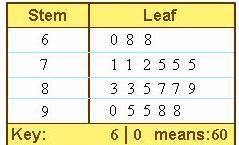
HELP this stem and leaf plot represents test scores of students in a math class if two test score 68 and 75 are added to the data which statement will be true
Answers
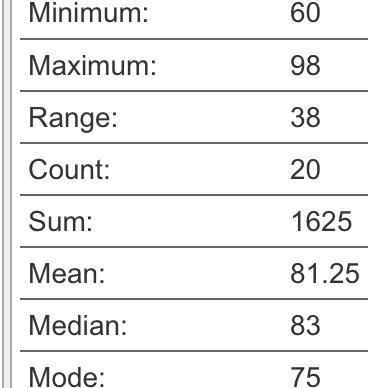
First you would need to find the median, mode, and range.
60 68 68 71 71 72 75 75 75 83 83 85 87 87 89 90 95 95 98 98
due to no answer choices, I am going to show you the basics of the plot before the 2 scores are added.
Answer:
Option A) The Median will change; the mode will stay the same
Step-by-step explanation:
Just did the Test on T4L and got it right :) Hope this helped (Pls mark me as brainliest)
The stem-and-leaf plot displays data collected on the size of 15 classes at two different schools.
Mountain View School Seaside School
0 5, 8
9, 8, 2, 0 1 0, 1, 2, 5, 6, 8
8, 7, 6, 5, 5, 4, 4, 3, 1, 0 2 5, 5, 7, 7, 8
0 3 0, 6
Key: 2 | 1 | 0 means 12 for Mountain View and 10 for Seaside
Part A: Calculate the measures of center. Show all work. (2 points)
Part B: Calculate the measures of variability. Show all work. (1 point)
Part C: If you are interested in a smaller class size, which school is a better choice for you? Explain your reasoning. (1 point)
Answers
For Mountain View School:
Data: 0, 0, 0, 0, 1, 2, 3, 4, 4, 5, 5, 5, 5, 6, 7, 8, 8, 8, 9
Mean: (0 + 0 + 0 + 0 + 1 + 2 + 3 + 4 + 4 + 5 + 5 + 5 + 5 + 6 + 7 + 8 + 8 + 8 + 9) / 19
= 100 / 19
≈ 5.26
To find the median, we need to arrange the data in ascending order: 0, 0, 0, 0, 1, 2, 3, 4, 4, 5, 5, 5, 5, 6, 7, 8, 8, 8, 9.
The median is the middle value, which is the 10th value in this case.
Median: 5
For Seaside School:
Data: 0, 0, 0, 1, 1, 2, 2, 4, 5, 5, 5, 5, 6, 7, 7, 8, 8, 8, 9
Mean: (0 + 0 + 0 + 1 + 1 + 2 + 2 + 4 + 5 + 5 + 5 + 5 + 6 + 7 + 7 + 8 + 8 + 8 + 9) / 19
= 80 / 19
≈ 4.21
To find the median, we need to arrange the data in ascending order: 0, 0, 0, 1, 1, 2, 2, 4, 5, 5, 5, 5, 6, 7, 7, 8, 8, 8, 9.
The median is the middle value, which is the 10th value in this case.
Median: 5
Now let's calculate the measures of variability, specifically the range and interquartile range (IQR).
Range: The range is the difference between the largest and smallest values in the dataset.
For Mountain View School:
Range: 9 - 0 = 9
For Seaside School:
Range: 9 - 0 = 9
Interquartile Range (IQR): The IQR is the difference between the third quartile (Q3) and the first quartile (Q1) and measures the spread of the middle 50% of the data.
For Mountain View School:
Q1 = 3
Q3 = 7
IQR = Q3 - Q1 = 7 - 3 = 4
For Seaside School:
Q1 = 2
Q3 = 7
IQR = Q3 - Q1 = 7 - 2 = 5
To determine which school is a better choice for a smaller class size, we can consider both the mean and the median.
Both the mean and median for Mountain View School are higher than those for Seaside School. This suggests that, on average, the class sizes at Mountain View School are larger than those at Seaside School. Therefore, if you are interested in a smaller class size, Seaside School would be a better choice
For Mountain View School:
- Median: The median class size is the middle value, which is 25.
- Mean: The mean class size is the sum of all the class sizes divided by the total number of classes, which is (29 + 28 + 28 + 27 + 25 + 24 + 24 + 23 + 21 + 20 + 19 + 18 + 15 + 13 + 10) / 15 = 21.27.
For Seaside School:
- Median: The median class size is the middle value, which is 20.
- Mean: The mean class size is the sum of all the class sizes divided by the total number of classes, which is (25 + 25 + 27 + 27 + 28 + 28 + 28 + 30 + 31 + 35 + 36 + 38 + 40 + 43 + 45) / 15 = 31.13.
Part B:
For Mountain View School:
- Range: The range is the difference between the largest and smallest values, which is 29 - 10 = 19.
- Interquartile Range (IQR): The IQR is the difference between the third quartile (Q3) and the first quartile (Q1). From the stem-and-leaf plot, we can see that Q1 is 20 and Q3 is 28. Therefore, the IQR is 28 - 20 = 8.
For Seaside School:
- Range: The range is the difference between the largest and smallest values, which is 45 - 25 = 20.
- Interquartile Range (IQR): The IQR is the difference between the third quartile (Q3) and the first quartile (Q1). From the stem-and-leaf plot, we can see that Q1 is 27 and Q3 is 38. Therefore, the IQR is 38 - 27 = 11.
Part C:
If you are interested in a smaller class size, Mountain View School is a better choice for you because it has a lower mean and median class size than Seaside School.
Help me plssss!!!!! I will give brainlist point!


Answers
HELP ASAP 80 POINTS (AND NOOOO LINKS OR DOWNLOADS)
Write an inequality of the form Ax + B ≤ C to represent the word problem using your answers for A, B, and C. Solve the inequality and show your work.
4. Graph the solution to your inequality on a number line or describe, in words, how to graph the inequality on a number line.
5. Explain what the solution means in the context of the word problem.
Answers
Answer:
Subtract 2 from both of the sides
Step-by-step explanation:
The height of a building is proportional to the number of floors. If the building is 135 ft with 9 floors, how many floors does this build have? How tall would the building be if it had 15 floors?
Answers
135/9= 15
This would mean that every floor is worth 15 ft
So, multiply 15 by 15 and you get 225
By this judgement, the building would be 225 ft if it had 15 floors.
I hope this helps!
Which of the following equations are true for the number 9?
A. 4 □ = 9/4
B. 1/9 = □ ÷ 9
C. 7 ÷ □ = 7/9
D. □ ÷ 1/9 = 81
("□" means 9)
Answers
Answer:
C and D
Step-by-step explanation:
(1/6) to the 2nd power
Answers
Answer:
0.0277777778
Step-by-step explanation:
\(\frac{1}{6} ^{2}\)
\(\frac{1}{6}\) × \(\frac{1}{6}\) = 0.0277777778
The answer is 0.02777777777
The sevens just keep going
Just put a line right beside the last 7 so show it's infinte
What possible transforms are shown below?
A reflection in the y-axis
A translation 4 units to the left
A rotation of 90°
A reflection in the x-axis

Answers
Can someone figre this one out for me too plss with work shown and explanation NO LINKS AND NO DOING IT JUST FOR POINTS will give brainliest

Answers
Answer:
3 right and 1 up
Step-by-step explanation:
hope this helps!
Answer:
Figure ABCD is translated 3 unit(s) right and 1 unit(s) up.
Step-by-step explanation:
Lets take the point C from the original figure and watch how it translates to it's prime point C' on the other figure. Start at point C and see how many units does it move right until it aligns with the point C', then from there how many points do you need to go up to reach exactly on the point C'. If done correctly, the answer would be: 3 units to the right and 1 unit up
Hope this helps, Good Luck!
A retirement community has a sign at its main entrance that says "Residents over the age of 55 welcome." Which of the following inequalities best represents the age of residents welcome in the retirement community?
a) z > 55
b) z < 55
c) z ≥ 55
d) z ≤ 55
Answers
c) z ≥ 55
This inequality states that the age 'z' should be greater than or equal to 55.
-3/4 x 2/5 = Simplify response
Answers
−3/10
Decimal Form:
−0.3
write the equation for this line

Answers
Answer:
y = 4x + 3
Step-by-step explanation:
Chung-Li is making cupcakes. He made the table below showing the amount of each ingredient needed for a certain number of cupcakes. Chung-Li plotted the data using the number of slices of strawberry as the x-coordinate and the number of slices of banana as the y-coordinate. He then drew a line to connect the points. Which point could be on the line that Chung-Li drew?

Answers
Answer:
C. (2,3)
Step-by-step explanation:
4 to 6 = 2 to 3
A Ferris wheel has an area of 50 square meters. Find
the radius of the Ferris wheel to the nearest meters.
Round the answer to the nearest whole meter.
Answers
Answer:
19.7 m
Step-by-step explanation:
Draw a circle to represent the ferris wheel with a 10.2 m radius. Draw a horizontal line through the circle center horizontal to the ground (at 13.1 m). Now draw a line from the center of the circle (ferris wheel) upward at 140 degrees until you reach the edge of the circle. Draw a line down from that point to the horizontal line at This is your right triangle to solve.
Hypotenuse is 10.2 m (radius of circle)
The angle of the triangle the supplementary angle of 140 degrees. 180-140=40 degrees
sin 40 degrees=rise /radius=rise/10.2
sin 40=0.6428=rise/10.2
rise=10.2(0.6428)
rise=6.6 m
13.1+6.6=19.7 m
The radius of the Ferris wheel to the nearest meters will be 4 meters.
What is the area of the circle?It is the close curve of an equidistant point drawn from the centre. The radius of a circle is the distance between the centre and the circumference.
Let r be the radius of the circle. Then the area of the circle will be
A = πr² square units
A Ferris wheel has an area of 50 square meters. Then the radius is calculated as,
πr² = 50
r² = 15.915
r = 3.989
r ≈ 4 meters
The radius of the Ferris wheel to the nearest meters will be 4 meters.
More about the area of a circle link is given below.
https://brainly.com/question/11952845
#SPJ3