Now, let us convert a machine code to a MIPS instruction. Locate address 0x00400010 from the Text
Segment window.
a. What is the machine code at this address in hex? Convert this code into binary.
b. From the binary version of this machine code. What is the instruction type? How can you tell? How
many fields are there in this instruction type? What are the names of these fields?
c. According to the binary machine code, what is the value of each field in hex?
d. Refer to the MIPS sheet, what operation is this instruction? How can you tell? What is the mapping
of the registers being used in this instruction?
e. What is the final MIPS instruction? Is it the same as the Source Column in the Text Segment
window?
Answers
The final MIPS instruction is lw $0, 0($4). This is the same as the Source Column in the Text Segment window. To answer this question, we should first locate the address 0x00400010 in the Text Segment window, which will show you the machine code at this address in hexadecimal format.
a. Next, convert this hexadecimal code to binary.
b. After obtaining the binary version of the machine code, you need to determine the instruction type by examining the opcode (the first 6 bits of the binary code). Based on the opcode, you can identify whether it is an R-type, I-type, or J-type instruction. The number of fields and their names differ for each instruction type:
- R-type: 6 fields (opcode, rs, rt, rd, shamt, funct)
- I-type: 4 fields (opcode, rs, rt, immediate)
- J-type: 2 fields (opcode, address)
c. To find the value of each field in hexadecimal, first identify the binary bits corresponding to each field based on the instruction type determined in step b. Then, convert each field from binary to hexadecimal.
d. To identify the operation and mapping of the registers, refer to the MIPS reference sheet. Match the opcode and (if applicable) the funct code to the corresponding operation. For R-type instructions, also identify the source registers (rs, rt) and the destination register (rd). For I-type instructions, identify the source register (rs), the target register (rt), and the immediate value. For J-type instructions, there is no register mapping.
e. The final MIPS instruction can be determined by combining the operation and register mappings obtained in step d. Compare this instruction to the one in the Source Column of the Text Segment window to verify if they are the same.
a. The machine code at address 0x00400010 in hex is 0x8fa40000. Converting this to binary gives us 10001111101001000000000000000000.
b. From the binary version of the machine code, we can see that this is an I-type instruction. We can tell because the first six digits (100011) correspond to the opcode for an I-type instruction. There are three fields in this instruction type: opcode, rs, and immediate.
c. The value of each field in hex is opcode (0x8), rs (0x14), and immediate (0x0).
d. According to the MIPS sheet, this instruction is an lw (load word) operation. We can tell because the opcode (0x8) corresponds to lw on the sheet. The mapping of registers being used in this instruction is: $4 (rs) and $0 (rt) are being used, and the immediate value (0x0) is being added to the value in $4 to get the memory address to load from.
e. The final MIPS instruction is lw $0, 0($4). This is the same as the Source Column in the Text Segment window.
Learn more about hexadecimal here: brainly.com/question/28875438
#SPJ11
Related Questions
Jamal groups 8 blocks as 5 blocks and 3 blocks What is another way to group the 8 blocks
Answers
Answer:
1 block and 7 blocks
Step-by-step explanation:
You can split 8 blocks into 1 and 7.
Hope this helps :)
Which interval or union of intervals represents the values for which f(x) is ≤ 0? Select the correct choice below and fill in the answer boxes to complete your choice.


Answers
Answer:
(-∞, -1]∪{5}
Step-by-step explanation:
We know that:
f(x) ≤ 0 is true if the graph of the function is intersecting the x-axis or below the x-axis.
So we can just look at the graph, we can see that in the interval:
(-∞, -1] (the value x = -1 is included, that is why we use the symbol ] instead of the parenthesis)
the graph is below or intersecting the x-axis
and this also happens at x = 5 or just denoted as {5}
Then the correct notation is:
(-∞, -1]∪{5}
How is this answer 30 m<1 if m<CUB = 78
Answers
Answer: I'm sorry, but it seems there is a mistake in the previous answer. If m < CUB = 78, then m < 78 and not 30 m < 1. This calculation is not making sense with the information given.
Step-by-step explanation:
A 40-year-old person who wants to retire at age 60 starts a yearty retirement contribution in the amount of $6,000. The retirement account is forecasted to average a 5% annual
rate of retum, ylelding a total balance of $198,395.72 at retirement age.
If this person had started with the same yearty contribution at age 30, what would the difference be in the account balances?
A spreadsheet was used to calculate the correct answer. Your answer may vary slightly depending on the technology used.
O $200,732.63
O $200,237.36
O $398,633.09
O S389.633.90
Answers
Para calcular la diferencia en los saldos de la cuenta de jubilación, necesitamos calcular los saldos en ambos casos y luego restarlos.
Para el primer caso, donde la persona comienza a hacer contribuciones anuales a los 40 años, tenemos:
Número de años hasta la jubilación: 60 - 40 = 20 años
Contribución anual: $6,000
Tasa de interés anual: 5%
Usando la fórmula para el valor futuro de una serie de pagos (anualidades) ordinarias, tenemos:
VF = Pmt x [(1 + r)^n - 1] / r
Donde VF es el valor futuro (saldo de la cuenta), Pmt es la contribución anual, r es la tasa de interés anual y n es el número de períodos (en este caso, el número de años hasta la jubilación).
Entonces, para este caso, el saldo de la cuenta sería:
VF = $6,000 x [(1 + 0.05)^20 - 1] / 0.05 = $198,395.72
Para el segundo caso, donde la persona comienza a hacer contribuciones anuales a los 30 años, tenemos:
Número de años hasta la jubilación: 60 - 30 = 30 años
Contribución anual: $6,000
Tasa de interés anual: 5%
Usando la misma fórmula que antes, el saldo de la cuenta sería:
VF = $6,000 x [(1 + 0.05)^30 - 1] / 0.05 = $398,633.09
Entonces, la diferencia en los saldos de la cuenta sería:
$398,633.09 - $198,395.72 = $200,237.37
Por lo tanto, la respuesta es la opción B) $200,237.36.
Answer: B- $200,237.36
Step-by-step explanation: Got it right on the test! And also the person above helped me out a lot!!
48 students failed a test. This is 16% of the total number of students. How many total students took the test?
PLZZZ help
Answers
Answer:
Step-by-step explanation:
s(16/100)=48
16s=4800
s=300
So there are a total of 300 students.
Please help asap! Correct answer gets brainliest
Answers
Answer: C - 35
Step-by-step explanation:
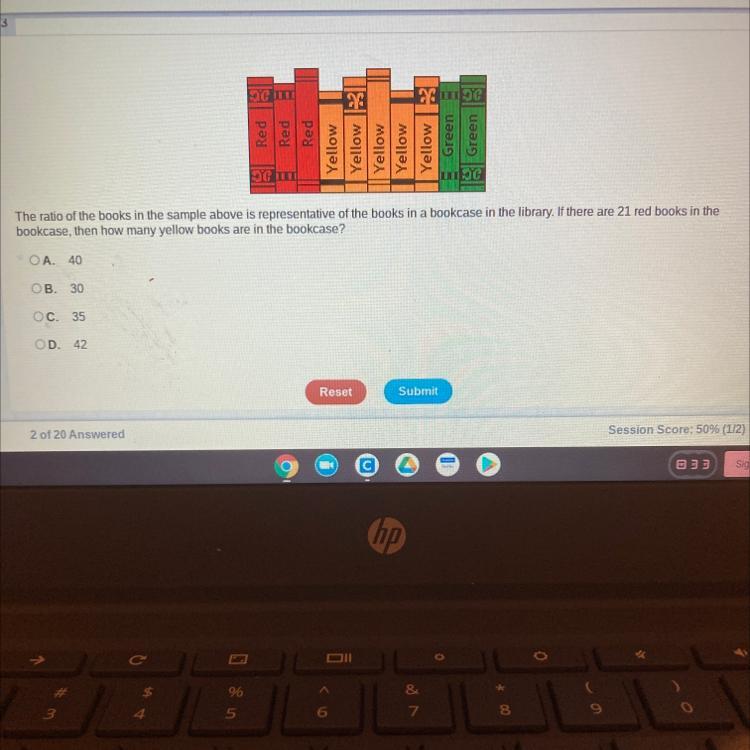
If the ratio is 3:5:2 and red books is 21, I believe the answer is C, 35 as 5 times 7 equals to 35.
Answer:
C (35)
Step-by-step explanation:
21 red
There are only 3 red which means you have to find out how you get 21
Find what numbers go with 3
3x7 is 21
mutiply yellow by 7 and get your answer (5x7)
35
PLEASE help, I've been trying to get this for like an hour.

Answers
The solution of the equation is (-2, 3) and to eliminate x we have to multiply equation(i) by 3 and multiply equation(ii) by 4.
How to solve system of equation by elimination method?System of equation can be solved using different method such as elimination method, substitution method and graphical method,
Let's use elimination method to solve the system of equation.
Therefore,
4x + 5y = 7
3x - 2y = - 12
Multiply equation(i) by 3 and equation(ii) by 4 to eliminate x.
Hence,
12x + 15y = 21
12x - 8y = - 48
Subtract the equations
23y = 69
y = 69 / 23
y = 3
Hence,
4x = 7 - 5y
4x = 7 - 5(3)
4x = 7 - 15
4x = -8
x = -8 / 4
x = -2
Therefore, the solution is (-2, 3)
learn more on system of equation here: https://brainly.com/question/27911202
#SPJ1
Define f(p)=∑ k=1
[infinity]
e −pln(k)
. For what values of p is f defined?
Answers
The function f(p) = ∑ \(e^{-p ln(k)}\) is defined for all values of p except p = 0 and p = 1. In the given function, f(p), we have a sum over the natural numbers k, where each term in the sum is \(e^{-p ln(k)}\).
Let's analyze the conditions for which this function is defined.
For any real number x, the natural logarithm ln(x) is defined only when x is positive. In our function, ln(k) is defined for all positive integers k.
Next, we consider the exponential term \(e^{-p ln(k)}\). Since the natural logarithm of k is always negative when k is a positive integer, the exponential term \(e^{-p ln(k)}\) is defined for all values of p.
However, there are two exceptions. When p = 0, the exponential term becomes \(e^0\) = 1 for any value of k.
As a result, the sum f(p) is no longer well-defined.
Similarly, when p = 1, the exponential term becomes \(e^{-p ln(k)}\) = 1/k for any positive integer k.
In this case, the sum f(p) also diverges and is not defined.
Therefore, the function f(p) is defined for all values of p except p = 0 and p = 1.
To learn more about natural logarithm visit:
brainly.com/question/29154694
#SPJ11
Can someone help first person to answer gets Brainliest
Answers
Answer:
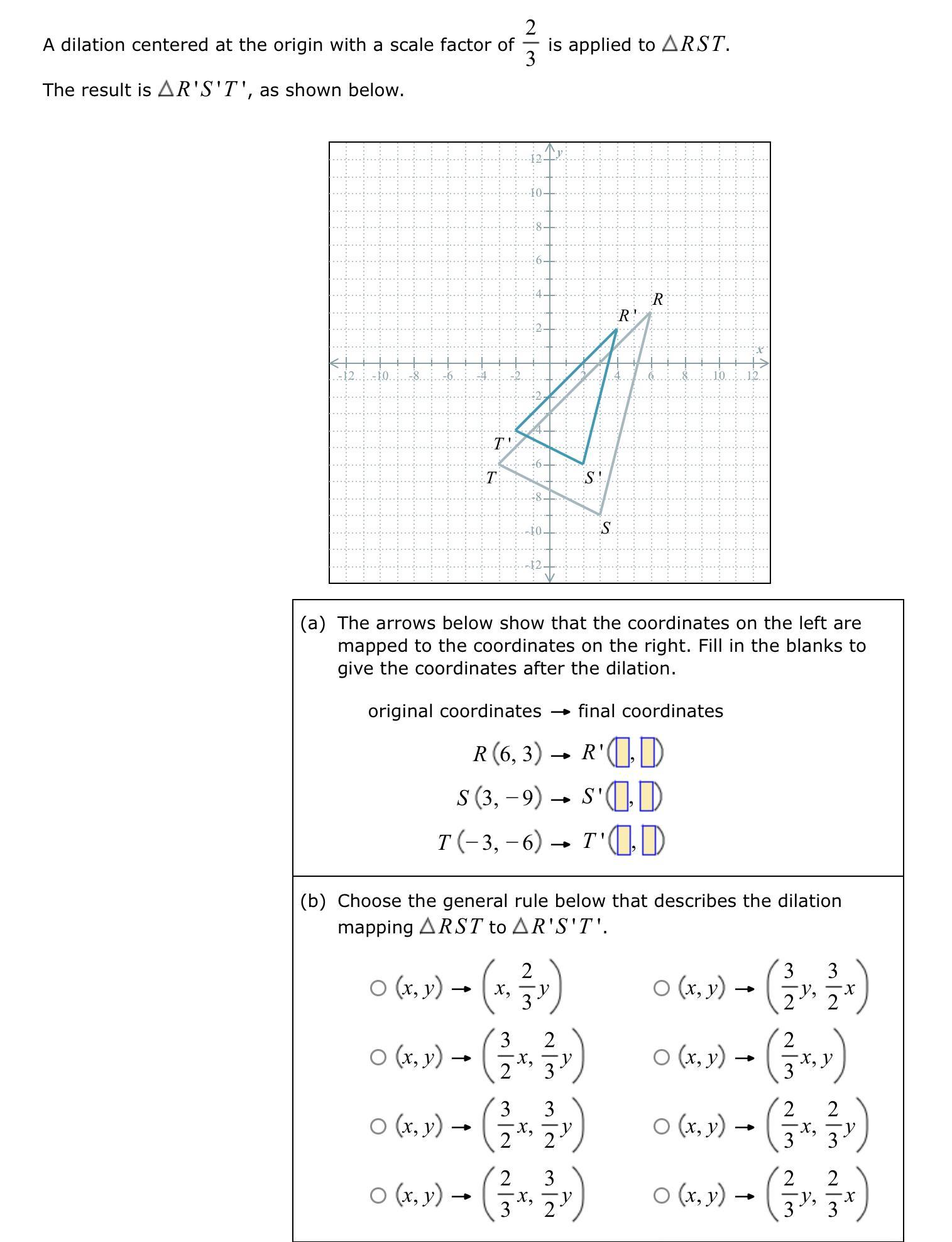
(a) is:
R'= (4, 2)
S'= (2, -6)
T' = (-2, -4)
(b) is:
The second to last option namely;
(x, y) = (2/3x, 2/3y)
Identify the factors of the function
y = 3x2 - 7x – 10
Answers
Answer:
(x + 1)(3x - 10)
Step-by-step explanation:
Given
3x² - 7x - 10
Consider the factors of the product of the x² term and the constant which sum to give the coefficient of the x- term.
product = 3 × - 10 = - 30 and sum = - 7
The factors are + 3 and - 10
Use these factors to split the x- term
3x² + 3x - 10x - 10 ( factor the first/second and third/fourth terms )
3x(x + 1) - 10(x + 1) ← factor out (x + 1) from each term
(x + 1)(3x - 10), thus
y = (x + 1)(3x - 10) ← in factored form
what's the answer to this pls I'll give brainliest

Answers
Answer:
41 the answer is 41 :)
Step-by-step explanation:
Which of the following relations is a function? A. (7, 1), (-2, 4), (3, 1), (7, 2) B. (3, 4), (-2, 6), (3, 3), (-7, 2) C. (3, 4), (-2, 2), (7, 1), (-7, 2) D. (3, 0), (-2, 3), (7, 1), (-2, 5)
Answers
Answer: B I believe
Step-by-step explanation:
what's the difference between the arithmetic and geometric average return (conceptually, not mathematically), and when is it best to use each?
Answers
Conceptually, the arithmetic and geometric average returns are different measures used to describe the performance of an investment or an asset over a specific period.
The arithmetic average return, also known as the mean return, is calculated by adding up all the individual returns and dividing by the number of periods. It represents the average return for each period independently.
On the other hand, the geometric average return, also called the compound annual growth rate (CAGR), considers the compounding effect of returns over time. It is calculated by taking the nth root of the total cumulative return, where n is the number of periods.
When to use each measure depends on the context and purpose of the analysis:
1. Arithmetic Average Return: This measure is typically used when you want to evaluate the average return for each individual period in isolation. It is useful for analyzing short-term returns, such as monthly or quarterly returns. The arithmetic average return provides a simple and straightforward way to assess the periodic performance of an investment.
2. Geometric Average Return: This measure is more suitable when you want to understand the compounded growth of an investment over an extended period. It is commonly used for long-term investment horizons, such as annual returns over multiple years.
The geometric average return provides a more accurate representation of the overall growth rate, accounting for the compounding effect and reinvestment of returns.
In summary, the arithmetic average return is suitable for analyzing short-term performance, while the geometric average return is preferred evaluating long-term growth and the compounding effect of returns.
learn more about Average Return here:
https://brainly.com/question/29662426
#SPJ11
simplify the following numerical expression as much as possible. write your answer in exponential form. let a and b be positive integers. 23a x 23b
Answers
The simplified expression in exponential form would be 23^(a + b).
To simplify the numerical expression 23a x 23b, we can combine the like terms.
Step 1: Simplify 23a and 23b individually.
The expression 23a means multiplying 23 by a, and 23b means multiplying 23 by b. We cannot simplify them further because we do not have specific values for a and b.
Step 2: Combine the simplified terms.
When we multiply 23a by 23b, we multiply the coefficients (23 x 23) and the variables (a x b). Therefore, the simplified expression is:
(23 x 23) x (a x b)
Step 3: Calculate the coefficient and write the answer in exponential form.
The coefficient (23 x 23) is equal to 529. In exponential form, we can write it as 23^2. So the final simplified expression is:
23^2 x (a x b)
In summary, the simplified numerical expression 23a x 23b can be written as 23^2 x (a x b) in exponential form.
To know more about exponential form refer here:
https://brainly.com/question/29166310
#SPJ11
2a+4=3 what is the value of a???????
Answers
Hey there!
2a + 4 = 3
ADD 4 to BOTH SIDES
2a + 4 - 4 = 3 - 4
CANCEL out: 4 - 4 because that gives you 1
KEEP: 3 - 4 because it helps solve for the a-value
2a = 3 - 4
3 - 4 = -1
2a = -1
DIVIDE 2 to BOTH SIDES
2a/2 = -1/2
CANCEL out: 2/2 because it gives you 1
KEEP: -1/2 because it gives you the value of the a-value
a = -1/2
SIMPLIFY IT!
Therefore, your answer is: a = -1/2
Good luck on your assignment and enjoy your day!
~Amphitrite1040:)
Keith bought a rechargeable digital pen for his tablet. The digital pen uses 3/5 of a cell’s power each hour. How many hours will the digital pen work with 3 cells? The digital pen will work for a hours with the 3 cells. Hint:
To find the number of hours the digital pen will work with 3
cells, find how many 3/5
are in 3?
Answers
The number of hours for the digital pen work with 3 cells would be 5.
Given that,
For his tablet, Keith bought a rechargeable digital pen.
The digital pen uses \(\dfrac{3}{5}\) of a cell’s power each hour.
Here, The digital pen uses \(\dfrac{3}{5}\) of a cell’s power each hour.
Hence, the number of hours for 1 cell,
\(1 cell = \dfrac{1}{3/5}\)
\(1 cell = \dfrac{5}{3} \ \text{hours}\)
Therefore, the number of hours the digital pen will work with 3 cells is,
\(3 \ \text{cell} = 5\ \text{hours}\)
To learn more about the divide visit:
https://brainly.com/question/28119824
#SPJ12
\(\sqrt{180x^{25}y^{23}z^{39}\)
Answers
\(6\)\(x^{12}\)\(y^{11}\)\(z^{19}\)\(\sqrt{5xyz}\)
How do you define the square root of a number?
In mathematics, a square root of a number x is a number y such that y^2 = x; in other words, a number y whose square (the result of multiplying the number by itself, or y ⋅ y) is x. For example, 4 and −4 are square roots of 16, because 42 = (−4)2 = 16.
\(\sqrt{180x^{25 } y^{23} z^{39}\)
\(180 = 2*2*3*3*5\\x^{25} = x*x*x........*x 25 times\\y^{23}= y*y*y.........*y 23 times\\ z^{39} = z*z*z........*z 39 times\)
we have
square terms comes out
x is 25 times so we can write x as \((x^{12})^{2}\) \(*\)\(x\) therefore \(x^{12}\) comes out and only left inside is x
similarly \((y^{11})^{2}\) \(*y\) therefore \(y^{11}\) comes out and only left inside is y
\((z^{19})^{2} *z\) therefore \(z^{19}\) comes out and left inside is z
then the expression become
\(6\)\(x^{12}\)\(y^{11}\)\(z^{19}\)\(\sqrt{5xyz}\)
learn more about of expression here
https://brainly.com/question/17579585
$SPJ9
I need the answer soon!
A museum charges $10 for general admission and $2 for each special exhibit you attend.
What does f(0) = 10 represent in the context of this problem?
Answers
In linear equation, If the person doesn't attend any events, n = 0, and the price stays at 10, therefore f(n) = 10 + 2n.
What in mathematics is a linear equation?
An x-y linear relationship, or two variables in which the value of one of them (often y) relies on the value of the other one, is what is known as a linear equation in two variables (usually x).The dependent variable in this scenario is y since it depends on the independent variable, x.To describe the cost of attending n events, create an equation using function notation.
A 10 dollar entrance fee is required each time, and a further 2 dollars must be paid for each unique exhibit that a visitor chooses to visit.
The function, which would depend on n events, is
If the person doesn't attend any events, n = 0, and the price stays at 10, therefore f(n) = 10 + 2n.
Learn more about linear equation
brainly.com/question/11897796
#SPJ13
HELP ME PLZZZ ASAP!
Factor to create an equivalent expression: 36a-16 .
Answers
Answer:
4(9a - 4)
Step-by-step explanation:
Answer:
4(9a - 4)
Step-by-step explanation:
Given
36a - 16 ← factor out 4 from each term
= 4(9a - 4)
what is the square root of 144?
Answers
the right answer is 12 and if you ever need more help just use the app mathaway
Find the mean and median of these data: 2, 5, 13, 15, 19, 21.
Answers
The Arithmetic Mean and Median of the given set of data ( 2, 5, 13, 15, 19, 21 ) are 12.5 and 14 respectively.
What is Arithmetic mean?Arithmetic mean is simply the average of a given set numbers. It is determined by dividing the sum of a given set number by their number of appearance.
Mean = Sum total of the number ÷ n
Where n is number of numbers
Median is the middle number in the data set.
Given the sets;
2, 5, 13, 15, 19, 21n = 6Mean = Sum total of the number ÷ n
Mean = (2 + 5 + 13 + 15 + 19 + 21) ÷ 6
Mean = 75 ÷ 6
Mean = 12.5
Median is the middle number in the data set.
Median = ( 13 + 15 ) ÷ 2
Median = 14
Therefore, the Arithmetic Mean and Median of the given set of data ( 2, 5, 13, 15, 19, 21 ) are 12.5 and 14 respectively.
Learn more about arithmetic mean here: brainly.com/question/13000783
#SPJ1
Find the exact length of the curve y=ln[(e^x+1)/(e^x-1)], a < x < b,
a > 0 (">"= greater than or equal to and "<" = less than or equal to)
Answers
The exact length of the curve y=ln[(e^x+1)/(e^x-1)], a ≤ x ≤ b, is equals to the ln[( eᵇ - e⁻ᵇ )/ ( eᵃ - e⁻ᵃ)].
The exact length of curves implies the length of arc of curve. Arc length is the distance between two points along a section of a curve, formula
Arc length = ₕ∫ᵏ√( 1 + ( y')² dx , h≤x≤k
We have a curve , y = ln[ (eˣ + 1) /(eˣ - 1) ] , a≤x≤b , a> 0
firstly, determine the first derivative of y with respect to x ..
dy/dx = y' = [ 1/(eˣ +1) /(eˣ -1)] d/dx (( eˣ + 1) /(eˣ -1) )
( apply chain rule )
= (eˣ -1 )/(eˣ +1 )[{(eˣ -1) eˣ - ( eˣ +1)eˣ}/(eˣ - 1)²]
( using quotient rule)
= (eˣ -1 )/(eˣ +1 )[(e²ˣ - eˣ - e²ˣ - eˣ)/(eˣ - 1)²]
= (eˣ -1 )/(eˣ +1 )[(- 2eˣ)/(eˣ - 1)²]
= -2eˣ /(eˣ -1 )(eˣ +1 )
dy/dx = - 2eˣ /e²ˣ -1
so, (dy/dx)² = (- 2eˣ /(e²ˣ -1) )²
= 4e²ˣ /(e²ˣ -1 )²
and 1 + (dy/dx)² = 1 + {4e²ˣ /(e²ˣ -1 )² }
= {(e²ˣ -1 )² + 4e²ˣ}/(e²ˣ -1 )²
= (e⁴ˣ + 1 - 2e²ˣ + 4e²ˣ)/(e²ˣ -1 )²
= ( e⁴ˣ + 1 + 2e²ˣ )/(e²ˣ -1 )²
1 + (dy/dx)² = (e²ˣ + 1)²/(e²ˣ -1 )²
Now plugging the value in arc length formula,
Arc length = ₐ∫ᵇ √{1 + (dy/dx)²} dx
= ₐ∫ᵇ √{(e²ˣ + 1)²/(e²ˣ -1 )²} dx
= ₐ∫ᵇ√{(e²ˣ + 1)/(e²ˣ -1 )}² dx
= ₐ∫ᵇ {(e²ˣ + 1)/(e²ˣ -1 )} dx
= ₐ∫ᵇ[eˣ(eˣ + e⁻ˣ)/eˣ(eˣ - e⁻ˣ )] dx
= ₐ∫ᵇ[(eˣ + e⁻ˣ)/(eˣ - e⁻ˣ )] dx
Arc length= ₐ∫ᵇ(cosh x)/(sinh x)dx ( using hyperbolic functions formulas )
let sinh x = t => cosh xdx = dt
and when x = a => t = sinh a
when x = b => t = sinh b
so, arc length = ₛᵢₙₕ ₐ∫ˢᶦⁿʰ ᵇ (1/t) dt
= [ ln( sinh b ) - ln(sinh a) ]
= ln( sinh b/ sinh a)
Arc length= [( eᵇ - e⁻ᵇ )/ ( eᵃ - e⁻ᵃ)]
Hence, length of curve is ln[( eᵇ - e⁻ᵇ )/ ( eᵃ - e⁻ᵃ)].
To learn more about arc length of curve, refer:
https://brainly.com/question/17748353
#SPJ4
The Heads Up Salon charges a stylist $50 a day to rent a station at the salon. Jenny, one of the stylists, makes $25.50 for each haircut. Which equation will help her decide how many haircuts, h, she must give in one day to make $154 after paying rent for her station?
Answers
To determine the number of haircuts Jenny needs to give in a day to earn $154 after paying her station rent at the Heads Up Salon, the equation h * $25.50 - $50 = $154 can be used, where h represents the number of haircuts.
Let's break down the equation step by step. Jenny earns $25.50 for each haircut, so if she gives h haircuts in a day, her total earnings from haircuts alone would be h * $25.50. However, she also needs to subtract the daily station rent of $50 from her earnings.
Therefore, the equation becomes h * $25.50 - $50 = $154, as she wants to make $154 after deducting the rent.
To solve this equation, Jenny needs to find the value of h that satisfies the equation. She can do this by isolating the variable h on one side of the equation. First, she adds $50 to both sides of the equation:
h * $25.50 - $50 + $50 = $154 + $50
This simplifies to:
h * $25.50 = $204
Next, she divides both sides of the equation by $25.50 to solve for h:
h = $204 / $25.50
By performing the calculation, she finds:
h ≈ 8
Hence, Jenny needs to give approximately 8 haircuts in a day to earn $154 after paying the station rent at the Heads Up Salon.
To learn more about equation click here: brainly.com/question/29657983
#SPJ11
solve by the substitution method
y= 3x- 19
y=x + 1
i need help on this fast!!!
Answers
Answer:
jhuygtfr
Step-by-step explanation:
Helen and her sister started watching a cartoon movie at 10:26 A.M. The movie was 2 hours and 51 minutes long. After the movie, they played a card game for 32 minutes and then played soccer in the backyard for 1 hour and 6 minutes. What time was it when Helen and her sister finished playing soccer?
Answers
Answer:
2:55 P.M
Step-by-step explanation:
After the movie: 10:26 A.M. + 2 hours and 51 minutes --> 1:17 P.M.
After the card game: 1:17 P.M. + 32 minutes --> 1:49 P.M.
After playing soccer: 1:49 P.M. + 1 hour and 6 minutes --> 2:55 P.M.
when f(x) = -3 what is x?
Answers
The function f(x) = -3; the value of x is not defined as the function is independent of 'x'.
What is defined as the independent function?The independent variables are function inputs, while the dependent variables are function outputs.
The value of the a dependent variable is determined by the input. The independent variable, on the other hand, is unrelated to anything; it is simply whatever you want to put in! The connection between the dependent as well as independent variables can be investigated.We can openly manipulate independent variables by trying to plug in any input value. In most math problems, we consider x to be the independent variable because it is the one we generally change.On a graph, we generally plot the independent variable just on horizontal axis (which we also call the x-axis).For the given question;
The given function is;
f(x) = -3
To find the value of x, which is to be substituted in the function to find f(x).
But as there is no x value present for the function, the function f(x) is said to be independent function.
To know more about the independent variable, here
https://brainly.com/question/28144505
#SPJ1
On a recent math test, Carlos had to find the volume of the rectangular prism below. He gave the answer of 60 in3, which was marked incorrect. Help Carlos understand how to correctly find the volume of the prism.
A cube that is eight inches in length, ten inches in width, and six inches in height.
Answers
Answer:
480 in
Step-by-step explanation:
Rectangular Prism Formula :
V=whl
Which,
W = Width
H = Height
L = Length
Solve:
Given that:
Length = 8 in
Width = 10 in
Height = 6 in
Since the formula is:
V = whl
Then,
V = 8 × 10 × 6
V = 80 × 6
V = 480 in
Kavinsky
plans for a vehicle are drawn to 1:192 scale. if one part of the vehicle measures 3/16 inch on the plans, what is the measurement of the actual part?
Answers
The measurement of the actual part is 36 inches. The plans are drawn to a 1:192 scale, so 3/16 inch on the plans is equal to 36 inches in actual size.
When plans for a vehicle are drawn to 1:192 scale, this means that for every 1 inch on the plans, the actual size of the vehicle is 192 inches. To calculate the measurement of the actual part, we need to determine how many inches 3/16 inch is on the plans. To do this, we can use the ratio 1:192 to convert the measurement from the plans to the actual size.
1/192 = 3/16 / x
To solve for x, we can multiply both sides of the equation by 16, which gives us:
16/192 = 3/16 * 16 / x
Simplifying, we get:
1/12 = 3/x
Finally, to solve for x, we can multiply both sides of the equation by x, which gives us:
x/12 = 3
Therefore, x = 36. This means that 3/16 inch on the plans is equal to 36 inches in actual size, so the measurement of the actual part is 36 inches.
Learn more about measurement here
https://brainly.com/question/4725561
#SPJ4
According to the Rational Root Theorem, which is a factor of the polynomial f(x) = 3x3 – 5x2 – 12x + 20?
Answers
Answer:
Step-by-step explanation:
You didn't give your options, but it doesn't matter. We'll find all the possibilities and then you can pick it from your list.
When I teach this in Algebra 2, I call it the "the c over d thing" and all my students know EXACTLY to what I am referring. "c" is the constant and "d" is the leading coefficient. The combination of c/d give you the possibilities of roots for the polynomial. There are no real roots that a polynomial can have other than the possibilities we find when we do the c/d thing.
Our c is a 20. All the factors of 20 are as follows (notice that we have both the positive and negative factors):
20: ±1, ±2, ±4, ±5, ±10, ±20
Our d is a 3. All the factors of 3 are as follows (again, both the + and the -):
3: ±1, ±3 and that's it for 3.
c/d is as follows. Make sure you put ever c over every d!!!:
c/d: ±\(\frac{1}{1}\), ±\(\frac{2}{1}\), ±\(\frac{4}{1}\), ±\(\frac{5}{1}\), ±\(\frac{10}{1}\), ±\(\frac{20}{1}\), ±\(\frac{1}{3}\), ±\(\frac{2}{3}\), ±\(\frac{4}{3}\), ±\(\frac{5}{3}\), ±\(\frac{10}{3}\), ±\(\frac{20}{3}\)
Those are all the possibilities for your roots for that polynomial. As long as the roots are real (and they won't always all be real!), there are no roots but these.
Answer:
its D on edge
Step-by-step explanation:
a coin is flipped until 4 tails in succession occur. list only those elements of the sample space that require 7 or less tosses. is this a discrete sample space? explain.
Answers
Yes, this is a discrete sample space because there are a finite number of possible outcomes. The possible outcomes are: TTTT, HTTTT, HHTTTT, HHHTTTT, THHTTTT, TTHHTTTT, TTTHHTTTT, TTTHTTTT. These are the only elements of the sample space that require 7 or less tosses.
To find these elements, we can start by listing the outcomes that require exactly 4 tosses: TTTT. Then we can add a head to the beginning of each of these outcomes to get the outcomes that require exactly 5 tosses: HTTTT. We can continue this process to get the outcomes that require exactly 6 tosses: HHTTTT, THHTTTT, and the outcomes that require exactly 7 tosses: HHHTTTT, TTHHTTTT, TTTHHTTTT, TTTHTTTT.
Therefore, the sample space is discrete because there are a finite number of possible outcomes, and we can list all of the elements of the sample space that require 7 or less tosses.
For more similar questions on elements:
brainly.com/question/11455584
#SPJ11