matthew burns 11 calories/min on average. How long would it take him to burn 18700 calories represent your answer in days, hours and minutes
Answers
Answer:
1 day 4 hours and 20 minutes
Explanation:
Matthew burns 11 calories/min
How long it would take him to burn 18700 calories is given as shown below:
\(\begin{gathered} =\frac{18700}{11}\times\frac{cal}{\frac{cal}{min}} \\ =1700\times cal\times\frac{min}{cal} \\ =1700min \\ 60min=1h \\ 24h=1day \\ \text{Converting we have:} \\ =1700min\times\frac{1h}{60} \\ =28\frac{1}{3}h \\ =28h\text{ }20mins \\ \text{Converting to days, hours, minutes we have:} \\ =24h+4h+20min \\ =1day\text{ }4hours\text{ }20minutes \end{gathered}\)Therefore, it would take him 1 day 4 hours and 20 minutes to burn those calories
Related Questions
which is the following is a source of income
Answers
Answer:
Investment is a source of Income.
ORSelf Employment Income
Answer: Business ownership
Step-by-step explanation: took the quiz
PLEASE HELP FAST!! IT IS URGENT!!
An athletic trainer would like to estimate how many additional calories are burned when completing a high-intensity interval training (HIIT) workout for 30 minutes rather than doing yoga for 30 minutes. A group of 30 volunteers is randomly assigned to take a 30-minute HIIT class or a 30-minute yoga class, and each volunteer wears a calorie- counting armband. Here are summary statistics and dotplots of the results. Group Name N mean min Q₁ med Q3 1: HIIT 15 449.4 41.699 386 416 457 481 2: Yoga 15 265.333 44.657 182 150 + 200 250 .00 SD + 300 00 231 + 350 270 400 310 max 510 325 + 450 500 550 HIIT

Answers
The answer to the given question is: Yes, all three conditions of inference are met.
How to solve this
1. Random: A random sample or randomized experiment should be used to obtain the data.
2. Normal: The sampling distribution of x bar (the sample mean)needs to be approximately normal. This is true if our parent population is normal or if our sample is reasonably large (n \geq 30)(n≥30)left parenthesis, n, is greater than or equal to, 30, right parenthesis.
(Note:
Not normal or unknown parent population; sample size is small (n<30)
As long as the parent population doesn't have outliers or strong skew, even smaller samples will produce a sampling distribution of x bar that is approximately normal.
In practice, we can't usually see the shape of the parent population, but we can try to infer shape based on the distribution of data in the sample.
If the data in the sample shows skew or outliers, we should doubt that the parent is approximately normal, and so the sampling distribution of x bar may not be normal either.
But if the sample data are roughly symmetric and don't show outliers or strong skew, we can assume that the sampling distribution of x bar will be approximately normal.)
3. Independent: Individual observations need to be independent. If sampling without replacement, our sample size shouldn't be more than 10% of the population.
For our example, we have taken the samples randomly and our samples are normally distributed and both the groups are independent of each other.
Therefore we can say that all three conditions for inference are met.
Read more about independent variables here:
https://brainly.com/question/82796
#SPJ1
A box contains 240 lumps of sugar. Five lumps are fitted across the box and there were three layers. How many lumps are fitted along the box?
Answers
Number of lumps across each layer = 5
Number of layers = 3
Total number of lumps = Number of lumps across each layer × Number of layers
Total number of lumps = 5 × 3 = 15
Therefore, 15 lumps of sugar are fitted along the box.
If it’s possible, please mark me brainliest!
(b) Ashley bought 21 pounds of flour for $11.
How many pounds of flour did she get per dollar?
pounds per dollar
Answers
Answer:
1.9 pounds per dollar when rounded
PLZ HELP ME AND SORRY IF THE PHOTO IS BLURRY!?!?

Answers
13 inch step by step
====================================================
Explanation:
Draw a vertical number line. Make sure 4, 0 and -9 are marked on it.
The distance from 4 to 0 is 4 units, or 4 spaces. Let A = 4.
The distance from 0 to -9 is 9 units, or 9 spaces. Let B = 9.
Add up those distances gives a total of A+B = 4+9 = 13 inches, which is the distance from 4 to -9.
----------------
As an alternative, we can subtract and apply absolute value
Let x = 4 and y = -9
|x-y| = |4-(-9)| = |4+9| = |13| = 13
or
|y-x| = |-9-4| = |-13| = 13
When absolute value is used, the order of subtraction doesn't matter.
A cylinder has a height of 15 millimeters. Its volume is 10,597.5 cubic millimeters. What is the
radius of the cylinder?
Answers
Answer: 15
Step-by-step explanation: r=V
πh=10597.5
π·15≈14.9962
I was on vacation for this unit and having a hard time

Answers
1.a
We can rewrite the given information in an algebraic expression as follows:
\(\frac{3}{8}x=6\)where x represents the number of 3/8-inch thick books. Solving for x:
\(x=\frac{6}{\frac{3}{8}}\)We can rearrange the operation:
\(x=\frac{6}{3}\cdot8\)\(x=\frac{48}{3}\)\(x=16\)Then, we need 16 3/8-inch books to make a stack 6 inches tall.
1.b
To solve this exercise, we can use the same procedure as in 1.a.
0. Writing the information in an algebraic expression.
\(\frac{1}{2}x=2\cdot\frac{3}{4}\)where x represents the groups of 1/2 pound.
We can convert the mixed number into an improper fraction:
\(2\cdot\frac{3}{4}=\frac{2\cdot4+3}{4}=\frac{8+3}{4}=\frac{11}{4}\)2. Rewriting the operation:
\(\frac{1}{2}x=\frac{11}{4}\)\(x=\frac{\frac{11}{4}}{\frac{1}{2}}\)\(x=\frac{11\cdot2}{4\cdot1}\)\(x=\frac{22}{4}\)\(x=5.5\)We have 5.5 groups of 1/2 pounds in 2 (3/4) pounds.
Answer:
• 1.a 16
,• 2.b 5.5
What is the perimeter of the shape below? Use 3.14 for pi. Answer with numbers only, no units.
DO NOT ROUND THE ANSWER

Answers
Step-by-step explanation:
The circumference of a WHOLE circle = pi * d
you have 1/2 of this and d = 10 ft
so 1/2 pi * 10 PLUS the two straight sides + 8+6
1/2 pi * 10 + 8 + 6
5 pi + 8 + 6
5 * 3.14 + 14 = 29.7 ft
here's the question ...........

Answers
Answer:
x intercept -7 and y intercept is 9
In class, we developed the formula
(a) Use the formula (using appropriate substitutions) to find the closed form for ∑2
= 2
(b) Use the formula in the notes for ∑
= 13 to find the closed form expression form for
∑
= 3 (assume a ≥ 1 and a ≤ b)
(c) In class, we developed the formula
Use this formula and some algebra to derive a closed form for the sum ∑
= 0( ― 1)2 ― 1
(d) Test your closed form solution in (c) to find the value of ∑3
= 0( ― 1)2 ― 1 and see if
it matches the manual computation of the 4 terms of the sum.
Answers
(a) The closed form for ∑2 is 2.
(b) The closed form expression for ∑3 is 24.
(c) The closed form for the sum ∑n = 0(― 1)² ― 1 is n(1 - n) / 2.
(d) The value of -3 matches the manual computation of the four terms.
Our closed form solution is correct.
To find the closed form for ∑2, we can use the formula for the sum of the first n terms of an arithmetic series:
∑2 = n(a + l) / 2
In this case, a = 2 (the first term) and l = 2 (the last term) since we are summing a series of 2's.
We also know that there is only one term, so n = 1.
Substituting these values into the formula, we have:
∑2 = 1(2 + 2) / 2
= 4 / 2
= 2
The formula for the sum of the first n terms of an arithmetic series is:
∑n = n(a + l) / 2
In this case, we have a = 3 (the first term), l = 13 (the last term), and n = 3 (the number of terms).
Substituting these values into the formula, we get:
∑3 = 3(3 + 13) / 2
= 3(16) / 2
= 48 / 2
= 24
The formula we developed in class is:
∑n = n(a + a + (n - 1)d) / 2
In this case, we have a = 0 (the first term) and d = -1 (the common difference).
Substituting these values into the formula, we get:
∑n = n(0 + 0 + (n - 1)(-1)) / 2
= n(0 - n + 1) / 2
= n(1 - n) / 2
To test the closed form solution for ∑3 = 0(― 1)² ― 1, we substitute n = 3 into the closed form expression we derived in part (c):
∑3 = 3(1 - 3) / 2
= 3(-2) / 2
= -6 / 2
= -3
Now, let's manually compute the sum of the first four terms of ∑3 = 0(― 1)² ― 1:
0(― 1)² ― 1 + 1(― 1)² ― 1 + 2(― 1)² ― 1 + 3(― 1)² ― 1
= 0 - 1 - 2 - 3
= -6
For similar questions on manual computation
https://brainly.com/question/32637761
#SPJ8
solve each of the following equations show your work if every number works write all real numbers if the equation has no solution write no solution. -2x - 5 = -13-(4n + 6)= -n + 2 (n + 6)-7 = 1 + n/36 - 5h = 3h + 14
Answers
Solve each of the following equations;
(1) -2x - 5 = -13
Add 5 to both sides of the equation
-2x = -13 + 5
-2x = -8
Divide both sides of the equation by -2
x = 4
(2) -(4n + 6) = -n + 2 (n + 6)
The minus sign affects both expressions in the parenthesis and you have
-4n - 6 = -n + 2n + 12
Next you collect the like terms and you have,
-4n + n- 2n = 12 + 6
**Note that when a negative value moves over to the other side of the equation, it becomes positive, and vice versa.
-6n + n = 18
-5n = 18
Next you divide both sides of the equation by -5 and you have,
n = - 18/5
n = - 5 3/5
(3) -7 = 1 + n/3
Subtract 1 from both sides of the equation
-7 - 1 = n/3
-8 = n/3
You cross multiply and you now have,
-8 * 3 = n
-24 = n
(4) 6 - 5h = 3h + 14
Collect like terms and you now have,
6 - 14 = 3h + 5h
-8 = 8h
Divide both sides of the equation by 8 and you now have,
-1 = h
A pair of boots costs $130. They are
on sale for $110.50. Find the percent
of change?
Answers
Answer:
15% off
Step-by-step explanation:
mark brainliest please
A new school is ordering math text books. They are 3/4 of an inch thick. How many these books will fit into a book shelf that is 2 feet long.
Answers
Answer:
Step-by-step explanation:
Answer:
32
Step-by-step explanation:
24 inches are 2 feet
3/4 x 32 = 24
24 inches = 2 feet
Find the cos of angle T....

Answers
Answer:
C = 24/25
Step-by-step explanation:
Recall, CAH.
Thus:
Cos T = adjacent/hypotenuse
Reference angle = T
Adjacent = 24
Hypotenuse = 25
Therefore,
Cos T = 24/25
how to convert h(x)=(x - 2)^2 - 4 to standard form
Answers
To convert a function to standard form, we move all terms to the right hand side and simplify. Since all terms in this function are all on the right side already, we can begin to simplify as follows;
\(\begin{gathered} (x-2)^2-4 \\ (x-2)(x-2)-4 \\ (x^2-2x-2x+4)-4 \\ x^2-4x+4-4 \\ x^2-4x \\ \text{The function now can be expressed in standard form as;} \\ h(x)=x^2-4x \\ \text{The y-intercept is derived at the point where x equals zero} \\ \text{That is, where the function crosses the y-axes} \\ \text{When x = 0, then;} \\ h(0)=0^2-4(0) \\ h(0)=0-0 \\ h(0)=0 \\ \text{Therefore the y-intercept is 0} \end{gathered}\)Which values from the set {-8, -6, -2, 0, 2, 4, 8} satisfy the following inequality?
Answers
he was never late negative to affirmative
Simplify: 2(16-7) + 32÷8=
Answers
Answer:
18 + 32 divided by 8. but if you want the answer it would be 22
Step-by-step explanation:
Answer: equals 22
Step-by-step explanation:
P.E.M.D.A.S
9x2=18 + 32/8=4
18 + 4 = 22
I need help please!!!

Answers
Siama and Wills used different methods to find the differences between (5x + 6x) and (2x - 1) but they both arrived at the same answer.
I prefer Wills method because it is easier and less complicated.
How to solve differences?Wills method:
(5x + 6x) - (2x - 1)
Subtract both 2x and -1
5x + 6x - 2x - - 1
5x + 4x + 1
In conclusion, Wills method is preferred when both methods are compared.
Read more on difference of numbers:
https://brainly.com/question/17301989
#SPJ1
I am stuck please help with this graph.
Answers
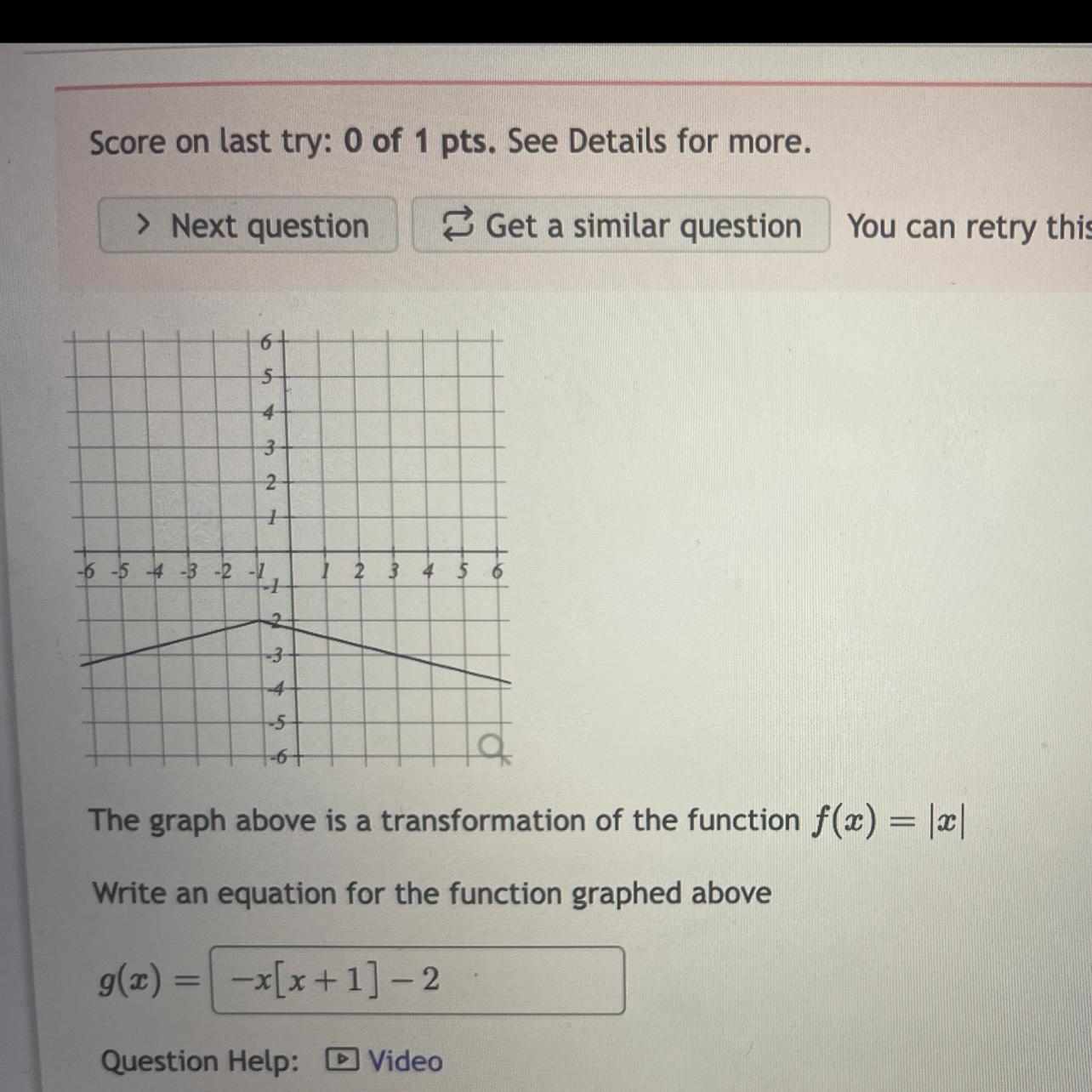
An equation for the function graphed above include the following: g(x) = -1/4|x + 1| - 2.
How to interpret and determine the equation of g(x)?By critically observing the graph of this absolute value function, we can reasonably infer and logically deduce that the parent absolute value function f(x) = |x| was vertically compressed by a factor of 1/4, reflected over the x-axis, followed by a vertical translation 2 units down, and then a horizontal translation to the left by 1 unit, in order to produce the transformed absolute value function as follows;
f(x) = |x|
y = A|x + B| + C
g(x) = -1/4|x + 1| - 2
In conclusion, the value of the variables A, B, and C are -1/4, 1, and 2 respectively.
Read more on absolute value function here: brainly.com/question/28308900
#SPJ1
Which of the following is true about the linear function f(x) = 5?
Function fis parallel to the x-axis and has a slope equal to zero.
Function fis parallel to the x-axis and has an undefined slope.
Function fis perpendicular to the x-axis and has a slope equal to zero.
Function fis perpendicular to the x-axis and has an undefined slane
Answers
Answer:
Function f is parallel to the x-axis and has a slope equal to zero
Step-by-step explanation:
The equation of a line
The slope-intercept form of the equation of a line is given by:
y = mx + b
Where:
m = slope of the line
b = y-intercept, or the point where the graph intercepts the y-axis
We have the equation of a line:
y = 5
It corresponds to a line with m=0 and b=5. This line has a slope of 0 and a y-intercept of 5.
A zero-slope line is a horizontal line, i.e., parallel to the x-axis.
The correct statement is (first choice):
Function f is parallel to the x-axis and has a slope equal to zero
Find the slope and the y-intercept of the line. 7x – 2y = -2 Write your answers in simplest form.
Answers
Answer:
slope = 7/2 or 3.5 as a decimal.
y-intercept = 1 or (0, 1) in coordinate form.
The subtotal of your computer purchase was $398.50. If the sales tax rate is
7.25%, how much will you pay in tax for the computer?
Answers
453.46
Step-by-step explanation:
398.50/7.25=54.96
398.50+54.96=453.46
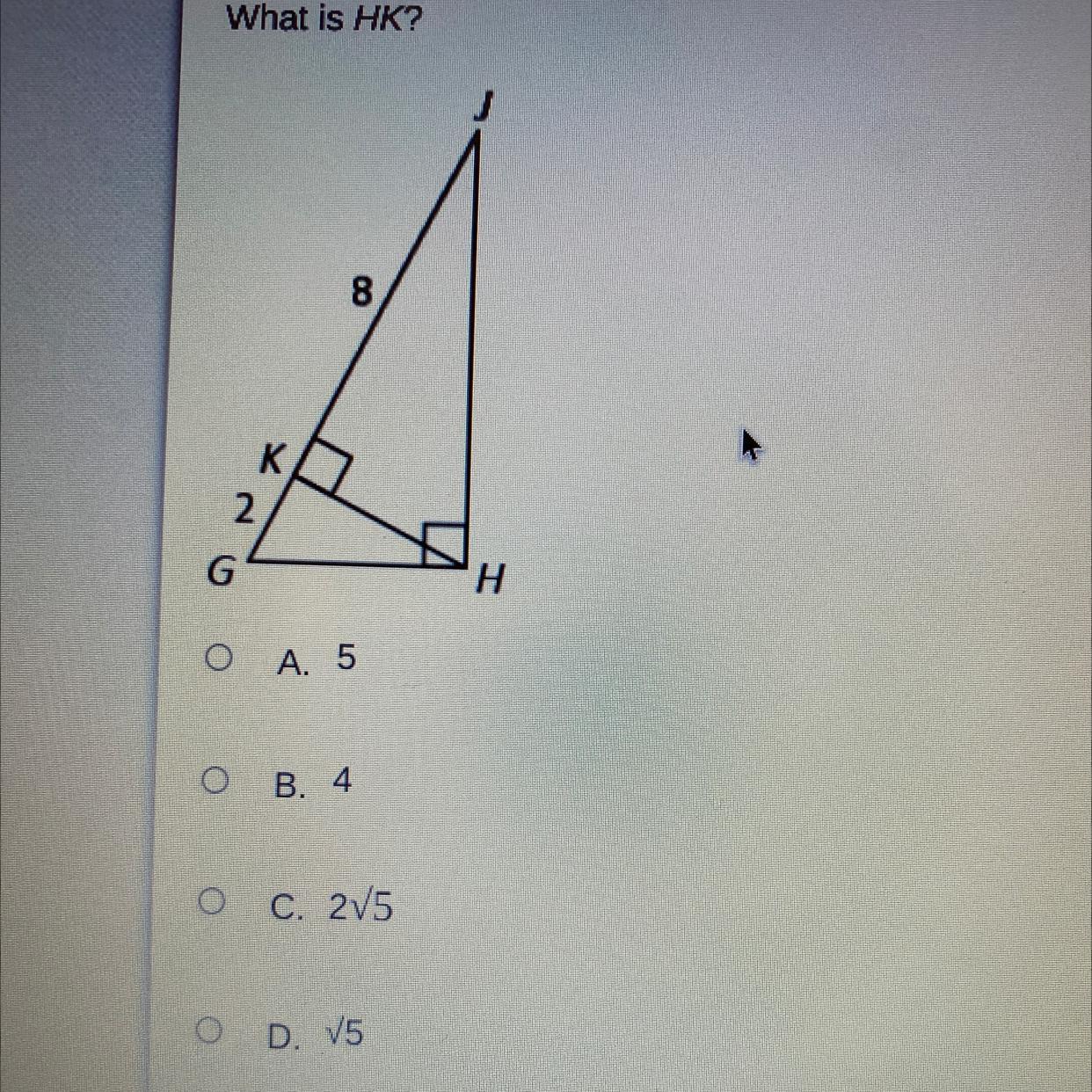
Need help with this geometry question.What is HK?
Answers
Answer:
Step-by-step explanation:
use a protractor if you have one or ask for one
What is answer? (-4589)+(+7658)=
Answers
Answer: Heyaa! ~
Your Answer is 3069
Step-by-step explanation:
(-4589)+(+7658)= 3069
Simplify the expression.Add together.
Hopefully this helps you! ~
I have 7 cookies. If I eat 1/4 of them of the cookies. How many cookies do I have left?
Answers
Answer:
6 thirds
Step-by-step explanation:
you're welcome
A line passes through the origin (−1, 1) and (4, n). Find the value of n.
Answers
The line y = - x has a coordinate value of (4, - 4) passing through the origin.
What are lines and their slopes?We know lines have various types of equations, the general type is
Ax + By + c = 0, and equation of a line in slope-intercept form is
y = mx + b.
Where slope = m and b = y-intercept.
the slope is the rate of change of the y-axis with respect to the x-axis and the y-intercept is the (0,b) where the line intersects the y-axis at x = 0.
Given, A line passes through the origin, (−1, 1) and (4, n).
So, The slope of the line is,
m = (1 - 0)/(- 1 - 0).
m = - 1.
Now,
1 = -1(-1) + b.
b = 0.
y = - x.
At x = 4,
y = - 4.
So, The point (4, n) is (4, - 4).
learn more about lines and slopes here :
https://brainly.com/question/3605446
#SPJ1
HELP ME OUT PLEASE!!!!!
Answers
Answer:
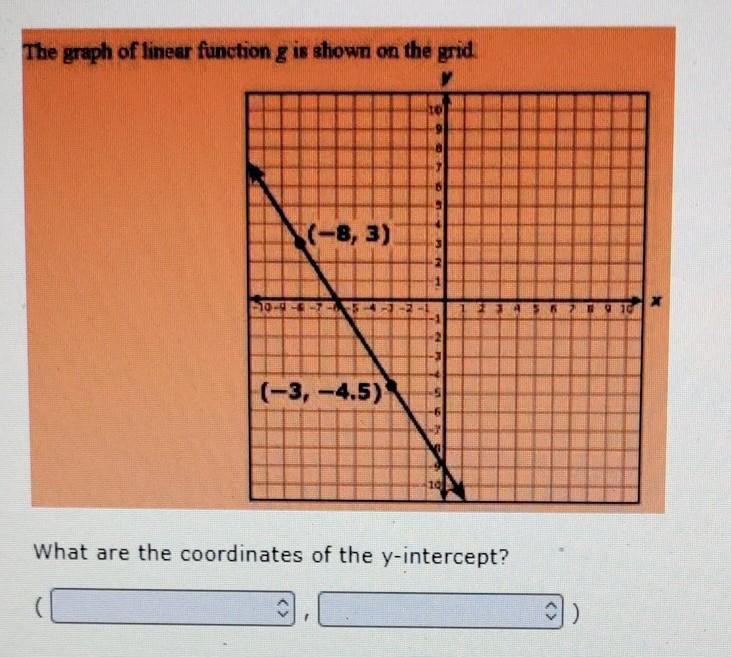
(0 , -9)
Step-by-step explanation:
The y intercept is where the line crosses the y axis.
Sam finished 5/6 of his homework, John finished 3/4 of his homework, and Tom finished 10/12 of his homework. Which two students finished the same amount of homework?
Answers
Answer:
Sam and Tom
Step-by-step explanation:
5 × 2= 10
6 × 2= 12
5/6= 10/12
In a rectangular prism, given a base area of 64 cm2 and a
height of 7.2 cm, what would be the volume of the
figure?
Answers
Answer:
46.8 cm^3
Step-by-step explanation:
If there is a 4 in 5 chance that your mom will tell you to clean your room today after school, what is the
probability that she won't? P(not A) = 1 - P(A)
Answers
She'll probably instruct you to clean your room, but there's a 1/5 or 0.2 (20%) probability she won't.
What are examples and probability?The likelihood or chance of an occurrence happening is known as probability. For instance, there is only one method to get a head and there are a total of two possible outcomes, so the probability of flipping a coin and getting heads is 1 in 2. (a head or tail). P(heads) = 12 is what we put.
P(A) = 4/5 (the probability of mom telling to clean the room)
P(not A) = 1 - P(A) = 1 - 4/5 = 1/5
Therefore, there is a 1/5 chance, or 0.2 percent, that she won't instruct you to clean your room.
To know more about probability visit:-
https://brainly.com/question/30034780
#SPJ9