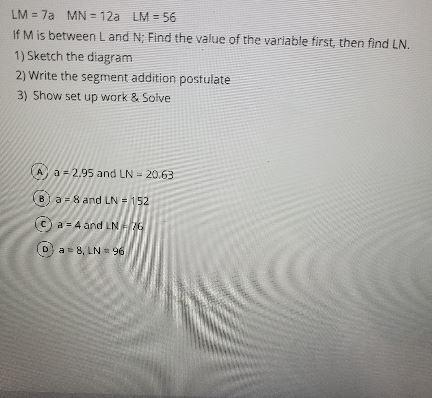
LM=7a MN=12aLM=56IF M is between L and N; find the value of the variable first then find LN
Answers
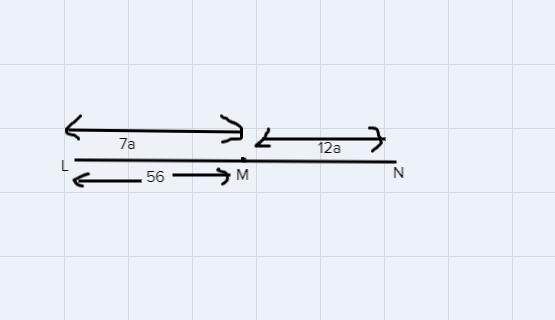
Sketch the line LN with point M between L and N.
Determine the value of by using segment LM.
\(\begin{gathered} LM=7a \\ 56=7a \\ a=\frac{56}{7} \\ =8 \end{gathered}\)Determine the length of line LN by addition segment postulates.
\(\begin{gathered} LN=LM+MN \\ =7a+12a \\ =19a \end{gathered}\)Substitute 8 for a in the equation to obtain the length LN.
\(\begin{gathered} LN=19\cdot8 \\ =152 \end{gathered}\)Thus, value of variable a is 8 and LN = 152. Option B is correct.
Related Questions
Choose the number to fill the blank so that the statement is TRUE. The least common multiple of _____, 12 and 18 is 36
Answers
Answer: 6
Step-by-step explanation:
A polynomial, P(x) = x2 + 2x + k has (x – 2) as a factor. What is
the value of k?
Answers
Answer:
x-2 =0
x=2
now
putting the x value in p
we have,
p(2) = x2 + 2x +k
= 2×2 +2×2+k
= 4+4+k
= 8+k
so,
Either
8+k =0
k= - 8
What is the area of the circle? Approximate using pi equals 22 over 7 and round to the nearest square yard.
a circle with radius labeled 61 yards
a. 383 square yards
b. 192 square yards
c. 23,389 square yards
d. 11,695 square yards
help
Answers
Answer:
≈ 11695 yd^2
The answer d
Step-by-step explanation:
Given:
r = 61 yd
\(\pi = \frac{22}{7} \)
Find: a - ?
\(a = \pi \times {r}^{2} = \frac{22}{7} \times {61}^{2} ≈ 11695\)
Find the value of x, 6,4, 3x, 4x+1

Answers
Answer:
If two chords intersect in a circle, then the product of the segments of one chord equals the product of the segments of the other chord.
6(3x) = 4(4x + 1)
18x = 16x + 4
2x = 4
x = 2
use distributive property to rewrite this problem: -2(n-7)
Answers
To rewrite the expression -2(n-7) using the distributive property, we need to distribute the -2 to both terms inside the parentheses. The distributive property states that for any numbers a, b, and c:
a(b + c) = ab + ac
Applying this property to the given expression:
-2(n-7) = -2 * n + (-2) * (-7)
Simplifying further:
-2(n-7) = -2n + 14
Therefore, the rewritten expression is -2n + 14.
5. In the diagram below, lines AB and CD intersect at E such that mZAEC = 2x+4 and
m/AED=5x+1.
Find the measure of ZDEB. Show how you found your answer.
Answers
Based on the information in the triangle, the measure of ZDEB is 54°.
How to calculate the valueA triangle is a polygon with three sides and three angles. It is one of the basic shapes in geometry. Triangles are commonly represented by drawing three line segments that connect three non-collinear points. The points where the line segments intersect are called the vertices of the triangle, and the line segments themselves are the sides of the triangle.
The sum of the measures of the angles of a triangle is 180 degrees. Therefore,
mZAEC + m/AED + mZDEB = 180
(2x+4) + (5x+1) + mZDEB = 180
7x+5 = 180
7x = 175
x = 25
mZDEB = 2x+4 = 2(25)+4 = 54 degrees
Hence, the answer is 54
Learn more about triangles on
https://brainly.com/question/17335144
#SPJ1

It’s simple math I’m just confused

Answers
Answer:
26 units
Step-by-step explanation:
make a proportion: so sides correspond alongside eachother.
so, 15/10 =24/Y, i know you need to solve for x, but you have to find the other blank length.
now cross multiply, 10*24=15*Y
240=15Y
240/15=
Y= 16
now add Y to the length 10 to get X. So you get 10+16=26
What is the slope of a line perpendicular to the
line whose equation is 6x - 9y = 216. Fully
simplify your answer.
Answers
Answer:
Slope is 2/3
Step-by-step explanation:
Jeremy spent $33 on 3 CDs. At This rate. how much would 6 CDs cost ?
Answers
33/3=11.
It costs $11 per CD.
6*11=66.
It would be $66 for 6 CDs.
Answer:
It would cost Jeremy $66 for 6 CDs
Step-by-step explanation:
3 CDs for $33
3(2)=6
$33(2)=$66
pls help! I need the answer fast!

Answers
Answer:
B is the answer
Step-by-step explanation:
hope it helps
Please see my question in the attachment, thanks

Answers
As x tends to negative one from the left, the value of f(x) tends to positive infinity. As x → -1⁻, f(x) → ∞.
What is a vertical asymptote?In Mathematics and Geometry, the vertical asymptote of a function simply refers to the value of x (x-value) which makes its denominator equal to zero (0).
By critically observing the graph of this rational function f(x) shown below, we can logically deduce that its vertical asymptote is at x = -1 and x = 2, and its horizontal asymptote is at y = 3.
In this context, we can logically deduce that the value of f(x) tends towards positive infinity, as x tends to negative one from the left;
As x → -1⁻, f(x) → ∞.
Read more on vertical asymptotes and functions here: brainly.com/question/28184937
#SPJ1
What is 9 to the power of 4 + 6(7 x 3) - 3?
Answers
Answer: 127^9 so 8594754748609400000
Step-by-step explanation: i’m not sure but 4+6 (7x3)-3 = 127 127^9
Please answer the question CORRECTLY with a logical explanation. You will get brainliest guaranteed.

Answers
Answer:
It is irrational, & cannot be written as a fraction.
Step-by-step explanation:
\(\sqrt{2}\) will give you a very odd number when plugged into the calculator.
1.414213562
With our knowledge of rational vs. irrational numbers, we know that means \(\sqrt{2}\) has to be irrational because it is not a whole number, not an integer, & cannot be condensed into a fraction.
Any time you see a number that isn't a perfect square in a square root, it might be best to guess it is irrational.
Always plug it into a calculator (if possible) to check!
Hope this helps. :)
I NEED YOUR HELP!! I'LL. GIVE YOU BRAINLIEST

Answers
Answer: ∠16 and ∠11
Step-by-step explanation:
All of these answer options include ∠16, so we know we're looking for an angle that is corresponding to ∠16. A corresponding angle is an angle that is in the same relative position. We will look at ∠9, ∠11, ∠2, and ∠12 since those are the given answer options, and see which is corresponding.
The correct corresponding angles are ∠16 and ∠11.

HELP ASAP WILL MARK BRAINLIEST!!!

Answers
1 =41
2 =85
3 =95
4 =85
5 =36
6 =49
7 =106
hope this helps
a recipe for bread requires 2 2/3 cups of white flour and 1 1/2 cups of whole wheat flour. The recipe yields 3 loaves of bread. how many cups of flour are in each loaf of bread? show your work or explain you answer.
Answers
In the given case, each loaf of bread contains 25/18 cups of flour.
To find how many cups of flour are in each loaf of bread, we need to divide the total amount of flour by the number of loaves.
First, let's convert the mixed numbers to improper fractions:
\(2 2/3 cups = 8/3 cups\)
\(1 1/2 cups = 3/2 cups\)
Next, we can add the two fractions to find the total amount of flour:
8/3 cups + 3/2 cups = (16/6 + 9/6) cups = 25/6 cups
So, the recipe requires 25/6 cups of flour to make 3 loaves of bread.
To find the amount of flour in each loaf, we divide 25/6 cups by 3:
(25/6 cups) / 3 = 25/18 cups
Therefore, each loaf of bread contains 25/18 cups of flour.
Alternatively, we could simplify the mixed numbers at the beginning:
2 2/3 cups = 8/3 cups
1 1/2 cups = 6/4 cups
Then we can add the fractions:
8/3 cups + 6/4 cups = (32/12 + 18/12) cups = 50/12 cups
Finally, we can divide by 3 to find the amount of flour in each loaf:
(50/12 cups) / 3 = 25/18 cups
So the answer is the same.
To know more about amount here
https://brainly.com/question/25109150
#SPJ1
It is percent
Thank youuu

Answers
A description that could explain what happened to the price of the share stock include the following: C. the price decreased by 90% and then increased by 75%.
What is a percentage?In Mathematics, a percentage simply refers to any number that is expressed as a fraction of hundred (100). This ultimately implies that, a percentage indicates the hundredth parts of any given number.
Based on the information provided, we can logically deduce that an algebraic expression that represents the situation is given by:
Algebraic expression = 1.75(0.1d)
Therefore, we have:
Rate of change (increase) = 1 + 0.75 = 75%.
Rate of change (decrease) = 1 - 0.1 = 90%.
Read more on percentage here: brainly.com/question/11360390
#SPJ1
order these in ascending order. 1 will be the least. 4 will be the greatest. 13.513.5%-26/20
Answers
Given the numbers: 13.5 , 13.5% , -26/2 , 0
At first convert all numbers to the same format, i will convert all to decimal numbers
so, the numbers will be:
13.5 , 0.135 , -13 , 0
Note: 13.5% = 13.5/100 = 0.135
so, ascending the numbers from the least to the greatest
-13
0
0.135
13.5
so, the order will be :
-26/2 , 0 , 13.5% , 13.5
According to Bureau of Labor Statistics, 22.1% of the total part-time workforce in the U.S. was between the ages of 25 and 34 during the 3 rd quarter of 2011. A random sample of 80 part-time employees was selected during this quarter. Using the normal approximation to the binomial distribution, what is the probability that fewer than 20 people from this sample were between the ages of 25 and 34?
Answers
Answer:
The probability is \(P(X < 20 ) = 0.68807\)
Step-by-step explanation:
From the question we are told that
The proportion of total part-time workforce is \(\r p = 0.221\)
The sample size is n = 80
Generally the mean is mathematically represented as
\(\mu = n* p\)
\(\mu = 0.221 * 80\)
\(\mu = 17.68\)
The proportion of not part - time workforce
\(q = 1- p\)
=> \(q = 1- 0.221\)
=> \(q = 0.779\)
The standard deviation is mathematically represented as
\(\sigma = \sqrt{ 80 * 0.221 * 0.779 }\)
\(\sigma = 3.711\)
Now applying the normal approximation,
Then the probability that fewer than 20 people from this sample were between the ages of 25 and 34 is mathematically represented as
\(P(X < 20 ) = P( \frac{X - \mu }{ \sigma } < \frac{ 20 - 17.68 }{ 3.711} )\)
Applying continuity correction
\(P(X < 20 ) = P( \frac{X - \mu }{ \sigma } < \frac{ (20-0.5 ) - 17.68 }{ 3.711} )\)
\(P(X < 20 ) = P( \frac{X - \mu }{ \sigma } < \frac{ (20-0.5 ) - 17.68 }{ 3.711} )\)
\(P(X < 20 ) = P( \frac{X - \mu }{ \sigma } < 0.4904 )\)
Generally
\(\frac{X - \mu }{ \sigma } = Z ( The \ standardized \ value \ of \ X )\)
So
\(P(X < 20 ) = P( Z< 0.4904 )\)
From the z-table
\(P( Z< 0.4904 ) = 0.68807\)
The probability is
\(P(X < 20 ) = 0.68807\)
account
1
14
1 point
shboard
The hour hand on a clock makes 1 revolution in 12 hours. What is the angular velocity in radians per minute?
Durses
radians/minute
roups
radians/minute
360
оооо
888
Tradians/minute
30
Vendar
3
E 36
7T
180
radians/minute
box
4
Previous
story
5
6
stery
?
O
US
>
Sign out
Answers
9514 1404 393
Answer:
π/360 radians/minute
Step-by-step explanation:
The angular velocity is ...
(2π radians)/(12 h) = (π rad)/(6× 60 min) = π/360 rad/min
Which of the functions below could have created this graph?

Answers
Answer:
D.
Step-by-step explanation:
End behavior : Left up and right down
Even degree with negative leading coefficient
AC is 9.1 centimeters and BC is 4.2 centimeters. Find AB
Answers
Answer:
AB = 4.9cm
Step-by-step explanation:
We know
AC is 9.1 centimeters, and BC is 4.2 centimeters.
Find AB
We take
9.1 - 4.2 = 4.9cm
So, AB = 4.9cm
Please help me with this

Answers
The volume of rectangular prism is 90 unit³.
We can consider the 1 block = 1 unit.
Length of prism = 5 unit
width of prism = 6 unit
Height of prism = 3 unit
So, Volume of rectangular prism
= l w h
= 5 x 6 x 3
= 90 unit³
Thus, the volume of rectangular prism is 90 unit³.
Learn more about Volume here:
https://brainly.com/question/1578538
#SPJ1
What is 888 x - 666?
Answers
What is 888 x - 666? = -591408
\(Hello\) \(There!\)
Ummmmm... I could be wrong?
I think it is...
-591408
Hopefully, this helps you!!
\(AnimeVines\)
What is the measure of angle A?
B 80°
A
(-3x)
Previous
Type your answer...
125°
(-x+90)⁰ (45-x

Answers
The measure of angle A is 200 degrees
How to determine the value
it is important to note that the sum of interior angles of a polygon is expressed as;
(n-2)180
Then,
3(180) = 540 degrees
Equate all the angles to 540 degrees
We have;
80 + -x + 90 + 45 - x + -3x + 125 = 540
collect like terms
-3x = 540 - 340
Make 'x' the subject
x = 200/-3
x = -66. 7
But angle A = -3x = -3(-66.7)
Multiply
A = 200 degrees
Learn about polygons at: https://brainly.com/question/1592456
#SPJ1
Answer FOR BRANLIEST ASAP

Answers
Answer:
D
Step-by-step explanation:
The vector (1, -3) is assumed to mean that P is translated right 1 unit and down 3 units. The only shape to the right and below P is shape D.
Ayuda porfa, es urgente
La siguiente tabla muestra la estatura de los estudiantes de noveno año de educación básica.
Con esos datos complete la tabla y determine los valores de las medidas de tendencia central.
160,160,160,161,162,163,164,165,165,165,165,166,167,167,167,167,168,168,168,169,170, 170, 170,171,173,173,173,175,175,176.

Answers
Answer:
Media: 167.88 cm
Mediana: 167.6 cm
Modo: 166.67 cm
Step-by-step explanation:
Hola!
La variable de interés es:
X: estatura de un alumno de noveno año de educación básica.
1)
Primero debes ordenar los datos de menor a mayor y contar cuantos de ellos corresponden dentro de cada intervalo determinado, por ejemplo, el primer intervalo es:
[160;164)
Los intervalos están definidos con el límite inferior cerrado, es decir que incluye el valor de dicho límite, y el límite inferior abierto, es decir, que ese valor no está incluido en el intervalo.
160,160,160,161,162,163,164,165,165,165,165,166,167,167,167,167,168,168,168,169,170, 170, 170,171,173,173,173,175,175,176.
f(1)= 6 (seis valores de estatura corresponden a este intervalo)
La sumatoria de todas las frecuencias absolutas debe dar por resultado el total de observaciones n= 30
Para el segundo intervalo [164;168)
f(2)= 10
2)
hi representa la frecuencia relativa simple y esta se calcula como fi/n
Por ejemplo para el primer intervalo:
h(1)= f(1)/n= 6/30= 0.20
Esta indica la proporción de que las alturas estén entre 160 y 164 cm.
En porcentaje se expresa como hi*100, para el primer intervalo: 0.20*100)= 20%
Para el segundo intervalo h(2)= f(2)/n= 10/30= 0.33 y su porcentaje es 33%
Como indican la proporción de cada categoría de la distribución, la sumatoria de las frecuencias relativas simples de todas las categorías debe ser 1.
3)
Como lo dice su nombre, esta frecuencia es acumulada y se calcula como la sumatoria de las frecuencias absolutas simples, para el primer intervalo, dado que previo a él no hay "nada" es igual a la frecuencia absoluta simple:
F(1)= f(1)
Para el segundo intervalo, es la frecuencia absoluta simple del primer intervalo más la frecuencia relativa simple del segundo intervalo:
F(2)= f(1) + f(2)= 6 + 10= 16
4)
Esta frecuencia también representa la sumatoria de las frecuencias relativas simples.
H(1)= h(1)= 0.20 como previo al primer intervalo no existe distribución definida, la frecuencia relativa acumulada es igual a la frecuencia relativa simple.
Para el segundo intervalo la frecuencia relativa acumulada es:
H(2)= h(1)+h(2)?= 0.20+0.33= 0.57
Adjunta a la respuesta encontrarás la tabla completa.
5)
Como no específica medidas de tendencia central requeridas, voy a calcular la media, mediana y modo utilizando la tabla.
Media
X[barra]= (∑x'fi)/n= ∑x'*hi
Dónde x' representa la marca de clase de cada intervalo. Para calcular la marca de clase de los intervalos debes realizar un promedio entre sus límites y su valor siempre debe encontrarse dentro de los límites del intervalo. Si no es así, has cometido un error de cálculos:
(Limite inferior + Limite superior)/2
1. [160;164) x₁'= (160+164)/2= 162
2. [164;168) x₂'= 166
3. [168;172) x₃'= 170
4. [172;176) x₄'= 174
Una vez que calculaste las marcas de clase, puedes calcular la media:
X[barra]= ∑x'*hi= (162*0.20)+(166*0.33)+(170*0.27)+(174*0.20)= 167.88 cm
Mediana:
La mediana es el valor de la variable que divide a la muestra en dos (50%-50%).
Para poder calcularla primero debes identificar su posición, en este tipo de presentación, debes identificar el intervalo en el que se encuentra incluida la mediana.
Para muestras pares, la posición de la mediana se calcula como:
PosMe= n/2= 30/2= 15
Esto significa que la mediana corresponde a la 15va observación de la muestra, observando la columna de las frecuencias absolutas (simples o acumuladas) debes identificar cual es el intervalo de la mediana:
Al segundo intervalo se corresponde una frecuencia acumulada de 16, lo que significa que la posición de la mediana está incluida en este intervalo:
[164;168)
Entonces puedes calcular la mediana como:
\(Me= Li + c [\frac{PosMe-F_{(i-1)}}{f_i} ]\)
Dónde
Li: es el límite inferior del intervalo de mediana.
c: es la amplitud del intervalo
F₍i₋₁₎: frecuencia absoluta acumulada del intervalo anterior al intervalo mediana
fi: frecuencia absoluta del intervalo mediana
\(Me= 164 + 4 [\frac{15-6}{10} ]= 167.6\)
Me= 167.6 cm, como puedes notar, el valor de la mediana se encuentra entre los límites del intervalo.
Modo o Moda:
El modo o la moda de una distribución corresponde al valor más observado, es decir, al valor con mayor frecuencia absoluta simple. Al igual que la media, para calcular el modo primero debes identificar el intervalo que lo contiene. En este caso, el intervalo modal será aquel con la mayor frecuencia absoluta simple.
[164;168)
La fórmula para calcular el modo es:
\(Md= Li + c[\frac{(f_{max}-f_{ant})}{(f_{max}-f_{ant})+(f_{max}-f_{post})} ]\)
Li: es el límite inferior del intervalo modal
c: es la amplitud del intervalo
\(f_{max}\): es la frecuencia absoluta simple del intervalo modal.
\(f_{ant}\): es la frecuencia absoluta simple del intervalo anterior al intervalo modal.
\(f_{post}\): es la frecuencia absoluta simple del intervalo posterior al intervalo modal.
\(Md= 164 + 4[\frac{10-6)}{(10-6)+(10-8)} ]= 164+4[\frac{4}{4+2} ]= 166.67\)
Md= 166.67 cm
¡Espero que tengas un buen día!

if $396 is invested at an interest rate of 13% per year and is compounded continuously, how much will the investment be worth in 3 years ?
Answers
Answer:
154.44
Step-by-step explanation:
What is 13% of 396?
Y is 13% of 396
Equation: Y = P% * X
Solving our equation for Y
Y = P% * X
Y = 13% * 396
Converting percent to decimal:
p = 13%/100 = 0.13
Y = 0.13 * 396
Y = 51.48
Now multiply by 3 (amount of continuous years)
51.48 * 3
=154.44
Hope it helps!
according to census the total number of male and female was 88,51,84,692, if number of male was 45,40,34,570what was the number of number of female population
Answers
According to census the total number of male and female was 88,51,84,692, if number of male was 45,40,34,570 the number of female population is 43,11,50,122.
To find the wide variety of girl population, we will subtract the quantity of male population from the full population.
Total population = 88,51,84,692
Number of male = 45,40,34,570
Number of female = Total population - Number of male
= 88,51,84,692 - 45,40,34,570
= 43,11,50,122
Therefore, the number of female population is 43,11,50,122.
For more details regarding population, visit:
https://brainly.com/question/15889243
#SPJ1
mega mart sells a large 5kg cake for $2500 while a 2kg chocolate cake cost $1200 what is the cheapest price sam would payfor 10kg of cake for the party
Answers
The cheapest price Sam would pay for 10kg of cake for the party is $5000 from Mega Mart.
To find the cheapest price Sam would pay for 10kg of cake for the party, we need to compare the prices of the available cakes and determine the most cost-effective option.
At Mega Mart, a 5kg cake costs $2500.
Therefore, the price per kilogram for this cake is:
Price per kilogram at Mega Mart = $2500 / 5kg = $500/kg.
At the same time, a 2kg chocolate cake costs $1200.
So, the price per kilogram for this cake is:
Price per kilogram for the chocolate cake = $1200 / 2kg = $600/kg.
Now, let's calculate the total price for 10kg of cake from each option:
Total price at Mega Mart for 10kg = $500/kg \(\times\) 10kg = $5000.
Total price for 10kg of chocolate cake = $600/kg \(\times\) 10kg = $6000.
Comparing the two options, we see that the Mega Mart cake is the more cost-effective choice.
Sam would pay a total of $5000 for 10kg of cake from Mega Mart, whereas the chocolate cake would cost $6000 for the same quantity.
Therefore, the cheapest price Sam would pay for 10kg of cake for the party is $5000 from Mega Mart.
In summary, Sam would pay the cheapest price of $5000 to purchase 10kg of cake for the party from Mega Mart.
For similar question on cheapest price.
https://brainly.com/question/1153322
#SPJ8