Juan used algebraic properties to make an equivalent expression. He listed the properties in the order that he used them.
Step
Property Used
1
Associative
2
Distributive
3
Addition
Which steps match the properties used?
15 + 7 n minus 8 + 3n = 7 n + 3 n + 15 minus 8 = (7 + 3) n + 15 minus 8 = 10 n + 7
12 n + 2 (4 n + 2) = 12 n + 8 n + 4 = (12 + 8) n + 9 = 20 n + 9
15 n + (17 n + 9) = (15 n + 7 n) + 9 = (15 + 7) n + 9 = 22 n + 9
12 n + 6 + 7 n = 12 n + 7 n + 6 = (12 + 7) n + 6 = 19 n + 16
Answers
Answer:
c
Step-by-step explanation:
1)
15 + 7n - 8 + 3n = 7n + 3n + 15 - 8 = (7 + 3)n + 15 - 8 = 10 n + 7
Associative Property of Addition
2)
12n + 2 (4 n + 2) = 12 n + 8 n + 4 = (12 + 8) n + 9 = 20 n + 9
Distributive Property of Equality
3)
15 n + (17 n + 9) = (15 n + 7 n) + 9 = (15 + 7) n + 9 = 22 n + 9
Addition Property of Equality,
4)
12 n + 6 + 7 n = 12 n + 7 n + 6 = (12 + 7) n + 6 = 19 n + 16
Associative Property of Addition
What is an expression?An expression contains one or more terms with addition, subtraction, multiplication, and division.
We always combine the like terms in an expression when we simplify.
We also keep all the like terms on one side of the expression if we are dealing with two sides of an expression.
Example:
1 + 3x + 4y = 7 is an expression.
3 + 4 is an expression.
2 x 4 + 6 x 7 – 9 is an expression.
33 + 77 – 88 is an expression.
We have,
The property used is the Associative Property of Addition, which allows us to regroup the terms without changing their order.
We grouped the terms (7n + 3n) and (15 - 8) together as (7 + 3)n and simplified them to get 10n + 7.
The property used is the Distributive Property of Multiplication over Addition, which allows us to distribute a factor to each term inside a parenthesis.
We distributed 2 to (4n + 2) to get 8n + 4, and then combined like terms to get,
12n + 8n + 4 = 20n + 4.
The property used is the Addition Property of Equality, which allows us to add the same quantity to both sides of an equation without changing its value.
We added 9 to both sides of the equation to get 15n + (17n + 9) + 9 = 15n + 17n + 18, which simplifies to 22n + 9.
The property used is the Associative Property of Addition, which allows us to regroup the terms without changing their order.
We grouped the terms (12n + 7n) and (6) together as (12 + 7)n and (6), and simplified to get 19n + 6.
Therefore,
15 + 7n - 8 + 3n = 7n + 3n + 15 - 8 = (7 + 3)n + 15 - 8 = 10 n + 7
Associative Property of Addition
12n + 2 (4 n + 2) = 12 n + 8 n + 4 = (12 + 8) n + 9 = 20 n + 9
Distributive Property of Equality
15 n + (17 n + 9) = (15 n + 7 n) + 9 = (15 + 7) n + 9 = 22 n + 9
Addition Property of Equality,
12 n + 6 + 7 n = 12 n + 7 n + 6 = (12 + 7) n + 6 = 19 n + 16
Associative Property of Addition
Learn more about expressions here:
https://brainly.com/question/3118662
#SPJ3
Related Questions
Find the standard form of the equation of the parabola with a vertex at the origin and a focus at (0.-4).
Oy=-x?
Oy2 = -4x
Oy2 = -16%
Oyə tox?
Answers
Answer:
\(x^2 = -16y\)
Step-by-step explanation:
Given
\(Vertex = (0,0)\\Focus = (0,-4)\)
Required
Equation of the parabola (in standard form)
The standard form of a parabola is \((x - h)^2 = 4p (y - k),\)
Such that
Vertex = (h,k)
Focus = (h, k + p)
For the vertex
This implies that (h,k) = (0,0)
h = 0 and k = 0
For the focus
This implies that (h, k + p) = (0, -4)
\(h = 0\\k + p = -4\)
Recall that \(k = 0;\)
Hence, \(0 + p = -4\)
\(p = -4\)
Substitute \(p = -4\), \(h = 0\ and\ k = 0\) in the given formula
\((x - h)^2 = 4p (y - k),\) becomes
\((x - 0)^2 = 4 * -4 (y - 0),\)
\((x)^2 = 4 * -4 (y),\)
\(x^2 = -16 (y),\)
\(x^2 = -16y\)
Hence,, the standard form is \(x^2 = -16y\)
Mike sold half of his comic books and then bought 9 more. He now has 16. How many did he begin with?
Answers
Answer:14
Step-by-step explanation:
Answer:
Mike had 14 to begin with.
Step-by-step explanation:
16 - 9 = 7
7 x 2 = 14
14 / 2 = 7
9 + 7 = 16
Use the Midpoint Rule with \(n=5\) to estimate the volume obtained by rotating about the y-axis the region under the curve \(y=\sqrt{1+x^3}\), \(0\leq x\leq 1\).
Answers
To estimate the volume using the Midpoint Rule with \(\displaystyle n=5\), we need to divide the interval \(\displaystyle 0\leq x\leq 1\) into \(\displaystyle n\) subintervals of equal width. Since \(\displaystyle n=5\), each subinterval will have a width of \(\displaystyle \Delta x=\frac{1-0}{5}=\frac{1}{5}\).
Now, let's calculate the volume using the Midpoint Rule. The formula for the volume obtained by rotating about the y-axis is:
\(\displaystyle V\approx 2\pi \sum _{i=1}^{n}y_{i}\Delta x\)
where \(\displaystyle y_{i}\) represents the value of the function \(\displaystyle y=\sqrt{1+x^{3}}\) evaluated at the midpoint of each subinterval.
First, let's find the midpoints of the subintervals. Since the width of each subinterval is \(\displaystyle \Delta x=\frac{1}{5}\), the midpoint of the \(\displaystyle i\)-th subinterval is given by:
\(\displaystyle x_{i}=\frac{\Delta x}{2}+\left( i-\frac{1}{2}\right) \Delta x=\frac{1}{10}+\left( i-\frac{1}{2}\right) \frac{1}{5}\)
Substituting \(\displaystyle x_{i}\) into the function \(\displaystyle y=\sqrt{1+x^{3}}\), we obtain:
\(\displaystyle y_{i}=\sqrt{1+\left( \frac{1}{10}+\left( i-\frac{1}{2}\right) \frac{1}{5}\right) ^{3}}\)
Now, we can calculate the approximate volume using the Midpoint Rule:
\(\displaystyle V\approx 2\pi \sum _{i=1}^{5}y_{i}\Delta x\)
Substituting the values of \(\displaystyle y_{i}\) and \(\displaystyle \Delta x\) into the formula, we can evaluate the sum and compute the estimated volume.
\(\huge{\mathfrak{\colorbox{black}{\textcolor{lime}{I\:hope\:this\:helps\:!\:\:}}}}\)
♥️ \(\large{\underline{\textcolor{red}{\mathcal{SUMIT\:\:ROY\:\:(:\:\:}}}}\)
How can you divided a fractions
Answers
Answer:
I have explained below
Brief explanation:
To divide fractions take the fraction you're dividing by and turn it around. Then replace the division sign with a multiplication sign.
This is how it works - I'll illustrate with an example
\(\frac{1}{2} :\frac{2}{3}\)
\(\frac{1}{2} : \frac{3}{2}\)
\(\frac{1}{2} *\frac{3}{2}\)
now just multiply over
\(\frac{1*3}{2*2}\)
\(\frac{3}{4}\)
--

What is the meaning of the word lucrative as it is used in the following sentence?
"Looks like my Internet business is pretty lucrative, wouldn't you say?"
Perfect
To strongly disagree
Your salary is extremely high because of all the money you make
Profitable, you make money from it
Answers
Answer:
Profitable, you make money from it.
Step-by-step explanation:
In this sentence, there is no sort of disagreement or talk about salary, and the word perfect does not fit the sentence structure.
Profitable, you make money from it. is the correct answer because the speaker is saying, "Looks like my internet business is (pretty lucrative)..."
-lucrative means profitable. Therefore the speaker is talking about how his business is successful, and doing well at the moment.
Rewrite the equation below so that it does not have fractions.

Answers
Answer:
Step-by-step explanation:
\(2-\frac{3}{4}x =\frac{2}{5}\\8-3x=\frac{8}{5}\\40-15x=8\)
I simply multiplied the equation on both sides by the denominators of each fraction to get whole numbers. You can also do this by multiplying by 20, since the product of the denominators is 20 and will guarantee to create a numerator that creates a fraction that is also a whole number.
20(3/4)=60/4=15
20(2/5)=40/5=8
20(2)=40
Answer:2-.75x=.40
Step-by-step explanation:
Please Help ASAP! Rewrite x^4y^2 − 3x^3y^3 using a common factor.
A. 3xy(x^3y − x^2y)
B. 3xy^2(x^2 − x^2y)
C. x^2y(xy − 3xy^2)
D. x^2y^2(x^2 − 3xy)
I think it's B. But I might be wrong.
Answers
Answer:
Step-by-step explanation:
you are completely right please follow your heart <3
You have to look at both x and y and it’s power. You have to look for the lowest power for x and y. For y as you can see that the lowest power is 2. As for x it can be either power of 3 or even 2. When you removed x^2 and y^2 from the equation. The inside parenthesis will be x^2-3xy. Just remember when you divide both x^2 and y^2, you subtract the power.
When you get the answer, please check the answer if it’s the same as the original. Meaning distribution both x^2 and y^2 to inside parenthesis. And for the power, you add them. This way you can double check and see if it’s the same.

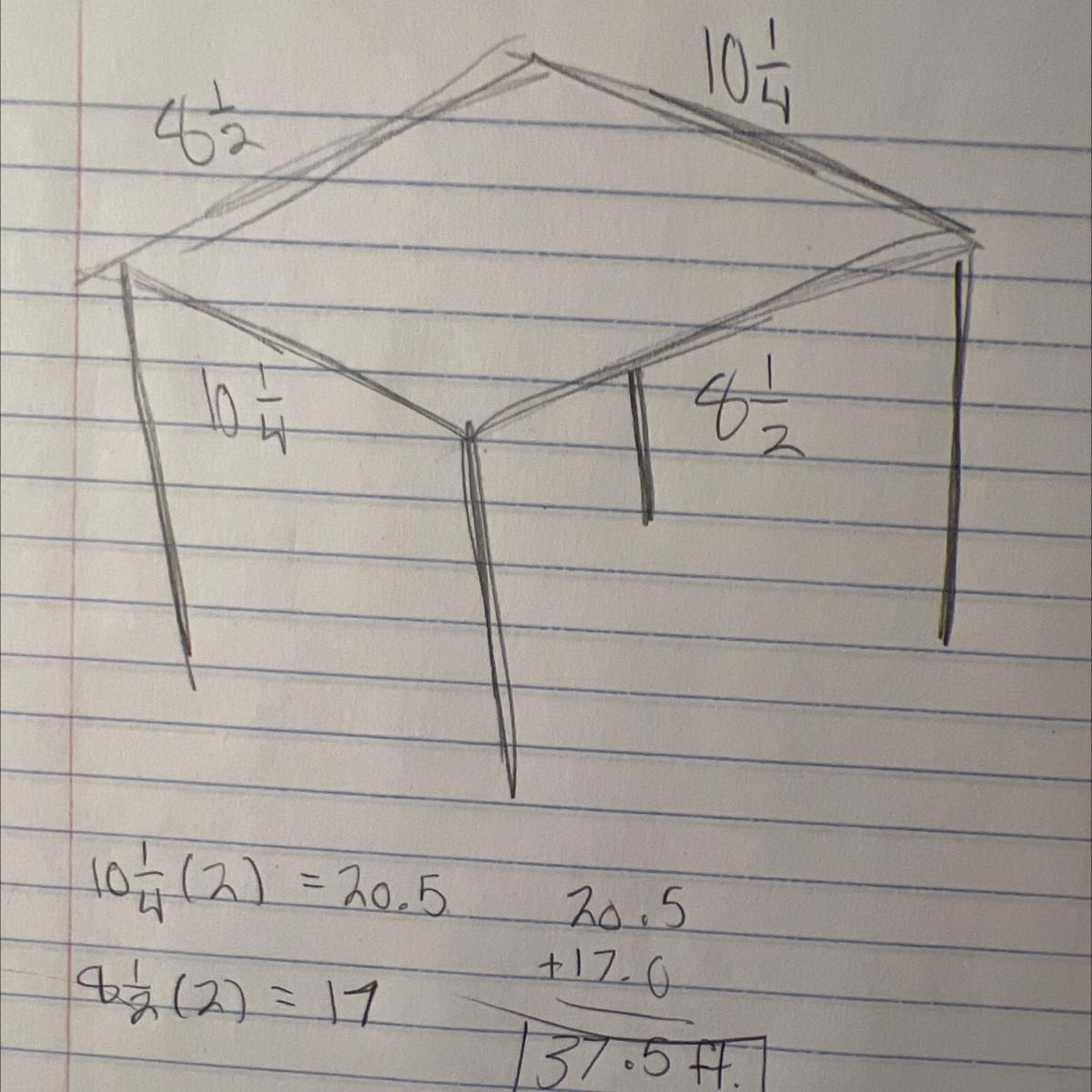
Plss show work :( thank u....

Answers
Answer:
Only if show feet
Step-by-step explanation:
pls
Multiply the pairs of numbers and match them with their products. Tiles (-5)(4.2) (-7)(-3) (4) (5) (2.5)(-9) Pairs 22.5 21 -22.5 -21 111
Answers
Here are the pairs matched with their products:
- (-5)(4.2) matches with -21
- (-7)(-3) matches with 21
- (2.5)(-9) matches with -22.5
Pairs (4) and (5) do not have corresponding products in the given options.
(-5)(4.2) = -21
(-7)(-3) = 21
(4)(5) = 20
(2.5)(-9) = -22.5
So, the pairs of numbers and their products are as follows:
(-5)(4.2) = -21 matches with -21.
(-7)(-3) = 21 matches with 21.
(4)(5) = 20 matches with 20.
(2.5)(-9) = -22.5 matches with -22.5.
I hope this helps!
I dont understand it if you need anything else just tell me

Answers
Answer:
Is there a question that goes with it?
Answer:
There's nothing to answer; no question
Step-by-step explanation:
The expression 9.00x+4.50y represents the total amount of money Harriet earns at her two jobs, where x represents the number of hours worked at job X and y represents the number of hours worked at job Y. Which shows an equivalent expression to the given expression and correctly describes the situation?
4.50(2x+y), which shows that Harriet earns twice as much per hour at job X than job Y.
4.50(2x+y), which shows that Harriet earns 4.50 times as much per hour at job X than job Y.
13.50xy, which shows that Harriet earns $13.50 each hour she works.
13.50xy, which shows that Harriet earns $13.50 every two hours she works.
Answers
13.50xy, which shows that Harriet earns $13.50 for each hour she works.
This expression represents the total amount of money Harriet earns at both jobs, where x represents the number of hours worked at job X and y represents the number of hours worked at job Y. The coefficient of xy, which is 13.50, represents the amount of money Harriet earns per hour, regardless of which job she is working. Therefore, this expression accurately reflects the situation described
Help pleeease
Im not sure what to do here D:

Answers
Answer:
A and C
Step-by-step explanation:
Step 1: Replace x with 2.5 and see if it makes the equation correct.
A. |2 1/2 + x = 5| Since 2 and 1/2 is also written as 2.5, and 2.5+2.5=5, the solution makes this equation true.
B. |25x = 63| 25 x 2.5 equals 62.5, which does not make this equation true because 63 ≠ 62.5
C. |6.75x + 4.25x = 27.5| I Rewrite this equation as
(6.75 x 2.5) + (4.25 x 2.5) which can simplify to 16.875 + 10.625 and it does in fact equal 27.5, so this solution does make the equation true.
Step 2: Eliminate the equation(s) that aren't true, and then answer.
A and C are correct.
HELPPPPPP ASAP I REALLY NEED HELP 20points

Answers
Answer:
\(x^2y^{11} / 16\)
Step-by-step explanation:
Hope this helped!
If you need more answers like these, you can try out M a t h w a y. It is really helpful for algebra.
Hope you have a wonderful day✨❤️
help
Is Figure BBB a scale copy of Figure AAA?

Answers
Reason - if the scale factor of a and b was 2, the dimensions of a would be 4, 7.2 and 10 not the ones present on A
The ratios of corresponding side lengths are not equal.
Therefore, Figure B is not a scale copy of Figure A.
Here, we have to determine if Figure B is a scale copy of Figure A, we need to compare the corresponding sides of the two triangles and check if the ratios of their side lengths are equal.
Figure A has side lengths: 3.6, 2, and 5.
Figure B has side lengths: 8.9, 4, and 11.3.
Let's check if the ratios of corresponding side lengths are equal:
Ratio of corresponding side lengths of A and B:
3.6 / 8.9 ≈ 0.4045
2 / 4 = 0.5
5 / 11.3 ≈ 0.4425
The ratios of corresponding side lengths are not equal.
Therefore, Figure B is not a scale copy of Figure A.
In order for two triangles to be scale copies of each other, all corresponding side lengths must have the same ratio.
Since the ratios of side lengths in Figure A and Figure B are not equal, they are not scale copies of each other.
To learn more on scale factor click:
brainly.com/question/5992872
#SPJ3
Drag each condition to the correct location on the table. Match each condition to the number of triangles that can be constructed to fit the condition. condition A: one side measuring 4 inches, another side measuring 8 inches, and a third side measuring 10 inches condition B: one angle measuring 60°, another angle measuring 40°, and a third angle measuring 90° condition C: one side measuring 4 inches, another side measuring 8 inches, and the angle between them measuring 70° condition D: one side measuring 5 inches, another side measuring 7 inches, and a third side measuring 12 inches condition E: one angle measuring 30°, another angle measuring 80°, and the length of the included side measuring 8 inches condition F: one angle measuring 40°, another angle measuring 80°, and a third angle measuring 60°
Answers
Answer:86
Step-by-step explanation: drag the 4 to the 8
What is the quotient of 28,435 ÷ 47
help !!!!!
Answers
Answer:
The quotient = 605
Step-by-step explanation:
28,435 divided by 47 equals 605. To check it, you can just do 47 multiplied by 605 and you will get 28,435. Hope this helps. :)
The division gives the quotient is 605.
What is Division?Multiplication is the opposite of division. If 3 groups of 4 add up to 12, then 12 divided into 3 groups of equal size results in 4 in each group. Creating equal groups or determining how many people are in each group after a fair distribution is the basic objective of division.
Given:
We have to divide 28,435 ÷ 47
So, the division is performed as follows
47 | 28435 | 605
-282
_____
235
- 235
______
0
Hence, the division gives the quotient is 605.
Learn more about division here:
https://brainly.com/question/21416852
#SPJ2
true or false: Two numbers are reciprocals of each other if they have different signs in front.
Answers
Answer:
yes if they are flipped fractions of each other
Step-by-step explanation:
Simplify the expression: -12/3(-8+(-4)^2-61+2
word version:
-12 divided by 3 (-8 plus -4) to the power of 2) subtract 61 add 2
I need a step-by-step explanation of how to solve this. I have tried multiple times and I can't get it right.
Answers
Answer:
Step-by-step explanation: 4 1/7 + 2 1/3 - 3/4 = 481/
84
= 5 61/
84
≅ 5.7261905
Answer:
Step-by-step explanation: 4 1/7 + 2 1/3 - 3/4 = 481/
84
= 5 61/
84
≅ 5.7261905
Step-by-step explanation:
HELP ASAP!!
What is the value of x in this triangle?
Enter your answer in the box.
x =

Answers
Answer:
x = 47
Step-by-step explanation:
We need to solve for the interior angle measure x. To get x, we know that the sum of the triangles angle measures are 180, so lets write an equation to find x.
\(x+102+31=180\)
Add like terms
\(x+133=180\)
Subtract 133 on both sides
\(x=47\)
To check our work, we can add the angle measures together so we know we got it right.
\(47+102+31=180\)
Answer:
x=48
Step-by-step explanation:
add 102 and 31 then subtract it by 180
please write a function for the points (1/3,0) (-2 3/4,0) and (0,-5) and explain the steps.
thank you!
Answers
The function for the points are y = -15x - 5
How to determine the functionFrom the information given, we have that;
The points are;
(1/3,0) (-2 3/4,0) and (0,-5)
Using the point-slope form of a linear equation, we have;
y - y₁ = m(x - x₁)
Such that;
m is the slope of the liney - y₁ and (x - x₁) are the pointsUsing (1/3, 0) and (0, -5), we have that the slope is;
m = (0 - (-5))/0 -1/3)
expand the bracket
= 5 / (-1/3)
= -15
Now, take any of the given points and substitute the values
Using (1/3, 0), we get;
y - 0 = -15(x - 1/3).
y = -15x - 5.
Learn more about functions at: https://brainly.com/question/25638609
#SPJ1
The function for the points solved by (1/3,0) (-2 3/4,0) and (0,-5) solved by point slope form is \(a=-15b-5\)
We have given the points:
(1/3,0) (-2 3/4,0) and (0,-5)
Using the formula of linear equation
\(a-\)\(a_{1}\)\(=x[b-b_{1}]\)
Where we will consider (1/3,0) = \(a-a_{1}\) and (0,-5) = \(b-b_{1}\)
that is 1/3 = \(a\), 0 = \(a_{1}\) and
0 = \(b\), -5 = \(b_{1}\)
\(x\) refers to the slope of line (take any variable)
Now for finding the value of \(x\),
\(x=a-a_{1}/b-b_{1}\)
inserting the values,
\(x=[0-[-5]]/[0-1/3]\\x= -15\)
Substitute the value of \(x\) in the equation
\(a-0=-15[b-1/3]\)
By simplifying the equation, we get
\(a=-15b-5\)
To know more about functions and points:
https://brainly.com/question/30721594
Simplify the expression. Write answer without spaces between terms and signs.
(–2h + 1) + 2(3h – 4)
Answers
Answer:
4h-7
Step-by-step explanation:
Step by Step Solution
STEP1:Equation at the end of step 1 (1 - 2h) + 2 • (3h - 4) STEP2:
Final result :
4h - 7
Solve
1. -6(2+x)
2. -9(-5-4c)
3. -1.4(-5+7g)
4. -4/3(3q-10)
5. -9(8+6n-4)
6. 2.3h(6-k)
7. 2(-2w-1.2+7x)
8. -2(h+8k)
Please and Thank You <3
Answers
Step-by-step explanation:
We just foil
1. -12-6x
2. 45+36c
3. 7+9.8g
4. -4q+40
5. -72-54n+36
6. 13.8h-2.3hk
7. -4w-2.4+14x
8. -2h-16k
This is the graph of f(x) = x+A/x+B. The grid lines in the graph are one unit apart. What is the value of A/B

Answers
The value of A/B is given as follows:
A/B = -2.
What are the asymptotes of a function f(x)?The vertical asymptotes are the values of x which are outside the domain, which in a fraction are the zeroes of the denominator.The horizontal asymptote is the value of f(x) as x goes to infinity, as long as this value is different of infinity.From the graph, the function has a vertical asymptote at x = 1, hence the value of B is given as follows:
B = -1 -> as x + B = 0 -> x = -B = -1.
When x = 0, y = -2, hence the value of A is obtained as follows:
A/-1 = -2
A = 2.
Then the division is given as follows:
A/B = 2/-1 = -2.
More can be learned about the asymptotes of a function at https://brainly.com/question/1851758
#SPJ1
You have a pizza with diameter 12
2
3 in., and a square box that is 12.65 in. across. Write 12
2
3 as a decimal. Can you fit the pizza inside the box?
What is the decimal expansion for 12
2
3?
A.12.6
B.12.65
C.12.6
D.12.66
pls help me
Answers
Answer:
D is the right choice and no you cannot fit the pizza inside the box.
Step-by-step explanation:
D is the answer because to turn 2/3 into a decimal you would divide 2 by 3 and the answer you would get would be 0.66666666666...You would then add 12 to the answer and get 12.6666... Once you get this answer you would round it to the hundredths to get 12.67 but since that is not an option you could use D, 12.66 inches.
Answer:
I believe the answer is D.
Step-by-step explanation:
A box contains several copies of Mrs. Spencer's new pamphlet. The box weighs 2,000 grams. This chart shows the effect of adding or taking away a pamphlet. Pamphlets Added to the box(x) Effect on the Box's Weight (y) 0 0 1 6 2 12 3 18 Is this an example of continuous or discrete data? discrete continuous

Answers
Answer:
This example represents discrete data.
Step-by-step explanation:
Discrete data refers to information that can only take certain specific values. In this case, the number of pamphlets added to the box (x) can only take on integer values such as 0, 1, 2, 3. Similarly, the effect on the box's weight (y) is also given as specific values: 0, 6, 12, 18.
In contrast, continuous data would involve measurements that can take any value within a range, such as height, weight, or temperature.
Since the number of pamphlets added and the corresponding effect on the box's weight are presented as specific, separate values, the data in this example is considered discrete.
Help me please! Bookwork code:k90

Answers
Answer:
Step-by-step explanation:
Let’s mark the Triangle Points as Point A, Point B, Point C.
Point A = 1x°
Point B = 2x°
Point C = 3x°
We know that the Angle Sum of a Triangle is equal to 180°.
So, Point A + Point B +Point C = 180°
= 1x° + 2x° + 3x° = 180°
= (1 + 2 + 3)x° = 180°
= 6x° = 180°
= x° = (180/6)°
= x° = 30°
| — — |
| Point A = 1 * 30° = 30° | ⇒
| Point B = 2 * 30° = 60° | ⇒ Only Extra Information
| Point C = 3 * 30° = 90° | ⇒
| — — |
Learn more about Finding Angles here
Visit —
https://brainly.com/question/28293784
https://brainly.com/question/31507476
Hope my answer helps you ✌️
Mark BRAINLIEST
Point A- 1x
Point B- 2x
Point C- 3x
We know that Angle sum property of a triangle states that the sum of angles of a triangle is 180•
So 1x+ 2x+ 3x = 180
Take X out as common
(1+2+3)x = 180
6x= 180
x=180/6
x= 30•
Which is your answer
Pls mark as brainliest
Simplify.
y + (15 + y)
(A) 15 + y
(B) 17 y
(C) 15 y
(D) 15 + 2 y
Answers
Answer:
D
Because it does not multiply and there are two (y)
Detailed Solution:
= y + (15 + y)
= y + 15 + y
= 2y + 15
=> 15 + 2y
christopher places an order for 48 dozen cookies to bring to his family holiday party. his family eats 2/3 of the cookies, how many cookies are left over?
Answers
Answer:
16 cookies are left.
Step-by-step explanation
2/3 of 48 is 32
48-32=16
2/3 of 48 is 32.
48-32=16
Graphs of functions on the interval [−4, 4] are depicted below. For each function, find:
1) The domain
2) Zeros of a function (the values of x where the function is zero)
3) Intervals where the function is positive and intervals where it is negative
Please see attached file for necessary graph.
![Graphs of functions on the interval [4, 4] are depicted below. For each function, find:1) The domain2)](https://i5t5.c14.e2-1.dev/h-images-qa/contents/attachments/8nL0x8qp9BIOkupn9s9p0OhonTXpaeZq.png)
Answers
Answer: hope the image helps
Step-by-step explanation:
![Graphs of functions on the interval [4, 4] are depicted below. For each function, find:1) The domain2)](https://i5t5.c14.e2-1.dev/h-images-qa/answers/attachments/tjUXOgtW1VWiuRBY8KNIZfXVi4NTNTwC.jpeg)
Using function concepts, it is found that:
1) The domain is \(x \in [-4,4]\).
2) The zeros are \(x = -2\) and \(x = 2\).
3)
The function is increasing for: \(x \in [-4,-2] \cup [-1,1]\).The function is decreasing for: \(x \in [-2,-1] \cup [1,4]\).---------------------------------------------
Item 1:
The domain of a function is the set that contains all input values.On a graph, it is the values that the horizontal axis, that is, the x-axis assumes.In this graph, it is values of x between -4 and 4, thus, the domain is: \(x \in [-4,4]\).Item 2:
The zeros of a function are the values of x for which y = 0.In the graph, it is the values of x for which it touches or crosses the x-axis.In this function, it is x = -2 and x = 2.Item 3:
On a graph, a function is increasing if it is pointing upwards.Thus, for this problem, it is increasing for: \(x \in [-4,-2] \cup [-1,1]\).It is decreasing if it is pointing downwards.Thus, for this problem, it is decreasing for: \(x \in [-2,-1] \cup [1,4]\).A similar problem is given at https://brainly.com/question/10891721
When is the multiplicative relationship used? choose more than one answer
A. When multiplying the same amount to an x-value.
B. When subtracting the same amount to an x-value.
C. When dividing the same amount to an x-value.
D. When adding the same amount to an x-value
Answers
Answers:
A. When multiplying the same amount to an x-value.
C. When dividing the same amount to an x-value.
Step-by-step explanation:
A Multiplicative Relationship uses multiplication or division to compare the independent and dependent quantities of a relationship.