Is it possible for two numbers to have a difference of 8, and a sum of -6? If so, what are the two numbers?
Answers
Answer: The two numbers are 1 and -7
1 minus -7 = 1 - (-7) = 1 + 7 = 8 .... difference
1 plus -7 = 1 + (-7) = -6 .... sum
===================================================
Explanation:
Let x and y be the two numbers. Let's say that x > y. Meaning that x is the bigger value.
They have a difference of 8 tells us that
x-y = 8
since "difference" is the result of subtraction. The term "sum" means the result of addition. Having a sum of -6 tells us
x+y = -6
We have this system of equations
\(\begin{cases}x-y = 8\\x+y = -6\end{cases}\)
We can add the equations straight down. So we add the x terms to get x+x = 2x. The y terms add to -y+y = 0y = 0, so the y terms go away. The stuff on the right hand side adds to 8+(-6) = 2
After adding the equations straight down, we boil things down to the equation 2x = 2 which solves to x = 1, after dividing both sides by 2.
Then you'll use x = 1 to find y
x-y = 8
1-y = 8
-y = 8-1
-y = 7
y = -7
or
x+y = -6
1+y = -6
y = -6-1
y = -7
Regardless of what equation you pick, you should end up with the same y value. This helps confirm we have the correct x value.
Another way to check is to plug (x,y) = (1,-7) into both equations of the system. You should end up with true statements after simplifying fully.
So the two numbers are x = 1 and y = -7
Related Questions
The ratio of blue to yellow
paint is 2:3. you have 9
cups of yellow paint, how
much blue do you need?
Answers
Answer:
6 cups of blue paint
Step-by-step explanation:
The ratio can be written like this:
2:3 = x:9
9/3 = 3
3*2 = 6
x=6, so the answer is 6 cups of blue paint.
How is optimum population determined in a nation?
Sub economic grade nine pls help its economic question
Answers
Through the amount of individual in that particular country and the resources available
optimum is achieved when the people are equal to the resources availability in that country
To visit the top of the Empire State Buidling, a ticket
cost $20.00 in 2009. In 2020, the price rose to $50.00. What was the percent increase?
Answers
Answer:
Step-by-step explanation:
the percent increase is
(50-20/20)*100=(30/20)*100=150
150% increase
1. Twenty-one is equal to the sum of two x's plus nine and four tenths. What is x?
Answers
Answer:
x = 5.8.
Step-by-step explanation:
2x + 9.4 = 21
2x = 21 - 9.4 = 11.6
x = 11.6 / 2
x = 5.8.
Suppose you measure the temperature of milk in a vat. ther thermemter says 28*R. What is the temperature in degrees Celsius? Fill in the black to complete the statement.
Answers
The temperature in degrees Celsius, when the thermometer reads 28 R, is approximately -257.59 °C.
To convert the temperature from degrees Rankine (R) to degrees Celsius (°C), we can use the formula:
°C = (°R - 491.67) × 5/9
Given that the temperature reading on the thermometer is 28 R, we can substitute this value into the formula to find the temperature in degrees Celsius:
°C = (28 - 491.67) × 5/9
Simplifying the calculation:
°C ≈ (-463.67) × 5/9
°C ≈ -257.59
To learn more about temperature visit;
https://brainly.com/question/7510619
#SPJ11
if u don’t mind what is bc=?

Answers
Answer:
bc = 24
Step-by-step explanation:
i took WAY to long to do that, sorry
what is 18/72 + 12/42
Answers
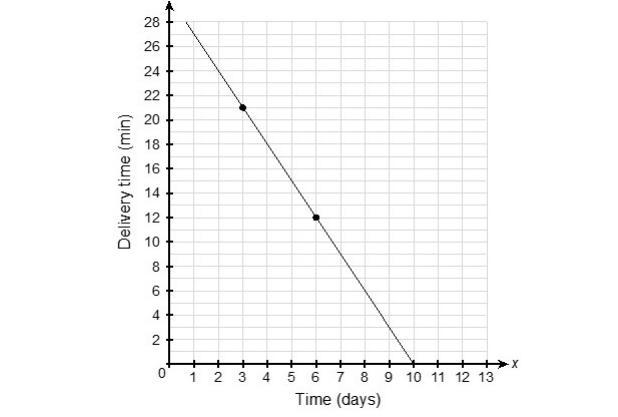
Mel works as a delivery person for Amazon. The graph shows a linear model for his delivery times on
different days.
(a) What is the equation of the line, first written in point-slope form and then written in slope-intercept
form? Show how you determined the equation.
(b) Based on the linear model, predict how long it initially took Phillip to deliver his packages.
Approximately how much did his delivery time decrease per day?
Answers
Answer:
Point slope form: -9 = m(3)
Slope intercept form: y = -3x + 30
At x = 0, his delivery time was 30 minutes. It decreased by 3 minutes per day.
Step-by-step explanation:
We have 2 points to calculate the line.
(3, 21) x1 y1
(6, 12) x2 y2
First, we need to calculate the slope.
m =
m =
m = -3
Point slope form is:
y - y1 = m(x - x1)
So for our case:
-9 = m(3)
And slope intercept form is:
y = mx + b
We need to solve for the y intercept (b)
y = -3x + b --- enter the slope
21 = -3(3) + b --- enter in any point on the line for x and y
21 = -9 + b
b = 30 --- solve for b
Now our slope intercept form of the line is:
y = -3x + 30
At x = 0, his delivery time was 30 minutes. It decreased by 3 minutes per day.
I need help with this please. :)

Answers
Slope is the the rise/run and in this case it’s 4/1 so it = to 4
What is 1% of 70?
1.4
0.8
0.7
0.9

Answers
Answer:
0.7 is the answer to your question
Answer:
0.7
Step-by-step explanation:
' Of ' almost always means multiplication, so the problem is 7% * 70.
This means 0.07 * 70 ( 7% = 0.07 ), and that is 0.7!
Hope this helped!
Rick charges $50 plus $40 an hour to fix cars. Let x be the number of hours that he works and y be the overall cost that he charges. Write the equation
Answers
A German worker takes 400 hours to produce a car and 2 hours to produce a case of wine. A French worker takes 600 hours to produce a car and X hours to produce a case of wine.
a) For what values of X will gains from trade be possible? Explain.
b) For what values of X will Germany export cars and import wine? Explain.
Answers
Germany will export cars and import wine when X (the time required to produce a case of wine in France) is less than 3, indicating that France has a comparative advantage in wine production and Germany has a comparative advantage in car production.
a) To determine the values of X for which gains from trade are possible, we need to compare the opportunity costs of car and wine production between Germany and France. The opportunity cost is the ratio of the number of hours required to produce one unit of one good to the number of hours required to produce one unit of the other good.
For Germany, the opportunity cost of producing a car is 400 hours/2 hours = 200 cases of wine per car.
For France, the opportunity cost of producing a car is 600 hours/X hours = 600/X cases of wine per car.
Gains from trade occur when the opportunity costs differ between countries, allowing them to specialize in the production of goods with lower opportunity costs and trade with each other. In this case, Germany has a lower opportunity cost of producing cars compared to wine (200 < 600/X), while France has a lower opportunity cost of producing wine compared to cars (600/X < 200).
To ensure gains from trade, Germany will specialize in car production, and France will specialize in wine production. Therefore, for gains from trade to be possible, the value of X must lie between the opportunity costs of car production for Germany and France, which is 200 < X < 600.
b) Germany will export cars and import wine when it has a comparative advantage in car production (lower opportunity cost) and France has a comparative advantage in wine production (lower opportunity cost).
Since Germany's opportunity cost of producing a car is 200 cases of wine per car, it will export cars if the opportunity cost of wine production in France (600/X) is higher than 200. Therefore, for Germany to export cars and import wine, the value of X must satisfy the condition 600/X > 200, which simplifies to X < 3.
Learn more about gain here:
https://brainly.com/question/32560317
#SPJ11
a box of popsicles contains 4 of each flavor: cherry, lemon-lime, grape, and orange. find the probability of one person randomly picking a cherry popsicle then another person selecting a grape popsicle from the box.
Answers
, the probability of one person randomly picking a cherry popsicle and another person selecting a grape popsicle from the box is 1/15.
The probability of one person randomly picking a cherry popsicle is 4/16 (since there are 4 cherry popsicles out of a total of 16 popsicles in the box), and the probability of another person selecting a grape popsicle from the remaining popsicles is 4/15 (since there are only 4 grape popsicles left out of 15 popsicles after one cherry popsicle has been selected).
The probability of an event is calculated by dividing the number of favorable outcomes by the total number of possible outcomes. In this case, the probability of one person randomly picking a cherry popsicle is 4/16 because there are 4 cherry popsicles in the box out of a total of 16 popsicles. After one cherry popsicle has been selected, there are only 15 popsicles left in the box, of which 4 are grape popsicles. Therefore, the probability of another person selecting a grape popsicle from the remaining popsicles is 4/15.
To find the overall probability of both events happening (one person picking a cherry popsicle and another person picking a grape popsicle), we multiply the two probabilities together:
(4/16) x (4/15) = 1/15
Therefore, the probability of one person randomly picking a cherry popsicle and another person selecting a grape popsicle from the box is 1/15.
To know more about probability visit:
brainly.com/question/30034780
#SPJ11
Please help? If you can!

Answers
Need help on this please help

Answers
Answer:
88
Step-by-step explanation:
The actual volume is 87.965
To the nearest tenth would be 88 (the hundreths place would round up the tenths place and it is 9 so .9 is rounded up to 1)
Find the distance from (1,−5,7) to each of the following.
(a) the xy-plane
(b) the yz-plane
(c) the xz-plane
(d) the x-axis
(e) the y-axis
(f) the z-axis
Answers
In all cases, the distance from the point (1, -5, 7) to the given plane or axis is 0.
To find the distance from a point to a plane or axis, we can use the formula for the distance between a point and a plane or axis in three-dimensional space. The formula is given by:
Distance = |Ax + By + Cz + D| / √(A² + B² + C²)
where (x, y, z) is the point, and the plane or axis is represented by the equation Ax + By + Cz + D = 0.
Let's calculate the distances for each case:
(a) Distance to the xy-plane:
The equation of the xy-plane is z = 0.
Substituting the values of the point (1, -5, 7) into the equation, we get:
1(0) - 5(0) + 7D + D = 0
8D = 0
D = 0
Using the formula, the distance is:
Distance = |1(0) + (-5)(0) + 7(0) + 0| / √(1² + (-5)² + 7²)
= 0 / √(1 + 25 + 49)
= 0
(b) Distance to the yz-plane:
The equation of the yz-plane is x = 0.
Substituting the values of the point (1, -5, 7) into the equation, we get:
0 + 5(0) - 7(0) + D = 0
0 + 0 - 0 + D = 0
D = 0
Using the formula, the distance is:
Distance = |1(0) + (-5)(0) + 7(0) + 0| / √(1² + (-5)² + 7²)
= 0 / √(1 + 25 + 49)
= 0
(c) Distance to the xz-plane:
The equation of the xz-plane is y = 0.
Substituting the values of the point (1, -5, 7) into the equation, we get:
0 - 5(0) + 7(0) + D = 0
0 - 0 + 0 + D = 0
D = 0
Using the formula, the distance is:
Distance = |1(0) + (-5)(0) + 7(0) + 0| / √(1² + (-5)² + 7²)
= 0 / √(1 + 25 + 49)
= 0
(d) Distance to the x-axis:
The equation of the x-axis is y = 0, z = 0.
Substituting the values of the point (1, -5, 7) into the equation, we get:
0 - 5(0) + 7(0) + D = 0
0 - 0 + 0 + D = 0
D = 0
Using the formula, the distance is:
Distance = |1(0) + (-5)(0) + 7(0) + 0| / √(1² + (-5)² + 7²)
= 0 / √(1 + 25 + 49)
= 0
(e) Distance to the y-axis:
The equation of the y-axis is x = 0, z = 0.
Substituting the values of the point (1, -5, 7) into the equation, we get:
0 + 5(0) + 7(0) + D = 0
0 + 0 + 0 + D = 0
D = 0
Using the formula, the distance is:
Distance = |1(0) + (-5)(0) + 7(0) + 0| / √(1² + (-5)² + 7²)
= 0 / √(1 + 25 + 49)
= 0
(f) Distance to the z-axis:
The equation of the z-axis is x = 0, y = 0.
Substituting the values of the point (1, -5, 7) into the equation, we get:
0 - 5(0) + 7(0) + D = 0
0 - 0 + 0 + D = 0
D = 0
Using the formula, the distance is:
Distance = |1(0) + (-5)(0) + 7(0) + 0| / √(1² + (-5)² + 7²)
= 0 / √(1 + 25 + 49)
= 0
In all cases, the distance from the point (1, -5, 7) to the given plane or axis is 0.
To learn more about distance visit:
brainly.com/question/32713911
#SPJ11
Simplify square root of 250 times Square root of 2
Answers
Answer:
Step-by-step explanation:
22.36067977
Se hizo un estudio estadístico sobre la duración de una marca de pilas. Los resultados, en horas, de una muestra de 15 pilas son: 20, 22, 25, 21, 22, 20, 23, 21, 24, 22, 24, 21, 23, 22, 21. Construye una tabla de frecuencias absolutas y relativas. a. Calcula las frecuencias absolutas y relativas acumuladas. b. ¿Qué porcentaje de pilas dura menos de 22 horas? Rta: sumo los hi < 22: 0,13 + 0,27 = 0,4 x 100% = 40% c. ¿Qué porcentaje de pilas dura menos de 21 horas? Rta: los hi < 21: 0,13 x 100% 13,33%
Answers
20,24,20 20concludes of 20
i need help with this geometry question !

Answers
Answer:
15
Step-by-step explanation:
First, calculate one side of your triangle like this:
\(A = h\frac{b}{2} \\\\A = 6 \frac{2.5}{2} \\\\A= 7.5\)
You have 2 halves however, so add them to get your total area.
HELP PLZ I’m struggling with this

Answers
Answer:
270 per year so 6 years is 1620 and add that with 6000=7620
You are in the buy and sell business. find out the wholesale price of an item (e.g. t-shirt, soap,toy) suppose you buy 24 pieces of that item at wholesale price. atleast at what price should you tell each item to have a 25% profit? how much will be your total profit in pesos from these items?
With explanation please!!
Answers
The wholesale price isn't given, suppose the wholesale price is $5
Answer:
$6.25 ; 1441.8 pesos
Step-by-step explanation:
Number of items purchased = 24
Wholesale price of item = x
To obtain a 25% profit, the sales price would be :
Wholesale price = wholesale price + 25% of wholesale price
(x = x + 0.25x) per unit
For 24 items :
24x + 0.25 * 24x
Unit wholesale price = 5
24(5) + 0.25*24(5)
= $150
Hence, sale price per unit will be :
$150 / 24
= $6.25
Total profit in pesos :
1 dollar = 48.06 pesos
Total profit = $150 - 24(5) = $150 - $120 = $30
$30 = (30 * 48.06) = 1441.8 pesos
what is the probability that after a fair coin is tossed 5 times that the result will contain 3 'heads' given that the first toss was a 'head' ?
Answers
Using Conditional probability,
The probability that after a fair coin is tossed 5 times that the result will contain 3 'heads' given that the first toss was a 'head' is 3/5.
A fair coin is tossed five times .
so, total possible outcomes = 2⁵ = 32
Let A: head observed on first toss
B: 3 heads observed.
Probability that the first toss was head (p) = 1/2
we have to find out probability that on 5 tosses result contain 3 heads given that first toss wss head .
Using Binomial Probability distribution
P (X= x) = ⁿCₓ (p)ˣ (q)⁽ⁿ⁻ˣ⁾
x = 3 , n = 5
we get , P(B) = P(X= 3 ) = ⁵C₃(1/2)³(1/2)²
=> P(B) = 10 ×(1/2)⁵= 5/16
since the first toss is fixed as a head.
P(A ∩ B) =P( X₁ = 1 and X₂+ X₃ + X₄ + X₅) = P(X₁= 1)P(X₂+X₃+X₄+X₅)
= 1/2 × ⁴C₂ (1/2)⁵ = 3 (1/2)⁴
The required probability is , Conditional probability P(B/A) = P(A ∩ B)/P(A)
= 3(1/2)⁴/ 5/16 = 3/5
Hence , the required probability is 3/5.
To learn more about Conditional Probability, refer:
https://brainly.com/question/10567654
#SPJ4
Which of the values is equivalent to 5^–3? A) 1 15 B) 1 125 C) − 15 D) − 125
Answers
Answer:
I'm guessing you forgot the "/"es. The answer is B) 1 / 125, or like the other person said, 0.008.
The value equivalent to the expression 5⁻³ is 1 / 125. The correct option is B.
What is an expression?The mathematical expression combines numerical variables and operations denoted by addition, subtraction, multiplication, and division signs.
Mathematical symbols can be used to represent numbers (constants), variables, operations, functions, brackets, punctuation, and grouping. They can also denote the logical syntax's operation order and other properties.
Given that the expression is 5⁻³. The value of the expression can be solved as below,
E = 5⁻³
E = 1 / ( 5 x5 x 5)
E = 1 / 125
Therefore, the correct answer is option B.
To know more about an expression follow
https://brainly.com/question/27850853
#SPJ2
A building 290 feet tall casts a 100 foot long shadow. If a person looks down from the top of the building, what is the measure of the angle between the end of the shadow and the vertical side of the building (to the nearest degree)?
Answers
The measure of the angle between the end of the shadow and the vertical side of the building is approximately 71 degrees.
Given the building is 290 feet tall and casts a 100 foot shadow.
Let x be the angle formed between the end of the shadow and the vertical side of the building.
Therefore, we can construct the following diagram;
From the diagram;
The tangent function relates the angle and the opposite side of a right triangle.
Therefore;
Tangent = opposite/adjacent
Tangent x = opposite/adjacent
Tangent x = 290/100
We can now take the inverse tangent of both sides;
x = tan^-1 (290/100)
x = 71.57 degrees, correct to two decimal places.
Therefore, the measure of the angle between the end of the shadow and the vertical side of the building is approximately 71 degrees.
To know more about tangent visit:
https://brainly.com/question/27021216
#SPJ11
using the table below what is a(b(4))?

Answers
Answer:
a(b(4))=11
Step-by-step explanation:
a(b(4) )= ?
b(4) = -3
a(-3) = 11
Choose which option shows the plan, which
option shows the front elevation and which
option shows the side elevation of this 3D
shape.
side
front
A
D
G
B
E
H
C
F
Answers
Looking at the triangular prism, the options showing the plan, front elevation and side elevation are:
Plan - A Front elevation - F Side elevation - J How to show the elevations ?To show the elevations of a triangular prism, you would need to draw a two-dimensional representation of each of the six faces of the prism, including the top, bottom, and four side faces.
For each face, you would draw the shape of the face, including any dimensions or angles necessary to accurately represent the face. Finally, you would draw lines to show the elevations of each face, indicating how they are connected to form the three-dimensional shape of the prism.
Find out more on front elevation at https://brainly.com/question/30683828
#SPJ1

Construct a 99% confidence interval of the population proportion using the given information x=75 n=150 Click here to view the table of critical values The lower bound is The upper bound Is (Round to three decimal places as needed )
Answers
To construct a 99% confidence interval of the population proportion, we first need to calculate the sample proportion:
p = x/n = 75/150 = 0.5, the 99% confidence interval for the population proportion is approximately (0.373, 0.627).
Next, we need to find the critical value associated with a 99% confidence level. Using the table of critical values provided, we find that the critical value for a 99% confidence level with 149 degrees of freedom is 2.617. We can now calculate the margin of error: E = critical value * square root(p*(1-p)/n) = 2.617 * square root(0.5*(1-0.5)/150) = 0.085
Finally, we can construct the confidence interval by adding and subtracting the margin of error from the sample proportion:
lower bound = p - E = 0.5 - 0.085 = 0.415
upper bound = p + E = 0.5 + 0.085 = 0.585
Therefore, the 99% confidence interval for the population proportion is (0.415, 0.585).
Step 1: Identify the sample proportion (P) and sample size (n).
In this case, x = 75 (number of successes) and n = 150 (sample size). To find the sample proportion, use the formula:
P = x/n
P = 75/150
P = 0.5
Step 2: Find the critical value (z) for a 99% confidence interval.
From a standard normal distribution table or using a calculator, the critical value (z) for a 99% confidence interval is approximately 2.576.
Step 3: Calculate the margin of error (E).
To calculate the margin of error, use the formula:
E = z * √(P * (1 - P) / n)
E = 2.576 * √(0.5 * (1 - 0.5) / 150)
E ≈ 0.127
Step 4: Find the lower and upper bounds of the confidence interval.
To find the lower bound, subtract the margin of error from the sample proportion. To find the upper bound, add the margin of error to the sample proportion.
Lower Bound = P - E
Lower Bound ≈ 0.5 - 0.127
Lower Bound ≈ 0.373 (rounded to three decimal places)
Upper Bound = P + E
Upper Bound ≈ 0.5 + 0.127
Upper Bound ≈ 0.627 (rounded to three decimal places)
So, the 99% confidence interval for the population proportion is approximately (0.373, 0.627).
learn more about confidence interval here: brainly.com/question/24131141
#SPJ11
4. What are the Z-scores for the following Confidence Interval levels? Remember, you MUST account for both tails of the curve, positive and negative, when identifying each. That means you will need to do a little math to obtain the correct z-value. 3 Points 68%= 85% = 99% =
Answers
In order to calculate the z-scores for the given Confidence Interval (CI) levels, we need to use the Z-table. It is also known as the standard normal distribution table. Here are the z-scores for the given Confidence Interval levels:1. 68% CI: The confidence interval corresponds to 1 standard deviation on each side of the mean.
Thus, the z-score for the 68% \(CI is ±1.00.2. 85% CI\): The confidence interval corresponds to 1.44 standard deviations on each side of the mean.
We can calculate the z-score using the following formula:\(z = invNorm((1 + 0.85)/2)z = invNorm(0.925)z ≈ ±1.44\)Note that invNorm is the inverse normal cumulative distribution function (CDF) which tells us the z-score given a certain area under the curve.3. 99% CI: The confidence interval corresponds to 2.58 standard deviations on each side of the mean. We can calculate the z-score using the following formula:\(z = invNorm((1 + 0.99)/2)z = invNorm(0.995)z ≈ ±2.58\)
Note that in general, to calculate the z-score for a CI level of (100 - α)% where α is the level of significance, we can use the following formula:\(z = invNorm((1 + α/100)/2)\) Hope this helps!
To know more about distribution visit:
https://brainly.com/question/29664127
#SPJ11
Look at the image below. Identify the coordinates for point X, so that the ratio of AX : XB = 5 : 4
Answers
The coordinates of X that partitions XY in the ratio 5 to 4 include the following: X (-1.6, -7).
How to determine the coordinates of point X?In this scenario, line ratio would be used to determine the coordinates of the point X on the directed line segment AB that partitions the segment into a ratio of 5 to 4.
In Mathematics and Geometry, line ratio can be used to determine the coordinates of X and this is modeled by this mathematical equation:
M(x, y) = [(mx₂ + nx₁)/(m + n)], [(my₂ + ny₁)/(m + n)]
By substituting the given parameters into the formula for line ratio, we have;
M(x, y) = [(5(2) + 4(-6))/(5 + 4)], [(5(-11) + 4(-2))/(5 + 4)]
M(x, y) = [(10 - 24)/(9)], [(-55 - 8)/9]
M(x, y) = [-14/9], [(-63)/9]
M(x, y) = (-1.6, -7)
Read more on line ratio here: brainly.com/question/14457392
#SPJ1
Missing information:
The question is incomplete and the complete question is shown in the attached picture.

A popular smartphone costs about $357.50 to
make. The company sells the phone at a 64%
markup. What is the sale price for this phone?
Answers
Step-by-step explanation:
first you find 60% of 357.50 which is $214.50. Next you would add $357.50+214.50=572
so the awnser is
the sale price of a popular smart phone is $572.
Hope this helps!!