Is 4:3 equivalent to 16: 12? How do you know?
Answers
Answer: Yes
Step-by-step explanation: They are equivalent because 4x4=16 and 4x3=12 .
Related Questions
Celeste studied 1.25 hours for her Math test. This was 0.5 hour less than she studied for her Science test. Use the following equation to find out how long she studied for her Science test.
Let h = hours studied
h – 0.5 = 1.25
Answers
Answer:
1.75 - 0.5 = 1.25
Step-by-step explanation:
Answer:
1.75 - 0.5 = 1.25
Step-by-step explanation:
What is the sale price of a pair of shoes that normally costs $55 and is discounted by 35%? Provide an explanation :)
Answers
55 x 35% = 19.25
55-19.25 = 35.75 The sale Price
Answer:
The sale price of a pair of shoes is $35.75
Step-by-step explanation:
I NEED THIS RIGHT AT THIS MOMENT ASAP PLS!!!!!!!!!!!!!!

Answers
The slope of a line can be calculated using the formula:
slope = (change in y-coordinates)/(change in x-coordinates)
In this case, the change in x-coordinates is (x + 9) - (3 - 2x), which simplifies to 4x + 6.
The change in y-coordinates is 7 - 12, which is -5.
For a vertical line, the slope is undefined, which means the change in x-coordinates must be zero. Therefore, we set 4x + 6 = 0 and solve for x:
4x + 6 = 0
4x = -6
x = -6/4
x = -3/2
So, the value of x for which the line passing through points F(3-2x, 12) and G(x + 9, 7) is vertical is x = -3/2.
A bus travels at a constant speed from point A to point B, which are 600 km apart. Some time later, a motorcyclist begins the trip from A to B, traveling at 100 km/h. The motorcyclist overtakes the bus at 150 km from A, and continues on to point B. The motorcyclist arrives at B, rests for 1 hour, and begins the return trip to A, crossing paths with the bus. When the bus arrives at B, the motorcyclist is 200 km from B. How far from B did the motorcycle and bus meet the second time?
Answers
Step-by-step explanation:
the motorcyclist starts x hours after the bus.
it takes the motorcyclist 1.5 hours to meet the bus the first time, 6 hours to reach B, rest 1 hour and go another 2 hours before the bus arrives at B.
so, the bus needs
x + 9 hours to reach B.
x + 1.5 hours for 150 km (for the first meeting with the motorcyclist).
the speed of the bus is 600/(x + 9) km/h or 150/(x + 1.5) km/h.
so,
600/(x + 9) = 150/(x + 1.5)
4/(x + 9) = 1/(x + 1.5)
4(x + 1.5)/(x + 9) = 1
4(x + 1.5) = x + 9
4x + 6 = x + 9
3x + 6 = 9
3x = 3
x = 1
the motorcyclist starts 1 hour after the bus.
the speed of the bus is
600/(x + 9) = 600/(1 + 9) = 600/10 = 60 km/h
when the motorcyclist is starting its return trip, he is 7 hours after his start, and the bus is 7+x = 7+1 = 8 hours after its start, that means at
8×60 = 480 km of its total trip of 600 km.
120 km are still left for the bus to go.
from that point on both travel the same time y going with their speeds until they meet the second time.
the motorcyclist travels 100y km building up distance from B, while the bus travels 60y km reducing the 120 km distance from B.
when they meet the second time, the distance from B for the motorcyclist is the same as the remaining distance for the bus.
so,
100y = 120 - 60y
160y = 120
y = 120/160 = 3/4 = 0.75 hours
so, they meet at
100 × 0.75 = 75 km from B.
Victor walks down Northern Boulevard to get to school every day. In the morning, he stops at Dunkin Donuts to get a hot drink. The map of his route, shown below, has a scale of 1 inch to 240 feet. Victor also plans to stop at the deli to pick up some lunch. What is the actual distance, in miles, between Dunkin Donuts and the deli? (1 mile = 5,280 feet)
Answers
Answer:
5040
Step-by-step explanation:
7th grade math pls help me

Answers
Answer:
I think the answer might be true
Step-by-step explanation:
Supplementary angles add up to 180 degrees. When the angles are placed next to each other, they should add up to 180. Let's try it... 130+50 = 180. Therefore, these angles are supplementary.
Also, for extra help, 180-degree angles make a straight line, like this one. When you get stuck, you can always refer to websites such as Khan Academy for practice and explanations. (https://www.khanacademy.org)
Sorry for the wordy explanation, but I hope I helped :)
Please help! You will get brainliest as long as it is correct!

Answers
Answer:
Part a is the bisector of 12=882
Part b is the tirector of 221-99=25
Step-by-step explanation:
just if someone gets this question!!

Answers
Answer:
You selected the correct answer.
Step-by-step explanation:
The ratio of the perimeter of a regular hexagon to the length of one of its sides is always 6 to 1.
Complete the table.
Perimeter of hexagon (inches) 6 30 48
Side length of hexagon (inches) 1
9
Answers
Answer:
45
Step-by-step explanation:
6+30+48-1-9=45
Explanation: adding all number together equal 45
A spinner with repeated colors numbered from 1 to 8 is shown. Sections 1 and 8 are purple. Sections 2 and 3 are yellow. Sections 4, 5, and 6 are blue. Section 7 is red.
Spinner divided evenly into eight sections with three colored blue, one red, two purple, and two yellow.
Determine the theoretical probability of the spinner not landing on red, P(not red).
0.125
0.250
0.675
0.875
Answers
Answer: 0.875
Step-by-step explanation:
there are 8 sections there are 7 of them that are not red so take the total of 8 sections and the number on sections that are not red in the form of a fraction as 7/8 which = 0.875 your welcome
Answer: D: 0.875
Step-by-step explanation:
What is the anwser to this one? Pls help

Answers
Answer: 1 1/2 paintings
Step-by-step explanation:
3/4 doubled is 1 1/2! hope this helps <3
2 (1)/(2) hours = 2 + 1/2 = (4/2) + 1/2 = 5/2 hours
Next, we calculate the fraction of a picture painted per hour:
Fraction painted per hour = (3)/(4) / (5)/(2) = (3)/(4) * (2)/(5) = (6)/(20) = (3)/(10)
Now, we can calculate the number of pictures painted in 5 hours:
Pictures painted in 5 hours = (3)/(10) * 5 = (15)/(10) = 1.5
The answer is : 1.5 picture
A set of 12 windup toys costs $9. What is the cost per windup toy?
Answers
Answer:
0.75
Step-by-step explanation:
9 ÷ 12 = 0.75
hope this helps...
Answer:
9/12 = 3/4 = 0.75
Step-by-step explanation:
PLS ANSWER>>>>>> I NEED ANSWER NOW!!!!

Answers
Answer:
c) Punishments in the Code of Hammurabi were adjusted depending on the status of the perpetrator and the victim.
Step-by-step explanation:
The Code of Hammurabi reflected the social hierarchy of ancient Babylonia in that it differentiated punishments based on the social status of the perpetrator and the victim. For example, the code stipulated different punishments for crimes committed by a nobleman versus those committed by a commoner. This demonstrates that ancient Babylonian society was structured into a hierarchy, with different levels of privilege and responsibility assigned based on social status. The Code of Hammurabi, then, serves as a tangible expression of this social hierarchy, showing the ways in which the laws of the land reflected and reinforced existing power dynamics.
Answer: c
Step-by-step explanation:
How far did I travel to reach my destination on each day of my three-day Trip?
a. On Day 1, after traveling 5/8 of the way to the first day's destination, I still had 15 miles left to go before reaching my first destination.
b. On Day 2, after traveling 18 miles, I still had 2/5 of that day's distance left to go before reaching my second destination.
c. On Day 3, after traveling 5/11 of that day's distance, I still had 6 more miles to travel than what I had already traveled that day, before reaching my third destination.
Answers
The total distances you traveled to reach your destination on each day of your three-day trip are as follows:
a) Day 1 = 40 miles
b) Day 2 = 30 miles
c) Day 3 = 11 miles.
How the total distances are determined:The total distances are determined using proportions.
Proportion refers to the fractional value of the whole number or quantity.
a) Day 1:
The fractional distance traveled = ⁵/₈
The remaining distance to travel = 15 miles
15 miles = ³/₈ (1 - ⁵/₈)
Proportionately, the total distance = 40 miles (15 ÷ ³/₈)
b) Day 2:
The distance traveled = 18 miles
The remaining distance to travel = ²/₅
The distance traveled = ³/₅ (1 - ²/₅)
³/₅ = 18 miles
Proportionately, the total distance = 30 miles (18 ÷ ³/₅)
c) Day 3:
The distance traveled = ⁵/₁₁
The distance to travel = 6 miles
The distance to travel in fractions = ⁶/₁₁ (1 - ⁵/₁₁)
Proportionately, if 6 miles = ⁶/₁₁, the total distance = 11 miles (6 ÷ ⁶/₁₁)
Learn more about proportions at https://brainly.com/question/1496357.
#SPJ1
please help i am so confused.

Answers
Answer:
Area of rectangle : 16 square units
Area of triangle : 6 square units
Area of figure : 22 square units
Step-by-step explanation:
The area of a rectangle = length x width
Here, the length of the rectangle is 4 units as well as the width
This means the area of the rectangle is 4 x 4 = 16 units²
The area of a triangle = ( length of base x height ) / 2
Here, the length of the base is 4 units and the height is 3 units
So the area of the triangle = (4x3)/2 = 12/2 = 6 units²
The area of the figure = sum of the two areas
So the area of the figure is 6 + 16 = 22 units²
Answer:
16 + 6 = 22 units²
Step-by-step explanation:
A square is a special kind of closed figure with four straight sides and four right angles that also has sides that all have equal length. Therefore, we can conclude that: A Square is a special kind of rectangle. Every Square is a rectangle, but not every rectangle is a square
Square Area = W x L or l²
Square Area = 4 x 4 = 16 units²
Triangle Area = 1/2 b x h
Triangle Area = 1/2 4 x 3
Triangle Area = 6 units²
Total Area = just sum
16 + 6 = 22 units²
PLS HELP ILL GIVE BRAINLIEST
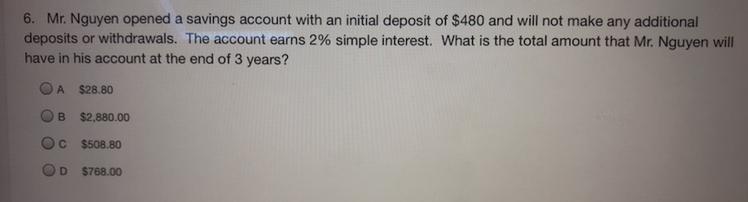
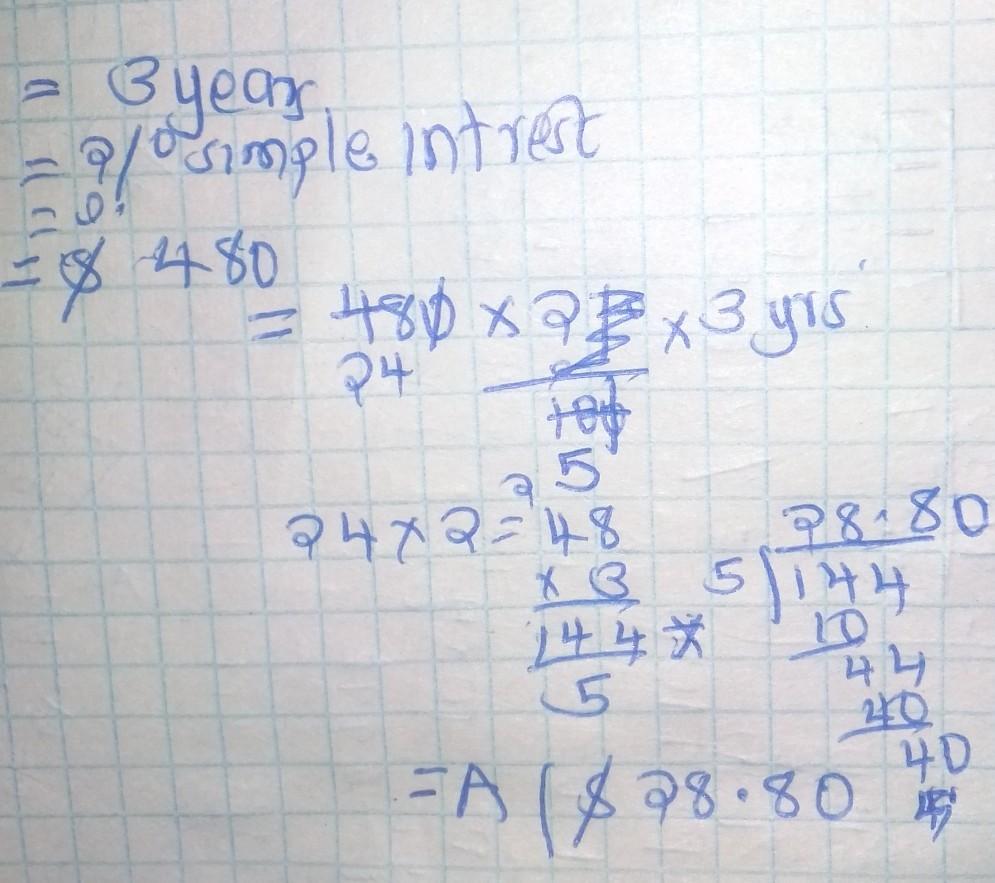
Answers
Answer:
28.8
Step-by-step explanation:
hi friend the answer is 28.80$ hope that helps you
What is the number, in cubic inches of the original box?

Answers
The volume of the original box is given as
V = lwh
V = 10(6)(3)
V = 180 in³
can someone help me on this.

Answers
Answer:
what grade is this
Step-by-step explanation:
The question is in the image below : )

Answers
$20/2.12(cost per liter) to get 9.43 liters and it’s asking for nearest so round down to 9 liters.
For the next problem if we know each pencil is .15 then we can do (.15)(x)=5 and then after dividing Both sides by .15 you get X = 33.33 which is roughly about 33(rounded)
I'm confused about this!

Answers
Answer:
16
Step-by-step explanation:
im presuming 33 own only a fish, and 20 own only a gerbil
so 32/100 pupils own both a fish and gerbil
this can be written as 32% or 0.32 for probabilty
so all u do now is 50 x 0.32
which is 16
Answer: It’s 16
Step-by-step explanation:
A restaurant customer left $1.30 as a tip. The tax was 8% and the tip was 10% of the cost including tax.
a. Which information is not needed to compute the bill after tax and tip?
b. What was the total bill?
Answers
Answer:
a. Which information is not needed to compute the bill after tax and tip?
The tax was 8%
b. What was the total bill?
The total bill is 9.9.
6.8(6.7 – 7.2) – 2(4.6 + 1.2) = ???????
Answers
Answer:
6.8(6.7 – 7.2) – 2(4.6 + 1.2) =-15
Step-by-step explanation:

What is the angle made by the hour hand and the minute of the clock at 8:57
Answers
Answer:
85 degrees
Step-by-step explanation:
A ballroom has a square dance floor. The area of the floor is 400 square feet. Of the length of each side of the square increased by one foot, would its area be a rational number? Explain.
Answers
Answer:
It is given in the question that
A ballroom has a square dance floor. The area of the floor is 400 square feet.
And the formula of the area of the square sides square.
So we will get
400= side^2
Taking square root on both sides,
side=20
And on increasing the side length by one foot, we will get the side length of 21 feet.
And it is not a perfect square.
And the area is
Area= 21^2 = 441ft^2
And 441 is a perfect square and a rational number.
Therefore true statements are A and E.
Step-by-step explanation:
^ means squared
Kim is playing a board game. He and his opponent were both on the same spot on the board until Kim got a card that sent him -6 spaces. For which of the following is absolute value not helpful?
To determine how many spaces there are on the board.
To determine the distance that Kim moved.
To determine the number of spaces between Kim's current spot and the one he came from.
To determine how far Kim is away from his opponent.
Answers
Answer:
Its To determine how many spaces there are on the bored
Step-by-step explanation:
which list shows how many equal-sized groups of 28 students Ms. Lee can make?
*Picture Attached*
*Greatest Common Factor*

Answers
Answer:
1,2,3,4 or 6
Step-by-step explanation:
Who ever get’s this right, I’ll give brainliest.

Answers
Solve for x
3x+1=7x-17
Answers
Answer:x=4.5
Step-by-step explanation:
3x+1=7x-17
3x18=7x
18=4x
x=4.5
To make a number pattern, Shana used the rule "Add 3," with a whole number as the starting number. Which statement must be true about Shana's list of numbers?
Answers
Answer:
you didnt put enough context in your question but if shana kept using three she would have mixed even and odds in her numbers if you could give more context to the question id be glad to help more
Hello everyone if you could help me that would be awesome

Answers
I don’t think I can help you sorry
Part B) $3.99 for small bags and 3.35 for large bags
Part C) the large bags is the better buy because the small bags are $0.64 more than the large bags.