In which way are photosynthesis and cellular respiration different?
A.
Cellular respiration stores ATP, while photosynthesis releases ATP.
B.
Cellular respiration produces oxygen, while photosynthesis uses oxygen.
C.
Photosynthesis releases energy, while cellular respiration stores energy.
D.
Photosynthesis used carbon dioxide, while cellular respiration produces carbon dioxide.
Answers
Answer:
D. Photosynthesis uses carbon dioxide while cellular produces carbon dioxide
Related Questions
Histamine is a substance that is released by cells in response to injury,
infections, stings and stuff that cause allergic responses, such as pollen.
Histamine causes dilation of blood vessels and swelling due to
accumulation of fluid in the tissues. People sometimes take antihistamine
drugs to counteract the effects of histamine. A sample of histamine having
a mass of 0.367 g is composed of 0.190 g of carbon, 0.031 g of hydrogen
and 0.146 g of nitrogen. What is its empirical formula?
Answers
Answer:
the emperical formula if histame is
Explanation:
C5H9N3
What theory offers a description of submicroscopic properties of matter and connects them to observable macroscopic properties?
Answers
Answer:
Kinetic Molecular theory of matter
Explanation:
Answer:
The kinetic molecular theory of matter offers a description of the microscopic properties of atoms (or molecules) and their interactions, leading to observable macroscopic properties (such as pressure, volume, temperature).
Explanation:
HELP ME PLEASE!!!! !!!!!!!!!!

Answers
How many molecules are in
5.657g H2SO4?
Answers
There are approximately 3.47 x 10²² molecules in 5.657g H₂SO₄.
To calculate the number of molecules in 5.657g H₂SO₄, we need to use the Avogadro's number and the molar mass of H₂SO₄.
The molar mass of H₂SO₄ is 98.079 g/mol.
We need to calculate the number of moles of H₂SO₄:
Number of moles = mass/molar mass
= 5.657g / 98.079 g/mol
= 0.05767 mol.
Then, we can use Avogadro's number, which is 6.022 x 10²³ molecules/mol, to find the number of molecules:
Number of molecules = number of moles x Avogadro's number
= 0.05767 mol x 6.022 x 10²³ molecules/mol
= 3.47 x 10²² molecules
To calculate the number of molecules in a given sample of a substance, you need to use the Avogadro's number, which is 6.022 x 10²³ molecules/mol. This means that one mole of a substance contains 6.022 x 10²³ molecules.
We are given the mass of H₂SO₄, which is 5.657 g. To calculate the number of molecules, we first need to determine the number of moles of H₂SO₄ in the given sample. The molar mass of H₂SO₄ is 98.08 g/mol. So, the number of moles of H₂SO₄ can be calculated as follows:
moles = mass / molar mass
moles = 5.657 g / 98.08 g/mol
moles = 0.0576 mol
Now, we can use the Avogadro's number to determine the number of molecules of H₂SO₄ in 0.0576 moles:
number of molecules = moles x Avogadro's number
number of molecules = 0.0576 mol x 6.022 x 10²³ molecules/mol
number of molecules = 3.47 x 10²² molecules
As a result, in 5.657 g of the material, there are roughly 3.47 x 10²² molecules of H₂SO₄.
To know more about the Molecules, here
https://brainly.com/question/11488454
#SPJ1
please help me
is for my daughter
Answers
Answer:
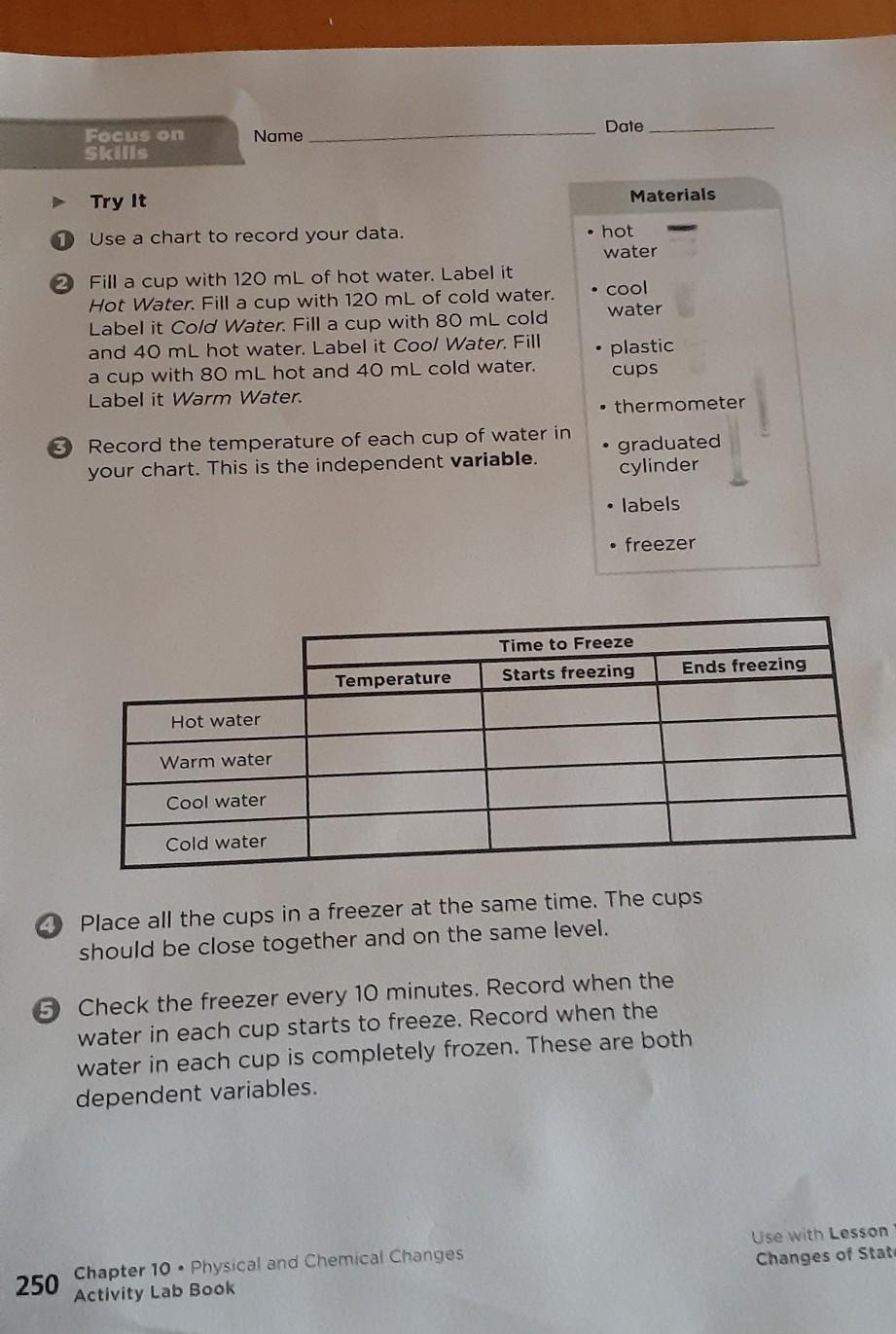
I think you have to freeze the water itself then take the temp with a thermometer ️of each one then record how long it takes each one to start freezing then how long it takes for it to melt
Explanation:
sorry if I'm wrong but you have to do the experiment yourself then fill it out
Define kinetic energy and thermal energy
Answers
Answer:
Kinetic energy is the energy by ethicalness of article's movement while Thermal energy is the inner energy of an item because of the motor energy of its particles.
Explanation:
Answer:
Thermal energy:
Thermal energy is a type of energy that is formed by the vibration of atoms and molecules inside matter. The faster they vibrate, the more energy they contain. They also gain more heat.
Kinetic energy:
Kinetic energy is the mass/energy that is in moving objects. When an object speeds up, it gains more kinetic energy. All moving objects contain kinetic energy. The moving object gains energy due to its motion.
Note:
Sorry if this is a bad explanation but hopefully this helped!
What is actual and theoritical yield
and give example
Answers
In chemistry, the actual yield refers to the quantity of a product that is obtained during an experiment or a chemical reaction. The theoretical yield, on the other hand, refers to the maximum amount of product that can be obtained from a given amount of reactant, assuming the reaction proceeds to completion and there are no losses due to factors such as side reactions or incomplete conversion of reactants.
The percentage yield is the ratio of the actual yield to the theoretical yield, expressed as a percentage.
For example, consider the combustion of 10.0 grams of methane gas (\(CH_4\)) in excess oxygen to produce carbon dioxide \((CO_2\)) and water (\(H_2O\)):
\(CH_4\) + 2O2 → \(CO_2\) + \(2H_2O\)
The balanced chemical equation shows that one mole of CH4 reacts with two moles of O2 to produce one mole of CO2 and two moles of \(H_2O\). Therefore, the theoretical yield of CO2 is calculated as follows:
10.0 g \(CH_4\) × (1 mol \(CH_4\)/16.0 g \(CH_4\)) × (1 mol \(CO_2\)/1 mol CH4) × (44.0 g \(CO_2\)/1 mol\(CO_2\)) = 27.5 g \(CO_2\)
If the actual yield of \(CO_2\) obtained from the reaction is 23.5 g, the percentage yield can be calculated as follows:
Percentage yield = (23.5 g CO2/27.5 g CO2) × 100% = 85.5%
For more question actual yield
https://brainly.com/question/20884766
#SPJ8
Convert 355 kJ to Cal
Answers
Answer =84.847
an aluminum kettle weighs 1.05 kg how much heat and joules is required to increase the temperature of this kettle from 23° c to 99° c
Answers
Answer:
71820 J
Explanation:
From the question given above, the following data were obtained:
Mass (M) = 1.05 Kg
Initial Temperature (T₁) = 23 °C
Final temperature (T₂) = 99 °C
Heat (Q) required =?
Next, we shall determine the change in temperature. This can be obtained as follow:
Initial Temperature (T₁) = 23 °C
Final temperature (T₂) = 99 °C
Change in temperature (ΔT) =?
ΔT = T₂ – T₁
ΔT = 99 – 23
ΔT = 76 °C
Finally, we shall determine the heat required. This can be obtained as follow:
Mass (M) = 1.05 Kg
Change in temperature (ΔT) = 76 °C
Specific heat capacity (C) of aluminum = 900 J/KgºC
Heat (Q) required =?
Q = MCΔT
Q = 1.05 × 900 × 76
Q = 71820 J
Thus, 71820 J heat energy is required.
In your own words, describe how the body breaks down and absorbs protein.
Answers
Answer:
Protein is a necessary ingredient that is important for numerous bodily functions, such as tissue growth and repair, hormone and enzyme production, and immune system maintenance. When humans eat protein, the amino acids that make up the protein are disassembled.
In the stomach, where it is combined with digestive enzymes and stomach acid, protein breakdown starts. The amino acids are separated from the protein bonds with the assistance of this combination. The small intestine then receives the resulting concoction of amino acids and peptides.
Additional digestive enzymes are released into the small intestine by the pancreas and the intestinal wall to further break down the protein into its component amino acids. The small intestine's inner wall then allows these amino acids to enter the circulation where they are then carried to various bodily cells.
Once inside the cells, amino acids can be digested to provide energy or utilised to create new proteins. To ensure that it has enough amino acids to meet its requirements, the body also controls the balance of amino acids in the bloodstream.
In conclusion, the breakdown and absorption of protein begins in the stomach when it is combined with digestive enzymes and stomach acid. Then, the process continues in the small intestine, where additional breakdown occurs, and ends with the absorption of individual amino acids into the bloodstream.
A sample of an unknown gas has a mass of 0.116 g. It occupies a volume of 25.0 mL at a temperature of 127°C and has a pressure of 155.3 kPa. Calculate the molar mass of the gas.
Answers
Answer:
The molar mass of the gas is 99.4 g/mol
Explanation:
Ideal gas law PV=nRT. P=155.3 T=127+273= 400K V=25.0 Gas constant=8.314 Now substiture the values into the equation n=PV/RT
n= (155.5kPa x 25.0mL x 1l/1000mL)/ 8.312l*KPa/mol*K x 400K
n= 0.001167 mol
Molar mass= Mass/ Number of moles
= 0.116g /0.001167 mol
= 99.4 g/mol
If a molecule has a triple bond, what can be assumed about the bond compared to a molecule with a double bond?
The length is more than a double bond
The strength is more than a double bond
The strength is less than a double bond
The length is the same as a double bond
Answers
While the length is less than a double bond, the strength exceeds that of a double bond.
Within the same molecule, how do triple bonds differ from double bonds?Due to the presence of two bonds rather than one, triple bonds are stronger than double bonds. An sp-sp sigma bond is created when one of each carbon atom's two sp hybrid orbitals intersects with the corresponding orbital from the other carbon atom.
Compared to double bonds, are triple bonds more durable and longer?Six electrons are shared by a sigma bond, two bonds, and a triple bond. Double bonds are more powerful than single bonds, and triple bonds are more powerful than double bonds, according to experiments.
To know more about double bond visit:-
https://brainly.com/question/30575593
#SPJ1
Answer: third
Explanation:
What happens when you hold up a book and drop it?
Answers
Answer:
it would fall-
What is the correct equilibrium constant expression for the following reaction? 3A2 = 2B3 when the reaction started with the initial concentrations of A2 = 3 M and B3 = 2 M and continued until the equilibrium concentrations of A2 = 2.5 M and B3 = 2.5 M
Answers
Answer:
Kc = [B₃]²/[A₂]³ = 0.40
Explanation:
3A₂ ⇄ 2B₃
Given at equilibrium => [A₂] =2.5 and [B₃] = 2.5
Kc = [B₃]²/[A₂]³ = (2.5)²/(2.5)³ = (2.5)⁻¹ = 0.40
If a less concentrated initial solution of sodium bicarbonate was used in beaker C, would that solution require more or less bicarbonate to neutralize the acid? Why?
Answers
If a less concentrated initial solution of sodium bicarbonate was used in beaker C, it would require more bicarbonate to neutralize the acid.
What is concentrated?Concentrated means something that has been increased in strength or power by reducing its volume. It can refer to a solution that has a higher concentration of solutes than the original solution, a sound that is louder or stronger, or a force that is more powerful or intense. Concentrated can also refer to a person’s focus or attention on one particular thing, when their thoughts and energy are directed to a single point.
This is because the concentration of sodium bicarbonate determines how much of the acid can be neutralized by the solution. If the initial solution is less concentrated, then it will take more of the bicarbonate to neutralize the same amount of acid.
To learn more about concentrated
https://brainly.com/question/30558048
#SPJ1
how many moles of Cl2(g) will be present at equilibrium?

Answers
The moles of Cl₂(g) will be present at equilibrium is 3.94 × 10⁻⁴ mol
To determine the number of moles of Cl₂(g) at equilibrium, we need to use the given equilibrium constant (Kₑ) and the initial concentrations of CO(g) and COCl₂(g).
Given:
[CO(g)] = 0.3500 mol
[COCl₂(g)] = 0.05500 mol
Kₑ = 1.2 × 10²
The balanced equation for the reaction is:
CO(g) + Cl₂(g) ⇌ COCl₂(g)
Let's denote the number of moles of Cl₂(g) at equilibrium as x. At the start, we have [Cl₂(g)] = 0 mol, but it will change by x at equilibrium.
Using the equilibrium expression, we can write:
Kₑ = [COCl₂(g)] / ([CO(g)] * [Cl₂(g)])
Plugging in the values:
1.2 × 10² = [COCl₂(g)] / (0.3500 * [Cl₂(g)])
To solve for [Cl₂(g)], we need to isolate it on one side of the equation:
[Cl₂(g)] = [COCl₂(g)] / (0.3500 * Kₑ)
Now, let's substitute the given values:
[Cl₂(g)] = 0.05500 / (0.3500 * 1.2 × 10²)
[Cl₂(g)] ≈ 3.94 × 10⁻⁴ mol
Therefore, approximately 3.94 × 10⁻⁴ moles of Cl₂(g) will be present at equilibrium.
Know more about moles here:
https://brainly.com/question/29367909
#SPJ8
The question was Incomplete, Find the full content below:
Starting with 0.3500 mol CO(g) and 0.05500 mol COCl₂(g) in a 3.050-L flask at 668 K, how many moles of Cl₂(g) will be present at equilibrium
CO(g) + Cl₂(g) ⇄ COCl₂(g) Ke 1.2 x 10^{2} at 668 K
besides caffeine what other compound are found in tea leaves?
Answers
Answer:
Tea also contains two substances related to caffeine: theobromine and theophylline
What name is given to the –NR2 group?
Answers
The amide group is the name given to the –NR2 group.
What do you men by amide group in organic chemistry?Amides are organic molecules with the amide functional group.
Amides can be primary, secondary, or tertiary. We call secondary and tertiary amides N-substituted amides.
Amides are named using the suffix -amide. Amides are formed in the reaction between an acyl chloride and either ammonia or a primary amine.
Amides react with aqueous acid to form a carboxylic acid and ammonium salt, and with aqueous alkali to form a carboxylate salt and ammonia.
Thus ,the amide group is the name given to the –NR2 group.
Learn more about amides, here:
https://brainly.com/question/13264957
#SPJ1
How do you identify a redox reaction?
Answers
Answer:
I think you have to calculate the oxidation number of each atom in the reaction.
Explanation:
Hope that helped! ^u^
HELPPp now plsss I really need help !!!!!
Answers
Answer:
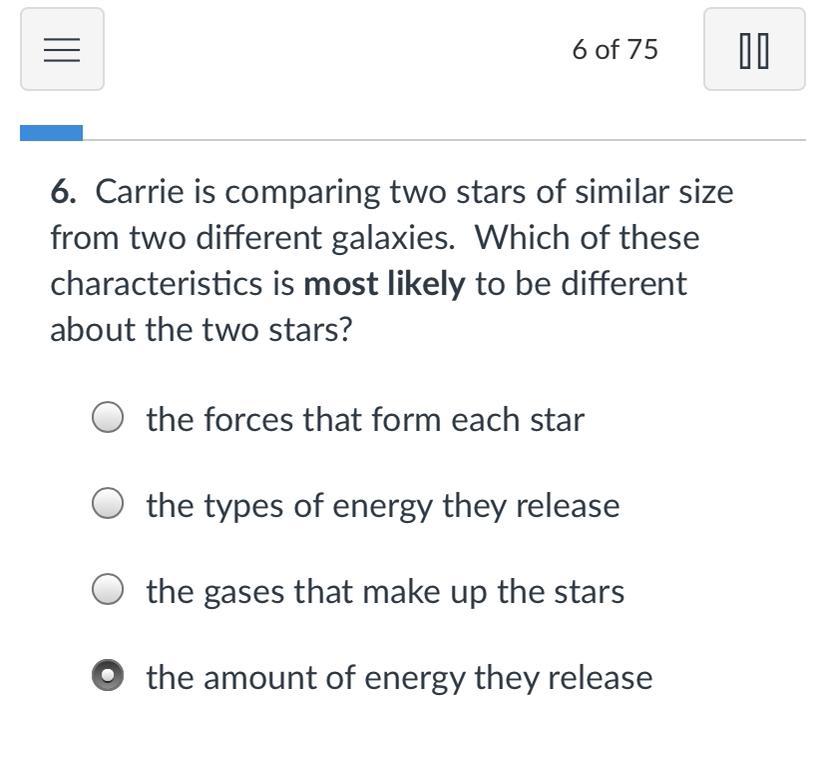
The Forces that form each star would be your answer :)
One of the most desirable of the old British sports cars was the beautiful Triumph Vitesse (1963-1971). Pictured below is the American version, called the Sports 6. A little expensive back in the day, only 679 were sold. Imagine you are on vacation, and for fun you and your companion select a cool, beautiful day in Gansu Province and ride the G30 highway from Lanzhou to the Mogao caves in Dunhuang, about distance of 686 miles. If you consume gasoline according to:
2 C8H18(l) + 25 O2(g)? 16 CO2(g) + 18 H2O(g)what volume of carbon dioxide gas would be produced by this motoring trip if your fuel consumption was 21.2 miles per gallon? Note that the density of gasoline is 0.805g/cm3, and one mole of any gas at 760 mmHg and 0oC is 22.4 L.
Answers
Answer:
\(V_{CO_2}=1.55x10^{5}LCO_2=155m^3CO_2\)
Explanation:
Hello,
In this case, given the reaction:
\(2 C_8H_{18}(l) + 25 O_2(g)\rightarrow 16 CO_2(g) + 18 H_2O(g)\)
The total consumed gallons are computed by considering 686 miles were driven and the consumption is 21.2 miles per gallon, thus:
\(V_{C_8H_{18}}=686miles*\frac{1gal}{21.2miles} =32.4gal\)
Hence, with the given density, one could compute the consumed grams and consequently moles of gasoline as well as moles that were consumed:
\(n_{C_8H_{18}}=32.4gal*\frac{3785.41cm^3}{1gal} *\frac{0.805g}{1cm^3} *\frac{1mol}{114g}=864.95mol C_8H_{18}\)
Next, since gasoline (molar mass = 114 is in a 2:16 molar relationship with the yielded carbon dioxide, we compute its produced moles as shown below:
\(n_{CO_2}=864.95mol C_8H_{18}*\frac{16molCO_2}{2molC_8H_{18}} =6919.6molCO_2\)
Finally, we could assume the given STP conditions to compute the volume of carbon dioxide, as no more information regarding the space wherein the carbon dioxide is available:
\(V_{CO_2}=\frac{n_{CO_2}RT}{P} =\frac{6919.6mol*0.082\frac{atm*L}{mol*K}*(0+273)K}{1atm} \\\\V_{CO_2}=1.55x10^{5}LCO_2=155m^3CO_2\)
Best regards.
How many things do controlled experiments attempt to test at one time? 0 1 3 2
Answers
Answer:
1
Explanation:
your can only test one thing at a time
Answer:
1
Explanation:
is the answerr to the problem
Modeling Nuclear Processes Quick Check
1 of 51 of 5 Items
Question
Which phrase best describes nuclear fusion?(1 point)
the process by which small nuclei combine into a larger nucleus
the process by which small nuclei combine into a larger nucleus
the process by which a large nucleus is divided into smaller nuclei
the process by which a large nucleus is divided into smaller nuclei
the spontaneous emission of radiation from an unstable nucleus
the spontaneous emission of radiation from an unstable nucleus
a series of reactions in which particles from one reaction trigger the next reaction
Answers
The phrase which best describes nuclear fusion is: A. the process by which small nuclei combine into a larger nucleus.
A nuclear reaction can be defined as a type of chemical reaction in which the nucleus of an atom of a radioactive chemical element is transformed by either being joined (fusion) or split (fission) with the nucleus of another atom of a radioactive chemical element and accompanied by a release of energy.
Generally, there are two (2) main types of nuclear reaction and these include:
Nuclear fission: it involves the collision of a heavy atomic nucleus with a neutron, thereby causing a split and release of energy.Nuclear fusion: it involves the joining of two smaller nuclei of atoms to form a single massive or heavier (larger) nucleus with the release of energy.In conclusion, nuclear fusion is best described as the process by which small nuclei combine into a larger nucleus, accompanied by a release of energy.
Read more: https://brainly.com/question/24040465
How do ionic bonds differ from covalent bonds?
Answers
7. What is the volume of the
composite
solid?
4 in.
3 in.
3 in.

Answers
Answer:
The volume of Component 1 is 36 cubic inches.
Explanation:
To calculate the volume of a composite solid, we need to determine the individual volumes of the different components and then add them together.
In this case, the composite solid consists of multiple components with the following dimensions:
Component 1:
Length: 4 inches
Width: 3 inches
Height: 3 inches
To find the volume of Component 1, we multiply the length, width, and height together:
Volume of Component 1 = Length x Width x Height = 4 in x 3 in x 3 in = 36 cubic inches
Therefore, the volume of Component 1 is 36 cubic inches.
Please provide the dimensions of the remaining components of the composite solid, and I will calculate the total volume by summing up the individual volumes.
PLEASE HELP ME NO ONE WILL THIS IS IMPORTANT ALOT OF POINTS! A student's favorite drink is sweet tea. Every morning he makes it by adding exactly thirty grams of sugar and one tea bag to one liter of hot water. Some days his tea does not taste as sweet as other days. Those same days he notices that there is sugar sitting at the bottom of the cup that will not dissolve no matter how long he stirs. He decided to filter out the remaining sugar and keep track of the data in the graph below.
Explain why different amounts of sugar might dissolve at different times.
Consider:
1. which day the least sugar dissolved and which day the most sugar dissolved.
2. what could have caused less sugar to dissolve on some days
3. what the student could do to his drink to make more sugar dissolve.
Be sure to consider the completeness of your response, supporting details, and accurate use of terms. Your response should be 6-8 complete sentences.

Answers
The solubility of a substance, such as sugar, depends on several factors, including temperature, pressure, and the presence of other solutes. In this case, the student adds the same amount of sugar and tea bag to the same amount of hot water every day, but the temperature of the water could vary from day to day, affecting how much sugar dissolves.
According to the graph, the least amount of sugar dissolved on day 3, while the most sugar dissolved on day 5. The difference in temperature on these days could explain this variation. On day 3, the water may have been cooler, making it more difficult for the sugar to dissolve. On the other hand, on day 5, the water may have been hotter, which could have increased the solubility of the sugar.
To increase the amount of sugar that dissolves in the tea, the student could try using hotter water or stirring the sugar more vigorously to distribute it evenly throughout the water. Alternatively, the student could try adding the sugar gradually while stirring to give it more time to dissolve before adding more.
Answer:
I'm not 100% sure on this because mine hasn't been graded yet, but here are the answers I submitted.
Explanation:
Which day the least sugar dissolved and which day the most sugar dissolved:
Day 4 is when the least sugar dissolved, and Day 2 is when the most sugar dissolved.
What could have caused less sugar to dissolve on some days:
The temperature of the tea could have caused the sugar not to dissolve on some days.
What the student could do to his drink to make more sugar dissolve.
The student would need to add the sugar to the tea as soon as it's done boiling. The Sugar will dissolve faster in a warmer tea due to more energy of movement.
Be sure to stir the tea as you add the sugar. Stirring the sugar into the tea speeds up the rate of dissolving by helping distribute the sugar particles throughout the tea.
If the student were to use granulated sugar, those are smaller particles and have greater surface area. Greater surface area allows for more contact between the tea and the sugar.
Which of the following items are made from renewable resources? Select the two correct answers. (1 point)
Responses
plastic fork
plastic fork
metal can
metal can
leather jacket
leather jacket
electronics
electronics
printer paper
Answers
A leather jacket and printer paper are examples of items that can be made from renewable resources, while plastic forks, metal cans, and electronics are not considered renewable due to their reliance on non-renewable materials and processes. Option C, E
The two correct answers that are made from renewable resources are:
C) Leather jacket: Leather is derived from animal hides, which are a byproduct of the meat industry. As long as there is a sustainable and responsible approach to animal farming, the production of leather can be considered renewable. The hides are obtained from animals that are raised for meat consumption, and their use in leather production helps reduce waste.
E) Printer paper: Printer paper can be made from various sources, including trees, bamboo, and recycled paper fibers. If the paper is sourced from sustainably managed forests or from fast-growing plants like bamboo, it can be considered renewable. Additionally, the use of recycled paper fibers reduces the demand for materials and promotes a more circular economy.
The other options, A) plastic fork, B) metal can, and D) electronics, are not made from renewable resources:
A) Plastic fork: Plastics are typically derived from fossil fuels, which are non-renewable resources. The production of plastic involves the extraction and processing of petroleum or natural gas, both of which are finite resources.
B) Metal can: Metal cans are predominantly made from aluminum or steel. While these metals can be recycled, their initial production requires the extraction of raw materials from the Earth, which is not a renewable process.
D) Electronics: Electronics are made from a wide range of materials, including metals, plastics, and various chemical compounds. The production of electronics involves the extraction of raw materials, many of which are non-renewable resources.
Option C and E.
For more such questions on renewable resources visit:
https://brainly.com/question/27734408
#SPJ8
Heat is added to ice at 0 °C. Explain why the temperature of the ice does not change. What does change?
Answers
Heat is added to ice at 0 °C. Explain why the temperature of the ice does not change. What does change?When heat is added to ice at 0°C, the temperature of the ice does not change. This happens because all the heat energy is used up in overcoming the intermolecular forces of attraction (hydrogen bonds) that exist between the water molecules in ice.
As a result, the ice undergoes a phase change, from a solid to a liquid. This process is called melting. During melting, the temperature of the ice remains constant at 0°C because all the heat energy is used up in overcoming the intermolecular forces of attraction.The energy required to melt ice is known as the heat of fusion. The heat of fusion is the amount of heat energy required to change 1 kilogram of a solid into a liquid at its melting point. For water, the heat of fusion is 334 kJ/kg. This means that 334 kJ of heat energy is required to melt 1 kg of ice at 0°C. Therefore, during the melting of ice, the temperature of the ice does not change, but the internal energy of the ice does change, and this is manifested in the change of phase from a solid to a liquid.In summary, when heat is added to ice at 0°C, the temperature of the ice does not change, and all the heat energy is used up in overcoming the intermolecular forces of attraction between the water molecules in ice. This results in the melting of ice without any change in temperature.For such more question on molecules
https://brainly.com/question/475709
#SPJ8
A cube has a mass of 501.00 g and a density of 5.739 g/cm³. What is the length of a side of this cube?
Answers
The length of a side of the cube is 28 cm
It is given that
mass of cube = 501.00 g
density of cube = 5.739 g/cm³
We can find volume by using formula of density
The density of a substance is a distinctive quality of matter that is crucial in the majority of scientific and technical disciplines. It is regarded as a characteristic property since its worth is distinct from that of other things and substances. In mathematics, density is defined as the ratio of a substance's mass to volume, and it can be written as
Density = mass/volume
volume = mass/density
volume = 501.00 g/5.739 g/cm³
volume = 87.29 cm³
a = length of sides of cube
a^3 = 87.29 = 3√87.29
a = 28 cm
Hence, the length of a side of the cube is 28 cm
Learn more about Length here:
https://brainly.com/question/25292087
#SPJ9
jagsir saw his mother adding dried neem leaves to the metal vessel filled with wheat. jagsir asked the reason for this from his mother. what would be his mothers reply?
Answers
Answer:
Because i want to. would be the reply
Explanation:
VOTE ME BRAINLIEST PLSSSSSSSSS
Answer:
none of the above
option d