In a simple linear regression model that predicts home price based on the number of bedrooms, the coefficient of determination is:
Answers
The coefficient of determination (R^2) in a simple linear regression model, which predicts home price based on the number of bedrooms, quantifies the goodness of fit of the model. It is calculated as the square of the correlation coefficient (r) between the number of bedrooms and the home price.
What is a simple linear regression model? A simple linear regression model is a statistical model that attempts to find the relationship between two quantitative variables. It is based on the idea that a dependent variable may depend on a single independent variable. As a result, a linear function is used to represent the relationship between the two variables.
A regression line, which is a straight line, is used to make predictions based on this relationship. It's important to note that the regression line can be used to make predictions only within the range of the data. Outside this range, the relationship between the two variables is unknown.
What is the coefficient of determination? The coefficient of determination, denoted as r-squared, is a statistic that indicates how well the regression line fits the data. The coefficient of determination is calculated as the ratio of the explained variation to the total variation. It ranges from 0 to 1, with 1 indicating a perfect fit between the regression line and the data and 0 indicating no relationship between the two variables.
Therefore, in a simple linear regression model that predicts home price based on the number of bedrooms, the coefficient of determination is a statistic that provides the measure of how well the model fits the data.
The coefficient of determination, denoted as R^2, represents the proportion of the variance in the dependent variable (home price) that can be explained by the independent variable (number of bedrooms) in a simple linear regression model.
In other words, R^2 measures the goodness-of-fit of the regression model. It indicates the percentage of the total variation in the home price that is accounted for by the variation in the number of bedrooms.
The coefficient of determination, R^2, can range from 0 to 1, where:
R^2 = 0 implies that the independent variable (number of bedrooms) does not explain any of the variations in the home price.
R^2 = 1 implies that the independent variable (number of bedrooms) explains all of the variations in the home price.
Therefore, the coefficient of determination (R^2) in a simple linear regression model that predicts home price based on the number of bedrooms is the square of the correlation coefficient (r) between the two variables. It represents the proportion of the variance in the home price that can be explained by the number of bedrooms.
Learn more about coefficient of determination at:
brainly.com/question/17237825
#SPJ11
Related Questions
I need help with this substitution problem

Answers
Answer:
x=5 and y=5
Step-by-step explanation:
I hope this helps
Answer:
x=5 y=5
Step-by-step explanation:
hope this is what ur looking for
Suppose MCAT scores are distributed normally with a mean of 113 and a variance of 144. Calculate the standard error of the mean for a random sample of 27 participants. Group of answer choices 1.00 21.75 5.33 0.44 2.31
Answers
If MCAT scores are distributed normally with mean (μ) = 113 and variance (σ²) = 144 and a random sample of 27 participants is taken, then the standard error of the mean is 2.31. The correct answer is option 5.
To find the standard error of the mean, follow these steps:
According to the central limit theorem, if the sample size is greater than or equal to 30, then the distribution of sample means is approximately normal, regardless of the shape of the population distribution. When the sample size is less than 30, we can still use the normal distribution as long as the population is also normally distributed. In this case, the population is normally distributed. Using the formula for the standard error of the mean for the sample, we get the standard error of the mean = σ/√n, where σ = population standard deviation= √(variance)= √144= 12, n = sample size= 27.Hence, the standard error of the mean = σ/√n= 12/√27≈ 2.31Hence, option 5) 2.31 is the correct answer.
Learn more about standard error of the mean:
brainly.com/question/29037921
#SPJ11
Find the equation for the plane through the points P0(5,3,−4),Q0(3,−2,−5), and R0(5,5,0). The equation of the plane is
Answers
The equation of the plane is −32X+4Y+24Z+188=0.
To find the equation for the plane through the points P0(5,3,−4), Q0(3,−2,−5), and R0(5,5,0), the steps are given below:
Step 1: Find two vectors on the plane
Let the vectors be
PQ¯→→⃗=Q0P0=⟨3−5,−2−3,−5+4⟩=⟨−2,−5,−1⟩
QR¯→→⃗=R0Q0=⟨5−3,5+2,0+5⟩=⟨2,7,5⟩
Step 2: Find the normal to the plane by taking the cross product of
PQ¯→→⃗ and QR¯→→⃗.
We have PQ¯→→⃗=⟨−2,−5,−1⟩
QR¯→→⃗=⟨2,7,5⟩
The normal N¯→→⃗ is given by
N¯→→⃗=PQ¯→→⃗×QR¯→→⃗
=⟨−2,−5,−1⟩×⟨2,7,5⟩
=⟨−32,4,24⟩
Step 3: Use one of the points to find the equation of the plane
The equation of the plane is given by the scalar product of
N¯→→⃗ and (X−X0¯→→⃗)N¯→→⃗⋅((X,Y,Z)−P0¯→→)=0
Substituting the values of N¯→→⃗ and P0¯→→, we have:
−32(X−5)+4(Y−3)+24(Z+4)=0
Multiplying and simplifying, we have:
−32X+4Y+24Z+188=0
Therefore, the equation of the plane is −32X+4Y+24Z+188=0.
Learn more about equation of the plane on the given link:
https://brainly.com/question/10524369
#SPJ11
This year, Farah's car is worth $22,000. If the value of Farah's car decreases by 8%, what will her car be worth next year?
Answers
Answer:
$20,240
Step-by-step explanation:
Multiply 22,000 by 0.92% since if you subtract 0.08 which is equivalent to 8% from 1, you would need that percentage to get to your final answer which is $20,240.
Another option is to do the same thing except multiply 22,000 by 0.08% in which $1,760 is being cut off as it decreases. Subtract that number from $22,000 to get the same answer mentioned earlier.
Answer:
$20,240
Step-by-step explanation:
This is a simple interest formula.
$22,000*(8%/100%) = $1760
$22,000-$1760 = $20,240
Which graph is an example of a function whose parent function is y = StartRoot x EndRoot?
On a coordinate plane, a curve starts at (negative 1, negative 1) and then curves up and to the right into quadrant 1.
On a coordinate plane, a parabola has a vertex at (0, 1).
On a coordinate plane, 2 curves are shown. Both curves have an asymptote at x = negative 1. One curved decreases from quadrant 2 into quadrant 1 and approaches y = 1. It crosses the y-axis at (0, 2). The other curve approaches y = 1 in quadrant 1 and then curves down and approaches y = negative 1 in quadrant 3. It crosses the x-axis at (negative 2, 0).
On a coordinate plane, a curve starts in quadrant 3 and then increases into quadrant 1. It crosses the y-axis at (0, negative 2) and crosses the x-axis at (1.5, 0).
Answers
Using translation concepts, the graph of a translated function of \(y = \sqrt{x}\) is given by:
On a coordinate plane, a curve starts in quadrant 3 and then increases into quadrant 1. It crosses the y-axis at (0, negative 2) and crosses the x-axis at (1.5, 0).
What is a translation?A translation is represented by a change in the function graph, according to operations such as multiplication or sum/subtraction in it's definition.
\(y = \sqrt{x}\) starts at (0,0) and in it's entirety, is in quadrant 1. When it is shifted down and left, it will start on quadrant 3 and increase into quadrant 1, hence the correct option is given by:
On a coordinate plane, a curve starts in quadrant 3 and then increases into quadrant 1. It crosses the y-axis at (0, negative 2) and crosses the x-axis at (1.5, 0).
More can be learned about translation concepts at https://brainly.com/question/4521517
#SPJ1
Answer:
A
Step-by-step explanation:
I took it
volume of prism
25cm 40cm
Answers
Find the value of day/dx when X = 1 and when Y = 1.Find the value of day/dx when X = 1 and when Y = 1.Find the value of day/dx when X = 1 and when Y = 1.Find the value of day/dx when X = 1 and when Y = 1.Find the value of day/dx when X = 1 and when Y = 1.Find the value of day/dx when X = 1 and when Y = 1.Find the value of day/dx when X = 1 and when Y = 1.Find the value of day/dx when X = 1 and when Y = 1.Find the value of day/dx when X = 1 and when Y = 1.Find the value of day/dx when X = 1 and when Y = 1.Find the value of day/dx when X = 1 and when Y = 1.Find the value of day/dx when X = 1 and when Y = 1.Find the value of day/dx when X = 1 and when Y = 1.Find the value of day/dx when X = 1 and when Y = 1.Find the value of day/dx when X = 1 and when Y = 1.Find the value of day/dx when X = 1 and when Y = 1.Find the value of day/dx when X = 1 and when Y = 1.Find the value of day/dx when X = 1 and when Y = 1.Find the value of day/dx when X = 1 and when Y = 1.Find the value of day/dx when X = 1 and when Y = 1.Find the value of day/dx when X = 1 and when Y = 1.
Answer:
The volume of a rectangular prism with length 25 cm and width 40 cm can be calculated as follows:
Volume = Length * Width * Height
Since the height is not given, we cannot calculate the exact volume.
Step-by-step explanation:
a person born in 1980 can claim, “I will be x years old in the year x squared.” write a Python program to determine the value of x
Answers
Answer:
python said x = 45
Step-by-step explanation:
yeah-ya..... right?
Terry is throwing a surprise party. She has invited 31 people. She is buying party favors that come in packages of 5. How many packages does Terry need to order so that she has enough for each guest to have one?
Answers
Answer:
Terry needs to buy 7 packages
Step-by-step explanation:
Terry has invited 31 people, meaning she needs 31 party favors
If they come in groups of five, we have to find how many packages(of 5) equal 31. Because 5 does not evenly multiply into 31, (it fits evenly inti 30) we have to add an extra package, meaning she will need 7 packages because 7×5 is 35, which is enough for each guest
Jazz buys a bag of lolipops from the store, where each lolipop costs $0.45. She wants to sale them at school and marks up the price 95%. How much would you pay for one of Jazz's lolipops at school?
Answers
Answer:
I see what's happening here
You're face to face with greatness
And it's strange
You don't even know how you feel
It's adorable
It's nice to see that humans never change
Open your eyes, let's begin
Yes it's really me, breathe it in
I know it's a lot, the hair, the bod
When you're staring at a demigod
So what can I say except
You're welcome
For the tide, the sun, the sky
Hey, it's okay, it's okay
You're welcome
I'm just an ordinary demiguy
What can I say except
You're welcome
For the tide, the sun, the sky
Hey, it's okay, it's okay
You're welcome
I'm just an ordinary demiguy
Honestly, I can go on and on
I could explain every natural phenomenon
The tide, the grass, the ground
Oh, that was me I was messing around
I killed a snake, I buried its guts
Sprouted a tree, now you've got coconuts
What's the lesson?
What is the takeaway?
Don't mess with Maui when he's on a breakaway
And the tapestry here in my skin
Is a map of the victories I win
Look where I've been, I make everything happen
Look at that mean mini Maui just tikkity tappin'
Singing and scratchin'
Flipping and snappin'
People are clappin', hearing me rappin'
And bring the chorus back in
Well anyway, let me say you're welcome
For the wonderful world you know
Hey, it's okay, it's okay
You're welcome
Well, come to think of it, I gotta go
Hey, it's your day to say
You're welcome
'Cause I'm gonna need that boat
I'm sailing away, away
You're welcome
'Cause Maui's the ultimate guy
You're welcome!
You're welcome!
Step-by-step explanation:
Which number is rational? 2 square root, pi ,10 square root ,16 squeare root
Answers
Answer:
Square root of 16 is rational beacuse Square root of 16=4 Whlie the others are Irational.
Step-by-step explanation:
Answer:
Step-by-step explanation: squarefoot of 16 is rational cause 16=4
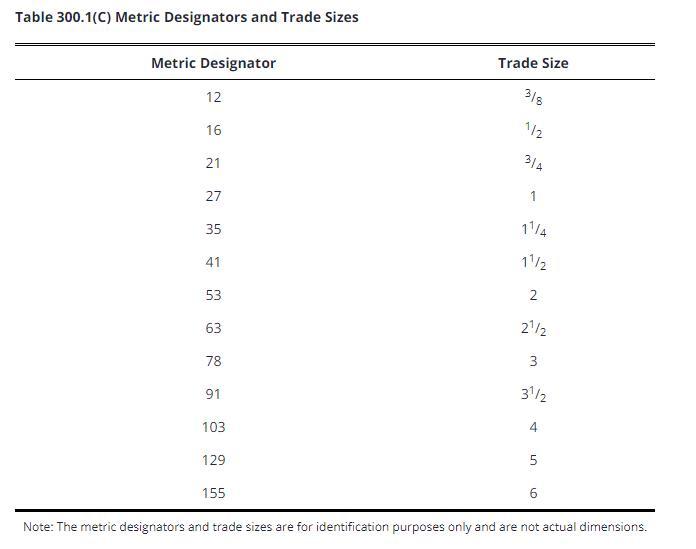
The metric designators and trade sizes are for identification purposes only and are not actual dimensions, as pointed out in the note to nec ? .
Answers
The metric designators and trade sizes are for identification purposes only and are not actual dimensions, as pointed out in the note in table 300.1(C).
What are identification purposes?For identification purposes, an acceptable ID MUST be issued by a Federal, State, County, or Municipal entity. For identification purposes, the single document must include the following criteria: photo, name, address (home/employer), date of birth, and be issued by a Federal, State, County, or Municipal entity.[Refer The table 300.1(C) below.]
Therefore, the metric designators and trade sizes are for identification purposes only and are not actual dimensions, as pointed out in the note in table 300.1(C).
Know more about identification purposes here:
https://brainly.com/question/11827791
#SPJ4
The correct question is given below:
The metric designators and trade sizes are for identification purposes only and are not actual dimensions as pointed out in the note to Table?
what would the angle be! asap answer

Answers
Answer:
x = 111°
Step-by-step explanation:
Angles in a triangle add up to 180
180 - (29+82) = 69
Angles on a straight line add up to 180
180 - 69 = 111
Answer:
111°
Step-by-step explanation:
the sum of the outer angles of a triangle is alway 180
so 180-82-29= 69°
180-69= 111°
help with these im posting more so check


Answers
Answer:
9 is c
10 is b
i think the last one is a but not too sure
Step-by-step explanation:
Joshua is buying a PlayStation 5. At
Best Buy it is normally priced at
$499.99 and there is a 20% discount.
He also found an Amazon deal that is
$470 (with taxes and shipping and
handling included).
Spo
What is the difference between the
two prices?
Which store would you choose?
Answers
The difference between the prices is given as follows:
$70.01.
The store to be chosen is given as follows:
Best Buy with the discount.
How to obtain the prices?The prices are obtained applying the proportions in the context of the problem.
At Best Buy it is normally priced at $499.99 and there is a 20% discount, meaning that 80% of the price is paid, hence:
0.8 x 499.99 = $399.99.
Best Buy has a lower price than the $470 at Amazon, and then the difference is given as follows:
470 - 399.99 = $70.01.
More can be learned about proportions at https://brainly.com/question/24372153
#SPJ1
One cubic meter represents a cube shape that measures 1 meter in all three dimensions. how long is each side in centimeters?
Answers
Each side of cube is 100 cm.
What is a cube?In Maths or in Geometry, a Cube is a solid three-dimensional figure, which has 6 square faces, 8 vertices and 12 edges. It is also said to be a regular hexahedron.
Given that,
Volume of cube = 1 cubic meter
We know that,
1 m = 100 cm
Also volume of cube = \(a^{3}\)
Then,
Volume of cube = 1000000 cm
\(a^{3}\) = \(100^{3}\)
a = 100 cm
Hence, Each side of cube is 100 cm.
To learn more about cube from the given link:
https://brainly.com/question/1972490
#SPJ4
A 2-column table with 6 rows. The first column is labeled t with entries negative 3, negative 2, negative 1, 0, 1, 2. The second column is labeled f of x with entries negative 12, m, 4, 0, negative 4, negative 2. If the table of the function contains exactly two potential turning points, one with an input value of –1, which statement best describes all possible values of m? m ≥ –12 –12 < m < 4 m ≤ 4 m ≥ 4 or m ≤ –12
Answers

Answer:
B
Step-by-step explanation:
right on edg3
Module 6 What is the line of best fit? Why do we want the sum of the residuals to be as close to zero as possible?
Answers
Answer:
zero residual equals zero mean
A line of best fit is a straight line that shows the appropriate correlation among scatter plots of a given data. It is majorly used when the plotted points are not linear, it can be used to express the relationship between dependent and independent variables.
The sum of the residuals should be close to zero because it shows that the line of best fit is accurately drawn. Thus, it implies that there is a linear relationship between the two variables. Since he residual is close to zero, the graph could be said to be a linear graph.
Haley’s work evaluating (Negative 2) Superscript 8 is shown below.
(Negative 2) Superscript 8 = (negative 2) (negative 2) (negative 2) (negative 2) (negative 2) (negative 2) (negative 2) (negative 2) = negative 256
Which statement best describe Haley’s first error?
Haley’s work evaluating (Negative 2) Superscript 8 is shown below.
(Negative 2) Superscript 8 = (negative 2) (negative 2) (negative 2) (negative 2) (negative 2) (negative 2) (negative 2) (negative 2) = negative 256
Which statement best describe Haley’s first error?
Answers
Answer:
256
Step-by-step explanation:
You multiply -2 an even amount of time which gives you a positive answer, if you were to multiply them an odd amount of times then it would be a negative number.
Answer:
The other guy is correct it is d Haley misinterpreted and got the wrong sign
Step-by-step explanation:
What is the perimeter of the triangle?

Answers
Answer:
36 unitsStep-by-step explanation:
it is an isosceles right triangle, we divide it in two parts and we have two right triangles, with the Pythagorean theorem we find the hypotenuse and add it to the other side to get the perimeter (SEE FIGURE)
BC and AC = √(8²+6²)
BC and AC = √(64+36)
BC and AC = √100
BC and AC = 10 units
now we add the sides and find the perimeter
16 + 10 + 10 =
36 units

let f be the function that satisfies the given differential equation (dy/dx = xy/2). write an equation for the tangent line to the curve y = f(x) through the point (1,1). then use your tangent line equation to estimate the value of f(1.2).
Answers
Our estimate for f(1.2) is 1.1 which satisfies differential equation.
To find the equation of the tangent line to the curve y = f(x) through the point (1,1), we first need to find the value of f(1) at x = 1. To do this, we can solve the differential equation given:
\(dy/dx = xy/2\)
Separating the variables, we get:
\(dy/y = x/2 dx\)
Integrating both sides, we get:
\(ln|y| = x^2/4 + C\)
Where C is the constant of integration. To find the value of C, we can use the initial condition that f(1) = 1:
ln|1| = 1/4 + C
C = -1/4
So our equation for f(x) is:
\(ln|y| = x^2/4 - 1/4\)
Simplifying, we get:
\(y = e^(x^2/4 - 1/4)\)
To find the equation of the tangent line through the point (1,1), we need to find the slope of the tangent line at x = 1. To do this, we take the derivative of f(x) and evaluate it at x = 1:
\(f'(x) = (1/2)x e^(x^2/4 - 1/4)f'(1) = (1/2)(1) e^(1/4 - 1/4) = 1/2\)
So the slope of the tangent line at x = 1 is 1/2. Using the point-slope form of a line, we get:
\(y - 1 = 1/2(x - 1)\)
Simplifying, we get:
y = 1/2 x + 1/2
To estimate the value of f(1.2), we can use our tangent line equation. Plugging in x = 1.2, we get:
\(y = 1/2(1.2) + 1/2 = 1.1\)
So our estimate for f(1.2) is 1.1.
Learn more about differential equation here:
https://brainly.com/question/30267790
#SPJ11
which of the following can be added without altering any of the fractions?
a. 3x/x-1 + 8/x-1
b. 6x+1/4x-8 + 1/4x+1
c. 6x/x+6 + 6x/x-6
d. 6x/x-7 + x-7/6x
Answers
Answer:
a
Step-by-step explanation:
\(\frac{3x}{x-1}\) + \(\frac{8}{x-1}\)
These fractions have a common denominator and so do not require to be altered.
The numerators can be added to simplify, that is
= \(\frac{3x+8}{x-1}\)
The remaining fractions have different denominators and would require to be altered before they could be added.
The side lengths of a 30-60-90 triangle are in the ratio 1 : 3:2. What is
sin 30°?

Answers
Answer:
1/2
Step-by-step explanation:
other answer was wrong

The value of sin30 is \(\frac{1}{2}\)
What is a 30-60-90 triangle?The 30-60-90 triangle is called a special right triangle as the angles of this triangle are in a unique ratio of 1:2:3.
According to the given sum:
In theory, we know,
For a 30-60-90 triangle, the sides opposite to 30° is x , side opposite to 60° is x*\(\sqrt3}\) and the side opposite to 90° is 2x
Therefore,
If x = 1,
The sides are \(\sqrt{3},2,1\) where,
perpendicular = \(\sqrt{3}\)
Base = 1
Hypotenuse = 2
We know sinФ = \(\frac{perpendicular}{Hypotenuse}\)
But in the case of sin30 , we have to take perpendicular as 1 and hypotenuse as 2, that is the angle has to be at base. If it was sin60, we would have taken perpendicular as \(\sqrt{3}\) and hypotenuse as 2.
Therefore,
Sin30 = \(\frac{1}{2}\)
Hence, we can conclude that the value of sin30 is \(\frac{1}{2}\).
Learn more about 30-60-90 triangle here:
https://brainly.in/question/10494802
#SPJ2
For Triangle ABC, if AB = 10 mm, BC = 19 mm, and CA = 15 mm, what is the SMALLEST angle measure? * 1 point Angle A Angle BFor Triangle ABC, if AB = 10 mm, BC = 19 mm, and CA = 15 mm, what is the SMALLEST angle measure? *
Angle A
Angle B
Angle C
Cannot be determined Angle C Cannot be determined
Answers
Answer:
Angle C
Step-by-step explanation:
1. Write three questions that could be used to challenge each claim.

Answers
The questions that could be used to challenge each claim goes as follows.
Nine out of ten mothers prefer Nutty brand peanut butter:What criteria were used to determine preference of mothers for the peanut butter?How many mothers were surveyed to reach conclusion?Were there other brands of peanut butter included in survey?Our disinfectant spray effectively kills 99.9% of germs in 30 seconds:What independent laboratory or organization conducted the tests to verify the claim?Will you provide specific details about the types of germs that were tested and killed by the disinfectant spray?Were there specific conditions that needed to be followed during the testing process to achieve the claimed effectiveness?Home Well, Canada's number one home furnishings retailer, is now hiring:What criteria or metrics were used to determine that Home Well is the number one home furnishings retailer in Canada?Are there any other reputable sources or rankings that support the claim of being the top home furnishings retailer?What positions are currently available for hiring and what are the specific qualifications or requirements for those positions?PowerPac batteries last longer than any other battery.What specific tests or experiments were conducted to compare the longevity of PowerPac batteries with other batteries?How were the batteries used during the testing process to ensure accurate and fair comparisons?Are there any independent studies or third-party verifications that support the claim of PowerPac batteries outlasting all other batteries?.Read more about Claim
brainly.com/question/2748145
#SPJ1
Mr Cooper’ claroom had 5 table. There were 4 tudent at each table. Mr Garcia’ claroom had 3 more tudent than Mr Cooper’ claroom
Answers
Mr. Garcia's classroom had 23 students.
Let's denote the number of students in Mr. Cooper's classroom as C and the number of students in Mr. Garcia's classroom as G.
Given that Mr. Cooper's classroom had 5 tables with 4 students at each table, we can write:
C = 5 * 4 = 20
It is also given that Mr. Garcia's classroom had 3 more students than Mr. Cooper's classroom, so we can write:
G = C + 3
Substituting the value of C from the first equation into the second equation, we get:
G = 20 + 3 = 23
Therefore, Mr. Garcia's classroom had 23 students.
Learn more about Equation here:
https://brainly.com/question/29657983
#SPJ4
Can someone please help me

Answers
2 false
3 false
4 true
Answer:
1 true
2 false
3 false
4 true
in how many different ways can the letters of the word detail' be arranged in such a way that the vowels occupy only the odd positions?
Answers
The number of ways in which the word detail can be arranged in such a way that the vowels occupy only the odd positions is 36.
We will find the number of permutations in which the word DETAIL can be arranged such that the vowels occupy odd positions.
The vowels are E, A and I. They can occupy 1st, 3rd and 5th position in any order. Hence, the number of ways to do that is 3! = 6.
Now, the consonants D, T and L can occupy 2nd, 4th and 6th position in any order. Hence, the number of ways to do that is 3! = 6.
Hence,
Total number of ways = 3! * 3! = 6*6 = 36.
To learn more about permutations, here:-
https://brainly.com/question/1216161
#SPJ4
An icecream shop has 10 flavors. One can choose 4 different
flavors. What is the total number of possible flavor
combinations?
a.
252
b.
462
c.
120
d.
330
e.
210
2.
Answers
An ice cream shop has 10 flavors and one can choose 4 different flavors. The question asks for the total number of possible flavor combinations.Therefore, we need to find the number of ways in which 4 flavors can be chosen from 10 flavors.
In such cases where order does not matter and repetitions are not allowed, we can use the formula for combinations which is as follows:C(n, r) = n! / (r! (n - r)!)Where n is the total number of items, r is the number of items being chosen at a time and ! represents the factorial function.
Using this formula we can find the total number of possible flavor combinations. Substituting the values in the above formula, we get:C(10, 4) = 10! / (4! (10 - 4)!)C(10, 4) = (10 * 9 * 8 * 7) / (4 * 3 * 2 * 1)C(10, 4) = 210Hence, there are 210 possible flavor combinations when one can choose 4 different flavors
.Explanation:The formula to be used for this type of question is combination. Combination is the method of selecting objects from a set, typically without replacement (without putting the same item back into the set) and where order does not matter. The formula for combination is given by C(n,r)=n!/(r!(n-r)!).
For more questions on: combinations
https://brainly.com/question/29595163
#SPJ8
Question 1 0.5 pts A man walks along a straight path at a speed of 4 ft/s. A searchlight is located on the ground 20 ft from the path and is kept focused on the man. Place the steps below in the correct order that they should be performed in order to the determine the rate at which the searchlight is rotating when the man is 15 ft from the point on the path closest to the searchlight. 1. Step 1 Draw a picture 2. Step 2 Write down the numerical info 3. Step 3 Determine what you are asket 4. Step 4 Write an equation relating the 5. Step 5 Plug in your known informatic 6. Step 6 Differentiate both sides of the h at a speed of 4 ft/s. A searchlight is located on the ground 20 ft d on th [Choose ] ey the de Differentiate both sides of the equation with respect to t on the 1 Determine what you are asked to find Write down the numerical information that you know Write an equation relating the variables Draw a picture Plug in your known information to solve the problem Write down the numerical info v V Determine what you are asker
Answers
In order to determine the rate at which the searchlight is rotating when the man is 15 ft from the point on the path closest to the searchlight, the following steps should be performed in this order
Learn more about Equation
brainly.com/question/24169758
#SPJ11
james brewer purchased 100 shares of stock for $73 a share. james also paid a $60 commission. what was the total purchase price for this transaction?
Answers
Answer:
$ 7360.00
Step-by-step explanation:
100 shares * $ 73/share + $60 = $ 7360
Based on the calculation below, the total purchase price for this transaction is $7,360.
How do we calculate the total purchase price of shares of stock?The total purchase price for this transaction can be calculated using the following formula:
Total purchase price = (Price per share * Units of shares purchased) + Commission ...................................... (1)
Substituting all the values into equation (1), we have:
Total purchase price = ($73 * 100) + $60 = $7,360
Learn more about share purchases here: https://brainly.com/question/20490753.
#SPJ11